
The hack squat is a machine-based squat variation used to build lower-body strength, especially in the quadriceps. The main benefit of the hack squat is that it lets you train your legs with a fixed path and more support than a free-weight squat, making it useful for quad-focused strength and muscle training.
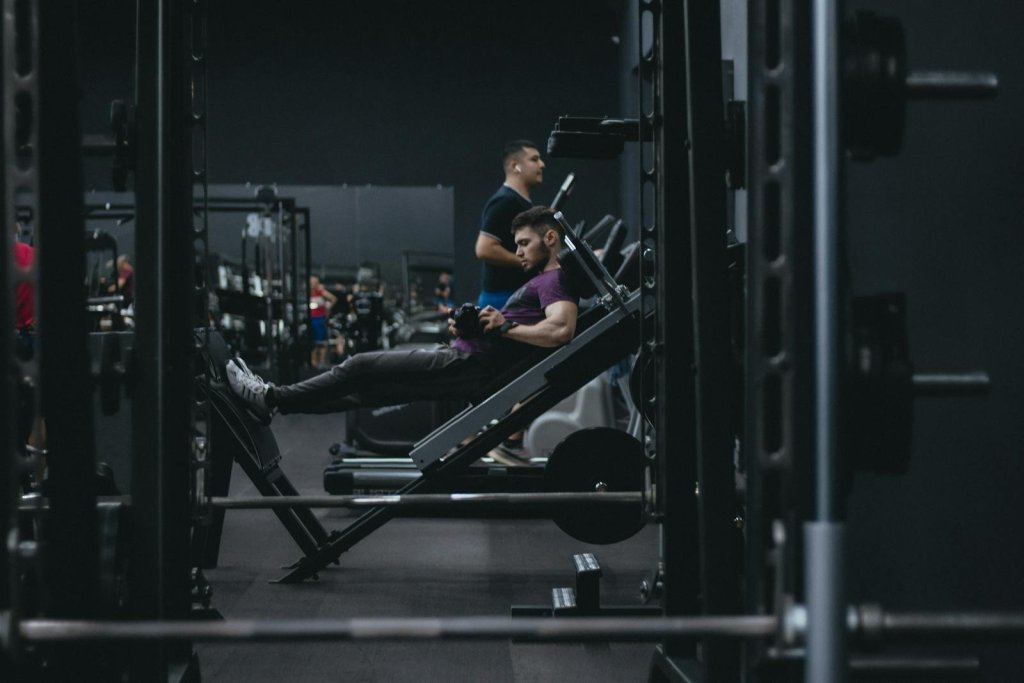
It is not a “better for everyone” exercise, but it can be a smart option if you want a stable way to train squats, reduce balance demands, and focus more directly on your legs. To get the most from it, you need the right setup, controlled depth, good knee tracking, and a load you can handle safely.
What Is a Hack Squat?
A hack squat is a lower-body strength exercise usually performed on a hack squat machine. You stand on an angled platform with your back and shoulders supported by pads, then bend your knees and hips to lower your body before pressing back up.
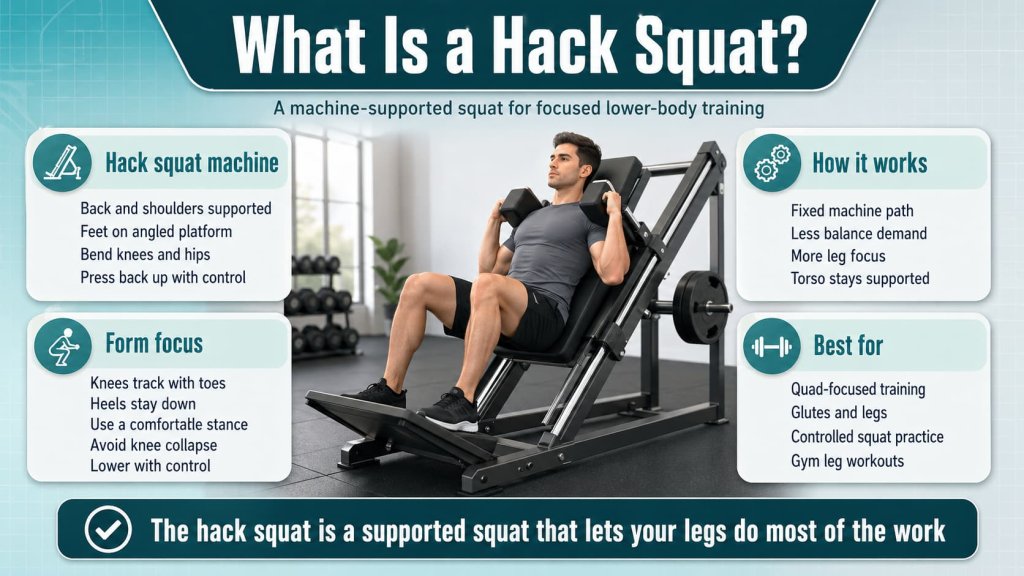
Unlike a barbell squat, the machine guides your path. This means you do not need as much balance or upper-body stabilization. That makes the hack squat useful for lifters who want to focus on their legs without managing a barbell on their back.
In simple terms, the hack squat is like a supported squat that keeps your torso more fixed while your legs do most of the work. General squat guidance from the American Council on Exercise emphasizes keeping the knees aligned with the toes, avoiding knee collapse, keeping the heels down, and using a comfortable squat stance.
Hack Squat Muscles Worked
The hack squat mainly works the lower body, with the strongest emphasis usually placed on the quadriceps.
Primary muscles worked
The main muscles worked during the hack squat include:
- Quadriceps: The front-thigh muscles that extend your knees and do much of the work during the press upward.
- Gluteus maximus: The large hip muscle that helps extend your hips as you stand.
- Hamstrings: The back-thigh muscles that assist hip control and knee stability.
- Adductors: Inner-thigh muscles that help stabilize the legs.
- Calves: Help support ankle position and foot pressure on the platform.
Supporting muscles
The hack squat also uses stabilizing muscles around the hips, trunk, and lower legs. However, because the machine supports your torso and controls the movement path, the core and trunk demand is usually lower than in a free-weight squat.
A PubMed indexed study comparing back squats and hack squats found that the back squat produced higher trunk muscle activation, while the hack squat allowed higher absolute loads. This supports a practical point: hack squats are excellent for leg-focused loading, but barbell squats usually challenge trunk control more.
Hack Squat Benefits
The hack squat has several useful benefits for lower-body training, especially if your goal is stronger legs and better quad development.
Builds quad strength
The hack squat is popular because it places a strong demand on the quadriceps. Since your torso is supported and the machine guides your path, many lifters can focus on pushing through the legs without worrying as much about balance.
This can be helpful for people who want a quad-focused movement after squats, deadlifts, lunges, or leg presses.
Provides machine-guided stability
The hack squat machine gives your body more support than a barbell squat. That does not make the movement effortless, but it does reduce the need to balance a free weight.
This can be useful for:
- Beginners learning a squat pattern
- Lifters who want controlled leg training
- People who struggle with barbell squat balance
- Bodybuilding-style workouts focused on muscle tension
May feel easier on the lower back for some people
Because your back is supported by the pad, hack squats may feel more comfortable than barbell back squats for some lifters. However, this does not mean the exercise removes all stress from the body.
Your knees, hips, ankles, and back still need good control. If you feel sharp pain or unusual discomfort, stop the exercise and adjust the load, depth, or foot position.
Easy to progress
Hack squats are easy to progress because you can add weight gradually while keeping the movement pattern consistent.
Progression options include:
- Adding small amounts of weight
- Increasing reps
- Slowing the lowering phase
- Pausing briefly at the bottom
- Improving depth while keeping control
Useful for hypertrophy training
The hack squat fits well into muscle-building workouts because it lets you train through a controlled range of motion and maintain tension on the legs.
For general strength training, the Mayo Clinic notes that using a resistance level that fatigues the muscle after about 12 to 15 repetitions can build strength efficiently for many people.
How to Do a Hack Squat With Proper Form
A good hack squat starts before the first rep. Take time to set up the machine correctly, choose a light-to-moderate load, and practice smooth reps before going heavy.
How to do it
- Step onto the hack squat machine and place your back flat against the pad.
- Position your shoulders under the shoulder pads.
- Place your feet about shoulder-width apart on the platform.
- Keep your feet flat and your toes slightly turned out if that feels natural.
- Brace your core and unlock the safety handles.
- Lower slowly by bending your knees and hips.
- Keep your knees tracking in the same direction as your toes.
- Lower only as far as you can while keeping control and comfort.
- Push through your midfoot and heel to stand back up.
- Stop just short of aggressively locking your knees at the top.
- Re-secure the safety handles when finished.
Trainer Tip
Think “controlled down, strong up.” Do not bounce at the bottom or rush the lowering phase. A slower descent helps you keep tension on the muscles and protects your form.
Common Hack Squat Mistakes
Even though the hack squat is machine-guided, form still matters. Small mistakes can shift stress away from the target muscles or make the movement feel uncomfortable.
| Mistake | Why it matters | Simple fix |
|---|---|---|
| Feet too low on the platform | Can increase knee stress for some people | Move feet slightly higher and reduce depth |
| Knees cave inward | Poor knee tracking may increase discomfort | Keep knees in line with toes |
| Heels lift off the platform | Reduces stability and control | Keep pressure through midfoot and heel |
| Lowering too fast | Increases bouncing and loss of control | Use a slow, steady descent |
| Going too deep too soon | May exceed current mobility or comfort | Use a pain-free range of motion |
| Locking knees hard at the top | Can shift stress into the joints | Finish tall without snapping the knees |
| Using too much weight | Form breaks down quickly | Reduce load and build gradually |
Hack Squat Foot Placement
Foot placement changes how the hack squat feels. There is no single perfect position for everyone because limb length, ankle mobility, hip structure, and machine design all matter.
Standard foot placement
A standard starting position is feet about shoulder-width apart and placed around the middle of the platform.
This is usually the best place to start because it gives a balanced feel between the quads and glutes.
Lower foot placement
Placing your feet lower on the platform usually increases knee bend and can make the exercise feel more quad-focused.
Use caution with this setup. If your knees feel uncomfortable or your heels lift, move your feet slightly higher.
Higher foot placement
Placing your feet higher on the platform usually increases hip involvement and may shift more work toward the glutes and hamstrings.
This can feel more comfortable for some lifters, but avoid turning it into a short-range leg press. Keep the movement controlled and use a depth that feels strong.
Wider foot placement
A wider stance may involve more inner thigh and glute contribution. However, your knees should still track in line with your toes.
Do not force a wide stance if it causes knee, hip, or ankle discomfort.
Hack Squat vs Leg Press
The hack squat and leg press are both machine-based lower-body exercises, but they feel different.
| Feature | Hack squat | Leg press |
|---|---|---|
| Body position | More upright, supported by back pad | Seated or reclined |
| Movement pattern | More squat-like | More press-based |
| Main focus | Quads, glutes, lower body | Quads, glutes, hamstrings |
| Balance demand | Low to moderate | Low |
| Torso involvement | Some bracing needed | Usually less |
| Best for | Squat-pattern leg training | Heavy lower-body pressing |
The hack squat may feel closer to a squat pattern, while the leg press may allow more lifters to use heavier loads with less balance demand.
Neither is automatically better. Choose based on your goal, comfort, equipment, and technique.
Hack Squat vs Barbell Squat
The hack squat and barbell squat can both build strong legs, but they are not the same exercise.
Hack squat
The hack squat is more stable and machine-guided. It is useful when you want to focus on your legs without managing a barbell.
Best for:
- Quad-focused training
- Machine-supported squatting
- Hypertrophy work
- Lower-body accessory training
Barbell squat
The barbell squat requires more balance, bracing, coordination, and trunk control. It trains the legs, hips, core, and upper back as part of a bigger free-weight pattern.
Best for:
- Full-body strength development
- Athletic strength
- Powerlifting-style training
- Learning free-weight squat mechanics
A balanced workout can include both. For example, you might use barbell squats as your main strength lift and hack squats as a controlled accessory exercise.
How Many Sets and Reps Should You Do?
Your ideal hack squat sets and reps depend on your goal, experience, and recovery.
| Goal | Sets | Reps | Load |
|---|---|---|---|
| Beginner form practice | 2–3 | 10–12 | Light to moderate |
| Muscle building | 3–4 | 8–12 | Moderate to challenging |
| Strength focus | 3–5 | 5–8 | Heavier but controlled |
| Finisher work | 2–3 | 12–15 | Lighter and smooth |
For most beginners, start with 2 to 3 sets of 10 to 12 reps using a weight you can control. Add load only when every rep looks steady.
The CDC recommends adults do muscle-strengthening activities at least 2 days per week, along with regular aerobic activity.
Where to Put Hack Squats in Your Workout
Hack squats can fit in different parts of a leg workout depending on your goal.
As a main leg exercise
Use hack squats early in your workout if they are your main lower-body lift.
Example:
- Hack squat
- Romanian deadlift
- Leg curl
- Calf raise
- Core exercise
After barbell squats
Use hack squats after barbell squats if you want more quad volume without needing another heavy free-weight movement.
Example:
- Barbell squat
- Hack squat
- Walking lunge
- Hamstring curl
- Calf raise
As a controlled finisher
Use lighter hack squats near the end of a workout if you want extra leg work with a controlled machine movement.
Example:
- 2 sets of 12 to 15 reps
- Slow lowering phase
- Smooth reps
- No bouncing
Who Should Be Careful With Hack Squats?
Hack squats can be useful, but they are not right for every body or every situation.
Be careful or get professional guidance first if you have:
- Current knee, hip, ankle, or back pain
- A recent lower-body injury
- A history of knee pain during squats
- Trouble controlling knee position
- Limited ankle mobility
- Balance or coordination concerns
- Medical restrictions on heavy resistance training
The Mayo Clinic advises checking with a doctor before starting strength training if you have a chronic condition or are older than 40 and have not been active recently. It also recommends warming up for 5 to 10 minutes and stopping an exercise if it causes pain.
Quick Hack Squat Form Checklist
Use this checklist before every set:
- Back stays against the pad
- Feet stay flat
- Core stays braced
- Knees track with toes
- Heels do not lift
- Descent stays controlled
- Depth stays comfortable
- No bouncing at the bottom
- No hard knee lockout at the top
- Load matches your form
FAQs About Hack Squat
Is the hack squat good for beginners?
Yes, the hack squat can be beginner-friendly because the machine guides your movement and reduces balance demand. Beginners should start light, learn the machine setup, and use a controlled range of motion.
What muscles does the hack squat work most?
The hack squat works the quadriceps most strongly, but it also trains the glutes, hamstrings, adductors, calves, and stabilizing muscles around the hips and trunk.
Is the hack squat better than the leg press?
The hack squat is not automatically better than the leg press. The hack squat feels more like a supported squat, while the leg press is a seated pressing movement. Both can build leg strength when done with good form.
Is the hack squat bad for your knees?
The hack squat is not automatically bad for your knees. Knee discomfort is more likely when the load is too heavy, the feet are poorly positioned, the knees cave inward, or the range of motion is too deep for your current control. Adjust your stance, reduce weight, and stop if pain sharpens or worsens.
Should your knees go past your toes on hack squats?
Some knee travel is normal during squatting, especially when targeting the quads. What matters most is that your feet stay flat, your knees track in line with your toes, and the movement feels controlled.
How deep should you go on hack squats?
Go as deep as you can while keeping your heels down, back supported, knees aligned, and movement pain-free. You do not need to force maximum depth if your form breaks down.
Can hack squats replace barbell squats?
Hack squats can replace barbell squats in some bodybuilding or general fitness programs, especially if barbell squats do not feel good for your body. However, barbell squats train more free-weight balance and trunk control, so the best choice depends on your goal.
Conclusion
The hack squat is a powerful lower-body exercise for building quad strength, training the glutes, and adding controlled squat volume to your leg workouts. It works best when you use a comfortable stance, keep your feet flat, track your knees with your toes, and progress the weight gradually.
Start light, master your setup, and focus on smooth reps before chasing heavier loads. For a stronger and safer leg day, use the hack squat as one part of a balanced lower-body program that also includes hip-hinge movements, single-leg exercises, calf work, and enough recovery.
References
- American Council on Exercise
Best for supporting basic squat form cues, including foot position, posture, and controlled movement. - American Council on Exercise Squat Technique Guide
Best for explaining squat mechanics, stance, depth, and how body structure can affect squat form. - Mayo Clinic Strength Training Basics
Best for supporting strength-training safety, warm-up guidance, and beginner-friendly rep recommendations. - Mayo Clinic Squat Demonstration
Best for supporting safe squat movement, knee alignment, neutral back position, and controlled depth. - CDC Adult Physical Activity Guidelines
Best for supporting weekly strength-training frequency and general adult fitness recommendations. - CDC What Counts as Muscle Strengthening
Best for explaining how resistance training fits into weekly muscle-strengthening activity. - PubMed Hack Squat vs Back Squat Study
Best for supporting the comparison between hack squats and back squats, especially trunk activation differences. - Mayo Clinic Health System Weight Training Safety
Best for supporting safe strength-training habits, gradual progression, and stopping if sharp pain occurs.