
In the squats vs lunges comparison, neither exercise is universally better: squats are generally more practical for building two-leg strength and handling heavier loads, while lunges are better suited to single-leg control, balance, and training each side separately. Most people benefit from including both movements in a balanced lower-body routine.
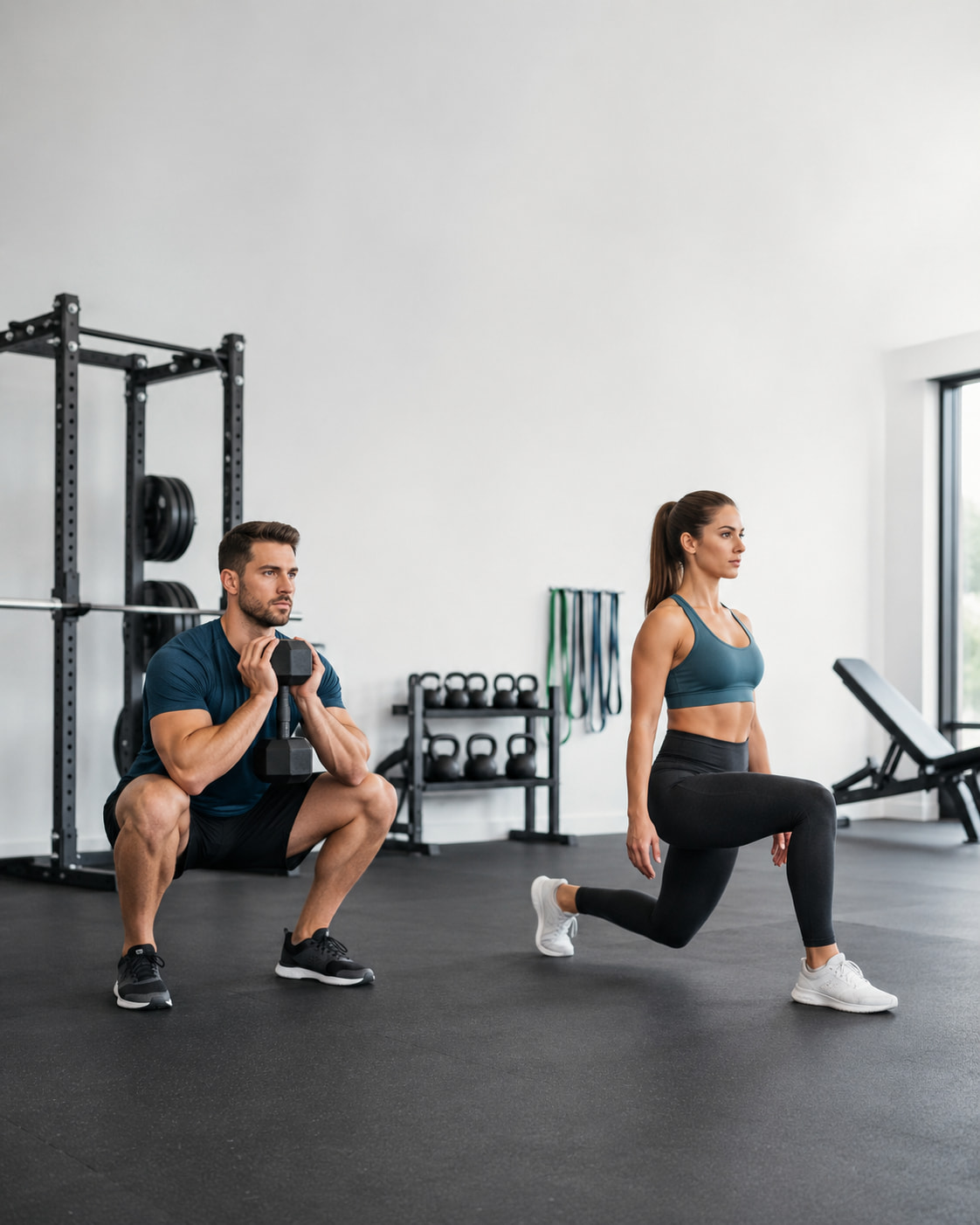
Squats and lunges work many of the same muscles, including the quadriceps, glutes, hamstrings, adductors, calves, and core. However, differences in stance, stability, loading, and movement pattern make each exercise better suited to particular goals.
The latest resistance-training guidance from the American College of Sports Medicine emphasizes that consistency, appropriate effort, and training major muscle groups regularly matter more than finding one “perfect” exercise. (ACSM, March 2026)
Squats vs Lunges at a Glance
| Category | Squats | Lunges |
|---|---|---|
| Movement pattern | Both legs work together | One leg receives more emphasis |
| Main muscles | Quads, glutes, adductors, hamstrings, core | Quads, glutes, hamstrings, adductors, calves, core |
| Balance demand | Low to moderate | Moderate to high |
| Loading potential | Usually higher | Usually lower per exercise |
| Best for | Bilateral strength and efficient leg training | Unilateral strength, balance, and coordination |
| Beginner difficulty | Usually easier | Often more technically demanding |
| Equipment | Body weight, dumbbells, kettlebells, barbell, or machine | Body weight, dumbbells, kettlebells, barbell, or cables |
| Everyday movement | Sitting, standing, and lifting | Stepping, walking, climbing, and changing direction |
What Is the Main Difference Between Squats and Lunges?
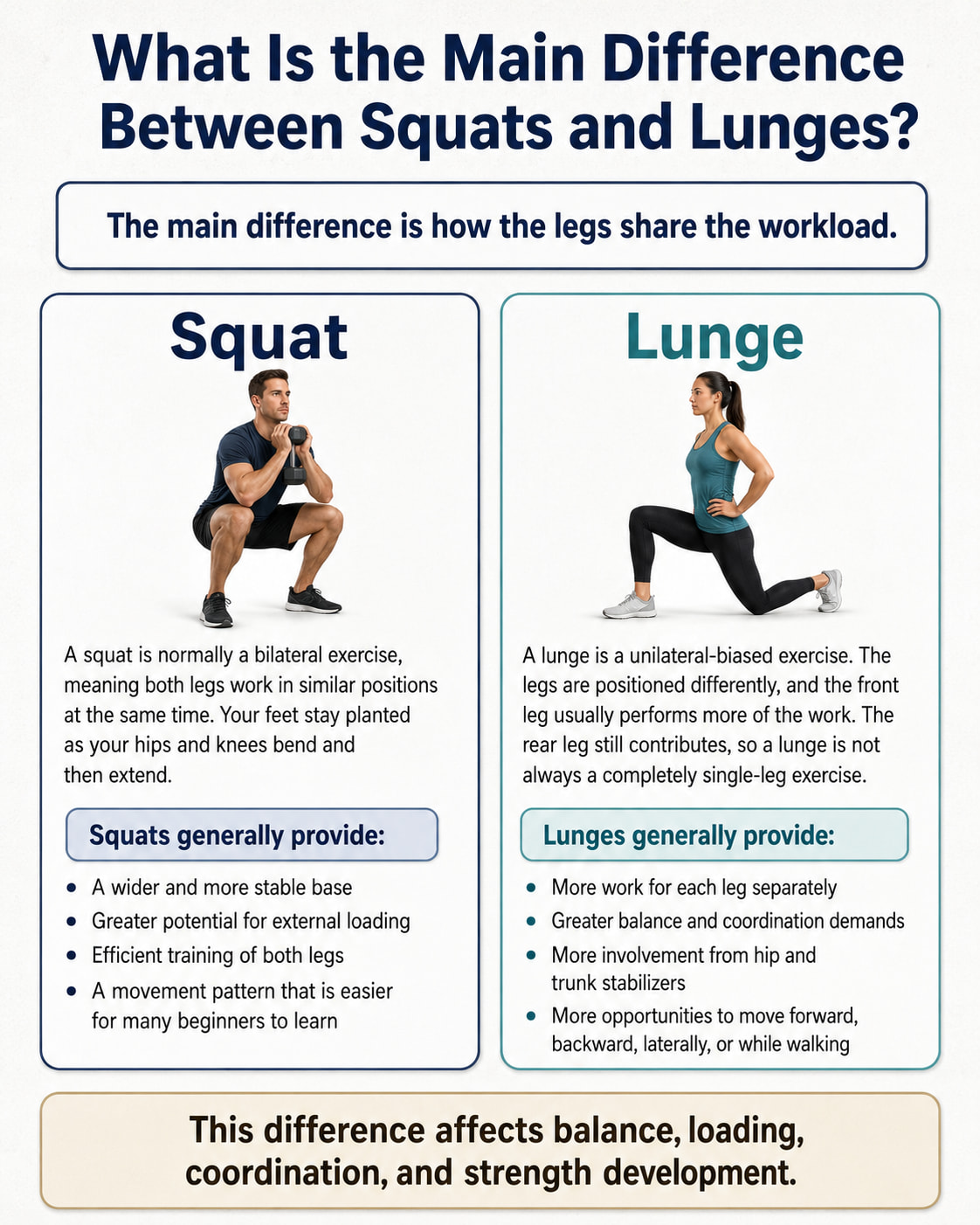
The main difference is how the legs share the workload.
A squat is normally a bilateral exercise, meaning both legs work in similar positions at the same time. Your feet stay planted as your hips and knees bend and then extend.
A lunge is a unilateral-biased exercise. The legs are positioned differently, and the front leg usually performs more of the work. The rear leg still contributes, so a lunge is not always a completely single-leg exercise.
This difference affects balance, loading, coordination, and strength development.
Squats generally provide:
- A wider and more stable base
- Greater potential for external loading
- Efficient training of both legs
- A movement pattern that is easier for many beginners to learn
Lunges generally provide:
- More work for each leg separately
- Greater balance and coordination demands
- More involvement from hip and trunk stabilizers
- More opportunities to move forward, backward, laterally, or while walking
Muscles Worked by Squats and Lunges
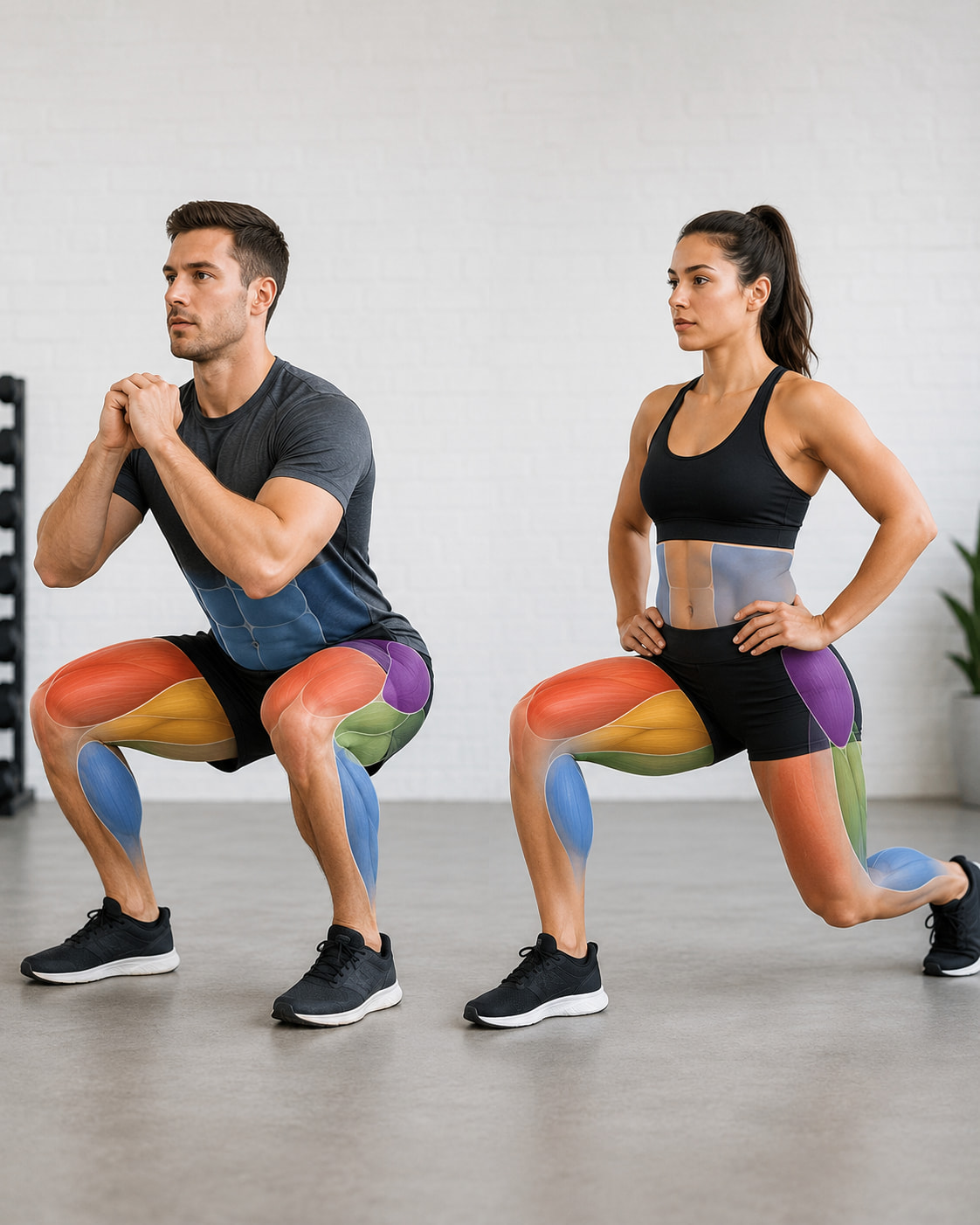
Squats and lunges train largely the same lower-body muscles. The amount of work performed by each muscle changes with exercise variation, stance, depth, step length, torso angle, and load placement.
Muscles Worked by Squats
The main muscles involved in squats include:
- Quadriceps: Straighten the knees as you stand.
- Gluteus maximus: Extends the hips during the upward phase.
- Adductors: Assist with hip extension and stabilization.
- Hamstrings: Help control the hips and knees.
- Calves: Stabilize the ankles and lower legs.
- Core and spinal muscles: Help control the torso under resistance.
The American Council on Exercise classifies the bodyweight squat as a beginner exercise targeting the thighs, hips, glutes, calves, and abdominal region. (ACE Bodyweight Squat Guide)
Squat depth can change the relative demands on the knees and hips. Load position also matters. For example, a front squat or goblet squat encourages a different torso position from a low-bar back squat.
Muscles Worked by Lunges
The main muscles involved in lunges include:
- Quadriceps
- Gluteus maximus
- Hamstrings
- Adductors
- Calves
- Gluteus medius and other hip stabilizers
- Abdominal and spinal stabilizers
The front leg usually performs most of the force-producing work, while the rear leg assists with balance and control. Lunge variations can shift the emphasis.
For example:
- A shorter step generally allows more forward knee movement and may increase quadriceps demand.
- A longer step may increase the contribution of the hip extensors.
- A slight controlled forward torso angle can increase hip involvement.
- A lateral lunge adds more side-to-side hip and adductor work.
Research on split-squat mechanics indicates that increasing step length can increase hip-extensor demands, although individual technique and anatomy also influence the result.
How to Do a Bodyweight Squat
How to do it:
- Stand with your feet around shoulder-width apart.
- Turn your toes slightly outward if that feels natural.
- Brace your trunk and keep your entire foot in contact with the floor.
- Bend your hips and knees as you lower under control.
- Allow your knees to track in line with your toes.
- Descend as far as you can while maintaining balance and control.
- Push through your feet to return to standing.
Common mistakes: Avoid lifting your heels, allowing the knees to collapse inward, rushing the descent, or forcing a depth you cannot control.
How to Do a Forward Lunge
How to do it:
- Stand tall with your feet approximately hip-width apart.
- Step forward far enough to create a stable stance.
- Keep the front foot flat as you bend both knees.
- Lower mostly downward rather than throwing your body forward.
- Keep the front knee tracking in line with the toes.
- Push through the front foot to return to standing.
- Repeat on the opposite side.
A practical forward-lunge setup emphasizes a controlled step, planted front foot, stable knee alignment, and a smooth return through the front leg.
Common mistakes: Avoid taking an uncontrolled step, pushing excessively from the rear foot, letting the front knee collapse inward, or slamming the rear knee into the floor.
Benefits of Squats
Squats are one of the most efficient exercises for training the lower body because both legs work simultaneously.
Builds Bilateral Lower-Body Strength
Squats are particularly useful when your goal is to become stronger in movements performed with both legs. This includes barbell squat performance, standing from a chair, lifting objects, and many jumping movements.
They also make it easier to use progressively heavier resistance because the stance is relatively stable.
Trains Several Muscles at Once
A squat combines movement at the hips, knees, and ankles. This allows you to train the quadriceps, glutes, adductors, calves, and trunk within one exercise.
Easy to Modify
Squats can be adapted to different experience levels and equipment.
Useful variations include:
- Chair squat
- Bodyweight squat
- Goblet squat
- Dumbbell squat
- Front squat
- Back squat
- Safety-bar squat
- Belt squat
- Hack squat
A beginner can start with a chair or bodyweight squat, while an experienced lifter can use a barbell or machine for greater resistance.
Efficient for Full Leg Workouts
Because both legs work together, squats usually require less total time than performing the same number of challenging sets for each leg separately.
Benefits of Lunges
Lunges add challenges that are not fully provided by a standard two-legged squat.
Trains Each Side Separately
Lunges allow you to concentrate on one side at a time. This may help you notice obvious differences in strength, balance, mobility, or control between your legs.
However, lunges should not be described as a guaranteed way to “fix” every muscle imbalance. Differences may require individual assessment and appropriate programming.
Improves Balance and Coordination
The split stance creates a narrower and less symmetrical base than a squat. Your hips, ankles, and trunk must work to keep you stable while you lower and rise.
Traditional and in-line lunges can create different balance demands even when overall lower-body muscle activation is similar.
Offers More Movement Directions
Squats are primarily performed up and down. Lunges can be performed in several directions:
- Forward
- Backward
- Laterally
- Diagonally
- While walking
This makes lunges useful for programs that need more movement variety.
Challenging With Less External Weight
Because one leg receives more emphasis, lunges can become difficult without requiring the same total external load as a heavy squat. This may be useful for home workouts or when heavy weights are unavailable.
Squats vs Lunges for Muscle Growth
Both squats and lunges can support lower-body muscle growth when they are performed with sufficient effort and progressively overloaded.
A 2025 systematic review and meta-analysis found no significant difference in muscle growth between unilateral and bilateral resistance training. Bilateral training produced greater gains in bilateral strength, while unilateral training produced greater gains in unilateral strength. The review included nine eligible studies, so its findings should be interpreted as general guidance rather than proof that every unilateral and bilateral exercise is interchangeable.
For muscle growth, the most important considerations include:
- Using a challenging resistance
- Performing enough weekly training volume
- Training through a controlled range of motion
- Gradually adding repetitions or resistance
- Recovering between hard sessions
- Choosing exercises you can perform consistently
Squats may make it easier to accumulate heavier bilateral work. Lunges can challenge each leg with less total weight.
For many people, a combination works well:
- Use a squat as the main compound exercise.
- Add a lunge as a unilateral accessory exercise.
Squats vs Lunges for Strength
Choose the movement that most closely matches the strength you want to develop.
Squats Are Better for Bilateral Strength
Prioritize squats when your main goal is:
- Increasing your back-squat or front-squat strength
- Handling heavier lower-body loads
- Developing two-leg force production
- Improving strength in squat-like movements
Strength is specific. You will normally improve a barbell squat most effectively by practicing an appropriate squat variation.
Lunges Are Better for Unilateral Strength
Prioritize lunges when your main goal is:
- Improving split-stance strength
- Training one side at a time
- Developing control during stepping movements
- Increasing strength in unilateral athletic positions
The 2025 review found that strength improvements generally favored the type of movement being trained: bilateral training improved bilateral strength more, while unilateral training improved unilateral strength more.
Squats vs Lunges for Glutes and Quads
Both exercises train the glutes and quadriceps. Technique matters more than the exercise name alone.
For More Quadriceps Emphasis
You may increase quadriceps involvement by using:
- A controlled squat with substantial knee flexion
- A front squat or heel-elevated squat
- A lunge with a moderate step length
- An upright torso
- A stable front foot and controlled forward knee movement
The knees do not have to remain behind the toes in every squat or lunge. Some forward knee travel is normal. The movement should remain controlled, with the knee generally tracking in the same direction as the foot.
For More Glute Emphasis
You may increase hip and glute involvement by using:
- A squat depth you can control
- A slightly wider or individually comfortable squat stance
- A longer lunge or split-squat stance
- A small, controlled forward torso angle
- A strong hip extension as you stand
One small comparative study reported greater gluteus maximus activation during lunges than back squats, but short-term muscle activation does not prove that lunges always produce greater long-term glute growth. Exercise selection, load, range of motion, effort, and total volume remain important.
Which Exercise Is Better for Balance and Athletic Performance?
Lunges generally create a greater balance challenge because the legs are separated and each side must control the body more independently.
A meta-analysis comparing unilateral and bilateral resistance training found that unilateral training produced greater improvements in unilateral jumping, while bilateral training had an advantage for bilateral strength. It did not find a consistent overall winner for every sprinting, jumping, or change-of-direction outcome.
This means athletes should not automatically replace all squats with lunges.
A balanced athletic program may include:
- Squats for bilateral strength and force production
- Lunges or split squats for unilateral strength
- Jumps, sprints, and direction-change drills for sport-specific performance
Squats vs Lunges for Beginners
Squats are usually easier for beginners because both feet remain planted and the base of support is wider.
A practical progression is:
- Chair squat
- Supported bodyweight squat
- Bodyweight squat
- Supported split squat
- Stationary split squat
- Reverse lunge
- Forward or walking lunge
- Loaded squat and lunge variations
Beginners who struggle with lunges can lightly hold a wall, chair, rail, or stable support. A split squat is another useful starting point because the feet remain in place instead of stepping during every repetition.
Are Squats or Lunges Better for Your Knees?
Neither exercise is automatically good or bad for every person’s knees.
Knee demands change according to:
- Exercise variation
- Squat depth
- Lunge step length
- Amount of forward knee travel
- External resistance
- Movement speed
- Current strength and mobility
- Injury history
- Individual anatomy
Laboratory research shows that squats and lunges can place different demands on the knee depending on depth and technique. This does not mean that higher joint force is automatically harmful; muscles and joints adapt to appropriately progressed resistance.
For more comfortable training:
- Start with body weight.
- Use a range of motion you can control.
- Keep the entire working foot planted.
- Let the knee track in the same general direction as the toes.
- Avoid sudden bouncing or collapsing inward.
- Add resistance gradually.
- Stop if you experience sharp, sudden, or worsening pain.
A reverse lunge may feel more stable than a forward lunge because the working foot stays planted while the other leg steps backward. However, individual responses vary.
Common Squat and Lunge Mistakes
| Mistake | Why it matters | Practical correction |
|---|---|---|
| Knees collapse inward | Reduces control and stability | Keep the knees moving in the same direction as the toes |
| Heels lift | Reduces foot stability | Use a comfortable stance and keep pressure across the full foot |
| Repetitions are rushed | Makes technique harder to control | Lower smoothly and stand without bouncing |
| Range is forced | May cause loss of position | Use the deepest range you can control comfortably |
| Load increases too quickly | Technique may break down | Add repetitions or small amounts of weight gradually |
| Breath is held too long | May cause lightheadedness | Brace, but breathe between repetitions when needed |
| Lunge stance is too narrow | Makes balance unnecessarily difficult | Keep some side-to-side space between the feet |
Should You Do Squats and Lunges in the Same Workout?
Yes. Squats and lunges complement each other and can be included in the same lower-body workout.
A common order is:
- Perform squats first as the heavier bilateral exercise.
- Perform lunges second as a unilateral accessory exercise.
This order is not mandatory. You can perform lunges first when unilateral strength, balance, or lunge performance is the main priority.
Beginner Lower-Body Workout
- Chair or bodyweight squat: 2–3 sets of 8–12 repetitions
- Supported reverse lunge: 2 sets of 6–10 repetitions per leg
- Glute bridge: 2–3 sets of 10–15 repetitions
- Standing calf raise: 2 sets of 10–15 repetitions
Rest approximately 60–90 seconds between sets.
Strength and Muscle Workout
- Goblet or barbell squat: 3–4 sets of 5–10 repetitions
- Dumbbell reverse lunge: 3 sets of 8–12 repetitions per leg
- Romanian deadlift: 3 sets of 6–12 repetitions
- Calf raise: 2–4 sets of 10–15 repetitions
Rest longer after demanding compound sets when necessary.
The ACSM’s March 2026 guidance recommends training all major muscle groups at least twice per week for most healthy adults. It also emphasizes gradual progression and notes that bodyweight exercises, bands, machines, and free weights can all be effective.
How to Choose Between Squats and Lunges
Choose squats when you want to:
- Build bilateral strength
- Use heavier resistance
- Train both legs efficiently
- Learn a foundational lower-body pattern
- Improve squat-specific performance
Choose lunges when you want to:
- Train each side separately
- Improve balance and coordination
- Develop split-stance strength
- Add more movement directions
- Challenge your legs with limited equipment
Choose both when you want well-rounded lower-body development.
Your best exercise is the one that matches your goal, feels manageable with proper technique, and can be progressed consistently.
Frequently Asked Questions
Are squats better than lunges?
Squats are better for some goals, particularly bilateral strength and efficient heavy loading. Lunges are better for unilateral strength, balance, and split-stance control. Neither is universally superior.
Can lunges replace squats?
Lunges can provide effective lower-body training when squats are unavailable or uncomfortable. However, they do not develop the exact same bilateral movement skill or squat-specific strength. Using both provides broader training.
Which builds more muscle, squats or lunges?
Both can build muscle when performed with sufficient effort, volume, and progressive overload. Current evidence comparing unilateral and bilateral training has not demonstrated a clear overall muscle-growth advantage for either approach.
Which is better for glutes?
Both exercises train the glutes. A deep, controlled squat can create substantial hip demand, while a longer lunge stance and slight forward torso angle may increase glute involvement. The best option is the one you can load and perform consistently.
Which is better for quads?
Both are effective quadriceps exercises. Squats allow both legs to work together, while lunges place more emphasis on the front leg. Knee bend, stance, range of motion, and torso position influence quadriceps demand.
Are lunges harder than squats?
Bodyweight lunges often feel harder because they require more balance and coordination. Squats may become more demanding when heavier external loads are used.
How often should you do squats and lunges?
Many healthy adults can train lower-body muscles at least twice weekly, depending on workout volume, intensity, experience, and recovery. Avoid repeating hard sessions when your technique or performance is still significantly affected by fatigue.
Conclusion
In the squats vs lunges comparison, the right choice depends on your goal. Squats are generally the stronger foundation for bilateral strength, efficient loading, and overall leg training. Lunges are valuable for unilateral strength, balance, coordination, and movement variety.
Most readers do not need to choose one and eliminate the other. Start with a squat variation you can control, add a suitable lunge variation, and progress gradually as your strength and technique improve.
References
- Resistance Training Prescription for Muscle Function, Hypertrophy, and Physical Performance in Healthy Adults.
- Comparison of Muscle Growth and Dynamic Strength Adaptations Induced by Unilateral and Bilateral Resistance Training: A Systematic Review and Meta-Analysis.
- Effects of Unilateral vs. Bilateral Resistance Training on Strength, Jumping, Sprinting, and Change-of-Direction Performance.
- A Biomechanical Review of the Squat Exercise.
- Effects of Step Lengths on the Biomechanical Characteristics of the Split Squat.
- Lunge Exercise: Proper Form and Muscles Worked.