
The main difference between a split squat and a lunge is that your feet stay planted during a split squat, while a lunge involves stepping into or out of the exercise. Both movements strengthen the legs and glutes, but split squats are generally better for controlled strength work, while lunges add more coordination, deceleration, and dynamic balance.
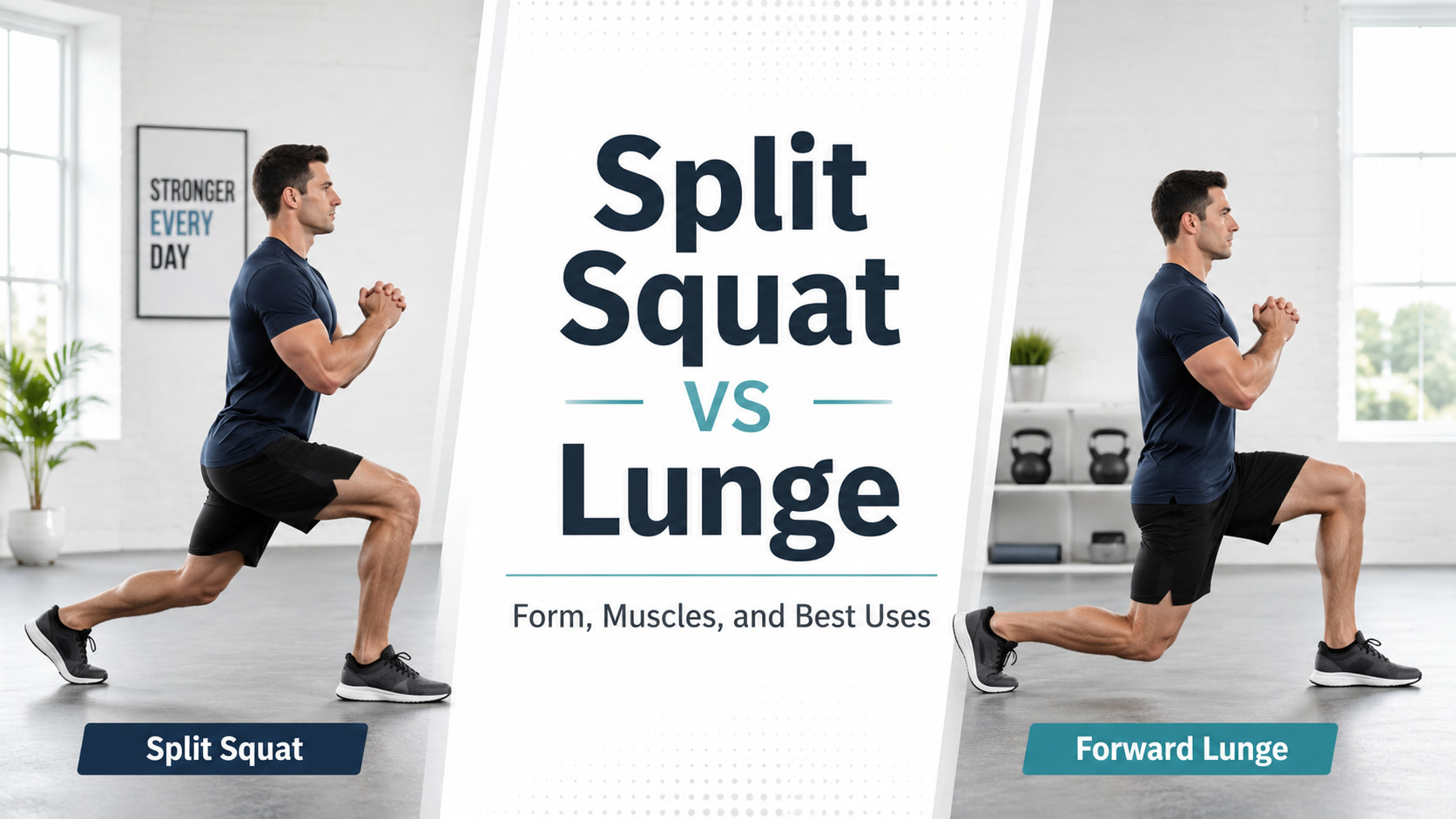
Understanding the split squat vs lunge comparison can help you choose the right exercise for your ability and training goals. Beginners may find the fixed stance of a split squat easier to control, whereas experienced exercisers may use forward, reverse, or walking lunges to add movement and variety.
Split Squat vs Lunge at a Glance
| Feature | Split squat | Lunge |
|---|---|---|
| Foot position | Both feet remain planted | One foot steps during each repetition |
| Movement pattern | Primarily up and down | Stepping followed by lowering and rising |
| Balance demand | Moderate | Usually higher |
| Coordination demand | Lower | Higher |
| Space required | Very little | Depends on the variation |
| Loading consistency | Easier to standardize | More affected by stride and balance |
| Main muscles | Quads, glutes, hamstrings | Quads, glutes, hamstrings |
| Best uses | Strength, muscle building, and technique | Dynamic balance, coordination, and conditioning |
| Beginner suitability | Usually easier to learn | Reverse lunges may be easier than forward lunges |
| Common variations | Standard, front-foot elevated, Bulgarian | Forward, reverse, walking, and lateral |
Neither exercise is automatically better. The right choice depends on whether you want a stable strength exercise or a more dynamic movement challenge.
What Is a Split Squat?
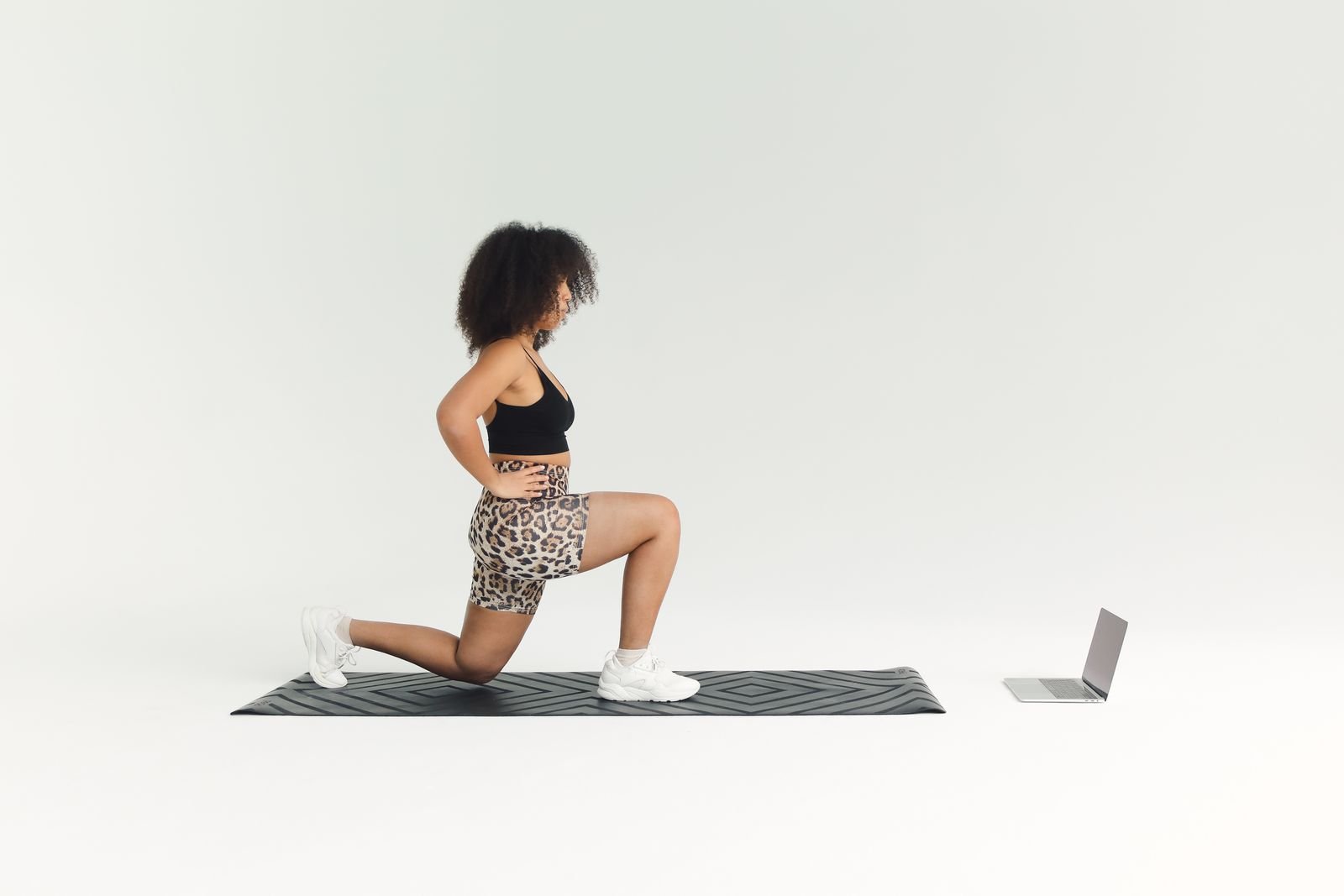
A split squat is a lower-body exercise performed from a stationary staggered stance. One foot is in front of the other, but both feet remain on the floor throughout the set.
You bend both knees to lower your body, then push through the front foot to return to the starting position. Most of the work should come from the lead leg, while the rear leg provides support and balance.
Split squats are sometimes called stationary lunges, which can create confusion. A practical way to distinguish them is simple: if you establish your stance before starting and keep your feet planted, you are performing a split squat.
A regular split squat should also not be confused with a Bulgarian split squat. In a Bulgarian split squat, the rear foot is elevated on a bench or stable platform. The National Academy of Sports Medicine classifies the Bulgarian version as an intermediate-to-advanced exercise because it requires more balance and places greater demand on the working leg.
What Is a Lunge?
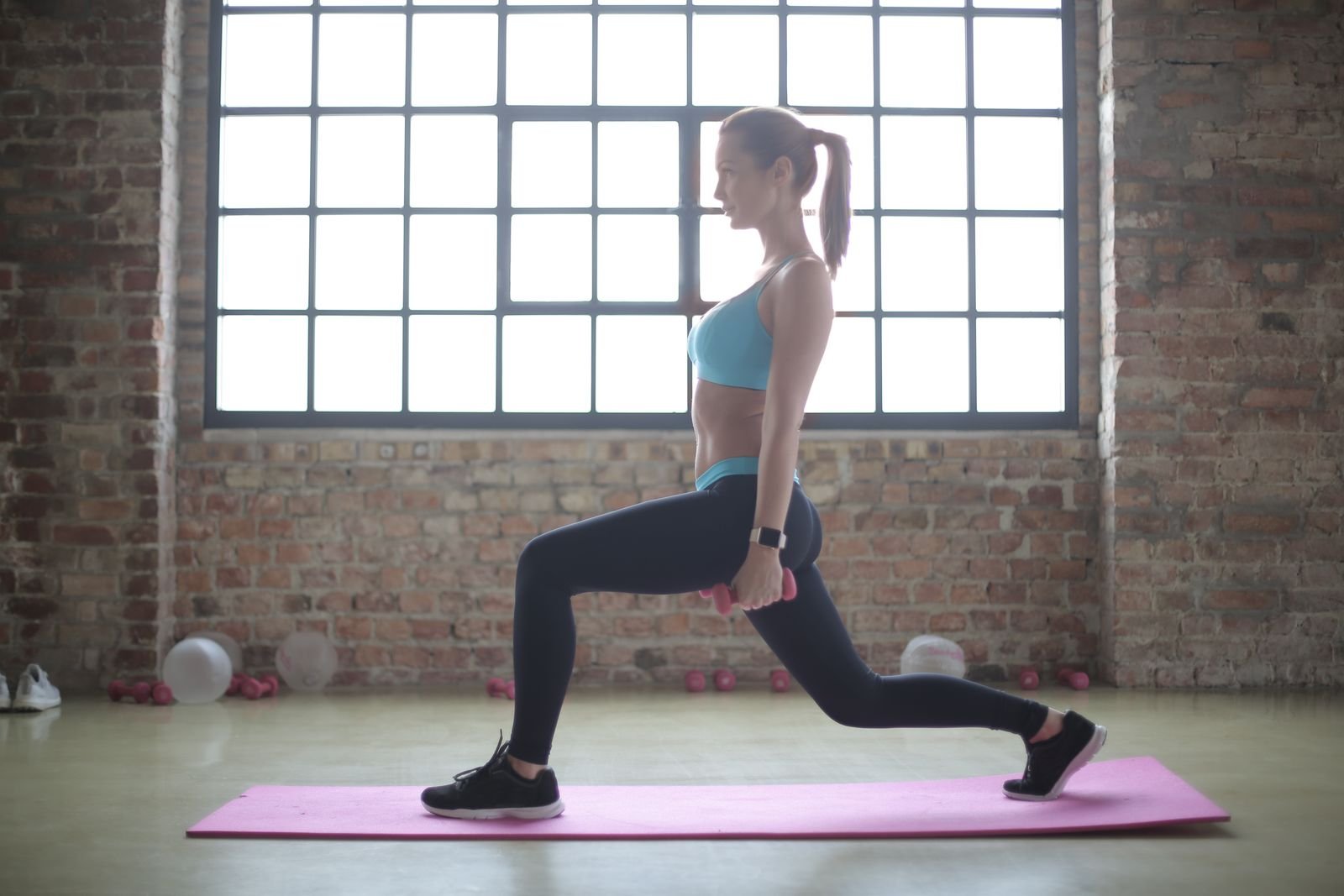
A lunge is a lower-body exercise in which you step forward, backward, or sideways before lowering your body. Depending on the variation, you may return to the original position or continue moving in the same direction.
Common lunge variations include:
- Forward lunges
- Reverse lunges
- Walking lunges
- Lateral lunges
- Curtsy lunges
- Deficit lunges
The step makes a lunge more dynamic than a split squat. You must control the landing, establish a stable position, lower your body, and then push back or move into the next repetition.
The Mayo Clinic lunge demonstration identifies the quadriceps and hamstrings as major working muscles and emphasizes controlled movement, a neutral back, and proper knee alignment.
What Is the Main Difference Between a Split Squat and a Lunge?
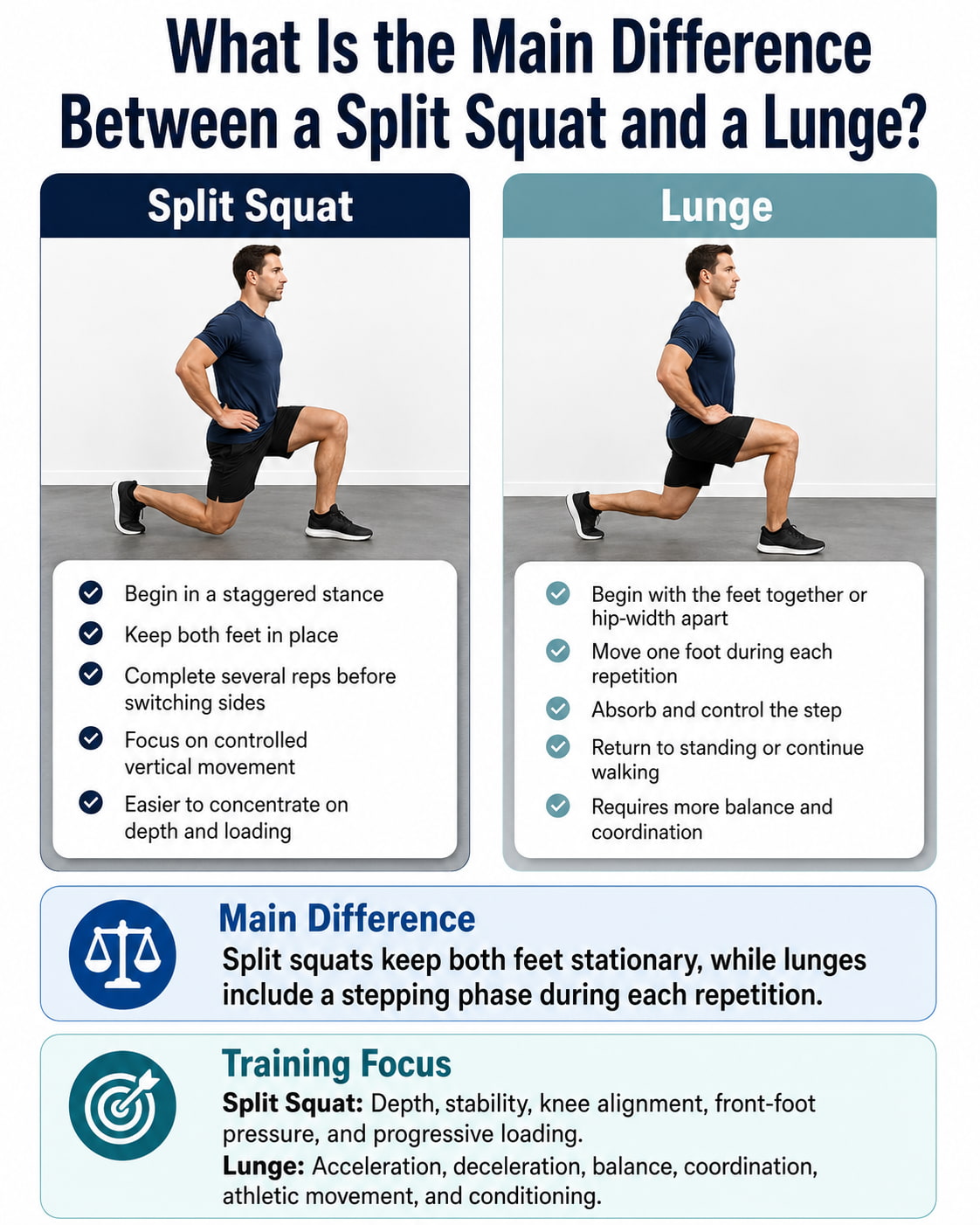
The primary difference is the transition into the exercise.
During a split squat:
- You begin in a staggered stance.
- Both feet remain in place.
- You complete several repetitions before switching sides.
- Your body moves mainly up and down.
During a lunge:
- You usually begin with your feet together or hip-width apart.
- One foot moves during each repetition.
- You must absorb and control the step.
- You return to standing or continue into another step.
Because split squats remove the stepping phase, they generally allow you to focus more closely on depth, front-foot pressure, knee alignment, and progressive loading.
Lunges add acceleration, deceleration, balance, and coordination. That can make them valuable for athletic movement and conditioning, but it may also make them harder to perform consistently.
Split Squat vs Lunge Muscles Worked
Split squats and lunges work many of the same lower-body muscles.
Primary Muscles
The main muscles involved include:
- Quadriceps
- Gluteus maximus
- Hamstrings
Supporting Muscles
Several other muscles help stabilize the hips, knees, ankles, and trunk:
- Adductors
- Calves
- Gluteus medius
- Hip rotators
- Abdominal muscles
- Spinal stabilizers
The muscles involved do not change simply because one exercise is stationary and the other involves stepping. However, the way those muscles are challenged can differ.
A 2025 study of loaded forward lunges found that step length and whether participants stepped into the movement influenced lower-body muscle activity. Longer steps generally increased activity in several muscles, while stepping versions produced greater glute activity during parts of the movement than stationary repetitions. The study measured short-term muscle activation, so it does not prove that one variation produces more long-term muscle growth. (Journal of Functional Morphology and Kinesiology).
Split Squat vs Lunge Form Differences
| Form point | Split squat | Lunge |
|---|---|---|
| Setup | Begin in the working stance | Step into the working stance |
| Front foot | Remains planted | Must land and become stable |
| Rear foot | Remains planted on the toes | Moves during the transition |
| Direction | Mostly vertical | Vertical plus forward, backward, or sideways |
| Balance | Fixed base of support | Base of support changes each rep |
| Rep consistency | Easier to repeat | Stride may change as fatigue increases |
| Main focus | Controlled lowering and rising | Controlling the step and lowering |
Your stance should be long enough to let both knees bend comfortably without the front heel lifting or the torso twisting.
There is no perfect stance length for every person. A 2023 biomechanics study found that changing split-squat stance length affected hip, knee, and ankle motion, joint moments, and muscle activity. Longer stances increased hip-extensor involvement more than knee-extensor involvement in the participants studied. (PubMed).
How to Do a Split Squat
Bodyweight Split Squat
How to do it:
- Stand with your feet hip-width apart.
- Step one foot backward into a staggered stance.
- Keep some side-to-side space between your feet rather than standing on one narrow line.
- Place the heel of your rear foot off the floor.
- Brace your core and keep your hips facing forward.
- Bend both knees and lower your body under control.
- Keep your entire front foot planted.
- Allow your front knee to track in the same direction as your toes.
- Lower only as far as you can while maintaining balance and alignment.
- Push through the front foot to rise.
- Complete your repetitions, then switch sides.
Trainer Tip: Think about lowering your hips toward the floor instead of pushing your body forward. Use a wall or chair lightly for balance while learning the movement.
How to Do a Forward Lunge
Bodyweight Forward Lunge
How to do it:
- Stand tall with your feet approximately hip-width apart.
- Brace your core and look straight ahead.
- Step forward far enough to create a stable stance.
- Plant your entire front foot before lowering.
- Bend both knees and lower under control.
- Keep the front knee aligned with the toes.
- Keep your front heel in contact with the floor.
- Stop at a comfortable depth without slamming the rear knee down.
- Push through the front foot to return to standing.
- Repeat on the opposite side.
Trainer Tip: Avoid taking a very short step or falling forward into the repetition. Land softly, establish your balance, and then lower your body.
Which Is Better for Beginners?
The standard split squat is generally the better starting exercise for beginners because the stance remains fixed. You can take time to adjust your feet before beginning the set and focus on one part of the movement at a time.
A practical beginner progression is:
- Supported split squat
- Bodyweight split squat
- Lightly loaded split squat
- Supported reverse lunge
- Bodyweight reverse lunge
- Forward or walking lunge
Reverse lunges can be a useful transition because the front foot stays planted while the other foot steps backward. Many people find this easier to control than stepping forward and absorbing their body weight.
The Bulgarian split squat is not necessarily the best starting point. Elevating the rear foot increases the balance and positioning demands, so it is better introduced after a regular split squat can be performed comfortably.
Which Is Better for Strength and Muscle Growth?
Split squats often have a practical advantage for strength and muscle-building workouts because the fixed stance makes them easier to standardize.
You can more consistently track:
- Stance position
- Range of motion
- Repetitions
- External load
- Tempo
- Proximity to muscular fatigue
That does not mean lunges cannot build strength or muscle. Loaded reverse lunges, forward lunges, and walking lunges can all provide a challenging training stimulus.
The most important factors are consistent technique, sufficient resistance, progressive overload, an appropriate range of motion, and recovery. Choose the exercise you can perform safely and progressively rather than assuming one movement is always superior.
Best practical choice: Use split squats when controlled strength or hypertrophy is the priority. Use lunges when you also want stepping, coordination, or a conditioning effect.
Which Is Better for Balance and Coordination?
Lunges generally create a greater dynamic balance challenge because your base of support changes during every repetition.
A forward lunge requires you to:
- Step accurately
- Absorb your momentum
- Stabilize the front knee and hip
- Control the bottom position
- Push back to standing
Walking lunges add another challenge because you continue moving forward rather than returning to the same position.
Split squats still train balance, especially when loaded or performed with the rear foot elevated. However, their fixed stance makes balance more predictable.
Best practical choice: Choose lunges for dynamic balance and movement control. Choose split squats when you want stability without removing unilateral training.
Which Is Better for the Glutes?
Both split squats and lunges can effectively train the glutes.
Glute involvement may increase when you use:
- A sufficiently long stance
- A comfortable but substantial range of motion
- Controlled hip flexion
- A slight forward torso lean
- Progressive resistance
Do not exaggerate the torso lean or let your back round. Your torso angle should remain controlled and appropriate for your mobility and the variation being performed.
Longer stances can increase hip-extensor demands, but they are not automatically better. An excessively long stance may make the movement unstable or restrict your depth.
Best practical choice: Either exercise can train the glutes. Choose split squats for consistent loading and lunges when you also want a dynamic challenge.
Which Is Better for the Quads?
Both exercises can strongly train the quadriceps because the lead knee bends and extends under resistance.
Quad demand is affected by:
- Knee range of motion
- Exercise depth
- External load
- Front-foot position
- Torso angle
- Step or stance length
A shorter stance may allow more forward knee movement, while a longer stance may increase hip demand. However, this relationship is not absolute, and both the quads and glutes remain involved.
Rather than forcing a specific stance, use one that allows you to keep the front foot planted, control the knee, and reach a useful depth without pain.
Split Squat vs Lunge for Knee Comfort
Neither split squats nor lunges are universally “better for the knees.” Comfort depends on the variation, technique, range of motion, load, previous injuries, and individual anatomy.
A split squat may feel more manageable because it removes the impact and uncertainty of stepping forward. Reverse lunges may also feel comfortable for some people because the working foot stays planted.
To reduce unnecessary knee stress:
- Begin with bodyweight.
- Use a stable stance.
- Keep the knee tracking with the toes.
- Control the lowering phase.
- Avoid bouncing at the bottom.
- Use a pain-free range of motion.
- Add resistance gradually.
Some forward knee movement is normal and is not automatically a form mistake. The important points are control, foot contact, appropriate load, and the absence of sharp or worsening pain.
Stop the exercise if it causes joint pain rather than normal muscular effort. Anyone recovering from an injury or surgery should ask an appropriate healthcare professional which variation and range are suitable.
Common Split Squat and Lunge Mistakes
Standing on a Tightrope
Placing the feet directly in one narrow line makes balance unnecessarily difficult.
Fix: Keep some side-to-side space between your feet, as though they were positioned on separate train tracks.
Using the Wrong Stance Length
A stance that is too short may make the movement cramped. An excessively long stance can restrict depth and make it difficult to rise.
Fix: Adjust your feet until you can bend both knees comfortably while keeping the front foot planted.
Letting the Front Knee Collapse Inward
The knee may drift inward because of poor control, excessive load, or fatigue.
Fix: Keep the knee tracking in the same general direction as the middle toes. Reduce the load or range if alignment becomes difficult.
Pushing Too Much With the Rear Leg
Excessive pressure from the rear foot reduces the work performed by the lead leg.
Fix: Use the back leg mainly for support and think about driving through the front foot.
Dropping Too Quickly
Falling into the bottom position reduces control and may make the joints absorb unnecessary force.
Fix: Lower for approximately two or three seconds and rise smoothly.
Adding Weight Too Soon
Heavy weights can hide balance problems and reduce your range of motion.
Fix: Develop stable bodyweight repetitions before adding dumbbells, kettlebells, or a barbell.
Useful Split Squat and Lunge Variations
Split Squat Variations
Supported split squat: Hold a stable surface lightly for balance.
Goblet split squat: Hold one dumbbell or kettlebell in front of your chest.
Dumbbell split squat: Hold weights at your sides for additional resistance.
Front-foot-elevated split squat: Place the front foot on a low stable platform to increase the available range of motion.
Bulgarian split squat: Elevate the rear foot to place more demand on the lead leg and balance system.
Lunge Variations
Reverse lunge: Step backward while keeping the working foot planted.
Forward lunge: Step forward and push back to the starting position.
Walking lunge: Continue moving forward with alternating steps.
Lateral lunge: Step sideways to train the hips and legs in a different plane.
Deficit reverse lunge: Stand on a low platform to increase the potential range of motion.
Choose variations based on your current control and goals. More advanced does not always mean more effective.
Can You Do Split Squats and Lunges in the Same Workout?
You can use both exercises in one program, but you may not need both in every workout because they train similar muscle groups.
One practical approach is to use a split squat as the main unilateral strength exercise and a lighter lunge variation for coordination or conditioning.
Example Lower-Body Workout
- Squat or deadlift: 3 sets
- Dumbbell split squat: 3 sets of 8–10 per leg
- Light walking lunge: 2 sets of 10 steps per leg
- Hamstring curl: 2–3 sets
- Calf raise: 2–3 sets
Another option is to alternate the exercises:
- Workout A: Loaded split squats
- Workout B: Reverse or walking lunges
Alternating them can provide variety while keeping total training volume manageable.
Suggested Sets and Reps
Use these ranges as practical starting points rather than strict rules.
| Goal | Sets | Reps |
|---|---|---|
| Learning technique | 2–3 | 6–8 per leg |
| General strength | 3–4 | 6–10 per leg |
| Muscle building | 3–4 | 8–15 per leg |
| Muscular endurance | 2–3 | 12–20 per leg |
| Dynamic warm-up | 1–2 | 5–8 per leg |
Rest for approximately 60–90 seconds between moderate sets. Heavier loaded sets may require two minutes or longer.
Start with bodyweight or a light load. Increase resistance only when you can complete the planned repetitions without losing balance, shortening the range excessively, or changing your alignment.
Split Squat vs Lunge: Which Should You Choose?
Choose a split squat when you want:
- A fixed and repeatable stance
- Easier technique practice
- Controlled unilateral strength work
- Consistent progressive loading
- An exercise that needs little floor space
Choose a lunge when you want:
- More dynamic balance
- Stepping and deceleration practice
- Greater coordination demands
- A conditioning option
- Movement in forward, backward, or lateral directions
For many people, the best solution is not choosing only one. Use split squats to build controlled single-leg strength and lunges to apply that strength through a more dynamic movement pattern.
Frequently Asked Questions
Is a split squat the same as a stationary lunge?
The terms are often used interchangeably. Both describe a staggered-stance exercise in which the feet stay planted. Calling it a split squat makes the distinction from stepping lunges clearer.
Are Bulgarian split squats a type of lunge?
A Bulgarian split squat is generally classified as a split-squat variation. The rear foot is elevated, but neither foot steps during the repetition. It is also called a rear-foot-elevated split squat.
Are split squats easier than lunges?
Standard split squats are often easier to coordinate because the feet remain planted. They can still be physically demanding, especially when performed deeply or with added weight.
Are split squats or lunges better for glutes?
Both can train the glutes effectively. Stance length, depth, torso position, load, and effort matter more than the exercise name alone.
Which exercise is better for beginners?
A supported or bodyweight split squat is usually the most practical starting option. Once that movement feels stable, beginners can progress to reverse lunges and then forward or walking lunges.
Can I replace lunges with split squats?
Yes. Split squats can replace lunges when your goal is lower-body strength or muscle development. However, they do not provide the same stepping, landing, and dynamic balance demands.
How often should I do split squats or lunges?
Most people can include one of these exercises in two or three weekly lower-body sessions, depending on workout volume and recovery. Leave enough time between hard sessions for your legs to recover.
Conclusion
In the split squat vs lunge comparison, the biggest difference is movement: split squats keep your feet planted, while lunges require a step. Both strengthen the quads, glutes, hamstrings, and supporting muscles.
Start with split squats when you need a stable, controlled way to develop unilateral leg strength. Add reverse, forward, or walking lunges when you are ready to challenge coordination and dynamic balance. Select the variation you can perform with consistent form, then progress the load or difficulty gradually.
References
- Mayo Clinic: Lunge Exercise
- National Academy of Sports Medicine: Bulgarian Split Squat
- PubMed: Effects of Step Lengths on Split Squat Biomechanics
- Journal of Functional Morphology and Kinesiology: Step Length and Stride Variation During Forward Lunges
- PubMed Central: Gluteal Muscle Forces During Hip-Focused Exercises