
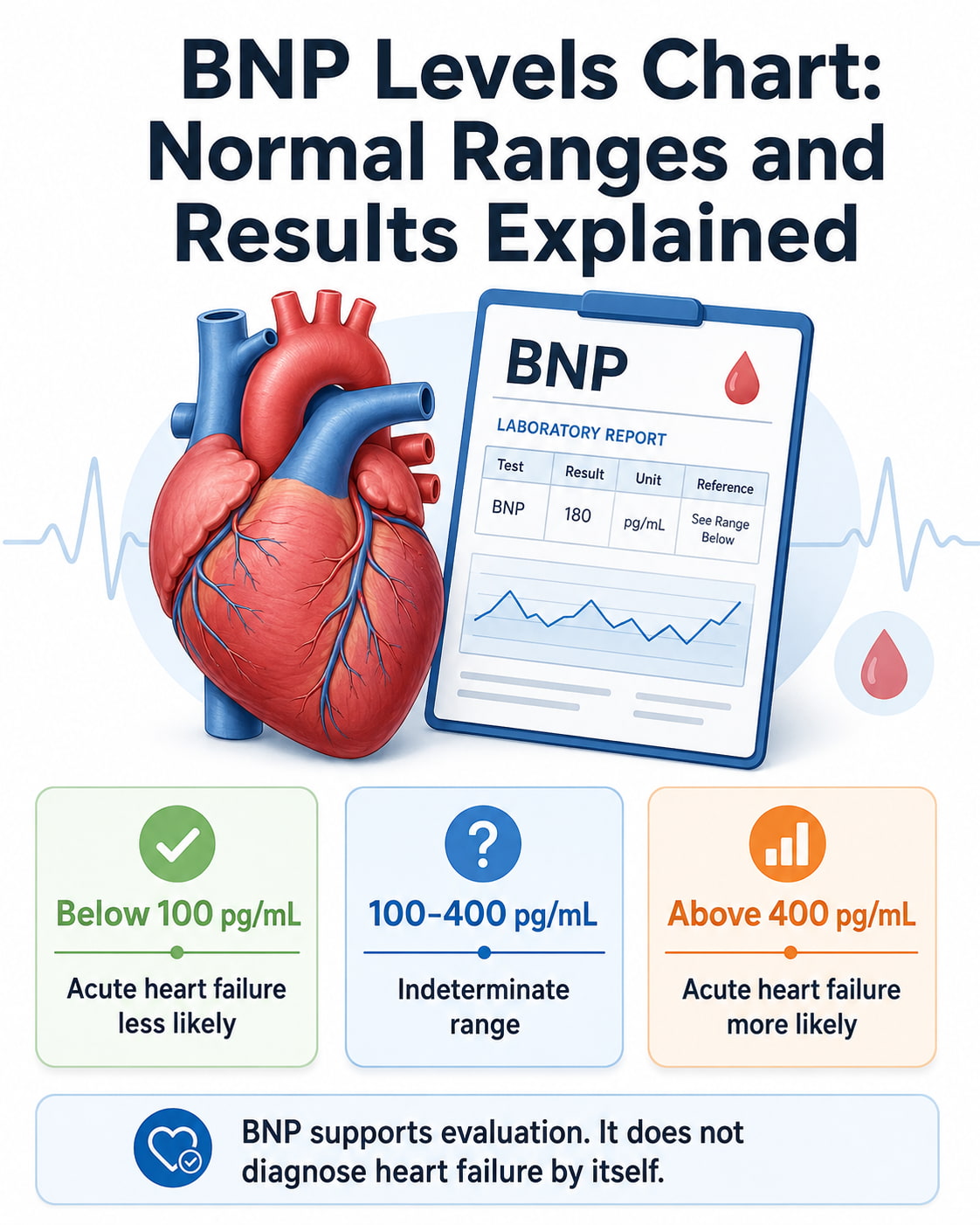
A BNP level below 100 pg/mL generally makes acute heart failure less likely, while levels above 400 pg/mL make it more likely. However, the correct interpretation depends on whether the test measures BNP or NT-proBNP, whether symptoms are sudden or ongoing, and factors such as age, kidney function, body weight, heart rhythm, medications, and the laboratory’s reference range.
A BNP levels chart can help you understand your result, but it cannot confirm or rule out heart failure by itself. Clinicians interpret the number together with symptoms, an examination, kidney tests, an electrocardiogram, and often an echocardiogram.
BNP Levels Chart at a Glance
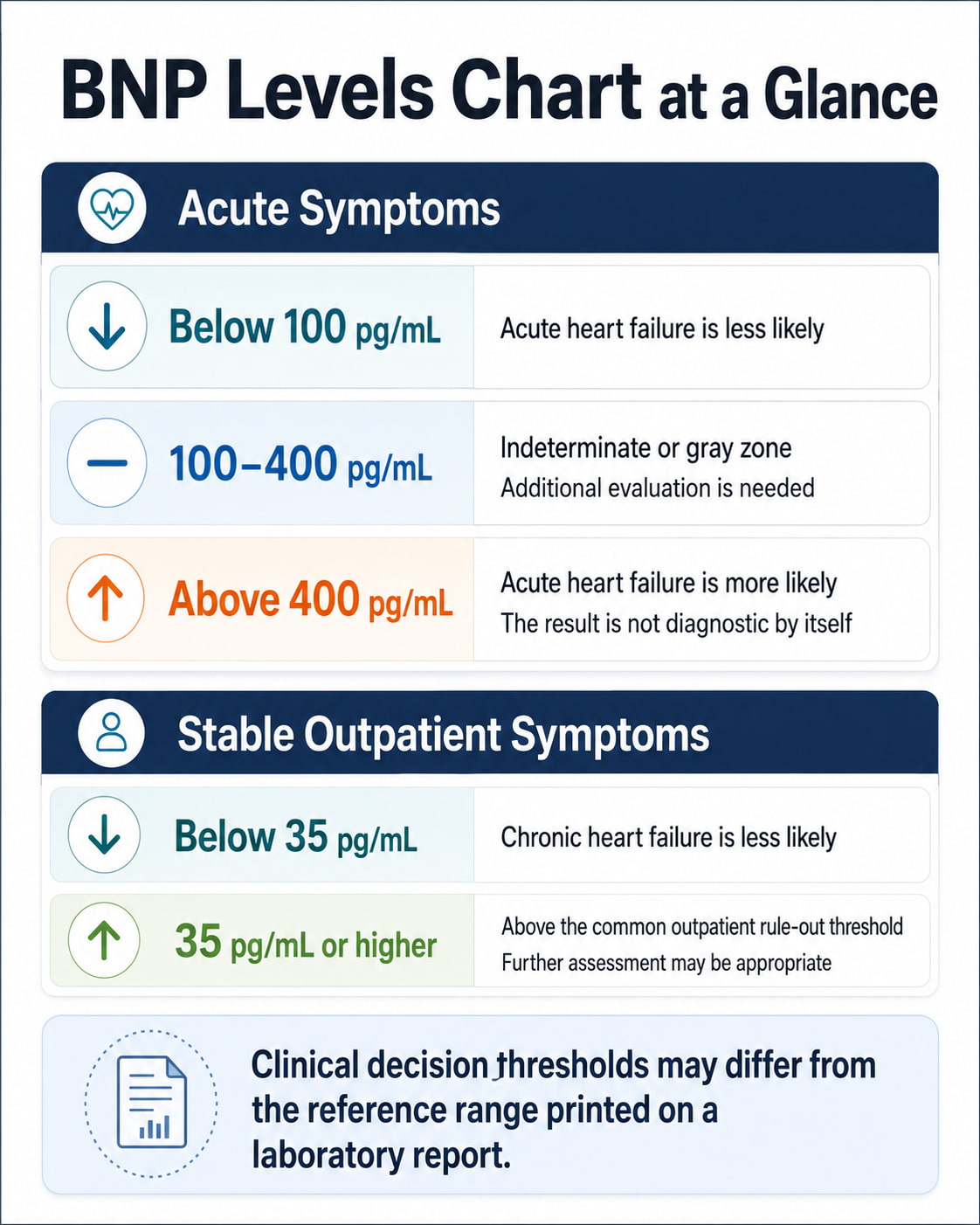
The following ranges are commonly used when an adult is being evaluated for new or suddenly worsening shortness of breath.
| BNP result | General interpretation |
|---|---|
| Below 100 pg/mL | Acute heart failure is less likely |
| 100–400 pg/mL | Indeterminate or “gray zone”; additional evaluation is needed |
| Above 400 pg/mL | Acute heart failure is more likely, but the result is not diagnostic by itself |
For stable outpatient symptoms, a lower BNP threshold may be used:
| BNP result in a stable outpatient setting | General interpretation |
|---|---|
| Below 35 pg/mL | Chronic heart failure is less likely |
| 35 pg/mL or higher | Above the commonly used outpatient rule-out threshold; further assessment may be appropriate |
These are clinical decision thresholds rather than universal laboratory “normal ranges.” The range printed on your report may differ because laboratories use different testing systems and reference populations.
NT-proBNP Levels Chart
BNP and NT-proBNP are related markers, but their numbers are not interchangeable. An NT-proBNP result should be compared only with NT-proBNP thresholds.
NT-proBNP for Acute Symptoms
| NT-proBNP result | General interpretation |
|---|---|
| Below 300 pg/mL at any adult age | Acute heart failure is unlikely |
| 300 pg/mL to the age-specific threshold | Indeterminate; clinical assessment and other tests are needed |
| Above 450 pg/mL if younger than 50 | Supports acute heart failure when symptoms and other findings agree |
| Above 900 pg/mL at age 50–75 | Supports acute heart failure when symptoms and other findings agree |
| Above 1,800 pg/mL if older than 75 | Supports acute heart failure when symptoms and other findings agree |
The age-specific thresholds are most applicable when significant kidney failure is absent. Reduced kidney function can raise NT-proBNP and may require a different interpretation. Mayo Clinic Laboratories reports that an NT-proBNP below 300 pg/mL has a very high negative predictive value for excluding acute heart failure.
NT-proBNP for Stable Outpatient Symptoms
| NT-proBNP result | General interpretation |
|---|---|
| Below 125 pg/mL | Chronic heart failure is less likely |
| 125 pg/mL or higher | Above the commonly used outpatient rule-out threshold; further evaluation may be needed |
Some health systems use different outpatient pathways. For example, the UK’s National Institute for Health and Care Excellence uses the following referral categories for untreated adults with suspected chronic heart failure:
- Below 400 ng/L: Heart failure is less likely, although the result does not completely exclude it.
- 400–2,000 ng/L: Specialist assessment and echocardiography are recommended within six weeks.
- Above 2,000 ng/L: Urgent assessment and echocardiography are recommended within two weeks.
These are UK referral thresholds, not universal definitions of normal and abnormal results.
Unit note: For BNP and NT-proBNP, 1 pg/mL is numerically equal to 1 ng/L. For example, 300 pg/mL equals 300 ng/L.
What Are BNP and NT-proBNP?
BNP stands for B-type natriuretic peptide, historically called brain natriuretic peptide. It is a hormone released mainly by heart muscle cells when the heart is exposed to increased pressure, stretching, or fluid volume.
When the body produces BNP, it first creates a larger precursor molecule. That molecule is divided into:
- BNP, the biologically active hormone
- NT-proBNP, an inactive fragment
Both enter the bloodstream and can be measured with a blood test. Higher concentrations may indicate that the heart is working under greater pressure, but they do not identify the cause on their own.
According to the American Heart Association, measuring BNP or NT-proBNP is useful for supporting the diagnosis or exclusion of heart failure in people with shortness of breath. These markers are also used for risk assessment in people with established heart failure.
BNP vs. NT-proBNP: What Is the Difference?
| Feature | BNP | NT-proBNP |
|---|---|---|
| Type of substance | Active hormone | Inactive fragment |
| Common acute rule-out level | Below 100 pg/mL | Below 300 pg/mL |
| Common acute rule-in approach | Above 400 pg/mL increases suspicion | Uses age-specific thresholds |
| Effect of kidney impairment | Can increase | Often more strongly affected |
| Effect of sacubitril/valsartan | BNP may be directly affected | Not directly broken down by neprilysin |
| Can the results be compared directly? | No | No |
An NT-proBNP of 500 pg/mL is not equivalent to a BNP of 500 pg/mL. Always confirm which test appears on your laboratory report before using a chart.
What Is Considered a Normal BNP Level?
There is no single BNP range that is normal for every person and every clinical situation.
A result may be interpreted differently depending on:
- Whether symptoms started suddenly or developed gradually
- Whether the test is BNP or NT-proBNP
- The laboratory’s assay and reference range
- Age and sex
- Kidney function
- Body mass index
- Heart rhythm
- Current heart-failure treatment
- Previous BNP or NT-proBNP results
For someone with sudden shortness of breath, BNP below 100 pg/mL generally makes acute heart failure less likely. For a stable outpatient with gradually developing symptoms, clinicians may use BNP below 35 pg/mL as the rule-out threshold.
That does not mean every BNP between 35 and 99 pg/mL confirms chronic heart failure. It means the result should be considered with the rest of the evaluation.
What Does a High BNP Level Mean?
A high BNP or NT-proBNP indicates that the heart or cardiovascular system may be under increased pressure or strain. Heart failure is an important possibility, particularly when the person also has symptoms such as:
- Shortness of breath during activity or at rest
- Difficulty breathing while lying flat
- Waking at night feeling short of breath
- Swelling in the feet, ankles, legs, or abdomen
- Rapid unexplained weight gain
- Fatigue or reduced ability to exercise
- Coughing or wheezing
- A feeling of fullness or reduced appetite
The National Library of Medicine explains that higher-than-normal results may support heart failure, but additional heart tests are usually needed to determine the actual cause.
Can BNP Be High Without Heart Failure?
Yes. Several cardiac and noncardiac conditions can raise natriuretic peptide levels.
Possible cardiac causes include:
- Atrial fibrillation
- Heart valve disease
- Heart muscle disease
- Left ventricular hypertrophy
- Right-sided heart strain
- Acute coronary syndrome or heart attack
- Myocarditis
- Pericardial disease
- Recent heart surgery
- Recent electrical cardioversion
Possible noncardiac causes include:
- Reduced kidney function
- Advanced age
- Anemia
- Pulmonary embolism
- Pulmonary hypertension
- Severe pneumonia
- Obstructive sleep apnea
- Sepsis
- Critical illness
- Severe burns
This is why a high BNP should not be treated as a stand-alone heart-failure diagnosis.
What Does a BNP of 100 to 400 Mean?
A BNP between 100 and 400 pg/mL is often called the gray zone during an acute evaluation.
In this range, heart failure is possible, but the number does not clearly separate it from other causes of shortness of breath. A clinician may consider:
- Previous heart disease
- Signs of fluid retention
- Lung disease
- Kidney function
- Atrial fibrillation
- Blood pressure
- Chest X-ray findings
- ECG results
- Echocardiogram findings
- Changes from the person’s previous BNP level
A value near 100 may still be important in a person with obesity or typical heart-failure symptoms. A value near 400 may have a non-heart-failure explanation, especially in someone with significant kidney disease or atrial fibrillation.
What Does a BNP Above 400 Mean?
A BNP above 400 pg/mL increases the likelihood of acute heart failure when a person has compatible symptoms. However, the result still cannot confirm the diagnosis without supporting clinical evidence.
The higher the level, the more likely significant cardiac stress may be present. Even so, a BNP of 500, 1,000, or higher does not tell you:
- What caused the elevation
- Whether the heart’s ejection fraction is reduced or preserved
- Whether symptoms are caused mainly by the heart, lungs, kidneys, or more than one condition
- What treatment is appropriate
- Whether the person requires hospitalization
Those decisions require a complete medical assessment.
Is There a Dangerous BNP Level?
There is no universal BNP “danger level” that applies to everyone.
Very high or rapidly increasing results may be associated with greater cardiac stress and a less favorable prognosis in people with confirmed heart failure. However, symptoms and overall condition are more important than one number when deciding how urgently care is needed.
Seek urgent medical care for:
- Severe or rapidly worsening shortness of breath
- Chest pain, pressure, or tightness
- Fainting or near-fainting
- Blue, gray, or unusually pale lips or skin
- New confusion
- Coughing up pink or frothy fluid
- Severe weakness or inability to remain awake
- Sudden shortness of breath with one-sided leg swelling
- Rapidly worsening swelling with breathing difficulty
Do not wait for a BNP test result when emergency symptoms are present.
Factors That Can Affect BNP Results
Age
BNP and NT-proBNP tend to rise with age. This does not mean that every high result in an older adult is harmless. Age is one factor used to interpret the result, particularly for NT-proBNP.
Kidney Function
The kidneys help clear natriuretic peptides from the circulation. Reduced kidney function can raise BNP and especially NT-proBNP, even when the degree of heart failure is uncertain.
Kidney impairment and heart failure also commonly occur together. A clinician generally reviews creatinine and estimated glomerular filtration rate alongside the natriuretic peptide result.
Atrial Fibrillation
Atrial fibrillation can increase BNP and NT-proBNP independently of typical left-sided heart failure. A higher result may therefore require different interpretation in someone with an irregular heart rhythm.
Obesity
Obesity can suppress natriuretic peptide concentrations. A person with obesity may have heart failure despite a BNP or NT-proBNP below a standard threshold.
A low result is still useful, but it should not automatically end the evaluation when symptoms, examination findings, or imaging remain concerning.
Heart-Failure Medication
Effective treatment that reduces pressure and fluid buildup may lower BNP or NT-proBNP over time.
Sacubitril/valsartan requires special consideration. Sacubitril blocks neprilysin, an enzyme involved in breaking down BNP. BNP may therefore rise or remain elevated after treatment begins even while the person is improving. NT-proBNP is not directly degraded by neprilysin and may be easier to follow during this therapy.
Timing of the Test
A result may be less reliable very early in a sudden heart-failure episode. NT-proBNP may not yet be elevated during the first hour of very acute heart failure in some cases.
Can You Have Heart Failure With a Normal BNP?
Yes, although a normal result makes heart failure less likely.
Situations in which heart failure may be present despite a low or normal result include:
- Obesity
- Very early testing after symptoms begin
- Symptoms that occur mainly during exercise
- Heart failure with preserved ejection fraction
- Effective treatment with diuretics or other heart-failure medication
- Certain structural conditions that limit ventricular filling
When suspicion remains high, a clinician may order an echocardiogram or other tests even when BNP or NT-proBNP is not elevated.
How Doctors Interpret a BNP Test
A BNP test is one part of a broader heart-failure evaluation.
Medical History and Symptoms
The clinician may ask about breathlessness, swelling, weight changes, fatigue, chest discomfort, sleep position, exercise tolerance, kidney disease, lung disease, and previous heart problems.
Physical Examination
The examination may look for:
- Leg or abdominal swelling
- Lung crackles
- Abnormal heart sounds
- An irregular heart rhythm
- Elevated neck veins
- Low oxygen levels
- High or low blood pressure
- Signs of poor circulation
Additional Tests
Depending on the situation, further testing may include:
- Electrocardiogram
- Echocardiogram
- Chest X-ray
- Complete blood count
- Kidney and electrolyte tests
- Liver and thyroid tests
- Troponin
- Urinalysis
- Cardiac stress testing or advanced imaging
The 2026 Second Universal Definition of Heart Failure emphasizes a comprehensive, individualized evaluation rather than relying on rigid numerical markers alone.
How Is the BNP Test Performed?
BNP and NT-proBNP are measured using a blood sample, usually taken from a vein in the arm. Some hospitals use rapid point-of-care testing when an immediate result may help guide an emergency evaluation.
No fasting or special preparation is usually required. Tell the healthcare professional about your medications and whether you have kidney disease, atrial fibrillation, obesity, or a previous heart-failure diagnosis because these details can affect interpretation.
How to Read Your BNP Laboratory Report
Use these steps when reviewing the result:
- Confirm the test name. Determine whether the report says BNP or NT-proBNP.
- Check the units. Results are commonly reported in pg/mL or ng/L.
- Read the laboratory reference interval. Use the range printed on your own report.
- Consider why the test was ordered. Acute emergency thresholds differ from stable outpatient thresholds.
- Review kidney function and heart rhythm. Both may change the meaning of the result.
- Compare with earlier results. In established heart failure, the trend may provide more context than one isolated value.
- Discuss the complete result with a clinician. Do not change medication or fluid intake based only on the number.
Frequently Asked Questions
What is a normal BNP level?
For sudden shortness of breath, BNP below 100 pg/mL generally makes acute heart failure less likely. In stable outpatient assessment, BNP below 35 pg/mL is a commonly used rule-out threshold. Your laboratory may provide a different reference range.
What BNP level indicates heart failure?
No BNP result confirms heart failure by itself. A BNP above 400 pg/mL makes acute heart failure more likely when compatible symptoms and examination findings are present. Results between 100 and 400 pg/mL require additional evaluation.
Is a BNP level of 100 high?
A BNP of 100 pg/mL is at the commonly used acute decision threshold. It does not automatically mean heart failure, but it may warrant further assessment, particularly if the person has shortness of breath, swelling, or other relevant symptoms.
What does a BNP over 1,000 mean?
A BNP over 1,000 pg/mL can indicate substantial cardiac pressure or volume stress, but the number does not identify the cause. Heart failure, kidney impairment, atrial fibrillation, valve disease, pulmonary hypertension, and critical illness may contribute.
Can kidney disease cause a high BNP?
Yes. Reduced kidney function can raise BNP and NT-proBNP. NT-proBNP is often affected more strongly, so kidney test results are important when interpreting a high value.
Can someone have heart failure with a normal BNP?
Yes. Obesity, very early testing, certain forms of heart failure, and current treatment may produce a lower-than-expected result. Further testing may still be appropriate when symptoms remain concerning.
Which result is better, BNP or NT-proBNP?
Both are useful. The best choice depends on the laboratory, clinical setting, kidney function, and medications. They use different thresholds and should not be compared directly.
Conclusion
A BNP levels chart is most useful as a starting point, not a diagnosis. BNP below 100 pg/mL generally makes acute heart failure less likely, 100–400 pg/mL is an indeterminate range, and a result above 400 pg/mL increases suspicion. NT-proBNP uses different thresholds, including age-specific levels during acute assessment.
Review the exact test name, units, laboratory range, symptoms, kidney function, medications, and previous results with a qualified healthcare professional. Seek urgent care for severe breathing difficulty, chest pain, fainting, confusion, or rapidly worsening symptoms regardless of the BNP number.
This content is for informational purposes only and not medical advice.
References
- American Heart Association, American College of Cardiology, and Heart Failure Society of America: 2022 Guideline for the Management of Heart Failure.
- American Heart Association, American College of Cardiology, European Society of Cardiology, and World Heart Federation: Second Universal Definition of Heart Failure, updated June, 2026.
- Mayo Clinic Laboratories: NT-Pro B-Type Natriuretic Peptide Test Interpretation and Reference Information.
- National Library of Medicine, MedlinePlus: Natriuretic Peptide Tests.
- National Institute for Health and Care Excellence: Chronic Heart Failure in Adults—Diagnosis and Management.