
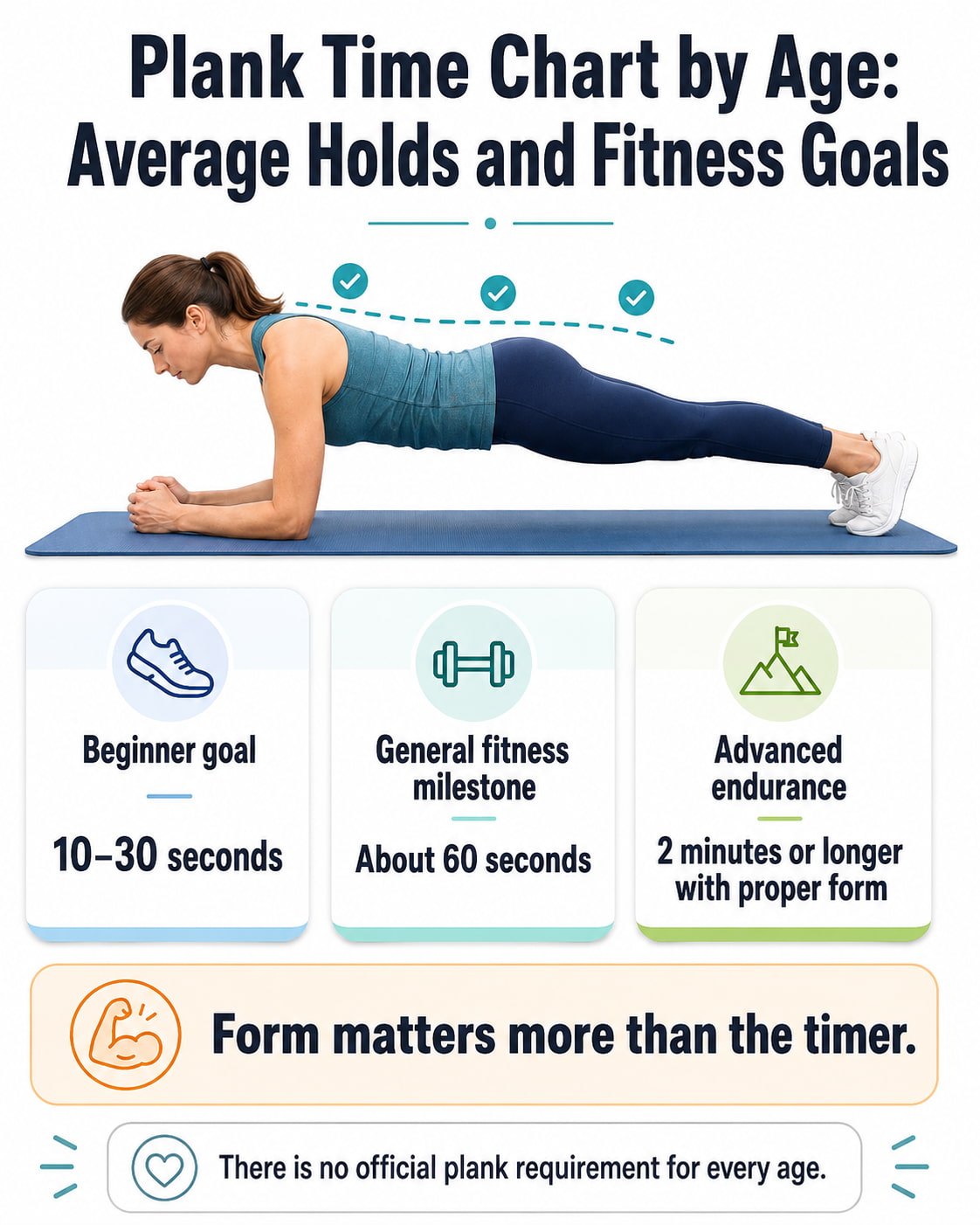
A controlled plank lasting 30 to 60 seconds is a useful fitness goal for many people, but no official plank time standard exists for each age. Published averages vary widely because researchers have studied different populations, including college students, athletes, active adults, and young tennis players.
Use a plank time chart by age as a general reference—not as a medical test or a requirement you must reach. Your technique, training history, body composition, plank variation, and reason for stopping can affect your time as much as your age.
Plank Time Chart by Age
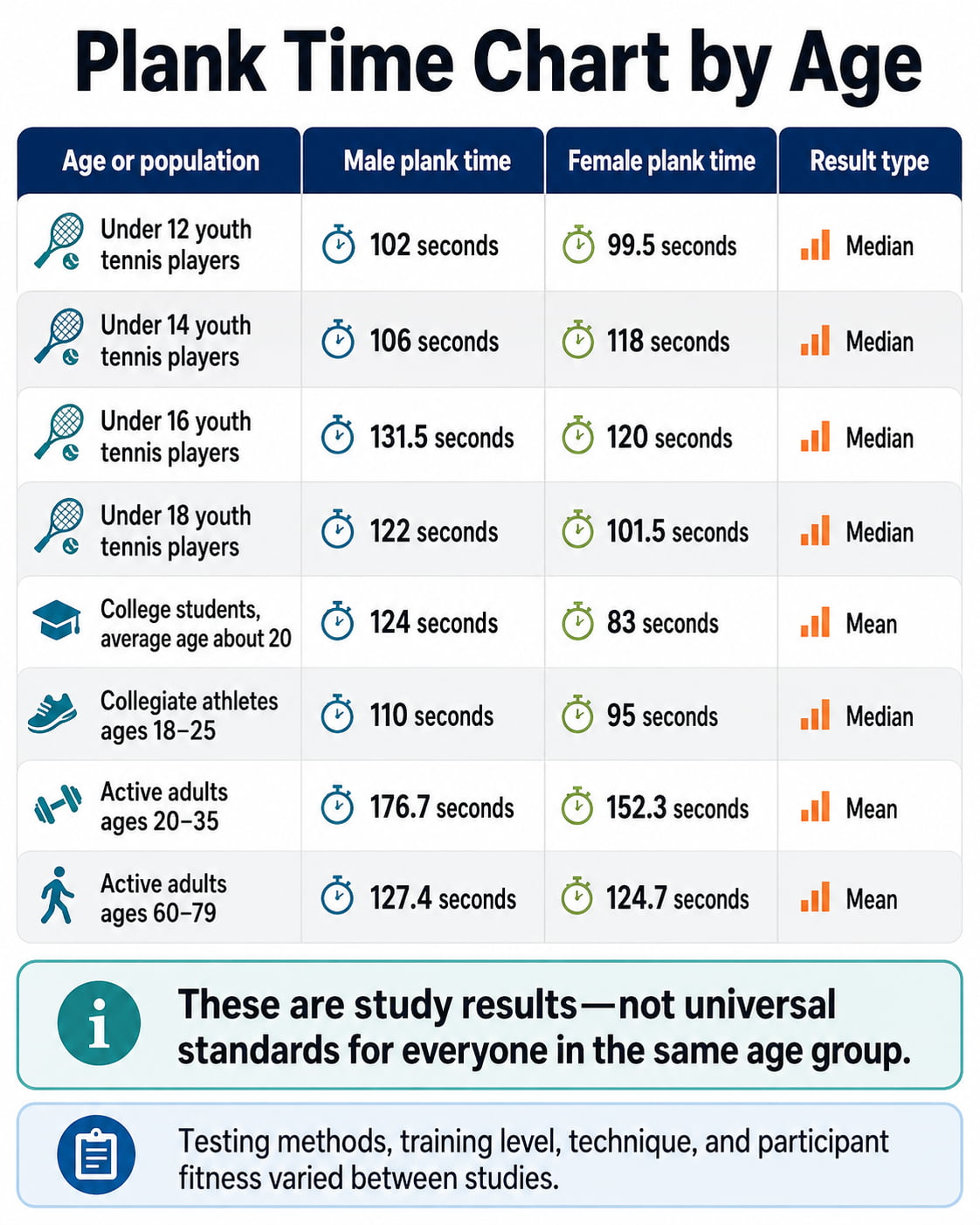
The chart below summarizes results from several published plank studies. These values describe the participants in those studies. They are not universal standards for everyone in the same age group.
| Age or population | Male plank time | Female plank time | Type of result |
|---|---|---|---|
| Under 12 youth tennis players | 102 seconds | 99.5 seconds | Median |
| Under 14 youth tennis players | 106 seconds | 118 seconds | Median |
| Under 16 youth tennis players | 131.5 seconds | 120 seconds | Median |
| Under 18 youth tennis players | 122 seconds | 101.5 seconds | Median |
| College students, average age about 20 | 124 seconds | 83 seconds | Mean |
| Collegiate athletes ages 18–25 | 110 seconds | 95 seconds | Median |
| Active adults ages 20–35 | 176.7 seconds | 152.3 seconds | Mean |
| Active adults ages 60–79 | 127.4 seconds | 124.7 seconds | Mean |
The youth figures come from a 2026 Frontiers study of 214 Croatian tennis players. The researchers found no consistent increase in plank performance across every age group, and the results apply most directly to trained young tennis players—not all children and teenagers.
A 2014 study of 471 college students reported average times of 124 seconds for men and 83 seconds for women. The median results were 110 seconds for men and 72 seconds for women. Varsity athletes averaged 123 seconds, compared with 83 seconds among nonathletes, showing how strongly training status can affect the result.
Another study involving collegiate athletes ages 18–25 reported median plank times of 110 seconds for men and 95 seconds for women. The middle half of participants recorded times between 84 and 135 seconds for men and between 73.5 and 122.5 seconds for women.
In a 2018 study comparing younger and older adults, active adults ages 20–35 averaged approximately 153 to 177 seconds, while those ages 60–79 averaged approximately 125 to 127 seconds. The authors noted that their participants appeared relatively active and that the results should not be treated as population-wide norms.
Important Chart Limitations
Ages missing from the chart do not have a scientifically established “normal” plank time. Reliable general-population data remain limited for:
- Children who do not play organized sports
- Adults in their 30s, 40s, and 50s
- Adults over age 80
- People with disabilities or chronic pain
- People recovering from surgery or injury
You should not estimate a missing age group simply by adding or subtracting seconds from another group.
Is There an Official Average Plank Time for Each Age?
No major health organization publishes an official plank-time requirement for every age. The Centers for Disease Control and Prevention recommends muscle-strengthening activity at least two days per week for adults, but its guidance does not require a specific plank duration.
Plank research also uses different testing procedures. One study may use a forearm plank, while another may use a high plank. Researchers may stop the timer after one technique error, several warnings, voluntary fatigue, or a fixed maximum time.
These differences make it difficult to compare every result directly.
A plank time should therefore answer a personal question:
Can you maintain proper alignment longer than you could before?
That comparison is usually more useful than trying to outperform an age-group average.
What Is a Good Plank Time?
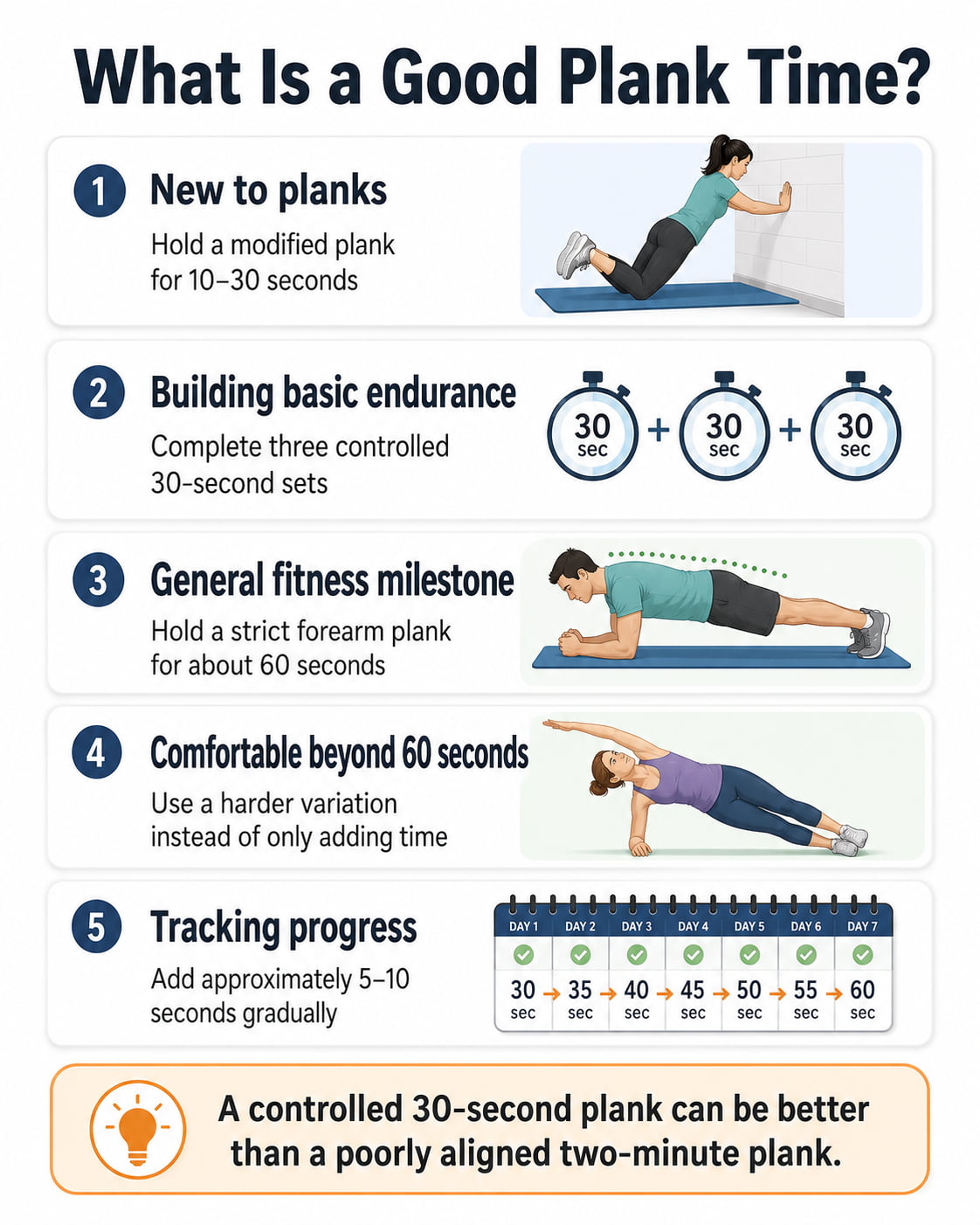
A good plank time is one you can maintain without sagging, raising your hips, holding your breath, or developing pain.
The following practical goals can help you choose an appropriate starting point.
| Current ability | Practical plank goal |
|---|---|
| New to planks | Hold a modified plank for 10–30 seconds |
| Building basic endurance | Complete three controlled 30-second sets |
| General fitness milestone | Hold a strict forearm plank for about 60 seconds |
| Comfortable beyond 60 seconds | Use a harder variation instead of only adding time |
| Tracking progress | Add approximately 5–10 seconds gradually |
These are training milestones, not diagnostic cutoffs. A person who holds a perfect 30-second plank may demonstrate better control than someone who remains in a poorly aligned position for two minutes.
The Cleveland Clinic’s plank guidance recommends starting with manageable 30-second sets, gradually working toward approximately one minute, and then considering a more challenging variation. It also recommends increasing plank time in five- to 10-second increments.
Is a 30-Second Plank Good?
A 30-second plank is a reasonable starting achievement, especially if you are a beginner or have recently returned to exercise.
During those 30 seconds, focus on:
- Keeping your elbows beneath your shoulders
- Maintaining a straight line from your head to your heels
- Bracing your abdomen
- Squeezing your glutes
- Breathing normally
When you can maintain all five points comfortably, add several seconds or another set.
Is a One-Minute Plank Good?
A strict one-minute plank is a useful general-fitness milestone. It shows that you can maintain whole-body tension and trunk stability for a sustained period.
It does not prove that you have exceptional overall fitness, however. A plank does not measure cardiovascular endurance, mobility, balance, leg strength, pulling strength, or power.
Is a Two-Minute Plank Good?
A controlled two-minute plank reflects substantial isometric endurance for many recreational exercisers. Published studies show that some active and college-aged participants average around or above this level, but those results come from selected populations.
Once you can hold a strict plank for more than a minute, you may gain more from increasing the difficulty instead of chasing progressively longer times. Options include a long-lever plank, side plank, plank shoulder tap, body saw, or plank with a controlled arm reach.
Plank Time for Children and Teenagers
Children and teenagers should not be pressured to meet adult plank standards. Growth, maturation, body proportions, sports participation, motivation, and familiarity with the exercise all affect performance.
In the 2026 youth tennis study, median results ranged from about 99.5 to 131.5 seconds across the male and female age groups. However, the participants were competitive tennis players. Their results should not become minimum targets for students or recreationally active children.
For young people, a better goal is to:
- Learn the position correctly.
- Hold it for a short period with normal breathing.
- Stop before technique deteriorates.
- Progress through games, movement, and varied strength exercises.
The CDC recommends that children and adolescents ages 6–17 receive at least 60 minutes of daily physical activity, including muscle- and bone-strengthening activities on at least three days each week. A plank may be one small part of that activity, but it should not replace running, jumping, climbing, sports, and other age-appropriate movement.
Average Plank Time for Adults
College-aged studies often report average plank times between approximately 80 and 125 seconds, depending on sex, athletic participation, and study design. Active adults in controlled research have sometimes averaged longer.
These figures may be higher than the typical result among inactive adults because research volunteers are often healthy enough and motivated enough to complete a maximal fitness test.
Training frequency also matters. In the 2014 college study, people who reported exercising more frequently generally performed better. Participants exercising more than five times per week recorded the longest average holds.
Someone who does not practice planks should not expect to match the time of a trained athlete, even when both people are the same age.
Plank Time for Adults Over 60
Plank performance does not automatically collapse after age 60. In the younger-versus-older adult study, men ages 60–79 averaged 127.4 seconds, while women averaged 124.7 seconds. These participants were relatively active and had no current shoulder or lower-back pain, so their results may not represent every older adult.
Older adults should select the variation that matches their current ability. Suitable options may include:
- A wall plank
- A plank against a sturdy countertop
- An elevated plank on a bench
- A knee-supported floor plank
- A standard forearm plank
Using an easier variation is not a failure. It allows you to strengthen the same bracing pattern with less load on your shoulders, wrists, spine, and hips.
The CDC advises adults 65 and older to perform muscle-strengthening activities at least two days per week and include balance-improving activities. The activity should match the person’s health, fitness, and physical abilities.
How to Test Your Plank Time Correctly
Use the same plank variation every time you test yourself. Comparing a knee plank with a full forearm plank will not show whether your endurance actually improved.
Standard Forearm Plank Test
- Place your forearms on a firm, comfortable surface.
- Position your elbows directly beneath your shoulders.
- Extend your legs and support your lower body on your toes.
- Keep your head, neck, back, hips, and legs in one line.
- Tighten your abdomen and glutes.
- Start the timer when you reach the correct position.
- Breathe normally throughout the hold.
- Stop when you can no longer maintain alignment.
In the 2018 study, participants held the plank until they stopped voluntarily or repeatedly failed to maintain neutral alignment. Researchers allowed up to three technique warnings.
For personal testing, stop the timer when you first lose the position and cannot correct it immediately. Do not continue with sagging hips simply to produce a longer number.
Keep Testing Conditions Consistent
For a fair comparison, use:
- The same plank variation
- The same surface
- Similar footwear
- The same warm-up
- A similar time of day
- Similar rest before testing
- The same definition of technique failure
Test after you have recovered from previous training. Shoulder, arm, abdominal, or leg fatigue can shorten your result even when your underlying fitness has not changed.
What Affects Your Plank Time?
Training Experience
People who regularly practice planks or other resistance exercises usually perform better than people who are unfamiliar with the movement.
The improvement may partly reflect stronger trunk muscles, but it may also come from better pacing, breathing, positioning, and tolerance of discomfort.
Body Size and Composition
A plank requires you to support much of your body mass against gravity. Height, weight distribution, waist circumference, body-fat percentage, and limb length can change the mechanical difficulty.
In the 2018 adult study, plank time had negative associations with BMI and waist circumference. However, BMI alone cannot determine whether someone has a strong or weak core.
Plank Variation
A high plank, forearm plank, knee plank, wall plank, and long-lever plank place different demands on the body. Record the variation beside your time so that future results remain meaningful.
Upper- and Lower-Body Fatigue
Your abdominal muscles are not always the first area to fatigue. In the college study, participants frequently stopped because of fatigue in the arms or legs. In the adult study, common reasons included shaking, back discomfort, upper-limb fatigue, abdominal fatigue, and alignment failure.
A plank is therefore a whole-body endurance test—not an isolated measurement of abdominal strength.
Technique and Breathing
Holding your breath can make the exercise feel harder and may cause you to stop early. Poor shoulder positioning or relaxed glutes can also shift stress toward your lower back.
Breathe slowly while maintaining firm abdominal tension.
How to Improve Your Plank Time Safely
Start With the Right Variation
Choose a version that allows you to maintain alignment for at least 10 seconds. Use a wall, countertop, bench, or your knees when a full plank causes immediate sagging.
Use Several Quality Sets
Three shorter sets usually allow better technique than one long, exhausting attempt.
For example:
- Hold for 20 seconds.
- Rest for 30–60 seconds.
- Repeat for two or three total sets.
Increase the duration only when the final set still looks controlled.
Progress Gradually
Add approximately five to 10 seconds rather than making a large jump. Cleveland Clinic recommends practicing planks two to four times per week and progressing to a more challenging movement after you can hold the position beyond approximately one minute.
You can also progress by:
- Extending your knees from a modified plank
- Moving from an elevated surface to the floor
- Narrowing your base of support
- Reaching one arm forward
- Lifting one foot briefly
- Practicing a side plank
- Increasing tension without increasing time
Train More Than the Front Plank
The front plank emphasizes your ability to resist spinal extension. A balanced core routine should also challenge side-to-side stability, rotation control, hip strength, and back endurance.
Useful complementary exercises include:
- Side planks
- Bird dogs
- Dead bugs
- Glute bridges
- Suitcase carries
- Controlled rows
- Pallof presses
Use versions that match your ability and available equipment.
Is a Longer Plank Always Better?
No. Plank time eventually becomes a measure of tolerance and pacing as well as muscular endurance.
Very long holds may also encourage people to:
- Raise their hips
- Let the lower back sag
- Shift weight away from the core
- Hold their breath
- Ignore shoulder or back discomfort
After you can hold a technically sound plank for approximately 60 seconds, increasing exercise difficulty can be more efficient than extending the timer indefinitely.
Your goal should be better control—not simply a bigger number.
When Should You Stop a Plank?
End the exercise when:
- Your hips repeatedly sag or rise
- Your lower back begins to arch
- Your shoulders cannot remain stable
- You cannot breathe normally
- You experience sharp or increasing pain
- You feel dizzy, faint, or unusually short of breath
- You develop numbness or tingling
A plank should create muscular effort, but it should not produce sharp back, neck, wrist, or shoulder pain. Cleveland Clinic recommends checking your technique when back or shoulder pain occurs and seeking guidance when you have a history of back problems.
People with heart disease, arthritis, diabetes, disabilities, or other chronic conditions should ask a healthcare professional what types and amounts of exercise are appropriate for them.
Frequently Asked Questions
How long should I be able to hold a plank for my age?
There is no official duration you must reach based only on your age. A controlled 30- to 60-second hold is a useful general goal, but your starting ability, technique, health, and training experience matter more than your birthday.
Is a one-minute plank considered good?
Yes. Holding a strict plank for one minute is a solid general-fitness milestone. The position should remain stable from the beginning to the end, without sagging hips or breath-holding.
Is a two-minute plank impressive?
A technically correct two-minute plank demonstrates strong isometric endurance for many recreational exercisers. However, active adults and trained athletes may commonly reach or exceed this duration.
How long should a beginner hold a plank?
A beginner can start with 10–30 seconds using a wall, elevated, knee-supported, or standard plank. Select the variation that allows normal breathing and correct alignment.
Does plank time decrease with age?
It may decrease on average, but age is not the only influence. In one study, active adults ages 60–79 averaged more than two minutes. Training, health, body composition, technique, and prior plank experience can all affect performance.
Is one long plank better than several short planks?
Not necessarily. Several shorter sets often help beginners maintain better technique and accumulate useful training time. One maximal hold is more appropriate as an occasional test than as the only way to train.
How often should I practice planks?
Two to four sessions per week can work for many people. Allow recovery when your abdomen, shoulders, back, or arms remain fatigued, and avoid maximal tests during every workout.
Conclusion
A plank time chart by age can provide useful context, but it cannot define whether your core is healthy, strong, or weak. Published averages come from specific groups and should not become mandatory targets for everyone.
Start with a variation you can control, record your time honestly, and improve in small steps. A pain-free 30- or 60-second plank with excellent alignment is more valuable than a longer hold performed with poor technique.
This content is for informational purposes only and not medical advice.
References
- Frontiers in Sports and Active Living: Normative Data and Predictors of Trunk Muscle Endurance Performance in Young Tennis Players, 2026
- Journal of Human Kinetics: Norms for an Isometric Muscle Endurance Test, 2014
- International Journal of Exercise Science: Fitness Norms for the Plank Exercise, 2014
- PubMed: The Prone Bridge Test—Performance, Validity, and Reliability Among Older and Younger Adults, 2018
- Cleveland Clinic: Plank Exercises—What They Do for Your Body
- Centers for Disease Control and Prevention: Adding Physical Activity as an Adult