
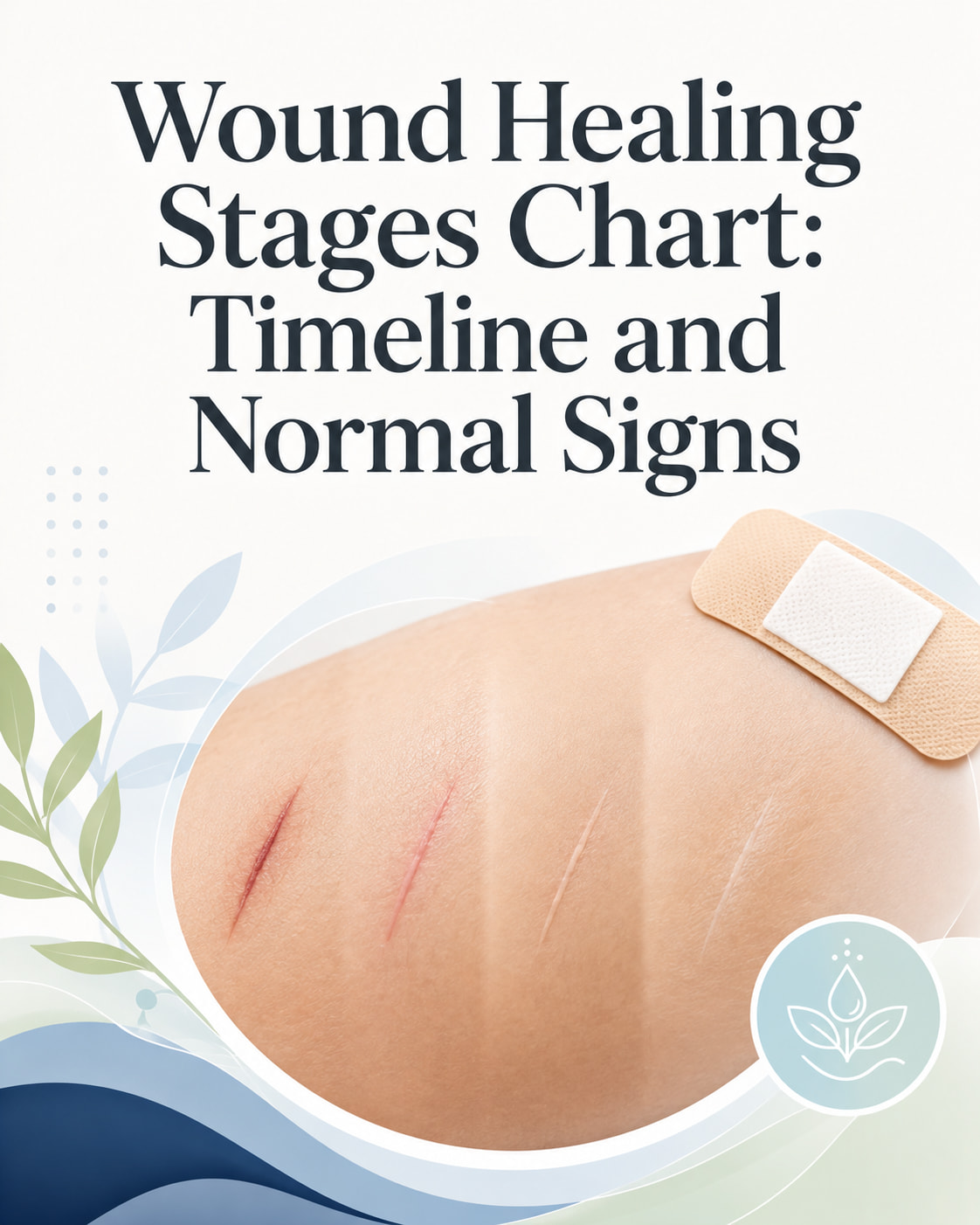
Wound healing normally progresses through four overlapping stages: hemostasis, inflammation, proliferation, and remodeling. Clotting begins immediately, early inflammation commonly lasts about two to five days, new tissue develops over the following weeks, and scar remodeling may continue for one to two years.
A wound healing stages chart can help you recognize expected changes, such as mild early redness, decreasing tenderness, new tissue growth, and gradual wound closure. However, worsening pain, spreading redness, pus, fever, black tissue, or a wound that opens may require medical attention.
The timeline below applies mainly to uncomplicated acute skin wounds, such as minor cuts, scrapes, and properly managed surgical incisions. Deep wounds, burns, bites, pressure injuries, diabetic ulcers, and infected wounds may heal differently.
Wound Healing Stages Chart at a Glance
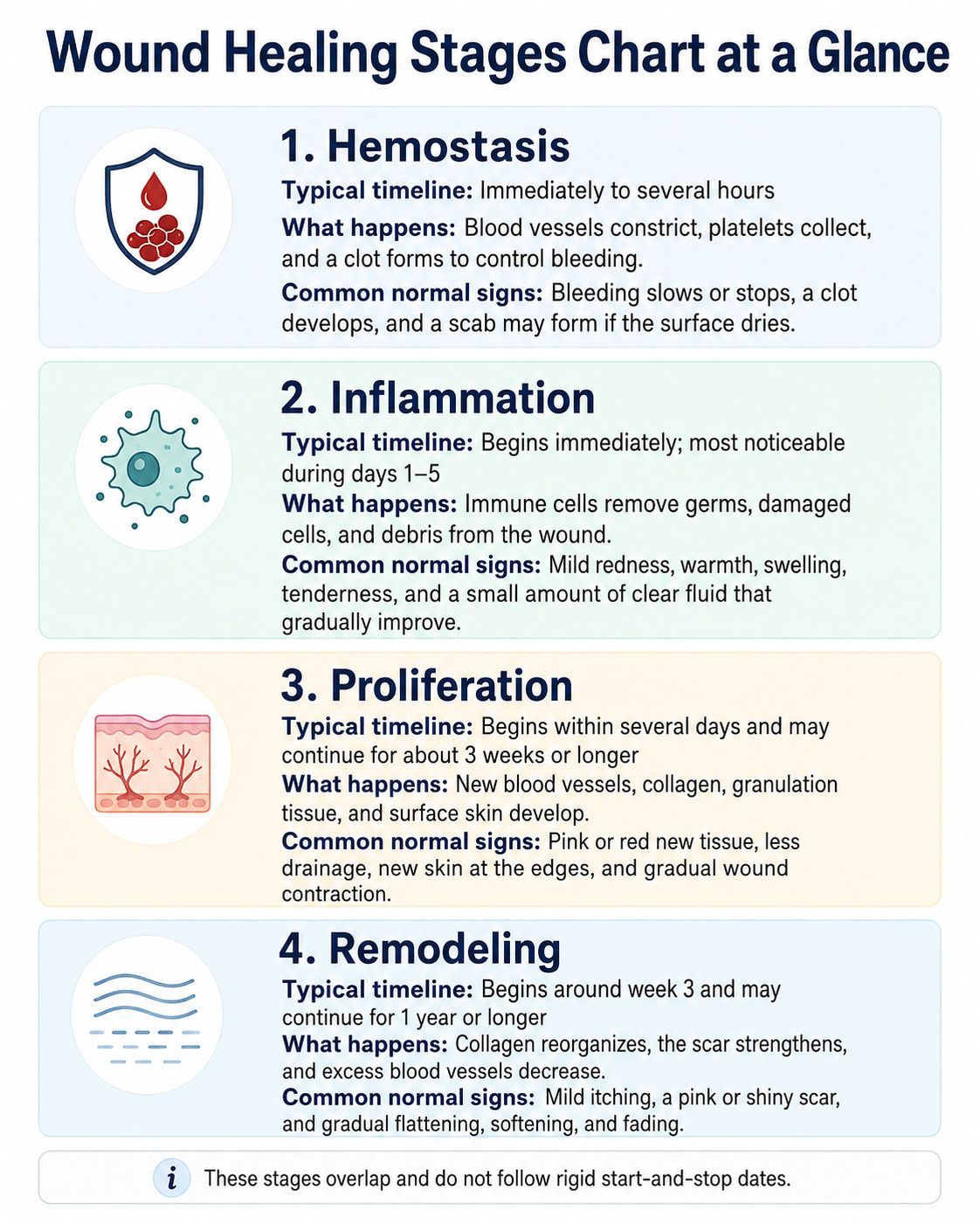
| Wound healing stage | Typical timeline | What happens | Common normal signs |
|---|---|---|---|
| 1. Hemostasis | Immediately to several hours | Blood vessels constrict, platelets collect, and a clot forms to control bleeding. | Bleeding slows or stops, a clot develops, and a scab may form if the surface dries. |
| 2. Inflammation | Begins immediately; most noticeable during days 1–5 | Immune cells remove germs, damaged cells, and debris from the wound. | Mild redness, warmth, swelling, tenderness, and a small amount of clear fluid that gradually improve. |
| 3. Proliferation | Begins within several days and may continue for about 3 weeks or longer | New blood vessels, collagen, granulation tissue, and surface skin develop. | Pink or red new tissue, less drainage, new skin at the edges, and gradual wound contraction. |
| 4. Remodeling | Begins around week 3 and may continue for 1 year or longer | Collagen reorganizes, the scar strengthens, and excess blood vessels decrease. | Mild itching, a pink or shiny scar, and gradual flattening, softening, and fading. |
These stages do not occur as separate, rigid blocks. Several phases may be active at the same time, and the exact timeline depends on the wound’s depth, size, location, cause, blood supply, and method of closure. The National Library of Medicine’s wound-healing review describes the process as four overlapping biological phases.
The Four Stages of Wound Healing
Stage 1: Hemostasis
Typical timing: immediately after the injury
Hemostasis is the body’s first response to a wound. Damaged blood vessels briefly narrow, and platelets begin sticking to the injured area. A mesh of fibrin then helps form a clot that limits blood loss and creates a temporary foundation for repair.
For a minor cut, bleeding usually begins slowing within minutes. A surface clot may dry into a scab when exposed to air.
Normal signs during hemostasis may include:
- Bleeding that gradually slows or stops
- A dark red or brown clot
- Mild soreness around the injury
- A scab forming on a dry wound
Not every wound bleeds or forms a visible scab. Burns, pressure injuries, and some puncture wounds may cause significant tissue damage without much surface bleeding.
Bleeding that remains heavy or does not stop after about 10 minutes of firm, continuous pressure requires urgent assessment.
Stage 2: Inflammation
Typical timing: immediately through approximately days 2–5
Inflammation is a necessary part of normal healing. Blood vessels widen so oxygen, nutrients, immune cells, and repair signals can reach the injured tissue.
White blood cells help remove damaged material and protect the wound from infection. This activity may make the area look mildly red, pink, swollen, or warm.
Common normal inflammatory signs include:
- Slight redness close to the wound
- Mild swelling
- Tenderness or sensitivity
- Mild warmth
- A small amount of thin, clear fluid
These signs should stay limited to the wound area and begin improving. According to MedlinePlus, the early inflammatory stage commonly lasts about two to five days.
Inflammation becomes more concerning when redness spreads, swelling increases, pain becomes worse, or drainage becomes thick, cloudy, foul-smelling, yellow, or green.
Stage 3: Proliferation
Typical timing: begins within several days and continues for several weeks
During proliferation, the body starts rebuilding the damaged area. Fibroblast cells produce collagen, while new blood vessels deliver oxygen and nutrients.
The wound also develops granulation tissue. This new tissue fills the wound bed and supports the growth of new surface skin. At the same time, the wound edges gradually pull inward.
Normal signs during proliferation may include:
- Pink or red new tissue in the wound bed
- New skin forming around the edges
- A wound that becomes smaller or shallower
- Less swelling and tenderness
- Decreasing drainage
- Improved comfort and movement
New granulation tissue may look moist, pink, or red because it contains many small blood vessels. It can bleed easily if rubbed or disturbed.
Do not pick at new tissue or repeatedly remove a scab. This can damage fragile cells, restart bleeding, and delay closure.
Stage 4: Remodeling and Scar Maturation
Typical timing: begins around week 3 and may continue for 1–2 years
Remodeling is the final and longest stage. The body reorganizes collagen fibers, removes unnecessary blood vessels, and strengthens the repaired area.
A new scar may initially look:
- Pink, red, or darker than the surrounding skin
- Slightly raised
- Shiny or stretched
- Firm
- Mildly itchy
These changes often become less noticeable over time. The scar may gradually flatten, soften, and fade, although some scars remain permanently visible.
A wound can look closed before it has regained much of its strength. Scar tissue reaches only about 80% of the strength of uninjured skin at three months and beyond, so newly healed areas remain vulnerable to stretching, pressure, and reinjury.
MedlinePlus notes that scar fading may continue for as long as two years.
What Does Normal Wound Healing Look Like?
Normal healing is usually defined by gradual improvement rather than one specific color or appearance.
Signs that generally suggest a wound is progressing normally include:
- Bleeding has stopped.
- Redness remains mild and close to the wound.
- Swelling and tenderness gradually decrease.
- Drainage becomes lighter or less frequent.
- New tissue forms in the wound bed.
- New skin grows from the edges.
- The wound becomes smaller or shallower.
- The edges move closer together.
- Pain improves instead of worsening.
- The closed wound develops a gradually fading scar.
A small amount of clear fluid can occur during early healing. Large amounts of fluid, increasing drainage, or a sudden change in color or odor should be assessed.
Normal Wound Healing vs. Possible Infection
| More consistent with normal healing | More concerning for infection or another complication |
|---|---|
| Mild redness close to the wound | Redness that spreads or becomes more intense |
| Mild swelling that decreases | Increasing or marked swelling |
| Tenderness that gradually improves | Worsening, throbbing, or persistent pain |
| A small amount of thin, clear fluid | Thick, cloudy, yellow, green, gray, or foul-smelling drainage |
| Pink or red new tissue | Black, dark, gray, or dying tissue |
| Wound gradually becoming smaller | Wound becoming wider, deeper, or reopening |
| Mild warmth near the wound | Increasing heat with pain and spreading redness |
| Mild itching after closure | Fever, chills, red streaks, weakness, or feeling unwell |
No single sign confirms an infection. A healthcare professional may need to examine the wound, particularly when several concerning changes occur together.
Is Redness Around a Healing Wound Normal?
A small amount of redness directly around a new wound can be normal during the inflammatory stage. It should generally remain limited and gradually fade.
Seek medical advice when redness:
- Spreads beyond the wound edges
- Becomes brighter or darker
- Returns after improving
- Occurs with increasing warmth, swelling, pain, pus, fever, or red streaks
Red streaks extending away from a wound may indicate a spreading infection and require prompt medical evaluation.
Is Clear Fluid From a Wound Normal?
A small amount of thin, clear, or pale-yellow fluid can occur during early healing. This fluid, known as serous drainage, comes from blood vessels and helps support the healing environment.
Drainage is more concerning when it:
- Suddenly increases
- Soaks through dressings repeatedly
- Becomes thick or cloudy
- Turns green, gray, dark yellow, or bloody
- Develops a strong or unpleasant odor
- Occurs with worsening pain, swelling, or redness
Excessive clear drainage can also be a warning sign and should not automatically be considered normal.
Does a Wound Need a Scab to Heal?
No. A wound can heal normally without developing a thick scab.
Scabs form when blood and wound fluid dry on the surface. They can protect the area temporarily, but modern minor-wound care usually aims to keep the wound clean, lightly moist, and covered.
The American Academy of Dermatology recommends applying plain petroleum jelly to minor cuts and scrapes and covering them with a clean bandage. A moist environment can prevent the wound from drying out and may reduce the size or itchiness of the resulting scar.
Do not apply petroleum jelly over surgical glue or adhesive strips unless your surgeon has approved it.
How Long Does a Wound Take to Heal?
Healing time varies widely.
A small surface scrape may close within several days. A deeper cut may take several weeks. A surgical incision may appear closed within two weeks but continue gaining strength for months.
Healing often takes longer when a wound:
- Is large or deep
- Has separated edges
- Is on the foot or over a moving joint
- Has poor blood flow
- Contains dead tissue or debris
- Is repeatedly exposed to pressure or friction
- Becomes infected
- Must fill from the bottom upward
- Occurs in someone with diabetes or reduced immune function
Burns, pressure injuries, diabetic foot ulcers, venous ulcers, arterial ulcers, and complex surgical wounds do not reliably follow a simple general timeline.
Primary vs. Secondary Wound Healing
The method by which a wound closes can significantly affect healing time.
Healing by Primary Intention
Primary healing occurs when clean wound edges are brought together with:
- Stitches
- Staples
- Skin adhesive
- Adhesive strips
Because the gap is small, less new tissue is needed. These wounds often close faster and leave a narrower scar when healing proceeds normally.
Healing by Secondary Intention
Secondary healing occurs when a wound remains open and fills gradually from the bottom upward.
This may happen with:
- Larger open wounds
- Some surgical wounds
- Abscess cavities
- Wounds with tissue loss
- Wounds that separate after closure
Secondary healing usually takes longer and creates more granulation tissue and a larger scar.
Factors That Can Delay Wound Healing
Several local and general health factors can interfere with normal healing.
Infection
Infection prolongs inflammation, damages developing tissue, and can make a wound larger or deeper.
Diabetes
Diabetes may affect circulation, sensation, immune response, and collagen formation. A foot wound in someone with diabetes should receive early professional evaluation, even when it appears small.
Poor Blood Circulation
Arterial disease, venous disease, swelling, and prolonged pressure can reduce the oxygen and nutrients available to healing tissue.
Smoking
Smoking reduces tissue oxygenation and increases the risk of infection, delayed healing, and surgical wound separation.
Inadequate Nutrition
The body needs enough calories, protein, fluids, vitamins, and minerals to rebuild tissue. Restrictive diets, poor appetite, swallowing problems, and digestive conditions can interfere with recovery.
Do not begin high-dose vitamin or mineral supplements solely for wound healing without medical guidance.
Medications and Medical Treatments
Corticosteroids, immunosuppressive medications, chemotherapy, and some anti-inflammatory medicines may affect healing. Do not stop a prescribed medication without speaking with the prescribing clinician.
Pressure, Friction, and Repeated Injury
Constant pressure, tight footwear, rubbing, scratching, or excessive movement can repeatedly damage fragile new tissue.
Age and Immune Function
Older adults and people with reduced immune function may heal more slowly and have a higher risk of infection.
How to Support Normal Wound Healing
The following guidance is intended for minor, uncomplicated wounds. Follow the instructions of your surgeon or wound-care clinician for surgical, deep, infected, or specially dressed wounds.
1. Wash Your Hands
Clean your hands before and after touching the wound or changing its dressing.
2. Control Bleeding
Apply firm, continuous pressure with clean gauze or cloth. Avoid lifting the material every few seconds to check, because this can disrupt the forming clot.
3. Gently Clean the Wound
For a minor wound, rinse away visible dirt and gently clean the surrounding area with mild soap and water.
Do not dig into a wound or attempt to remove deeply embedded objects yourself.
4. Avoid Harsh Disinfectants
Do not routinely pour hydrogen peroxide, rubbing alcohol, or iodine into a healing wound. These products can irritate or damage developing tissue. The American College of Surgeons advises against these disinfectants for surgical wound care.
5. Keep a Minor Wound Covered
Apply a suitable nonstick dressing and change it when directed, when dirty, or when wet. A covered wound is better protected from friction, dirt, and repeated injury.
6. Follow Instructions for Stitches or Skin Glue
Do not remove stitches, adhesive strips, staples, or surgical glue yourself unless a clinician has instructed you to do so.
Avoid applying creams or ointments over skin glue unless approved.
7. Protect the New Scar
Once the wound has fully closed, protect the scar from sunlight. Broad-spectrum sunscreen with an SPF of 30 or higher may help reduce persistent red or brown discoloration.
Check Your Tetanus Vaccination Status
Wound care includes assessing tetanus risk, especially after punctures, bites, crush injuries, burns, or wounds contaminated with soil, feces, or saliva.
According to the Centers for Disease Control and Prevention, people who completed their primary tetanus vaccination series may need a booster when:
- The last dose was 10 or more years ago for a clean, minor wound.
- The last dose was 5 or more years ago for a dirty or major wound.
People with an unknown or incomplete vaccination history should contact a healthcare professional. Some people with dirty or major wounds may also require tetanus immune globulin.
When to Seek Medical Care
Contact a healthcare professional promptly when:
- The wound is large, deep, jagged, or gaping.
- Fat, muscle, tendon, or bone is visible.
- The wound is on the face, hand, genitals, or over a major joint.
- A bite, nail, fishhook, dirty object, or puncture caused the injury.
- Dirt or another object remains embedded.
- You develop numbness, tingling, weakness, or difficulty moving the area.
- Redness, swelling, warmth, or pain is increasing.
- The wound produces pus or foul-smelling drainage.
- Black, gray, or dying tissue appears.
- Red streaks extend away from the wound.
- The wound becomes larger or deeper.
- Stitches or staples come out early.
- A closed wound opens.
- You have diabetes, severe circulation problems, or reduced immune function.
- The wound is not showing steady improvement.
Seek emergency help for severe bleeding, loss of feeling or function, serious associated injuries, or bleeding that does not stop after approximately 10 minutes of firm pressure.
Frequently Asked Questions
What are the four stages of wound healing?
The four stages are hemostasis, inflammation, proliferation, and remodeling. They overlap, so more than one stage may be occurring at the same time.
How long does the inflammatory stage last?
Early inflammation is usually most noticeable during the first two to five days. Mild redness, swelling, tenderness, warmth, and limited clear drainage can occur, but these signs should gradually improve.
What color should a healing wound be?
Healthy new granulation tissue often appears pink or red. New skin may look pink, shiny, or lighter or darker than the surrounding skin. Color alone cannot confirm that healing is normal, so also watch the wound’s size, pain, odor, drainage, and surrounding redness.
Is itching a normal sign of healing?
Mild itching can occur as new skin forms and the scar begins maturing. Severe itching, a widespread rash, blisters, increasing redness, or swelling may indicate irritation, an allergic reaction, or another problem.
Can a wound be infected without pus?
Yes. Infection may cause increasing redness, warmth, swelling, pain, fever, wound separation, or red streaks even when visible pus is absent.
Why is my wound healing slowly?
Possible reasons include infection, poor circulation, diabetes, smoking, repeated pressure, inadequate nutrition, immune suppression, certain medications, or the wound’s depth and location. A wound that stops improving should be evaluated rather than managed solely by comparing it with a timeline.
How long does a scar take to fade?
Scar remodeling can continue for one to two years. Some scars become flatter and lighter, while others remain raised, darker, lighter, or permanently visible.
Conclusion
A wound healing stages chart provides a useful overview, but the most important sign is steady improvement. Mild early redness, tenderness, clear drainage, and later itching can occur during normal healing. Pain, swelling, redness, drainage, and wound size should generally decrease over time.
Keep minor wounds clean, protected, and appropriately covered. Check your tetanus status and seek medical care for deep, contaminated, worsening, or slow-healing wounds.
This content is for informational purposes only and not medical advice.