
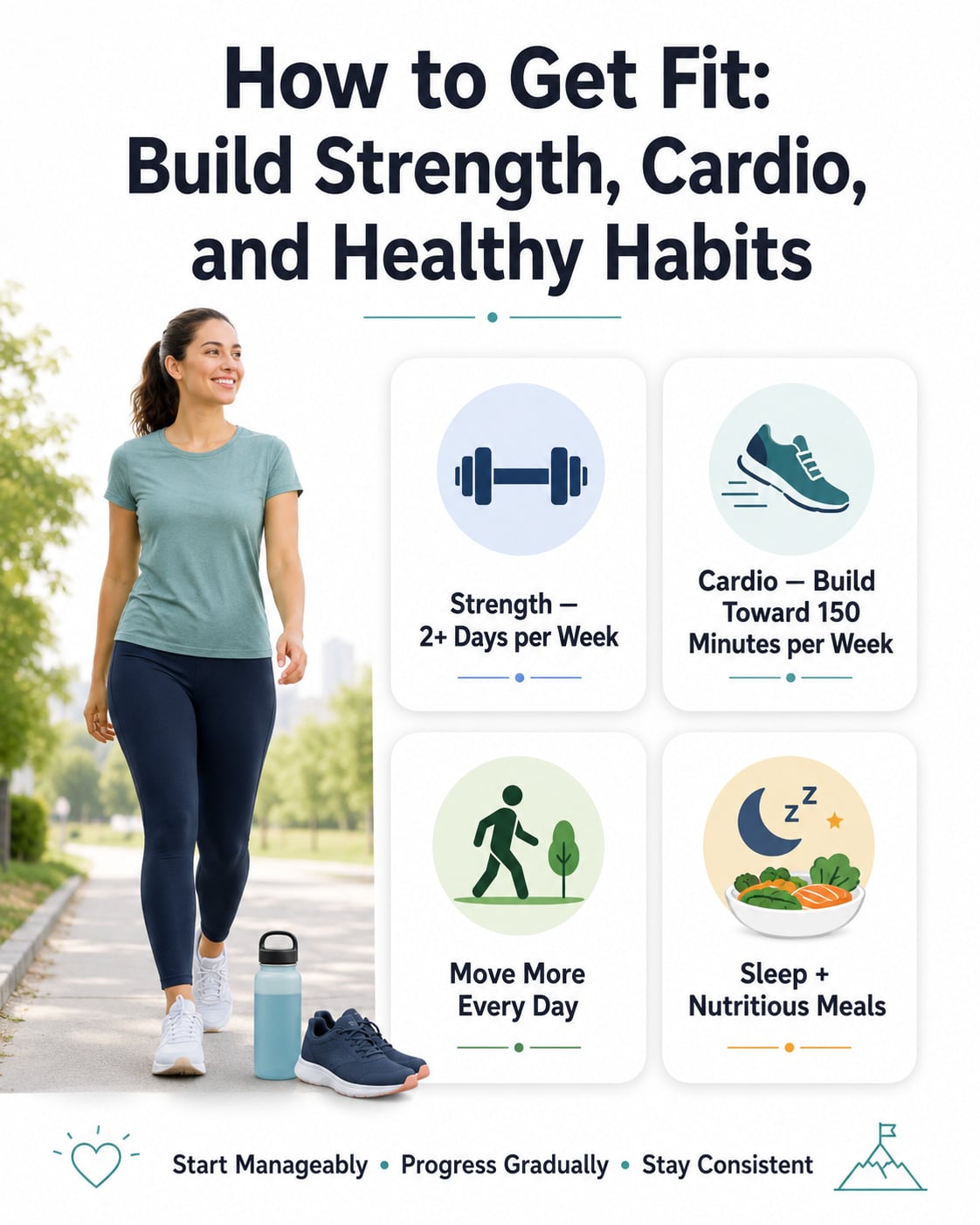
Getting fit does not require punishing daily workouts, expensive equipment, or a perfect diet. The most reliable way to get fit is to combine two weekly full-body strength workouts with regular cardio, more everyday movement, nutritious meals, and adequate sleep—then gradually make the routine more challenging.
Most beginners can start with short, manageable workouts at home or in a gym. The goal is not to do as much as possible during your first week. It is to build a routine you can repeat long enough for your strength, endurance, and movement capacity to improve.
The Centers for Disease Control and Prevention recommends that adults work toward at least 150 minutes of moderate-intensity aerobic activity per week, or 75 minutes of vigorous activity, plus muscle-strengthening activity on at least two days. You do not need to reach the full target immediately. Smaller amounts of activity still count, especially when you are starting from an inactive baseline.
What Does It Mean to Get Fit?
Fitness is not defined only by body weight, visible muscle, or how hard you can exercise.
A balanced level of fitness includes several abilities:
- Cardiovascular endurance: Your heart and lungs can support sustained activity.
- Muscular strength: Your muscles can produce enough force for exercise and daily tasks.
- Muscular endurance: You can repeat movements without tiring too quickly.
- Mobility: Your joints can move through comfortable, useful ranges of motion.
- Balance and coordination: You can control your body during movement.
- Recovery capacity: You can exercise regularly without persistent exhaustion or pain.
Someone may improve fitness without losing weight. For example, you may walk farther, lift more, climb stairs with less effort, or recover faster even when the number on the scale does not change.
A successful fitness plan should therefore improve how your body performs—not simply how it looks.
How to Get Fit: Start With a Realistic Baseline
Before choosing a workout plan, consider what you can currently do comfortably.
You do not need a difficult fitness test. A few practical questions are enough:
- Can you walk continuously for 10 minutes?
- Can you stand up from a chair without using your hands?
- Can you perform a wall push-up with control?
- Do stairs leave you mildly winded or completely exhausted?
- Do you have joint pain, balance concerns, or an old injury?
- How many days can you realistically exercise?
- Do you prefer home workouts, a gym, outdoor activity, or classes?
Your answers help determine an appropriate starting point.
For example, someone who already walks for 30 minutes several days per week can begin with longer cardio sessions than someone who currently becomes tired after five minutes. Both people can improve, but they should not start with the same workload.
Choose a Minimum Routine You Can Maintain
Create a “minimum week” that you can complete even when work, family responsibilities, or low motivation make exercise difficult.
A practical minimum might be:
- Two 20-minute strength workouts
- Three 10-minute walks
- One longer recreational activity on the weekend
You can do more when time and energy allow. However, maintaining a realistic minimum prevents one disrupted week from turning into a month without exercise.
Work Toward the Weekly Exercise Guidelines
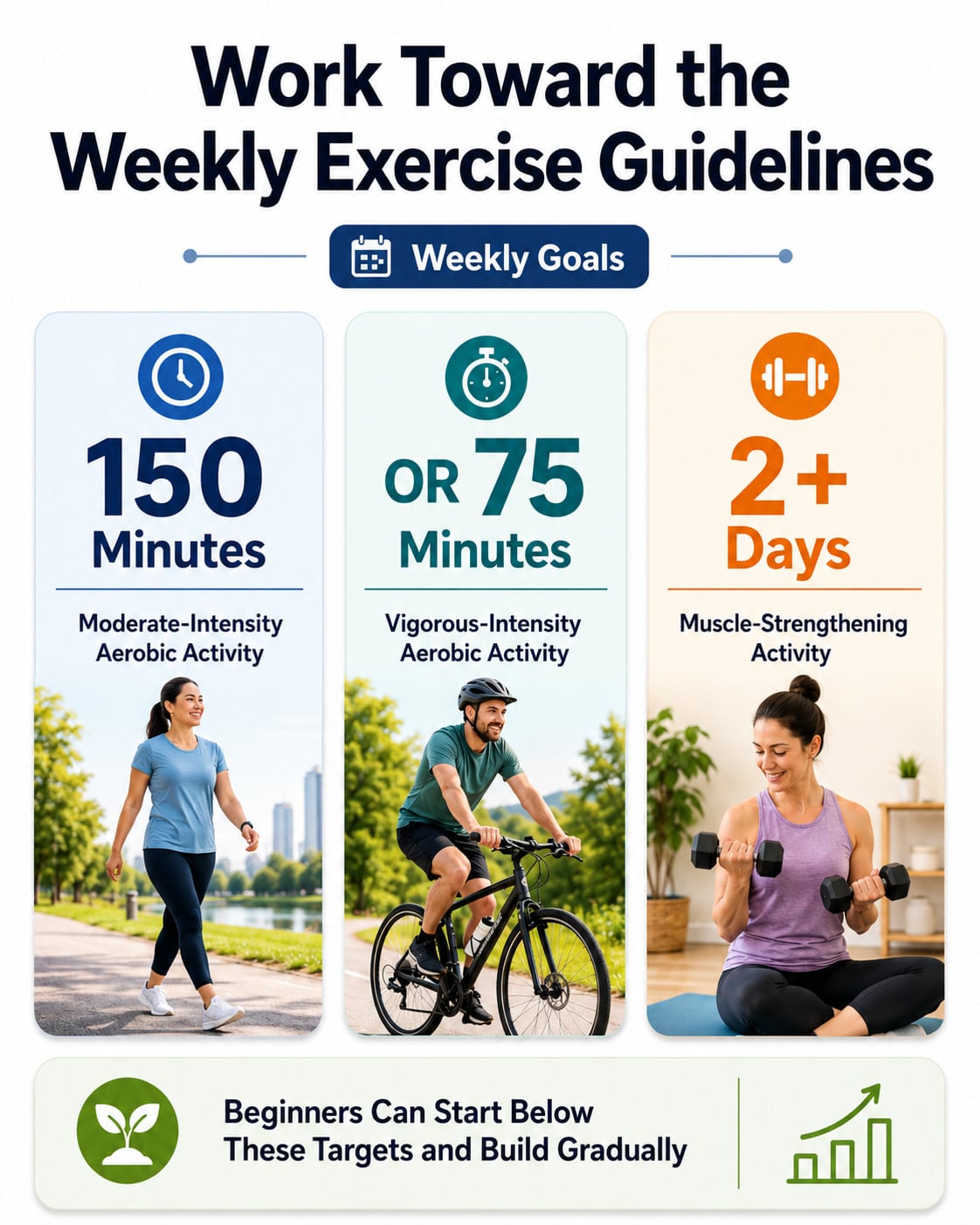
The standard adult activity target is:
| Type of activity | Weekly target |
|---|---|
| Moderate-intensity aerobic activity | At least 150 minutes |
| Vigorous-intensity aerobic activity | At least 75 minutes |
| Combination of moderate and vigorous activity | An equivalent mixture |
| Muscle-strengthening activity | At least 2 days |
| Balance activity for adults 65 and older | Regularly during the week |
These are goals to work toward, not requirements you must meet during your first week.
A beginner could start with 30 to 60 total cardio minutes per week and build from there. Someone who is already moderately active may be able to begin closer to the full recommendation.
How to Recognize Moderate-Intensity Cardio
Use the talk test instead of relying only on a fitness tracker.
During moderate-intensity activity:
- Your breathing becomes faster.
- Your heart rate increases.
- You can talk in complete sentences.
- You would have difficulty singing.
On a 0-to-10 effort scale, moderate activity generally feels like a 5 or 6. Vigorous activity usually begins around a 7 or 8, when speaking more than a few words becomes difficult.
Most beginners should spend the majority of their cardio time at a moderate or easier intensity. Hard intervals can be added later when the body has adapted to regular movement.
Build Strength at Least Twice a Week
Strength training supports muscles, bones, joints, posture, physical function, and the ability to perform everyday tasks.
The 2026 resistance-training guidance from the American College of Sports Medicine emphasizes that consistency is more important for most adults than complicated programming. Bodyweight exercises, resistance bands, machines, dumbbells, and home-based workouts can all be effective. Training every set to complete muscular failure is also unnecessary for the average healthy adult.
Beginner Full-Body Strength Workout
Perform the following routine twice per week on nonconsecutive days.
| Movement | Beginner exercise | Starting amount |
|---|---|---|
| Squat | Chair sit-to-stand or bodyweight squat | 8–12 reps |
| Hip extension | Glute bridge | 8–12 reps |
| Push | Wall, counter, or incline push-up | 6–12 reps |
| Pull | Resistance-band row or seated cable row | 8–12 reps |
| Single-leg movement | Supported split squat or low step-up | 6–10 reps per side |
| Core stability | Bird dog or dead bug | 6–10 reps per side |
| Carry or grip | Light farmer carry | 20–30 seconds |
Start with one set of each exercise. After one or two weeks, progress to two sets if you are recovering comfortably. Two or three sets can be used as your strength and work capacity improve.
Rest for approximately 60 to 120 seconds between sets. Take more time when needed to maintain good technique.
How Hard Should Strength Training Feel?
Use a resistance that makes the final few repetitions challenging without forcing you to sacrifice posture or control.
At the end of most sets, you should feel that you could probably perform another two or three good repetitions. This provides useful effort without requiring complete muscular failure.
Stop the set when:
- Your movement becomes rushed or uncontrolled.
- You cannot maintain a comfortable range of motion.
- You begin using momentum to move the resistance.
- You experience sharp, increasing, or unusual pain.
Temporary muscle fatigue is expected. Joint pain, numbness, chest discomfort, or worsening symptoms should not be ignored.
How to Progress Your Strength Workouts
Progress one part of the exercise at a time.
You might:
- Add one or two repetitions.
- Add a second set.
- Use a slightly stronger resistance band.
- Increase the dumbbell weight by a small amount.
- Slow the lowering portion of the movement.
- Change to a more challenging variation.
For example, begin with eight chair squats. Build toward 12 controlled repetitions. Then add a second set or progress to a bodyweight squat using a higher range of motion.
You do not need to change every exercise each week. Repeating the same basic movements makes it easier to improve technique and measure progress.
Improve Your Cardio Gradually
Cardio includes any rhythmic activity that raises your breathing and heart rate for a sustained period.
Effective options include:
- Brisk walking
- Cycling
- Swimming
- Water exercise
- Dancing
- Hiking
- Rowing
- Elliptical training
- Low-impact aerobics
- Jogging or running
- Active sports
Choose an activity that fits your joints, current fitness, environment, and personal preferences. Walking is often the simplest starting choice, but it is not the only option.
Beginner Cardio Starting Point
A beginner could start with:
- 10 to 20 minutes per session
- Three sessions per week
- An easy-to-moderate pace
- At least one recovery day between harder sessions
When this feels manageable, add about five minutes to one or two sessions. Continue building until you approach 150 total moderate-intensity minutes per week.
You may also divide the activity into shorter blocks. Three 10-minute walks spread through the day can be more practical than one uninterrupted 30-minute session.
Try Walk Intervals When Continuous Cardio Feels Difficult
Use this simple session:
- Walk easily for three minutes.
- Walk briskly for one minute.
- Return to an easy pace for two minutes.
- Repeat the brisk and easy intervals four to six times.
- Finish with three minutes of easy walking.
Keep the brisk intervals controlled. You should be working harder, but you should not feel as though you are sprinting.
As your endurance improves, lengthen the brisk intervals or shorten the easy portions. Do not change both at the same time.
Move More Outside Your Workouts
Formal workouts are only one part of an active lifestyle.
Daily movement can increase your total activity without making every day feel like a training day. It may also be easier to maintain than relying entirely on long gym sessions.
Practical ways to move more include:
- Walk for five to ten minutes after a meal.
- Take movement breaks during long periods of sitting.
- Walk during phone calls.
- Use stairs when they are appropriate for you.
- Park slightly farther from an entrance.
- Perform household or yard work.
- Play actively with children or pets.
- Walk or cycle for short errands when safe.
- Choose an active weekend activity.
You do not need to reach a universal daily step number before movement becomes useful. Focus first on doing more than your current baseline and gradually reducing long periods of uninterrupted sitting.
Four-Week Beginner Plan for Getting Fit
The following plan combines strength, cardio, and daily movement. Repeat any week if you need more time before progressing.
| Week | Strength | Cardio | Daily movement |
|---|---|---|---|
| Week 1 | 2 full-body sessions, 1 set per exercise | 3 sessions of 10–15 minutes | Stand or move for a few minutes during long sitting periods |
| Week 2 | 2 sessions, 1–2 sets per exercise | 3 sessions of 15–20 minutes | Add a 5–10-minute walk after a meal on 3 days |
| Week 3 | 2 sessions, mostly 2 sets | 3 sessions of 20–25 minutes | Continue short walks and movement breaks |
| Week 4 | 2 sessions, 2 sets per exercise | 3–4 sessions of 25–30 minutes | Choose one active recreational activity |
This plan may bring you close to 120–150 weekly cardio minutes by Week 4, depending on the number and length of your sessions. There is no need to force the full amount if your body is not ready.
Example Weekly Fitness Schedule
| Day | Activity |
|---|---|
| Monday | Full-body strength workout |
| Tuesday | Moderate cardio |
| Wednesday | Easy walk or recovery movement |
| Thursday | Full-body strength workout |
| Friday | Moderate cardio |
| Saturday | Longer walk, bike ride, swim, or recreational activity |
| Sunday | Rest or gentle movement |
The schedule is flexible. You may move sessions to fit your responsibilities, but avoid placing two demanding strength workouts for the same muscles on consecutive days.
Eat to Support Strength, Energy, and Recovery
Exercise works better when your regular meals provide enough energy and nutrients.
The current Dietary Guidelines for Americans, 2025–2030 prioritizes whole, nutrient-dense foods such as protein foods, vegetables, fruits, healthy fats, whole grains, and dairy or appropriate alternatives. It also recommends limiting highly processed foods that contain large amounts of refined carbohydrates, added sugars, sodium, and less-healthful fats.
Build Simple, Balanced Meals
Most meals can include:
- A protein source: Eggs, fish, poultry, lean meat, yogurt, cottage cheese, beans, lentils, tofu, or tempeh
- Vegetables or fruit: Fresh, frozen, canned, or cooked options can all be useful
- A carbohydrate source: Potatoes, oats, rice, whole-grain bread, pasta, beans, or fruit
- A source of fat: Nuts, seeds, avocado, olive oil, dairy, or fatty fish
- Fluids: Water or another suitable unsweetened beverage
You do not need a specialized “fitness diet.” Start by improving the quality and consistency of your regular meals.
Eat Enough Protein Regularly
Protein supplies amino acids used in muscle maintenance and adaptation.
Instead of trying to consume most of your protein at dinner, include a protein-rich food in several meals throughout the day. The appropriate amount depends on body size, age, total calorie intake, training demands, health conditions, and food preferences.
People with kidney disease, certain metabolic conditions, or medically prescribed diets should discuss major protein changes with a healthcare professional or registered dietitian.
Hydrate According to Your Needs
Fluid requirements vary with body size, climate, medication use, exercise intensity, and sweat rate.
Drink regularly throughout the day and bring water to longer or warmer workouts. Dark urine, persistent thirst, headache, and declining exercise performance may occur when fluid intake is inadequate, although these signs can have other causes.
Sports drinks are usually unnecessary for ordinary short or moderate workouts. They may be useful during prolonged exercise, heavy sweating, or specific athletic situations.
Fitness Does Not Require Weight Loss
You can become stronger and improve cardiovascular fitness without losing weight.
When fat loss is also a goal, nutrition and physical activity need to create a sustainable energy deficit over time. Avoid extreme restriction, skipping meals to compensate for exercise, or using workouts as punishment for eating.
A registered dietitian can provide individualized guidance when weight management is complicated by diabetes, digestive conditions, pregnancy, medication use, disordered eating, or other medical concerns.
Make Sleep and Recovery Part of the Plan
Exercise creates a training stimulus. Recovery allows your body to adapt to that stimulus.
According to the CDC’s adult sleep guidance, adults ages 18–60 generally need at least seven hours of sleep per night. Adults ages 61–64 are advised to get seven to nine hours, while adults 65 and older are advised to get seven to eight hours. Individual needs and sleep quality can vary.
Support recovery by:
- Keeping a reasonably consistent sleep schedule
- Allowing recovery between demanding workouts
- Eating regular, balanced meals
- Staying hydrated
- Using easier training days
- Avoiding repeated all-out exercise
- Reducing training when you are sick or unusually fatigued
Rest Days Do Not Have to Mean No Movement
A recovery day can include:
- An easy walk
- Gentle cycling
- Comfortable stretching
- Mobility work
- Light household activity
- Relaxed recreational movement
The activity should leave you feeling the same or better afterward—not more exhausted.
Soreness Is Not Required for Progress
Mild muscle soreness can occur after a new workout, but it is not proof that the session was effective.
Do not deliberately chase soreness. A productive workout can improve strength and fitness without causing significant discomfort the next day.
Reduce the workout or seek appropriate guidance when soreness is severe, affects normal movement, continues to worsen, or is accompanied by swelling, weakness, or dark urine.
How to Progress Without Overdoing It
Progress comes from gradually asking your body to do slightly more.
The safest approach is to adjust one variable at a time.
For Strength Training
Increase one of the following:
- Repetitions
- Sets
- Resistance
- Range of motion
- Exercise difficulty
- Movement control
For Cardio
Increase one of the following:
- Session duration
- Weekly frequency
- Pace
- Incline
- Interval length
Do not increase duration, intensity, frequency, and resistance simultaneously.
After increasing your training, maintain the new level long enough to determine how well you recover. Reduce the workload if your performance, sleep, mood, or joint comfort consistently worsens.
How to Track Your Fitness Progress
Use measurements that reflect what you want your body to do.
Helpful progress markers include:
- Number of workouts completed
- Walking time or distance
- Cardio pace at the same perceived effort
- Number of controlled repetitions
- Resistance used for an exercise
- Ability to use a harder exercise variation
- Recovery time after climbing stairs
- Balance and movement control
- Energy during daily activities
- Sleep quality and consistency
You may also track body weight or measurements when they are relevant to your goal. However, normal fluid shifts can make daily scale changes misleading.
Review your progress every four weeks rather than judging the plan after every workout.
Repeat the Same Simple Check
Choose two or three safe checks, such as:
- Distance walked in 10 minutes
- Number of controlled chair stands
- Number of incline push-ups
- Length of a comfortable plank variation
- Resistance used for a row or squat
Repeat them under similar conditions every four to six weeks. Avoid testing a maximum lift or exercising to complete exhaustion when you are inexperienced.
Common Mistakes That Slow Fitness Progress
Doing Too Much Too Soon
Starting with daily high-intensity workouts often produces excessive fatigue, soreness, or pain. Begin below your maximum capacity and leave room to progress.
Relying Only on Cardio
Walking, cycling, or running can improve cardiovascular fitness, but they do not replace a complete strength program. Train the major muscle groups at least twice per week.
Changing Workouts Constantly
Frequent variety may feel interesting, but changing every movement makes progress difficult to measure. Keep the main exercises consistent for several weeks.
Treating Every Workout Like a Test
Most sessions should build your fitness, not prove it. You do not need a personal record, maximum heart rate, or all-out effort every time you exercise.
Measuring Success by Sweat or Soreness
Sweat is strongly affected by temperature, clothing, genetics, and hydration. Soreness reflects novelty and tissue stress more than workout quality.
Ignoring Sleep and Food
Training harder cannot fully compensate for chronically inadequate sleep or an eating pattern that does not support your activity.
Using an All-or-Nothing Mindset
A 15-minute workout is still useful. One missed session does not ruin your progress. Resume the plan at the next practical opportunity instead of waiting for a new week or month.
When to Talk to a Healthcare Professional
Moderate activity is generally appropriate for most adults, but individual guidance may be important when you have:
- Heart, lung, kidney, or metabolic disease
- Diabetes with complications
- Uncontrolled high blood pressure
- Significant arthritis or joint pain
- Balance problems or repeated falls
- A recent surgery or serious injury
- Unexplained shortness of breath
- A history of fainting during activity
- Pregnancy-related exercise concerns
- Medications that affect heart rate, blood pressure, or balance
You may still be able to exercise. The purpose of professional guidance is to identify suitable activities, modifications, and intensity levels.
Stop exercising and seek urgent medical attention for chest pressure or pain, fainting, severe or unusual shortness of breath, confusion, or symptoms that may indicate a medical emergency. The American Heart Association lists chest discomfort, upper-body discomfort, and shortness of breath among possible heart attack warning signs. Call 911 or your local emergency number when serious symptoms occur.
Frequently Asked Questions
How can a complete beginner start getting fit?
Begin with two short full-body strength sessions and three 10-to-20-minute cardio sessions per week. Walk more during the day, eat regular balanced meals, and maintain a consistent sleep schedule. Increase one part of the routine only after your current level feels manageable.
How many days per week should I work out to get fit?
Many beginners can start with four or five active days that include two strength sessions and two or three cardio sessions. These workouts do not all need to be long or difficult. Easy walking and mobility work can be performed on recovery days.
Can I get fit by walking?
Walking can improve cardiovascular endurance, support daily activity, and help you build an exercise habit. Brisk walking can also contribute to the weekly moderate-intensity activity target.
However, walking alone does not provide a complete strength program. Add at least two weekly sessions that challenge the major muscle groups.
Can I get fit at home without equipment?
Yes. Squats, chair stands, glute bridges, incline push-ups, lunges, bird dogs, and other bodyweight exercises can build strength. Resistance bands and adjustable dumbbells can provide additional progression, but they are not required to begin.
For cardio, you can walk outdoors, march indoors, climb stairs when appropriate, dance, or follow a low-impact routine.
How long does it take to get fit?
There is no universal timeline. Progress depends on your starting point, workout consistency, training dose, nutrition, sleep, age, health, and the type of fitness you want to improve.
Some people notice that daily activity feels easier within the first several weeks. Larger improvements in strength, endurance, or body composition generally require consistent training over a longer period. Focus on measurable monthly progress rather than expecting a complete transformation by a fixed date.
Should I do cardio or strength training first?
When cardio and strength are performed in separate sessions, the order does not matter.
When you combine them in one workout:
- Perform strength first when increasing strength is the main goal.
- Perform cardio first when endurance performance is the main goal.
- For general fitness, start with the activity you are most likely to complete with good effort and technique.
A short easy warm-up before strength training is still appropriate.
Do I need to lose weight to be considered fit?
No. Fitness includes strength, endurance, mobility, balance, and physical function. These can improve without weight loss.
Body composition may be one personal goal, but it should not be the only way you measure health or fitness progress.
Conclusion
Getting fit is not about finding the hardest workout. It is about building a balanced routine that you can continue.
Start with two full-body strength sessions, several short cardio workouts, and more daily movement. Eat regular nutrient-dense meals, protect your sleep, and progress one variable at a time. Track what your body can do, not only how it looks.
Choose your two strength days and your first three cardio sessions now. A simple plan placed on your calendar is more useful than an ambitious routine you never begin.
This content is for informational purposes only and not medical advice.
References
- CDC: Physical Activity Guidelines for Adults
- American College of Sports Medicine: 2026 Resistance Training Guidelines
- Office of Disease Prevention and Health Promotion: Dietary Guidelines for Americans, 2025–2030
- CDC: Recommended Sleep by Age
- American Heart Association: Heart Attack and Stroke Warning Signs