
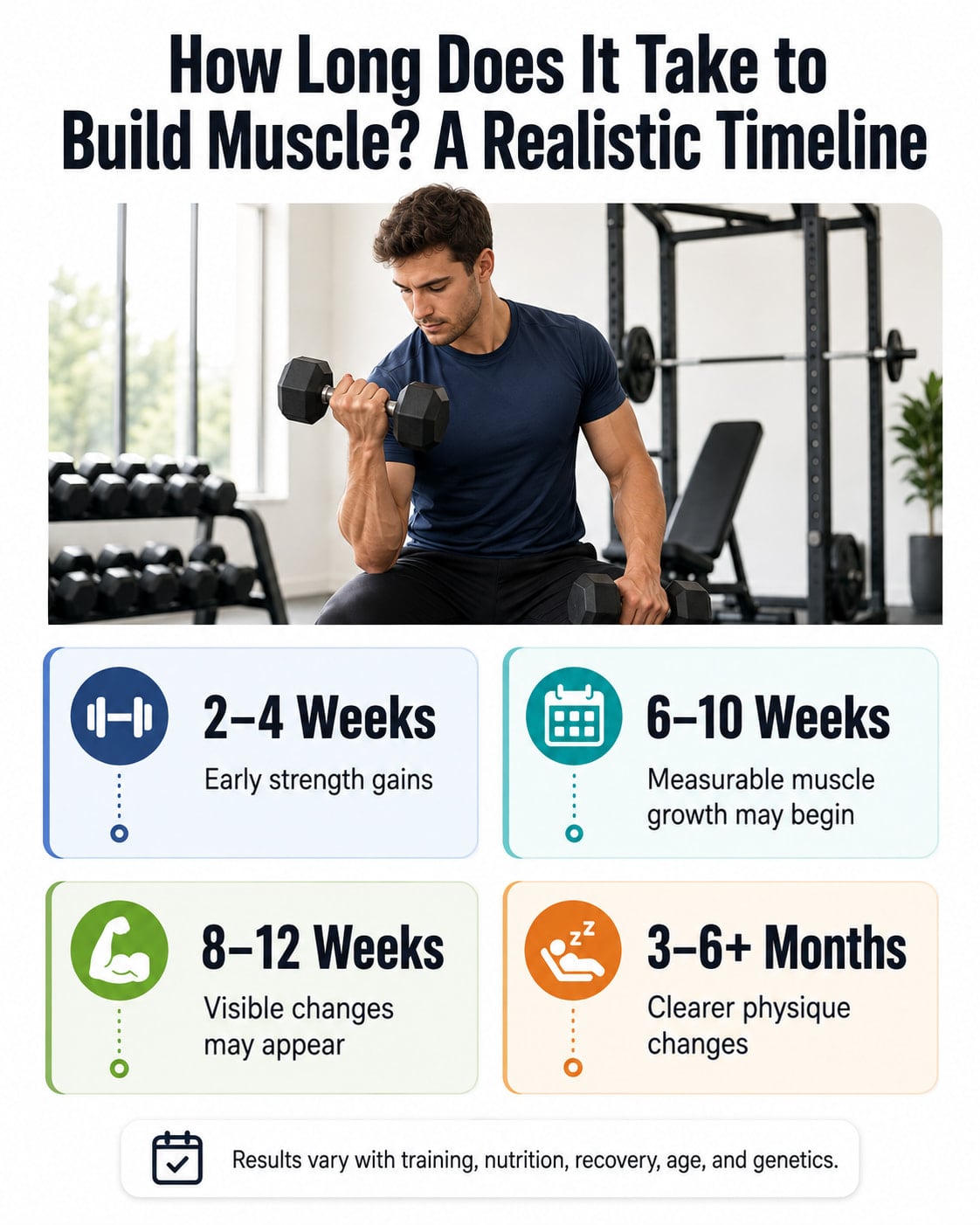
A realistic muscle-building timeline is 2–4 weeks for early strength gains, approximately 6–10 weeks for measurable muscle growth, 8–12 weeks for possible visible changes, and 3–6 months for clearer results. Building a substantially more muscular physique usually takes 6–12 months or longer.
However, there is no guaranteed deadline. How long it takes to build muscle depends on your training experience, workout quality, protein and calorie intake, sleep, age, genetics, and consistency.
The encouraging part is that you do not need a perfect routine. You need regular resistance training, gradual progression, enough protein and food, and sufficient recovery. The latest 2026 ACSM resistance-training guidelines emphasize that consistency matters more than using complicated programs or advanced training techniques.
How Long Does It Take to Build Muscle?
Most people experience muscle-building progress in stages. Strength often improves before a noticeable increase in muscle size occurs.
| Time After Starting | What You May Notice |
|---|---|
| First 1–2 weeks | Better exercise coordination, a temporary muscle pump, soreness, and improved confidence with the movements |
| Weeks 2–4 | Early strength improvements, better technique, and the ability to complete more repetitions |
| Weeks 6–10 | Measurable muscle growth may begin appearing when training, nutrition, and recovery are adequate |
| Weeks 8–12 | Some beginners may notice changes in photos, measurements, muscle definition, or clothing fit |
| Months 3–6 | Clearer changes in muscle size, body shape, and strength usually become easier to recognize |
| Months 6–12 | Consistent trainees may build a visibly more muscular physique |
| After 1 year | Muscle growth can continue, but progress usually becomes slower and requires more precise programming |
These ranges are estimates rather than promises. Small studies have detected changes in muscle size within a few weeks, but very early increases may partly reflect swelling rather than permanent muscle growth. A review of the development of muscle hypertrophy concluded that early size changes are often influenced by muscle damage and swelling, while more reliable hypertrophy develops after repeated training sessions.
What Happens During the First Month of Training?
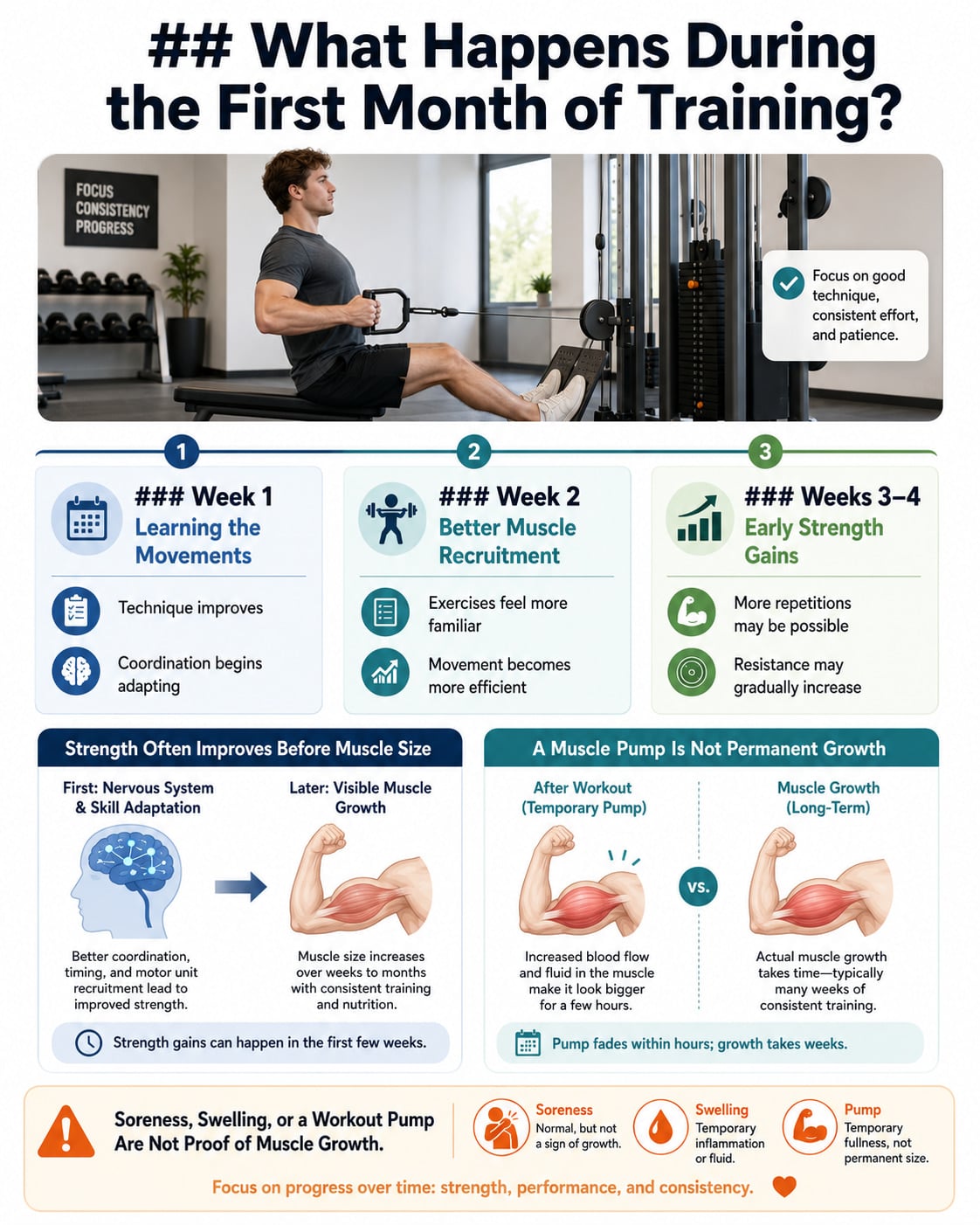
Your body begins adapting as soon as you start resistance training, but the first changes are not always visible.
Strength Often Improves Before Muscle Size
During the first few weeks, your nervous system becomes better at coordinating movement and recruiting muscle fibers. You may lift more weight or complete more repetitions even though your muscles do not look noticeably larger.
Your technique may also improve. A beginner who learns to squat, press, pull, and hinge more efficiently can demonstrate rapid strength gains without having added a large amount of new muscle tissue.
This is normal progress. Getting stronger is often one of the earliest signs that your training program is working.
A Muscle Pump Is Not Permanent Growth
Muscles often look larger immediately after exercise because more blood and fluid enter the working tissue. Carbohydrates stored in muscle as glycogen also hold water.
This temporary fullness is commonly called a muscle pump. It may last for a few hours, but it is not the same as permanent hypertrophy.
Similarly, soreness does not prove that a muscle is growing. You can build muscle without severe soreness, and excessive soreness may make it harder to train consistently.
When Does Muscle Growth Become Noticeable?
Measurable growth and visible growth are not the same.
Researchers can use ultrasound, MRI, muscle biopsies, or other methods to detect relatively small changes. Those changes may not yet be obvious in a mirror or photograph.
For many beginners, visible changes may begin around 8–12 weeks. Other people may require several additional months.
How quickly muscle becomes visible depends on:
- Your starting muscle mass
- Your body-fat level
- The size of the muscle group being trained
- Your training history
- Genetics and body structure
- Lighting, posture, and clothing
- How consistently you train and recover
Shoulders and arms may appear different sooner because they are easy to see and measure. Changes in the back, glutes, or thighs may take longer to recognize, even when those muscles are growing.
You may also overlook gradual progress because you see your body every day. Monthly photographs and measurements usually provide a clearer comparison than checking the mirror after every workout.
How Much Muscle Can You Gain in a Month?
There is no scientifically established monthly muscle-gain rate that applies to everyone.
Popular estimates such as gaining one or two pounds of muscle per month are rough coaching guidelines, not guarantees. They may also confuse changes in lean body mass with actual new muscle tissue.
Lean body mass includes:
- Skeletal muscle
- Body water
- Stored glycogen
- Organs
- Bone
- Other nonfat tissue
For this reason, an increase in lean mass on a body-composition test does not mean every pound gained is newly built muscle.
Expected Progress by Training Experience
| Training Level | General Muscle-Gain Pattern |
|---|---|
| Beginner | Usually has the greatest potential for relatively fast strength and muscle gains |
| Intermediate | Can continue building muscle, but progress normally requires more structured training |
| Advanced | Gains are usually smaller and slower because the trainee is closer to their current potential |
| Returning trainee | May regain previously developed muscle faster than someone building it for the first time |
Rather than setting an exact monthly muscle target, evaluate your progress over at least 8–12 weeks. Look for improving gym performance, gradually changing measurements, and consistent progress photos.
Factors That Affect How Long It Takes to Build Muscle
Two people can follow similar programs and progress at different rates. The following factors have the greatest influence on your personal timeline.
1. Your Training Experience
Beginners typically respond quickly because resistance training is a new stimulus. Someone who has trained seriously for several years usually gains muscle more slowly.
Returning to exercise after a long break can also produce relatively fast progress. Previously trained muscles may regain lost size and strength more quickly than they were originally developed.
2. Weekly Training Volume
Training volume refers to the amount of work you perform, often measured as challenging sets per muscle group each week.
The American College of Sports Medicine’s March 2026 guidance suggests that approximately 10 weekly sets per muscle group can be an effective target for hypertrophy. It also recommends training all major muscle groups at least twice per week. These recommendations came from an overview of 137 systematic reviews representing more than 30,000 participants.
A 2026 meta-regression found that muscle and strength gains generally increased as weekly training volume increased. However, the benefits showed diminishing returns, meaning every additional set produced progressively smaller potential improvements. Training frequency appeared less important for hypertrophy than the total amount of productive weekly work.
A beginner does not need to start with a high-volume bodybuilding routine. Approximately 6–10 challenging weekly sets per muscle group can be a manageable starting range. Volume can be increased gradually when progress stalls and recovery remains good.
3. How Hard You Train
Muscle-building sets should be challenging enough to create a reason for your body to adapt.
You do not need to reach complete muscular failure on every set. For most exercises, stopping when you believe you could complete approximately one to three more good repetitions can provide a productive stimulus without creating unnecessary fatigue.
Research indicates that hypertrophy tends to improve as sets are performed closer to failure, but the exact ideal distance from failure is uncertain. The ACSM review also found that reaching complete failure did not consistently improve outcomes for the average healthy adult.
4. Progressive Overload
Repeating exactly the same workout with the same resistance and repetitions may eventually stop providing enough stimulus.
Progressive overload means gradually increasing the challenge. You can progress by:
- Adding one or more repetitions
- Increasing the resistance slightly
- Performing an additional set
- Improving your range of motion
- Using better control and technique
- Completing the same workout with less unnecessary fatigue
Progress should be gradual. Increasing weight too quickly can reduce exercise quality and increase the likelihood of pain or injury.
5. Exercise Selection and Technique
Machines, free weights, resistance bands, cables, and bodyweight exercises can all support muscle growth. The best option is one that safely challenges the target muscle and allows you to progress.
The 2026 ACSM review found that equipment type did not consistently determine results for healthy adults. You do not need a barbell-only program or an expensive gym membership to build muscle.
Use a comfortable range of motion, control the resistance, and avoid sacrificing technique simply to lift more weight.
6. Protein Intake
Protein supplies amino acids that your body uses to repair and build muscle tissue.
A systematic review and meta-analysis found that increasing protein intake produced small additional improvements in lean body mass among healthy adults performing resistance training. Significant benefits were observed among adults younger than 65 consuming at least approximately 1.6 grams of protein per kilogram of body weight per day.
For many healthy adults focused on maximizing muscle growth, about 1.6 g/kg per day is a practical target.
| Body Weight | Approximate Protein at 1.6 g/kg |
|---|---|
| 130 pounds or 59 kg | 94 grams per day |
| 150 pounds or 68 kg | 109 grams per day |
| 175 pounds or 79 kg | 126 grams per day |
| 200 pounds or 91 kg | 146 grams per day |
Good protein sources include:
- Poultry and lean meat
- Fish and seafood
- Eggs
- Milk, Greek yogurt, and cottage cheese
- Tofu, tempeh, and other soy foods
- Beans, peas, and lentils
- Protein powder when convenient
Spread protein-containing foods across the day rather than depending on one unusually large meal.
People with kidney disease, liver disease, medically prescribed diets, or other health conditions should discuss major protein-intake changes with a qualified healthcare professional.
7. Calorie Intake
Your body also needs enough total energy to support training and recovery.
Beginners, returning trainees, and some people with higher body-fat levels may build muscle while eating around maintenance or losing fat. However, building muscle generally becomes harder during a prolonged or aggressive calorie deficit.
A meta-analysis found that energy deficits reduced resistance-training gains in lean mass, even though strength could still improve. This does not mean you must aggressively “bulk.” It means consistently under-eating may extend your muscle-building timeline.
When muscle gain is your main goal:
- Eat enough to support stable training performance
- Avoid an unnecessarily large calorie deficit
- Use a modest surplus rather than uncontrolled overeating if additional calories are needed
- Monitor your waist, body weight, and gym performance
- Adjust intake gradually instead of making extreme changes
A large calorie surplus does not guarantee proportionally faster muscle growth. It can simply produce faster fat gain.
8. Sleep and Recovery
Muscle-building workouts provide the stimulus, but adaptation occurs while you recover.
The joint sleep recommendation from the American Academy of Sleep Medicine and Sleep Research Society advises healthy adults to sleep at least seven hours regularly. Some people need more, especially during demanding training periods.
Signs that recovery may be inadequate include:
- Declining performance across several workouts
- Persistent soreness
- Unusual fatigue
- Poor sleep
- Reduced motivation
- Irritability
- Joint discomfort
- Difficulty completing normal training loads
Rest days are part of a productive program, not lost opportunities.
9. Age
Muscle growth can occur throughout adulthood. Older adults may need more time to recover and may have a slower response, but age does not make hypertrophy impossible.
In one small 10-week study of healthy older adults, significant increases in quadriceps muscle cross-sectional area became detectable after nine weeks of training. The participants also improved leg-press strength. Because the study was small, its exact results should not be treated as a guarantee for every older adult.
10. Genetics and Starting Body Composition
Genetics influence muscle-fiber characteristics, limb lengths, muscle shape, recovery, appetite, and responsiveness to training.
Starting body composition also affects how quickly growth becomes visible. Someone with less body fat may notice muscle definition sooner, while a person with more body fat can still build muscle without seeing immediate definition.
Genetics affect the rate of progress, but they do not remove the value of consistent training.
How to Build Muscle as Efficiently as Possible
You cannot force unlimited muscle growth, but you can avoid many of the mistakes that delay progress.
Follow a Consistent Training Schedule
For most beginners, resistance training two to four days per week is enough.
A simple approach is to train the entire body two or three times weekly. Another option is an upper- and lower-body split performed four days per week.
The exact schedule matters less than training each major muscle group regularly and allowing enough recovery between hard sessions.
Use a Practical Starting Framework
| Training Variable | Beginner Starting Point |
|---|---|
| Weekly frequency | 2–4 resistance-training sessions |
| Muscle frequency | Each major muscle group at least twice weekly |
| Weekly volume | Approximately 6–10 challenging sets per muscle group |
| Repetitions | Often 6–15 per set for convenience, although other ranges can work |
| Effort | Finish most sets with about 1–3 good repetitions remaining |
| Progression | Add repetitions first, then increase resistance gradually |
| Recovery | Allow at least one easier or rest day when needed |
Muscle can grow across a wide range of resistance levels when sets are sufficiently challenging. Heavier weights are generally more specific to developing maximal strength, while moderate loads are often easier for beginners to control.
Prioritize Basic Movement Patterns
A balanced program can include:
- A squat or leg-press movement
- A hip-hinge movement
- A horizontal push
- A horizontal pull
- A vertical push
- A vertical pull
- Optional arm, shoulder, calf, and core exercises
You do not need dozens of exercises. Select movements you can perform comfortably, practice them consistently, and track your progress.
Keep a Training Log
Record:
- Exercise name
- Resistance used
- Repetitions
- Number of sets
- Any pain or technique problems
- How many repetitions you believe remained at the end of each set
A written log makes progressive overload easier and prevents you from relying on memory.
How to Tell Whether You Are Building Muscle
Do not use the scale as your only measure. Muscle can increase while fat decreases, producing little change in total body weight.
Use several tracking methods together.
Progress Photos
Take photographs every four weeks under similar conditions:
- Same lighting
- Same distance from the camera
- Same clothing
- Same posture
- Similar time of day
Daily photos are usually too frequent to show meaningful differences.
Body Measurements
Measure areas such as your:
- Upper arms
- Chest
- Waist
- Hips
- Thighs
- Calves
Use the same measuring technique each time. Changes in circumference can also reflect fat, water, or measurement error, so compare them with photos and gym performance.
Strength and Repetition Progress
Building muscle is not the only reason strength increases, but steadily performing more repetitions or using more resistance is a positive sign.
Progress may look like:
- Squatting the same weight for 10 repetitions instead of 7
- Using a heavier dumbbell with the same technique
- Performing more controlled push-ups
- Completing a full range of motion that was previously difficult
Average Body Weight
Body weight can change daily because of hydration, food, sodium, carbohydrate intake, and digestion.
Weighing under similar conditions and comparing weekly averages provides more useful information than reacting to one measurement.
Why You May Not Be Seeing Muscle Growth
| Possible Problem | Practical Solution |
|---|---|
| Inconsistent training | Follow the same basic program consistently for at least 8–12 weeks |
| No progressive overload | Record workouts and gradually add repetitions or resistance |
| Sets are too easy | Finish most working sets closer to the point where another repetition would be difficult |
| Too little weekly volume | Add a small number of sets when recovery is good |
| Excessive training volume | Reduce unnecessary sets and prioritize productive exercises |
| Constantly training to failure | Leave one to three good repetitions in reserve on most sets |
| Insufficient protein | Build meals around protein-rich foods and monitor approximate daily intake |
| Aggressive calorie restriction | Use a smaller deficit or eat around maintenance when muscle gain is the priority |
| Poor sleep | Create a consistent sleep schedule and aim for at least seven hours |
| Program hopping | Stop changing routines every week and allow time for measurable progress |
| Unrealistic expectations | Evaluate changes over months rather than days |
If you have trained consistently for several months without any improvement in repetitions, resistance, measurements, or photos, review your program and nutrition. A qualified trainer or registered dietitian may help identify problems that are difficult to notice on your own.
Stop an exercise and seek professional guidance if you experience persistent sharp pain, unexplained swelling, sudden weakness, or symptoms that worsen with training.
Frequently Asked Questions
Can You Build Noticeable Muscle in One Month?
You may become stronger and develop a small amount of measurable muscle within one month, especially as a beginner. However, a major visible transformation is unlikely.
Many first-month changes come from improved coordination, increased glycogen and water storage, and a temporary muscle pump. Give your program at least 8–12 weeks before judging its effectiveness.
Is Three Months Enough to Build Muscle?
Three months is enough time for many beginners to make noticeable progress when they train consistently, eat enough protein, and recover properly.
You may notice better muscle definition, improved measurements, heavier lifts, and changes in clothing fit. The amount of change will vary, but three months is a more realistic evaluation period than three or four weeks.
Can You Build Muscle While Losing Fat?
Yes, it is possible, particularly for beginners, returning trainees, and some people with higher body-fat levels. This is often called body recomposition.
However, it is not guaranteed, and muscle gain may be slower during a calorie deficit. Use resistance training, eat adequate protein, avoid extreme calorie restriction, and evaluate your progress over several months.
Do You Need to Train Every Day to Build Muscle?
No. Most people can build muscle with two to four well-planned resistance-training sessions per week.
Muscle groups need both repeated training and sufficient recovery. Training every day is not automatically more effective, especially when the additional workouts reduce performance or cause persistent fatigue.
Do You Need to Train to Failure?
No. Complete muscular failure is not required for muscle growth.
Your working sets should still feel challenging. Stopping with approximately one to three good repetitions remaining is a practical approach for many exercises. Training to failure can be used selectively, but doing it on every set may create unnecessary fatigue.
How Long Does It Take to Build Muscle After Age 40, 50, or 60?
Adults can build muscle at these ages, but the timeline varies. Early strength improvements may still occur within several weeks, while visible muscle growth commonly requires a few months of consistent training.
Older adults may benefit from gradual progression, adequate protein, sufficient sleep, and more attention to recovery. Anyone with a medical condition, significant joint problem, or long period of inactivity should consider getting individualized exercise guidance.
Do You Need Supplements to Build Muscle?
No. Supplements are not required.
Resistance training, adequate food, sufficient protein, and sleep are the main priorities. Protein powder can be a convenient food product when meeting protein needs through meals is difficult, but it does not build muscle without effective training.
Conclusion
So, how long does it take to build muscle? Expect early strength gains within 2–4 weeks, measurable muscle growth after approximately 6–10 weeks, and possible visible changes after 8–12 weeks. Clearer physique changes generally require 3–6 months, while substantial development usually takes 6–12 months or longer.
Do not judge your progress by one workout or one week. Follow a manageable resistance-training program, gradually increase the challenge, eat enough protein, recover properly, and compare your results every four to eight weeks. Consistent months of training—not perfect individual workouts—produce meaningful muscle growth.
References
- American College of Sports Medicine — 2026 Resistance Training Guidelines
- PubMed — ACSM Position Stand on Resistance Training Prescription
- PubMed — Development of Skeletal Muscle Hypertrophy Through Resistance Training
- PubMed — Resistance Training, Protein Synthesis, and Muscle Hypertrophy
- PubMed — Weekly Training Volume, Frequency, Strength, and Hypertrophy
- PubMed — Protein Intake to Support Muscle Mass and Function
- PubMed — Energy Deficiency and Resistance-Training Gains
- American Academy of Sleep Medicine — Recommended Sleep for Healthy Adults