
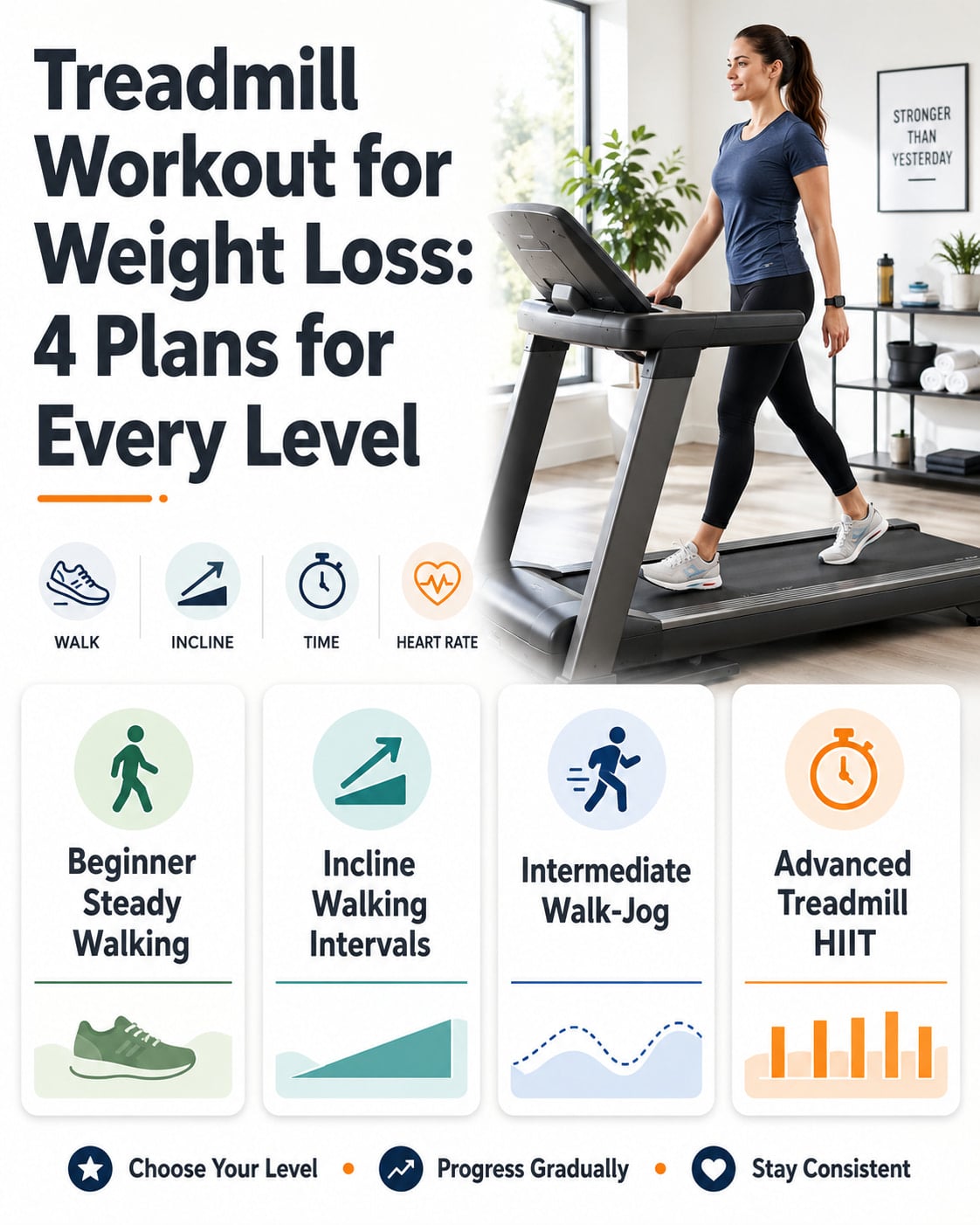
A treadmill workout can support weight loss by increasing calorie expenditure, especially when you combine it with sustainable eating habits and consistent weekly exercise. The best treadmill workout for weight loss is not necessarily the fastest or hardest one. It is the workout you can perform safely, recover from, and repeat regularly.
The four plans below cover steady walking, incline intervals, walk-jog training, and high-intensity intervals. Choose the plan that matches your current fitness—not the plan that looks hardest—and adjust the speed according to your effort level.
According to the Centers for Disease Control and Prevention, physical activity uses energy and can contribute to the calorie deficit required for weight loss. However, exercise usually works best when paired with appropriate calorie intake and other sustainable habits.
Can a Treadmill Workout Help With Weight Loss?
Treadmill walking and running can both help with weight loss. They raise your heart rate, increase energy expenditure, and make it easier to track your workout duration and intensity.
The treadmill also allows you to change the challenge without changing activities. You can increase:
- Workout duration
- Walking or running speed
- Treadmill incline
- The number of weekly sessions
- The length of your faster intervals
However, the treadmill does not automatically cause weight loss. Your results depend on your total calorie intake, current body weight, workout consistency, sleep, recovery, health, and other daily activities.
Research supports focusing on total weekly exercise rather than searching for one “fat-burning” treadmill setting. A 2024 JAMA Network Open systematic review and meta-analysis included 116 randomized clinical trials and 6,880 adults with overweight or obesity. Increasing moderate-to-vigorous aerobic exercise up to 300 minutes per week was associated with greater reductions in body weight, waist circumference, and body fat. At least 150 minutes per week was associated with clinically important changes in waist circumference and body-fat measures, although individual results varied.
The practical takeaway is simple: weekly consistency matters more than finding a perfect speed, incline, or workout trend.
How Long Should You Use a Treadmill for Weight Loss?
Current Physical Activity Guidelines for Americans recommend that adults work toward:
- 150–300 minutes of moderate-intensity aerobic activity per week
- Or 75–150 minutes of vigorous-intensity aerobic activity per week
- Or an equivalent combination of both
- Muscle-strengthening exercise on at least two days per week
These are general health targets, not a guarantee of a particular amount of weight loss. Beginners can start below these levels and gradually increase their activity.
A practical starting schedule is:
| Current level | Starting treadmill goal |
|---|---|
| New to exercise | 20–25 minutes, 3 days per week |
| Comfortable with brisk walking | 25–35 minutes, 3–4 days per week |
| Comfortable with walk-jog intervals | 30–40 minutes, 3–4 days per week |
| Experienced runner | A mix of easy, moderate, and interval sessions |
You do not have to complete all your weekly activity in long workouts. Shorter sessions still count. Two 15-minute walks may be more manageable than one 30-minute workout on a busy day.
How to Choose Your Treadmill Speed and Incline
There is no single best treadmill speed for weight loss. A speed of 3 mph may feel easy to one person and challenging to another.
Instead of relying only on the number shown on the treadmill, use your breathing and perceived effort.
Use the Talk Test
The CDC’s talk test provides a simple way to judge workout intensity:
- During moderate-intensity exercise, you can talk but would have difficulty singing.
- During vigorous-intensity exercise, you can usually say only a few words before pausing for breath.
Use a 0–10 Effort Scale
| Effort level | RPE | How it should feel |
|---|---|---|
| Very easy | 1–2 | Comfortable warm-up or recovery pace |
| Easy | 3–4 | Breathing slightly faster; full conversation is easy |
| Moderate | 5–6 | Breathing noticeably faster; you can talk but not sing |
| Hard | 7–8 | Challenging but controlled; only short phrases are comfortable |
| Maximum | 9–10 | Near-all-out effort; unnecessary for these workouts |
RPE means rating of perceived exertion. For most weight-loss treadmill sessions, the majority of your time can be spent between RPE 4 and 6. Harder intervals may briefly reach RPE 7 or 8.
Suggested Speed and Incline Ranges
These are starting ranges, not fixed prescriptions:
| Treadmill setting | Suggested starting range |
|---|---|
| Easy walking speed | 1.8–2.8 mph |
| Brisk walking speed | 2.5–3.8 mph |
| Jogging speed | Often 4–6 mph |
| Easy incline | 0–2% |
| Moderate incline | 3–6% |
| Challenging incline | Above 6% |
Your brisk walk may be slower or faster than these ranges. Reduce the speed or incline if you cannot maintain a natural stride, upright posture, and controlled breathing.
Treadmill Workout for Weight Loss: 4 Plans
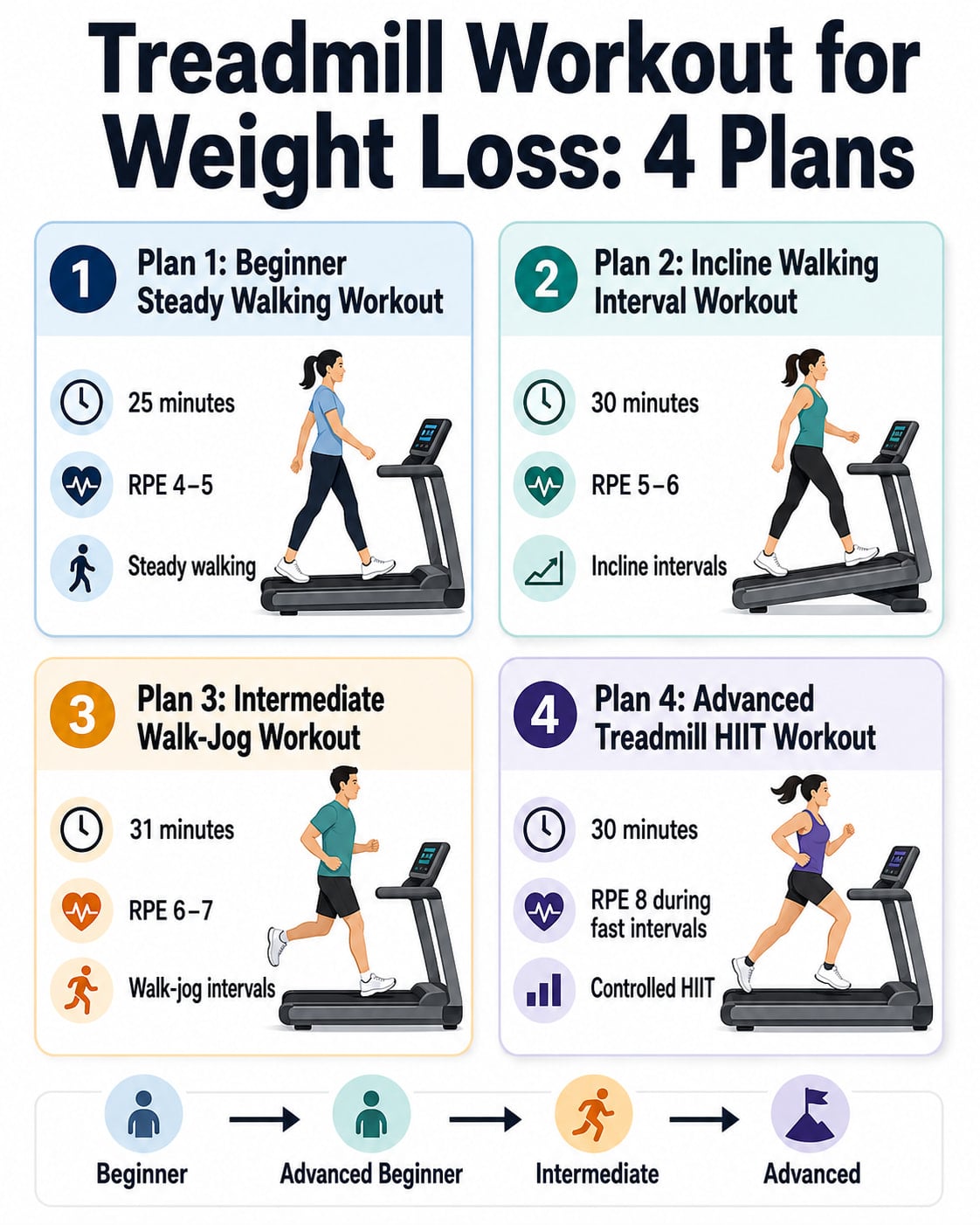
Use the plan that matches your current ability. Each workout includes a warm-up and cool-down.
| Plan | Level | Duration | Main training style |
|---|---|---|---|
| Plan 1 | Beginner | 25 minutes | Steady walking |
| Plan 2 | Advanced beginner | 30 minutes | Incline walking intervals |
| Plan 3 | Intermediate | 31 minutes | Walk-jog intervals |
| Plan 4 | Advanced | 30 minutes | Controlled HIIT |
The speed numbers are only examples. Your effort level and movement quality are more important.
Plan 1: Beginner Steady Walking Workout
Best for: New exercisers, people returning after a break, and anyone who wants a simple treadmill walking workout for weight loss.
Total time: 25 minutes
Suggested frequency: 3–5 days per week
Main effort: RPE 4–5
| Time | Speed | Incline | Effort |
|---|---|---|---|
| 0–5 minutes | 1.8–2.5 mph | 0–1% | RPE 2–3 |
| 5–20 minutes | 2.5–3.5 mph | 0–2% | RPE 4–5 |
| 20–25 minutes | 1.8–2.5 mph | 0% | RPE 2–3 |
How to Do It
Begin with an easy five-minute walk. Gradually increase your speed until you are walking briskly but can still carry on a conversation.
Keep your head up, shoulders relaxed, and arms moving naturally. Take comfortable steps rather than trying to make your stride unusually long.
During the last five minutes, gradually slow down. Do not stop the belt abruptly after the brisk section.
How to Progress
Repeat this workout for at least one or two weeks. When it feels comfortable, add five minutes to the brisk-walking section.
Build toward a total workout time of 30–40 minutes before making large increases in speed or incline.
Plan 2: Incline Walking Interval Workout
Best for: People who can already walk briskly for approximately 25–30 minutes and want a harder workout without jogging.
Total time: 30 minutes
Suggested frequency: 2–4 days per week
Hard-interval effort: RPE 5–6
| Time | Workout |
|---|---|
| 0–5 minutes | Easy walking at 0–1% incline |
| 5–25 minutes | Complete five incline-and-recovery rounds |
| 25–30 minutes | Easy walking at 0% incline |
Complete the following four-minute round five times:
| Interval | Duration | Speed | Incline | Effort |
|---|---|---|---|---|
| Incline walk | 2 minutes | 2.5–3.5 mph | 3–6% | RPE 5–6 |
| Recovery walk | 2 minutes | 2.2–3.2 mph | 0–2% | RPE 3–4 |
How to Do It
Use a speed that allows you to walk with a natural stride. Your breathing should become noticeably faster during each incline interval, but the pace should remain controlled.
If you need to pull on the handrails or lean backward to maintain the incline, reduce either the incline or the speed. A lower setting performed with good posture is more useful than a high setting that changes your walking mechanics.
How to Progress
Change only one variable at a time. You can:
- Add one more interval round
- Increase the incline by approximately 1%
- Increase the speed by 0.1–0.2 mph
- Shorten the recovery interval slightly
Do not increase all four variables in the same workout.
Plan 3: Intermediate Walk-Jog Workout
Best for: People who can walk briskly for at least 30 minutes and can jog comfortably for short periods.
Total time: Approximately 31 minutes
Suggested frequency: 2–3 nonconsecutive days per week
Jogging effort: RPE 6–7
| Time | Workout |
|---|---|
| 0–5 minutes | Gradually increase from easy to brisk walking |
| 5–26 minutes | Complete seven walk-jog rounds |
| 26–31 minutes | Easy walking cool-down |
Complete the following three-minute round seven times:
| Interval | Duration | Suggested speed | Effort |
|---|---|---|---|
| Controlled jog | 1 minute | Often 4–6 mph | RPE 6–7 |
| Brisk walk | 2 minutes | 2.8–3.8 mph | RPE 3–4 |
Use any speed that produces a smooth jog. Some people may jog below 4 mph, while others may need a higher speed.
How to Do It
The jogging intervals should feel challenging but repeatable. Your first interval and last interval should look similar.
Avoid turning each jogging interval into a sprint. The goal is to accumulate controlled running time—not to reach your maximum speed.
How to Progress
Once you can complete all seven rounds without losing form, try one of these progressions:
- Jog for 90 seconds and walk for 90 seconds
- Jog for two minutes and walk for one minute
- Add one additional three-minute round
- Keep the intervals the same and increase the jogging speed slightly
Stay with each progression until it feels controlled before moving forward again.
Plan 4: Advanced Treadmill HIIT Workout
Best for: Experienced exercisers who already run regularly and tolerate faster treadmill intervals.
Total time: 30 minutes
Suggested frequency: 1–2 nonconsecutive days per week
Fast-interval effort: RPE 8
| Time | Workout |
|---|---|
| 0–8 minutes | Gradual walking-to-jogging warm-up |
| 8–24 minutes | Complete eight fast-and-easy rounds |
| 24–30 minutes | Gradually slow to an easy walk |
Complete the following two-minute round eight times:
| Interval | Duration | Speed | Effort |
|---|---|---|---|
| Fast interval | 45 seconds | Controlled fast-running pace | RPE 8 |
| Recovery | 75 seconds | Easy walk or jog | RPE 2–4 |
How to Do It
Select a fast pace you can repeat eight times without grabbing the rails, jumping onto the side platforms, or losing control of your stride.
The intervals should be hard, but they should not be maximum-effort sprints. During the recovery periods, slow down enough to regain control of your breathing before the next interval.
Use a low incline, such as 0–2%, unless you are already experienced with incline running.
How to Progress
Choose one progression:
- Add one or two rounds, up to 10 total
- Increase the fast interval from 45 to 60 seconds
- Reduce recovery from 75 to 60 seconds
- Increase the speed slightly
Do not increase the speed, work duration, and number of intervals simultaneously.
HIIT is optional. It is not automatically better for weight loss than moderate exercise, and beginners do not need it. A challenging workout that causes excessive soreness, fatigue, or missed future sessions may be less useful than a moderate workout you can repeat consistently.
Sample Weekly Treadmill Workout Schedule
You do not need to perform the same workout every day. A mixture of challenging and easier sessions can make the routine easier to maintain.
| Level | Monday | Wednesday | Friday or Saturday |
|---|---|---|---|
| Beginner | Plan 1 | Plan 1 | Plan 1 |
| Advanced beginner | Plan 2 | Plan 1 | Plan 2 |
| Intermediate | Plan 3 | Plan 1 or 2 | Plan 3 |
| Advanced | Plan 4 | Easy Plan 1 or 2 | Plan 3 |
Add muscle-strengthening exercise on two days when possible. These sessions can include squats, hinges, rows, presses, lunges, carries, or modified alternatives suited to your ability.
A strength workout does not have to be performed immediately after the treadmill. Place it where it fits your schedule and recovery.
How to Progress Your Treadmill Workouts
Progress does not require making every workout harder. You need enough challenge to improve, but you also need enough recovery to remain consistent.
1. Build Duration First
Add approximately five minutes to an easy or moderate workout. Longer sessions allow you to increase weekly activity without immediately raising the impact or intensity.
2. Add Weekly Frequency
Once you recover comfortably from your current schedule, add another easy walking session. An additional moderate workout is often easier to tolerate than making every existing workout harder.
3. Increase Speed or Incline Gradually
Increase one setting at a time. A small change in speed can feel much harder when combined with a steep incline.
4. Keep Easy Days Easy
Not every treadmill workout should be HIIT. Easy and moderate sessions help you accumulate activity while managing fatigue.
5. Watch Your Performance
The workout may be progressing too quickly if you experience:
- Persistent joint or muscle pain
- Worsening performance across several workouts
- Unusual exhaustion
- Repeated difficulty completing planned intervals
- The need to hold the rails throughout the workout
Reduce the duration or intensity and rebuild gradually.
How Many Calories Can You Burn on a Treadmill?
The number of calories burned depends on several factors:
- Body weight
- Workout duration
- Walking or running speed
- Incline
- Fitness level
- Movement efficiency
- How much you use the handrails
As a reference, the CDC estimates that a 154-pound person may use approximately:
| Activity | Estimated calories in 30 minutes |
|---|---|
| Walking at 3.5 mph | 140 calories |
| Running or jogging at 5 mph | 295 calories |
A person who weighs more may use more energy during the same activity, while a lighter person may use less. These numbers are estimates rather than guaranteed results.
Treadmill consoles also provide estimates. The number may be more personalized when you enter your weight, but it still cannot account perfectly for your fitness, stride, body composition, or handrail use.
Avoid “eating back” every calorie shown on the display. Treat the number as a rough workout-tracking tool, not an exact measurement.
Is Incline Walking Better for Weight Loss?
Incline walking is useful, but it is not automatically better than level walking or running.
Increasing the incline can make walking feel harder without requiring a faster belt speed. This may suit people who enjoy walking, want more variety, or are not ready to jog.
Running generally uses more energy per minute than comfortable walking, but many people can walk for longer and recover more easily. The better choice is the method that lets you accumulate enough weekly activity without pain or excessive fatigue.
Consider these trade-offs:
| Incline walking | Running |
|---|---|
| Raises effort without requiring fast belt speeds | Usually expends more energy per minute |
| May be easier to sustain than running | Can save time when fitness and joints tolerate it |
| Can challenge the calves and legs | Involves greater impact and running-specific demands |
| Easy to adjust in small increments | Requires adequate running fitness and technique |
You can also combine both methods. For example, use incline walking for moderate sessions and controlled running for one weekly interval workout.
Common Treadmill Weight-Loss Mistakes
Choosing a Workout That Is Too Advanced
A hard workout is not automatically an effective workout. Starting with a plan that is beyond your current fitness may cause excessive soreness, poor technique, or skipped sessions.
Holding the Handrails Throughout the Workout
The rails are useful for briefly stabilizing yourself when starting or stopping. However, if you must constantly pull on them to keep up, reduce the speed or incline.
Increasing Speed and Incline Together
Changing both settings at once can create a much larger increase in difficulty than expected. Adjust one variable and evaluate how your body responds.
Doing HIIT Every Day
High-intensity sessions require recovery. Use easier walking or rest days between hard treadmill workouts.
Ignoring Nutrition
Treadmill workouts can increase energy expenditure, but they cannot consistently offset an eating pattern that provides more calories than your body uses.
Aim for meals that support fullness and recovery, including appropriate portions of protein, fiber-rich foods, fruits, vegetables, whole grains, and healthy fats according to your needs and preferences.
Trusting the Calorie Display Too Much
The displayed calorie number is an estimate. Track your workout time, effort, speed, incline, and consistency instead of judging success by one console number.
Trying to Target Belly Fat
A treadmill can contribute to overall fat loss, but it cannot choose where your body loses fat first. Waist measurements may decrease as overall body fat decreases, but genetics and individual biology influence the pattern.
Treadmill Workout Safety Tips
Allow time for your body to transition into and out of exercise. The American Heart Association recommends warming up for approximately 5–10 minutes by performing your planned activity at a slower pace. It also recommends gradually reducing your walking speed for 5–10 minutes during the cool-down.
Follow these additional precautions:
- Learn the stop and speed controls before beginning.
- Attach the emergency safety clip when one is available.
- Wear supportive, properly fitting athletic shoes.
- Keep clothing, towels, pets, and objects away from the moving belt.
- Look forward rather than repeatedly looking down at your feet.
- Change the speed gradually.
- Avoid jumping from a fast-moving belt onto the side platforms.
- Stop if pain changes your natural stride.
- Drink fluids according to your needs and exercise environment.
Consult a qualified healthcare professional before starting vigorous treadmill exercise if you have a chronic medical condition, are recovering from surgery or an injury, take medication that affects exercise response, or are unsure what level of activity is appropriate.
The National Institute of Diabetes and Digestive and Kidney Diseases advises stopping exercise and seeking help for warning signs such as chest pain, tightness or pressure, extreme shortness of breath, dizziness, or feeling sick.
Frequently Asked Questions
Is 30 Minutes on a Treadmill Enough to Lose Weight?
Thirty minutes can make a useful contribution to your weekly activity and calorie expenditure. Whether it produces weight loss depends on your weekly exercise volume, food intake, current weight, consistency, and other individual factors.
Three 30-minute workouts provide 90 minutes of weekly activity. You can gradually add time or another session as your fitness improves.
What Treadmill Speed Is Best for Weight Loss?
There is no universal best speed. Choose a speed that creates a moderate effort you can sustain with good posture.
For many people, brisk walking may fall between 2.5 and 3.8 mph, but your appropriate speed may be outside that range. Use the talk test: you should be able to talk but not sing during a moderate workout.
What Incline Should I Use on a Treadmill?
Beginners can start at 0–2%. Once level walking feels comfortable, try short intervals at approximately 3–6%.
There is no need to begin with a steep incline. Reduce the setting if you have to lean backward, shorten your stride excessively, or pull on the handrails.
How Many Days a Week Should I Use a Treadmill?
Three days per week is a practical starting point. You may gradually build to four or five days by combining easy, moderate, and harder sessions.
Avoid doing hard running intervals on consecutive days. Walking sessions may be performed more often when they do not cause pain or excessive fatigue.
Is Walking or Running Better for Weight Loss?
Running normally uses more energy per minute, while walking is often easier to sustain and recover from. Both can support weight loss.
Walking may be the better choice if it allows you to exercise more consistently. Running may be helpful if you are already conditioned for it and need a time-efficient workout. A combination of the two also works well.
Can a Treadmill Workout Reduce Belly Fat?
A treadmill workout may contribute to overall fat loss and reductions in waist circumference, but it cannot specifically remove fat from the abdomen.
Your body determines where fat is lost based partly on genetics, hormones, age, and other individual factors. Focus on consistent activity, nutrition, strength training, sleep, and long-term progress.
Is the 12-3-30 Treadmill Workout Good for Beginners?
The 12-3-30 workout involves walking for 30 minutes at 3 mph and a 12% incline. That incline can be demanding and should not automatically be considered a beginner workout.
A new exerciser can use the same basic idea at a lower setting, such as 2–3 mph and a 2–5% incline. Increase the incline only when you can maintain an upright posture without relying on the rails.
Conclusion
A successful treadmill workout for weight loss should be challenging enough to increase your breathing and heart rate but manageable enough to repeat every week.
Start with the plan that matches your current fitness. Track your workout duration, perceived effort, speed, and incline. When you can complete the workout comfortably with good form, increase only one variable at a time.
For your next session, choose one of the four plans and record how it feels. Consistent, controlled workouts will usually serve you better than occasional all-out efforts.
References
- Centers for Disease Control and Prevention: Physical Activity and Your Weight and Health
- Office of Disease Prevention and Health Promotion: Current Physical Activity Guidelines
- JAMA Network Open: Aerobic Exercise and Weight Loss in Adults
- American Heart Association: Warm Up and Cool Down
- National Institute of Diabetes and Digestive and Kidney Diseases: Staying Active at Any Size