
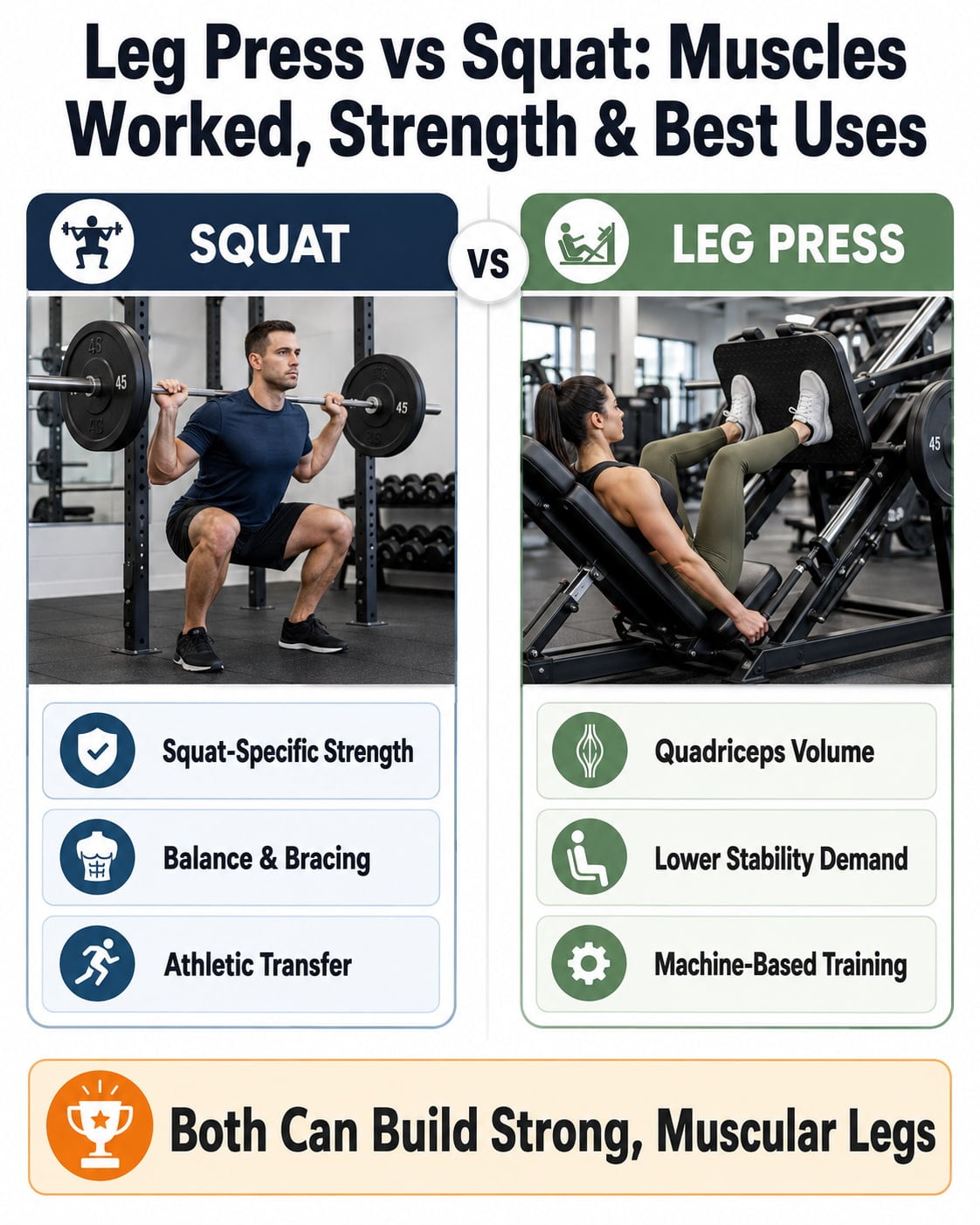
Squats are generally better for developing squat-specific strength, balance, bracing, and athletic movement, while leg presses are better for adding lower-body training volume with less stabilization demand. Both exercises can build your quadriceps, glutes, and overall leg strength when performed consistently with progressive resistance.
The best choice in the leg press vs squat debate depends on your goals, experience, mobility, equipment, and comfort. You do not have to perform barbell squats to build strong legs, and you do not need a leg press if squats already fit your program.
The 2026 American College of Sports Medicine resistance-training guidelines emphasize consistency and individualization rather than searching for one perfect exercise or training method.
Leg Press vs Squat at a Glance
| Category | Squat | Leg Press |
|---|---|---|
| Main muscles | Quadriceps, glutes, and hip adductors | Primarily quadriceps, with glutes and hip adductors assisting |
| Core involvement | High | Low to moderate |
| Balance requirement | High | Low |
| Learning curve | Moderate to high | Generally lower |
| Squat strength | Best choice | Limited transfer |
| Leg-press strength | Limited transfer | Best choice |
| Athletic transfer | Generally better | More limited |
| Quadriceps volume | Effective | Often easier to accumulate |
| Glute and adductor development | Strong potential with sufficient depth | Depends heavily on machine setup and range |
| External weight used | Usually lower | Usually higher, but numbers are not directly comparable |
| Systemic fatigue | Usually higher | Often lower |
| Best use | Full-body strength, powerlifting, coordination, athletic preparation | Bodybuilding, quadriceps volume, accessory training, lower-skill leg work |
The squat provides a greater whole-body challenge because you must control the weight while balancing and bracing. The leg press supports your torso and guides the resistance along a fixed or semi-fixed path, allowing you to focus more directly on pushing with your legs.
What Is the Difference Between a Leg Press and a Squat?
Both exercises involve movement at the hips and knees, but the way you perform them is very different.
During a squat, you support your body and the external resistance while lowering and standing back up. Your ankles, knees, hips, spine, and trunk must work together to maintain balance and posture.
During a leg press, you sit or recline against a padded backrest and push a platform or sled away from your body. The machine supports your upper body and removes much of the balance requirement.
This difference affects:
- How much stabilization is required
- Which muscles limit the exercise
- How much displayed weight you can use
- How much technique the movement requires
- How well strength transfers to other activities
Neither movement is automatically better in every category.
Leg Press vs Squat Muscles Worked
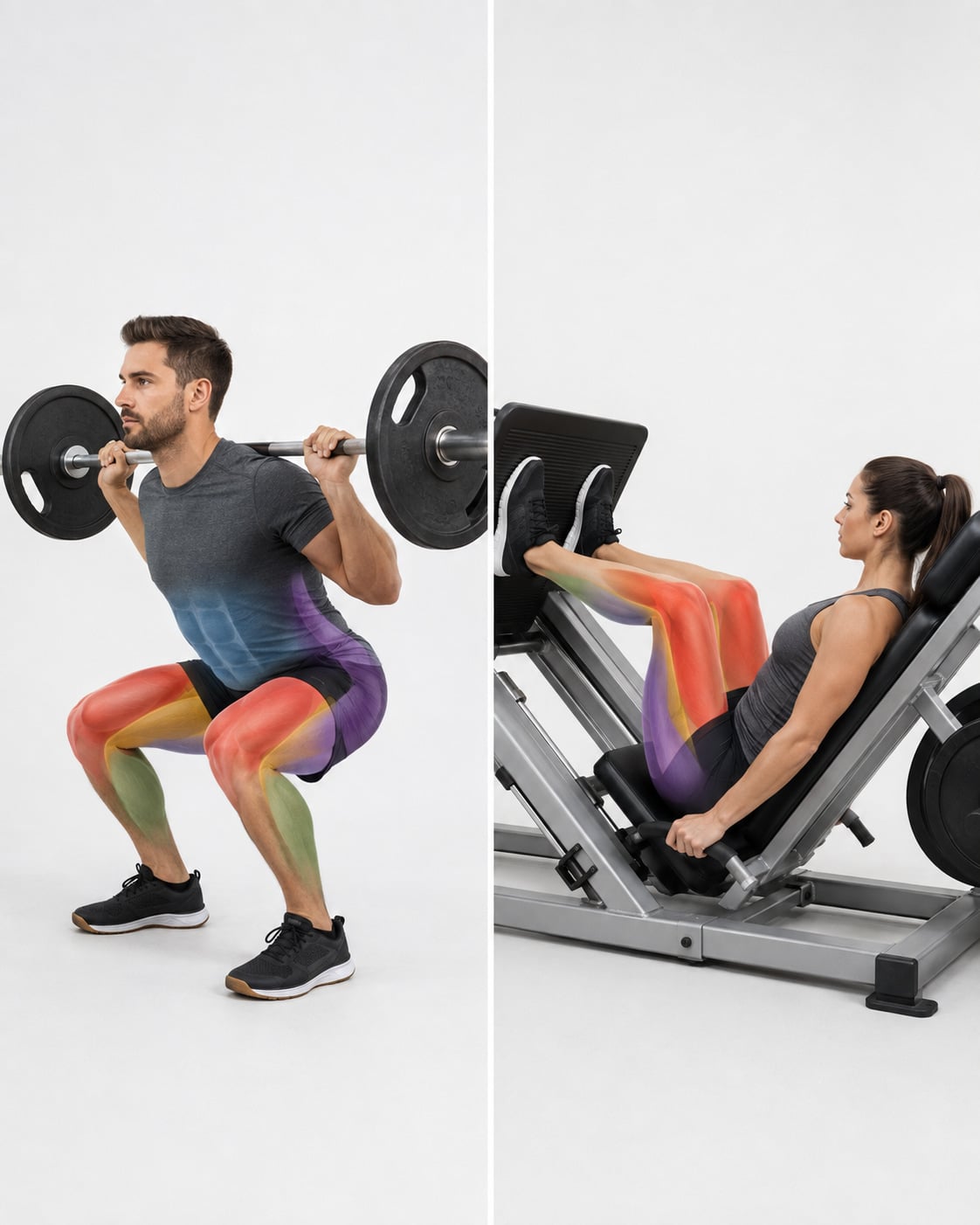
Squats and leg presses train many of the same lower-body muscles. However, the relative contribution of each muscle changes with exercise technique, machine design, stance, depth, and individual anatomy.
Squat Muscles Worked
The main muscles worked during a squat include:
Quadriceps
The quadriceps on the front of your thighs straighten your knees as you stand up.
The quadriceps group includes:
- Vastus lateralis
- Vastus medialis
- Vastus intermedius
- Rectus femoris
Your quadriceps are highly active during both the lowering and lifting phases of the squat.
Gluteus Maximus
The gluteus maximus extends your hips as you rise from the bottom position.
Glute involvement generally increases when you use a controlled range of motion that creates substantial hip flexion. However, you should only squat as deeply as you can while maintaining balance, control, and a comfortable position.
Hip Adductors
The hip adductors are located along the inner thighs. The adductor magnus, in particular, can contribute significantly to hip extension during a squat.
A study of squat depth and lower-body muscle growth found that full squats produced greater growth in the gluteus maximus and adductors than half squats in the participants studied. Quadriceps growth was similar between the two squat depths.
Core and Spinal Stabilizers
Your abdominal muscles, obliques, and spinal erectors help keep your torso stable while you support the load.
These muscles do not necessarily move through a large range, but they must produce tension to prevent unwanted movement of the spine and pelvis.
Hamstrings and Calves
The hamstrings and calves assist with movement and joint stability, but they are not usually the primary muscles targeted by squats.
The squat-depth study mentioned above did not find significant hamstring growth after either full- or half-squat training. For balanced leg development, consider including a knee-flexion exercise, such as a leg curl, and a hip-hinge exercise, such as a Romanian deadlift.
Leg Press Muscles Worked
The main muscles worked during a leg press include:
Quadriceps
The quadriceps are usually the primary muscles trained by the leg press. They extend your knees as you push the platform away.
A systematic review of leg press muscle activation found that the quadriceps generally showed the greatest activity during the exercise. The vastus lateralis and vastus medialis demonstrated particularly high activation.
Gluteus Maximus
The gluteus maximus assists with hip extension as you push out of the bottom position.
Glute contribution may become more noticeable when you use a range of motion that allows greater hip flexion. However, lowering the platform too far can cause your pelvis to roll away from the pad. More depth is not helpful if you lose control of your lower back.
Hip Adductors
The hip adductors help control the position of your thighs and assist with hip extension.
Their contribution can vary depending on your stance width, foot angle, machine design, and depth.
Hamstrings and Calves
The hamstrings and calves can assist during the movement, but the leg press is not usually a complete replacement for direct hamstring or calf training.
Does the Squat Work Your Core More?
The squat generally requires much more trunk stabilization than the leg press.
In a study comparing lower-body exercises, the leg press produced lower average core-muscle activation while allowing participants to use greater three-repetition maximum loads than either Smith-machine or free-weight squats.
Choose squats when you want your legs and trunk to work together. Choose the leg press when you want to challenge your legs without balance or core strength ending the set first.
Which Builds More Strength?
Both exercises build strength, but the improvements are highly specific to the movement you practice.
Squats Are Better for Squat Strength
To become better at squatting, you need to squat.
Squat strength depends on more than leg-muscle force. It also involves:
- Balance
- Bar positioning
- Bracing
- Coordination
- Movement timing
- Confidence under a free weight
Leg presses can strengthen many of the muscles used in a squat, but they do not fully reproduce these skill and stabilization demands.
A direct comparison of squat, leg-press, and combined training found that squat training transferred more effectively to maximal squat strength than leg-press training.
Leg Presses Are Better for Leg-Press Strength
The same specificity principle applies to the leg press. Regularly practicing the machine improves your ability to produce force within that machine’s movement path.
A high leg-press number does not automatically predict a high squat number. Machine angles, sled weight, friction, pulley systems, range of motion, and body position can all affect the resistance you experience.
Free Weights and Machines Can Both Build Strength
A 2023 meta-analysis of free-weight and machine-based training included 13 studies and 1,016 participants. Free-weight training produced greater improvements when strength was tested with free weights, while machine training tended to perform better when strength was tested on machines.
When the researchers compared more neutral measures of strength, muscle growth, and jump performance, they did not find a consistent overall advantage for either equipment type.
The practical lesson is simple: train in a way that matches the type of strength you want to develop.
Which Is Better for Athletic Performance?
Squats generally offer better transfer to activities that require you to support your body, maintain balance, and produce force through the ground.
These activities may include:
- Jumping
- Sprinting
- Changing direction
- Climbing
- Lifting objects from the floor
- Contact sports
In one direct training study, the squat group improved squat-jump performance by approximately 12.4% and countermovement-jump performance by approximately 12%. The leg-press group did not experience the same level of improvement.
That does not make the leg press useless for athletes. It can still add muscle, strengthen the legs, and provide training volume. However, athletes usually need standing, free-moving exercises that more closely match the coordination demands of their sport.
Leg Press vs Squat for Muscle Growth
Current evidence does not establish a universal winner for muscle growth.
The free-weight versus machine-training meta-analysis found no significant overall difference in hypertrophy between the two equipment categories. However, that does not prove that every squat and every leg-press variation produce identical results. Direct, long-term comparisons between these specific exercises remain limited.
Muscle growth depends heavily on whether an exercise allows you to:
- Train through a controlled and tolerable range
- Apply progressive overload
- Perform enough weekly volume
- Bring the target muscles reasonably close to fatigue
- Recover between sessions
- Maintain consistent technique
Squat Advantages for Muscle Growth
Squats train several muscle groups simultaneously and can be an efficient choice when you want to develop your:
- Quadriceps
- Glutes
- Hip adductors
- Trunk stabilizers
A well-controlled squat through a substantial range can be especially useful for glute and adductor development.
The limitation is that balance, bracing, breathing, or lower-back fatigue may sometimes end a set before your quadriceps reach their desired training stimulus.
Leg-Press Advantages for Muscle Growth
The leg press reduces many of those stabilization demands.
This can make it easier to:
- Focus on your quadriceps
- Perform additional leg-training volume
- Use moderate or high repetitions
- Train closer to local muscular fatigue
- Continue training after squats
- Challenge the legs when your upper body is fatigued
For bodybuilding or general hypertrophy, combining squats and leg presses can be more practical than trying to declare one exercise the permanent winner.
Which Is Better for the Quadriceps?
Both exercises can build your quadriceps.
The leg press may have a practical advantage when your main goal is accumulating quadriceps-focused volume. Because your torso is supported, you may be able to continue a set without balance or trunk fatigue limiting you.
Squats remain an effective quadriceps exercise, especially when you use a controlled range and allow your knees to bend naturally. Your exact proportions, stance, bar position, heel elevation, and squat depth influence how the movement feels.
A simple approach is to use squats as your primary compound exercise and leg presses as an additional quadriceps movement.
Which Is Better for the Glutes?
Squats may have an advantage for glute development when performed through a deep, controlled range that your mobility and anatomy allow.
The leg press also trains the glutes, particularly near the bottom of the movement. However, the machine must allow enough hip flexion without causing your pelvis or lower back to lift away from the pad.
Do not force depth on either exercise. Use the deepest range you can control without pain, bouncing, or losing a stable torso position.
Leg Press vs Squat for Different Goals
| Goal | Better Choice | Why |
|---|---|---|
| Powerlifting | Squat | The squat is a competition lift and requires specific practice |
| Squat strength | Squat | Strength and technique improvements are movement-specific |
| Athletic transfer | Squat | Greater standing balance, bracing, and coordination demands |
| Quadriceps volume | Leg press | Lower stabilization requirements make extra sets easier |
| General muscle growth | Both | Each offers different practical advantages |
| Glute and adductor development | Squat | A substantial controlled depth can strongly involve the hips |
| Lower-skill machine training | Leg press | The machine guides the movement path |
| Core and bracing development | Squat | The trunk must stabilize the load |
| Bodybuilding | Both | Squats provide a compound foundation; leg presses add targeted volume |
| Training around shoulder limitations | Leg press | No bar must be supported across the shoulders |
| Home training | Squat variation | A leg-press machine may not be available |
| Training with balance limitations | Leg press may be easier | The seat and backrest provide support |
Personal comfort matters. An exercise that looks ideal on paper is not useful if you cannot perform it consistently and without persistent pain.
Are Squats or Leg Presses Safer?
Neither exercise is automatically safer for everyone.
Safety depends on:
- Your current health and injury status
- Exercise technique
- Training load
- Range of motion
- Fatigue
- Machine dimensions
- Mobility
- Previous training experience
Are Squats Bad for Your Knees?
Squats are not inherently bad for healthy knees.
A 2024 review of deep squatting and knee-joint health examined 15 studies. Fourteen reported no negative effects on knee-joint health, and the authors concluded that deep squats appear safe for healthy resistance-trained people when appropriate technique is maintained.
This does not mean everyone must squat deeply. Your appropriate range may be influenced by your anatomy, mobility, symptoms, training experience, and goals.
Is the Leg Press Safer for Your Back?
The supported position can reduce the balance and bracing demands placed on your back. That may make the leg press more comfortable for some people.
However, lowering the platform too far can cause your pelvis to rotate and your lower back to round away from the pad. Heavy loading does not make poor positioning harmless.
Keep your lower back and pelvis supported, and stop the descent before your position changes.
When to Seek Professional Guidance
Stop the exercise and obtain guidance from a qualified healthcare professional if you experience:
- Sharp or worsening pain
- Joint swelling
- Numbness or tingling
- Sudden weakness
- Pain that continues after training
- Symptoms following a recent injury or surgery
A physical therapist or other qualified clinician can help determine whether the issue is the exercise itself, your technique, your current training load, or an underlying condition.
How to Squat With Proper Form
Squat technique varies with body proportions and the specific variation you perform. The following cues provide a practical starting point.
1. Set Your Stance
Stand with your feet approximately shoulder-width apart. Turn your toes slightly outward if that feels natural.
Your ideal stance may be narrower or wider depending on your hip structure and mobility.
2. Brace Your Trunk
Take a controlled breath and create tension around your abdomen before descending.
Keep your ribs and pelvis in a stable position without excessively arching or rounding your lower back.
3. Bend Your Hips and Knees Together
Allow your hips and knees to bend as you lower.
Your knees can travel forward as long as your feet remain stable and the movement is comfortable.
4. Keep Your Knees Aligned
Let your knees follow the general direction of your toes.
Avoid allowing them to collapse inward, especially as you begin standing up.
5. Use a Controlled Depth
Descend as far as you can while maintaining:
- Full-foot contact
- Balance
- A controlled spine position
- Comfortable knees and hips
- Consistent tension
You do not have to force your thighs below parallel if you cannot maintain control.
6. Stand Up Smoothly
Push through your whole foot and extend your knees and hips together.
Avoid letting your hips rise much faster than your chest.
How to Use the Leg Press With Proper Form
Leg-press machines differ, so adjust the setup before adding substantial weight.
1. Adjust the Seat
Set the backrest or seat so you can reach the platform without your hips lifting or your lower back rounding.
2. Position Your Feet
Place your feet approximately shoulder-width apart on the platform.
Use a stance that allows your knees to bend comfortably while tracking in the same general direction as your toes.
3. Release the Safety Handles
Extend your legs enough to release the safety mechanism, but avoid aggressively locking your knees.
4. Lower the Platform Slowly
Bend your knees and hips under control.
Stop when you reach a comfortable depth or before your pelvis starts lifting from the pad.
5. Press Through Your Whole Foot
Push the platform away while keeping your heels and the balls of your feet in contact with it.
Keep your knees aligned rather than allowing them to collapse inward.
6. Rerack the Weight Securely
Finish the repetition under control and fully engage the machine’s safety mechanism before relaxing.
Common Squat Mistakes
Common squat errors include:
- Adding weight before learning the movement
- Losing balance over the toes or heels
- Allowing the knees to collapse inward
- Relaxing the trunk at the bottom
- Forcing a range you cannot control
- Bouncing out of the bottom position
- Letting the hips rise much faster than the chest
- Continuing despite sharp pain
A lighter goblet squat can be useful for learning control before moving to a heavier barbell variation.
Common Leg-Press Mistakes
Common leg-press errors include:
- Loading the machine beyond your controllable range
- Performing very short repetitions only to move more weight
- Allowing the lower back or hips to lift from the pad
- Letting the knees collapse inward
- Bouncing the sled out of the bottom
- Aggressively locking the knees
- Pushing on the thighs with the hands
- Failing to secure the safety mechanism
The amount of weight on the machine matters less than performing consistent repetitions through a useful, controlled range.
Why Can You Leg Press More Than You Squat?
Most people can use a much larger displayed load on the leg press because:
- The machine supports the torso.
- Balance is not a major limiting factor.
- The resistance follows a guided path.
- You do not have to support the full load on your back.
- The sled may move at an angle rather than vertically.
- Machine friction and leverage change the effective resistance.
- The listed weight may or may not include the sled.
You cannot reliably convert a leg-press number into a squat number. Even two different leg-press machines may feel substantially different with the same plates loaded.
Track progress separately for each exercise.
Can Leg Press Replace Squats?
The leg press can replace squats when your main goals are general lower-body strength and muscle growth, especially if squatting is uncomfortable, unavailable, or unsuitable for your current situation.
However, the leg press cannot fully replace the squat when your goal is:
- Competing in powerlifting
- Maximizing squat technique
- Developing free-standing barbell strength
- Training balance and bracing
- Improving movement skills that closely resemble squatting
You can also replace barbell squats with another squat variation, such as:
- Goblet squats
- Front squats
- Safety-bar squats
- Belt squats
- Smith-machine squats
- Split squats
- Step-ups
The barbell back squat is valuable, but it is not mandatory for every effective leg-training program.
Should You Do Squats and Leg Presses in the Same Workout?
You can perform both in the same workout if your total training volume and recovery are appropriate.
A common order is:
- Squat first while your balance, bracing, and coordination are fresh.
- Leg press afterward to add quadriceps and glute volume.
- Add a hamstring movement if needed.
- Finish with calves or other accessory work.
The order can change when the leg press is your primary exercise or when you are intentionally prioritizing quadriceps training.
Example Strength-Focused Workout
- Squat: 3 sets of 4–6 repetitions
- Leg press: 2–3 sets of 8–12 repetitions
- Romanian deadlift: 2–3 sets of 6–10 repetitions
- Calf raise: 2–3 sets of 10–15 repetitions
Example Muscle-Building Workout
- Squat: 3 sets of 6–10 repetitions
- Leg press: 3 sets of 10–15 repetitions
- Leg curl: 3 sets of 10–15 repetitions
- Calf raise: 3 sets of 10–20 repetitions
These are examples rather than universal prescriptions. Start with less volume if you are new to resistance training.
The 2026 ACSM guidance recommends training major muscle groups at least twice per week as a general target. It also emphasizes heavier loading for maximal strength and sufficient weekly volume for hypertrophy, while noting that individualization and consistency remain more important than complicated programming.
How to Choose Between the Leg Press and Squat
Choose the squat when you:
- Want to improve your squat
- Compete in powerlifting
- Want greater balance and bracing demands
- Are training for standing strength or athletic performance
- Have the mobility and control to perform it comfortably
- Prefer free weights
Choose the leg press when you:
- Want to add quadriceps-focused volume
- Prefer a machine-guided movement
- Want less balance and stabilization demand
- Have difficulty supporting a bar
- Want a useful accessory after squats
- Can use the machine without knee, hip, or back discomfort
Use both when you:
- Want a combination of whole-body strength and targeted leg volume
- Are training for muscle growth
- Recover well from your current program
- Enjoy both exercises
- Have enough time and equipment
Frequently Asked Questions
Is the leg press as good as squats?
The leg press can be as useful as squats for building lower-body muscle, depending on your program and effort. Squats are generally better for squat-specific strength, balance, bracing, and athletic transfer. Leg presses are often better for adding targeted leg volume with less stabilization demand.
Can I build big legs with only the leg press?
You can build your quadriceps and glutes with the leg press when you train consistently and progressively. However, a complete leg program should usually include movements for the hamstrings, calves, and hips rather than relying on one exercise.
Which is better for quads, leg press or squat?
Both train the quadriceps effectively. The leg press may make it easier to accumulate quadriceps-focused sets because the machine supports your torso. Squats provide a greater whole-body challenge and also train balance and bracing.
Which exercise works the glutes more?
Squats performed through a substantial, controlled range may offer an advantage for glute and adductor development. Leg presses also train the glutes, especially when the machine allows adequate hip flexion without your pelvis lifting from the pad.
Is the leg press better than squats for bad knees?
Not automatically. Either movement may feel better or worse depending on your condition, technique, range of motion, load, and machine setup. Persistent or unexplained knee pain should be assessed by a qualified healthcare professional.
Why is my leg press so much stronger than my squat?
The leg press supports your torso, guides the resistance, and removes much of the balance requirement. Machine angle, friction, leverage, and sled design also affect the effective resistance. Leg-press and squat weights should not be compared directly.
Should beginners start with squats or leg presses?
Either can be appropriate. A leg press may be easier to learn because balance is less demanding. A bodyweight or goblet squat can teach useful coordination and movement skills. Beginners should start with manageable resistance and prioritize controlled technique.
Conclusion
In the leg press vs squat comparison, the better exercise depends on what you need from it.
Choose squats for squat-specific strength, bracing, balance, athletic transfer, and efficient full-body training. Choose the leg press for quadriceps-focused volume, machine-based training, and a lower stabilization requirement.
For general muscle growth, you do not have to choose only one. Squats can provide the primary compound movement, while leg presses can help you add controlled lower-body volume afterward. Start with a manageable workload, track your progress, and use the exercises you can perform consistently without persistent pain.
References
- American College of Sports Medicine — 2026 Resistance Training Guidelines
- PubMed — Free-Weight vs. Machine-Based Strength Training Meta-Analysis
- PubMed — Leg Press Muscle Activation Systematic Review
- PubMed — Squat Depth and Lower-Limb Muscle Growth
- PubMed — Squat, Leg Press, and Combined Training Outcomes
- PubMed — Squat vs. Leg Press Effects on Jump Performance
- PubMed — Core Activation During Squats and Leg Presses
- PubMed — Deep Squatting and Knee-Joint Health