
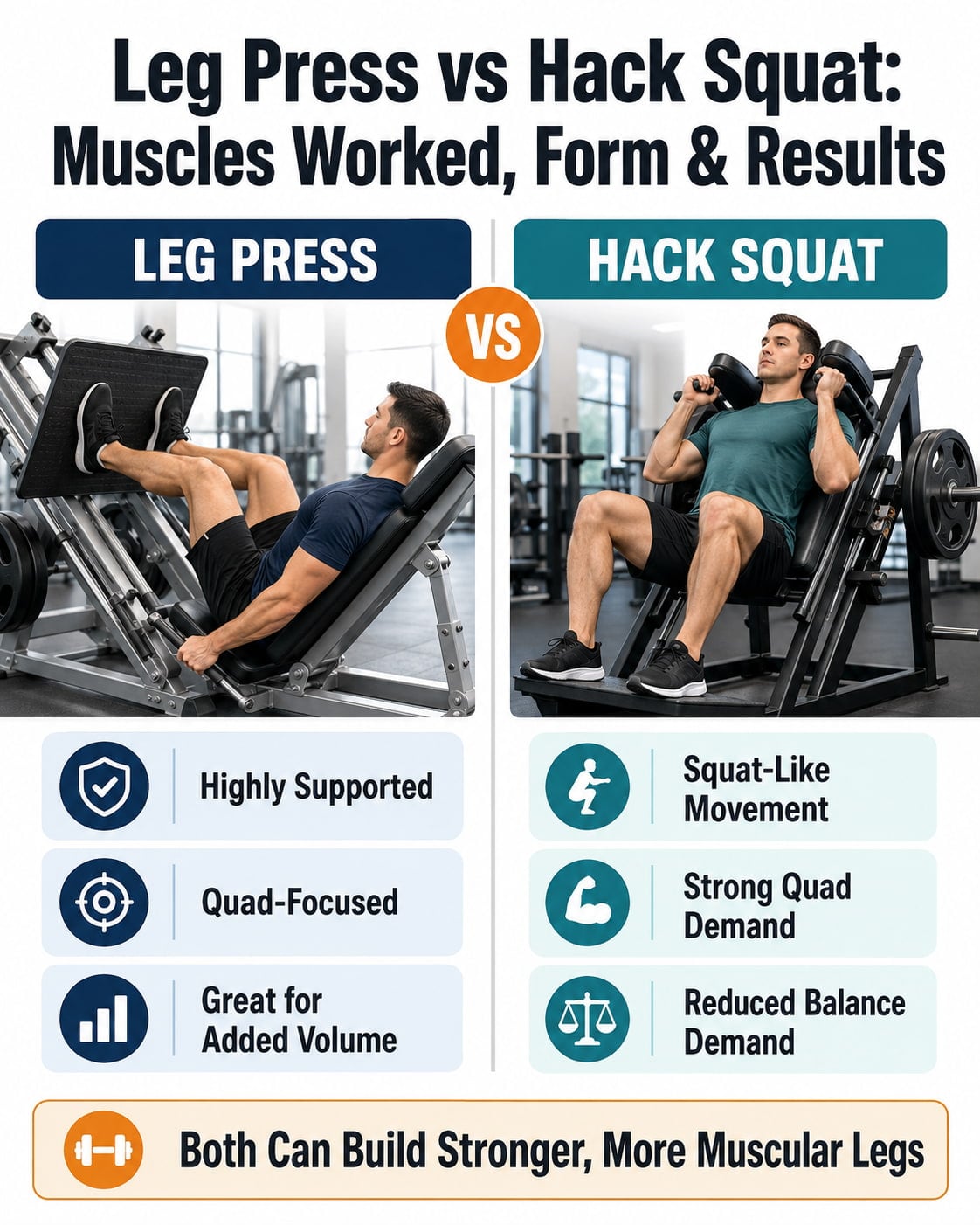
In the leg press vs hack squat comparison, neither exercise is universally better: the hack squat offers a more squat-like movement, while the leg press provides greater torso support and is often easier for high-volume leg training. Both exercises can effectively build your quadriceps and glutes when you use a controlled range of motion, train with enough effort, and gradually increase the challenge.
Choose the hack squat when you want a stable squat pattern with less balance demand than a barbell squat. Choose the leg press when you want a highly supported exercise that lets you focus almost entirely on moving the weight with your legs.
Direct long-term research comparing the two exercises is limited. Based on the available evidence, your technique, training volume, effort, progression, and individual comfort are likely more important than declaring one machine the absolute winner.
Leg Press vs Hack Squat: Quick Comparison
| Feature | Leg Press | Hack Squat |
|---|---|---|
| Body position | Seated or reclined against a backrest | Standing against back and shoulder pads |
| Movement pattern | You push a platform or sled away | You lower and raise your body with the sled |
| Primary muscles | Quadriceps | Quadriceps |
| Secondary muscles | Glutes, adductors, hamstrings, calves | Glutes, adductors, hamstrings, calves |
| Torso support | Very high | High |
| Core demand | Relatively low | Higher than the leg press but lower than a free-weight squat |
| Squat similarity | Lower | Higher |
| Typical loading | Often allows more plates | Usually uses less displayed weight |
| Beginner-friendly | Usually easier to learn | Stable, but setup may require more practice |
| Best use | Additional leg volume and controlled pressing | A primary squat-pattern exercise |
| Common form problem | Lower-back rounding at excessive depth | Hips or back lifting away from the pad |
Both are linear-guided machines that increase stability by restricting the movement path. However, machine design, sled angle, platform position, counterweight, and friction can differ significantly. This means the weight displayed on one machine cannot be directly compared with the weight on another. The National Strength and Conditioning Association’s guide to resistance-training equipment also notes that machine suitability depends on factors such as training experience, body proportions, goals, and personal preference.
What Is a Leg Press?
The leg press is a supported, multi-joint exercise involving movement at the hips and knees. Depending on the machine, you may sit upright, recline at an angle, or lie beneath a platform.
During a repetition, you lower the platform toward your body by bending your hips and knees. You then extend both joints to press the platform away.
Because the backrest supports your torso, you do not have to balance the resistance or stabilize your spine as much as you would during an unsupported squat. This can make the leg press useful for:
- Beginners learning to train their legs
- Adding quadriceps volume after other exercises
- Training close to muscular fatigue without balance becoming the limiting factor
- Single-leg pressing
- People who find unsupported squats difficult to coordinate
The supported position does not eliminate the need for proper technique. Lowering the platform too far can cause your pelvis to roll away from the pad and your lower back to round.
What Is a Hack Squat?
The hack squat is a machine-based squat performed with your back against a pad and your shoulders beneath padded supports.
Instead of pushing a platform away from your torso, you bend your hips and knees to lower your body along the machine’s fixed track. You then stand back up by extending your knees and hips.
The movement is more similar to a squat than a conventional leg press because your body moves with the sled. However, the pads and fixed track reduce the balance and trunk-stabilization demands of a free-weight squat.
A study comparing hack squats with back squats found that the supported hack squat required less trunk muscle activation, although participants could use heavier absolute loads on the hack squat. This suggests that the hack squat can challenge the legs without requiring the same degree of torso stabilization as a barbell back squat. (View the hack squat and back squat study)
Leg Press vs Hack Squat Muscles Worked
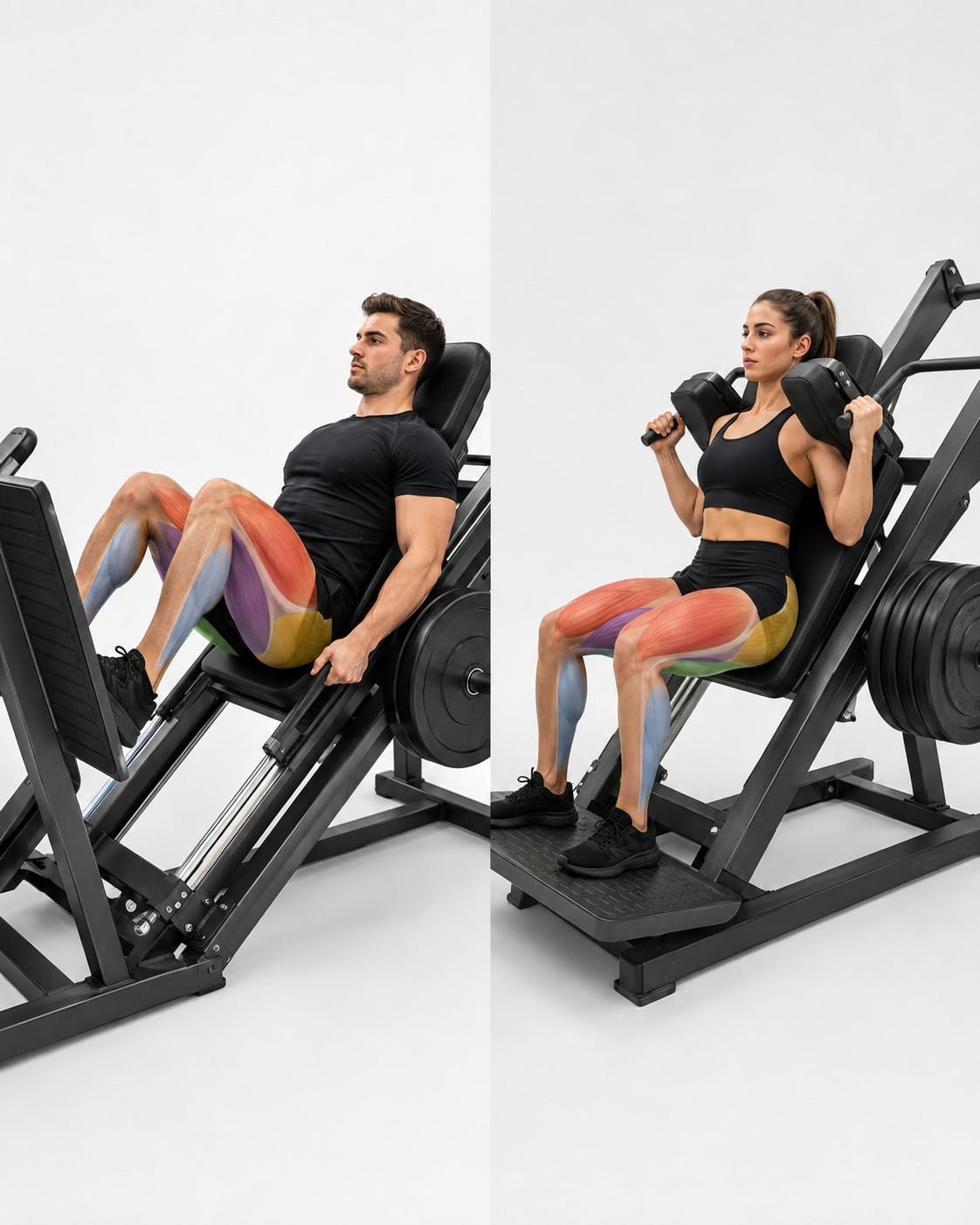
Both exercises train the same general lower-body muscle groups. The main differences come from your body position, the machine’s design, your range of motion, and how much movement occurs at the hips and knees.
Quadriceps
The quadriceps are the primary muscles worked in both exercises. They extend, or straighten, your knees as you push the sled upward.
The quadriceps group includes:
- Vastus lateralis
- Vastus medialis
- Vastus intermedius
- Rectus femoris
A systematic review of leg press muscle activation found that the quadriceps generally produced the greatest muscle activity during the exercise. The vastus lateralis and vastus medialis showed particularly high activation, and quadriceps activity tended to increase with greater knee flexion.
The hack squat also places substantial demand on the quadriceps because the knees must extend against resistance. Many people find the hack squat especially effective for quad-focused training because the backrest allows them to maintain a relatively upright torso while reaching significant knee flexion.
That does not prove the hack squat builds more quadriceps muscle than the leg press. Both can provide a strong growth stimulus when performed through a controlled, comfortable range of motion.
Gluteus Maximus
Your gluteus maximus helps extend your hips as you rise from the bottom of either exercise.
Glute involvement generally increases when an exercise includes more hip flexion. This is one reason deeper repetitions may feel more demanding on the glutes. However, you should not force additional depth if:
- Your pelvis lifts away from the pad
- Your lower back noticeably rounds
- Your heels lift
- You lose knee control
- The position causes pain
A higher foot position may create more hip movement on some machines, but it does not completely turn either exercise into a glute isolation exercise.
Hip Adductors
The adductors on the inside of your thighs help control the hips and contribute to hip extension, particularly from a deeper position.
A wider stance may make some people feel their adductors working more, but stance width does not guarantee that one muscle will be isolated. Your stance should first allow stable feet, controlled knees, and a comfortable range of motion.
Hamstrings
The hamstrings assist with hip extension and help control the movement, but they are not the primary muscles in either exercise.
Because the hips and knees move at the same time, the hamstrings do not shorten as dramatically as they do during exercises such as leg curls. Neither the hack squat nor the leg press should be your only hamstring exercise.
For more complete leg development, combine them with a knee-flexion or hip-hinge exercise such as:
- Seated leg curls
- Lying leg curls
- Romanian deadlifts
- Good mornings
- Hip hinges
Calves
The gastrocnemius and soleus help stabilize the ankle and maintain foot pressure against the platform.
They work secondarily unless you intentionally perform a calf-raise variation on the leg press. Regular hack squats and leg presses are not replacements for direct calf training.
Core and Lower-Back Muscles
The leg press requires relatively little trunk stabilization because your torso is supported by the seat.
The hack squat requires more active bracing because you are standing and moving with the sled. However, the backrest and shoulder pads still reduce the trunk demands compared with an unsupported barbell squat.
How to Do the Leg Press With Proper Form
The exact setup will vary between horizontal, selectorized, and 45-degree leg press machines.
Step-by-Step Leg Press Form
- Adjust the seat. Sit with your head, upper back, lower back, and pelvis supported by the pad.
- Position your feet. Place them approximately hip- to shoulder-width apart in a comfortable position on the platform.
- Check your starting position. Your heels should remain flat, and your knees should follow the same general direction as your toes.
- Brace your torso. Hold the handles and create gentle abdominal tension before releasing the safety stops.
- Lower the platform slowly. Bend your hips and knees while maintaining full-foot contact.
- Stop at your controlled depth. End the descent before your pelvis begins rolling away from the seat or your lower back noticeably rounds.
- Press the platform away. Push evenly through your feet while keeping your knees controlled.
- Finish without forceful lockout. Extend your knees under control, but do not snap them into hyperextension.
- Complete the set and secure the machine. Confirm that the safety mechanism is engaged before moving your feet.
ACE’s seated leg press exercise guide similarly recommends keeping the back and sacrum against the pad, maintaining heel contact, controlling the return, and avoiding forceful knee lockout.
Common Leg Press Mistakes
Loading Too Much Weight
Using excessive weight often leads to shallow repetitions, bouncing, or loss of pelvic position. Use a load you can control through your intended range.
Letting the Lower Back Round
If your pelvis curls forward as the sled approaches, you have probably exceeded your usable range of motion. Reduce the depth or adjust the seat.
Allowing the Knees to Collapse Inward
Your knees do not have to point perfectly straight ahead, but they should generally follow the direction of your toes rather than collapsing inward under load.
Lifting the Heels
Heel lift may indicate that your feet are too low, your depth is excessive, or the machine does not fit your ankle mobility. Move your feet slightly higher or shorten the range.
Pushing on Your Knees With Your Hands
Use the handles for stability. Pressing on your knees changes the movement and may hide the fact that the load is too heavy.
How to Do the Hack Squat With Proper Form
Hack squat machines differ considerably, so you may need to adjust your foot position before finding a comfortable setup.
Step-by-Step Hack Squat Form
- Set the safety stops. Make sure you understand how the machine locks and unlocks before adding substantial weight.
- Position your body. Place your shoulders securely under the pads and keep your head, upper back, lower back, and pelvis against the backrest.
- Set your feet. Begin with a hip- to shoulder-width stance and place your feet where your heels can remain down.
- Unrack the sled. Extend your legs enough to release the safety handles without forcefully locking your knees.
- Brace your torso. Maintain steady abdominal tension and keep your body against the pad.
- Lower under control. Bend your hips and knees together while maintaining full-foot pressure.
- Track your knees naturally. Allow your knees to follow your toes. Depending on your proportions, they may move forward past your toes.
- Use a comfortable depth. Descend until you reach your available range without your heels lifting, knees collapsing, or pelvis peeling away from the pad.
- Drive upward. Push through your whole foot and extend your hips and knees.
- Secure the sled. Reengage the safety handles before leaving the machine.
Common Hack Squat Mistakes
Placing the Feet Too Low
An extremely low foot position may cause your heels to lift or create more knee flexion than you can comfortably control.
Placing the Feet Too High
Moving your feet excessively high may shorten the range of motion and turn the exercise into a partial hip-dominant press. A higher position is not automatically better for the glutes.
Bouncing Out of the Bottom
Rapidly reversing direction can reduce control and make it harder to maintain a stable position. Pause briefly or use a smooth transition.
Lifting Away From the Backrest
Your pelvis and torso should remain supported. If they lift, reduce the load, adjust your feet, or stop the descent earlier.
Forcefully Locking the Knees
Finish each repetition under muscular control rather than snapping the joints into a hard lockout.
Leg Press vs Hack Squat for Muscle Growth
Both exercises can build substantial lower-body muscle. There is not enough direct long-term evidence to conclude that the hack squat consistently produces more growth than the leg press or vice versa.
A 2023 systematic review and meta-analysis of machine and free-weight training found no significant difference in muscle hypertrophy between the two equipment categories. Although that analysis was not a direct leg press-versus-hack-squat comparison, it supports a broader point: equipment choice is less important than whether an exercise can be performed consistently, progressively, and with enough effort.
The March 2026 ACSM resistance-training guidelines also emphasize consistency over unnecessary complexity. ACSM recommends training all major muscle groups at least twice weekly and suggests that approximately 10 challenging weekly sets per muscle group can help optimize hypertrophy. Training to complete failure on every set is not required.
Which Is Better for Quadriceps Growth?
The hack squat may be the more convenient choice when:
- You can comfortably reach substantial knee flexion
- You want a squat-like main exercise
- You prefer moving your body with the sled
- Your balance limits free-weight squats
The leg press may be better when:
- You want to add more quadriceps volume after another compound exercise
- You prefer a more supported position
- You want to train one leg at a time
- Lower-body fatigue makes standing exercises difficult to control
The exercise that lets you train your quadriceps through a controlled range, progress over time, and recover properly is likely the better option for you.
Which Is Better for Glute Growth?
Neither exercise is automatically superior for the glutes.
A deep, controlled hack squat may involve substantial hip extension, while a leg press can also challenge the glutes when the hips move through a comfortable range. Machine geometry and individual proportions can change the experience.
For a complete glute program, consider pairing either exercise with movements such as hip thrusts, Romanian deadlifts, split squats, or step-ups.
Which Exercise Builds More Strength?
Strength is specific to the movement you practice.
- Regular leg pressing will improve your leg press strength.
- Regular hack squatting will improve your hack squat strength.
- Barbell squat strength is best developed by practicing barbell squats.
The hack squat has more visual and mechanical similarity to a squat, so it may provide more useful practice for producing force through a squat-like pattern. However, its supported torso and fixed track still make it different from a free-weight squat.
The leg press often allows more displayed weight because the torso is supported and the sled moves at an angle. That does not mean the leg press develops more usable strength or that a 500-pound leg press equals a 500-pound hack squat.
For strength-focused training, ACSM’s 2026 guidance recommends heavier loads—around 80% of one-repetition maximum—for approximately two to three sets per exercise. The appropriate load still depends on your experience, technique, and goals.
Which Is Better for Knee Comfort?
There is no universal winner for knee comfort.
Both exercises require the knees to bend and straighten under resistance. The amount and direction of joint loading depend on:
- Machine design
- Foot position
- Range of motion
- Resistance
- Repetition speed
- Training history
- Mobility
- Individual anatomy
A lower foot position may create more knee flexion on some machines, while a higher position may increase hip involvement. Neither position is automatically dangerous.
Your knees may also travel past your toes during a controlled squat or press. This is not automatically a form error. The more important questions are whether your feet remain stable, your knees track naturally, and the movement is pain-free.
Reduce the load or range of motion when you cannot maintain control. Stop and seek professional assessment if you experience sharp pain, significant swelling, joint locking, instability, or pain that persists or worsens.
Which Is Better for Lower-Back Comfort?
Both exercises provide more back support than an unsupported squat, but neither is automatically appropriate for every person with back pain.
Leg Press Considerations
The seated or reclined position may feel comfortable because the backrest supports your torso. However, deep hip flexion can cause your pelvis to rotate and your lower back to round away from the pad.
Use only the range you can control while maintaining stable contact with the seat.
Hack Squat Considerations
The backrest helps stabilize your torso, but the shoulder pads transmit force through your body as you move the sled. You must still brace and maintain contact with the pad.
Choose the machine that allows you to move without pain or loss of position. People with an existing back condition, recent injury, or unexplained symptoms should discuss exercise selection with an appropriate healthcare or rehabilitation professional.
Does Foot Placement Change the Muscles Worked?
Foot placement can change joint angles and how an exercise feels, but small stance changes do not completely isolate individual muscles.
A study examining stance width, foot rotation, and movement speed during the inclined leg press found that different foot positions did not meaningfully change the overall pattern of thigh muscle activation. The researchers recommended choosing a natural, comfortable position rather than forcing a stance to target a specific part of the quadriceps. (View the inclined leg press foot-position study)
Higher Foot Placement
A higher position may reduce the amount of forward knee movement and increase hip flexion on some machines. You may feel more work in the glutes, but the quadriceps remain active.
Lower Foot Placement
A lower position may allow greater knee flexion and make the exercise feel more quadriceps-focused. Do not place your feet so low that your heels lift or your knees become uncomfortable.
Wider Stance
A wider stance may provide more space for the hips and may increase the sensation in the adductors. It does not completely isolate the inner thighs.
Narrower Stance
A narrower stance may feel more natural for some people but does not selectively isolate the outer quadriceps.
Start with a comfortable hip- to shoulder-width stance. Adjust only when the change improves stability, range of motion, or comfort.
Leg Press vs Hack Squat: Which Should You Choose?
| Your Goal or Situation | Better Starting Choice | Why |
|---|---|---|
| Build bigger quadriceps | Either | Both can provide effective knee-extension training |
| Use a squat-like machine exercise | Hack squat | The body moves with the sled in a squat pattern |
| Add volume after squats | Leg press | The highly supported position reduces balance demands |
| Learn machine-based leg training | Leg press | Setup and movement are usually easier to understand |
| Reduce trunk demands | Leg press | The seated position provides more torso support |
| Replace barbell squats temporarily | Hack squat | It most closely resembles a supported squat pattern |
| Train one leg at a time | Leg press | Many machines make unilateral pressing practical |
| Train around knee discomfort | Whichever feels better | Comfort depends on the machine, setup, load, and individual |
| Train around lower-back discomfort | Whichever preserves position | Neither exercise is universally safest |
| Maximize overall leg development | Use either or both | Results depend more on programming and progression |
Can You Do Leg Press and Hack Squat in the Same Workout?
Yes, but you do not need both exercises in every session.
They have considerable overlap, so doing too many hard sets of each may create unnecessary fatigue without adding a meaningful benefit.
A practical approach is to use the hack squat as your main squat-pattern exercise and the leg press for additional controlled volume.
Sample Quad-Focused Workout
- Hack squat: 3 sets of 6–10 repetitions
- Leg press: 2–3 sets of 10–15 repetitions
- Leg extension: 2–3 sets of 10–15 repetitions
- Leg curl: 3 sets of 8–15 repetitions
- Calf raise: 3 sets of 10–20 repetitions
Keep approximately one to three good repetitions in reserve on most sets. You can occasionally train closer to failure, but your technique should remain controlled.
Simple Beginner Option
Choose only one machine:
- Leg press or hack squat: 2–3 sets of 8–12 repetitions
- Train the movement one or two times per week
- Begin with a weight that leaves two or three controlled repetitions in reserve
- Add repetitions before adding more weight
- Increase the load only when all repetitions remain stable
How to Progress
Use one of these methods:
- Add one repetition to each set
- Add a small amount of weight
- Improve your range of motion
- Improve control during the lowering phase
- Perform the same work with better technique
Do not judge progress only by the number of plates. Machine changes, seat adjustments, sled angles, and depth can all affect how much weight you can move.
Frequently Asked Questions
Is the Hack Squat Better Than the Leg Press?
The hack squat is better when you want a supported squat pattern, while the leg press is better when you want maximum torso support and convenient high-volume leg work. Neither is universally better for building muscle.
Which Exercise Is Better for Quads?
Both exercises strongly train the quadriceps. The hack squat may feel more quad-focused when it allows deep, controlled knee flexion, but a properly performed leg press can also produce a strong quadriceps stimulus.
Which Exercise Works the Glutes More?
The answer depends on machine design, foot position, depth, and individual anatomy. Greater controlled hip flexion generally increases the role of the glutes, but neither exercise completely isolates them.
Is the Hack Squat Harder Than the Leg Press?
Many people find the hack squat harder because their entire body moves with the sled and they must brace in a standing position. However, difficulty varies between machines, and displayed weights cannot be compared directly.
Can the Hack Squat Replace the Leg Press?
Yes. You do not need the leg press when the hack squat fits your program, feels comfortable, and allows continued progression. The reverse is also true.
Should I Do Hack Squats or Leg Presses First?
Perform the exercise most important to your goal first. Use the hack squat first when it is your primary strength or squat-pattern movement. Use the leg press first when improving your leg press or using it as your main quadriceps exercise is the priority.
How Many Sets and Reps Should I Do?
Beginners can start with two or three sets of 8–12 repetitions. For muscle growth, three or four sets of approximately 8–15 controlled repetitions is a practical range. Strength-focused lifters may use heavier sets of around 4–8 repetitions, provided they can maintain proper form.
Conclusion
The leg press and hack squat are both effective exercises for developing stronger, more muscular legs.
Choose the hack squat when you want a supported, squat-like exercise that challenges the quadriceps through substantial knee flexion. Choose the leg press when you want greater torso support, convenient unilateral training, or additional leg volume after other exercises.
You can also use both: perform the hack squat as your primary movement and finish with the leg press for controlled higher-repetition work. Whichever option you select, prioritize a stable setup, comfortable range of motion, gradual progression, and consistent training.
References
- American College of Sports Medicine — 2026 Resistance Training Guidelines
- PubMed — Systematic Review of Leg Press Muscle Activation
- PubMed — Hack Squat and Back Squat Trunk Muscle Activation
- PubMed — Foot Position and Muscle Activation During the Inclined Leg Press
- PubMed — Machine vs. Free-Weight Training Meta-Analysis
- PubMed — Range of Motion and Resistance-Training Adaptations
- NSCA — Types of Resistance-Training Equipment
- ACE Fitness — Seated Leg Press Exercise Guide