
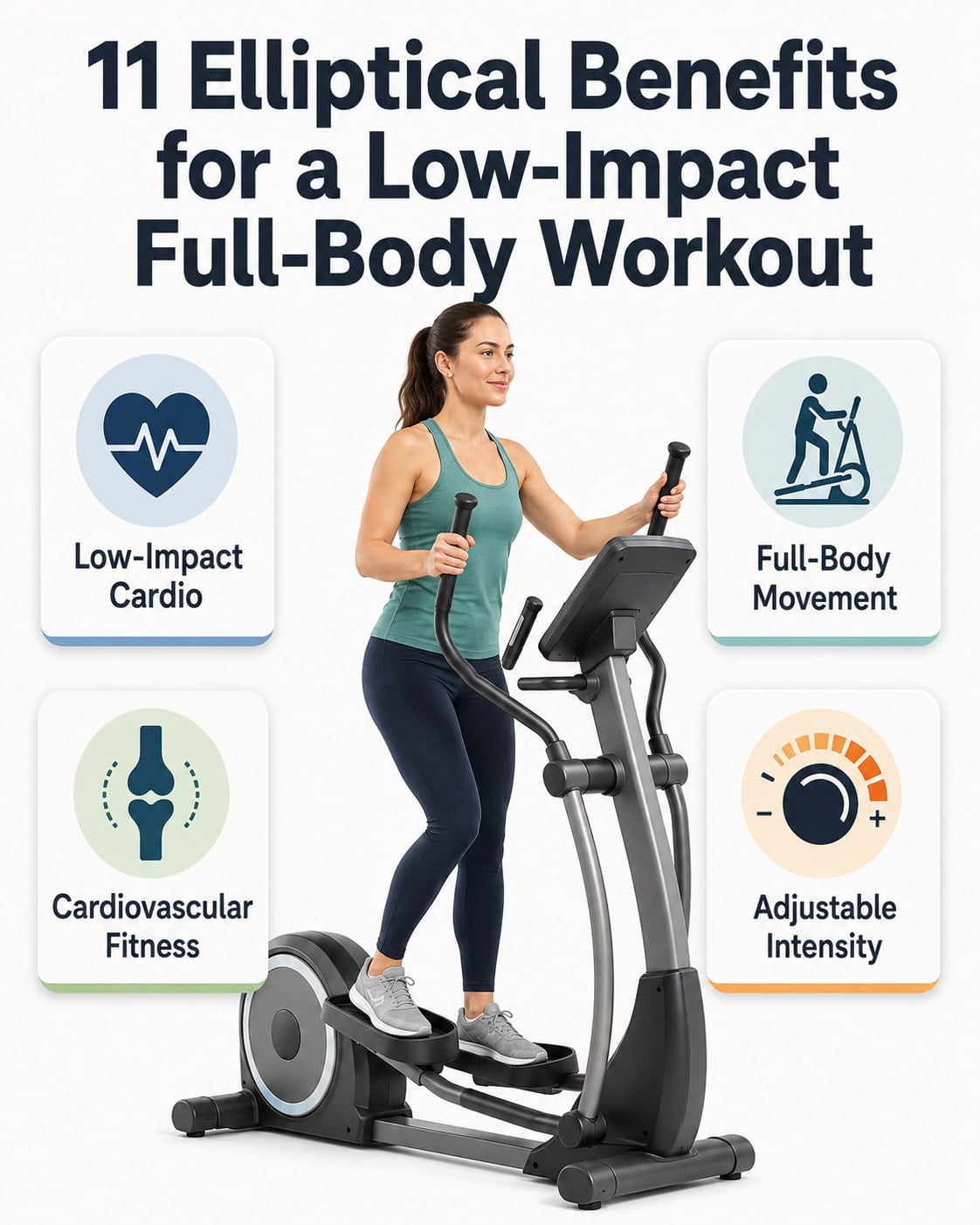
Elliptical benefits include improved cardiovascular fitness, meaningful calorie expenditure, lower-impact movement, and coordinated upper- and lower-body exercise. An elliptical can provide an effective low-impact, full-body cardio workout when you actively use the handles, choose an appropriate resistance, and maintain good form.
Because your feet remain on the pedals, an elliptical avoids the repeated foot strikes associated with running. You can also adjust the resistance, incline, speed, and workout duration to match your fitness level.
However, “low impact” does not mean “no joint stress,” and a full-body elliptical workout does not replace dedicated strength training. Understanding both the benefits and limitations can help you use the machine more effectively.
Under the current Physical Activity Guidelines for Americans, adults should generally complete 150–300 minutes of moderate-intensity aerobic activity or 75–150 minutes of vigorous activity each week. Adults also need muscle-strengthening exercise on at least two days per week. Elliptical workouts can count toward the aerobic portion when they raise your heart rate and breathing rate sufficiently.
What Is an Elliptical Workout?
An elliptical, sometimes called a cross-trainer, is a stationary cardio machine with pedals that travel in an oval pattern. Most models also have moving handles that allow you to push and pull with your arms while your legs move the pedals.
The basic motion combines elements of:
- Walking
- Stair climbing
- Cycling
- Cross-country skiing
Unlike a treadmill, an elliptical guides your feet through a fixed path. This can make the movement feel smooth and controlled, although stride length and pedal spacing differ between machines.
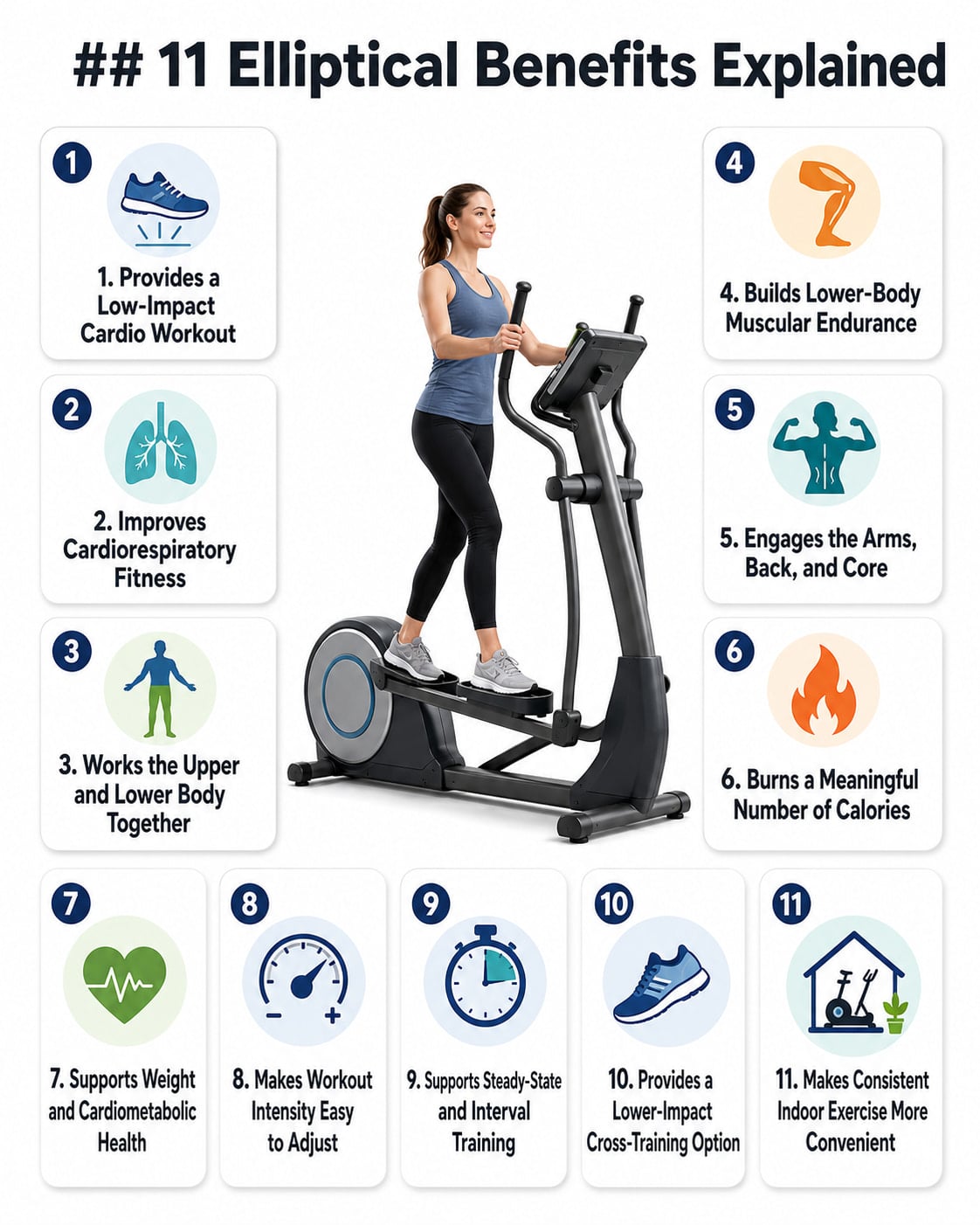
11 Elliptical Benefits Explained
1. Provides a Low-Impact Cardio Workout
One of the best-known elliptical benefits is its smooth, low-impact movement.
Your feet stay in contact with the pedals, so there is no repeated landing force from striking the ground. This may make the elliptical more comfortable than running for people who want to reduce pounding on their feet, ankles, knees, or hips.
A joint-loading study of elliptical exercise found lower vertical reaction forces and loading rates than level walking. However, researchers also measured greater forces or moments in certain directions at the knees and hips. In other words, an elliptical reduces impact but does not eliminate joint loading.
Machine fit also matters. An uncomfortable stride length, excessive resistance, poor foot placement, or leaning heavily on the handles can still aggravate your joints.
2. Improves Cardiorespiratory Fitness
Elliptical exercise challenges your heart and lungs to deliver oxygen to your working muscles. When performed consistently at a moderate or vigorous intensity, it can improve aerobic endurance.
In a small 12-week training study, women who trained on an elliptical three times per week improved their measured aerobic capacity. Their improvements were similar to those seen in groups using a treadmill or stair climber when training volume and intensity were comparable. Because the study was small, its findings should not be generalized to everyone, but it supports the elliptical as a legitimate cardio-training option.
Improved aerobic fitness may make everyday activities such as brisk walking, climbing stairs, and carrying groceries feel more manageable.
3. Works the Upper and Lower Body Together
An elliptical with moving handles allows your arms and legs to work at the same time.
Your legs press and pull the pedals while your arms push and pull the handles. This creates coordinated movement across several major muscle groups and can raise the overall effort compared with letting your legs do all the work.
To get the full-body benefit:
- Push one handle forward while pulling the other toward you.
- Keep your grip relaxed rather than squeezing tightly.
- Avoid allowing the handles to move your arms passively.
- Maintain steady pressure through both the pedals and handles.
The elliptical is still primarily a cardio and muscular-endurance machine. It does not provide the same progressive strength stimulus as exercises such as squats, rows, presses, and deadlifts.
4. Builds Lower-Body Muscular Endurance
Your quadriceps, glutes, hamstrings, and calves repeatedly contract throughout an elliptical workout. Resistance makes these muscles work harder to keep the pedals moving.
A comparison of elliptical training with walking and cycling found substantial quadriceps involvement during elliptical exercise. The researchers also observed greater quadriceps-hamstring coactivation than in the other exercise conditions they examined.
Over time, this repeated work can improve muscular endurance—the ability to continue producing force for an extended period.
It may also help beginners develop some initial strength. However, people seeking significant muscle growth or maximal strength should combine elliptical workouts with progressive resistance training.
5. Engages the Arms, Back, and Core
Actively using the moving handles can involve the:
- Biceps and upper back as you pull
- Triceps, chest, and shoulders as you push
- Abdominal and back muscles as you stabilize your torso
The amount of upper-body involvement depends on your effort. Lightly holding the handles while driving the entire movement with your legs provides little upper-body challenge.
Your core also helps you remain upright and control side-to-side movement. Keep your rib cage stacked over your pelvis, look forward, and avoid resting your body weight on the handles.
Clinical exercise guidance from Cleveland Clinic and Hospital for Special Surgery describes the elliptical as a full-body exercise when the moving handles are used purposefully.
6. Burns a Meaningful Number of Calories
Elliptical exercise can expend a meaningful amount of energy, particularly when you increase the resistance, pace, or workout duration.
The 2024 Adult Compendium of Physical Activities assigns elliptical exercise the following values:
| Elliptical effort | MET value | Estimated calories in 30 minutes for a 155-pound adult |
|---|---|---|
| Moderate effort | 5.0 METs | About 185 calories |
| Vigorous effort | 9.0 METs | About 332 calories |
These figures are estimates calculated from MET values. Actual calorie expenditure varies with body weight, fitness level, cadence, resistance, incline, active handle use, and machine design.
The calorie number displayed on the machine may also be inaccurate, especially when it does not use your individual body weight or heart-rate data.
7. Supports Weight and Cardiometabolic Health
Regular elliptical workouts increase your total physical activity and energy expenditure. That can support weight management when combined with an eating pattern that meets your nutritional needs and creates an appropriate calorie deficit.
The elliptical cannot selectively reduce belly fat, and no specific workout guarantees weight loss. Body-weight changes also depend on food intake, sleep, medications, health conditions, genetics, and daily movement outside the gym.
A June 2026 American Heart Association scientific statement reported that regular physical activity can improve blood pressure, insulin resistance, cholesterol, and cardiorespiratory fitness even when substantial weight loss does not occur.
That means an elliptical routine may support health even when the scale changes slowly or not at all.
8. Makes Workout Intensity Easy to Adjust
Most ellipticals allow you to change one or more of the following:
- Resistance
- Incline
- Pedaling speed
- Workout duration
- Direction
- Interval settings
Beginners can start with a low resistance and a comfortable pace. More experienced users can add resistance, increase cadence, extend the workout, or perform intervals.
Increase only one variable at a time when possible. Raising resistance, incline, speed, and duration simultaneously can cause fatigue and make it difficult to maintain good technique.
More resistance is not automatically better. Use a setting that allows you to move smoothly without bouncing, twisting, or pulling excessively on the handles.
9. Supports Steady-State and Interval Training
The elliptical works well for several cardio formats.
For a steady-state workout, maintain a consistent moderate effort for 20–45 minutes. This can help build aerobic endurance without requiring frequent changes to the controls.
For interval training, alternate harder periods with easier recovery periods. For example:
- 30 seconds hard and 90 seconds easy
- One minute hard and two minutes easy
- Two minutes moderately hard and two minutes easy
Intervals can make a shorter session challenging, but they are not necessary for everyone. Beginners should first become comfortable with steady, controlled exercise before adding high-intensity intervals.
10. Provides a Lower-Impact Cross-Training Option
Runners, walkers, and recreational athletes can use the elliptical to add aerobic training without repeating the exact impact pattern of their primary activity.
In one small study, participants exercising at the same perceived effort had similar oxygen consumption and energy expenditure on an elliptical and treadmill, although their heart rates were higher on the elliptical. This suggests that the elliptical can provide a useful cardio stimulus during cross-training.
It is not a perfect replacement for sport-specific practice. Running outdoors, for example, requires ground contact, balance, forward propulsion, and impact tolerance that the elliptical does not reproduce.
Cross-training is most useful as part of a varied program rather than as an automatic substitute for every other activity.
11. Makes Consistent Indoor Exercise More Convenient
An elliptical allows you to exercise indoors regardless of heat, cold, rain, darkness, traffic, or poor air quality.
You can control the duration and intensity without planning a route. You can also stop immediately if you feel uncomfortable, which may be reassuring for beginners.
Convenience matters because the most effective exercise program is one you can perform regularly. An activity that fits your schedule, feels manageable, and does not repeatedly aggravate pain is more likely to become a sustainable habit.
What Muscles Does an Elliptical Work?
The exact muscle contribution depends on the machine, resistance, incline, direction, posture, and how actively you use the handles.
| Body area | Main muscles involved | Primary role |
|---|---|---|
| Front of thighs | Quadriceps | Straighten the knees and press the pedals |
| Hips and buttocks | Gluteus maximus | Extend the hips and drive the pedals |
| Back of thighs | Hamstrings | Assist hip extension and knee control |
| Lower legs | Calves | Help control the ankles and pedals |
| Arms | Biceps and triceps | Pull and push the handles |
| Chest and back | Pectorals, trapezius, and latissimus dorsi | Assist the pushing and pulling motion |
| Shoulders | Deltoids | Move and stabilize the handles |
| Core | Abdominals, obliques, and spinal muscles | Maintain an upright, stable torso |
Increasing resistance can raise the muscular demand, but the elliptical remains primarily an aerobic and muscular-endurance exercise.
Elliptical Benefits and Limitations at a Glance
| Potential benefit | Important limitation |
|---|---|
| Lower impact than running | Not completely free of knee or hip loading |
| Upper- and lower-body movement | Does not replace full-body strength training |
| Meaningful calorie expenditure | Does not guarantee fat loss |
| Adjustable resistance and incline | High settings can cause poor form |
| Indoor convenience | Does not build outdoor walking or running skills as specifically |
| Standing, weight-bearing exercise | May provide less bone-loading stimulus than impact exercise or resistance training |
| Controlled movement path | A fixed stride may not fit every body comfortably |
How to Use an Elliptical Correctly
Proper technique can make your workout more comfortable and effective.
Stand Tall
Keep your head up, shoulders relaxed, and torso upright. Avoid rounding your back or leaning heavily on the console.
Keep Your Feet Flat
Maintain contact through the whole foot instead of lifting your heels excessively. Position your feet so your knees track comfortably in line with your toes.
Use the Handles Actively
Push and pull the moving handles while continuing to drive the pedals with your legs. Keep your grip light enough to avoid unnecessary hand and shoulder tension.
Choose Controllable Resistance
Use enough resistance to prevent the pedals from moving uncontrollably, but not so much that you have to rock your body or pull yourself forward.
Move Smoothly
Aim for a quiet, controlled stride. Bouncing, twisting, or repeatedly shifting your hips may indicate that your speed or resistance is too high.
Warm Up and Cool Down
Begin with three to five minutes at an easy pace. Finish by gradually reducing your resistance and speed rather than stopping abruptly.
A Simple 20-Minute Beginner Elliptical Workout
Use a 1–10 effort scale, where 1 is extremely easy and 10 is your maximum effort.
| Time | Effort | Instructions |
|---|---|---|
| 0–4 minutes | 2–3 | Warm up at low resistance |
| 4–10 minutes | 4–5 | Maintain a comfortable, purposeful pace |
| 10–16 minutes | 6, then 3–4 | Alternate one brisk minute with one easy minute |
| 16–18 minutes | 4–5 | Return to a steady moderate pace |
| 18–20 minutes | 2–3 | Reduce resistance and cool down |
Beginners can shorten the session to 10–15 minutes. Add a few minutes as your comfort and endurance improve.
How Often Should You Use an Elliptical?
Your ideal frequency depends on your fitness level, workout intensity, recovery, and other exercise.
A practical starting point is:
- Two to four elliptical sessions per week
- 15–30 minutes per session
- Mostly easy-to-moderate effort
- At least one easier day after a demanding interval workout
Thirty minutes on an elliptical five days per week can provide 150 minutes of aerobic activity, provided the sessions reach at least moderate intensity.
You should still include strength training for the major muscle groups at least twice per week. Walking, mobility work, balance exercises, and other enjoyable activities can also help create a more complete program.
Is an Elliptical Good for Your Knees?
An elliptical may feel more comfortable than running because your feet remain supported and there is no landing impact. However, it is not automatically appropriate for every knee problem.
The repeated knee-bending motion, resistance level, pedal spacing, and machine stride can affect comfort. Some research has found that ellipticals can create meaningful knee and hip joint moments despite producing lower impact forces than walking.
Stop or reduce the workout if you experience:
- Sharp or increasing joint pain
- Swelling
- A feeling that the knee is giving way
- Pain that changes your normal movement
- Symptoms that remain worse after the workout
People recovering from knee or hip surgery should follow their surgeon’s or physical therapist’s exercise timeline rather than assuming low-impact exercise is immediately safe.
Who Should Be Cautious With Elliptical Exercise?
Speak with an appropriate healthcare professional before starting or significantly increasing exercise when you have:
- A recent injury or operation
- Significant balance or coordination problems
- Unexplained chest discomfort
- A heart or lung condition that limits exercise
- Persistent knee, hip, ankle, or back pain
- Dizziness, fainting, or unexplained shortness of breath
- Medical instructions that restrict physical activity
Hold the stationary supports when getting on and off the machine. Begin at the lowest resistance, and confirm that the pedals and stride feel comfortable before increasing your speed.
Stop exercising and seek urgent medical attention for chest pain, fainting, severe breathing difficulty, or other sudden and concerning symptoms.
Frequently Asked Questions
Is an elliptical good for weight loss?
An elliptical can support weight loss by increasing calorie expenditure and helping you become more active. Results still depend on your total energy intake, workout consistency, sleep, health, medications, and other lifestyle factors. It does not guarantee weight loss or target fat from one body area.
Is 30 minutes on an elliptical enough?
Thirty minutes can be an effective cardio session. Five moderate-intensity 30-minute workouts would total 150 minutes, meeting the minimum weekly aerobic target for most adults. Shorter sessions can also provide benefits, especially when you are starting.
Does an elliptical burn belly fat?
Elliptical exercise uses energy and may contribute to overall fat loss when you maintain an appropriate calorie deficit. It cannot selectively burn fat from your abdomen. Where your body loses fat first is influenced partly by genetics and individual physiology.
Does an elliptical provide a full-body workout?
It can provide full-body cardio when you actively push and pull the moving handles while driving the pedals with your legs. However, it does not train every muscle through a full range of motion or replace progressive resistance training.
Can you use an elliptical every day?
Some people can perform easy or moderate elliptical exercise on consecutive days. Daily high-intensity workouts may not provide enough recovery. Vary your intensity, monitor pain and fatigue, and include other forms of movement and strength training.
Does an elliptical build muscle?
The elliptical can improve muscular endurance and may produce modest initial strength gains in beginners. It is generally not the best tool for substantial muscle growth because resistance and progression are more limited than with dedicated strength exercises.
Is an elliptical better than a treadmill?
Neither machine is universally better. An elliptical usually provides less landing impact and more upper-body involvement. A treadmill more closely reproduces natural walking and running and may be preferable for developing those specific skills. Choose the machine that fits your goals, comfort, and ability to exercise consistently.
Conclusion
The main elliptical benefits are lower-impact cardio, adjustable intensity, meaningful calorie expenditure, and coordinated upper- and lower-body movement. It can be especially useful when you want an indoor workout that challenges your heart and muscles without the repeated foot strikes of running.
Start with a comfortable resistance and 10–20 minutes of controlled exercise. Gradually increase your duration or intensity as your fitness improves, and combine elliptical workouts with strength training for a more balanced routine.
References
- Office of Disease Prevention and Health Promotion: Physical Activity Guidelines for Americans
- CDC: Health Benefits of Physical Activity for Adults
- 2024 Adult Compendium of Physical Activities: Conditioning Exercise
- PubMed: Joint Loading in the Lower Extremities During Elliptical Exercise
- PubMed Central: Comparison of Elliptical Training, Walking, Treadmill Walking, and Cycling
- PubMed: Physiological Changes Following a 12-Week Elliptical Training Program
- PubMed: Energy Expenditure on a Treadmill Versus an Elliptical
- American Heart Association: Physical Activity in Obesity Treatment and Cardiometabolic Health
- Hospital for Special Surgery: Elliptical Benefits and Exercise Guidance
- Cleveland Clinic: Elliptical Machine Benefits