
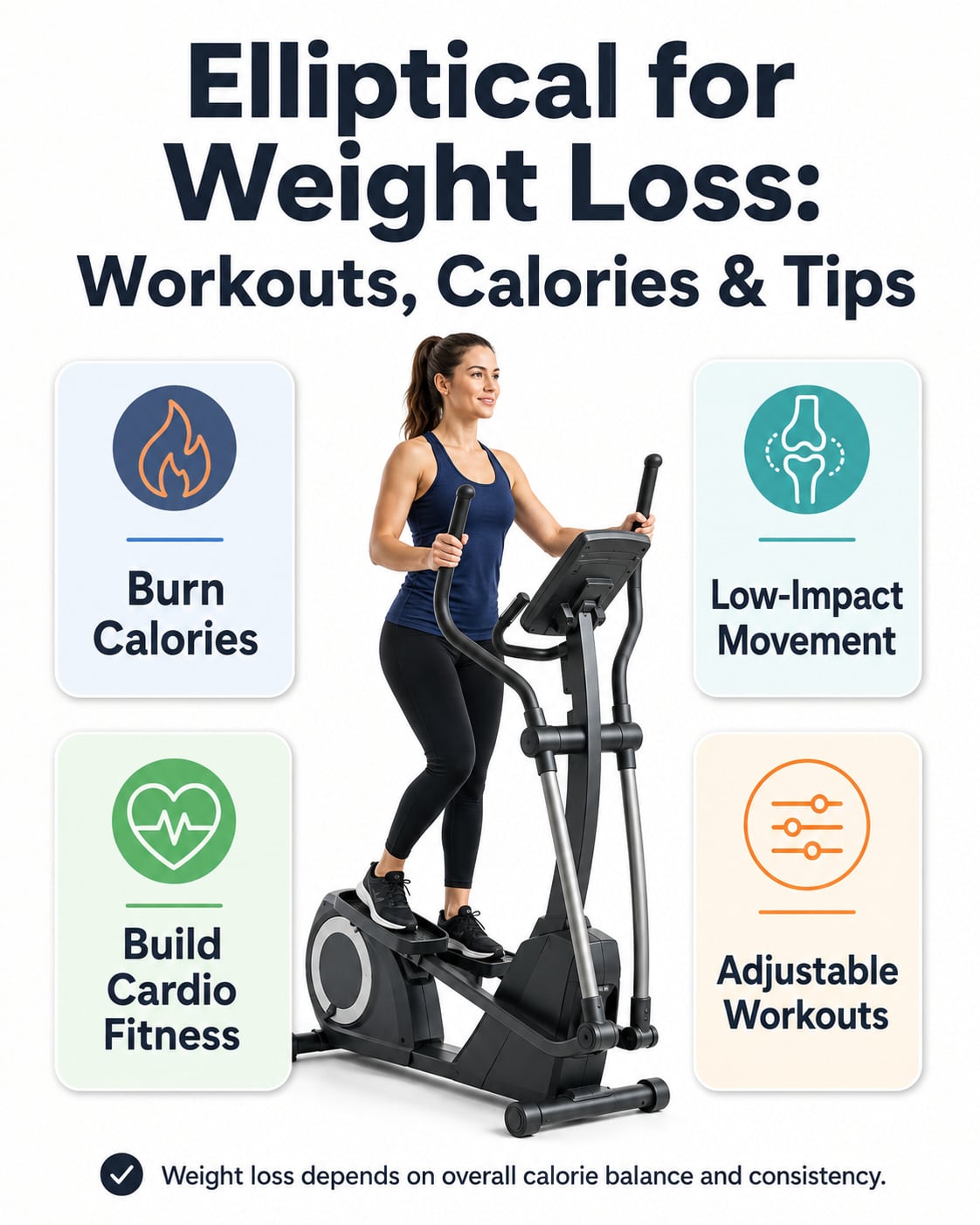
The elliptical can help with weight loss when regular workouts contribute to a sustainable calorie deficit. It burns calories, improves cardiovascular fitness, and allows you to adjust the resistance, pace, and workout length to match your current fitness level.
However, elliptical exercise is only one part of a successful weight-loss plan. Your overall calorie intake, daily movement, strength training, sleep, recovery, medications, and health conditions can all affect your results.
A practical starting goal is to work toward 150 minutes of moderate-intensity aerobic activity each week, while also completing muscle-strengthening exercise at least twice a week. Some people may need more activity, nutrition changes, or both to achieve and maintain weight loss.
Is the Elliptical Good for Weight Loss?
Yes. The elliptical can be an effective cardio machine for weight loss because it increases the amount of energy your body uses.
According to the CDC’s guidance on physical activity and weight, combining physical activity with a reduction in calorie intake creates the calorie deficit needed for weight loss. The CDC also notes that reducing calorie intake usually accounts for most initial weight loss, while regular physical activity is particularly important for maintaining the result.
A 2024 systematic review and meta-analysis published in JAMA Network Open examined 116 randomized clinical trials involving 6,880 adults with overweight or obesity. The researchers found that body weight, waist circumference, and body-fat measures generally decreased as weekly moderate-to-vigorous aerobic exercise increased toward 300 minutes.
The analysis also found that at least 150 minutes of aerobic exercise per week was associated with meaningful reductions in waist circumference and body-fat measures. However, this research evaluated aerobic exercise broadly rather than elliptical training alone, and the average results cannot predict exactly how much weight one person will lose.
The elliptical works best when you:
- Exercise consistently
- Use enough resistance or speed to create a meaningful effort
- Gradually increase your weekly exercise volume
- Avoid compensating by eating back all the calories you believe you burned
- Combine cardio with strength training and balanced eating habits
How the Elliptical Supports Weight Loss
It Increases Calorie Expenditure
Your body uses energy to move the pedals and handles, maintain posture, and support your working muscles. Increasing your workout duration, resistance, or pace can raise energy expenditure.
The number of calories you burn is influenced by your:
- Body weight
- Fitness level
- Workout duration
- Resistance setting
- Pedaling speed
- Use of the moving handles
- Movement efficiency
- Elliptical machine design
Two people completing the same workout may therefore burn different numbers of calories.
It Makes Workout Intensity Easy to Adjust
You can increase or decrease the resistance and pace without stopping the workout. This makes the elliptical suitable for steady cardio, interval training, recovery sessions, and longer endurance workouts.
Machine resistance levels are not standardized. Level 8 on one elliptical may feel completely different from level 8 on another. Use your breathing and perceived effort instead of relying only on the number displayed on the console.
It Removes Repeated Landing Impact
Your feet remain in contact with the pedals, so elliptical exercise avoids the repeated foot strikes that occur during running.
Research comparing elliptical exercise with walking found lower loading rates around heel strike during elliptical movement. However, the machine still places demands on your hips, knees, ankles, muscles, and tendons. Low impact does not mean no joint loading or no possibility of discomfort.
This lower-impact movement may make it easier for some people to accumulate more weekly exercise without the soreness they experience from running. It is not automatically the best choice for every joint problem or injury.
It Can Involve the Upper and Lower Body
Ellipticals with movable handles allow you to push and pull with your arms while pedaling with your legs.
Your legs still provide much of the effort, but coordinated handle use can involve your back, chest, shoulders, and arms. Avoid letting the handles move your arms passively. Push and pull them with control while maintaining an upright posture.
How Many Calories Does the Elliptical Burn?
The exact number varies, but standardized MET values can provide a useful estimate.
A MET, or metabolic equivalent, represents the energy cost of an activity relative to rest. The 2024 Adult Compendium of Physical Activities assigns the following values:
- Elliptical trainer at moderate effort: 5.0 METs
- Elliptical trainer at vigorous effort: 9.0 METs
These are standardized research estimates rather than guarantees for an individual workout.
Estimated Calories Burned in 30 Minutes
The following estimates use the standard MET calculation:
Calories per minute = METs × 3.5 × body weight in kilograms ÷ 200
| Body weight | Moderate effort, 5 METs | Vigorous effort, 9 METs |
|---|---|---|
| 125 pounds | About 149 calories | About 268 calories |
| 155 pounds | About 185 calories | About 332 calories |
| 185 pounds | About 220 calories | About 396 calories |
| 200 pounds | About 238 calories | About 429 calories |
Vigorous effort should feel genuinely challenging. Simply selecting a high resistance number does not necessarily mean you are exercising at 9 METs.
Also, 9 METs does not mean resistance level 9. METs measure estimated energy expenditure, while machine resistance levels are manufacturer-specific settings.
Why the Console’s Calorie Number May Be Different
An elliptical console calculates calories using an algorithm. Its estimate may be affected by whether you entered your correct weight, whether the machine considers resistance and incline, and how the manufacturer designed the calculation.
Use the displayed number as a tracking tool rather than a precise measurement. For example, you can compare similar workouts completed on the same machine, but you should not assume you burned the exact number shown.
Avoid automatically eating back every calorie displayed by the machine. If the estimate is too high, doing so can reduce or eliminate your intended calorie deficit.
How Hard Should an Elliptical Workout Feel?
A simple 1-to-10 rating of perceived exertion, or RPE, can help you control your intensity.
| Effort | RPE | How it should feel |
|---|---|---|
| Very easy | 1–2 | Comfortable warm-up or recovery pace |
| Easy | 3 | Light breathing; easy to maintain |
| Moderate | 4–6 | Breathing faster but still able to talk |
| Hard | 7–8 | Challenging; only short sentences are comfortable |
| Very hard | 9 | Difficult to sustain; only a few words at a time |
| Maximum | 10 | All-out effort; unnecessary for most weight-loss workouts |
During moderate-intensity exercise, your breathing and heart rate are noticeably faster, but you can still have a conversation. During vigorous exercise, breathing becomes too difficult for normal conversation.
Most of your weekly elliptical training does not need to be extremely hard. Moderate workouts are often easier to recover from and can help you accumulate more total exercise time.
How Long Should You Use the Elliptical for Weight Loss?
The current Physical Activity Guidelines for Americans recommend that adults complete:
- 150–300 minutes of moderate-intensity aerobic activity per week
- Or 75–150 minutes of vigorous-intensity aerobic activity
- Or an equivalent combination of both
- Plus muscle-strengthening activity at least two days per week
You do not need to complete all your weekly exercise in long sessions. Shorter workouts still count toward your total.
Beginner Starting Point
A beginner could start with:
- 15–20 minutes per workout
- Three workouts per week
- Mostly easy-to-moderate effort
- At least one recovery day between challenging sessions
Once that feels comfortable, add approximately five minutes to one or two workouts. Continue until you can perform 25–30 minutes without losing your posture or feeling excessively fatigued.
Intermediate Starting Point
Someone who already exercises regularly could aim for:
- 30–45 minutes per session
- Four or five days per week
- Mostly moderate exercise
- One or two harder interval workouts
- At least one lighter or rest day
Do not increase workout duration, resistance, interval frequency, and speed all at once. Changing one variable at a time makes it easier to evaluate how your body responds.
Best Elliptical Workouts for Weight Loss
The following workouts use perceived effort because machine levels vary. Adjust the resistance and pace until you reach the recommended RPE without rocking, bouncing, or leaning heavily on the handles.
20-Minute Beginner Elliptical Workout
This workout helps you practice your technique and establish a consistent routine.
| Time | Effort | Instructions |
|---|---|---|
| 0–5 minutes | RPE 2–3 | Pedal easily and gradually raise your breathing rate |
| 5–10 minutes | RPE 4 | Increase the resistance or pace slightly |
| 10–15 minutes | RPE 5 | Maintain a purposeful but controlled effort |
| 15–20 minutes | RPE 2–3 | Gradually reduce the resistance and cool down |
Complete this workout two or three times per week. Increase the duration only when you can finish with controlled form and normal recovery.
30-Minute Steady-State Elliptical Workout
Steady-state cardio is useful for accumulating moderate-intensity exercise without the fatigue of repeated hard intervals.
| Time | Effort | Instructions |
|---|---|---|
| 0–5 minutes | RPE 2–3 | Warm up at low resistance |
| 5–10 minutes | RPE 4 | Settle into a comfortable working pace |
| 10–25 minutes | RPE 5–6 | Maintain consistent speed and resistance |
| 25–30 minutes | RPE 2–3 | Cool down gradually |
You should finish feeling as though you worked, but not completely exhausted.
30-Minute Elliptical Interval Workout
Intervals alternate challenging efforts with easier recovery periods. They can make a workout more engaging and help improve cardiovascular fitness.
| Time | Effort | Instructions |
|---|---|---|
| 0–5 minutes | RPE 2–3 | Warm up gradually |
| 5–25 minutes | RPE 7–8 and 3–4 | Alternate 1 minute hard with 1 minute easy for 10 rounds |
| 25–30 minutes | RPE 2–3 | Cool down at low resistance |
During each hard interval, increase the pace, resistance, or both. Reduce the setting if your shoulders tense, your hips rock, or you begin pulling excessively on the handles.
Beginners can start with 30 seconds hard followed by 90 seconds easy.
45-Minute Endurance Elliptical Workout
A longer moderate workout increases your total weekly exercise volume without requiring an all-out effort.
| Time | Effort | Instructions |
|---|---|---|
| 0–5 minutes | RPE 2–3 | Easy warm-up |
| 5–15 minutes | RPE 4 | Comfortable aerobic pace |
| 15–35 minutes | RPE 5–6 | Controlled moderate effort |
| 35–40 minutes | RPE 4 | Reduce the resistance slightly |
| 40–45 minutes | RPE 2–3 | Cool down |
Build up to this workout gradually. You do not need to begin with 45 minutes if you are currently comfortable with only 20 or 30.
30-Minute Resistance-Focused Elliptical Workout
This routine uses resistance changes to challenge your legs without requiring extremely fast pedaling.
| Time | Effort | Instructions |
|---|---|---|
| 0–5 minutes | RPE 2–3 | Warm up at light resistance |
| 5–25 minutes | RPE 5–7 | Alternate 3 minutes at moderate resistance with 2 minutes at higher resistance |
| 25–30 minutes | RPE 2–3 | Lower the resistance and cool down |
During the higher-resistance sections, maintain a smooth stride. The resistance is too high if you have to twist, rock from side to side, or use the handles to hold your body up.
Sample Weekly Elliptical Plan for Weight Loss
This example reaches 150 minutes of elliptical exercise and includes two strength-training days. It is best suited to someone who already tolerates regular exercise.
| Day | Workout |
|---|---|
| Monday | 30-minute steady-state elliptical workout |
| Tuesday | 20-minute easy elliptical workout plus full-body strength training |
| Wednesday | Rest, mobility work, or an easy walk |
| Thursday | 30-minute elliptical interval workout |
| Friday | Full-body strength training |
| Saturday | 45-minute endurance elliptical workout |
| Sunday | 25-minute easy-to-moderate elliptical workout |
Weekly elliptical total: 150 minutes
A beginner does not need to start with this much. Three 20-minute workouts provide a more manageable starting point. Add time gradually as your fitness and recovery improve.
You can also substitute walking, cycling, swimming, or another form of cardio for one or more elliptical sessions. Your plan does not need to use one machine exclusively.
How to Use the Elliptical Correctly
Good form helps you produce the effort with your muscles instead of leaning on the machine.
1. Step Onto the Machine Carefully
Hold the fixed handles while stepping onto the pedals. Remember that the pedals may begin moving immediately.
2. Center Your Feet on the Pedals
Keep your entire foot supported rather than shifting onto your toes. Your heels may lift slightly because of the machine’s motion, but avoid deliberately staying on the balls of your feet.
3. Stand Upright
Keep your chest lifted, shoulders relaxed, and head facing forward. Avoid rounding your back or leaning heavily over the console.
Your torso may have a slight natural forward angle, but your body should not depend on the handles for support.
4. Keep Your Knees Tracking Naturally
Your knees should generally move in the same direction as your toes. Avoid allowing them to collapse sharply inward.
A small difference in alignment can occur because of individual anatomy and machine design. Stop or adjust your position if the movement causes pain.
5. Use a Light Grip
Hold the handles firmly enough to remain secure, but do not squeeze them unnecessarily. A tight grip can increase tension in your hands, arms, shoulders, and neck.
6. Move the Pedals Actively
Do not let the machine carry you through the motion. Push the pedals down and back, then continue the movement smoothly forward.
Hospital for Special Surgery advises using enough resistance to feel challenged while still maintaining control and technique. It also recommends learning the leg movement before adding the moving handles if coordinating both feels difficult.
7. Use the Movable Handles When You Can Control Them
Push and pull the handles in coordination with your legs. Keep your torso steady instead of rotating or shifting side to side.
Using the fixed handles is reasonable when you are learning the movement, regaining balance, or unable to coordinate the arm action safely.
8. Cool Down Before Stepping Off
Reduce the pace and resistance for several minutes. Wait for the pedals to slow, hold the fixed handles, and step off carefully.
Tips to Get Better Weight-Loss Results
Combine Exercise With Sustainable Eating Habits
It is possible to complete regular elliptical workouts without losing weight if your calorie intake matches or exceeds your energy expenditure.
You do not need an extreme diet. Focus on repeatable habits such as:
- Eating regular, balanced meals
- Including protein-rich foods
- Choosing fruits, vegetables, whole grains, and other fiber-rich foods
- Watching portions of calorie-dense foods
- Limiting drinks that add substantial calories without much fullness
- Planning snacks instead of eating them automatically
- Avoiding the habit of rewarding every workout with extra food
The CDC notes that gradual weight loss of approximately one to two pounds per week is more likely to be maintained than faster loss, although individual progress can be slower or less consistent. Body weight is also influenced by medications, medical conditions, hormones, age, stress, sleep, and genetics.
Strength Train at Least Twice a Week
Elliptical training improves aerobic fitness, but it does not replace progressive strength training.
A 2025 systematic review and meta-analysis of resistance exercise during dietary weight loss found that adding resistance exercise helped preserve fat-free mass, increased fat-mass loss, and improved strength compared with diet-only weight-loss programs. It did not necessarily produce a larger change in total scale weight.
A basic strength program can include movements such as:
- Squats or leg presses
- Hip hinges or deadlift variations
- Rows
- Chest presses or push-ups
- Overhead presses
- Calf raises
- Core exercises
Select exercises that are appropriate for your experience, mobility, and health.
Increase Duration Before Adding Frequent Hard Intervals
Longer moderate workouts are often easier to recover from than repeated high-intensity sessions.
Before adding multiple interval workouts, establish a routine you can maintain. For example:
- Exercise three days per week.
- Increase your workouts from 20 to 30 minutes.
- Add a fourth moderate session.
- Add one interval workout.
- Increase resistance or interval difficulty gradually.
Intervals can be useful, but they are not required for weight loss.
Use Enough Resistance to Stay in Control
Very low resistance may allow the pedals to move with little muscular effort. Excessive resistance can cause poor technique and premature fatigue.
Choose a setting that allows you to:
- Maintain an upright posture
- Control the entire pedal cycle
- Keep a smooth rhythm
- Avoid bouncing or rocking
- Reach your intended RPE
Track More Than the Scale
Body weight can change from day to day because of hydration, sodium intake, food volume, digestion, and hormonal changes.
Useful progress measures include:
- Average weekly body weight
- Waist circumference
- Weekly exercise minutes
- Workout resistance and duration
- Perceived effort
- Resting and exercise heart rate trends
- Strength-training performance
- How your clothes fit
- How easily you complete daily activities
Use measurements collected under similar conditions. For example, weigh yourself at a consistent time rather than comparing a morning measurement with an evening measurement.
Protect Your Recovery
More exercise is not always better. Recovery supports workout performance and consistency.
Signs that you may need to reduce your training load include:
- Persistent fatigue
- Declining workout performance
- Unusual irritability
- Sleep disruption
- Joint or tendon pain
- Muscle soreness that does not improve
- Loss of motivation
- An unusually high resting heart rate
Replace a hard workout with an easy session or rest day when necessary.
Common Elliptical Weight-Loss Mistakes
Leaning Heavily on the Handles
Supporting your body weight with your arms can reduce the muscular demand and encourage poor posture. Lower the resistance or pace until you can stand more independently.
Doing the Same Easy Workout Every Time
Repeating the same pace and resistance can still support activity, but your fitness may stop progressing.
Gradually change one variable, such as:
- Duration
- Resistance
- Pace
- Interval structure
- Weekly frequency
Making Every Workout High Intensity
Hard intervals require more recovery and are difficult to perform well every day. Most people benefit from combining one or two harder sessions with moderate and easy workouts.
Trusting the Calorie Display Too Much
Console calories are estimates. Use them to compare similar sessions, not as permission to consume the same number of extra calories.
Increasing Too Much Too Soon
Jumping from occasional 20-minute workouts to daily 60-minute sessions can increase fatigue and musculoskeletal discomfort. Build your weekly volume progressively.
Expecting the Elliptical to Target Belly Fat
Exercise cannot force fat loss from one specific body area. The elliptical can contribute to overall fat loss, which may eventually reduce abdominal fat, but genetics and individual fat-distribution patterns influence where visible changes appear first.
Ignoring Strength Training
Cardio can increase calorie expenditure, but strength training helps you maintain or improve muscular strength and supports the preservation of lean mass during weight loss.
Elliptical vs Other Cardio for Weight Loss
No cardio machine is automatically best for everyone.
| Exercise | Main advantage | Possible limitation |
|---|---|---|
| Elliptical | Adjustable, low-impact movement with optional arm involvement | Motion may feel unnatural, and poor posture is easy to hide |
| Treadmill walking | Familiar movement that can be adjusted with speed and incline | More repeated landing impact than the elliptical |
| Running | Can provide vigorous exercise without needing a machine outdoors | Higher impact and greater recovery demands |
| Stationary bike | Seated, low-impact cardio that is easy to control | Less weight-bearing and limited upper-body involvement |
| Rowing machine | Involves the upper and lower body | Requires more technical coordination |
| Stair climber | Strong lower-body demand and high potential intensity | Can fatigue the legs quickly and encourage leaning on the rails |
A small study of 18 untrained adults found that treadmill and elliptical exercise produced similar oxygen consumption and energy expenditure when participants worked at the same perceived effort, even though heart rate was higher on the elliptical. Because the study was small, it should not be interpreted as proof that both machines always burn the same number of calories.
The better option is generally the one that allows you to train consistently, reach an appropriate intensity, and complete enough weekly exercise without worsening pain.
When to Speak With a Healthcare Professional
Speak with a qualified healthcare professional before beginning vigorous elliptical intervals if you have a medical condition, have recently had surgery, are pregnant and have exercise concerns, or have been advised to limit physical activity.
You should also seek guidance if exercise repeatedly causes:
- Knee, hip, ankle, or back pain
- Unusual weakness
- Heart palpitations
- Dizziness or near-fainting
- Shortness of breath that is unexpected for the effort
- Symptoms that continue after the workout ends
Stop exercising and seek urgent medical help for chest pressure or pain, fainting, or sudden unexplained shortness of breath. These can be warning signs of a medical emergency.
Frequently Asked Questions
Is 30 Minutes on the Elliptical Enough to Lose Weight?
Thirty minutes can contribute meaningfully to weight loss, especially when performed five days per week. Five 30-minute sessions provide 150 weekly minutes, which meets the minimum aerobic target associated with substantial health benefits.
Weight loss still depends on your total calorie balance. Thirty minutes may not produce weight loss if increased eating offsets the calories used during exercise.
How Many Days a Week Should I Use the Elliptical?
Beginners can start with three days per week. More experienced users may complete four to six sessions if some workouts are easy and recovery remains adequate.
You do not have to use the elliptical every day. Walking, strength training, cycling, swimming, and rest days can all be part of a balanced plan.
Can the Elliptical Reduce Belly Fat?
The elliptical cannot selectively burn belly fat. It can support overall fat loss by increasing energy expenditure.
As total body fat decreases, abdominal fat may also decrease. Where you lose visible fat first is influenced by genetics, hormones, age, and body-fat distribution.
What Is the Best Elliptical Resistance for Weight Loss?
There is no universal resistance number because machine settings differ.
For steady cardio, choose a resistance that produces an RPE of approximately 4–6 while allowing you to maintain smooth, controlled form. During intervals, you may temporarily increase the resistance or pace to reach an RPE of 7–8.
Is Speed or Resistance Better for Weight Loss?
Both can raise workout intensity.
Higher speed increases movement rate, while higher resistance increases the force required for each stride. Use a combination that raises your breathing rate without causing bouncing, rocking, or loss of control.
For beginners, increasing workout duration is usually a more manageable first progression.
How Long Does It Take to See Results From an Elliptical?
There is no reliable universal timeline. You may notice improved endurance and easier workouts before you see major changes in body weight or appearance.
Your rate of progress depends on your calorie deficit, starting weight, exercise consistency, strength training, sleep, medications, health, and other individual factors. Evaluate trends over several weeks rather than judging the plan from a few daily weigh-ins.
Can I Use the Elliptical Every Day?
Some people can use it daily when most sessions are easy or moderate. However, daily training is not required for weight loss.
Take a rest or lighter day when you have persistent fatigue, declining performance, or joint and tendon discomfort. Alternating the elliptical with other activities can also reduce repetitive stress and keep your routine more enjoyable.
Conclusion
The elliptical can be a practical and effective part of a weight-loss plan. It increases calorie expenditure, supports cardiovascular fitness, and allows you to adjust your workouts without the repeated landing impact of running.
Start with a duration you can manage, use moderate effort for most sessions, and gradually work toward at least 150 weekly minutes. Combine your elliptical workouts with balanced eating habits, two strength-training sessions per week, and enough recovery.
Choose one beginner or steady-state workout, schedule your next three sessions, and track your weekly minutes rather than chasing a perfect calorie number.
References
- CDC — Physical Activity and Your Weight and Health
- CDC — Steps for Losing Weight
- Physical Activity Guidelines for Americans — Top 10 Things to Know
- 2024 Adult Compendium of Physical Activities — Conditioning Exercise
- JAMA Network Open — Aerobic Exercise and Weight Loss in Adults
- PubMed — Resistance Exercise During Dietary Weight Loss
- Hospital for Special Surgery — Elliptical Benefits and Proper Use
- PubMed — Energy Expenditure on a Treadmill vs. an Elliptical
- PubMed — Joint Loading During Elliptical Exercise
- American Heart Association — Heart Attack, Stroke and Cardiac Arrest Symptoms