
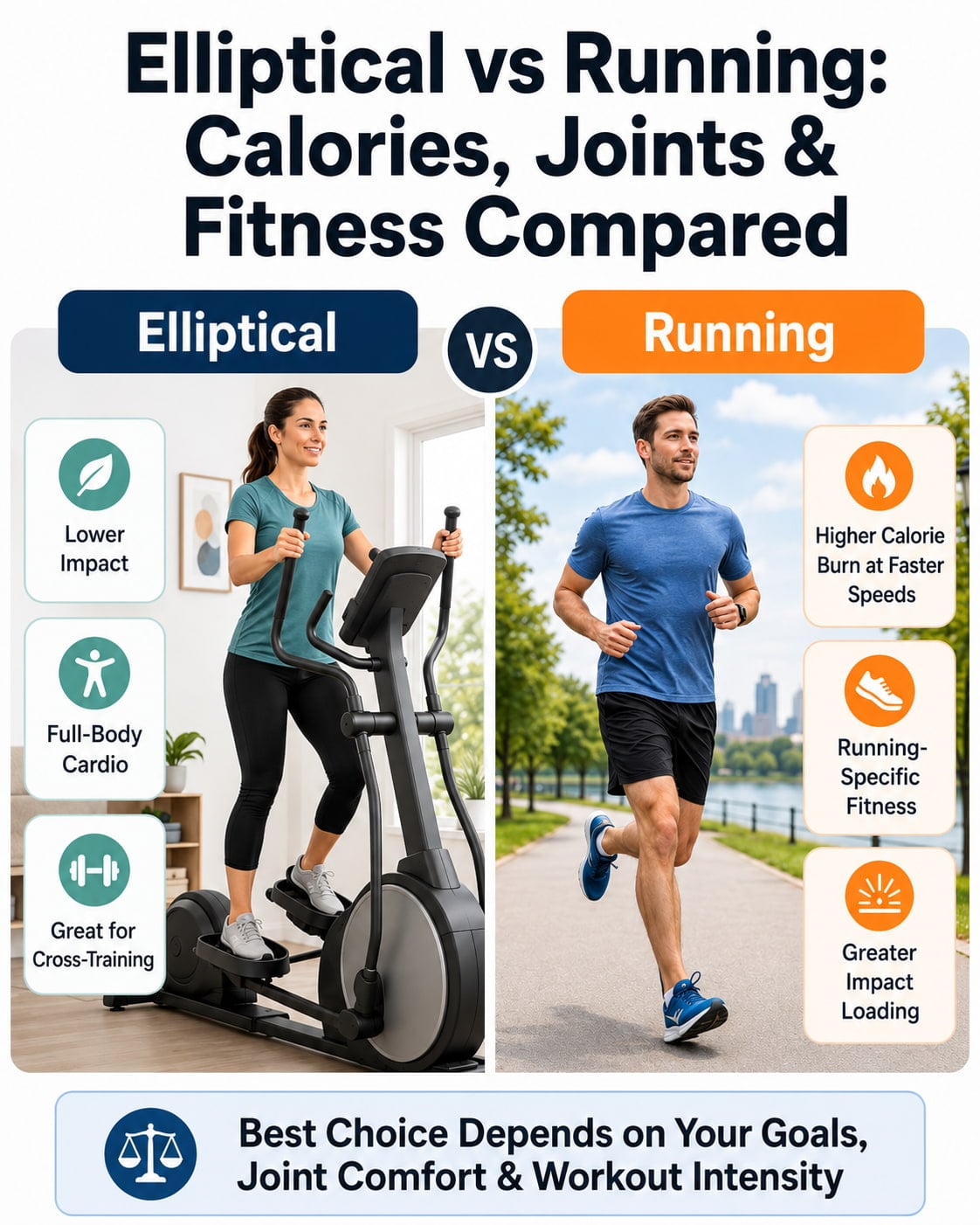
When comparing elliptical vs running, both can deliver an effective cardiovascular workout. Running usually burns more calories at moderate-to-fast speeds and develops running-specific fitness, while the elliptical reduces repeated landing impact and may be more comfortable for people with sensitive joints.
The better exercise depends on your goals, fitness level, joint tolerance, and preferred workout intensity. Running is usually the stronger choice for race preparation, bone-loading exercise, and maximizing calorie expenditure per minute. The elliptical is often better for lower-impact cardio, cross-training, and adding exercise without increasing running mileage.
Elliptical vs Running at a Glance
| Category | Elliptical | Running |
|---|---|---|
| Calorie burn | Moderate to high, depending on resistance and effort | Usually higher at moderate-to-fast speeds |
| Joint impact | Lower repeated impact because your feet remain supported | Repeated landing forces with each stride |
| Cardiovascular fitness | Can provide moderate or vigorous cardio | Can provide moderate or vigorous cardio |
| Running performance | Supports aerobic fitness but does not fully reproduce running mechanics | Best for improving running pace, economy, and endurance |
| Muscles worked | Legs, glutes, core, and upper body when using movable handles | Legs, glutes, calves, core, and stabilizing muscles |
| Bone-loading stimulus | Weight-bearing but relatively low impact | Greater impact-related loading |
| Equipment | Requires access to a machine | Can be performed outdoors or on a treadmill |
| Cross-training | Excellent for reducing additional running impact | More specific but adds running-related stress |
| Beginner friendliness | Easy to control speed and resistance | May require a gradual walk-run progression |
| Best overall use | Lower-impact cardio and cross-training | Running performance and higher-intensity calorie burn |
Neither option wins every category. Your actual results depend more on workout intensity, duration, weekly consistency, recovery, and progression than on the exercise name alone.
Elliptical vs Running Calories: Which Burns More?
Running generally burns more calories as speed increases. However, a vigorous elliptical workout can use approximately as much energy as an easy or moderate run.
The 2024 Adult Compendium’s conditioning exercise data assigns elliptical training a value of 5.0 METs at moderate effort and 9.0 METs at vigorous effort. Its running activity data ranges from 6.5 METs at 4.0–4.2 mph to 11.0 METs at 7 mph. A MET estimates how much energy an activity uses compared with resting.
Estimated Calories Burned in 30 Minutes
The following estimates are for a 155-pound adult:
| Activity | MET Value | Estimated Calories in 30 Minutes |
|---|---|---|
| Elliptical, moderate effort | 5.0 | About 185 |
| Running at 4.0–4.2 mph | 6.5 | About 240 |
| Running at 5.0–5.2 mph | 8.5 | About 314 |
| Elliptical, vigorous effort | 9.0 | About 332 |
| Running at 6.0–6.3 mph | 9.3 | About 343 |
| Running at 7 mph | 11.0 | About 406 |
These figures are estimates, not guaranteed results. They are based on standard MET calculations and include the energy your body would use at rest during the same period.
Your actual calorie burn may be higher or lower depending on:
- Body weight and body composition
- Running speed or elliptical cadence
- Resistance and incline
- Fitness level
- Workout duration
- Movement efficiency
- How actively you use the elliptical handles
- Machine design and calibration
What Direct Comparison Research Shows
A small controlled treadmill-versus-elliptical study found that oxygen consumption and energy expenditure were similar when participants used both machines at the same perceived effort. Heart rate was higher on the elliptical, which means heart rate alone may not always provide a fair machine-to-machine comparison.
A separate 2024 study comparing seven indoor cardio machines found that the treadmill produced the highest energy expenditure during short, high-intensity tests, with the elliptical ranking behind the treadmill and stair climber. That study included 30 recreationally active men and used brief 12-minute tests, so it does not represent every person or workout.
The practical conclusion is simple:
- Running usually burns more calories when you maintain a moderate or fast pace.
- A hard elliptical workout can match or exceed the calorie cost of slow running.
- A longer elliptical session may burn more total calories than a shorter run.
Do not rely completely on the calorie number shown on either machine. Cardio equipment usually provides an estimate based on limited personal information.
Which Is Better for Your Joints?
The elliptical is generally the lower-impact choice because your feet stay in contact with the pedals. Running includes an airborne phase followed by repeated ground contact, creating greater impact with each stride.
However, lower impact does not mean no joint stress.
Why the Elliptical Is Lower Impact
Because the pedals guide your feet through a continuous path, the elliptical removes the abrupt heel-strike pattern found in walking and running.
A biomechanical study of elliptical joint loading found smaller vertical reaction forces and lower heel-strike loading rates during elliptical exercise than during level walking. However, the elliptical also produced greater hip-flexor and knee-extensor moments in that study. The research involved 15 men, used no added workload, and compared the elliptical with walking rather than running.
This means the elliptical may reduce impact while still placing meaningful demand on the knees, hips, quadriceps, and surrounding muscles.
Factors that can affect joint comfort include:
- Resistance level
- Ramp angle
- Pedal spacing
- Stride length
- Cadence
- Body position
- Previous injuries
- Individual anatomy
Use a controlled resistance that allows you to keep your feet flat and your movement smooth. Avoid leaning heavily on the handles or allowing your knees to collapse inward.
Does Running Damage Your Knees?
Running is not automatically harmful to healthy knees.
A 2023 systematic review and meta-analysis of nine observational studies found no significant difference in knee osteoarthritis prevalence between runners and nonrunning controls. The researchers also found no higher prevalence among the weekly running-volume groups they examined. However, several studies had a high risk of bias, so the evidence does not prove that every running volume is risk-free.
An additional overview of 20 reviews and 12 original studies concluded that common physical activities, including recreational running, were not associated with structural progression of knee osteoarthritis.
Running may still aggravate symptoms when someone has:
- A recent lower-body injury
- Rapidly increased training volume
- Poor recovery
- Significant strength or mobility limitations
- Pain that changes normal running form
- A condition requiring temporary impact restrictions
The elliptical may be a better temporary or long-term option when running causes repeated discomfort. Persistent pain, swelling, locking, instability, or pain that changes how you walk or run should be evaluated by a qualified healthcare professional.
Elliptical vs Running for Cardiovascular Fitness
Both running and elliptical training can improve cardiovascular fitness when the workout is challenging enough.
A study of 18 trained runners compared treadmill running, elliptical training, and stepper exercise at 60%, 70%, and 80% of the peak workload established for each machine. Oxygen consumption, heart rate, fuel use, and energy expenditure changed with intensity but did not significantly differ between the exercise modes at matched relative workloads.
That means the elliptical can provide a legitimate cardiovascular workout—not simply an easier substitute for running.
For General Cardiovascular Health
Either exercise can help you accumulate moderate- or vigorous-intensity aerobic activity.
According to current U.S. physical activity guidance, adults should work toward:
- 150–300 minutes of moderate-intensity aerobic activity each week
- 75–150 minutes of vigorous-intensity aerobic activity each week
- An equivalent combination of moderate and vigorous activity
- Muscle-strengthening activity on at least two days each week
Inactive adults can begin with smaller amounts and gradually work toward those targets.
During moderate exercise, you should usually be able to speak in short sentences. During vigorous exercise, talking becomes much more difficult.
For Improving Running Performance
Running is the better choice when your primary goal is to:
- Run a 5K, 10K, half marathon, or marathon
- Improve outdoor running pace
- Develop running economy
- Adapt to repeated impact
- Practice pacing and terrain changes
- Improve running-specific coordination
Your body adapts specifically to the activity you perform. The elliptical can maintain or improve aerobic fitness, but it cannot fully reproduce the balance, foot contact, tendon loading, stride mechanics, and impact tolerance required for running.
Muscles Worked: Elliptical vs Running
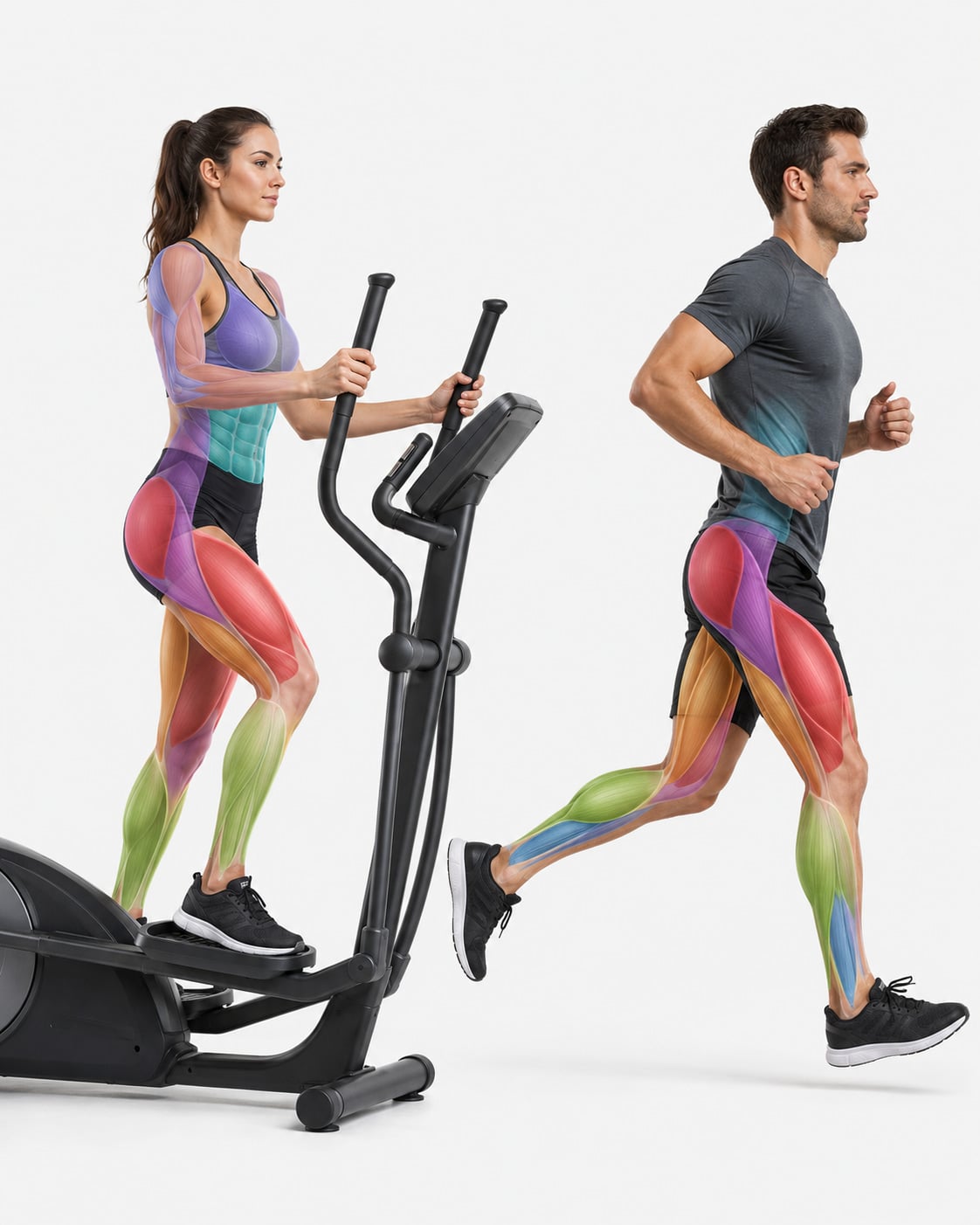
Running and elliptical training use many of the same major lower-body muscles, including the:
- Quadriceps
- Gluteus maximus
- Hamstrings
- Calves
- Hip muscles
- Core stabilizers
The movement patterns and muscular demands are different.
Muscles Worked on the Elliptical
The elliptical mainly trains the quadriceps and glutes as you press the pedals down and back. The hamstrings and calves assist throughout the movement.
Machines with movable handles also involve the:
- Biceps
- Triceps
- Shoulders
- Upper-back muscles
- Chest muscles
Upper-body involvement depends on how actively you push and pull the handles. Simply holding them without applying force adds little muscular demand.
Increasing resistance can make the muscles work harder, but elliptical training should not be considered a complete replacement for strength training.
Muscles Worked While Running
Running requires repeated single-leg support, propulsion, and landing control.
The calves, glutes, hamstrings, quadriceps, foot muscles, and hip stabilizers must coordinate to absorb force and move the body forward. The core helps maintain posture, while the arms contribute to balance and rhythm.
In a small study of trained runners, lower-extremity muscular effort was generally lower on the elliptical and stepper than during treadmill running at comparable relative intensities. Quadriceps activity was an exception and did not significantly differ between the exercise modes.
Running is therefore more specific for developing the muscular coordination and lower-leg resilience required for running itself.
Which Is Better for Bone Health?
Running usually provides a greater bone-loading stimulus because it involves repeated impact and ground-reaction forces.
The elliptical is weight-bearing because you exercise while standing. However, its smooth pedal path reduces the abrupt impact that makes running more mechanically demanding.
Running may be the better choice when increasing impact-related loading is appropriate. The elliptical may be more suitable when impact needs to be reduced because of pain, injury recovery, low exercise tolerance, or professional guidance.
Neither should be your only strategy for bone and muscle health. A complete routine should also include progressive resistance exercises appropriate for your ability.
People with osteoporosis, a previous stress fracture, significant bone loss, or a high fracture risk should ask a healthcare professional which types of impact exercise are appropriate.
Elliptical vs Running for Weight Loss
Running often burns more calories per minute, particularly at moderate and fast speeds. That does not automatically make it better for long-term weight loss.
The elliptical may be more effective for a particular person when it allows:
- Longer workouts
- More frequent exercise
- Less joint discomfort
- Better recovery
- Additional cardio between running days
- Greater long-term consistency
Weight loss occurs when average energy expenditure exceeds energy intake over time. Physical activity supports that process, but eating patterns, sleep, medications, medical conditions, stress, age, and genetics may also affect body weight.
The CDC explains that combining physical activity with an appropriate reduction in calorie intake creates the calorie deficit needed for weight loss. The amount of activity required varies from person to person.
Neither the elliptical nor running selectively removes belly fat. Fat loss occurs throughout the body according to factors such as genetics and overall energy balance.
For weight management, compare your weekly totals rather than focusing on a single workout. Four manageable elliptical sessions may be more valuable than one exhausting run that leaves you too sore to exercise again.
Which Is Better for Beginners?
The elliptical is often easier for beginners because speed and resistance are simple to control and there is no repeated landing impact. It can help someone become comfortable with sustained cardio before adding higher-impact exercise.
Running can also be beginner-friendly when introduced through a gradual walk-run plan.
Beginner Elliptical Tips
- Begin with 10–20 minutes at an easy or moderate effort.
- Keep your entire foot supported on the pedal.
- Stand tall with relaxed shoulders.
- Hold the handles lightly instead of leaning on them.
- Use enough resistance to maintain control without straining.
- Increase duration before making every workout harder.
Beginner Running Tips
- Start with alternating walking and easy running.
- Run at a pace that feels controlled rather than fast.
- Use short, comfortable steps.
- Keep your shoulders and hands relaxed.
- Allow recovery time between early running sessions.
- Increase distance or duration gradually.
Change one main variable at a time. Increasing speed, distance, frequency, and hills simultaneously can create more stress than your body is prepared to handle.
Stop exercising and seek prompt medical care if you experience chest pain, fainting, severe breathing difficulty, or signs of a serious injury.
Can the Elliptical Replace Running?
The elliptical can replace running for some goals, but not all.
The Elliptical Can Replace Running When Your Goal Is:
- Improving general cardiovascular fitness
- Completing a lower-impact cardio workout
- Increasing weekly activity
- Managing running-related fatigue
- Cross-training during a reduced-running period
- Exercising indoors without treadmill impact
The Elliptical Cannot Fully Replace Running When Your Goal Is:
- Preparing for a running race
- Improving running economy
- Adapting your feet and lower legs to impact
- Practicing race pace
- Learning to manage outdoor terrain
- Developing running-specific technique
A runner can maintain cardiovascular fitness with the elliptical during a temporary reduction in mileage. However, race preparation still requires a gradual return to actual running when medically appropriate.
How to Combine Elliptical Training and Running
You do not need to choose only one exercise. Combining them can help you build aerobic fitness while managing total running stress.
Example Weekly Options
| Goal | Possible Weekly Approach |
|---|---|
| General fitness | Two elliptical workouts, one run or walk-run workout, and two strength sessions |
| Beginner running | Two walk-run sessions, one easy elliptical workout, and two strength sessions |
| Established runner | Key running workouts plus one easy elliptical recovery or cross-training session |
| Higher cardio volume | Replace some easy running mileage with moderate elliptical training |
| Impact-sensitive exercise | Use the elliptical as the main cardio activity and introduce running only as tolerated |
These are flexible examples rather than fixed prescriptions. Adjust frequency, intensity, and duration according to your fitness, recovery, symptoms, and schedule.
Keep most workouts controlled. Hard intervals can be performed on either machine, but frequent high-intensity training may increase fatigue and reduce recovery.
Elliptical vs Running: Which Should You Choose?
Choose the elliptical when you want:
- Lower-impact cardiovascular exercise
- A controlled indoor workout
- Cardio during an impact-sensitive period
- Upper- and lower-body rhythmic movement
- Additional training without more running mileage
- A machine-based workout with adjustable resistance
Choose running when you want:
- Higher calorie expenditure at faster speeds
- Running-specific fitness
- Race preparation
- Outdoor exercise
- Greater impact-related bone loading
- Minimal equipment requirements
Choose both when you want to improve running fitness while controlling total impact and adding variety to your training.
The best choice is the activity you can perform safely, progressively, and consistently. A theoretically superior workout offers little benefit when it causes repeated pain or is difficult to maintain.
Frequently Asked Questions
Does running burn more calories than the elliptical?
Running usually burns more calories at moderate-to-fast speeds. However, vigorous elliptical training can burn approximately as many calories as slower running. Body weight, resistance, speed, duration, and effort determine the actual difference.
Is 30 minutes on the elliptical equal to 30 minutes of running?
Not automatically. Thirty minutes of vigorous elliptical exercise may be comparable to an easy or moderate run for cardiovascular effort and estimated calorie expenditure. It does not provide the same impact, stride practice, or running-specific muscular adaptations.
Is the elliptical better than running for bad knees?
The elliptical reduces repeated landing impact and may feel more comfortable. However, it still places demand on the knees and quadriceps, and certain machine settings may aggravate some symptoms. Exercise choice should be based on the cause of the pain and guidance from a qualified professional when needed.
Can the elliptical improve running fitness?
Yes. The elliptical can support cardiovascular endurance and help runners add aerobic training with less impact. It is useful for cross-training, but running is still necessary to improve running-specific technique, economy, and impact tolerance.
Which is better for losing belly fat?
Neither exercise specifically targets belly fat. Running may burn more calories per minute, while the elliptical may allow longer or more frequent workouts. Overall calorie balance and consistency matter more than the cardio machine you choose.
Does the elliptical build muscle?
The elliptical challenges the quadriceps, glutes, hamstrings, calves, and sometimes the upper body. Higher resistance can increase muscular effort, but the elliptical is primarily a cardiovascular machine and does not replace progressive strength training.
Can you use the elliptical every day?
Some people can perform easy or moderate elliptical workouts on consecutive days because the activity is relatively low impact. You should still vary intensity and allow recovery when you experience unusual fatigue, declining performance, or persistent pain.
Conclusion
Running is usually better for maximizing calorie expenditure at faster speeds, improving running performance, and providing greater impact-related loading. The elliptical is usually better for lower-impact cardio, cross-training, and increasing aerobic exercise without adding more running mileage.
Start with the option that matches your current ability and feels sustainable. Choose a manageable workout this week, track how your joints and energy levels respond, and increase the challenge gradually rather than trying to do too much at once.
References
- 2024 Adult Compendium of Physical Activities — Conditioning Exercise
- 2024 Adult Compendium of Physical Activities — Running
- Comparison of Energy Expenditure on a Treadmill and Elliptical Device
- Energy Expenditure and Physiological Responses Across Indoor Cardio Machines
- Joint Loading in the Lower Extremities During Elliptical Exercise
- Running Volume and Knee Osteoarthritis Prevalence: Systematic Review and Meta-Analysis
- Physiological Responses to Treadmill, Elliptical, and Stepper Exercise
- Muscular Activation During Treadmill, Stepper, and Elliptical Exercise
- Physical Activity Guidelines for Americans
- CDC Physical Activity and Weight Management Guidance