
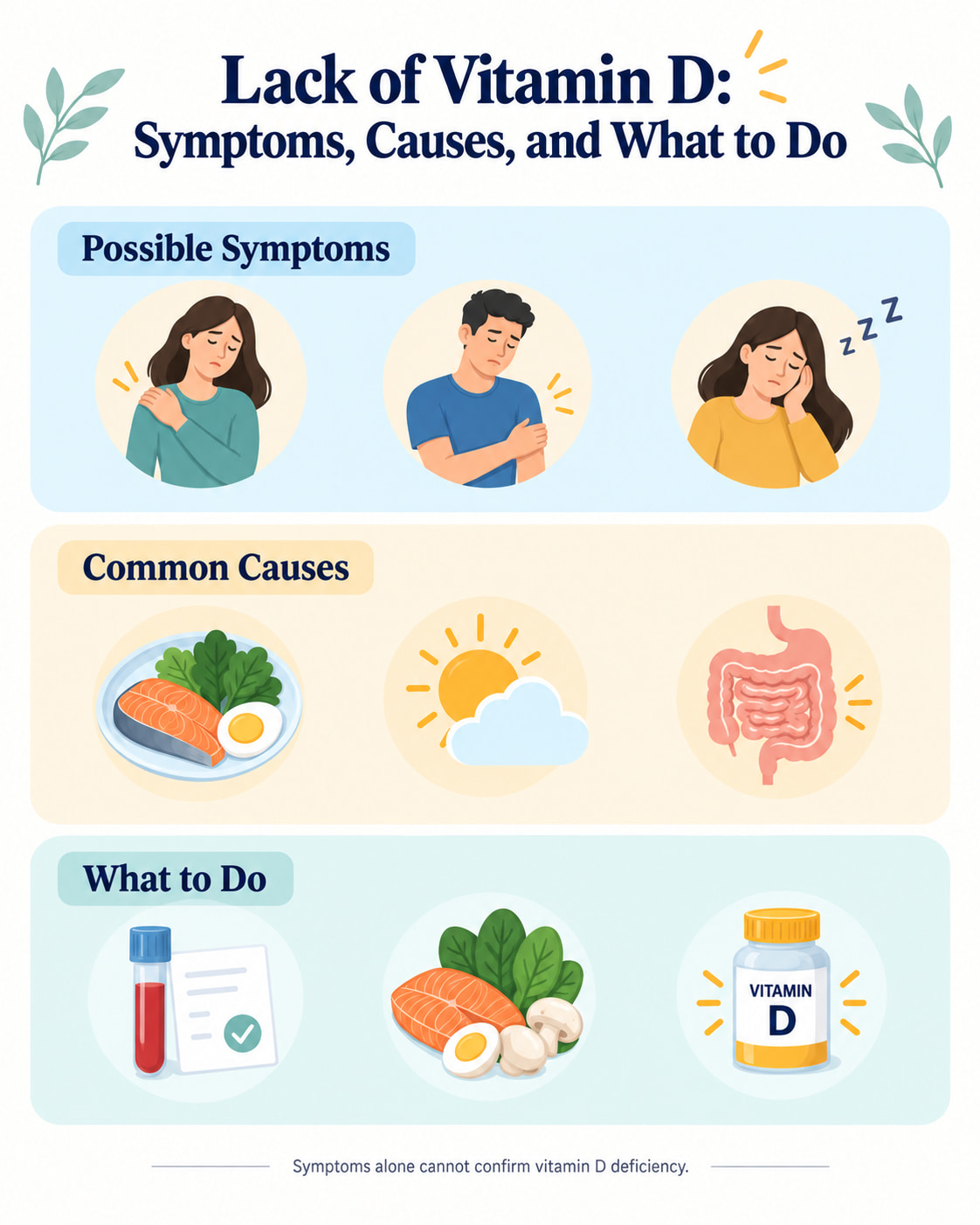
A lack of vitamin D may cause no noticeable symptoms, but a more substantial deficiency can lead to bone pain, muscle aches, and weakness. Symptoms alone cannot confirm the problem. A healthcare professional may recommend a blood test based on your symptoms, medical history, and risk factors.
The important distinction is between meeting your everyday vitamin D needs and correcting a diagnosed deficiency. The right approach may involve dietary changes, supplements, and follow-up—not simply taking the highest dose available.
What Does a Lack of Vitamin D Mean?
Vitamin D helps your body absorb calcium and supports normal muscle and nerve function. Vitamin D deficiency means your body does not have enough to support these functions adequately.
When deficiency becomes severe or prolonged, bones may not mineralize properly. This can lead to osteomalacia, a condition involving softened bones in adults. In growing children, vitamin D deficiency can contribute to rickets, which affects bone development. Not every mildly low blood result means these complications are present.
Symptoms of a Lack of Vitamin D
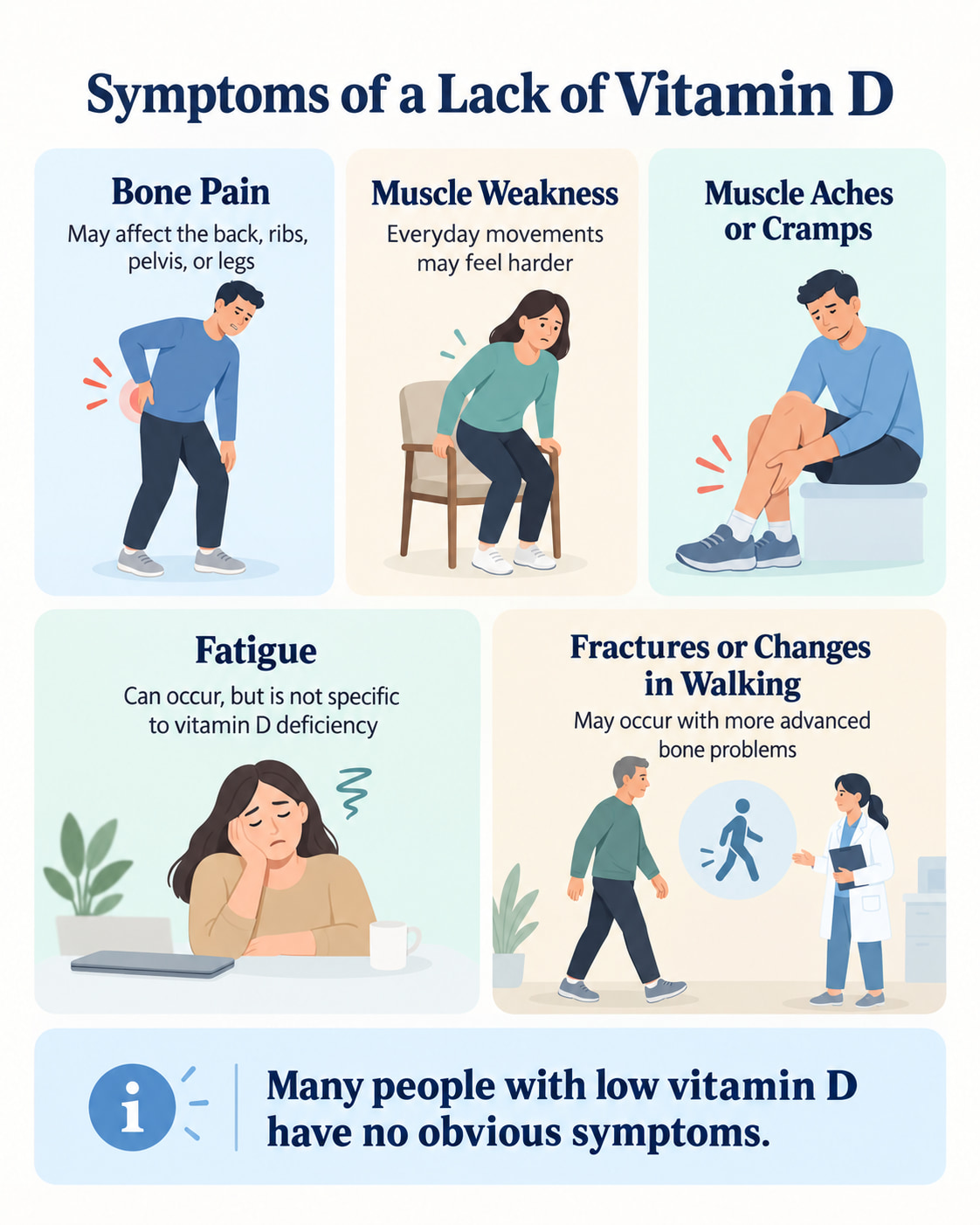
Many people with low vitamin D feel completely normal. Others notice vague symptoms that overlap with numerous health conditions. There is no reliable symptom checklist that can diagnose vitamin D deficiency at home.
Bone Pain and Muscle Weakness
When deficiency affects bone and muscle health, symptoms may include:
- Bone pain: Persistent discomfort in the back, ribs, pelvis, or legs.
- Muscle weakness: Difficulty climbing stairs, getting out of a chair, or walking normally.
- Muscle discomfort: Aches, cramps, or twitching.
These features are particularly relevant to osteomalacia, rather than every slightly low vitamin D result.
Pay attention to changes in everyday function. Newly needing your arms to push yourself out of a chair, for example, is worth discussing with a clinician rather than dismissing as ordinary tiredness.
Fatigue
Fatigue may occur alongside vitamin D deficiency, but it is not a specific sign.
In a small 2016 randomized trial, 120 otherwise healthy adults with fatigue and low vitamin D received vitamin D or a placebo. Fatigue scores improved more in the vitamin D group after four weeks. However, this does not establish vitamin D as a general solution for tiredness, especially in people whose levels are already adequate.
Fractures or Changes in Walking
More advanced bone problems can involve fractures after minor injuries or changes in walking. These require medical assessment; they should not be managed by simply adding an over-the-counter supplement.
What Causes a Lack of Vitamin D?
Low vitamin D can develop for several reasons, sometimes in combination.
| Possible cause | How it can contribute |
|---|---|
| Low dietary intake | Your usual diet contains few vitamin D-rich or fortified foods. |
| Limited sunlight exposure | You spend little time outdoors or regularly cover most of your skin. |
| Reduced absorption | Conditions such as celiac disease or Crohn’s disease can make vitamin D harder to absorb. |
| Gastric bypass surgery | Changes to the digestive tract can reduce absorption. |
| Kidney or liver disease | These organs may have difficulty converting vitamin D into forms your body can use. |
| Certain medicines | Some anti-seizure medicines, steroids, and weight-loss medicines can affect vitamin D absorption or processing. |
MedlinePlus identifies these as important causes and risk factors. Do not stop a prescribed medicine because you suspect it affects vitamin D; ask your clinician or pharmacist to review it.
Older age, darker skin, and obesity are also associated with lower blood vitamin D levels. However, belonging to a higher-risk group does not establish a diagnosis or automatically mean that testing is necessary.
How Is Vitamin D Deficiency Diagnosed?
The Usual Blood Test
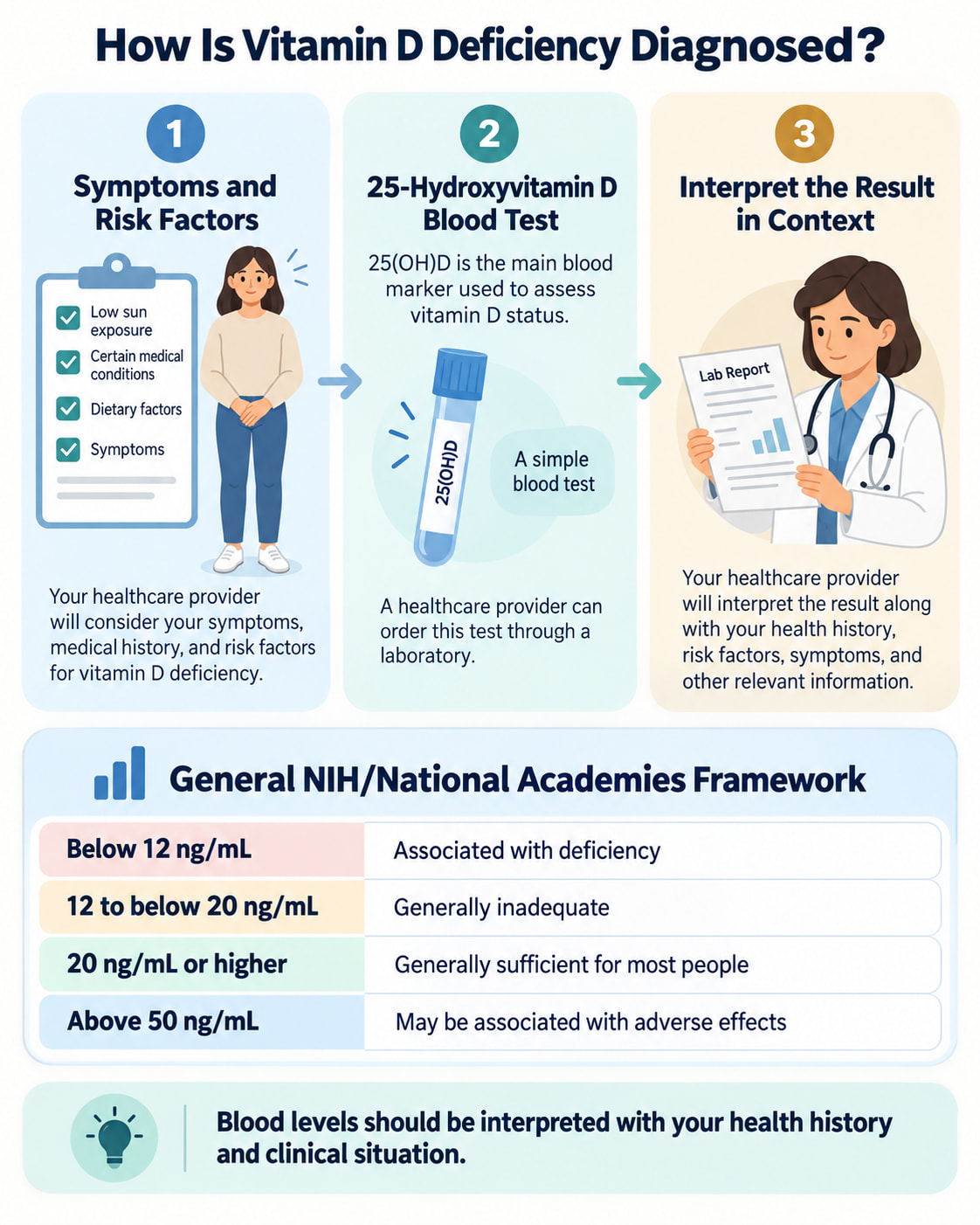
The standard test measures 25-hydroxyvitamin D, often written as 25(OH)D. This is the main blood marker used to assess vitamin D status.
A different test measures active vitamin D, or 1,25-dihydroxyvitamin D. It is generally used for other clinical questions, such as certain kidney or calcium-related problems—not routine nutritional assessment.
Understanding Your Results
The NIH Office of Dietary Supplements’ guidance, updated June, 2025, summarizes the following National Academies framework:
| Blood 25(OH)D level | Equivalent in nmol/L | General interpretation |
|---|---|---|
| Below 12 ng/mL | Below 30 | Associated with vitamin D deficiency. |
| 12 to below 20 ng/mL | 30 to below 50 | Generally considered inadequate. |
| 20 ng/mL or higher | 50 or higher | Sufficient for most people, but increasingly high levels are not necessarily better. |
| Above 50 ng/mL | Above 125 | May be associated with adverse effects. |
These are general reference categories, not a personalized target. A high result alone also does not establish vitamin D toxicity.
Does Everyone Need Testing?
No. The Endocrine Society’s 2024 guideline suggests against routine vitamin D testing in generally healthy adults without an established reason for testing. It also does not establish a universal blood-level target for disease prevention.
Separately, the USPSTF’s 2021 recommendation found insufficient evidence to determine whether screening benefits asymptomatic, community-dwelling, nonpregnant adults. That does not mean testing is never useful.
A clinician may recommend testing when investigating bone pain, muscle weakness, low bone density, fractures, or conditions that interfere with nutrient absorption.
What to Do About a Lack of Vitamin D
1. Review Your Symptoms and Risk Factors
Before an appointment, write down when your symptoms started and how they affect your usual activities. Bring a list—or photos of the labels—of your medicines and supplements.
Useful questions to ask include: “Could another condition explain these symptoms?” and “Would a vitamin D test change the next steps?”
If deficiency is confirmed, the recommended approach can depend on its severity, your age, pregnancy status, and underlying health conditions. Food changes alone are often insufficient to correct an established deficiency.
2. Understand Your Everyday Vitamin D Needs
The NIH’s recommended daily vitamin D amounts for adults are:
| Adult group | Recommended daily intake |
|---|---|
| Ages 19–70 | 600 IU / 15 micrograms |
| Ages 71 and older | 800 IU / 20 micrograms |
| Pregnancy and breastfeeding | 600 IU / 15 micrograms |
These amounts represent total nutritional intake, not an additional supplement dose or a prescription for correcting deficiency.
Recommendations may differ in particular circumstances. For example, the Endocrine Society provides additional supplementation guidance for pregnancy and adults age 75 and older. Your clinician can help reconcile general intake recommendations with your needs.
3. Include Vitamin D Foods
Useful food sources include fatty fish such as salmon and trout, fortified milk or plant-based alternatives, fortified cereals, and mushrooms labeled as UV-exposed. Egg yolks provide smaller amounts.
Check the Nutrition Facts label because fortification varies between products. A plant-based drink or yogurt does not necessarily contain vitamin D simply because a similar product does.
For a practical starting point, check the milk or plant-based drink you already buy and look for vitamin D on the label. Then consider which vitamin D-containing foods fit your usual meals.
4. Follow the Prescribed Supplement Schedule
For diagnosed deficiency, a clinician may prescribe a higher-dose course for a limited period, followed by a lower maintenance dose. Some prescriptions are taken daily; others are taken weekly.
The dose and the frequency both matter. Follow the label exactly, and ask a pharmacist whenever the instructions are unclear. Do not turn a weekly prescription into a daily routine or double a dose to make up for a missed one.
5. Keep Sun Protection in Place
Do not try to correct low vitamin D through tanning beds or deliberate unprotected sun exposure.
The American Academy of Dermatology’s vitamin D guidance recommends obtaining adequate vitamin D through food and appropriate supplementation rather than UV exposure. Its sun-protection advice includes shade, protective clothing, and broad-spectrum, water-resistant sunscreen with SPF 30 or higher on uncovered skin.
How Long Does It Take to Correct Vitamin D Deficiency?
There is no single recovery timeline. NHS guidance notes that bone, muscle, or joint symptoms related to deficiency may improve over weeks or months as vitamin D levels recover. Improvement is not necessarily immediate.
Ask your clinician when symptoms should be reassessed and whether follow-up blood testing is appropriate. Persistent symptoms are a reason to review the diagnosis and plan—not automatically increase the dose.
Feeling better also does not necessarily mean your prescribed course is finished. Follow the agreed schedule, including any maintenance plan.
Can You Take Too Much Vitamin D?
Yes. For adults, the general upper intake limit is 4,000 IU, or 100 micrograms, per day from food, drinks, and supplements combined. This is a safety limit, not a daily target. A clinician may prescribe more temporarily for a diagnosed deficiency.
Too much supplemental vitamin D can raise blood calcium levels and damage the kidneys or heart. Possible warning signs include vomiting, confusion, increased urination, and an irregular heartbeat.
Check the vitamin D amount across all products you use. For example, a multivitamin and a separate vitamin D supplement may contribute to the same daily total. Ask a pharmacist to review the combination rather than assuming each product is safe to add independently.
When to See a Doctor
Arrange an assessment for persistent bone pain, meaningful muscle weakness, or difficulty with normal movement. Fractures after minor injuries also warrant evaluation. Concerns about a child’s bone development need professional assessment rather than an adult supplement plan.
Seek prompt medical advice if you develop vomiting, confusion, increased urination, or an irregular heartbeat while taking vitamin D. These can be signs of excessive calcium and should not be interpreted as a reason to take more.
Frequently Asked Questions
Can You Have Vitamin D Deficiency Without Symptoms?
Yes. Many people have no obvious symptoms. Feeling well does not establish that your level is adequate, but it also does not mean you need routine testing.
Can You Check Vitamin D Levels Without a Blood Test?
Symptoms, diet, and medical history can help identify risk, but they cannot provide a measured vitamin D level. When testing is appropriate, a 25(OH)D blood test is usually used.
What Is the Difference Between Vitamin D2 and D3?
D2 and D3 are two forms of vitamin D. Both raise blood levels, although D3 generally raises them more effectively and maintains them longer. Either may be used in a clinician-directed plan.
Should You Take Vitamin D With Food?
Vitamin D is best absorbed with a meal or snack containing some fat. Follow the instructions for your specific product or prescription.
Can a Lack of Vitamin D Cause Depression?
Depression has multiple contributing factors, and a vitamin D result cannot establish its cause. The National Institute of Mental Health describes research on vitamin D supplements for depression as inconsistent. Persistent low mood deserves appropriate assessment rather than relying on supplements alone.
Will You Need Vitamin D Supplements Forever?
Not necessarily. Some people need a limited course, while others need ongoing maintenance because their risk factors remain. Ask your clinician how long to continue rather than stopping or continuing a higher dose indefinitely.
Conclusion
A lack of vitamin D is worth addressing, but symptoms and supplement marketing are not enough to guide the decision. The useful next step is to review your symptoms, dietary intake, medicines, and risk factors.
Start by checking your food and supplement labels. If you have persistent symptoms or a low blood-test result, bring that information to a healthcare professional and agree on a clear assessment and follow-up plan.
This content is for informational purposes only and not medical advice.
References
- NIH Office of Dietary Supplements: Vitamin D—Health Professional Fact Sheet and Vitamin D—Consumer Fact Sheet.
- MedlinePlus: Vitamin D Deficiency and Vitamin D Test.
- Endocrine Society: Vitamin D for the Prevention of Disease: 2024 Guideline.
- U.S. Preventive Services Task Force: Vitamin D Deficiency in Adults: Screening—2021 Recommendation.
- Yale Medicine: Vitamin D Deficiency.
- Nowak and colleagues, 2016: Effect of Vitamin D3 on Self-Perceived Fatigue: A Double-Blind Randomized Placebo-Controlled Trial.
- American Academy of Dermatology: Vitamin D: Guidance and Facts.
- National Institute of Mental Health: Depression.