
A dumbbell glute bridge is a floor-based exercise that primarily trains your glutes by adding resistance as you raise your hips. Your hamstrings assist, while your core helps control your trunk and pelvis.
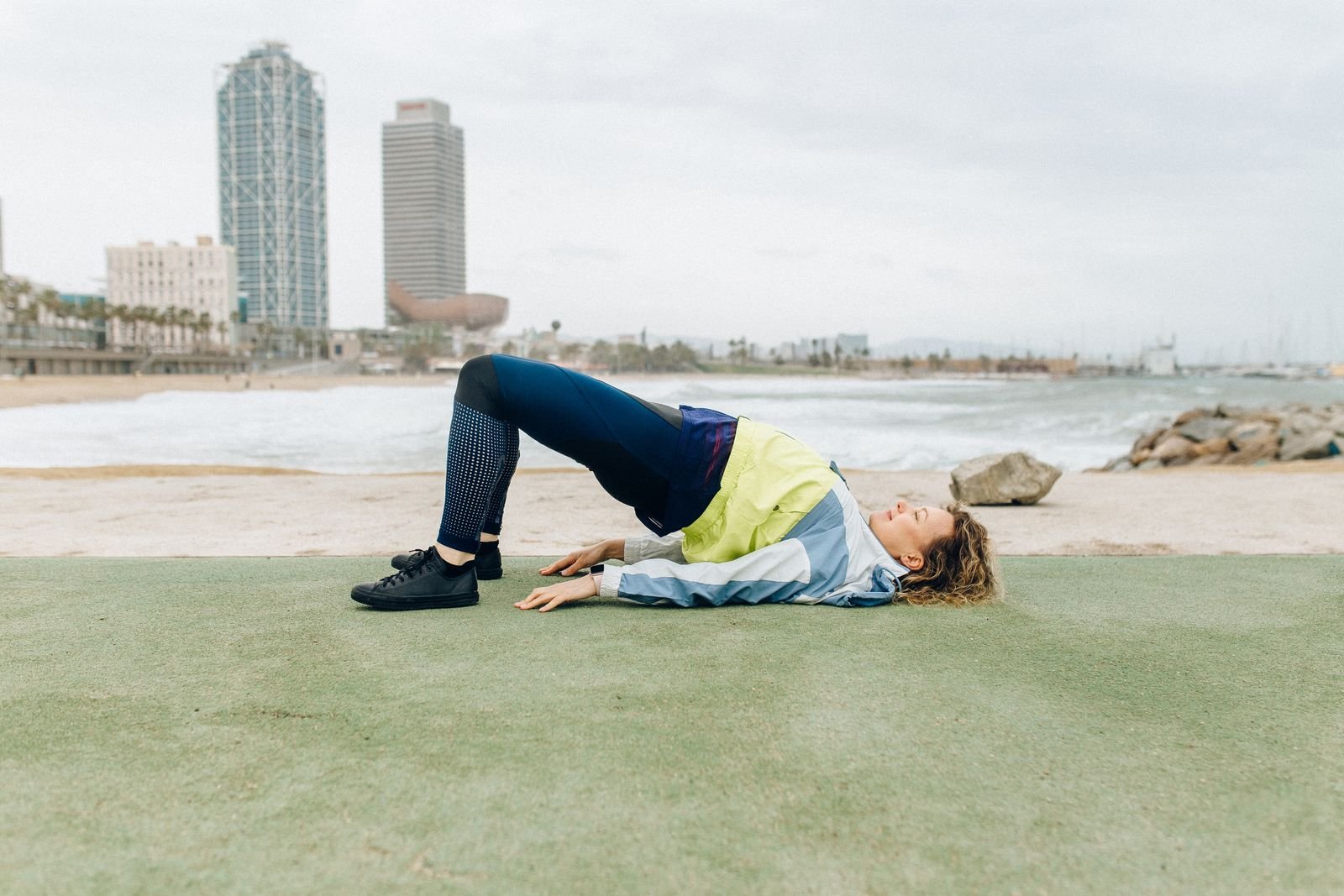
The setup is simple: lie on your back, plant your feet, and hold one dumbbell across the front of your hips. The key is to lift through your hips while keeping your lower back controlled. Learning that distinction helps you choose a suitable weight and make each repetition count.
How to Do a Dumbbell Glute Bridge
You need one dumbbell, a stable floor surface, and enough room to lie down. An exercise mat and a folded towel or pad can make the setup more comfortable.
Warm up with several minutes of easy movement, then practice a few bodyweight bridges before adding resistance.
Step-by-Step Instructions
- Set the weight in position. While seated, place the dumbbell horizontally across the front of your hips near the hip crease. Hold it with both hands as you lower yourself onto your back. Keep it away from your abdomen, and add padding if needed.
- Plant your feet. Bend your knees and position your feet about hip-width apart. Keep your knees pointing in the same direction as your toes. Adjust your foot distance until the position feels stable.
- Support your head and shoulders. Keep your head and shoulder blades resting on the floor throughout the exercise.
- Brace your abdomen. Gently tighten your midsection and keep your ribs from flaring upward. Avoid starting with an exaggerated lower-back arch.
- Raise your hips. Exhale, squeeze your glutes, and press through your planted feet. Apply firm heel pressure while keeping the whole foot down.
- Pause at the top. Finish with your shoulders, hips, and knees roughly aligned, provided you can do so comfortably. Stop before your lower back starts arching.
- Lower with control. Inhale and bring your hips back toward the mat without dropping or bouncing. Maintain your grip on the dumbbell.
These cues follow the emphasis in ACE’s bridge technique guidance on abdominal control, hip extension, and avoiding excessive back arching.
A useful form check: Your hips should rise while your ribs and lower back remain controlled. Extra height is unnecessary if it requires bending through your spine.
When the set ends, lower your hips fully before moving the dumbbell. Use a lighter weight if positioning, holding, or removing it feels awkward.
Dumbbell Glute Bridge Muscles Worked
The gluteus maximus is the main target, but several muscles contribute to the movement.
| Muscle or muscle group | What it does |
|---|---|
| Gluteus maximus | Produces hip extension as you raise your hips |
| Hamstrings | Assist with hip extension |
| Abdominal and deep core muscles | Help control your trunk and pelvis |
| Erector spinae | Help stabilize your spine |
Some hamstring effort is normal. Feeling your hamstrings does not automatically mean you are doing the exercise incorrectly.
Likewise, the exercise does not need to create an intense burning sensation to involve your glutes. Prioritize controlled repetitions and an appropriate load over chasing a particular feeling.
Dumbbell Glute Bridge Sets, Reps, and Weight
For regular training, 2–3 sets of 8–12 repetitions is a practical starting point. Beginners can first learn the movement with bodyweight or a light dumbbell.
| Training purpose | Suggested sets and reps | How to approach it |
|---|---|---|
| Learning the movement | 1–2 sets of 12–15 reps | Keep the resistance light and focus on control |
| General strength and muscle development | 2–3 sets of 8–12 reps | Use a challenging weight without losing form |
| Higher-repetition work | 2–3 sets of 15–20 reps | Choose a lighter load and maintain the same technique |
These are starting options, not strict boundaries between different results. Direct research on dumbbell floor bridges is limited, so the recommendations combine established bridge technique with general resistance-training guidance.
How Heavy Should the Dumbbell Be?
Choose a weight that makes the final repetitions challenging while allowing you to keep the dumbbell steady and your lower back controlled.
For working sets, aim to finish with approximately 2–3 good repetitions still possible. This is often called “repetitions in reserve.” For example, after completing 10 repetitions, you should feel that you could perform another two or three with similar technique.
ACSM’s resistance-training position stand, published in 2026, describes this as a practical effort target. It also explains that taking every set to muscular failure is unnecessary. The exact ideal effort level varies, so beginners can stay farther from failure while learning.
Reduce the weight if your hips twist, your back arches, or you cannot control the descent.
Rest and Weekly Frequency
Start with approximately 1–2 minutes of rest between sets. Take longer when needed to repeat the movement with good control.
Two sessions per week is a reasonable starting schedule. For example, you might perform weighted bridges on Monday and Thursday.
NASM advises allowing recovery between heavily loaded glute sessions. Account for other exercises that challenge your glutes, including squats, lunges, and deadlifts, when planning those sessions.
How to Progress
Use a simple repetition range rather than forcing a weight increase every week:
- Choose a range, such as 8–12 repetitions.
- Keep the same dumbbell while gradually increasing controlled repetitions.
- Once you reach 12 repetitions across your planned sets at the intended effort, try the next manageable weight.
- Build your repetitions again with the heavier dumbbell.
If the next weight is too large a jump, keep practicing with the current load. Progress should preserve your technique.
Benefits of Dumbbell Glute Bridges
Dumbbell glute bridges offer several practical advantages:
- They add resistance to a familiar movement. A dumbbell can make bodyweight bridges more challenging as you become stronger.
- They require little equipment. You can perform them at home or in a gym without a bench.
- They let you track progress. Recording your weight, sets, and repetitions makes changes easy to follow.
- They provide a focused hip-extension exercise. They can sit alongside other movements in a broader lower-body routine.
If your goal is muscle growth, the exercise needs to remain appropriately challenging over time. An easy set with the same light dumbbell indefinitely may eventually provide too little challenge.
Common Dumbbell Glute Bridge Mistakes
| Mistake | What to do instead |
|---|---|
| Arching the lower back to lift higher | Brace your abdomen and stop at controlled hip extension |
| Letting the knees collapse inward | Keep the knees aligned with the direction of your toes |
| Allowing the dumbbell to roll | Hold both ends securely and reduce the weight if necessary |
| Rushing or bouncing repetitions | Lift smoothly, pause briefly, and lower under control |
| Using more weight than you can manage | Choose a load you can position, stabilize, and move comfortably |
Why Do You Feel It Mainly in Your Hamstrings?
Check your foot placement. Feet positioned farther from your hips can increase the hamstring contribution.
In a small study of 25 physically active men, changing knee angles during bodyweight bridges changed the balance of muscle activity. More bent-knee positions favored gluteus maximus activity compared with more extended-knee positions.
Try bringing your feet slightly closer and reassessing the movement. Make small adjustments rather than forcing a specific distance or knee angle. If a muscle cramps, lower your hips and pause before resetting.
The study tested bodyweight bridges, so it does not establish one ideal setup for every dumbbell bridge.
Dumbbell Glute Bridge vs. Hip Thrust
The main difference is where your upper body rests.
| Feature | Dumbbell glute bridge | Dumbbell hip thrust |
|---|---|---|
| Upper-body support | Floor | Stable bench |
| Foot position | On the floor | On the floor |
| Typical range of motion | Shorter | Greater |
| Equipment | Dumbbell; optional mat and pad | Dumbbell and bench; optional pad |
Keeping your shoulders on the floor makes the movement a glute bridge. Supporting your upper back on a bench makes it a hip thrust.
Neither exercise is automatically the best choice for everyone. Consider your available equipment, comfort, ability to control the movement, and training goals.
A small study comparing barbell bridges and hip thrusts found differences in immediate muscle activity. It did not measure long-term muscle growth or test dumbbell bridges. That finding cannot establish that the dumbbell bridge builds more muscle than a hip thrust.
Dumbbell Glute Bridge Variations and Progressions
Choose an option that matches what you need to practice or change.
Bodyweight Glute Bridge
Remove the dumbbell and use the same basic technique. This is useful for learning the movement, practicing your setup, or warming up before loaded sets.
Paused Dumbbell Glute Bridge
Hold the top position for one or two seconds before lowering. Keep your ribs and pelvis controlled throughout the pause. Use a lighter dumbbell if needed.
Single-Leg Bodyweight Glute Bridge
Keep one foot planted and lift the other foot off the floor. Raise and lower your hips while keeping your pelvis level.
Begin without a dumbbell. This variation increases the challenge of controlling one side at a time, so it is an option rather than a required next step after bilateral bridges.
When a dumbbell becomes too awkward to handle comfortably, another loading setup may be more practical. A barbell bridge or hip-thrust machine can be considered with appropriate instruction.
Safety Tips and When to Get Help
Stop the set if the movement causes pain. Mayo Clinic recommends stopping painful weight-training exercises and reducing the weight or repetitions when you cannot maintain proper form.
A qualified trainer can help check your setup. Seek guidance from a healthcare professional or physical therapist if discomfort persists, you are recovering from an injury or surgery, or you are unsure whether the exercise fits your current restrictions.
Glute bridges can be part of a fitness routine, but an online exercise guide cannot determine the cause of back, hip, or knee pain.
Frequently Asked Questions
Can You Do Glute Bridges With One Dumbbell?
Yes. One dumbbell held horizontally across the front of your hips is enough to add resistance. Keep both hands on it throughout the set.
Where Should the Dumbbell Sit During a Glute Bridge?
Position it across the front of your hips near the hip crease. Keep it away from your abdomen, and use a towel or pad if the pressure is uncomfortable.
Are Dumbbell Glute Bridges Good for Beginners?
They can be, once you can perform a controlled bodyweight bridge. Start light and practice keeping your pelvis steady before increasing the load.
Can Dumbbell Glute Bridges Build Muscle?
They can contribute to glute muscle development when the resistance remains challenging and your training progresses. Results depend on the overall program and recovery; no particular dumbbell or repetition count guarantees growth.
Can You Do Dumbbell Glute Bridges Every Day?
Daily weighted sessions are unnecessary. Begin with two sessions per week and allow recovery between demanding glute workouts. Light bodyweight practice creates a different level of fatigue from challenging weighted sets.
Why Does My Lower Back Hurt During Glute Bridges?
Excessive back arching can contribute to discomfort, but pain has several possible causes. Stop the exercise rather than pushing through it. If discomfort persists or returns, get professional guidance.
Conclusion
The dumbbell glute bridge offers a straightforward way to load your glutes with minimal equipment. Keep the weight secure, plant your feet, and lift only as high as you can while controlling your lower back.
Start by practicing the movement, then use a manageable weight and record your repetitions. Build the challenge gradually as your technique becomes consistent.
References
- American Council on Exercise: Glute Bridge Instructions
- Cleveland Clinic: Glute Bridge Technique and Form Tips
- NASM: Floor Bridge Exercise Guide
- NASM: Glute Bridge Coaching and Programming
- PureGym: Dumbbell Glute Bridge Instructions
- ACSM: Resistance-Training Position Stand
This content is for informational purposes only and not medical advice.