
Jump rope workouts can give you a challenging cardio session by combining short jumping intervals with recovery periods. You can start with a basic bounce, practice different footwork, or combine jumping with simple bodyweight exercises.

The eight routines below include clear timing instructions and easier options. Choose one that matches your current coordination and endurance.
Timing note: The listed 10–20 minutes cover each main workout, including recovery intervals. Allow additional time to warm up and cool down.
Jump Rope Workouts at a Glance
These are flexible example routines. You can shorten the jumping periods, take longer breaks, or complete fewer rounds as needed.
| Workout | Main workout time | Actual jumping time | Suggested experience |
|---|---|---|---|
| Beginner Starter | 10 minutes | 3 minutes 20 seconds | Beginner |
| Rhythm Builder | 12 minutes | 6 minutes | Beginner with basic coordination |
| Alternate-Foot Practice | 12 minutes | 4 minutes | Beginner to intermediate |
| Boxer-Step Practice | 15 minutes | 5 minutes | Intermediate coordination |
| Interval Ladder | 15 minutes | 7 minutes | Intermediate |
| Endurance Intervals | 16 minutes | 12 minutes | Comfortable with longer jumping bouts |
| Faster Intervals | 18 minutes | 6 minutes | Intermediate |
| Rope and Bodyweight Circuit | 20 minutes | 6 minutes, plus bodyweight exercises | Comfortable with 45-second jumping bouts |
Choose one workout per session. The list is not a required progression: the endurance workout contains the most jumping, even though it is not the longest session.
How to Prepare for Jump Rope Workouts
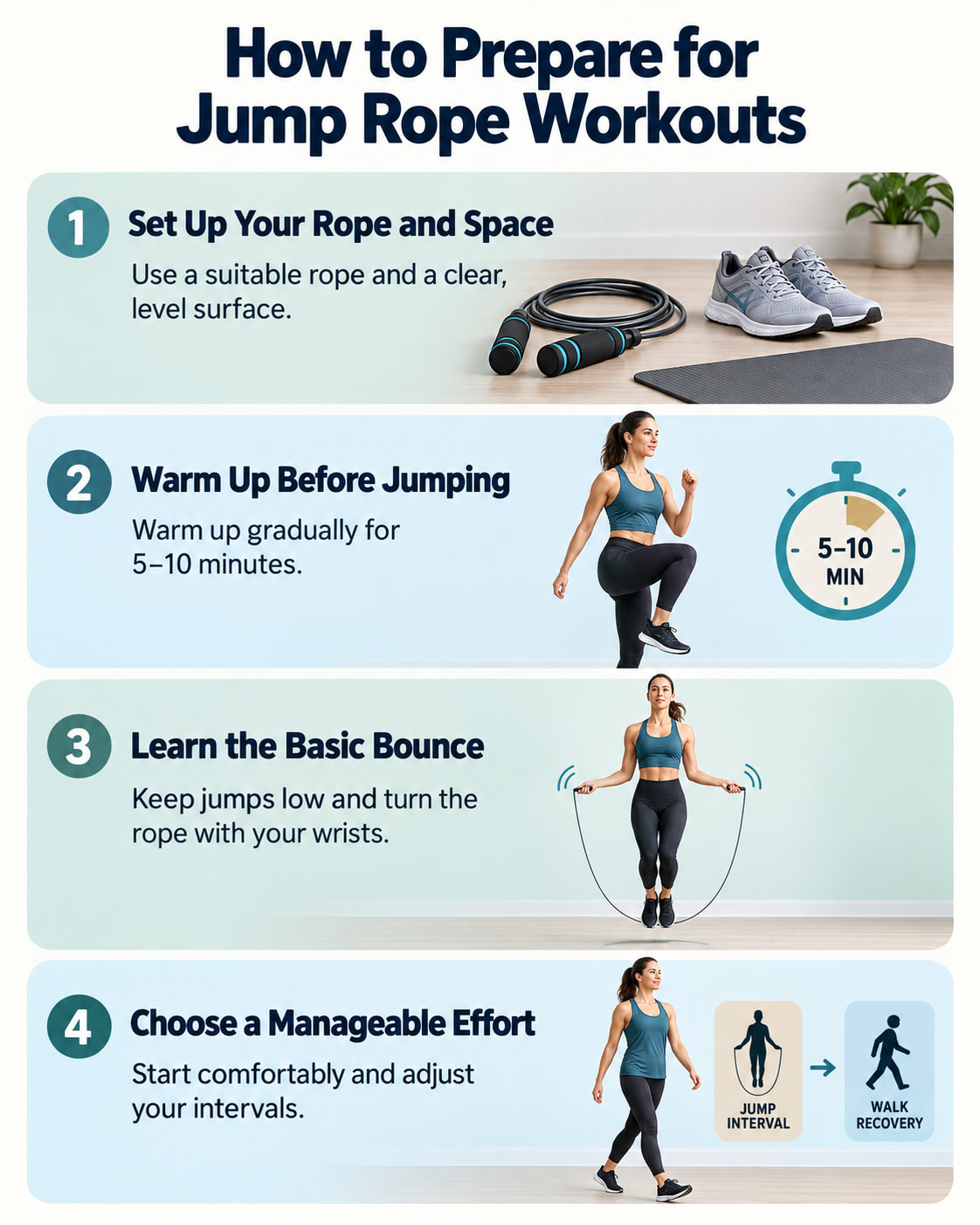
Set Up Your Rope and Space
You need an adjustable rope, comfortable athletic shoes, a timer, and enough clear space to swing the rope.
Check the area above and around you, especially ceiling fans, furniture, and other people. Use a level, nonslip surface.
To check rope length, stand on its middle and lift the handles. Chest-to-armpit height is a common starting guide, but follow the rope’s sizing instructions and adjust until it passes smoothly overhead and beneath your feet.
Warm Up Before Jumping
The American Heart Association recommends warming up for approximately 5–10 minutes before moderate or vigorous aerobic exercise. Start gently and increase your effort gradually.
For these workouts, begin with easy walking or marching. Gradually increase your pace, add comfortable arm movements, and rehearse a few low bounces when ready.
After the workout, spend approximately 5–10 minutes gradually slowing down, such as by walking at an increasingly easy pace. A 10-minute routine with a five-minute warm-up and five-minute cool-down takes 20 minutes altogether.
Learn the Basic Bounce
The American Council on Exercise’s form guidance emphasizes an upright posture, relaxed shoulders, close elbows, wrist-driven turns, and low jumps.
Use these steps:
- Stand tall with your feet comfortably close together.
- Hold the handles beside your hips with your elbows near your body.
- Turn the rope mainly with your wrists.
- Jump with both feet just high enough to clear the rope.
- Land softly with slightly bent knees.
- Continue with one rope turn per jump.
Practice a few controlled repetitions before starting the timer. If you trip, reset calmly without rushing to make up missed jumps.
Choose a Manageable Effort
Jumping rope can become vigorous quickly. The CDC describes moderate effort as being able to talk but not sing; during vigorous activity, you can usually say only a few words before pausing for breath.
For your first sessions, focus on maintaining control and recovering comfortably between intervals. Shorten the work period if your breathing or technique becomes difficult to manage.
8 Jump Rope Workouts to Try
Each routine includes its final recovery period in the total time. Recovery can mean easy walking, marching, or resting as needed. Extra breaks will lengthen the session, which is fine.
1. 10-Minute Beginner Starter
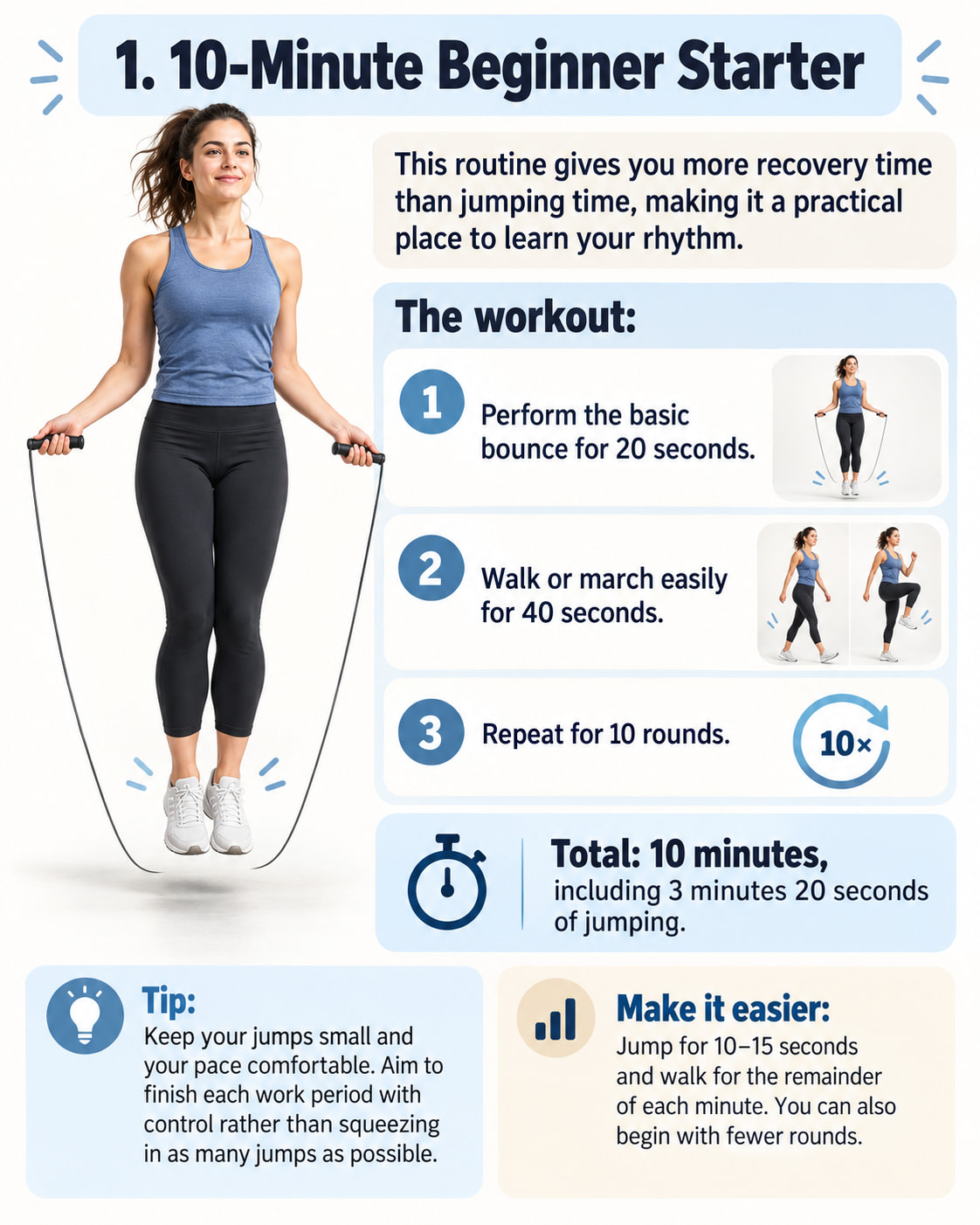
This routine gives you more recovery time than jumping time, making it a practical place to learn your rhythm.
The workout:
- Perform the basic bounce for 20 seconds.
- Walk or march easily for 40 seconds.
- Repeat for 10 rounds.
Total: 10 minutes, including 3 minutes 20 seconds of jumping.
Keep your jumps small and your pace comfortable. Aim to finish each work period with control rather than squeezing in as many jumps as possible.
Make it easier: Jump for 10–15 seconds and walk for the remainder of each minute. You can also begin with fewer rounds.
2. 12-Minute Rhythm Builder
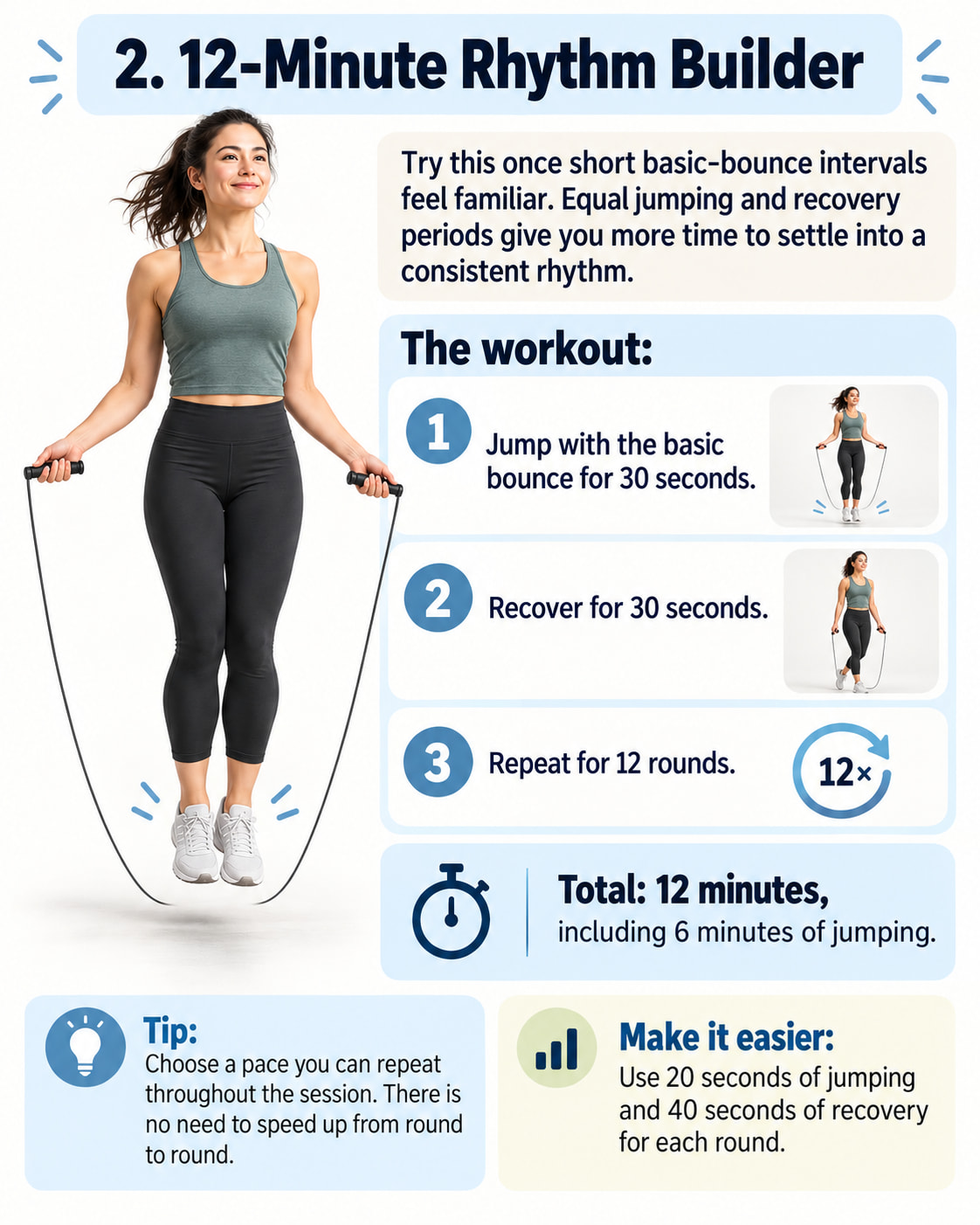
Try this once short basic-bounce intervals feel familiar. Equal jumping and recovery periods give you more time to settle into a consistent rhythm.
The workout:
- Jump with the basic bounce for 30 seconds.
- Recover for 30 seconds.
- Repeat for 12 rounds.
Total: 12 minutes, including 6 minutes of jumping.
Choose a pace you can repeat throughout the session. There is no need to speed up from round to round.
Make it easier: Use 20 seconds of jumping and 40 seconds of recovery for each round.
3. 12-Minute Alternate-Foot Practice
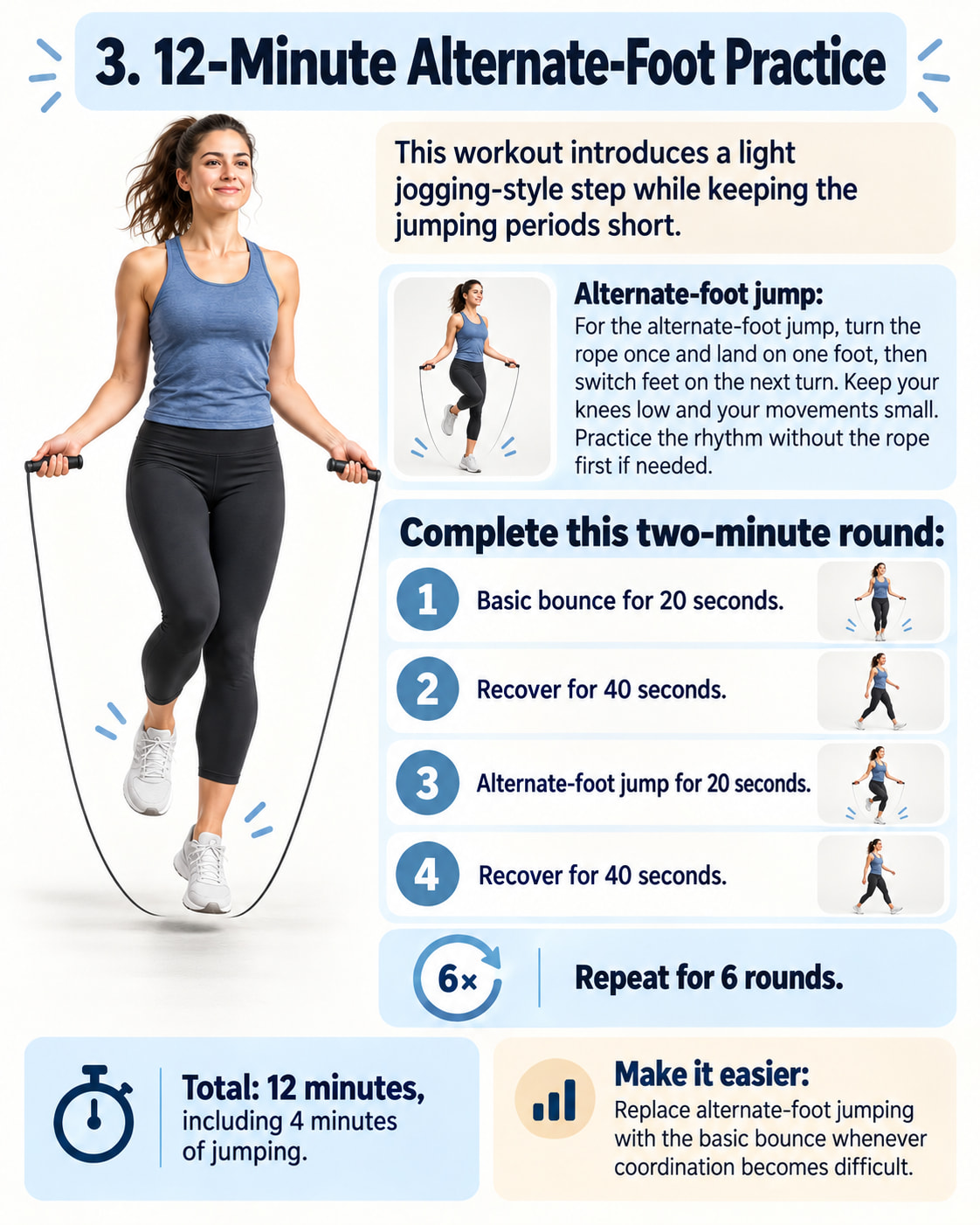
This workout introduces a light jogging-style step while keeping the jumping periods short.
For the alternate-foot jump, turn the rope once and land on one foot, then switch feet on the next turn. Keep your knees low and your movements small. Practice the rhythm without the rope first if needed.
Complete this two-minute round:
- Basic bounce for 20 seconds.
- Recover for 40 seconds.
- Alternate-foot jump for 20 seconds.
- Recover for 40 seconds.
Repeat for 6 rounds.
Total: 12 minutes, including 4 minutes of jumping.
Make it easier: Replace alternate-foot jumping with the basic bounce whenever coordination becomes difficult.
4. 15-Minute Boxer-Step Practice
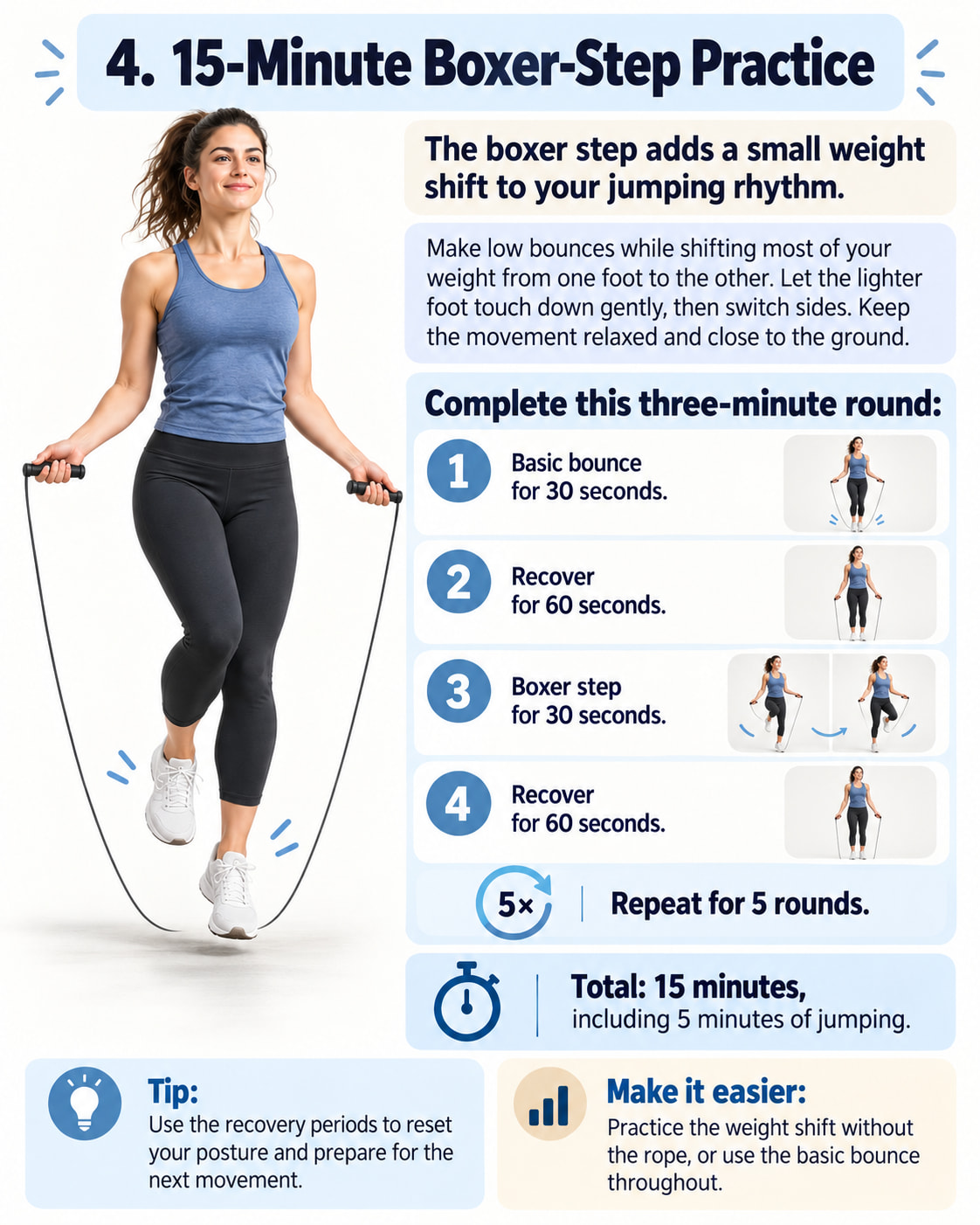
The boxer step adds a small weight shift to your jumping rhythm.
Make low bounces while shifting most of your weight from one foot to the other. Let the lighter foot touch down gently, then switch sides. Keep the movement relaxed and close to the ground.
Complete this three-minute round:
- Basic bounce for 30 seconds.
- Recover for 60 seconds.
- Boxer step for 30 seconds.
- Recover for 60 seconds.
Repeat for 5 rounds.
Total: 15 minutes, including 5 minutes of jumping.
Use the recovery periods to reset your posture and prepare for the next movement.
Make it easier: Practice the weight shift without the rope, or use the basic bounce throughout.
5. 15-Minute Interval Ladder
This routine changes the length of the jumping periods. Keep your pace controlled as the work intervals get longer.
Complete this five-minute block:
| Minute | Jump | Recover |
|---|---|---|
| 1 | 20 seconds | 40 seconds |
| 2 | 30 seconds | 30 seconds |
| 3 | 40 seconds | 20 seconds |
| 4 | 30 seconds | 30 seconds |
| 5 | 20 seconds | 40 seconds |
Repeat the block 3 times.
Total: 15 minutes, including 7 minutes of jumping.
Use the basic bounce throughout so you can concentrate on the timer and your form.
Make it easier: Change the 40-second jumping interval to 30 seconds, followed by 30 seconds of recovery.
6. 16-Minute Endurance Intervals
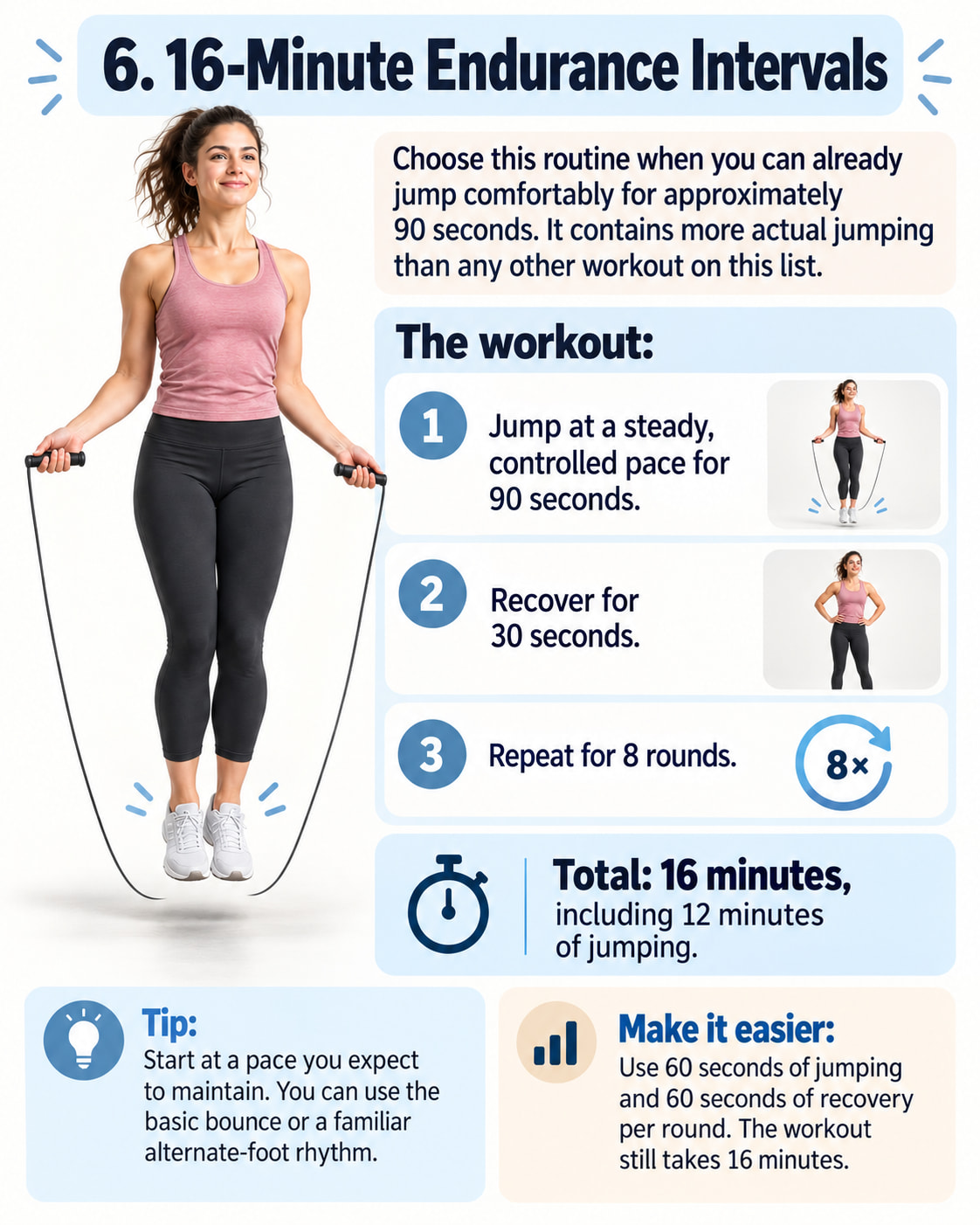
Choose this routine when you can already jump comfortably for approximately 90 seconds. It contains more actual jumping than any other workout on this list.
The workout:
- Jump at a steady, controlled pace for 90 seconds.
- Recover for 30 seconds.
- Repeat for 8 rounds.
Total: 16 minutes, including 12 minutes of jumping.
Start at a pace you expect to maintain. You can use the basic bounce or a familiar alternate-foot rhythm.
Make it easier: Use 60 seconds of jumping and 60 seconds of recovery per round. The workout still takes 16 minutes.
7. 18-Minute Faster Intervals
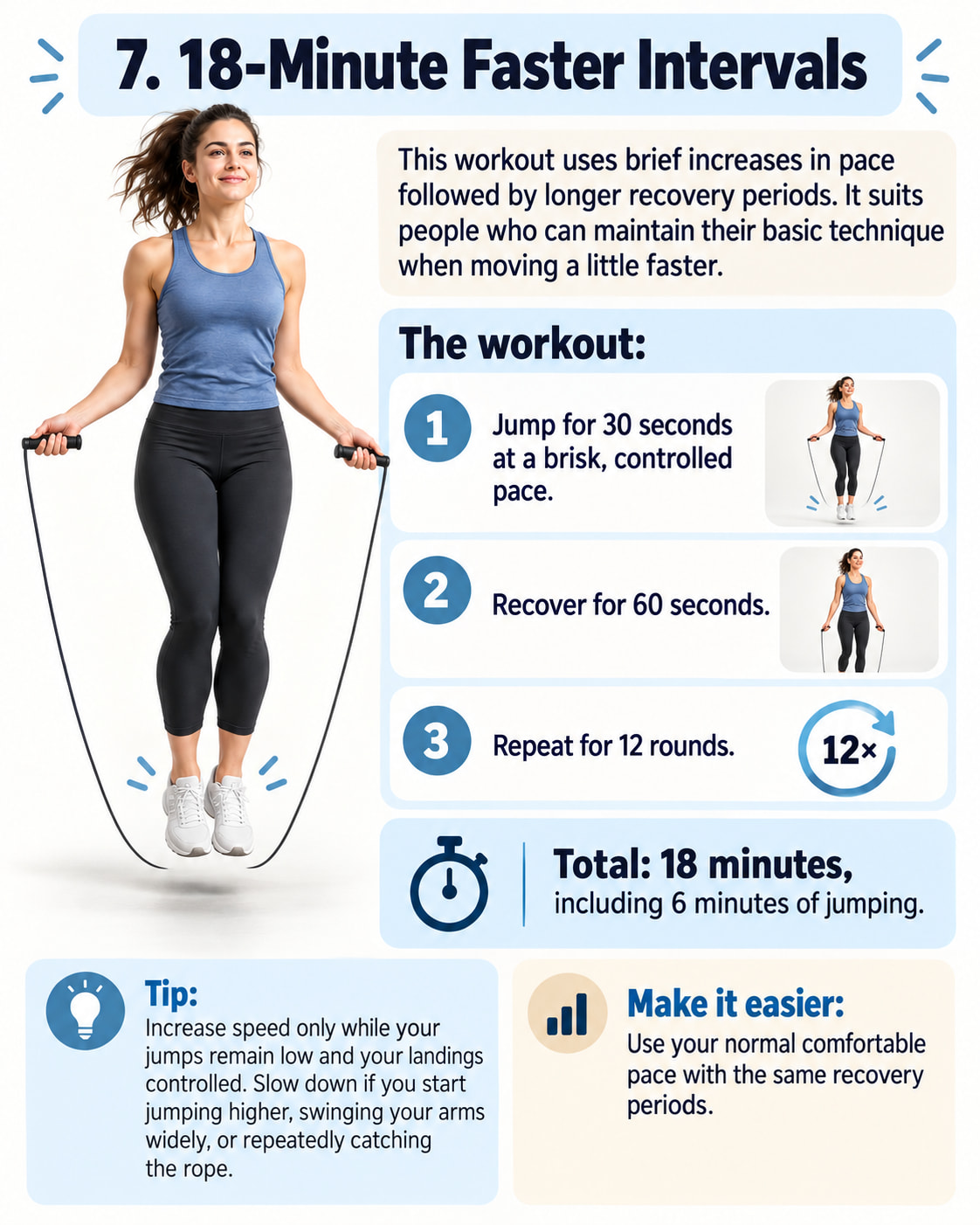
This workout uses brief increases in pace followed by longer recovery periods. It suits people who can maintain their basic technique when moving a little faster.
The workout:
- Jump for 30 seconds at a brisk, controlled pace.
- Recover for 60 seconds.
- Repeat for 12 rounds.
Total: 18 minutes, including 6 minutes of jumping.
Increase speed only while your jumps remain low and your landings controlled. Slow down if you start jumping higher, swinging your arms widely, or repeatedly catching the rope.
Make it easier: Use your normal comfortable pace with the same recovery periods.
8. 20-Minute Rope and Bodyweight Circuit
This routine alternates jumping with squats and wall push-ups. Set up near a stable wall, with a clear place to put the rope during transitions.
Complete this five-minute round:
| Exercise | Work time | Transition or recovery |
|---|---|---|
| Basic bounce | 45 seconds | 15 seconds |
| Bodyweight squats | 45 seconds | 15 seconds |
| Basic bounce | 45 seconds | 15 seconds |
| Wall push-ups | 45 seconds | 15 seconds |
| Easy walking | 60 seconds | Included |
Repeat for 4 rounds.
Total: 20 minutes, including 6 minutes of jumping, 6 minutes of bodyweight exercises, and 8 minutes of walking or transitions.
For the bodyweight squat, stand with your feet around shoulder-width apart. Bend your hips and knees to lower to a comfortable depth, keep your feet planted, and stand back up. Let your knees follow the direction of your toes.
For the wall push-up, place your hands against a stable wall around chest height. Step back slightly, keep your body aligned, bend your elbows to bring your chest toward the wall, and press away.
Use the transition periods to set down the rope safely and change position. Take longer when needed.
Make it easier: Jump for 20–30 seconds of each rope interval and walk for the remaining time. Use a shallower squat and stand closer to the wall for push-ups.
What Benefits Can Jump Rope Workouts Offer?
Jump rope combines cardiovascular effort with practice coordinating your hands and feet. It also requires little equipment and can fit into a small, clear exercise area.
Research supports improvements in aerobic fitness with regular training. A 2025 randomized trial involving 59 healthy young adults found that eight weeks of interval or continuous rope skipping improved aerobic fitness compared with a control group. However, body composition did not change significantly. The study used longer sessions than several routines here, so it does not establish specific results from these workouts.
Jump rope can contribute to your weekly aerobic activity. Current CDC recommendations call for at least 150 minutes of moderate activity or 75 minutes of vigorous activity weekly, plus muscle-strengthening activities on at least two days.
Count activity according to its actual effort. Easy recovery periods do not automatically count as vigorous exercise, and rope jumping alone does not cover every part of a balanced strength program.
How Often Should You Do Jump Rope Workouts?
A cautious starting option is two short sessions per week with recovery days between them. You might try the beginner starter on Monday and Thursday, using fewer rounds if needed.
As your coordination and recovery improve, you can adjust the schedule. Increase one demand at a time: jumping duration, number of rounds, pace, or footwork difficulty.
The American Academy of Orthopaedic Surgeons recommends building exercise gradually and allowing recovery when fatigue, significant soreness, or pain develops.
Pay attention to how your feet and lower legs feel later that day and before the next session. Repeat a manageable workout before moving to a more demanding one.
Jump Rope Safety and When to Modify
Jump rope involves repeated landing impact. If you have a current injury, an existing restriction on impact exercise, or a health condition that makes vigorous activity uncertain, get individualized guidance before starting.
Stop jumping if you develop pain. Persistent or worsening shin, foot, ankle, or knee symptoms deserve assessment rather than repeated attempts to push through them. Abrupt increases in training can contribute to overuse problems such as shin splints.
For a lower-impact option, march or step from side to side while mimicking the wrist movements. Jumping without a rope still involves landing impact.
Stop exercising and seek medical help for chest discomfort, dizziness, or unusual or severe breathlessness. Persistent chest discomfort or other signs of a possible heart attack require emergency care.
Frequently Asked Questions About Jump Rope Workouts
Is 10 Minutes of Jumping Rope a Good Workout?
A 10-minute interval session can be a useful way to practice technique and accumulate activity. Its intensity depends on your pace and how much time you spend jumping. Beginners can benefit from using most of that time for recovery while learning the movement.
How Long Should a Beginner Jump Rope?
Start with brief efforts that you can complete comfortably, such as 10–20 seconds followed by longer recovery. You do not need to jump continuously for 10 minutes. Begin with a few rounds and build gradually as your coordination and tolerance improve.
Can You Do Jump Rope Workouts Every Day?
Daily jumping is not necessary. When you are new to it, recovery days give you time to assess soreness and tolerance. Your eventual frequency should reflect your total activity, experience, and recovery rather than a requirement to jump every day.
How Many Calories Do Jump Rope Workouts Burn?
There is no single number that applies to everyone. Body weight, pace, technique, and actual jumping time affect energy expenditure. The 2024 Adult Compendium assigns different energy costs to different skipping speeds, but those values are estimates.
A 10-minute beginner routine containing 3 minutes 20 seconds of jumping will not have the same expenditure as 10 minutes of continuous jumping.
Can Jump Rope Workouts Help With Weight Management?
They can add physical activity to your routine, but weight loss is not guaranteed. Your overall eating pattern, activity, and consistency also matter. The 2025 trial discussed above improved aerobic fitness without significant changes in body composition.
Is Jumping Rope Better Than Running?
The better choice depends on your preferences, fitness, coordination, and comfort. There is no dependable universal rule that 10 minutes of rope jumping equals 30 minutes of running; a small study directly comparing those durations found different training responses.
What Should You Do if You Keep Tripping Over the Rope?
Check your rope length, keep your hands near your hips, and slow down. Practice a few basic bounces at a time. Reset after a missed jump and continue when ready. Short, controlled practice is more useful than rushing through repeated mistakes.
Conclusion
Start with the workout that matches your current ability, even if that means a few short jumping intervals. Keep your technique controlled, allow recovery, and build up gradually.
For your next session, choose the 10-Minute Beginner Starter, set a simple interval timer, and give yourself enough time to warm up and cool down.
References
- CDC: Adult Activity Recommendations
- CDC: How to Measure Physical Activity Intensity
- American Heart Association: Warm Up, Cool Down
- American Council on Exercise: Jumping Rope—Not Just for Kids Anymore
- Divers Alert Network: Jump Rope Training
- European Journal of Clinical Nutrition: Rope-Skipping Training in Young Adults
- AAOS: Safe Exercise
- AAOS: Shin Splints
- 2024 Adult Compendium of Physical Activities: Sports