
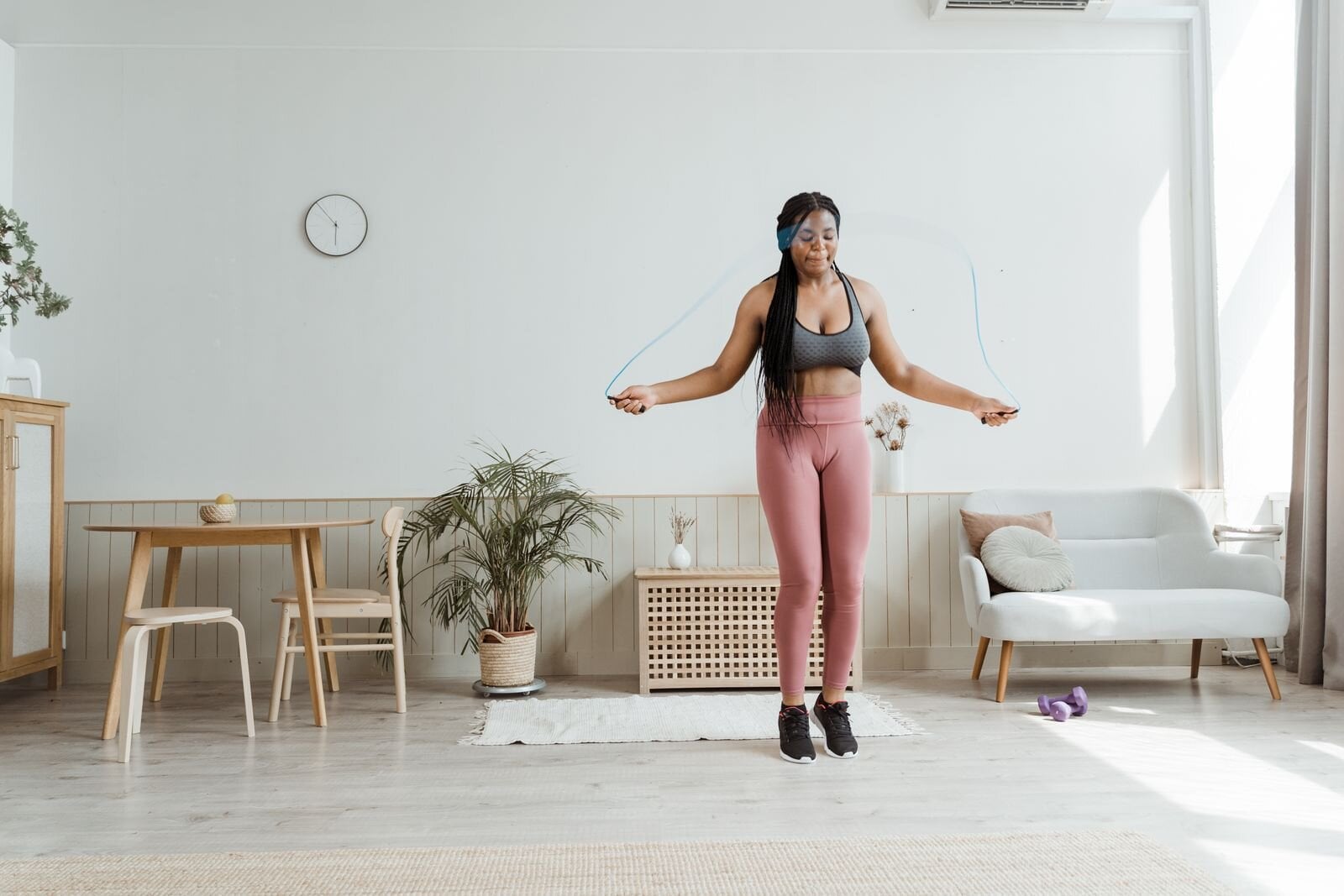
The best weight loss exercises at home combine calorie-raising cardio with bodyweight strength movements, including jump rope, burpees, mountain climbers, step-ups, squats, lunges, and push-ups. These exercises may support weight loss by increasing energy expenditure, improving fitness, and helping you maintain muscle.
However, no single exercise guarantees fat loss. The CDC’s guidance on physical activity and weight explains that physical activity increases the calories your body uses, while weight loss requires a calorie deficit over time. Your eating habits, total activity, sleep, medications, medical conditions, and consistency can all influence your results.
You do not need a gym or expensive equipment. Most of the exercises below require only enough floor space to move safely. A jump rope, exercise mat, and stable stair or step are optional.
Can You Lose Weight With Exercises at Home?
Yes, home workouts can help you lose weight when they are performed consistently and combined with eating habits that support an appropriate calorie intake.
A 2024 systematic review and meta-analysis of aerobic exercise included 116 randomized clinical trials and 6,880 adults with overweight or obesity. The researchers found that body weight, waist circumference, body-fat percentage, and abdominal fat generally decreased as weekly aerobic exercise increased up to 300 minutes. At least 150 minutes per week of moderate-to-vigorous exercise was associated with clinically important reductions in waist circumference and body-fat measures.
That does not mean everyone needs to begin with 150 minutes immediately. A beginner may need to start with 10- or 15-minute sessions and build gradually.
For the best overall approach, combine:
- Aerobic movements that raise your heart rate
- Strength exercises that challenge your major muscle groups
- Regular daily movement, such as walking and taking stairs
- A sustainable eating pattern that supports a calorie deficit
- Enough recovery to exercise consistently
What Makes an At-Home Exercise Effective for Weight Loss?
The exercise that theoretically burns the most calories is not always the best choice. An effective weight loss exercise should be challenging enough to increase energy expenditure but manageable enough to repeat regularly.
Look for exercises that meet these criteria:
Uses Large Muscle Groups
Movements involving your legs, hips, trunk, and upper body generally require more energy than movements involving one small muscle group.
Raises Your Heart Rate
Faster movements and full-body exercises can increase cardiovascular demand. Intensity should still match your current fitness and experience.
Can Be Modified
A useful exercise should have beginner, low-impact, and more advanced versions. For example, a step jack may replace a jumping jack, while an incline mountain climber may replace the floor version.
Includes Strength Work
Strength exercises may not always produce the highest calorie expenditure per minute, but they help create a balanced routine. A 2025 meta-analysis found that adding resistance exercise during diet-induced weight loss helped protect fat-free mass, supported greater fat loss, and improved strength compared with dietary restriction alone.
The American College of Sports Medicine also emphasized in its March 2026 resistance-training guidance that bodyweight exercises and home-based routines can meaningfully improve strength and physical function.
10 Best Weight Loss Exercises at Home
The following list includes both high-intensity calorie-burning exercises and controlled strength movements. You do not need to perform all ten during every workout.
1. Jump Rope
Jumping rope is a vigorous cardio exercise that requires little space and challenges coordination, endurance, and the lower body.
Estimated calories burned: About 135 calories in 10 minutes for a 155-pound adult.
How to Do It
- Stand upright with the rope behind your heels.
- Keep your elbows close to your sides.
- Turn the rope mainly with your wrists.
- Make small jumps rather than pulling your knees high.
- Land softly through the balls of your feet.
Begin with 20 to 30 seconds of jumping followed by 30 to 60 seconds of recovery. Increase the work period only when you can maintain light, controlled landings.
Beginner modification: Perform an “invisible rope” motion while alternating heel taps or small steps instead of jumping.
Practical tip: Jump rope can place significant demand on your calves and Achilles tendons. Start with short intervals rather than attempting a long continuous session on your first day.
2. Burpees
Burpees combine several movements into one exercise: squatting, moving into a plank, returning to standing, and optionally jumping. This makes them demanding even without equipment.
Estimated calories burned: About 92–135 calories in 10 minutes for a 155-pound adult.
How to Do It
- Stand with your feet about shoulder-width apart.
- Bend your knees and place your hands on the floor.
- Step or jump your feet back into a high plank.
- Keep your core firm and avoid letting your lower back sag.
- Step or jump your feet toward your hands.
- Stand up or finish with a controlled vertical jump.
Beginner modification: Place your hands on a stable countertop or bench, step your feet back one at a time, and remove the jump.
Start with three to five controlled repetitions or 15 to 20 seconds of work. Quality matters more than speed.
3. Mountain Climbers
Mountain climbers raise your heart rate while requiring your shoulders and core to stabilize your body.
Estimated calories burned: About 92–135 calories in 10 minutes for a 155-pound adult.
How to Do It
- Begin in a high plank with your hands under your shoulders.
- Keep your body in a relatively straight line.
- Bring one knee toward your chest.
- Return that foot and repeat with the opposite leg.
- Alternate at a pace that allows you to control your hips and trunk.
Beginner modification: Place your hands on a wall, countertop, or sturdy bench. The higher hand position reduces the load on your wrists, shoulders, and core.
Try 20 to 30 seconds, then rest. Slow mountain climbers are still useful when performed with good control.
4. Jumping Jacks
Jumping jacks are a simple way to add total-body cardio to a home workout. They can be performed alone, during a warm-up, or between strength exercises.
Estimated calories burned: About 92 calories in 10 minutes for a 155-pound adult.
How to Do Them
- Stand with your feet together and arms at your sides.
- Jump your feet outward while raising your arms overhead.
- Land with your knees slightly bent.
- Jump back to the starting position.
- Continue with a steady rhythm.
Low-impact modification: Step one foot to the side while raising your arms, return to the center, and alternate sides. These are called step jacks.
Do not assume that the jumping version is automatically better. Step jacks can still raise your heart rate when performed continuously with active arm movement.
5. High Knees or Jogging in Place
Jogging in place requires no equipment and can be adjusted by changing your speed, arm movement, or knee height.
Estimated calories burned: About 59–92 calories in 10 minutes for a 155-pound adult.
How to Do It
- Stand tall with your chest lifted.
- Begin jogging lightly in place.
- Swing your arms naturally.
- Increase your pace gradually.
- Raise your knees only as high as you can without leaning backward or losing control.
Low-impact modification: Perform a fast power march. Drive your opposite arm and knee forward while keeping one foot on the floor.
Use 20- to 60-second intervals depending on your fitness. You do not need to force your knees to hip height for the exercise to be effective.
6. Shadow Boxing
Shadow boxing is a useful standing cardio option for small spaces. It can also involve your upper body more than many traditional home cardio movements.
Estimated calories burned: About 114 calories in 10 minutes for a 155-pound adult.
How to Do It
- Stand with one foot slightly ahead of the other.
- Keep your knees soft and your hands near your face.
- Punch forward and quickly bring your hand back.
- Alternate jabs, crosses, and controlled hooks.
- Move your feet or shift your weight as space allows.
Keep the punches controlled, and do not lock your elbows. Avoid holding heavy dumbbells while punching because the added momentum may place unnecessary stress on your shoulders and elbows.
Beginner modification: Keep your feet planted and punch at a comfortable pace.
Try one- to two-minute rounds followed by 30 to 60 seconds of easy marching.
7. Step-Ups
Step-ups use the large muscles of your legs and hips while increasing your heart rate. The exercise can be adjusted through step height, pace, and workout duration.
Estimated calories burned: About 68–90 calories in 10 minutes for a 155-pound adult.
How to Do Them
- Use the lowest stair or a stable exercise step.
- Place your entire foot on the step.
- Press through that foot to lift your body.
- Bring the second foot onto the step.
- Step down slowly and repeat.
- Alternate which leg leads.
Keep your knee tracking in the same general direction as your toes. Avoid pushing excessively from the foot that remains on the floor.
Beginner modification: Use a low step, move slowly, and keep a wall or sturdy railing nearby for balance.
Never use a chair, rolling stool, unstable box, or soft piece of furniture for step-ups.
8. Bodyweight Squats
Bodyweight squats strengthen your thighs and hips. They also fit easily into a circuit with more cardiovascular exercises.
Estimated calories burned: About 37–80 calories in 10 minutes for a 155-pound adult.
How to Do Them
- Stand with your feet around shoulder-width apart.
- Brace your midsection gently.
- Move your hips backward and bend your knees.
- Lower only as far as you can while keeping your feet stable.
- Press through your feet to stand.
- Finish tall without forcefully leaning backward.
Your knees may move forward during a squat. The important point is to keep them controlled and generally aligned with your toes.
Beginner modification: Perform chair sit-to-stands. Lower yourself to a sturdy chair, lightly touch or sit, and stand again.
Start with 8 to 12 repetitions. Add repetitions or slow the lowering phase as the exercise becomes easier.
9. Reverse Lunges
Reverse lunges train one leg at a time and can help improve lower-body strength, coordination, and balance.
Estimated calories burned: About 37–80 calories in 10 minutes for a 155-pound adult.
How to Do Them
- Stand tall with your feet about hip-width apart.
- Step one foot backward.
- Bend both knees to lower your body.
- Keep most of your pressure through the front foot.
- Push through the front foot to return to standing.
- Alternate sides or complete one side at a time.
Use a shorter step and shallower range if a full lunge feels unstable.
Beginner modification: Hold a wall, countertop, or sturdy chair for support. You can also replace lunges with split-stance knee bends without repeatedly stepping backward.
10. Push-Ups
Push-ups are not usually the highest-calorie exercise on this list, but they strengthen your chest, shoulders, arms, and trunk. Including them helps prevent a home workout from becoming entirely lower-body focused.
Estimated calories burned: About 37–80 calories in 10 minutes for a 155-pound adult.
How to Do Them
- Place your hands slightly wider than shoulder-width apart.
- Form a straight line from your head through your hips.
- Bend your elbows and lower your chest toward the surface.
- Keep your elbows angled slightly backward rather than directly outward.
- Push through your hands to return to the starting position.
Choose the variation that lets you maintain proper body position:
- Wall push-ups
- Countertop push-ups
- Bench or sturdy-table push-ups
- Knee push-ups
- Full floor push-ups
Start with 5 to 12 controlled repetitions. Move to a lower surface only after your current version becomes manageable.
How Many Calories Do At-Home Exercises Burn?
Calories burned depend on several factors, including:
- Body weight
- Workout intensity
- Exercise technique
- Fitness level
- Work-to-rest ratio
- Workout duration
- Movement efficiency
The 2024 Adult Compendium of Physical Activities uses metabolic equivalent, or MET, values to classify exercise intensity. For example, it lists vigorous calisthenics at 7.5 METs and both general rope skipping and vigorous intervals involving movements such as burpees or mountain climbers at 11 METs.
The following calculations illustrate approximately how many calories a 155-pound adult might expend during 10 minutes of active movement:
| Activity Category | MET Value | Approximate Calories in 10 Minutes |
|---|---|---|
| Moderate calisthenics | 3.8 | 47 |
| Vigorous calisthenics | 7.5 | 92 |
| General rope skipping | 11.0 | 135 |
| Vigorous burpee or mountain-climber intervals | 11.0 | 135 |
These are rough estimates—not personal measurements or guaranteed results. A workout containing rest periods will generally burn fewer calories than the same amount of uninterrupted active work. A person who weighs less may expend fewer calories, while a heavier person may expend more at the same MET level.
Do not choose exercises based only on the highest number. A controlled 25-minute low-impact workout may be more useful than five minutes of exhausting exercise that leaves you too sore to train again.
20-Minute Weight Loss Workout at Home
This routine alternates cardio and strength exercises so that one muscle group does not carry the entire workout.
Three-Minute Warm-Up
Perform each movement for 30 seconds:
- Easy marching in place
- Arm circles
- Alternating heel taps
- Slow chair squats
- Side steps
- Faster marching
Fourteen-Minute Circuit
Perform each exercise for 40 seconds, followed by 20 seconds of transition or recovery. Complete the seven exercises twice.
| Order | Exercise | Lower-Impact Option |
|---|---|---|
| 1 | Jumping jacks | Step jacks |
| 2 | Bodyweight squats | Chair sit-to-stands |
| 3 | Shadow boxing | Slower punches with planted feet |
| 4 | Mountain climbers | Countertop mountain climbers |
| 5 | Reverse lunges | Supported shallow lunges |
| 6 | High knees | Power marching |
| 7 | Push-ups | Wall or countertop push-ups |
During the first round, use a moderate pace and concentrate on form. Increase your effort slightly during the second round only if you remain in control.
The CDC’s talk test provides a simple intensity check. During moderate activity, you should generally be able to talk but not sing. During vigorous activity, you may be able to say only a few words before pausing for breath.
Three-Minute Cool-Down
Slowly march until your breathing begins to settle. Follow with gentle calf, thigh, chest, and shoulder stretches. Avoid suddenly sitting or lying down immediately after a demanding interval.
Low-Impact Weight Loss Exercises for Beginners
You do not need jumping movements to create an effective home workout. Low-impact exercise may be more appropriate when you are new to exercise, live above another apartment, have limited space, or experience discomfort with repeated landing.
Try these substitutions:
| Higher-Impact Exercise | Lower-Impact Alternative |
|---|---|
| Jump rope | Invisible rope with alternating steps |
| Burpees | Incline step-back burpees |
| Floor mountain climbers | Wall or countertop mountain climbers |
| Jumping jacks | Step jacks |
| High knees | Power marching |
| Fast step-ups | Slow step-ups on a low stair |
| Deep squats | Chair sit-to-stands |
| Full push-ups | Wall push-ups |
Begin with a pace that lets you maintain good posture. Ten controlled minutes are more useful than a longer session performed with poor technique.
As your fitness improves, progress one variable at a time:
- Add several minutes to the workout.
- Complete an additional round.
- Add a few repetitions.
- Reduce rest slightly.
- Use a more challenging exercise variation.
- Increase your pace while maintaining control.
Avoid increasing duration, speed, impact, and workout frequency all at once.
How Often Should You Do Weight Loss Exercises at Home?
The current Physical Activity Guidelines for Americans recommend that adults work toward:
- 150 to 300 minutes of moderate-intensity aerobic activity per week
- 75 to 150 minutes of vigorous-intensity aerobic activity per week
- Or an equivalent combination of moderate and vigorous activity
- Muscle-strengthening exercise on at least two days per week
People who are inactive are encouraged to begin with smaller amounts and gradually work toward the recommended range.
Some people may need approximately 300 minutes or more of weekly aerobic activity to reach or maintain a weight-loss goal. The exact amount varies because exercise is only one part of energy balance.
Example Weekly Home Exercise Schedule
This is an example to work toward rather than a required starting point.
| Day | Activity |
|---|---|
| Monday | 20-minute circuit plus 10 minutes of easy movement |
| Tuesday | 30 minutes of low-impact cardio |
| Wednesday | Rest or gentle mobility |
| Thursday | 20-minute strength-focused circuit plus 10 minutes of marching |
| Friday | 30 minutes of step-ups, shadow boxing, and step jacks |
| Saturday | 30-minute mixed cardio and strength workout |
| Sunday | Rest or relaxed activity |
This provides approximately 150 minutes of activity and includes at least two strength-focused sessions. Beginners can perform shorter sessions and add time gradually.
How to Get Better Weight Loss Results From Home Workouts
Combine Cardio and Strength Training
Cardio movements help increase energy expenditure during the session. Strength exercises challenge your muscles and support a more balanced program.
You can combine both by alternating exercises such as:
- Jumping jacks and squats
- Shadow boxing and push-ups
- High knees and reverse lunges
- Jump rope and chair sit-to-stands
Make Your Eating Pattern Sustainable
Exercise does not automatically offset frequent overeating. Choose an eating pattern that provides adequate nutrition and that you can maintain rather than relying on severe restriction.
Weight management is also influenced by sleep, stress, medications, health conditions, age, hormones, and environmental factors.
Track More Than the Scale
Body weight can fluctuate from day to day because of food intake, hydration, sodium, digestion, and other factors.
Consider tracking:
- Weekly workout minutes
- Exercises completed
- Repetitions or interval duration
- Waist measurements
- Energy and stamina
- How quickly you recover
- Changes in exercise technique
Increase Everyday Movement
Formal workouts are helpful, but they are not your only opportunity to move. Walking, household chores, carrying groceries, taking stairs, and standing more frequently can add activity throughout the day.
Choose Consistency Over Exhaustion
A workout does not need to leave you unable to move the next day. Repeating manageable sessions each week is generally more practical than alternating extreme effort with long periods of inactivity.
Safety Tips Before Starting
Follow these precautions when performing weight loss exercises at home:
- Clear furniture, cords, rugs, and other tripping hazards.
- Wear footwear appropriate for the activity and floor surface.
- Use only a stable stair or exercise platform for step-ups.
- Warm up before fast or high-impact movements.
- Keep initial sessions short if you have been inactive.
- Stop an exercise if pain changes your movement.
- Allow recovery after demanding workouts.
- Stay hydrated, especially in a warm room.
- Avoid training through sharp, increasing, or unexplained pain.
Speak with a qualified healthcare professional about appropriate activity if you have heart disease, diabetes, uncontrolled high blood pressure, significant joint problems, balance difficulties, a current injury, or another condition that may affect exercise. Individualized guidance may also be appropriate during pregnancy, after childbirth, or after surgery.
Stop exercising and seek prompt help for chest pressure, extreme or unusual shortness of breath, dizziness, or feeling faint. Chest discomfort accompanied by shortness of breath, nausea, sweating, or lightheadedness may be a medical emergency.
Frequently Asked Questions
Which Exercise Burns the Most Calories at Home?
Vigorous jump rope, burpees, mountain climbers, and other full-body intervals can have high energy demands. However, the exercise that burns the most calories per minute is not necessarily the best personal choice. Consider your fitness, joint tolerance, experience, and ability to sustain the routine.
Can 30 Minutes of Home Exercise a Day Help With Weight Loss?
Yes. Thirty minutes per day provides 210 minutes of weekly activity when performed every day, placing you within the recommended 150- to 300-minute range for moderate exercise. Weight loss still depends on your total calorie balance and individual circumstances.
Can You Lose Weight With Home Workouts and No Equipment?
Yes. Squats, lunges, push-ups, step jacks, mountain climbers, burpees, high knees, and shadow boxing can all be performed without traditional gym equipment. Bodyweight training can also improve strength and physical function.
Is HIIT Better Than Moderate Exercise for Weight Loss?
Not necessarily. HIIT can provide a challenging workout in a limited amount of time, but it is not required for weight loss. Moderate exercise may be easier to recover from and accumulate consistently. The best approach is one that matches your fitness and helps you achieve enough weekly activity.
What Are the Best Low-Impact Weight Loss Exercises at Home?
Useful options include power marching, step jacks, shadow boxing, low step-ups, chair squats, wall push-ups, and countertop mountain climbers. Move continuously at a pace that noticeably increases your breathing while allowing you to maintain good form.
How Many Days a Week Should I Exercise to Lose Weight?
Many people distribute their activity across three to five days, although shorter daily sessions can also work. Focus on your total weekly minutes and include strength exercises on at least two days. Include recovery days based on workout intensity and how your body responds.
Can Home Exercises Reduce Belly Fat?
Home exercise may help reduce total body fat, waist circumference, and abdominal fat when combined with an appropriate overall weight-loss plan. However, performing exercises for one body part does not guarantee that fat will be lost specifically from that area. A 2024 meta-analysis found that increasing aerobic exercise was associated with reductions in waist circumference and both visceral and subcutaneous abdominal fat.
Conclusion
The best weight loss exercises at home are not limited to the hardest or highest-impact movements. A practical routine combines cardio exercises such as jump rope, step jacks, high knees, and shadow boxing with strength movements such as squats, lunges, and push-ups.
Start with versions you can perform safely, use short intervals, and progress gradually. Choose five to seven exercises from this guide and complete the 20-minute routine two or three times this week. Build toward the recommended weekly activity range as your fitness and recovery improve.
References
- CDC: Physical Activity and Your Weight and Health
- Physical Activity Guidelines for Americans
- NIDDK: Tips for Starting Physical Activity
- PubMed: Aerobic Exercise and Weight Loss in Adults
- PubMed: Resistance Exercise During Dietary Weight Loss
- ACSM: Updated Resistance Training Guidelines
- 2024 Adult Compendium of Physical Activities
- American Heart Association: Heart Attack and Stroke Symptoms