
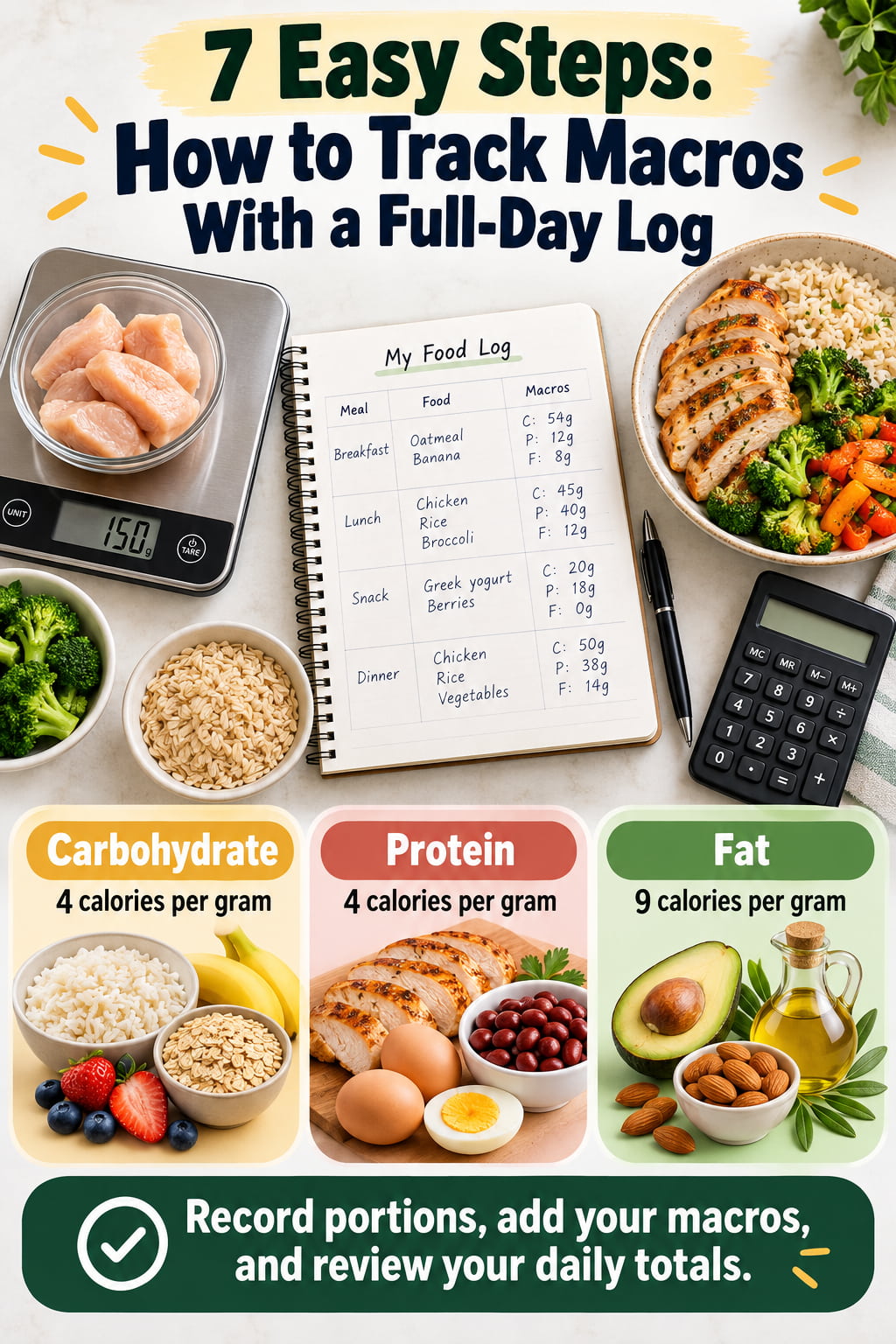
To track macros, record the grams of carbohydrate, protein, and fat in the portions you eat, then add your daily totals and compare them with targets suited to your needs. Learning how to track macros starts with reading food labels, measuring portions, and choosing a logging method you can maintain.
A food log can show how your meals contribute to your intake and where an adjustment might be useful. You can use an app, a spreadsheet, or a notebook.
The seven steps below explain the process, followed by a full-day example. The sample numbers illustrate the calculations; your own needs may differ.
What Are Macros?
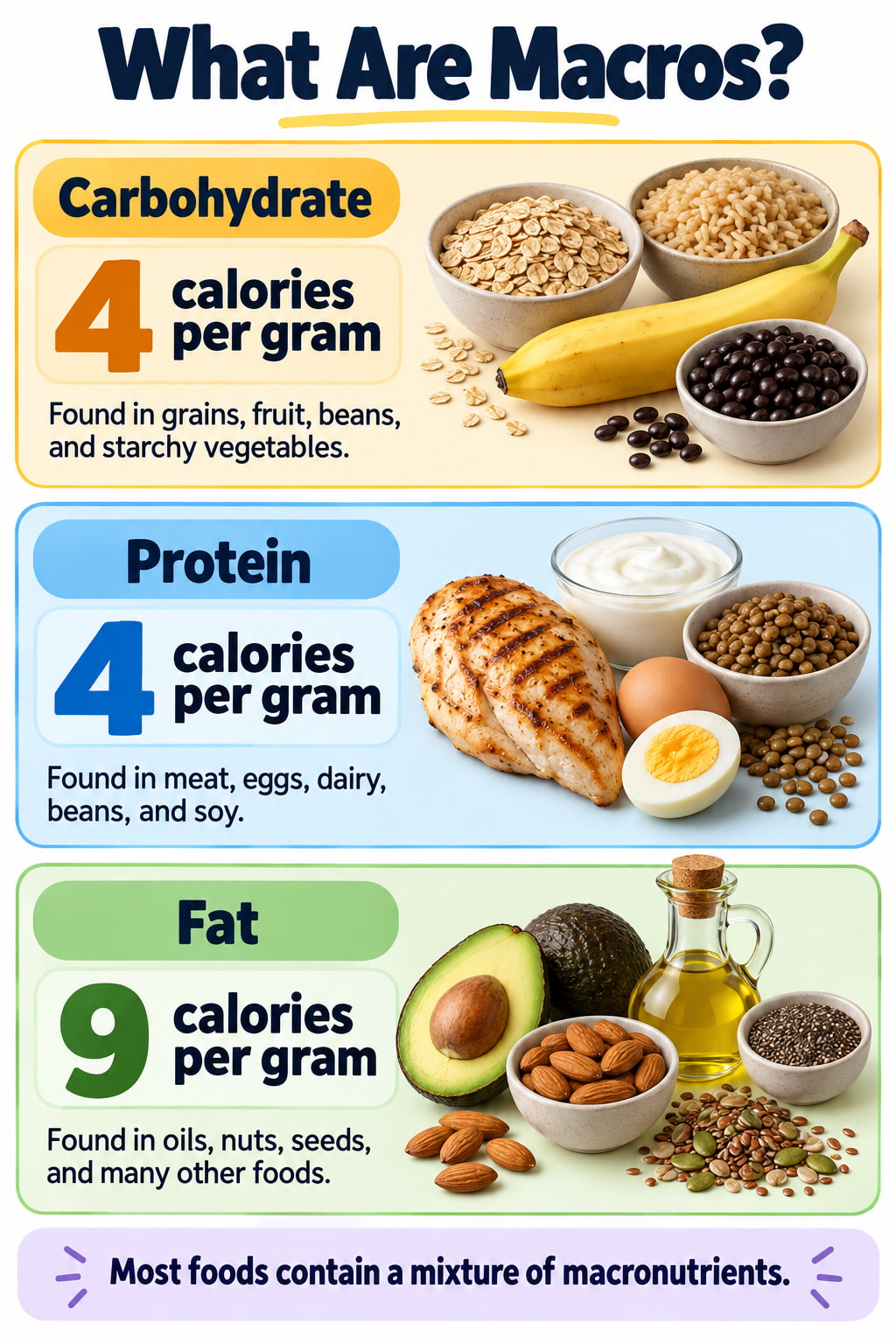
“Macros” is short for macronutrients. In food tracking, it usually refers to carbohydrate, protein, and fat.
| Macronutrient | General calorie conversion | Common food sources |
|---|---|---|
| Carbohydrate | About 4 calories per gram | Grains, fruit, beans, starchy vegetables, and milk |
| Protein | About 4 calories per gram | Meat, fish, eggs, dairy, beans, lentils, and soy |
| Fat | About 9 calories per gram | Oils, nuts, seeds, avocado, and fats within other foods |
Most foods contain a mixture. Beans provide carbohydrate and protein, while nuts contribute fat, protein, and carbohydrate. Log all three values for each food.
Also, grams of food and grams of a nutrient are different measurements. A 100-gram portion of chicken is 100 grams of food, not 100 grams of protein.
How to Track Macros in 7 Easy Steps
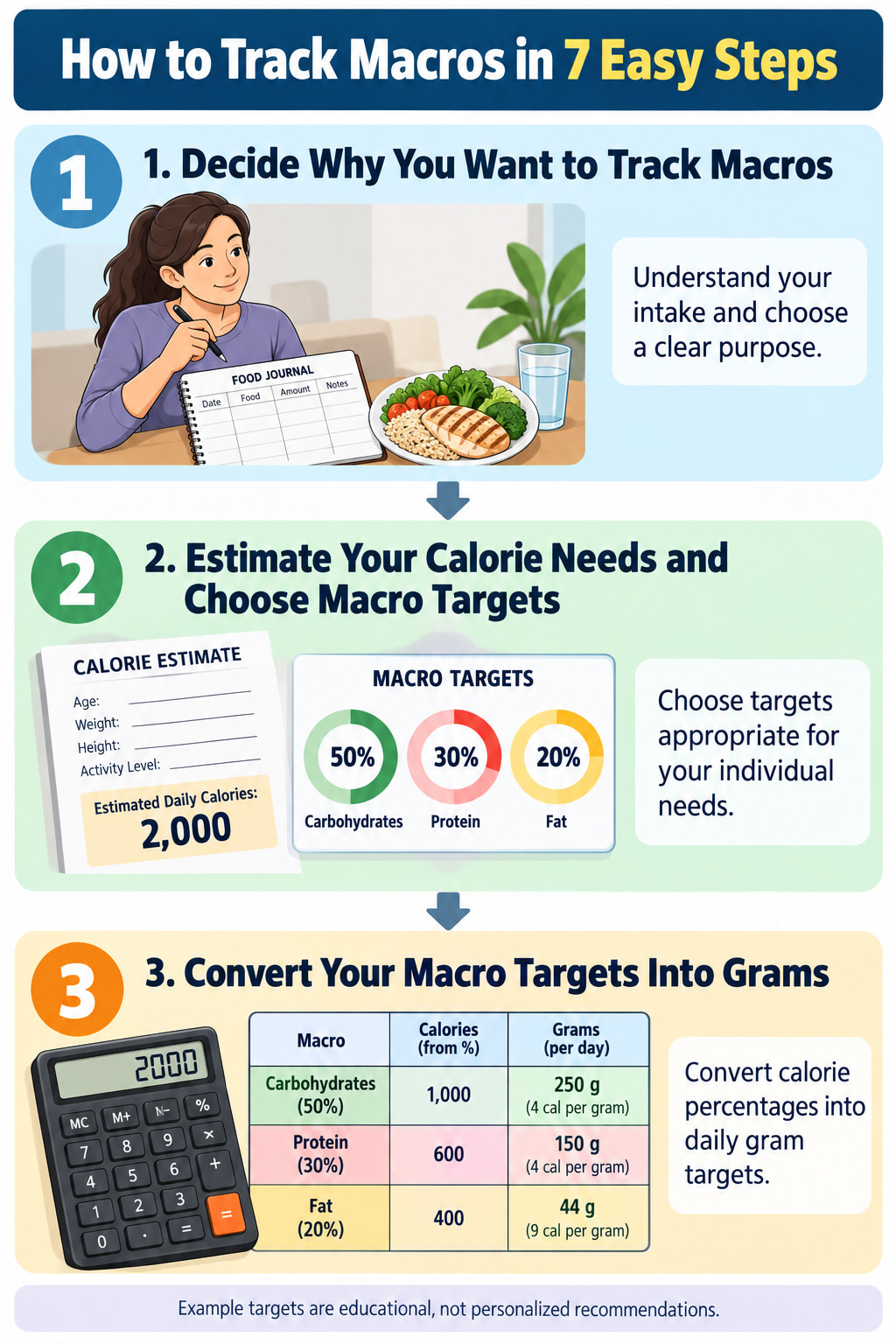
1. Decide Why You Want to Track Macros
Choose a clear purpose before setting targets. You might want to:
- Understand how much protein your meals provide.
- Learn what different portions contain.
- Support an exercise routine.
- Work toward an appropriate weight-management goal.
You can begin by recording a usual day without changing what you eat. That gives you a starting point and helps you learn the process.
A weight-loss goal is not required. The useful question is whether the information helps you make practical food choices.
2. Estimate Your Calorie Needs and Choose Macro Targets
Calorie needs vary with factors such as age, body size, sex, and activity level. The USDA DRI Calculator can estimate energy and nutrient needs, but its results remain estimates.
Do not automatically adopt a 2,000-calorie target because it appears on food labels. That number is a general reference.
For healthy adults, the National Academies’ reference ranges describe the following proportions of daily calories:
| Macronutrient | Adult reference range |
|---|---|
| Carbohydrate | 45%–65% of calories |
| Protein | 10%–35% of calories |
| Fat | 20%–35% of calories |
These ranges provide context for planning. Any combination you select should add up to 100%; combining the upper end of every range would not work.
Protein goals may also be expressed relative to body weight. The Dietary Guidelines for Americans, 2025–2030, published in January 2026, lists a protein serving goal of 1.2–1.6 grams per kilogram of body weight per day, adjusted for individual calorie requirements.
For example, that calculation gives 84–112 grams for someone weighing 70 kilograms, or about 154 pounds. This is a body-weight-based serving goal; the table above expresses protein as a percentage of calories.
Your health, activity, and overall eating pattern matter when choosing targets. If a clinician or registered dietitian has provided a plan, use those individualized targets.
3. Convert Your Macro Targets Into Grams
If your targets are percentages, convert them into grams:
Daily macro grams = daily calories × the macro percentage as a decimal ÷ calories per gram
Divide carbohydrate and protein calories by 4. Divide fat calories by 9.
For a hypothetical 2,000-calorie day using 50% carbohydrate, 20% protein, and 30% fat:
| Macronutrient | Calculation | Daily amount |
|---|---|---|
| Carbohydrate | 2,000 × 0.50 ÷ 4 | 250 g |
| Protein | 2,000 × 0.20 ÷ 4 | 100 g |
| Fat | 2,000 × 0.30 ÷ 9 | About 66.7 g |
This ratio demonstrates the math. It is not a universal recommendation.
If your plan already gives targets in grams, you can enter those directly into your tracker.
4. Choose a Simple Tracking Method
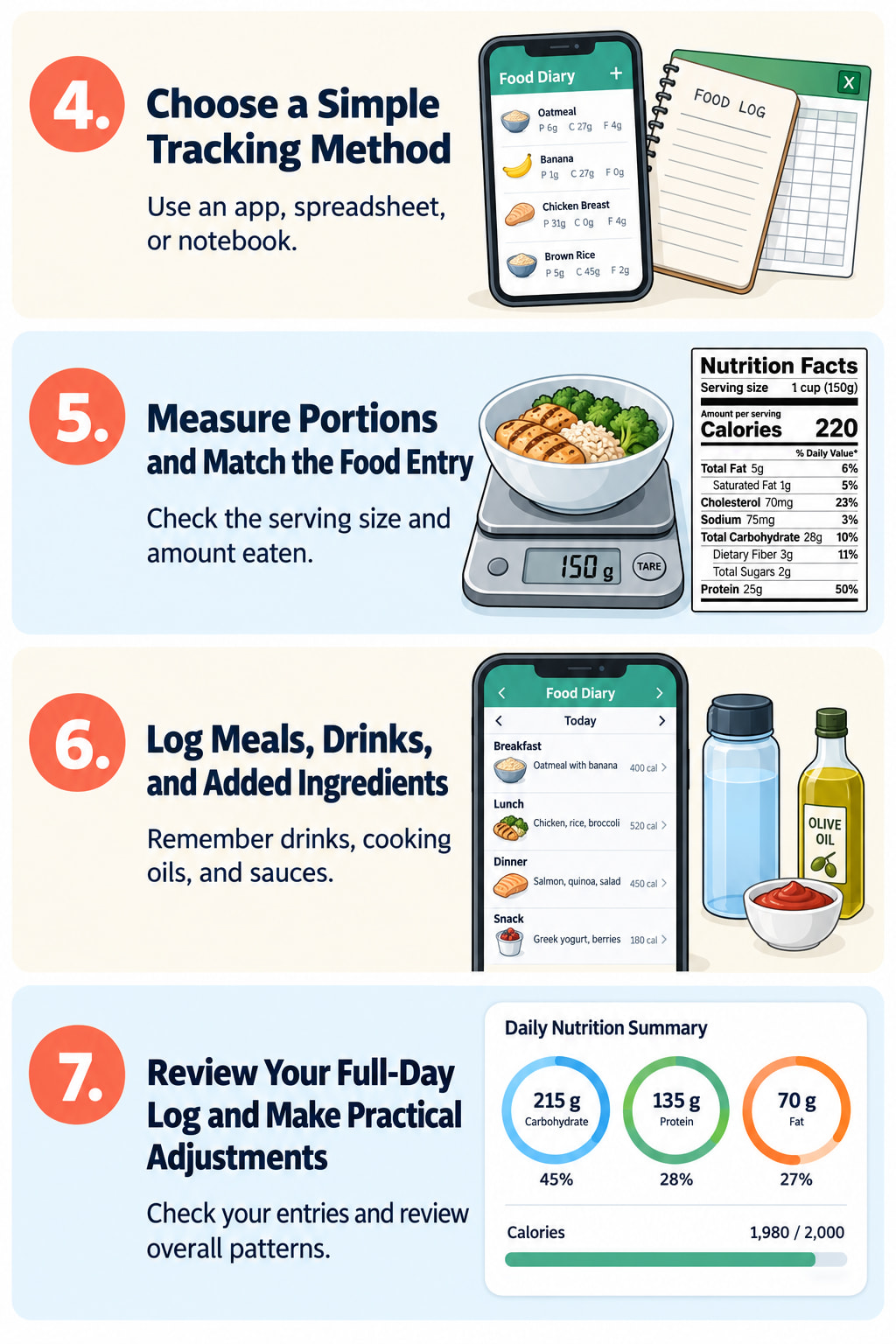
Choose a method that fits your routine:
- Nutrition app: Useful for adding totals and saving frequently eaten foods.
- Spreadsheet: Useful if you prefer entering your own values and formulas.
- Notebook: Works well when you are comfortable reading labels and adding numbers.
For each entry, record the food, amount eaten, calories, carbohydrate, protein, and fat.
Use the package label for the product you have. For foods without a label, a matching USDA FoodData Central entry can provide an estimate. In an app, check that the brand, portion size, and nutrient values match before saving an entry.
For restaurant meals, use the restaurant’s published nutrition information when available and account for customizations. When details are unavailable, record your best estimate and mark it as estimated.
5. Measure Portions and Match the Food Entry
The amount you eat determines what you log. According to FDA label guidance, nutrient amounts usually refer to one labeled serving. The serving size is not a recommendation for how much you should eat.
Use this formula:
Amount logged = nutrient amount per labeled serving × amount eaten ÷ labeled serving amount
For example:
- A hypothetical label lists 5 grams of protein per 40-gram serving.
- Your portion weighs 60 grams.
- You ate 60 ÷ 40 = 1.5 servings.
- Log 5 × 1.5 = 7.5 grams of protein.
Apply the same multiplier to calories, carbohydrate, and fat.
A kitchen scale can make gram-based entries easier. Place your empty bowl on the scale, reset it to zero, and add the food. Measuring cups and spoons are another option when they match the listed portion.
Match raw food weights to raw entries and cooked weights to cooked entries. For example, if you weigh rice after cooking, choose a cooked-rice entry. Dry rice and cooked rice are not interchangeable gram for gram because cooking changes their water content.
For a mixed homemade dish, use the recipe method in the next step.
6. Log Meals, Drinks, and Added Ingredients
Record the foods and drinks you consume, including additions that are easy to overlook:
- Milk, cream, or sugar added to coffee.
- Cooking oil, butter, dressing, and sauces.
- Snacks, spreads, and toppings.
- Calorie-containing drinks.
Logging close to mealtime can make it easier to remember the details. Save meals you eat regularly so you can reuse them, then adjust the portion or ingredients when needed.
How to Log a Homemade Recipe
For a casserole, soup, smoothie, or other mixed dish:
- Enter the ingredients and quantities used.
- Add their nutrition values to create the batch total.
- Divide the finished dish into equal portions, or weigh the finished batch.
- Log the fraction you eat.
Suppose a finished dish weighs 1,200 grams and your portion weighs 300 grams. Your portion is 300 ÷ 1,200 = one-quarter of the batch. Log one-quarter of its estimated nutrients.
Weigh the food without the pot or storage container. For mixed dishes, distribute the ingredients as evenly as practical when portioning.
If a saved recipe already includes its oil, sauce, or toppings, do not add them again. Log any extras separately.
7. Review Your Full-Day Log and Make Practical Adjustments
Add your calories and each macro separately. Before comparing the totals with your targets, check for:
- The wrong serving size or number of servings.
- A raw-food entry used for a cooked portion.
- Missing drinks, sauces, or cooking ingredients.
- An ingredient logged both individually and within a recipe.
Then look beyond the numbers. Consider whether your meals provided variety, whether you felt adequately fed, and whether the tracking routine was manageable.
Use repeated patterns to guide future planning. One day gives you information, but it does not describe your entire eating pattern. If your targets consistently leave you hungry, fatigued, or struggling to eat enough, review them with a registered dietitian.
Full-Day Macro Log Example
This example uses published recipe nutrition from the American Heart Association and Tennessee’s government wellness recipe collection. It demonstrates how to record recipe servings and add a day’s intake.
The portions and totals are illustrative, rather than a personalized meal plan. Use the exact recipe entry when reproducing these numbers; substitutions and additional ingredients can change them.
| Meal | Recipe and portion logged | Calories | Carbohydrate | Protein | Fat |
|---|---|---|---|---|---|
| Breakfast | Banana Bread Overnight Oats: 1 serving, or ¼ of the recipe | 458 | 63 g | 15 g | 15 g |
| Lunch | Penne with Shrimp: 2 servings, or ¼ of the eight-serving recipe | 770 | 97 g | 49 g | 17 g |
| Dinner | Creamy Chicken and Mushroom Soup: 1 serving, or ⅙ of the recipe | 377 | 23 g | 42 g | 13 g |
| Snack | Peanut Butter Banana Smoothie: 1 serving, or ½ of the recipe | 260 | 40 g | 11 g | 8 g |
| Total | 1,865 | 223 g | 117 g | 53 g |
The overnight oats entry includes its walnut topping. The pasta, soup, and smoothie entries include the ingredients in their published recipes. Any additional food or drinks would need their own entries.
How to Compare the Log With Your Targets
Using the earlier 2,000-calorie calculation only as a demonstration:
| Measure | Illustrative target | Logged amount | Difference |
|---|---|---|---|
| Calories | 2,000 | 1,865 | 135 below |
| Carbohydrate | 250 g | 223 g | 27 g below |
| Protein | 100 g | 117 g | 17 g above |
| Fat | About 66.7 g | 53 g | About 13.7 g below |
This comparison shows how a tracker works. It does not mean you should force additional food or restrict another meal to make every number match.
First check the entries and whether the targets suit you. If a pattern continues, use it to plan future meals with appropriate portions and food choices.
Why Calories and Macro Calculations May Differ
Multiplying this day’s displayed macros by the general calorie factors gives:
223 × 4 + 117 × 4 + 53 × 9 = 1,837 calories
The recipes’ published calorie values add up to 1,865. Rounding and different energy-calculation methods can cause differences between displayed nutrients and calories; the figures alone do not identify the exact reason here.
Use the published calorie values consistently in your log. A small mismatch does not automatically mean you entered the food incorrectly.
Keep Food Quality in Your Macro-Tracking Routine
Macro totals describe only part of a diet. They do not tell you whether you are getting enough fiber, vitamins, or minerals.
Continue choosing a variety of vegetables, fruit, whole grains, protein foods, and other nutrient-rich options that suit your needs. Check nutrients such as fiber, sodium, saturated fat, and added sugars alongside the three macros.
You can also simplify tracking over time. NIDDK notes that measuring and counting everything does not need to be a lifelong task; it can help you learn typical portions.
When to Get Individual Guidance
Get help choosing calorie and macro targets if you have a medical condition, are pregnant or breastfeeding, or are planning food intake for a child or teenager.
Diabetes meal planning can depend on medication and other individual factors. Kidney disease can also change protein needs. A registered dietitian or your healthcare team can help you choose appropriate amounts.
If you have an eating-disorder history, discuss detailed food tracking with your care team first. If logging leads to significant distress, compulsive checking, or increasingly restrictive eating, seek support and consider a less numerical approach.
Frequently Asked Questions About How to Track Macros
How Do I Calculate My Macros as a Beginner?
Start with an estimate of your calorie needs and suitable macro targets. If the targets are percentages, multiply calories by each percentage as a decimal, then divide carbohydrate and protein calories by 4 and fat calories by 9. You can also begin by logging your usual intake while you learn the process.
Can I Track Macros Without an App?
Yes. Record your foods, portions, calories, carbohydrate, protein, and fat in a notebook or spreadsheet. Use food labels or reliable nutrition entries, adjust the values for your portions, and add each column at the end of the day.
Should I Weigh Food Raw or Cooked?
Either can work when the food entry matches. Use a raw entry for a raw weight and a cooked entry for a cooked weight. For a mixed dish, save the full recipe and log your portion of the finished batch.
Should I Track Total Carbs or Net Carbs?
Use total carbohydrate consistently for the beginner method in this guide. On US Nutrition Facts labels, fiber and sugars are already included within total carbohydrate, so do not add them again. If your care team has given you a specific carbohydrate-counting method, follow that guidance.
How Do I Track Macros in Homemade Meals?
Add the nutrients from the ingredients, then divide the batch into portions. You can use equal servings or calculate your portion as a fraction of the finished food’s weight. Save the recipe so you can reuse it, updating ingredients and amounts when they change.
Do I Need to Hit My Macro Targets Exactly Every Day?
Exact matches are generally unnecessary for a basic educational food log. Portions and nutrition values are estimates, and everyday intake varies. Check your usual patterns and overall food quality. Follow any more specific instructions provided as part of an individualized medical nutrition plan.
Is Tracking Macros Better Than Counting Calories?
Macro tracking gives you more detail about where your calories come from, but it is not established as universally better for weight loss.
A 2025 study in Obesity involving 502 adults found that greater adherence to dietary self-monitoring and calorie goals was associated with better weight-loss outcomes within a broader program. It did not establish that tracking all three macros works better than tracking calories.
Choose the level of detail that helps you understand your intake without making eating unnecessarily complicated.
Conclusion
Learning how to track macros comes down to matching foods and portions, recording their nutrients, and reviewing the totals with realistic expectations. Accurate entries and a manageable routine matter more than chasing perfect numbers.
Start by logging one familiar meal. Once the process feels comfortable, record a full day and review what you learned. Keep food quality, adequate intake, and your individual needs part of the process.
This content is for informational purposes only and not medical advice.
References
- USDA: DRI Calculator for Healthcare Professionals.
- National Academies: Dietary Reference Intake Tables.
- HHS and USDA: Dietary Guidelines for Americans, 2025–2030.
- FDA: How to Understand and Use the Nutrition Facts Label.
- FDA: Total Carbohydrate.
- USDA FoodData Central: Frequently Asked Questions.
- American Heart Association: Banana Bread Overnight Oats.