
Protein provides about 4 calories per gram, so 25 grams of protein contributes approximately 100 calories. This is the general conversion factor listed by the USDA Food and Nutrition Information Center.
Understanding this calculation helps you separate calories from protein from total food calories. Start with the protein grams in your portion, multiply by four, and check the food label for the serving’s overall calorie count.
How Many Calories per Gram of Protein Should You Count?
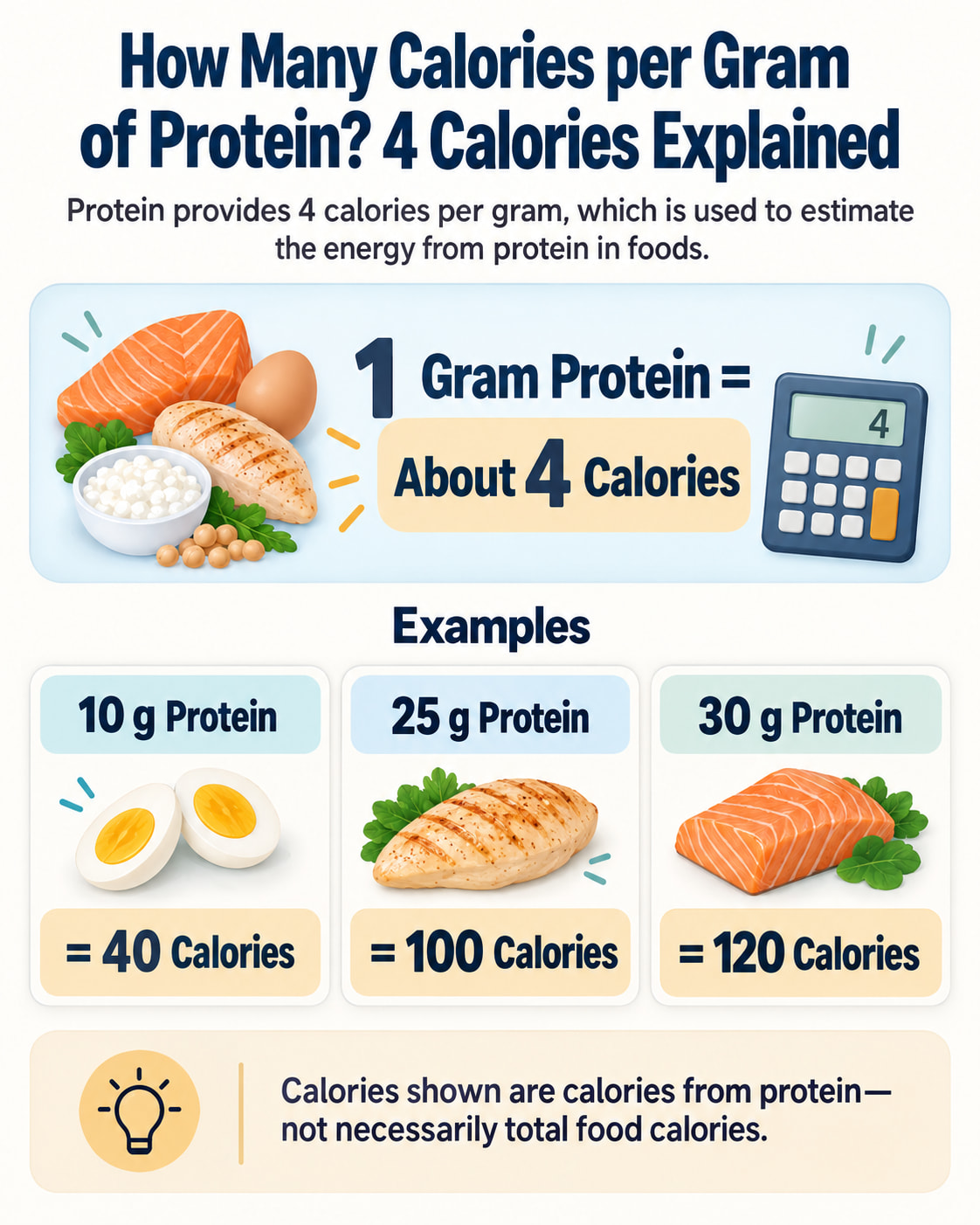
For a basic nutrition calculation, use 4 calories for each gram of protein. This estimates protein’s energy contribution, not necessarily the total energy in the food.
In nutrition, a food Calorie means a kilocalorie, abbreviated kcal. Therefore, “4 calories per gram” and “4 kcal per gram” describe the same food-energy value.
How to Calculate Calories From Protein
Use this formula:
Calories from protein = grams of protein × 4
For example, a serving containing 18 grams of protein contributes an estimated:
18 × 4 = 72 calories from protein
Here are common amounts calculated with the same formula:
| Protein Amount | Calculation | Estimated Calories From Protein |
|---|---|---|
| 1 gram | 1 × 4 | 4 calories |
| 10 grams | 10 × 4 | 40 calories |
| 20 grams | 20 × 4 | 80 calories |
| 25 grams | 25 × 4 | 100 calories |
| 30 grams | 30 × 4 | 120 calories |
| 50 grams | 50 × 4 | 200 calories |
| 100 grams | 100 × 4 | 400 calories |
These are conversion examples, not recommended serving sizes or daily protein targets.
Why Does Protein Provide 4 Calories per Gram?
The four-calorie value comes from the Atwater system, which uses conversion factors to estimate food energy.
As explained in the FAO’s food-energy report, these factors account for energy losses associated with digestion, absorption, and urinary excretion. Protein’s general factor is 4 kcal per gram. Food-specific factors can differ because proteins vary in composition and digestibility.
The practical distinction is simple: four calories per gram is a useful general estimate, not an exact measurement for every protein-containing food.
Protein Calories vs Total Food Calories
A food’s protein content does not tell you its complete calorie count.
According to the FDA’s explanation of food-label calories, the Calories figure includes energy from all sources in the serving, including protein, carbohydrates, and fat.
Consider this hypothetical protein bar:
| Figure | What It Means |
|---|---|
| 40 grams | Weight of the entire bar |
| 20 grams of protein | Protein contained in the bar |
| 80 calories from protein | Estimated using 20 × 4 |
| 200 total calories | Calories listed for the whole bar |
The bar’s protein contributes approximately 80 calories. Its other energy-containing ingredients contribute to the remaining total.
Do not add those 80 protein calories to the 200 calories on the label. They are already included.
Grams of Protein vs Grams of Food
In the example above, multiplying the bar’s 40-gram weight by four would not calculate its protein calories. You need the 20 grams listed as protein.
The same distinction applies when reading a powder label. A serving’s weight and its protein content are separate figures. Use the protein line, not the scoop’s total weight, for the protein-calorie calculation.
Match the Calculation to Your Portion
The FDA’s Nutrition Facts label guidance explains that nutrient amounts generally refer to the stated serving. Some labels also provide a separate column for the entire package. Check which amount you are using.
For the hypothetical bar:
- Half a bar: 10 grams of protein, approximately 40 calories from protein, and 100 total calories.
- Two bars: 40 grams of protein, approximately 160 calories from protein, and 400 total calories.
Adjust both the protein amount and total calories to match your portion.
Protein vs Carbohydrates vs Fat: Calories per Gram
USDA lists the following general energy factors for the three main macronutrients:
| Macronutrient | General Calories per Gram |
|---|---|
| Protein | 4 |
| Carbohydrate | 4 |
| Fat | 9 |
Using these factors, 10 grams of protein contributes about 40 calories, while 10 grams of fat contributes about 90 calories.
A basic estimate of a food’s energy is:
Estimated calories = (protein grams × 4) + (carbohydrate grams × 4) + (fat grams × 9)
However, this formula may not reproduce every label exactly. Rounding, fiber, sugar alcohols, and permitted alternative calculation methods can affect the result.
Also, total calories divided by protein grams is a different calculation.
For the hypothetical bar:
200 total calories ÷ 20 grams of protein = 10 total food calories per gram of protein supplied
That ratio describes the whole product. It does not change protein’s general four-calorie energy factor.
Why Nutrition Label Calories May Not Match Your Calculation
A small difference between your calculation and a package label does not automatically indicate an error.
Under FDA nutrition-labeling rules, several details can explain the difference:
- Numbers are rounded. Calories are generally rounded according to federal labeling rules, and nutrient amounts also have specific rounding requirements.
- Calculations can use unrounded amounts. When general or specific food factors are used, calculations can be based on nutrient quantities before the values are rounded for the label.
- Other energy factors are permitted. Food-specific Atwater factors and separate factors for certain carbohydrates, including some sugar alcohols, can produce a different result from basic 4-4-9 arithmetic.
For everyday tracking, use the labeled calorie total for the portion you eat. Treat your protein calculation as an estimate of one part of that total rather than a replacement for it.
Should You Subtract Calories Used During Digestion?
Do not apply a fixed “digestion discount” to protein calories.
Your body uses energy to digest, absorb, and process food. This is called the thermic effect of food, and it belongs on the energy-expenditure side of the calculation.
The FAO’s food-energy report distinguishes this process from the food-energy values used in the general Atwater system.
To keep the accounting consistent, use the food label for calorie intake and the four-calorie factor for basic protein conversions. Do not replace it with a universal lower number.
Frequently Asked Questions
How Many Calories Are in 30 Grams of Protein?
Using the general factor, 30 grams of protein contributes approximately 120 calories:
30 × 4 = 120 calories
A food containing that protein may have additional calories from carbohydrates, fat, or other energy-containing ingredients.
Does 100 Grams of Protein Equal 400 Calories?
Yes. 100 grams of protein contributes approximately 400 calories using the four-calorie factor.
However, 100 grams of protein is not the same as a 100-gram portion of food. The portion’s protein content must be checked separately.
How Many Grams of Protein Provide 100 Calories?
When the 100 calories come specifically from protein, divide by four:
100 ÷ 4 = 25 grams of protein
You cannot assume that a food containing 100 total calories provides 25 grams of protein. Its calories may come from a mixture of nutrients.
Does Plant Protein Have Fewer Calories per Gram Than Animal Protein?
For general calculations, use 4 calories per gram for either source.
Food-specific energy factors can differ, but the general Atwater system does not assign separate standard four-calorie values based simply on whether the protein comes from plant or animal foods.
Why Might a Shake With 25 Grams of Protein Have 150 Calories?
Its protein contributes approximately:
25 × 4 = 100 calories from protein
Carbohydrates, fat, or other energy-containing ingredients can account for additional calories. The label’s total represents the whole drink, not protein alone.
Also check whether the nutrition information describes the powder alone or the drink as prepared with milk or another ingredient.
How Do You Calculate the Percentage of Calories From Protein?
First estimate the calories from protein, then divide by the food’s total calories and multiply by 100:
Percentage of calories from protein = (protein grams × 4 ÷ total calories) × 100
For the hypothetical protein bar:
(20 × 4 ÷ 200) × 100 = 40%
Approximately 40% of that bar’s calories come from protein.
This is different from the Percent Daily Value (%DV) on a Nutrition Facts label, which compares the amount of a nutrient in a serving with its daily reference value.
The Bottom Line
Protein provides about 4 calories per gram. Multiply protein grams by four to estimate its calorie contribution, but keep that number separate from the food’s total calories.
For example:
25 grams of protein × 4 = approximately 100 calories from protein
When reading a Nutrition Facts label, check the serving size, find the grams of protein, and calculate the protein’s calorie contribution if needed. Use the labeled calorie total for the overall calories in your portion so you do not count protein twice.
References
- USDA National Agricultural Library — Food and Nutrition Information Center
- Food and Agriculture Organization — Calculation of the Energy Content of Foods: Energy Conversion Factors
- U.S. Food and Drug Administration — Calories on the Nutrition Facts Label
- U.S. Food and Drug Administration — How to Understand and Use the Nutrition Facts Label
- Electronic Code of Federal Regulations — 21 CFR § 101.9: Nutrition Labeling of Food
This content is for informational purposes only and not medical advice.