
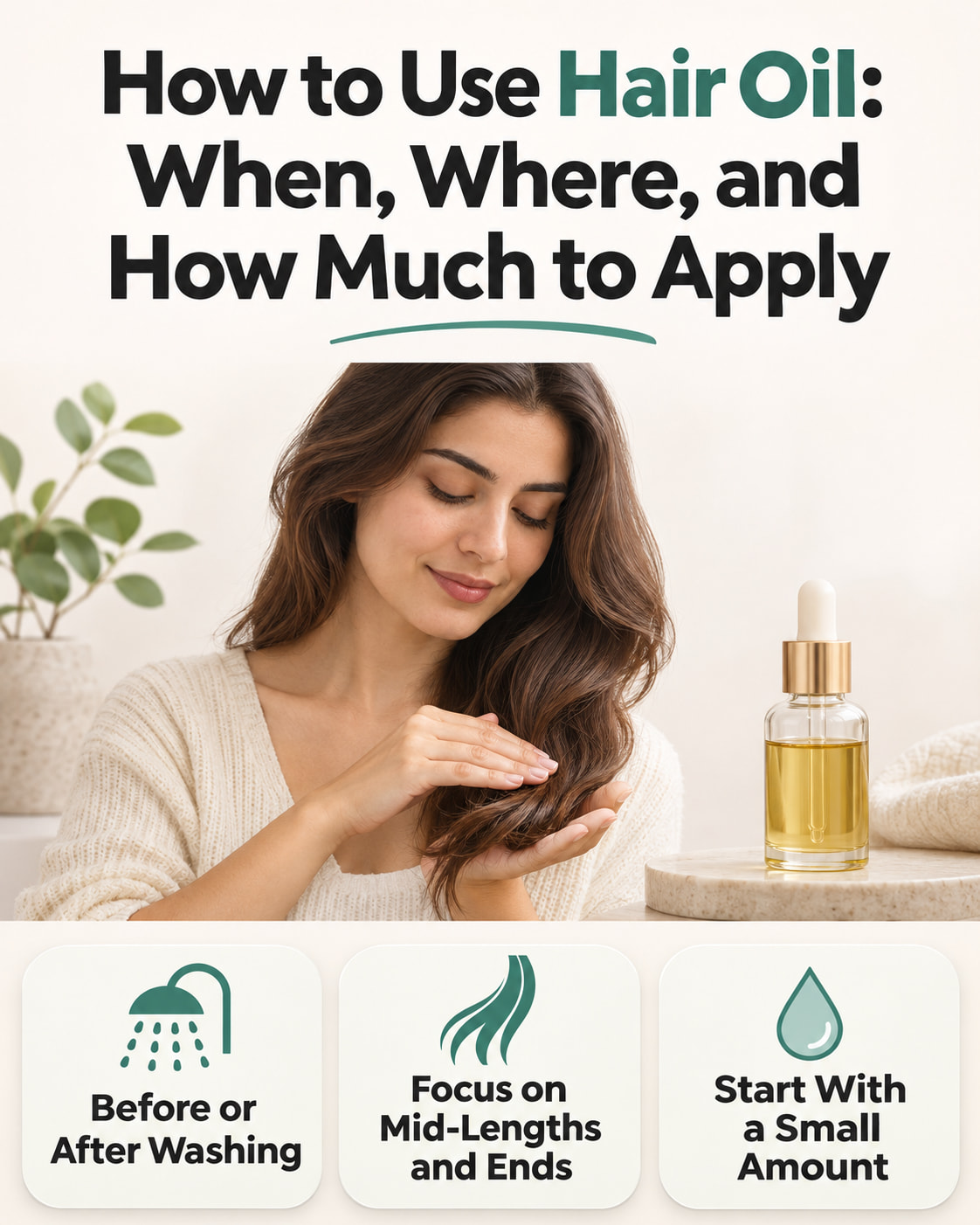
Learning how to use hair oil starts with checking whether your product is meant to be washed out or left in. Apply a small amount mainly to the mid-lengths and ends, following its directions for damp or dry hair.
The goal is softer, more manageable hair without a heavy coating. A prewash oil, a leave-in styling oil, and a scalp product can have different instructions. Choosing the right method helps you avoid greasy roots, unnecessary buildup, and an irritated scalp.
What Does Hair Oil Do?
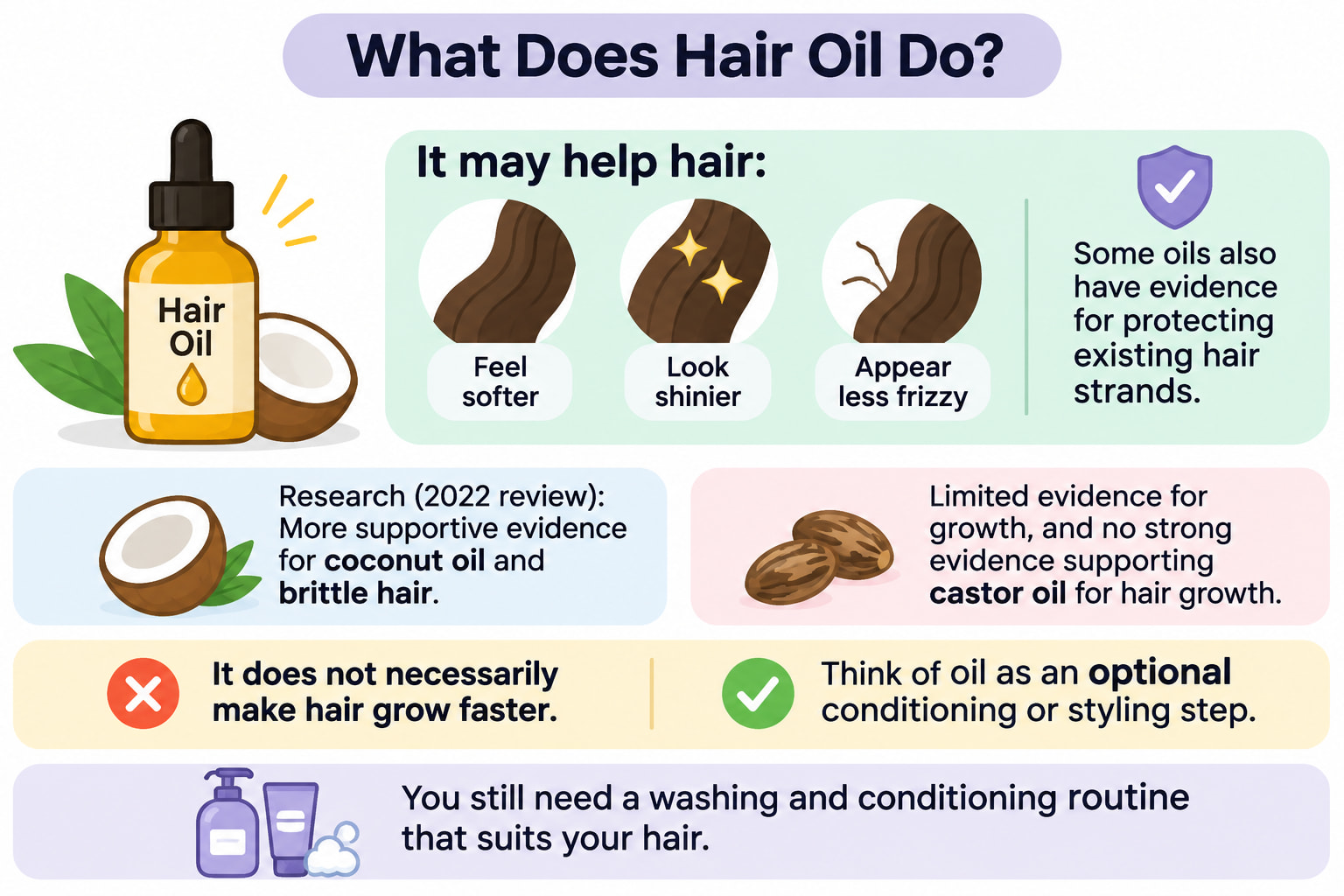
Depending on the oil and formula, hair oil may help hair feel softer, look shinier, or appear less frizzy. Some oils also have evidence for protecting existing hair strands.
However, cosmetic improvements do not necessarily mean faster growth. A 2022 systematic review found more supportive evidence for coconut oil and brittle hair, but limited evidence for its effect on growth. It also found no strong evidence supporting castor oil for hair growth.
Think of oil as an optional conditioning or styling step. You still need a washing and conditioning routine that suits your hair.
When Should You Apply Hair Oil?
Choose your timing based on what the product is designed to do.
| Your goal | When to apply | Where to focus |
|---|---|---|
| Condition hair before a wash | Before shampooing, following the oil’s directions | Mid-lengths and ends |
| Add softness after washing | On towel-dried hair, if the product allows | Hair lengths, especially dry ends |
| Smooth flyaways or finish a style | On dry hair, if the product allows | The areas that need a small touch-up |
| Use a product intended for the scalp | At the time and frequency stated on its label | Only the intended scalp areas |
You do not need to use all these methods. Start with the one that matches your main concern. Some styling oils specifically allow both damp- and dry-hair application, so check your bottle before choosing.
How to Use Hair Oil Before Washing
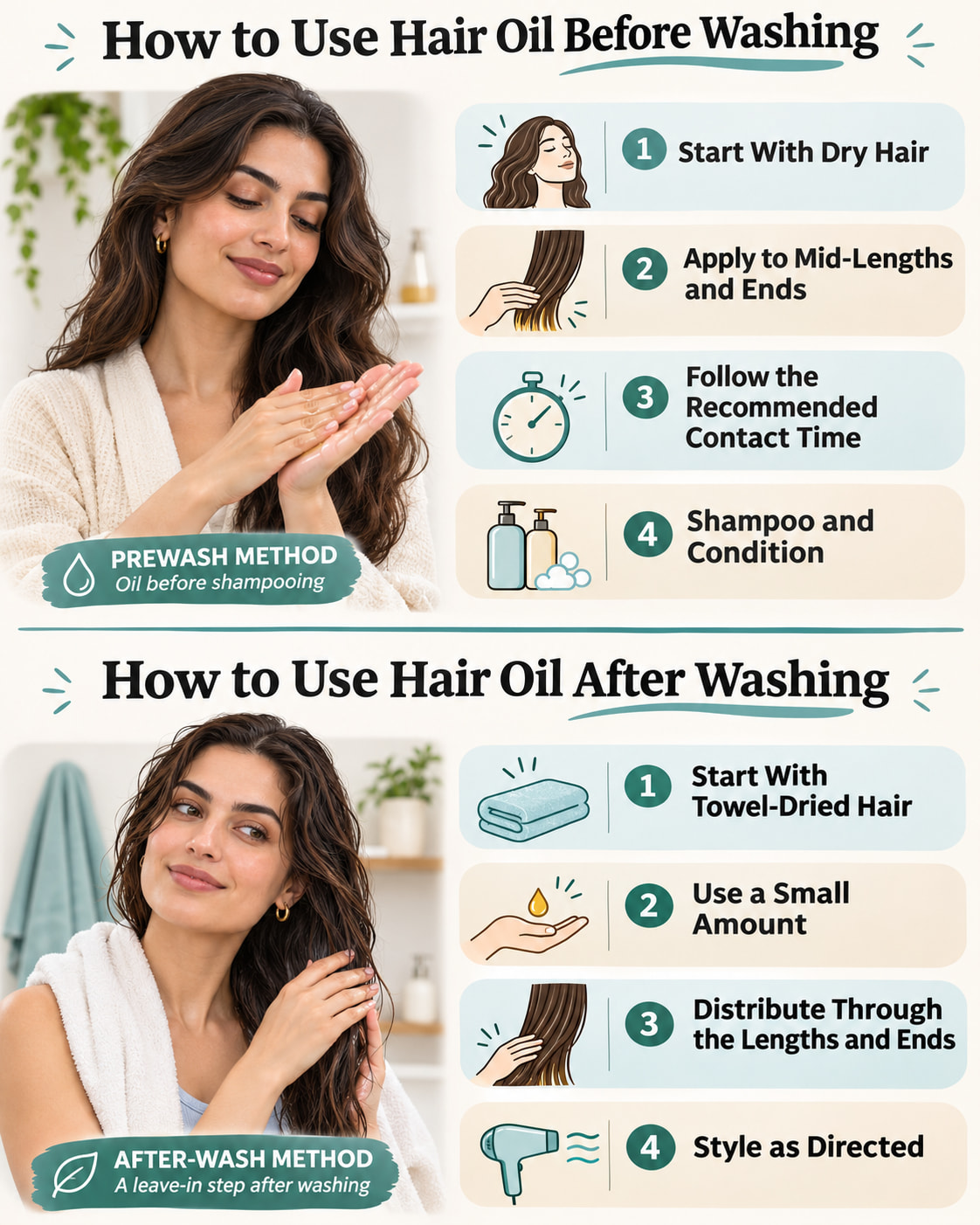
A prewash application gives you the option to use oil and then remove it during shampooing.
Cleveland Clinic’s hair-oiling guidance describes a routine using a pea-sized amount on dry hair, left for 20 minutes to an hour before washing. It suggests trying this weekly.
To follow that approach:
- Separate your hair into manageable sections. Handle tangles gently rather than pulling through them.
- Spread the oil between your palms. This makes it easier to distribute a small amount.
- Work it through the mid-lengths and ends. Aim for a light, even coating.
- Leave it on for the recommended time. The 20–60-minute example is a starting routine, not a proven optimum for every oil.
- Shampoo and condition. Cleanse your scalp and rinse the oil from your hair.
Follow any different directions on a formulated product. Adding enough oil to make your hair drip is unnecessary for trying this method.
How to Use Hair Oil After Washing
Use this method with an oil intended to remain in your hair.
- Shampoo and rinse out your conditioner.
- Gently blot away excess water. Leave your hair damp if that is what the oil’s label recommends.
- Dispense the suggested amount into your palms.
- Spread it through the lengths and ends. Apply it evenly instead of concentrating it in one spot.
- Style according to the product’s instructions.
AAD hair-care guidance recommends conditioning after washing and handling wet hair gently. Avoid rough towel rubbing or forcing a brush through tangles.
If you also use leave-in conditioner, follow the directions for both products. The AAD suggests that a little oil, such as argan oil, can be an additional step when hair still feels dry or frizzy after leave-in conditioner.
How to Use Hair Oil on Dry Hair
For a finishing touch, use a product labeled for dry-hair application. Spread a small amount between your palms, then lightly smooth it over the ends or areas with flyaways.
Check the result before adding more. You may only need to touch up a few sections.
Where Should You Apply Hair Oil?
Focus on the Mid-Lengths and Ends
For ordinary cosmetic oiling, begin with the hair lengths. The “mid-lengths” are the portion between your roots and tips.
You can concentrate the application on dry-feeling ends rather than coating every strand from root to tip. Cleveland Clinic’s olive-oil guidance specifically recommends a few drops applied mainly to the middle and ends of the hair.
Be Selective About Scalp Application
Scalp oiling is optional. A product intended to smooth hair lengths does not automatically need to reach your scalp.
If you have dandruff, persistent itching, inflammation, or a very oily scalp, get guidance before adding scalp oil. Flaking can have several causes, and cosmetic oil should not replace an established scalp-care plan.
Keep oil away from acne-prone facial skin when possible. According to AAD guidance on hair-product breakouts, oils from hair products can contribute to bumps around the hairline, forehead, and neck.
How Much Hair Oil Should You Use?
Use the smallest amount that gives you the result you want, starting with the product’s directions. There is no single drop count that works for every formula and head of hair.
For example, OLAPLEX No.7 instructions specify 2–3 drops. That amount applies to that particular product; it is not a universal rule for pure oils or other styling blends.
Use the following adjustments as practical guidance:
| Your hair or situation | How to approach the amount |
|---|---|
| Fine hair or hair that becomes greasy easily | Begin with a very small application, focused on the ends |
| Thick, coarse, or dry hair | Distribute a small amount evenly, then assess whether another light application is needed |
| Long or dense hair | Work in sections so you can judge coverage |
| A dry-hair touch-up | Apply only to the areas that need smoothing |
| Hair feels heavy or looks oily afterward | Use less at the next application |
A drop and a pump are not interchangeable measurements. Follow the dispenser instructions on your own bottle.
How Often Should You Use Hair Oil?
Frequency depends on the product, your washing schedule, and how your hair responds.
A prewash routine belongs before a planned wash. Leave-in oils may allow more frequent use; some formulas permit daily application. That does not mean daily use is necessary.
Look at the result between applications:
- If your hair still feels smooth and manageable, you may not need more.
- If only the ends feel dry, limit any touch-up to those areas.
- If your hair becomes limp, greasy, or coated, reduce the amount or frequency.
- If your scalp develops itching, redness, or a rash, stop using the product.
Change one part of the routine at a time so you can tell what works.
Hair Oiling Mistakes to Avoid
Using Oil Instead of Conditioner
Keep conditioner in your routine. Oil can add a finishing or conditioning benefit, but it should not automatically replace a product formulated to condition and detangle your hair.
Assuming Every Oil Protects Against Heat
A styling oil may provide heat protection if its label explicitly says so. Plain oil should not automatically be treated as a heat protectant.
Use an appropriate heat-protection product according to its directions, and keep styling temperatures as low as practical.
Heating Oil Before Every Application
Room-temperature application is a simple starting point. The AAD’s hair-loss guidance cautions people with thinning or fragile hair against hot-oil applications because the heat may cause additional damage.
Applying Undiluted Essential Oils
Concentrated essential oils are different from carrier oils and finished hair products. Do not apply undiluted rosemary, peppermint, or other essential oils directly to your scalp.
DermNet’s essential-oil safety guidance explains that direct application can cause sensitization and allergic contact dermatitis.
Continuing Despite Irritation
Wash off and stop using a product that causes burning, itching, redness, or a rash. Testing a new product on a small area first may help identify a reaction, but it cannot guarantee that irritation will never occur.
When to Get Help for Scalp or Hair Problems
Arrange a dermatology appointment if you notice:
- Persistent or severe flaking.
- Ongoing scalp irritation.
- New or unexplained hair loss.
- Breakage that continues despite gentle care.
These concerns can have causes that a cosmetic oil cannot address. If you already have a prescribed scalp-care routine, ask whether an additional oil fits that plan.
Frequently Asked Questions
Should You Apply Hair Oil Before or After Washing?
Either can be appropriate. Use a wash-out oil before shampooing, or a leave-in oil after washing if its directions allow. Choose one method based on the product and your goal.
Is It Better to Apply Hair Oil to Wet or Dry Hair?
Follow the label. Some prewash methods use dry hair, while certain leave-in oils allow damp or dry application. There is no single best choice for every formula.
Can You Leave Hair Oil in Overnight?
Only use a product overnight if it is suitable for that contact time. Overnight application is not required for a basic routine, and leaving an oil on longer is not automatically better.
Do You Always Have to Wash Hair Oil Out?
No. A leave-in styling oil is designed to stay in the hair as directed. A prewash product is meant to be removed. Check the instructions instead of applying the same rule to every oil.
Do You Need Conditioner if You Use Hair Oil?
Yes, continue using a conditioner suited to your hair. Oil is an optional addition, particularly when the lengths or ends still feel dry or look frizzy.
Can You Apply Hair Oil Before Blow-Drying?
Some formulated styling oils allow this. Check whether the product provides heat protection, and use an appropriate heat protectant if it does not. Follow the application directions for both products.
Does Hair Oiling Make Hair Grow Faster?
Ordinary hair oiling is not an established way to speed up growth or regrow thinning hair. Improving the appearance or condition of existing strands is different from producing new hair.
Conclusion
Learning how to use hair oil comes down to choosing the right product, applying a small amount, and watching how your hair responds. Focus on the lengths and ends, follow the intended timing, and keep your regular washing and conditioning routine.
Start with one application method and adjust only what your hair needs.
This content is for informational purposes only and not medical advice.
References
- Cleveland Clinic. Hair Oiling: Should You Try It?
- Cleveland Clinic. Is Olive Oil Good for Your Hair?
- American Academy of Dermatology. Tips for Healthy Hair.
- American Academy of Dermatology. Dermatologists’ Top Tips for Using Leave-In Conditioner.
- Phong C, et al. Coconut, Castor, and Argan Oil for Hair in Skin of Color Patients: A Systematic Review.
- American Academy of Dermatology. Are Your Hair Care Products Causing Breakouts?