
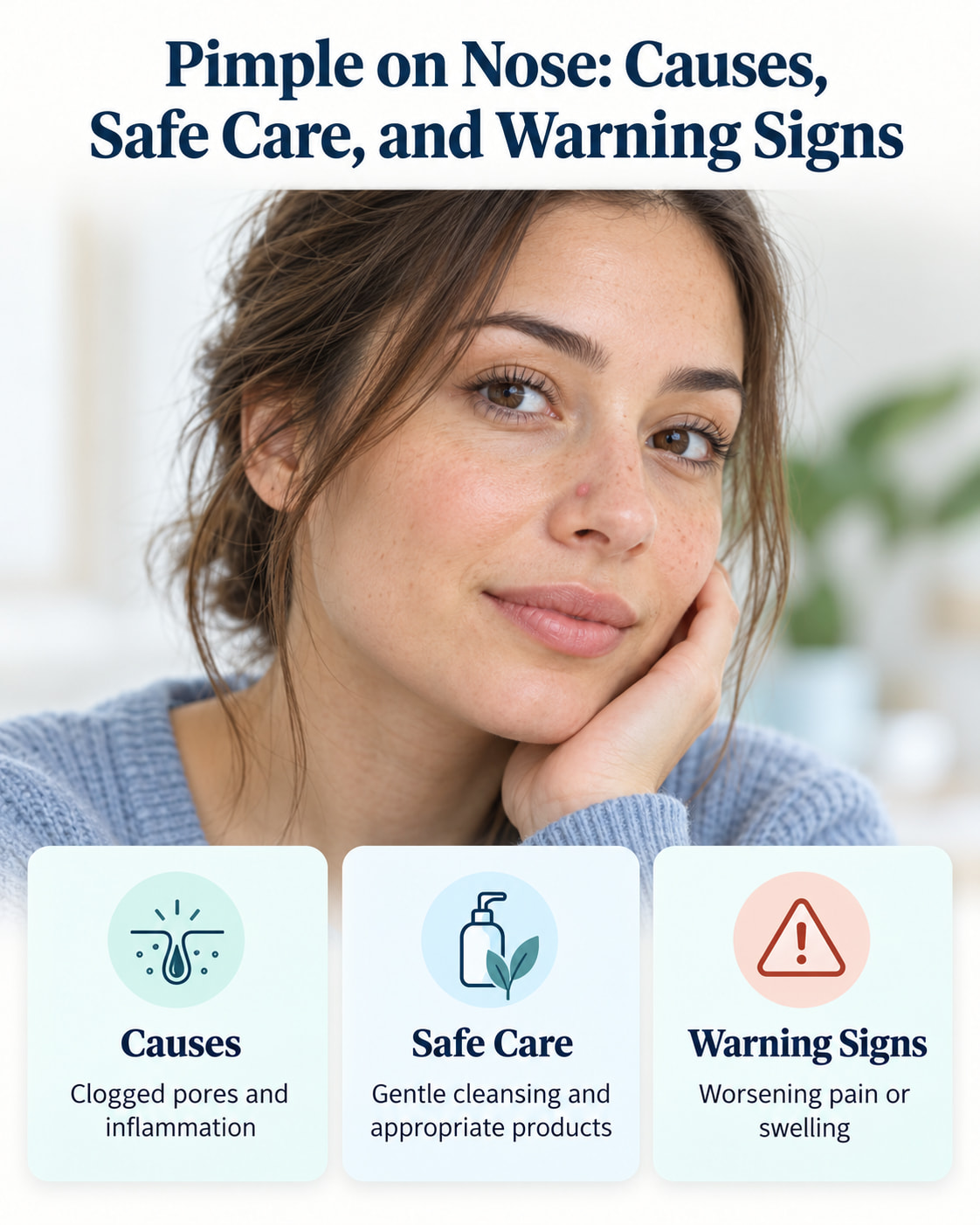
A pimple on the nose often comes from a clogged, inflamed pore, and gentle skin care may help a small acne spot on the outside of the nose. A sore inside the nostril, spreading swelling, or a bump that repeatedly bleeds needs a different approach.
Start by noticing exactly where the bump is and whether symptoms are getting worse. Avoid squeezing it, keep your routine gentle, and seek medical advice when the appearance or symptoms suggest something other than ordinary acne.
What Causes a Pimple on the Nose?
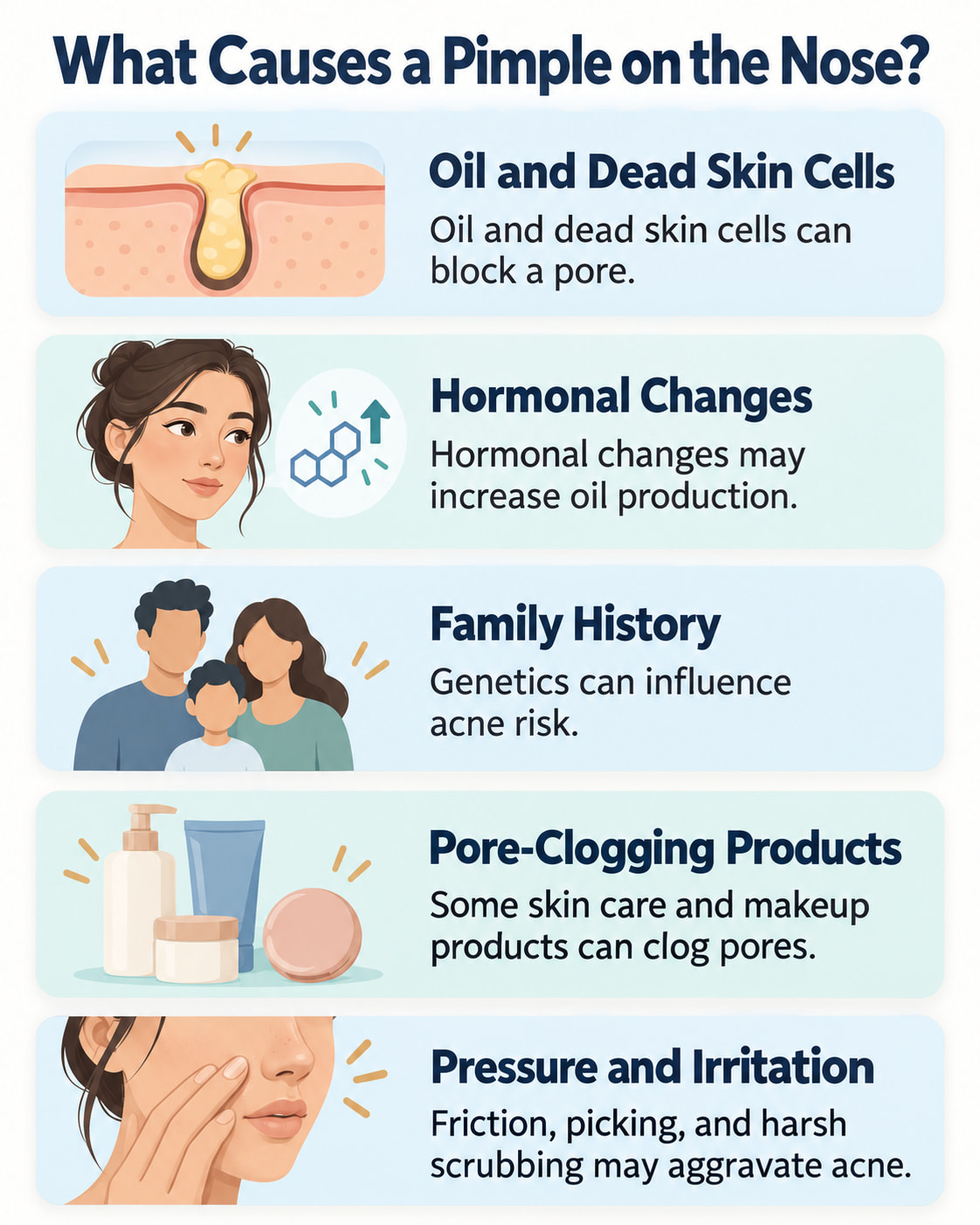
Acne develops when oil and dead skin cells collect inside a hair follicle and block its opening. Bacteria within the follicle can contribute to inflammation, producing a raised, tender pimple.
Several factors can contribute to breakouts:
- Hormonal changes: Hormones can increase oil production, particularly during puberty and other life stages.
- Family history: Some people inherit a greater tendency to develop acne.
- Pore-clogging products: Certain cosmetics, moisturizers, and hair products can contribute to blocked pores.
- Pressure and irritation: Friction, repeated touching, picking, and harsh scrubbing may aggravate acne.
- Certain medications: Some medicines can contribute to acne. Ask the prescriber about suspected side effects rather than stopping medication yourself.
Stress can make existing acne worse. However, a pimple does not mean your skin is dirty. Washing more aggressively can irritate the skin and make the problem more noticeable.
Is It Acne or Another Type of Nose Bump?
The location and pattern of a bump offer useful clues, but they cannot confirm a diagnosis.
| What you notice | Possible explanation | What to keep in mind |
|---|---|---|
| A small dark pore or closed white or skin-colored bump | Blackhead or whitehead | These are clogged pores. A blackhead’s dark color is not dirt. |
| A raised, tender bump, sometimes with a white or yellow center | Inflamed acne pimple | A pus-filled acne spot is called a pustule. |
| A painful lump beneath the skin without an obvious head | Deeper acne nodule or cyst | Deep acne is more likely to leave scars and may need dermatology care. |
| A sore near the nostril opening with crusting, tenderness, or bleeding | Nasal vestibulitis or an infected hair follicle | This needs different care from ordinary external acne. |
| Repeated acne-like bumps with ongoing facial redness | Rosacea | A clinician can distinguish rosacea from acne. |
| Small, flat, painless gray, light brown, or yellowish dots | Sebaceous filaments | These are normal structures that help move oil to the skin’s surface. |
A bump that does not resolve, repeatedly breaks open, or gradually changes should be examined rather than continually managed as acne.
How to Care for a Pimple on the Nose Safely
The following guidance applies to ordinary acne on intact skin outside the nose. A sore inside the nostril or a suspected boil needs separate assessment.
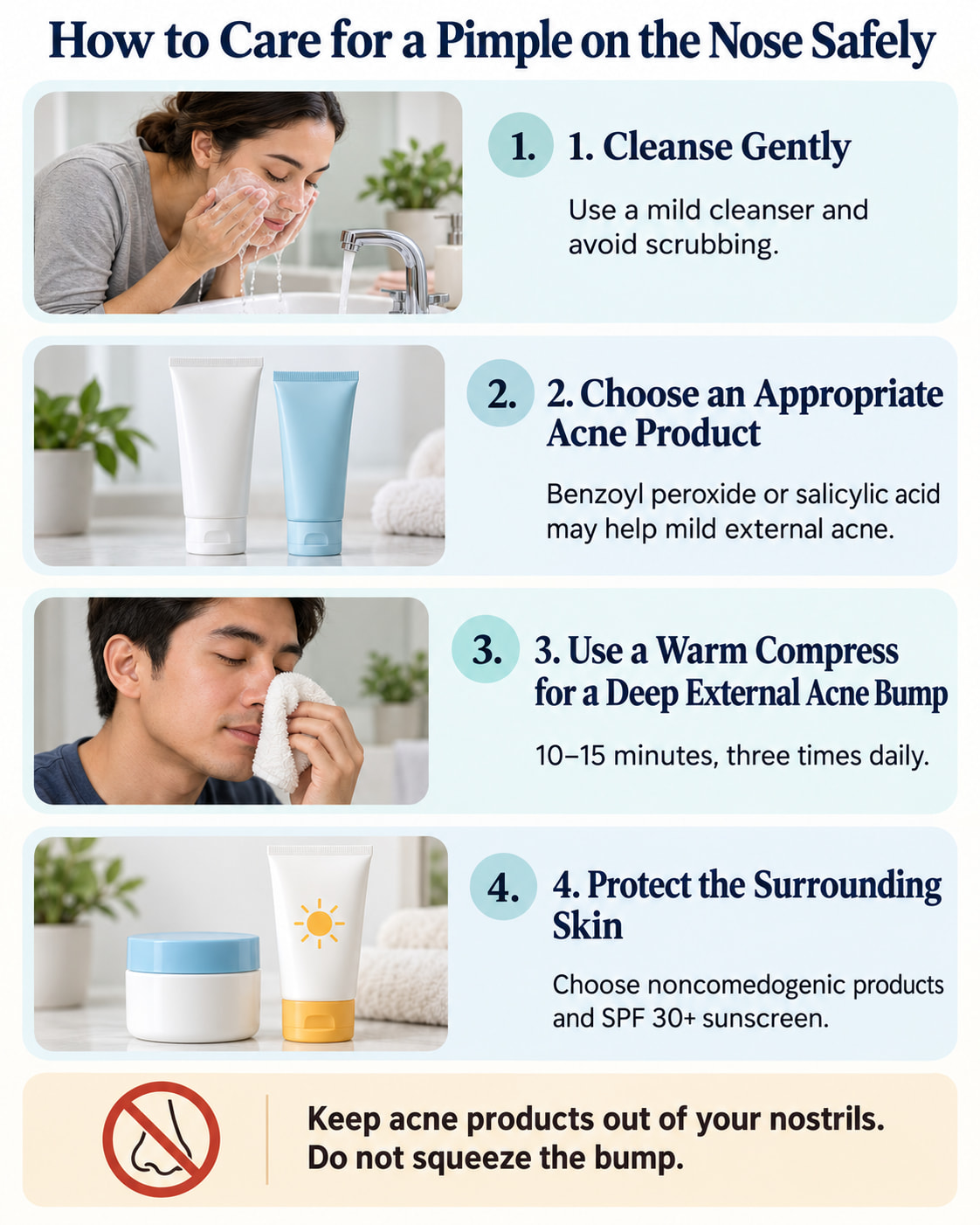
1. Cleanse Gently
Wash your face with a mild cleanser up to twice daily and after sweating. Use your fingertips and lukewarm water, then pat the skin dry.
Avoid scrubbing the bump with a brush, rough cloth, or abrasive exfoliant. Repeatedly washing the area will not force a blocked pore to clear.
2. Choose an Appropriate Acne Product
For mild external acne, a pharmacist can help you choose a suitable nonprescription product. Two common ingredients are:
| Ingredient | How it may help | Main precautions |
|---|---|---|
| Benzoyl peroxide | Reduces acne-associated bacteria | Can cause dryness, peeling, or stinging and may bleach hair and fabric. |
| Salicylic acid | Helps loosen material blocking pores | Can cause irritation or stinging, especially when used too aggressively. |
Mayo Clinic’s nonprescription acne guidance suggests considering a lower-strength 2.5% benzoyl peroxide product to limit irritation. Nonprescription salicylic acid acne products commonly contain 0.5%–2%.
Begin with one suitable product and follow its label. Applying more than directed will not make it work faster. If irritation persists, stop using it and ask a pharmacist or clinician for advice.
Keep benzoyl peroxide and salicylic acid out of your nostrils, eyes, and mouth. Do not apply acne products to a picked-open or otherwise damaged area.
3. Use a Warm Compress for a Deep External Acne Bump
The American Academy of Dermatology recommends a warm, damp washcloth for a deep, painful acne pimple.
Use a clean cloth with comfortably warm water for 10–15 minutes, three times daily. Use a clean cloth each time and avoid water hot enough to burn your skin.
Do not squeeze afterward. A compress should not delay medical assessment of a suspected nasal infection or boil.
4. Protect the Surrounding Skin
A noncomedogenic moisturizer may help with dryness from acne products. When outdoors, use a noncomedogenic, broad-spectrum sunscreen with SPF 30 or higher, along with shade and protective clothing.
A hydrocolloid acne patch may help protect an external spot. Follow the product instructions and keep patches outside the nostrils.
What If the Pimple Is Inside Your Nose?
A sore inside the nose may involve an irritated or infected hair follicle. Nasal vestibulitis affects the area near the nostril opening and can cause crusting, bleeding, pain, or swelling.
The Merck Manual describes nasal vestibulitis as a bacterial infection commonly associated with nose picking or repeated nose blowing. Plucking nasal hairs can also contribute to problems in this area.
Contact a healthcare professional about a painful, crusted, or recurring sore inside the nostril. A clinician can determine whether prescription medication or another form of care is appropriate.
While arranging advice:
- Leave the sore and any scabs alone.
- Avoid plucking nasal hairs.
- Keep facial acne products out of the nostril.
- Do not attempt to puncture or drain the bump.
Increasing swelling, fever, or significant pain deserves prompt attention.
Why You Should Not Pop a Nose Pimple
Squeezing a pimple can push its contents deeper into the skin and increase inflammation. It can also introduce bacteria, prolong irritation, and increase the risk of dark marks or scars.
Avoid using needles, tweezers, or extraction tools to open it yourself. If a deep or persistent bump needs a procedure, a qualified clinician should assess it first.
What About the Facial “Danger Triangle”?
The nose and upper-lip region have venous connections through which certain infections can rarely spread to deeper structures. One serious complication is cavernous sinus thrombosis, a blood clot involving veins behind the eyes.
These complications are rare. The practical message is to avoid squeezing and recognize worsening infection, rather than assume that every nose pimple is dangerous.
How Long Does a Pimple on the Nose Last?
There is no single timeline for every nose bump. A superficial acne spot, a deep nodule, and an infected nasal follicle can behave differently.
For recurring acne, the American Academy of Dermatology advises allowing roughly six to eight weeks to assess improvement from an appropriate, consistent acne regimen. That timeframe refers to acne management overall, not how long you should ignore one suspicious bump.
Seek advice sooner if a spot becomes more painful, swelling spreads, or it repeatedly bleeds or breaks open. A worsening nasal infection should not be watched for weeks while waiting for an acne product to work.
When to Seek Medical Help
Arrange a Medical Appointment
Contact a clinician or dermatologist if:
- A painful or crusted sore develops inside your nostril.
- A bump persists or repeatedly returns in the same place.
- You develop deep, painful acne or scarring.
- Your acne is not improving with consistent care.
- You are unsure whether the bump is acne.
A sore that does not resolve, repeatedly bleeds, or keeps reopening deserves an examination. Some skin cancers can resemble a small bump or persistent sore, including on the nose. This does not mean a stubborn spot is necessarily cancer, but it should not be overlooked.
Get Urgent Care for Signs of Infection
Seek urgent medical assessment for:
- A suspected boil on your face.
- Increasing warmth, pain, or swelling around a bump.
- Swelling or skin discoloration spreading beyond the original spot.
- Fever, chills, or feeling unwell with a painful facial lesion.
The NHS recommends urgent assessment for facial boils. Seek advice promptly if you suspect a boil and have diabetes or a weakened immune system.
Seek Emergency Care for Serious Nasal or Eye Symptoms
Cleveland Clinic advises emergency assessment for a nasal boil or painful swelling at the nose tip. This concern is different from mild tenderness confined to a small, superficial acne spot.
Emergency evaluation is also important if a possible nasal or facial infection occurs with:
- Swelling around an eye.
- Pain or difficulty moving an eye.
- Blurred or double vision.
- A severe or worsening headache, especially behind the eyes.
- Confusion or unusual drowsiness.
How to Reduce Future Nose Breakouts
A consistent routine can help limit irritation and pore blockage:
- Choose noncomedogenic skin care, sunscreen, and makeup.
- Remove makeup before bed.
- Wash gently and avoid repeatedly switching products.
- Keep your hands away from blemishes.
- Avoid harsh scrubs and irritating astringents.
- Trim visible nasal hairs carefully rather than plucking them.
If breakouts keep returning, a dermatologist can help identify the cause and develop a suitable ongoing plan.
Frequently Asked Questions
Why Is the Pimple on My Nose So Painful?
An inflamed acne bump can be tender, especially when it extends deeper beneath the skin. Pain inside the nostril may also come from an infected hair follicle. Increasing pain, spreading swelling, or fever warrants medical assessment.
Can I Pop a Pimple on My Nose If It Has a White Head?
Avoid squeezing it, even when a white or yellow center is visible. Popping can increase inflammation, introduce bacteria, and leave a mark or scar. A visible head does not make home extraction risk-free.
Can a Pimple on the Nose Go Away Overnight?
There is no reliable way to make every pimple disappear overnight. Avoid repeatedly applying strong products in an attempt to speed things up. Gentle care and leaving the spot alone reduce additional irritation.
Can I Put Acne Cream Inside My Nostril?
Keep standard facial acne products out of your nostrils. Benzoyl peroxide and salicylic acid are intended for external skin use and can irritate sensitive nasal surfaces. Ask a clinician about a painful or crusted internal sore.
Why Does a Bump Keep Coming Back in the Same Spot?
A pore can become blocked again, but a recurring bump may have another explanation. If it repeatedly returns, never fully resolves, bleeds, or changes in appearance, arrange an examination instead of assuming it is always acne.
Are the Tiny Dots on My Nose Pimples?
Some tiny dots are blackheads, while others are sebaceous filaments. Filaments are normal, usually flat and painless, and help carry oil to the skin’s surface. Avoid squeezing them simply because they are visible.
Conclusion
For an ordinary pimple on the outside of your nose, start with gentle cleansing, suitable skin care, and a hands-off approach. Keep acne products out of your nostrils.
If the bump is inside your nose, keeps returning, or develops worsening pain or swelling, contact a healthcare professional. Seek urgent or emergency care for the warning signs described above.
This content is for informational purposes only and not medical advice.
References
- NIAMS: Acne Causes and Risk Factors
- Mayo Clinic: Acne Symptoms and Causes
- American Academy of Dermatology: Adult Acne
- American Academy of Dermatology: Acne Skin Care Tips
- Mayo Clinic: Nonprescription Acne Products
- Mayo Clinic: Benzoyl Peroxide Proper Use
- Cleveland Clinic: Cavernous Sinus Thrombosis
- American Academy of Dermatology: Acne and Rosacea