
Ghee can be part of a balanced diet when used in small amounts, but its proven health benefits are more limited than many online claims suggest. It provides a modest amount of vitamin A, contains very little lactose, and works well for higher-heat cooking. However, ghee is also calorie-dense and high in saturated fat.
The current 2025–2030 Dietary Guidelines for Americans recommend keeping saturated fat below 10% of total daily calories and prioritizing oils that provide essential fatty acids, such as olive oil. Therefore, ghee is best used as a flavor-rich cooking fat rather than as a supplement or a primary source of nutrition.
What Is Ghee?
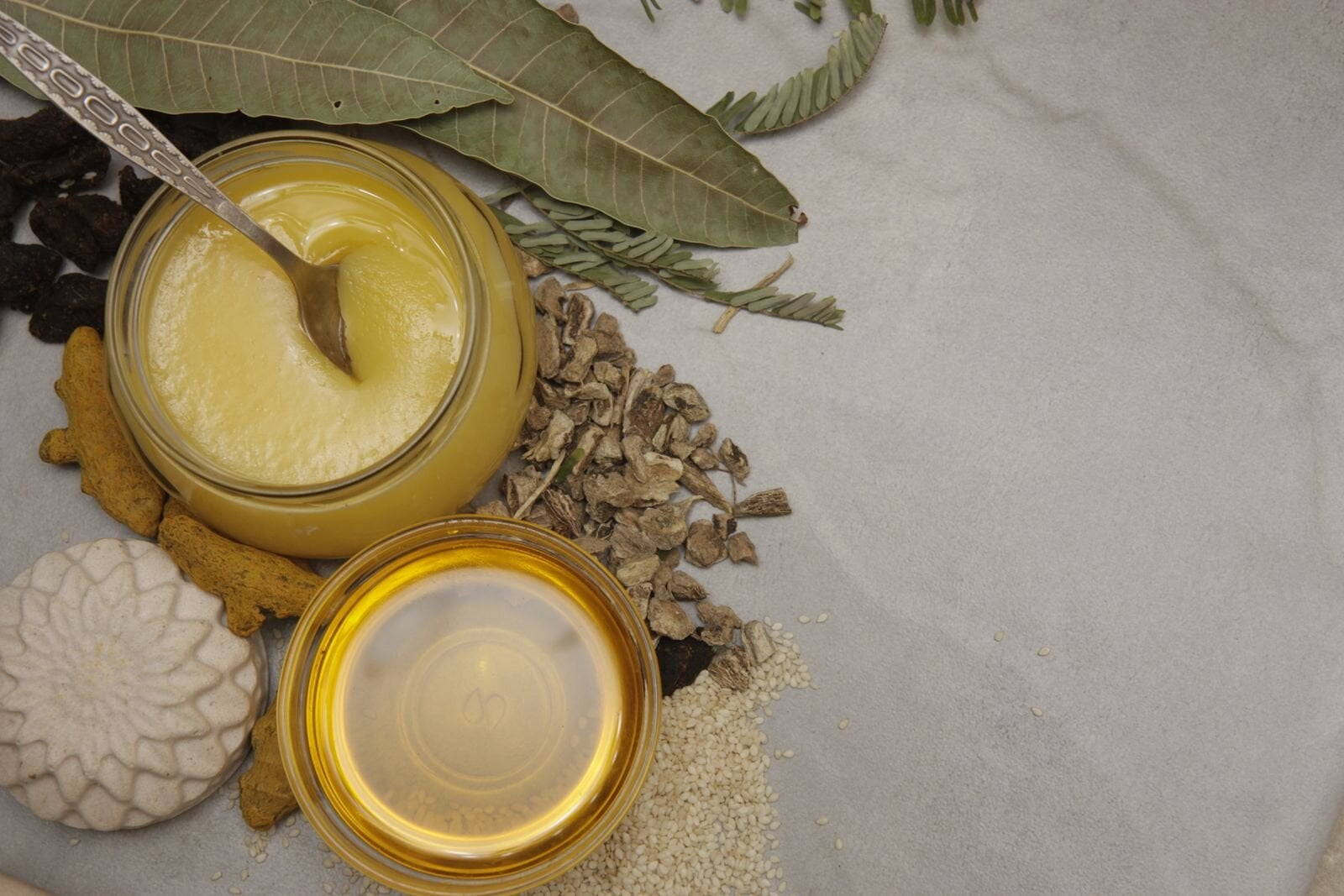
Ghee is a concentrated dairy fat traditionally used in South Asian and Middle Eastern cooking. It is made by slowly heating milk, cream, or butter until most of the water evaporates and the nonfat milk solids separate from the fat.
The remaining clear fat is strained and allowed to cool. The longer heating process gives ghee its distinctive golden color and nutty, slightly caramelized flavor.
The Codex Alimentarius standard defines ghee as a product obtained exclusively from milk, cream, or butter through the near-total removal of water and nonfat milk solids. Under that standard, ghee contains at least 99.6% milk fat.
Is Ghee the Same as Clarified Butter?
Ghee is a type of clarified butter, but the terms are not always used in exactly the same way.
With basic clarified butter, the butter is heated until the water evaporates and the milk solids separate. The clear butterfat is then strained.
Ghee is generally cooked longer. The milk solids are allowed to brown before being removed, producing a deeper flavor and aroma. Both products contain far less water and fewer milk solids than regular butter.
Ghee Nutrition Facts
Ghee is almost entirely fat. It contains virtually no carbohydrate, fiber, or protein.
The following values are approximate amounts in one tablespoon of ghee, or about 14 grams:
| Nutrient | Approximate amount | FDA Daily Value |
|---|---|---|
| Calories | 126 | No established Daily Value |
| Total fat | 13.9 g | 18% |
| Saturated fat | 8.7 g | 43% |
| Monounsaturated fat | 4.0 g | No established Daily Value |
| Polyunsaturated fat | 0.5 g | No established Daily Value |
| Cholesterol | 36 mg | 12% |
| Carbohydrate | 0 g | 0% |
| Protein | Less than 0.1 g | 0% |
| Vitamin A | 118 mcg RAE | 13% |
| Vitamin E | 0.4 mg | 3% |
These estimates are calculated from published food-composition data for ghee. Nutrient content can vary slightly according to the brand, serving weight, animal source, and manufacturing process. Always use the Nutrition Facts label when tracking a specific product.
Is Ghee High in Saturated Fat?
Yes. One tablespoon provides approximately 8 to 9 grams of saturated fat.
The FDA considers a food high in a nutrient when one serving supplies 20% or more of its Daily Value. Because one tablespoon of ghee provides roughly 43% of the Daily Value for saturated fat, it qualifies as a high-saturated-fat food.
A teaspoon is a much smaller portion. It contains approximately:
- 42 calories
- 4.6 grams of total fat
- 2.9 grams of saturated fat
Using a teaspoon rather than pouring ghee directly from the jar makes it easier to control both calories and saturated fat.
Is Ghee Rich in Vitamins?
Ghee contributes some vitamin A, but it is not a concentrated source of numerous vitamins and minerals.
One tablespoon supplies approximately 13% of the FDA Daily Value for vitamin A. Vitamin A is important for normal vision, immune function, growth, and cell development. However, ghee is not the only way to obtain it. Eggs, dairy products, fish, orange vegetables, leafy greens, and fortified foods can also contribute vitamin A.
Ghee contains only a small amount of vitamin E and is not a meaningful source of protein, fiber, calcium, iron, potassium, or vitamin C. Generic food-composition data also do not support describing it as a reliable source of vitamin D.
Potential Ghee Health Benefits
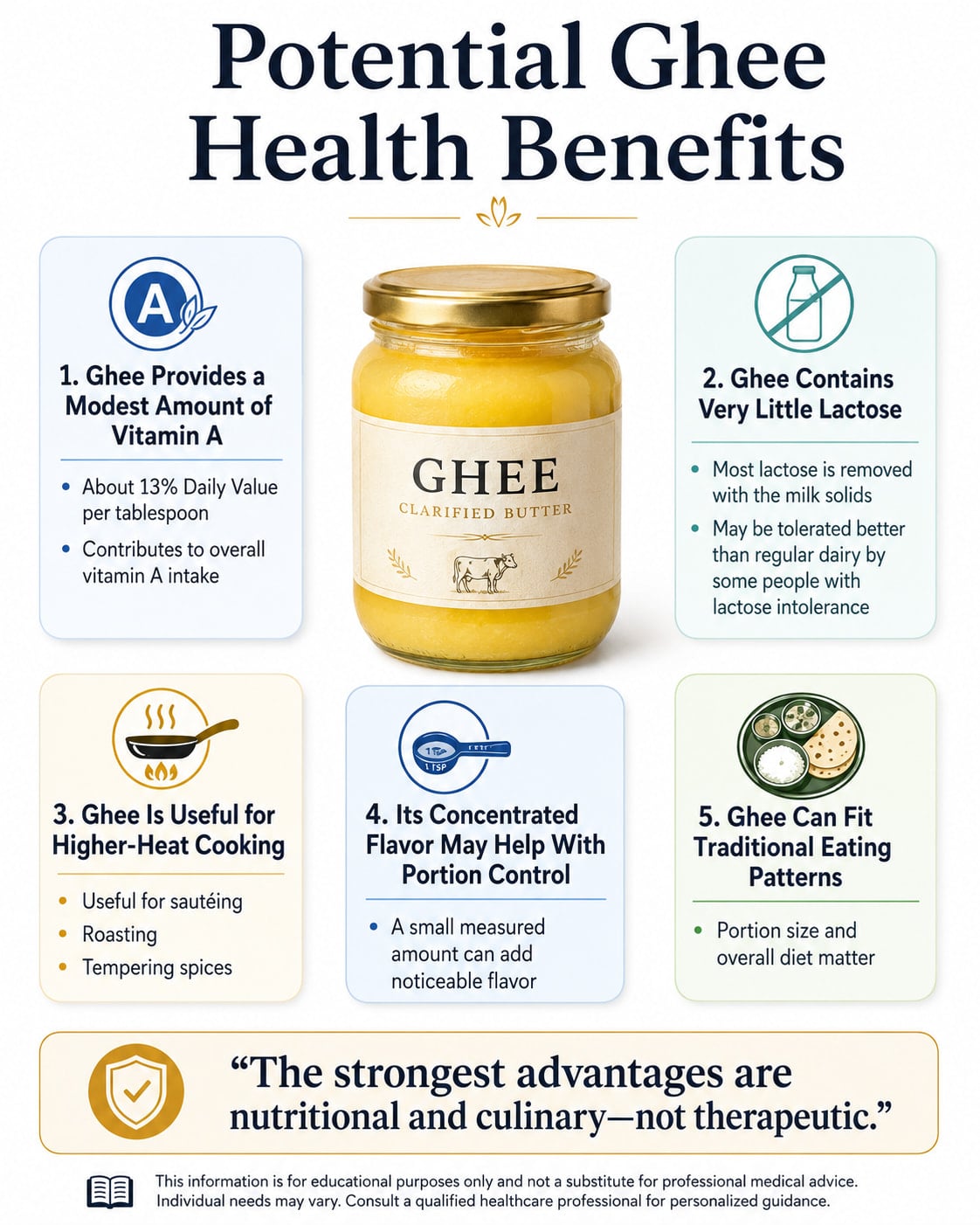
Most legitimate ghee health benefits are modest or practical. Ghee should not be presented as a food that prevents disease or produces major metabolic changes.
1. Ghee Provides a Modest Amount of Vitamin A
Because ghee is concentrated milk fat, it retains some preformed vitamin A.
A tablespoon provides approximately 118 micrograms of retinol activity equivalents, equal to about 13% of the FDA Daily Value. This can contribute to a person’s overall vitamin A intake, but eating additional ghee solely for vitamin A would also add substantial calories and saturated fat.
Ghee is therefore better viewed as a food that contributes some vitamin A, not as a vitamin A supplement.
2. Ghee Contains Very Little Lactose
Most lactose is found in the watery, nonfat portion of dairy foods. Because nearly all water and milk solids are removed while making ghee, very little lactose remains.
A laboratory analysis of five ghee samples found between less than 0.05 and 2.9 milligrams of lactose per 100 grams. The two butter samples tested contained approximately 685 to 688 milligrams per 100 grams.
This means many people with lactose intolerance may tolerate ghee better than milk or regular butter. However:
- Lactose levels can vary between products.
- Individual tolerance differs.
- Low lactose does not make ghee dairy-free.
- Lactose intolerance is different from a milk allergy.
Someone with severe lactose intolerance should begin with a small amount and monitor symptoms rather than assuming every product will be symptom-free.
3. Ghee Is Useful for Higher-Heat Cooking
Removing most of the water and milk solids makes ghee less likely to burn as quickly as regular butter.
It can be useful for:
- Sautéing vegetables
- Tempering or blooming spices
- Pan-cooking eggs
- Roasting vegetables
- Preparing rice, curries, and lentils
- Light pan-frying
- Adding flavor to flatbreads
Smoke points vary according to purity, production, and storage. Regardless of the stated smoke point, stop heating ghee if it begins producing visible smoke or an unpleasant burned smell.
A higher smoke point is a cooking advantage. It does not automatically make ghee more nutritious or more heart-friendly than olive, canola, or other plant oils.
4. Its Concentrated Flavor May Help With Portion Control
Ghee has a stronger roasted, buttery flavor than many neutral oils. A measured teaspoon may be enough to flavor a pan of vegetables, a bowl of lentils, or a serving of rice.
Using ghee this way can provide the desired flavor without automatically using a full tablespoon. This is a practical culinary advantage rather than a proven biological health benefit.
5. Ghee Can Fit Traditional Eating Patterns
Ghee has an important place in many South Asian cuisines and cultural traditions. A healthy eating pattern does not need to eliminate every traditional source of saturated fat.
The more useful approach is to consider:
- How much ghee is used
- How often it is eaten
- What other saturated-fat foods are consumed
- Whether unsaturated oils are also used
- The person’s cholesterol levels and medical history
A teaspoon used to flavor vegetables or lentils has a different nutritional impact from several tablespoons used in fried foods or rich desserts.
Are the Gut Health Benefits of Ghee Proven?
Ghee contains butyric acid, also called butyrate, a short-chain fatty acid. This has led to claims that eating ghee improves the intestinal microbiome or digestive health.
However, the presence of butyric acid in a food does not prove that a normal serving produces a meaningful clinical benefit. Direct human studies showing that ghee improves digestive symptoms, intestinal inflammation, or microbiome diversity are limited.
Most human research on ghee has focused on cholesterol, blood glucose, insulin, body weight, and other cardiometabolic markers—not measurable digestive-health outcomes. Claims that ghee “repairs the gut” therefore go beyond the available evidence.
Fiber-rich foods such as beans, lentils, oats, whole grains, fruits, vegetables, nuts, and seeds remain more established components of an eating pattern that supports gut microbial activity.
Does Ghee Raise Cholesterol?
Ghee is high in saturated fat, and some people experience increases in LDL-related cholesterol markers when saturated fats replace unsaturated fats.
A randomized crossover trial found that a ghee-rich diet increased apoB and non-HDL cholesterol compared with an olive-oil-rich diet. The trial included 30 healthy adults who followed each diet for four weeks.
Compared with the olive oil period, the ghee period increased:
- ApoB by 0.09 g/L
- Non-HDL cholesterol by 0.53 mmol/L
The difference in LDL cholesterol did not reach statistical significance. There were also no significant differences in body weight, fasting glucose, insulin, or triglycerides.
The study had important limitations. It was small, lasted only four weeks per intervention, and ghee made up more than 80% of participants’ cooking fat. Its findings do not prove that an occasional teaspoon of ghee is harmful. However, they do not support replacing olive oil with ghee for claimed cardiovascular benefits.
A separate 2024 randomized trial involving 110 adults with fatty liver disease found that replacing routinely consumed ghee with rapeseed oil for 12 weeks produced more favorable liver and metabolic outcomes than continuing ghee. Weight also changed during the trial, so the results cannot establish that ghee alone causes fatty liver disease.
How Saturated-Fat Guidelines Apply to Ghee
The 2025–2030 Dietary Guidelines for Americans recommend keeping saturated fat below 10% of total daily calories. On a 2,000-calorie diet, that equals approximately 22 grams of saturated fat per day.
One tablespoon of ghee contains approximately 8.7 grams. That uses about 39% of the guideline’s daily upper amount before accounting for saturated fat from:
- Meat
- Cheese
- Milk and yogurt
- Butter
- Coconut or palm oil
- Baked foods
- Desserts
- Restaurant meals
The American Heart Association uses a stricter target, recommending less than 6% of calories from saturated fat. For a 2,000-calorie diet, that is approximately 13 grams per day. One tablespoon of ghee would supply roughly two-thirds of that amount.
These figures are general benchmarks, not personalized prescriptions. Individual recommendations may be lower for someone with high LDL cholesterol, familial hypercholesterolemia, cardiovascular disease, or another relevant medical condition.
Ghee vs. Butter: Which Is Healthier?
Ghee and butter have more similarities than differences. Both come from milk fat, contain substantial saturated fat, and provide some vitamin A.
| Feature | Ghee | Regular butter |
|---|---|---|
| Fat concentration | Approximately 99% or more | Approximately 80% |
| Calories per tablespoon | About 120–126 | About 100 |
| Saturated fat per tablespoon | About 8–9 g | About 7 g |
| Lactose | Minimal | Low, but generally higher than ghee |
| Milk proteins | May remain in trace amounts | Present |
| Flavor | Nutty and roasted | Creamy and mild |
| Higher-heat cooking | More suitable | Milk solids burn sooner |
| Milk-allergy safety | Not automatically safe | Not safe |
Ghee is more concentrated because its water has been removed. As a result, a tablespoon generally contains slightly more calories and fat than a tablespoon of butter.
Ghee may be the more convenient choice for higher-temperature cooking or for someone who tolerates trace lactose better than the lactose in butter. It is not automatically a healthier choice for cholesterol or heart health.
Ghee vs. Olive Oil and Canola Oil
Olive and canola oils contain much more unsaturated fat and considerably less saturated fat than ghee.
| Feature | Ghee | Olive oil | Canola oil |
|---|---|---|---|
| Main type of fat | Saturated fat | Monounsaturated fat | Monounsaturated and polyunsaturated fat |
| Saturated fat per tablespoon | About 8–9 g | About 2 g | About 1 g |
| Dairy-free | No | Yes | Yes |
| Flavor | Rich and buttery | Fruity to neutral | Usually neutral |
| Best role | Flavoring and selected recipes | Everyday cooking, dressings, roasting | Everyday cooking and higher-heat uses |
| Cardiovascular positioning | Limit portions | Generally preferred | Generally preferred |
Replacing some saturated fat with unsaturated fat is different from simply adding olive or canola oil to an already high-fat diet. The practical goal is to use unsaturated oil instead of some ghee, butter, or other saturated-fat-rich cooking fat.
For example, use olive or canola oil for routine cooking and reserve a teaspoon of ghee for dishes where its flavor matters.
How Much Ghee Can You Eat per Day?
There is no official universal limit specifically for ghee.
The amount that fits depends on:
- Total calorie needs
- Overall saturated-fat intake
- Frequency of eating other high-fat foods
- LDL and non-HDL cholesterol levels
- Cardiovascular and metabolic health
- Personal food preferences
For many people, one teaspoon at a time is a practical flavoring portion. One teaspoon supplies about 42 calories and 2.9 grams of saturated fat. This is not an official medical limit or a guarantee that the amount is appropriate for everyone.
A simple approach is to:
- Measure ghee instead of pouring it freely.
- Check the product’s serving size and saturated fat.
- Use olive, canola, or another unsaturated oil for most routine cooking.
- Consider saturated fat from the entire day, not only from ghee.
- Follow personalized advice if a healthcare professional has given you a specific cholesterol or saturated-fat target.
Eating one teaspoon in a mostly plant-forward diet is different from eating it alongside large amounts of cheese, fatty meat, butter, coconut oil, and fried foods.
Best Ways to Use Ghee
Ghee works best when its flavor provides a clear culinary benefit.
Temper Spices
Warm a teaspoon of ghee and briefly cook cumin seeds, mustard seeds, garlic, ginger, or other spices before adding them to lentils, vegetables, or curries.
Add Flavor to Vegetables
Use a small measured amount for sautéing or toss roasted vegetables with a teaspoon after cooking.
Finish Rice or Lentils
Instead of adding several spoonfuls during cooking, stir a teaspoon into the finished dish. This often provides more noticeable flavor with less total ghee.
Cook Eggs
A small amount can prevent sticking and add a richer flavor to scrambled, fried, or baked eggs.
Use It Selectively in Baking
Ghee can replace butter in some recipes, but the texture may change because ghee contains almost no water. It also does not make baked food lower in calories or saturated fat.
Combine Flavor With a Lower-Saturated-Fat Base
Cook most of a dish with olive or canola oil, then finish it with a small amount of ghee. This retains some characteristic flavor while reducing the amount of ghee required.
Ghee Risks and Side Effects
High Saturated-Fat Intake
The main nutritional concern is saturated fat. Frequent large servings can make it difficult to stay within recommended limits, especially when the diet also includes other high-saturated-fat foods.
People with high LDL cholesterol or a strong family history of early heart disease may be particularly sensitive to the type of cooking fat they use regularly.
High Calorie Density
Ghee provides about 126 calories per tablespoon. Three unmeasured tablespoons would contribute nearly 380 calories.
Ghee does not automatically cause weight gain. However, regularly adding concentrated fats without reducing calories elsewhere can contribute to a calorie surplus.
Ghee Is Not Automatically Safe for Milk Allergy
Lactose intolerance involves difficulty digesting the milk sugar lactose. A milk allergy is an immune reaction to milk proteins. These are different conditions.
The FDA’s food-allergen guidance explains that ghee is a milk-derived fat and that residual milk protein is often present. When residual protein remains, milk must be declared as an allergen.
Therefore:
- People with lactose intolerance may tolerate some ghee.
- People with a diagnosed milk allergy should not assume ghee is safe.
- Anyone with a history of severe allergic reactions should follow guidance from an allergist.
Labels such as “lactose-free,” “pure,” “grass-fed,” or “organic” do not prove that a ghee product is free from allergenic milk protein.
Digestive Discomfort From Large Amounts
Although ghee contains very little lactose, consuming a large amount of any concentrated fat can cause nausea, fullness, loose stools, or abdominal discomfort in some people.
Reducing the portion and eating ghee as part of a mixed meal may be easier to tolerate.
Who Should Limit or Avoid Ghee?
People may need to limit ghee more carefully if they have:
- Elevated LDL, non-HDL cholesterol, or apoB
- Familial hypercholesterolemia
- Established cardiovascular disease
- Fatty liver disease
- A calorie-controlled weight-management plan
- Instructions to follow a low-saturated-fat eating pattern
People with a diagnosed milk allergy should generally avoid ghee unless an allergist has specifically determined that a particular product is appropriate.
Having one of these conditions does not mean that every person must permanently eliminate ghee. It means portion size, frequency, overall diet, laboratory results, and professional guidance become more important.
Common Ghee Claims: Facts vs. Hype
| Claim | What the evidence shows |
|---|---|
| Ghee burns abdominal fat | No direct evidence shows that adding ghee causes fat loss. It is calorie-dense. |
| Ghee produces significant weight loss | Human research has not shown a weight-loss advantage over olive oil. |
| Ghee improves gut health because it contains butyrate | Ghee contains butyric acid, but direct human evidence for meaningful digestive benefits is limited. |
| Ghee is dairy-free | False. It is made from milk fat and may contain residual milk proteins. |
| Ghee is safe for everyone with dairy problems | It may be tolerated with lactose intolerance, but milk allergy is different. |
| Ghee is healthier than all vegetable oils | Not supported. Olive and canola oils contain much less saturated fat. |
| A high smoke point makes ghee heart-healthy | Smoke point relates to cooking performance, not cardiovascular effects. |
| Ghee controls blood sugar | Direct research has not shown it to be superior to unsaturated oils for glucose control. |
Frequently Asked Questions
What are the main scientifically supported ghee health benefits?
The clearest advantages are its modest vitamin A content, very low lactose level, concentrated flavor, and usefulness for higher-temperature cooking. Strong claims involving weight loss, immunity, digestive health, or disease prevention are not supported by robust human evidence.
Is ghee healthier than butter?
Not necessarily. Ghee contains less lactose and performs better at higher temperatures, but it is more concentrated in fat and calories. Both ghee and butter are high in saturated fat. The best choice depends on the recipe, portion, lactose tolerance, and overall diet.
Does ghee increase LDL cholesterol?
It may increase LDL-related markers in some people, particularly when it replaces an unsaturated oil. In a small randomized trial, ghee increased apoB and non-HDL cholesterol compared with olive oil, although the difference in LDL cholesterol itself was not statistically significant.
Is ghee lactose-free?
Ghee contains extremely little lactose, but the amount is not guaranteed to be zero in every product. Many people with lactose intolerance can tolerate it, but individual responses vary.
Is ghee safe for someone with a milk allergy?
It should not automatically be considered safe. Residual milk protein may remain even when lactose and most milk solids have been removed. People with milk allergy should consult an allergist and carefully review allergen labeling.
How much ghee should you eat per day?
There is no official ghee-specific daily allowance. A measured teaspoon is a practical amount for flavoring food, but suitability depends on total saturated-fat intake, calorie needs, cholesterol levels, and medical history.
Does ghee help with weight loss or gut health?
Ghee has not been shown to cause weight loss. It also lacks strong direct human evidence for improving gut symptoms or microbiome health. It can still fit into a balanced diet when its calories and saturated fat are accounted for.
Conclusion
Ghee is a flavorful, versatile dairy fat—not a miracle food. Its legitimate advantages include minimal lactose, a modest amount of vitamin A, and suitability for higher-temperature cooking. Its main limitations are high calorie density and substantial saturated fat.
Use ghee like a concentrated seasoning: measure a teaspoon, reserve it for recipes where its flavor matters, and rely more often on unsaturated oils such as olive or canola oil. People with milk allergy, elevated cholesterol, cardiovascular disease, or fatty liver disease should obtain individualized guidance before making ghee a regular cooking fat.
This content is for informational purposes only and not medical advice.
References
- Dietary Guidelines for Americans, 2025–2030
- FDA Daily Values for Nutrition and Supplement Facts Labels
- Codex Alimentarius Standard for Milkfat Products, CXS 280-1973
- Norwegian Food Composition Table: Ghee Nutrition Data
- PubMed: Lactose and Galactose Content of Ghee and Other Milk Fats
- British Journal of Nutrition: Ghee vs. Olive Oil Randomized Crossover Trial