
Maca root benefits for men appear to be most promising for libido and possibly mild sexual-function concerns, but it has not been clearly proven to raise testosterone or reliably improve fertility. That is the most accurate way to understand maca today. Because maca is sold as a supplement, it is also important to look at product quality and safety, not just the marketing claims.
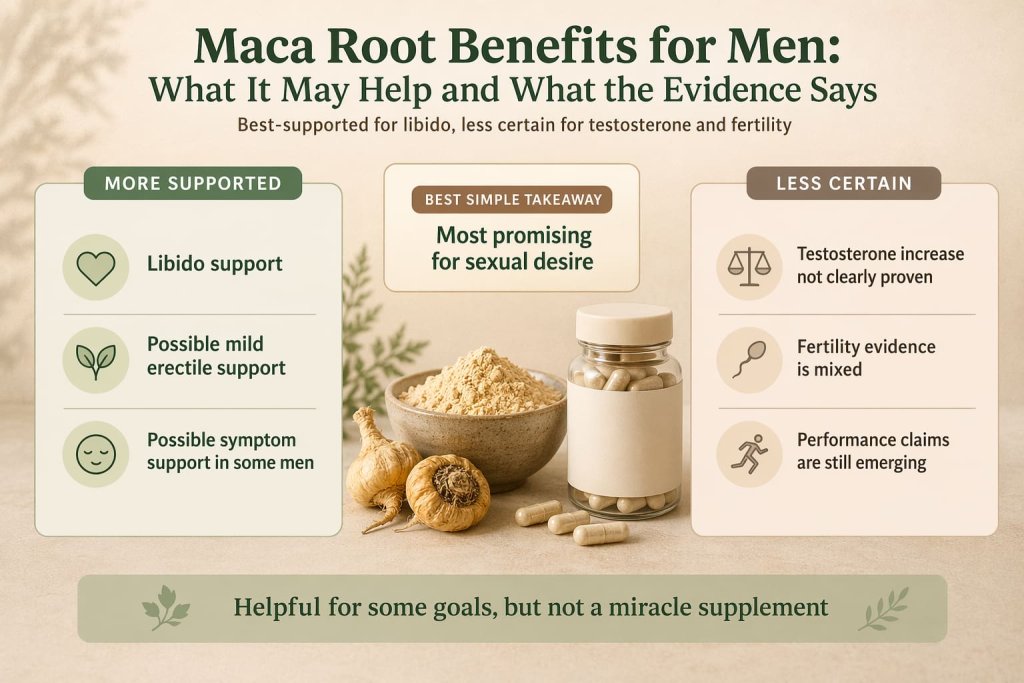
For men who are curious about maca, the practical takeaway is simple: the strongest evidence is around sexual desire, the evidence for erectile function is more limited, and claims about testosterone, muscle gains, or sperm improvements are much less certain. The safest approach is to use it cautiously, buy carefully, and keep expectations realistic.
What Is Maca Root?
Maca is the root of Lepidium meyenii, a plant in the Brassicaceae family that grows at high altitude in the Peruvian Andes. It is commonly sold as powder or capsules and is often marketed for libido, energy, fertility, and general vitality. A recent NIH review notes that maca has a wide range of traditional and commercial uses, but the quality of evidence is not the same for every claim.
Maca Root Benefits for Men With the Best Evidence

May support libido and sexual desire
The best human evidence for maca in men is for sexual desire. A PubMed-indexed clinical trial found that men taking maca reported improved sexual desire after about 8 to 12 weeks, and the effect was not explained by changes in testosterone or estradiol. That matters because it suggests maca may work through mechanisms other than simply “boosting male hormones.”
This is why libido is usually the first benefit mentioned in serious reviews. The signal is not huge, and the studies are still small, but libido is the area where maca has the clearest human data in men so far. The 2024 NIH review also highlights sexual desire as one of the main areas where clinical studies have found benefit.
May modestly help erectile function
Some studies and reviews suggest maca may also help erectile function, but this evidence is less established than the libido evidence. A 2023 systematic review in the Journal of Men’s Health specifically evaluated maca for erectile dysfunction in men, while the 2024 NIH review summarized clinical findings suggesting possible improvement in erectile function and subjective wellbeing in men.
The key word here is may. The evidence is still limited, and maca should not be presented as a proven treatment for erectile dysfunction. Men with persistent erectile problems should think of maca as a possible adjunct, not a substitute for medical evaluation.
Ongoing erectile dysfunction should not be self-treated with supplements alone. According to the National Institute of Diabetes and Digestive and Kidney Diseases, ED may be a symptom of another health problem, including diabetes, heart and blood vessel disease, hormone issues such as low testosterone or thyroid imbalance, medication side effects, or mental health factors. That makes medical evaluation especially important if erection problems are frequent, new, or getting worse.
May help some men with symptoms of late-onset hypogonadism
One more recent area of interest is symptom relief in men with late-onset hypogonadism symptoms who still have normal testosterone levels. A 2023 randomized, double-blind, placebo-controlled clinical trial reported that maca may be considered effective and safe for eugonadal men with these symptoms. In other words, some men with low-libido or low-vitality symptoms may feel better even when their testosterone is not actually low. World Journal of Men’s Health published the trial, and PubMed also indexed it.
That finding is interesting, but it should still be treated cautiously. It is one trial in a specific group of men, not final proof that maca is a go-to option for age-related hormone symptoms.
Benefits Often Claimed but Not Clearly Proven
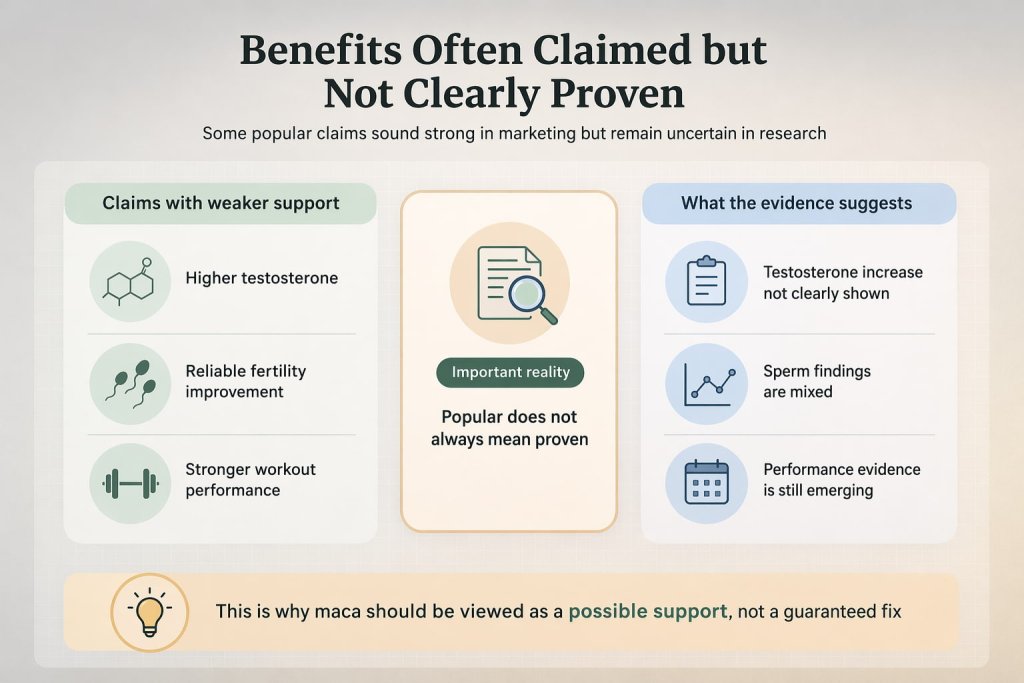
Maca does not appear to reliably raise testosterone
This is one of the biggest myths around maca. The marketing often implies a testosterone boost, but human studies do not clearly support that. A PubMed study on reproductive hormones found no meaningful change in serum reproductive hormone levels in healthy adult men taking maca, and the libido trial also found improved desire without a testosterone rise.
So if your main goal is to “increase testosterone,” maca is not one of the better-supported options. Based on current evidence, it is more accurate to think of maca as a supplement that may influence some symptoms or subjective wellbeing rather than a supplement that clearly increases male sex hormones.
Fertility and sperm quality are still a gray area
Maca is also heavily promoted for male fertility, but the evidence is mixed. A 2022 systematic review and meta-analysis in Frontiers in Pharmacology found that the human trials were few and small, and that the results for semen quality were inconsistent. The review specifically noted mixed efficacy for sperm concentration and sperm motility.
That does not mean maca cannot help any man at all. It means the current research is too limited to make a strong claim. Men dealing with infertility are usually better served by a proper medical workup than by relying on supplement marketing.
Energy, stamina, and workout performance are still emerging areas
Many supplement labels frame maca as an energy or performance booster. There is some growing research interest here, including a 2024 systematic review in Nutrients, but this area is still much less solid than the libido research.
For most men, it is better to view performance claims as preliminary rather than proven. Right now, sexual-desire support has stronger human evidence than exercise-performance support.
How Long Does Maca Take to Work?
Maca is not the kind of supplement that usually shows a same-day effect in clinical research. In the libido studies, improvement was generally reported after about 8 weeks, with follow-up through 12 weeks. That is why it makes little sense to judge maca after only a few days.
A fair real-world test is to decide what you are hoping to improve first, use one consistent product, and evaluate it over several weeks rather than jumping between products every few days. That approach will not change the science, but it will at least help you judge your own response more clearly.
How Much Maca Root Do Men Take in Studies?
The main human studies in men have commonly used doses in the 1.5 to 3 grams per day range, often for 8 to 12 weeks. A systematic review of maca for sexual function noted that the optimum dose is still unknown, which is an important limitation.
What matters just as much is that NCCIH warns that supplements sold in stores or online may differ in important ways from the products used in research. So even when two labels both say “maca,” they may not perform the same way.
One practical detail matters here: study doses are only useful if the label lets you match them. Maca products are not always interchangeable because studies have used different varieties and preparations, including black, red, and yellow maca and different forms such as powder or gelatinized products. The FDA says supplement labels should list serving size, servings per container, and the amount of each dietary ingredient per serving, except when a product uses a proprietary blend. In real life, that means it is smarter to choose a product that clearly states the exact maca amount and form instead of hiding the dose inside a blend. An independent certification program such as NSF can add another layer of quality control by checking whether the label matches the contents and screening for undeclared ingredients or unacceptable contaminant levels.
Safety and Quality: What Men Should Know Before Buying
Short-term human studies generally describe maca as well tolerated, and recent reviews report rare adverse effects overall. But there is still an important limitation: most clinical studies have been small and short, usually lasting weeks to a few months, so long-term safety is much less certain than supplement marketing often implies. That is a good reason to use maca cautiously, especially if you take prescription medicines or combine it with other sexual-enhancement products.
Safety box
Before using maca regularly, keep these points in mind:
- Supplements may interact with medications or pose risks if you have certain medical conditions or are preparing for surgery, according to NCCIH.
- Product quality can vary, and what is on the label is not always what is in the bottle.
- Some sexual-enhancement supplements have been found to contain hidden prescription drugs.
- If you have ongoing erectile dysfunction, fertility concerns, or symptoms that make you wonder about testosterone, it is smarter to get checked than to self-diagnose with supplements.
The biggest safety warning for men is not necessarily maca itself. It is the broader “male enhancement” supplement market. The FDA reported that one product sold as Peru Maca contained hidden sildenafil, the active ingredient in Viagra. FDA warned that this undeclared drug can interact with nitrates and dangerously lower blood pressure.
That is why men should be careful with products making drug-like promises such as “instant male performance,” “works like Viagra,” or “rapid ED fix.” Even if the label says “natural,” that does not make it automatically safe. NCCIH also notes that supplements promoted for sexual enhancement are a category where hidden drug ingredients are a known concern.
How to Use Maca Realistically
If you want to try maca, keep the approach simple:
- Use it for one clear reason, such as libido support.
- Give it enough time to judge fairly, usually several weeks rather than several days.
- Do not expect it to act like testosterone therapy or a prescription ED drug.
- Avoid products with exaggerated sexual-enhancement claims.
- Stop and speak with a clinician if you notice side effects or if you take regular medications.
Frequently Asked Questions
Does maca root increase testosterone in men?
Current human evidence does not clearly show that maca raises testosterone in healthy men. Libido improvements seen in studies happened without meaningful changes in testosterone levels.
Is maca root good for erectile dysfunction?
It may help some men, but the evidence is still limited. Maca is not a proven replacement for standard erectile-dysfunction evaluation or treatment.
How long does maca root take to work for men?
The better-known human studies found improvements after about 8 weeks, with follow-up through 12 weeks.
Is maca root worth trying for male fertility?
The evidence is too mixed to make a strong recommendation. Some studies suggest possible benefit, but the overall research is still too small and inconsistent to treat maca as a reliable fertility solution.
Conclusion
Maca root benefits for men are real enough to be interesting, but not strong enough to justify the hype. The best-supported use is libido, with some limited evidence for erectile function and possible symptom relief in certain men who have low-testosterone-type symptoms despite normal testosterone levels. Claims about testosterone, fertility, and workout performance are much less certain.
If you decide to try maca, buy carefully, keep expectations modest, and focus on safety as much as benefits. That gives you the best chance of making a smart decision instead of chasing supplement marketing.
This content is for informational purposes only and not medical advice.
References
- U.S. Food and Drug Administration — Public Notification: Peru Maca contains hidden drug ingredient
- National Institute of Diabetes and Digestive and Kidney Diseases — Symptoms and Causes of Erectile Dysfunction
- PubMed — Effect of Lepidium meyenii (MACA) on sexual desire and its absent relationship to serum testosterone levels in healthy adult men
- PubMed — Effect of Lepidium meyenii (Maca), a root with aphrodisiac and fertility-enhancing properties, on serum reproductive hormone levels in adult healthy men
- World Journal of Men’s Health — Efficacy and Safety of Maca (Lepidium meyenii) in Patients with Symptoms of Late-Onset Hypogonadism
- Frontiers in Pharmacology / PubMed Central — Maca (Lepidium meyenii Walp.) on semen quality parameters: A systematic review and meta-analysis
- Nutrients — Effects of Maca (Lepidium meyenii Walp.) on Physical Performance in Animals and Humans: A Systematic Review and Meta-Analysis
- NSF — Supplement and Vitamin Certification