
The Peloton Bike primarily works your quadriceps, glutes, hamstrings, and calves, while also engaging your core and upper-body stabilizers. Knowing what muscles the Peloton bike works helps you pick the right ride types (endurance vs climbs vs intervals), improve form, and balance cycling with strength training for better results.
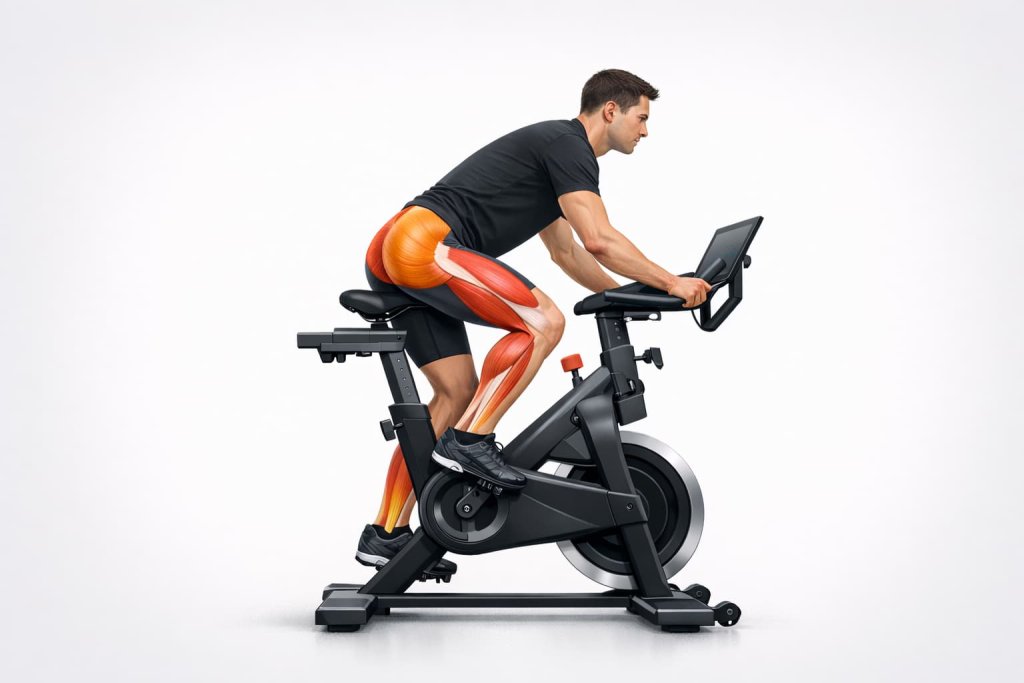
This guide breaks down the main and supporting muscles Peloton cycling uses, how different ride styles shift emphasis, and how to maximize muscle engagement safely.
What muscles does the Peloton bike work most?
1) Quadriceps (front of thighs) — primary
Your quads do a large share of the work on every ride, especially during the downstroke and higher-cadence efforts. Peloton also highlights quads as a top muscle group worked on the Bike.
2) Glutes (glute max & glute med) — power + stability
Your glutes contribute heavily to power production—especially when resistance rises. You’ll typically feel more glute involvement during climbs and out-of-saddle segments, where you’re driving force through the pedals with stronger hip extension.
3) Hamstrings (back of thighs) — support + balance
Hamstrings help across the pedal cycle (particularly as you transition through and “smooth out” the stroke). Strong hamstrings can help balance quad dominance and support better knee comfort during higher-effort rides.
4) Calves (gastrocnemius & soleus) — stability + control
Your calves help stabilize the ankle and transfer force efficiently into the pedals. They’re often more noticeable at higher cadence or when your ankle position gets “bouncy.”
Secondary muscles Peloton cycling activates
5) Hip flexors
Hip flexors assist with lifting and transitioning the leg through the pedal cycle. Because cycling is repetitive, hip flexors may feel tight—especially if you sit a lot during the day—so stretching and mobility work can help.
6) Core (abs, obliques, lower back)
Your core stabilizes your torso on the saddle and helps keep your posture steady during harder efforts. Core engagement typically increases when you ride out of the saddle or push higher resistance.
7) Upper body (arms, shoulders, upper back) — mostly stabilization
Your arms and upper body mainly provide support and posture control (hands on handlebars, shoulders stacked, upper back engaged). Cycling alone usually isn’t enough stimulus to build significant upper-body strength—so adding strength sessions is smart if that’s your goal.
How Peloton ride types change muscle emphasis
| Peloton ride type | Muscles emphasized | What you’ll likely feel most |
|---|---|---|
| Seated endurance / steady rides | Quads (primary), calves + glutes (support) | Quad fatigue, steady leg burn, aerobic effort |
| Climbs / high resistance | Glutes + quads (primary), hamstrings + core (support) | Glute drive, heavier “push,” slower cadence strength feel |
| Out-of-saddle segments | Glutes + quads (primary), core (support) | More total-body effort and stability demand |
| Intervals / HIIT rides | Quads + glutes (primary), hamstrings + calves (support) | High fatigue spikes, power bursts, legs “on fire” |
Does the Peloton bike build muscle?
Peloton cycling can support muscle endurance and definition in the lower body—especially if you ride consistently and include resistance (not only easy spinning). However, noticeable muscle size gains typically require progressive resistance training (weights or challenging bodyweight strength work).
What muscles Peloton cycling does NOT train well
- Chest
- Shoulders (for growth/strength)
- Biceps and triceps (for growth/strength)
- Upper-back thickness (lats/rhomboids for growth)
If you want balanced full-body development, add 2–3 strength sessions per week (upper body + lower body + core).
How to maximize muscle engagement on the Peloton Bike
- Use resistance intentionally: Mix in climb rides or add resistance during intervals to recruit more glute/hamstring contribution.
- Ride tall (don’t “hang” on the handlebars): Keep shoulders relaxed and core engaged for better power transfer.
- Try controlled out-of-saddle work: Great for glute emphasis, but keep it smooth and stable (no rocking).
- Check bike fit: A poor saddle height/fore-aft setup can shift load to knees or hips.
- Recover well: Stretch calves and hip flexors, and add mobility if you feel tightness.
FAQs: What muscles does the Peloton bike work?
1) Does Peloton work abs?
Yes, your core works for posture and stability—especially during climbs and out-of-saddle efforts. But cycling won’t replace direct core training if your goal is stronger abs.
2) Does Peloton make your thighs bigger?
Most riders build endurance and leg definition rather than large thigh size. Significant muscle growth usually requires heavier resistance training and a consistent calorie surplus.
3) Is Peloton good for glutes?
Yes. Glutes tend to work more during higher resistance, climb rides, and controlled out-of-saddle segments. If glutes are a goal, prioritize climbs and strength training too.
4) Does Peloton work calves?
Yes—calves support ankle stability and power transfer. If calves feel overworked, recheck your ankle position and bike fit.
5) Can Peloton replace leg day?
It can replace “cardio leg day” for endurance, but it doesn’t fully replace progressive strength training for maximum strength and muscle growth. A combined plan works best.
6) Is Peloton low-impact on joints?
Yes, cycling is generally considered low-impact compared to running, which is one reason it’s popular for joint-friendly cardio.
Conclusion
The Peloton Bike delivers a strong lower-body workout—mainly targeting the quads, glutes, hamstrings, and calves—while also engaging your core and upper-body stabilizers for posture. For the best long-term results (and balanced physique), combine cycling with consistent strength training and mobility work.