
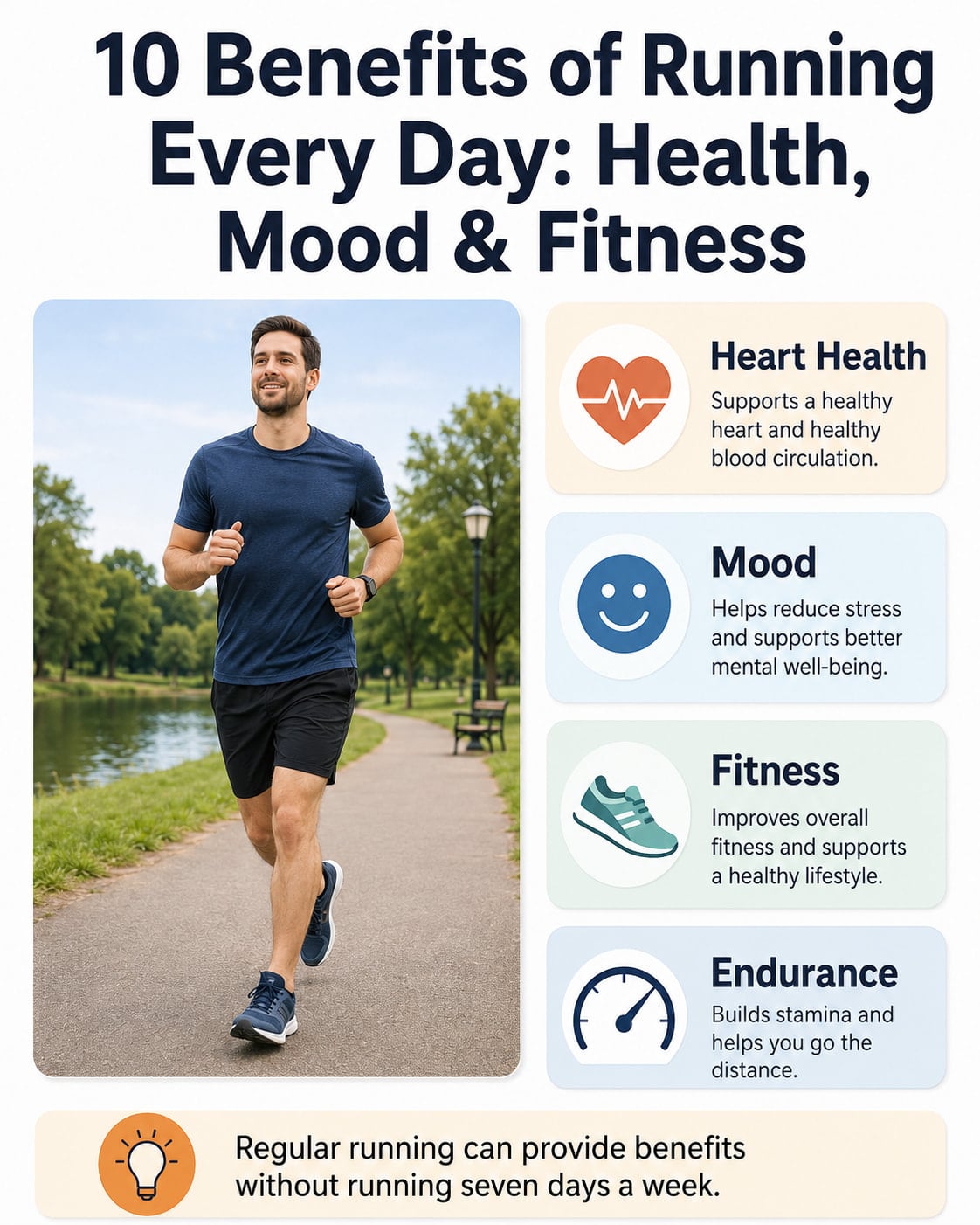
Running every day can support cardiovascular fitness, heart health, mood, sleep, metabolic health, bone strength, and endurance—but you do not need to run seven days a week to get these benefits. For most people, the health advantages come from running regularly and building an appropriate amount of weekly physical activity while allowing enough recovery.
Running is a vigorous aerobic activity, so even relatively short runs can contribute toward weekly exercise goals. Current CDC guidance recommends that adults get at least 75 minutes of vigorous-intensity aerobic activity per week, such as jogging or running, or 150 minutes of moderate activity, plus muscle-strengthening activities on at least two days per week.
If you enjoy frequent running, daily runs can work for some experienced runners. However, beginners usually benefit from starting with fewer running days and increasing training gradually.
10 Benefits of Running Every Day
Running affects much more than your legs. Regular aerobic exercise can influence your cardiovascular system, metabolism, mental well-being, sleep, and long-term health.
Here are 10 evidence-supported benefits worth knowing.
1. Improves Cardiovascular Fitness
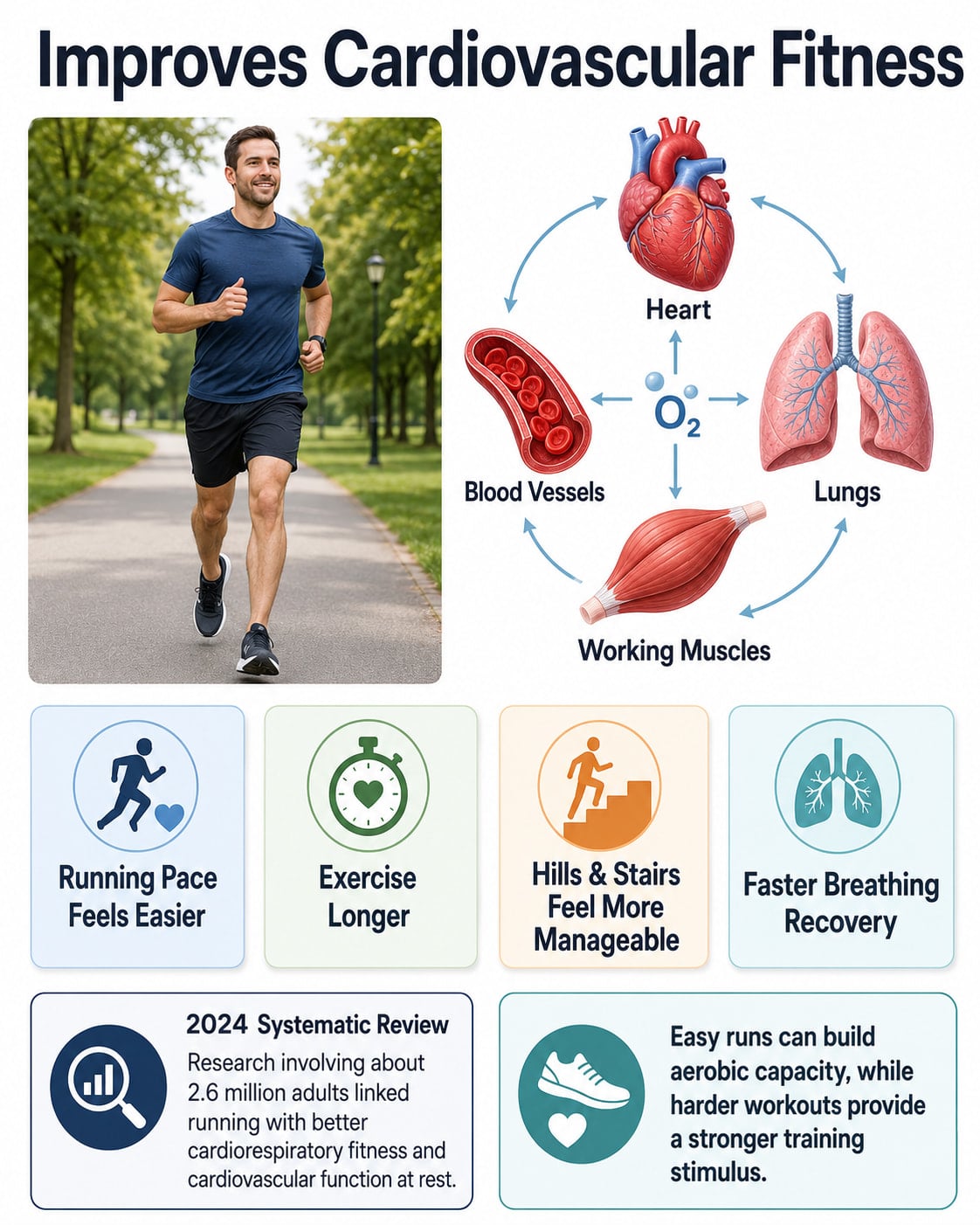
One of the clearest benefits of running is improved cardiorespiratory fitness—the ability of your heart, lungs, blood vessels, and muscles to supply and use oxygen during activity.
As your fitness improves, you may notice that:
- Your usual running pace feels easier.
- You can exercise longer before becoming tired.
- Hills and stairs become more manageable.
- Your breathing recovers faster after exercise.
A 2024 systematic review covering research involving about 2.6 million adults found that running was associated with improvements in cardiorespiratory fitness and cardiovascular function at rest.
You do not need to run hard every day to improve fitness. Easy runs can build aerobic capacity while harder workouts can provide a stronger training stimulus.
2. Supports Heart Health
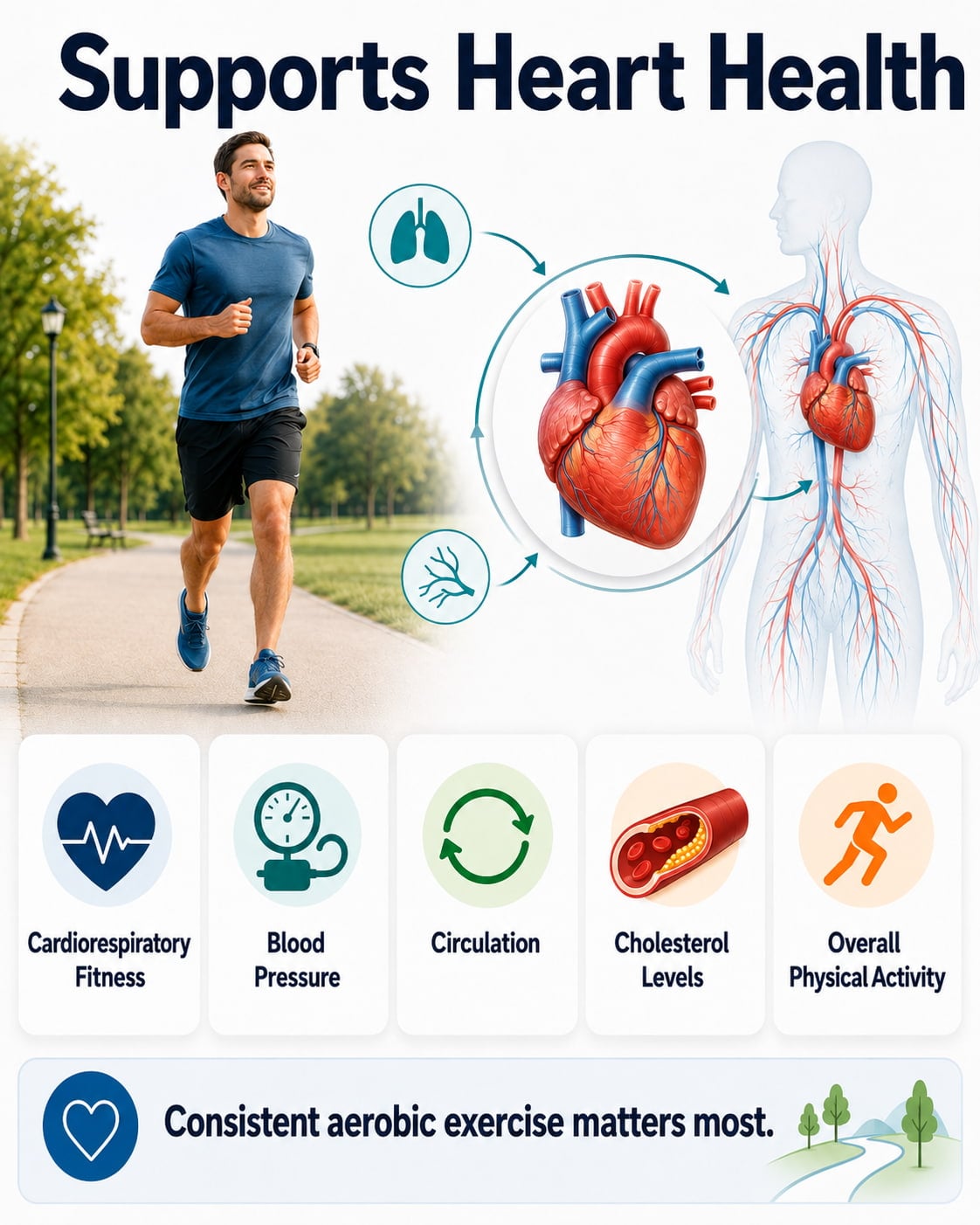
Regular running provides vigorous aerobic exercise, which helps train the cardiovascular system.
According to the CDC’s current guidance on the health benefits of physical activity, regular physical activity is associated with a lower risk of heart disease and stroke. Moderate-to-vigorous activity can also provide an immediate reduction in blood pressure.
Running may therefore contribute to improvements in several factors connected with cardiovascular health, including:
- Cardiorespiratory fitness
- Blood pressure
- Circulation
- Cholesterol levels
- Overall physical activity levels
The benefit does not depend on completing a hard run every day. Consistent, appropriately dosed aerobic exercise is what matters most.
3. Is Associated With a Lower Risk of Premature Death
Running has also been linked with longer-term health outcomes.
A systematic review and meta-analysis of 14 studies involving 232,149 participants found that running participation was associated with a:
- 27% lower risk of all-cause mortality
- 30% lower risk of cardiovascular mortality
- 23% lower risk of cancer mortality
compared with not running.
These numbers describe associations in population studies, so they do not prove that running alone caused the lower risk. Diet, smoking, body weight, medical history, and other lifestyle factors can also influence longevity.
Importantly, the researchers did not find a clear pattern showing that increasingly large amounts of running always produced increasingly large benefits. More running is not automatically better.
4. May Help Improve Blood Pressure
Running temporarily increases heart rate and blood flow while you exercise, but regular aerobic activity can support healthier resting blood pressure over time.
The CDC lists reduced blood pressure as one of the immediate benefits that can follow a session of moderate-to-vigorous physical activity.
For people with hypertension, exercise may be an important part of an overall health plan, but it should not replace prescribed medication or individualized medical care.
If you have uncontrolled high blood pressure or another cardiovascular condition, ask your healthcare professional what running intensity is appropriate for you.
5. Supports Blood Sugar and Metabolic Health
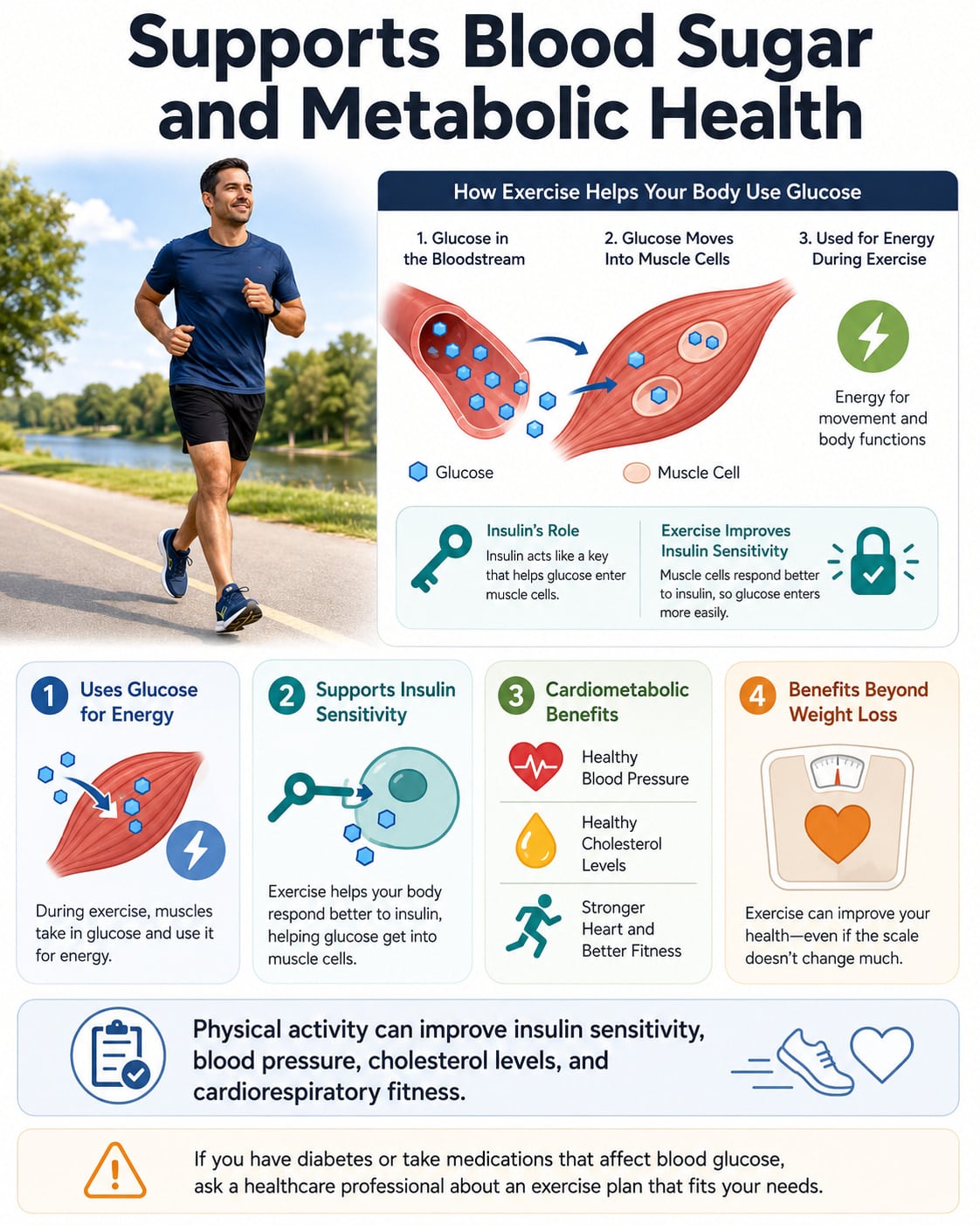
Regular running requires your muscles to use energy, including glucose and fatty acids. Repeated physical activity can also improve how the body responds to insulin.
A June 2026 American Heart Association scientific statement on physical activity and cardiometabolic health reported that physical activity can improve insulin sensitivity, blood pressure, cholesterol levels, and cardiorespiratory fitness—even when major weight loss does not occur.
This is an important point: exercise can benefit your health even if the number on the scale changes very little.
For people living with diabetes or taking medications that affect blood glucose, exercise plans may need to be individualized with a healthcare professional.
6. Helps With Healthy Weight Management
Running uses considerably more energy than sitting and can help increase total daily energy expenditure.
That can make running useful as part of a weight-management strategy, especially when it is combined with:
- Balanced nutrition
- Adequate protein
- Strength training
- Daily movement
- Sufficient sleep
- Sustainable eating habits
However, running every day does not guarantee weight loss.
The American Heart Association notes that physical activity provides significant cardiometabolic benefits independently of weight loss. It also reports that exercise alone often produces only modest weight loss unless weekly activity levels become relatively high.
For long-term results, focus on overall health habits rather than trying to compensate for food intake with excessive running.
7. Can Improve Mood and Reduce Feelings of Anxiety
Many runners notice that they feel calmer or mentally refreshed after running, and research on physical activity supports this effect.
According to the CDC, a single session of moderate-to-vigorous physical activity can reduce short-term feelings of anxiety. Regular physical activity is also associated with a lower risk of depression.
A run can also provide:
- Time away from everyday distractions
- A predictable routine
- A sense of accomplishment
- Outdoor time when running outside
- Social interaction when running with others
Running should not be presented as a replacement for professional mental health care. Rather, it can be one supportive part of a healthy lifestyle.
8. May Improve Sleep Quality
Regular activity can also benefit sleep.
The CDC identifies improved sleep quality as an immediate benefit associated with moderate-to-vigorous physical activity.
Better sleep matters for runners because sleep supports recovery, concentration, mood, and physical performance.
However, timing and intensity can affect people differently. If a hard evening run consistently leaves you feeling too alert to sleep, experiment with finishing strenuous workouts earlier and reserving evening sessions for easy running or walking.
9. Supports Bone Health
Running is a weight-bearing activity. Each stride creates mechanical loading through the legs, which provides a stimulus to the bones.
Regular physical activity is associated with better bone health, according to current CDC guidance.
Running can therefore be one component of a bone-supportive exercise routine, especially when combined with resistance training.
Bone health also depends on factors such as:
- Adequate calorie intake
- Calcium and vitamin D
- Hormonal health
- Age
- Genetics
- Strength training
- Recovery
Increasing running mileage while chronically under-fueling can work against bone health and may increase the risk of bone stress injuries.
10. Builds Endurance and Everyday Stamina
Consistent running teaches your body to sustain activity more efficiently.
Over time, this can make longer runs easier and can also improve your ability to handle everyday activities that require endurance.
You may find it easier to:
- Walk longer distances
- Climb several flights of stairs
- Hike
- Participate in recreational sports
- Complete physically demanding daily tasks
Regular running also develops muscular endurance in the lower body, particularly in the calves, quadriceps, hamstrings, glutes, and muscles that stabilize the hips and ankles.
Running alone is not ideal for maximizing muscle size or total-body strength, however. Strength training at least twice per week remains useful alongside running.
Is Running Every Day Good for You?
Running every day can be appropriate for some experienced runners, but it is not necessary for good health and is not the best starting point for most beginners.
Current physical activity recommendations focus on total weekly activity—not on exercising intensely seven days in a row.
For general health, adults should work toward at least:
| Activity | Weekly Target |
|---|---|
| Moderate aerobic exercise | 150 minutes |
| OR vigorous aerobic exercise | 75 minutes |
| Muscle-strengthening activity | At least 2 days |
More activity can provide additional benefits, but the amount should fit your fitness level and ability to recover.
A beginner might run three nonconsecutive days each week and use the remaining days for walking, strength training, light cycling, mobility work, or rest.
An experienced runner who enjoys daily running might alternate short easy runs with occasional longer or harder sessions rather than treating every day as a demanding workout.
What Happens If You Run Every Day?
Your results depend largely on how much, how hard, and how quickly you increase your training.
A short, comfortable 15- to 20-minute run is very different from running hard for an hour every day.
When training matches your current fitness and recovery capacity, regular running can gradually improve endurance and cardiovascular fitness.
When the workload exceeds your ability to recover, you may instead experience:
- Persistent soreness
- Declining performance
- Unusual fatigue
- Reduced motivation
- Sleep problems
- Pain during running
- Overuse injuries
The goal should be consistent training that your body can recover from—not simply maintaining an unbroken daily running streak.
How to Run Frequently Without Doing Too Much
If you want to run most days, make the majority of your running comfortable.
A practical approach is to:
- Keep easy days genuinely easy. You should usually be able to speak in sentences during an easy run.
- Limit demanding workouts. Avoid turning every run into intervals, hills, tempo work, or a personal record attempt.
- Increase distance gradually. Large jumps in a single run can raise injury risk.
- Include strength training. Strengthen the calves, quads, hamstrings, glutes, hips, and core.
- Eat enough to support training. Increasing mileage while significantly restricting calories can compromise recovery.
- Prioritize sleep. Training adaptations occur during recovery as well as during exercise.
- Take rest when you need it. A day without running will not erase your fitness.
A 2025 cohort study followed 5,205 runners across 588,071 running sessions and found higher overuse-injury rates when the distance of a single run increased by more than 10% compared with the runner’s longest run during the previous 30 days. Very large single-run spikes carried even greater risk.
That finding applies specifically to changes in single-session distance and should not be interpreted as proof of a universal “10% per week” rule.
Does Running Every Day Hurt Your Knees?
Running does not automatically mean that your knees will wear out.
A systematic review and meta-analysis of 25 studies involving 125,810 people reported hip or knee osteoarthritis prevalence of 3.5% among recreational runners, compared with 10.2% among sedentary/non-running controls and 13.3% among competitive runners.
The researchers emphasized that these findings show an association, not proof that recreational running prevents osteoarthritis.
Previous injuries, very high training volumes, body composition, genetics, occupation, and other factors can also influence joint health.
If running repeatedly causes localized joint pain, swelling, limping, or pain that worsens from run to run, reducing training and getting an appropriate evaluation is more sensible than trying to run through it.
Who Should Be Careful About Running Every Day?
Daily running deserves extra caution if you:
- Are completely new to running
- Are returning after a long break
- Have a current bone, muscle, tendon, or joint injury
- Have recently increased your mileage significantly
- Are experiencing persistent pain
- Have a medical condition that affects exercise safety
- Are consistently exhausted or unable to recover between workouts
People with known cardiovascular disease, significant medical conditions, or symptoms such as chest pain, fainting, or unusual shortness of breath should seek appropriate medical guidance rather than simply pushing through symptoms.
How Often Should Beginners Run?
Beginners generally do not need to run every day.
Starting with about three running or run-walk sessions per week gives you time to learn the movement, build aerobic fitness, and observe how your body responds.
For example:
- Monday: Easy run-walk
- Tuesday: Walking or strength training
- Wednesday: Easy run-walk
- Thursday: Rest or light activity
- Friday: Easy run-walk
- Saturday: Walking or strength training
- Sunday: Rest or easy recreational activity
As your fitness improves, you can gradually increase either duration, frequency, or distance rather than changing everything at once.
Frequently Asked Questions
Is running 30 minutes every day good for you?
Thirty minutes of running can provide substantial aerobic exercise, but doing it every day is not necessary for health. If you tolerate the workload well, keeping most runs comfortable and varying intensity can make frequent running more manageable. Beginners may benefit from running fewer days at first.
Is it better to run every day or every other day?
Neither schedule is universally better. Running every other day gives beginners more recovery time, while experienced runners may tolerate frequent easy running. Your training history, intensity, mileage, age, sleep, nutrition, and injury history all matter.
Can running every day help you lose weight?
Running increases energy expenditure and may support weight management, but daily running does not guarantee weight loss. Body weight is influenced by overall energy intake, activity, sleep, medications, medical conditions, and other factors.
How long should you run each day?
There is no ideal daily duration for everyone. Current U.S. guidance recommends at least 75 minutes of vigorous aerobic activity per week for adults, or an equivalent combination of moderate and vigorous activity. Beginners can start with much shorter run-walk sessions and progress gradually.
Does running every day build muscle?
Running can improve muscular endurance and place substantial demands on the calves, quadriceps, hamstrings, and glutes, particularly during hills or faster running. However, resistance training is generally more effective when the primary goal is increasing muscle size and strength.
Do you need rest days from running?
Not everyone needs a completely inactive day every week, but everyone needs adequate recovery. Recovery may involve full rest, walking, easy cycling, mobility work, or a very short easy run. If soreness, fatigue, pain, or declining performance continues to accumulate, additional recovery is warranted.
Conclusion
The benefits of running every day can include better cardiovascular fitness, improved mood and sleep, stronger endurance, healthier metabolic function, and support for long-term heart and bone health. Running participation is also associated with a lower risk of premature death.
But seven consecutive running days are not required to receive these benefits.
For most people, the better goal is to run consistently at a level they can recover from. Start gradually, make most runs comfortable, strengthen your muscles, eat and sleep adequately, and take recovery days when your body needs them.
If you are new to running, begin with a manageable run-walk schedule rather than chasing a daily streak. Sustainable running is far more valuable than forcing yourself to run every day.
References
- CDC — Health Benefits of Physical Activity for Adults
- CDC — Adult Activity: An Overview
- American Heart Association — Physical Activity and Cardiometabolic Health
- British Journal of Sports Medicine — Running and Mortality Systematic Review
- British Journal of Sports Medicine — Running Distance and Injury Risk Study
- Journal of Orthopaedic & Sports Physical Therapy — Running and Hip/Knee Osteoarthritis Review
- Systematic Review — Health Benefits of Different Sports