
To do leg extensions correctly, adjust the machine so your knees line up with its pivot point, position the lower-leg pad just above your ankles, keep your back supported, and straighten your knees with a smooth, controlled motion. Lower the weight slowly, keep your hips planted, and use a load you can control without kicking or swinging.
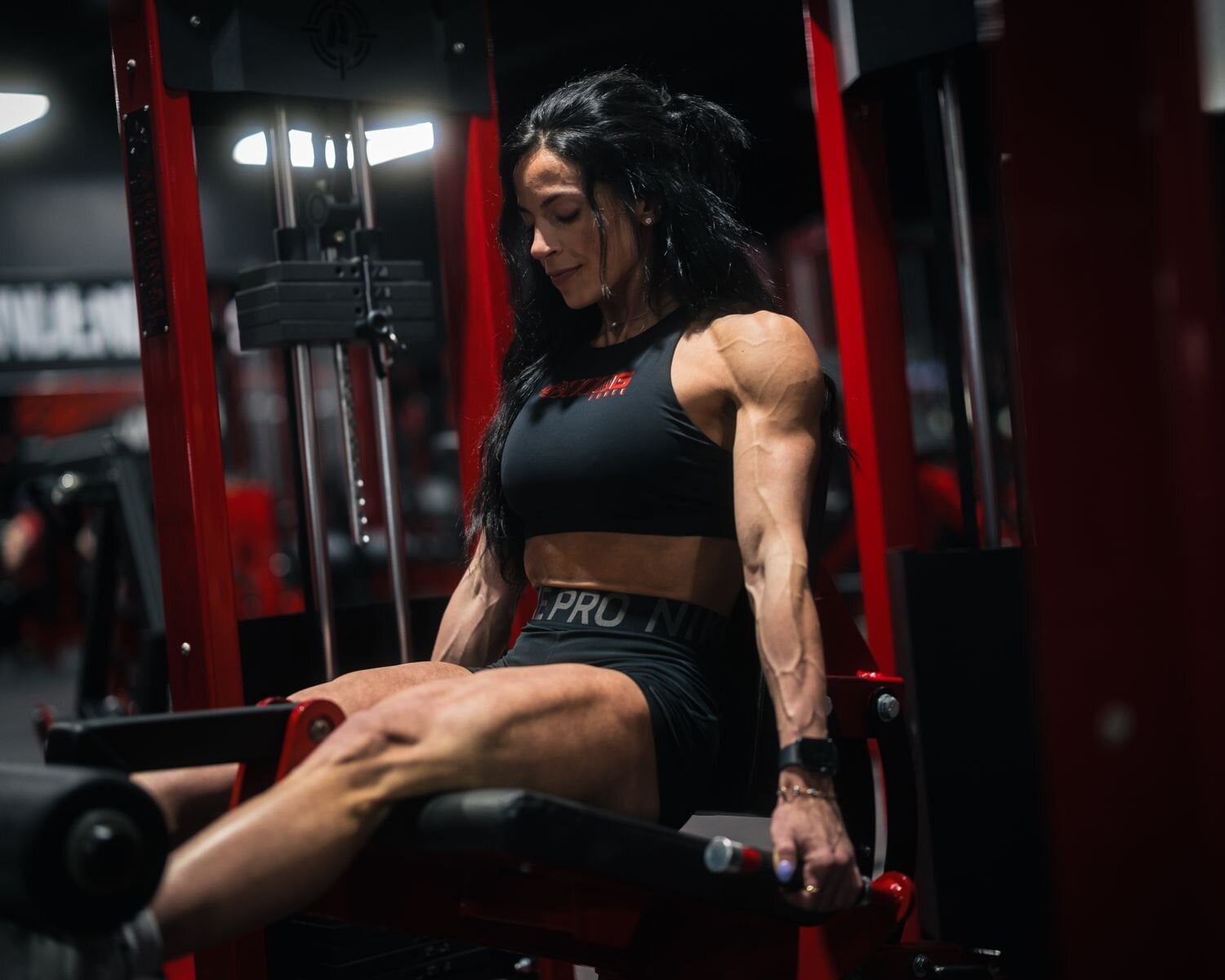
Learning how to do leg extensions properly matters because small setup errors can make the exercise uncomfortable and reduce how effectively you train your quadriceps. The machine is straightforward once it fits your body correctly, and you do not need extremely heavy weights to make it useful.
For most healthy beginners, 2–3 sets of about 8–15 controlled reps is a practical starting point. Your ideal load, range of motion, and rep range can vary based on your experience, goals, and knee comfort.
What Is a Leg Extension?
The leg extension is a seated, machine-based resistance exercise in which you straighten your knees against resistance.
It is a single-joint, open-kinetic-chain exercise because movement primarily occurs at the knee while your feet move freely rather than remaining fixed to the floor.
The exercise mainly targets the quadriceps at the front of your thighs. According to the Cleveland Clinic’s overview of the quadriceps, one of the quadriceps group’s primary functions is extending, or straightening, the knee.
Leg extensions are commonly used as:
- A quadriceps-strengthening exercise
- An accessory exercise after squats or leg presses
- A way to add direct quad training without heavily loading the hips or back
- A machine exercise for people who want a stable, easy-to-learn resistance movement
How to Set Up the Leg Extension Machine Correctly
Good leg-extension form starts before the first repetition. Spend a few seconds adjusting the machine to your body rather than simply using the previous person’s settings.
1. Adjust the Seat and Back Pad
Sit down with your back against the backrest.
Adjust the seat or back pad until the center of your knee joint is approximately aligned with the machine’s pivot or axis of rotation. Many machines mark this point with a visible dot or circular indicator.
This alignment is a standard manufacturer recommendation. For example, Precor’s leg-extension design guidance specifically describes an adjustable back pad that allows the knee to align with the machine pivot for appropriate biomechanics.
Your knees should also bend comfortably at the starting position without the front edge of the seat pressing excessively into the backs of your knees.
2. Position the Lower-Leg Pad
Adjust the roller so it rests across your lower shins just above the ankles.
Do not position the pad directly on your ankle joint or far up toward the middle of the shin.
Cybex machine instructions similarly specify placing the tibia pad just above the ankle and aligning the knee with the machine’s axis of rotation.
3. Choose Your Starting Range of Motion
Some machines allow you to adjust how deeply your knees bend at the beginning of each repetition.
Choose a starting position that:
- Feels comfortable
- Allows your hips and back to remain against the pads
- Does not cause sharp knee pain
- Lets you control the resistance throughout the movement
You do not need to force your knees into a deeper starting position simply because the machine allows it.
4. Select a Manageable Weight
Start lighter than you think you need, especially if you are learning the exercise.
The right starting weight should allow you to complete every repetition without:
- Kicking the weight upward
- Lifting your hips from the seat
- Rocking your torso
- Cutting the range of motion dramatically
- Losing control on the way down
Once your setup and technique feel consistent, increase resistance gradually.
How to Do Leg Extensions With Proper Form
Once the machine is adjusted, follow these steps.
Step 1: Sit Firmly Against the Back Pad
Keep your back supported and your hips in contact with the seat.
Hold the machine’s handles lightly for stability. You can brace your abdominal muscles gently to help keep your torso still.
Step 2: Keep Your Knees Pointing Forward
Your thighs and knees should remain in a comfortable, natural position rather than collapsing inward or rotating excessively outward.
Avoid deliberately twisting your feet during the exercise in an attempt to target different portions of the quadriceps.
Step 3: Extend Your Knees Smoothly
Contract your quadriceps and lift the lower-leg pad by straightening your knees.
Move smoothly rather than trying to kick the weight upward.
Continue until your legs are comfortably near straight. Do not aggressively snap or force the knees backward at the top.
Step 4: Briefly Control the Top Position
When you reach the top, keep tension in your quadriceps.
A long pause is not required. Simply avoid bouncing through the position or using momentum to reverse direction.
Step 5: Lower the Weight Under Control
Bend your knees and allow the lever to return toward the starting position slowly.
Do not let the weight stack crash down between repetitions.
Step 6: Repeat With the Same Technique
Each repetition should look similar to the previous one.
If your range becomes much shorter, your torso starts rocking, or you can no longer control the lowering phase, the weight may be too heavy.
Leg Extension Form at a Glance
| Setup/Form Point | What to Do |
|---|---|
| Knee position | Align the knee joint with the machine pivot |
| Lower-leg pad | Place it across the lower shin just above the ankle |
| Back | Keep it supported against the back pad |
| Hips | Keep them planted on the seat |
| Knees | Point them naturally forward/upward |
| Upward phase | Straighten the knees smoothly |
| Top position | Reach a comfortable near-straight position without snapping the knees |
| Lowering phase | Lower slowly and under control |
| Weight | Use a resistance you can move without swinging |
| Breathing | Exhale during the effort and inhale as you return, without deliberately holding your breath |
How Many Leg Extensions Should You Do?
There is no single rep range that everyone must use.
For a healthy adult learning the exercise, the following is a useful starting framework:
| Goal | Sets | Reps | Approach |
|---|---|---|---|
| Beginner/general fitness | 2–3 | 8–15 | Light-to-moderate, controlled resistance |
| Muscle building | 2–4 | 8–15 | Finish sets with only a few good reps remaining |
| Muscular endurance | 2–3 | 15–20+ | Lighter resistance with consistent form |
| Strength emphasis | 2–4 | About 6–10 | Gradually heavier resistance for experienced lifters |
These are practical ranges rather than strict rules.
The American College of Sports Medicine’s 2026 resistance-training Position Stand synthesized 137 systematic reviews involving more than 30,000 participants. It found that progressive resistance training improves strength and muscle size and that strength can benefit from heavier loading, complete range of motion, and multiple sets. The review also found that reaching momentary muscular failure was not consistently necessary for better results.
For most recreational lifters, this means you can focus on controlled repetitions and gradual progression rather than trying to make every leg-extension set an all-out effort.
How Much Weight Should You Use for Leg Extensions?
There is no appropriate universal starting weight because machines differ considerably in lever design, cable systems, weight stacks, and resistance curves.
Instead of comparing the number on the stack with someone else’s, choose a weight that allows you to:
- Maintain your machine setup.
- Use your intended range of motion.
- Perform every rep without kicking.
- Lower the weight under control.
- Finish the set feeling as though you could perform roughly another two or three technically sound repetitions.
If 12 reps feel easy and your technique remains solid, you can add a small amount of resistance at your next session.
If you cannot complete your target reps without swinging or shortening the movement, reduce the load.
Should You Fully Straighten Your Knees on Leg Extensions?
For a healthy, pain-free person, moving toward a comfortable straight-knee position can be part of a normal leg extension. However, do not forcefully snap the knee into hyperextension or push through joint pain.
Your usable range depends on:
- Your anatomy
- The machine
- Your mobility
- Previous injuries
- Current knee symptoms
- Any rehabilitation restrictions
ACSM’s 2026 review found that training through a complete range of motion can favor strength development, but that does not mean every person should force exactly the same range on every machine.
If a certain part of the movement consistently causes knee pain, do not assume that simply working through it is beneficial.
What Muscles Do Leg Extensions Work?
Leg extensions primarily train the quadriceps, the large group of muscles at the front of the thigh responsible for knee extension.
Because the hips and torso remain relatively stable, the machine allows you to concentrate directly on extending the knee.
This makes the leg extension different from compound exercises such as squats and lunges, where the hips, knees, ankles, and multiple muscle groups contribute to the movement.
Do Leg Extensions Build Muscle?
They can contribute to quadriceps growth when included in a progressive resistance-training program.
A study published in the Journal of Strength and Conditioning Research in 2026 compared Smith-machine back squats with leg extensions in 63 previously untrained young women. Participants performed three sets of 8–12 repetitions twice per week for eight weeks. Leg extensions produced greater increases in measured rectus femoris thickness, while squats produced greater growth in one measured region of the vastus lateralis.
The study does not mean leg extensions are universally “better” than squats. It shows that different exercises can produce different regional adaptations within the quadriceps.
Are Leg Extensions Bad for Your Knees?
Leg extensions are not automatically bad for healthy knees, but knee loading changes throughout the movement, and the exercise may need to be modified for certain injuries or conditions.
The leg extension is an open-chain knee-extension exercise. These exercises have sometimes been questioned in rehabilitation because quadriceps forces and forces around the knee can vary according to knee angle, resistance, and injury status.
However, a 2024 systematic review of open- and closed-chain exercises after ACL injury or reconstruction found that open-chain exercises could improve quadriceps strength and were not consistently associated with worse knee laxity outcomes than closed-chain exercises. The authors emphasized that the certainty of the evidence was low to very low, so the findings should be interpreted cautiously.
This is particularly important for people in rehabilitation: evidence about ACL rehabilitation should not be interpreted as permission to choose your own loading, knee angles, or rehabilitation timeline after surgery.
Talk with a physical therapist, sports medicine clinician, or other qualified healthcare professional before performing loaded knee extensions if you:
- Recently had knee surgery
- Are recovering from an ACL or other ligament injury
- Have persistent or unexplained knee pain
- Experience swelling or instability
- Have been given specific range-of-motion restrictions
If you’re otherwise healthy but experience sharp or worsening joint pain during the exercise, stop and reassess your setup, load, and range rather than pushing through it.
Common Leg Extension Mistakes
Using Too Much Weight
Heavy resistance is not useful if you have to throw your body backward and kick the pad upward.
Reduce the weight until your quadriceps can control both phases of the repetition.
Misaligning Your Knees With the Pivot
If the seat is too far forward or backward, your knee may not line up correctly with the machine.
Adjust the backrest before choosing your working weight.
Putting the Pad on Your Ankles
The roller should generally contact your lower shin above the ankle, not press directly into the ankle joint.
Kicking the Weight Up
Momentum reduces control and can turn a simple knee-extension movement into a full-body effort.
Lift smoothly instead.
Letting the Weight Drop
The lowering phase is part of the exercise.
Control it instead of allowing the machine to pull your legs rapidly back to the starting position.
Lifting Your Hips Off the Seat
If your hips repeatedly rise, the load may be too heavy or your machine setup may need adjustment.
Keep your hips and back supported.
Forcefully Locking the Knees
Straightening your knees is part of the exercise, but snapping forcefully into the top position is unnecessary.
Finish each rep smoothly.
Training Through Sharp Knee Pain
Muscular fatigue or a burning sensation in the quadriceps is different from sharp joint pain.
Pain is a reason to stop and reassess rather than a sign that the exercise is “working better.”
Where Should Leg Extensions Go in Your Workout?
Leg extensions can be used in several ways depending on your goal.
After Compound Leg Exercises
A common approach is:
- Squat or leg press
- Lunges or another compound movement
- Leg extensions
This allows your larger compound lifts to come first while you are fresh and uses leg extensions to add direct quadriceps work afterward.
As Your Main Quad Exercise
If squats or other compound exercises are not part of your program, leg extensions can still provide direct resistance training for the quadriceps.
However, they do not train the entire lower body. A balanced program will usually include exercises for your hamstrings, glutes, calves, and other movement patterns as well.
Earlier in a Workout
You can also perform leg extensions earlier when improving knee-extension strength or emphasizing the quadriceps is a major goal.
The best exercise order depends on what you want to prioritize.
Leg Extensions vs. Squats: Which Is Better?
Neither exercise has to replace the other.
Leg extensions:
- Primarily involve knee extension
- Directly challenge the quadriceps
- Require little balance
- Are easy to load incrementally
- Do not train the hips and trunk as extensively
Squats:
- Use the knees and hips together
- Train several lower-body muscle groups
- Require more coordination
- Are more specific to squatting ability
- Provide broader compound-movement training
The 2026 comparison discussed earlier found different regional quadriceps adaptations from each exercise and substantially greater gains in squat strength among participants who actually trained squats.
For many lifters, using a compound lower-body exercise plus a leg extension is more practical than treating the two as competitors.
How to Progress Leg Extensions
Once you can perform your target number of reps comfortably with good technique, progress gradually.
You can progress by:
- Adding a small amount of weight
- Performing another controlled repetition
- Adding a set when appropriate
- Improving your control through the available range
- Becoming more consistent with your weekly training
For example, if your target is 8–12 reps:
- Session 1: 50 lb × 9 reps
- Session 2: 50 lb × 10 reps
- Session 3: 50 lb × 12 reps
- Next session: increase the weight slightly and begin building your reps again
The numbers are only an example. Actual machine resistance varies significantly.
Frequently Asked Questions
How do beginners do leg extensions?
Start with a light weight and adjust the machine so your knee joints line up with its pivot. Position the roller just above your ankles, keep your back against the pad, extend your knees smoothly, and lower the weight under control. About 2–3 sets of 8–15 reps is a practical starting range.
Where should the pad sit on a leg-extension machine?
The pad should generally rest across the lower shin just above the ankle joint. It should not sit directly on the ankle bone. Machine designs differ, so also follow the instruction placard on your specific equipment.
Should I lock my knees during leg extensions?
You can straighten your knees through a comfortable range, but you should not aggressively snap them backward or force hyperextension. Use a smooth transition at the top.
How many leg extensions should I do?
For general fitness or muscle training, 2–3 sets of roughly 8–15 reps works well as a practical starting point. Your total training volume should depend on your experience, goals, recovery, and the other quad exercises in your program.
Are leg extensions good for building quads?
Yes. Leg extensions directly load the knee-extensor muscles and can contribute to quadriceps growth when performed consistently with progressive resistance. Current research also indicates that their regional muscle-building effects can differ from those of squats.
Can I do leg extensions if my knees hurt?
Do not assume that leg extensions are appropriate simply because they are performed on a machine. Knee pain has many possible causes. If the exercise causes sharp or persistent pain, stop and have your symptoms assessed, particularly if you have an injury, swelling, instability, or a history of knee surgery.
Are leg extensions better before or after squats?
If improving squat performance is your priority, squats usually make sense first. If your goal is specifically to prioritize knee-extension strength or your quadriceps, you may place leg extensions earlier. For a typical lower-body workout, they work well after compound exercises.
Conclusion
Learning how to do leg extensions comes down to getting the machine setup right and keeping every repetition controlled. Align your knees with the pivot, place the pad just above the ankles, keep your hips and back supported, and extend your knees without kicking or forcefully snapping them straight.
Start with a manageable weight, aim for about 2–3 sets of 8–15 reps if you are a beginner, and increase resistance gradually as your technique and strength improve.
Leg extensions can be a useful way to add direct quadriceps training, especially alongside compound exercises such as squats or leg presses. If you have an existing knee injury, recent surgery, or persistent knee symptoms, get individualized guidance before adding loaded knee extensions to your program.
References
- American College of Sports Medicine — Resistance Training Prescription for Muscle Function, Hypertrophy, and Physical Performance in Healthy Adults, 2026
- Cleveland Clinic — Quad Muscles: Anatomy and Function
- Precor — Vitality Leg Extension Equipment Guidance
- Frontiers in Sports and Active Living — Open vs. Closed Kinetic Chain Exercises in ACL Rehabilitation, 2024
- PubMed — Comparison of Muscle Hypertrophy and Strength Adaptations Induced by Back Squat and Leg Extension Resistance Exercises, 2026