

There is no single best time to exercise for weight loss that works for everyone. Current research shows that morning and evening exercise can both support weight loss, and the most effective time is usually the one you can follow consistently while maintaining an appropriate overall calorie deficit.
Some studies suggest morning workouts may offer advantages for certain people, but stronger randomized evidence has not shown that exercising in the morning produces more weight loss than exercising later in the day. A 2026 systematic review also concluded that research on exercise timing, appetite, body weight, and body composition remains inconsistent.
So, rather than forcing yourself to work out at 6 AM because you heard it burns more fat, focus on a schedule that helps you exercise regularly, recover well, and maintain healthy eating habits.
What Is the Best Time to Exercise for Weight Loss?
For most people, the best time to exercise for weight loss is the time you can consistently complete your workouts .
Morning workouts may fit well if you prefer exercising before your day becomes busy. Afternoon or evening exercise can be equally useful if you have more energy or more available time later.
Here is the practical comparison:
| Exercise time | Potential advantages | Possible drawbacks |
|---|---|---|
| Morning | Easier to complete before daily responsibilities; may help establish a routine | You may feel stiff or low on energy soon after waking |
| Afternoon | Body is already warmed up; may fit lunch breaks or flexible schedules | Work or other commitments may interfere |
| Evening | Convenient after work; some people feel stronger later in the day | Very late intense workouts may not suit everyone’s sleep routine |
| Any consistent time | Makes regular weekly exercise easier to maintain | Requires protecting that time in your schedule |
Timing can influence how a workout feels, but weekly exercise volume and consistency matter much more for weight management than the clock itself.
What Science Says About the Best Time to Exercise for Weight Loss
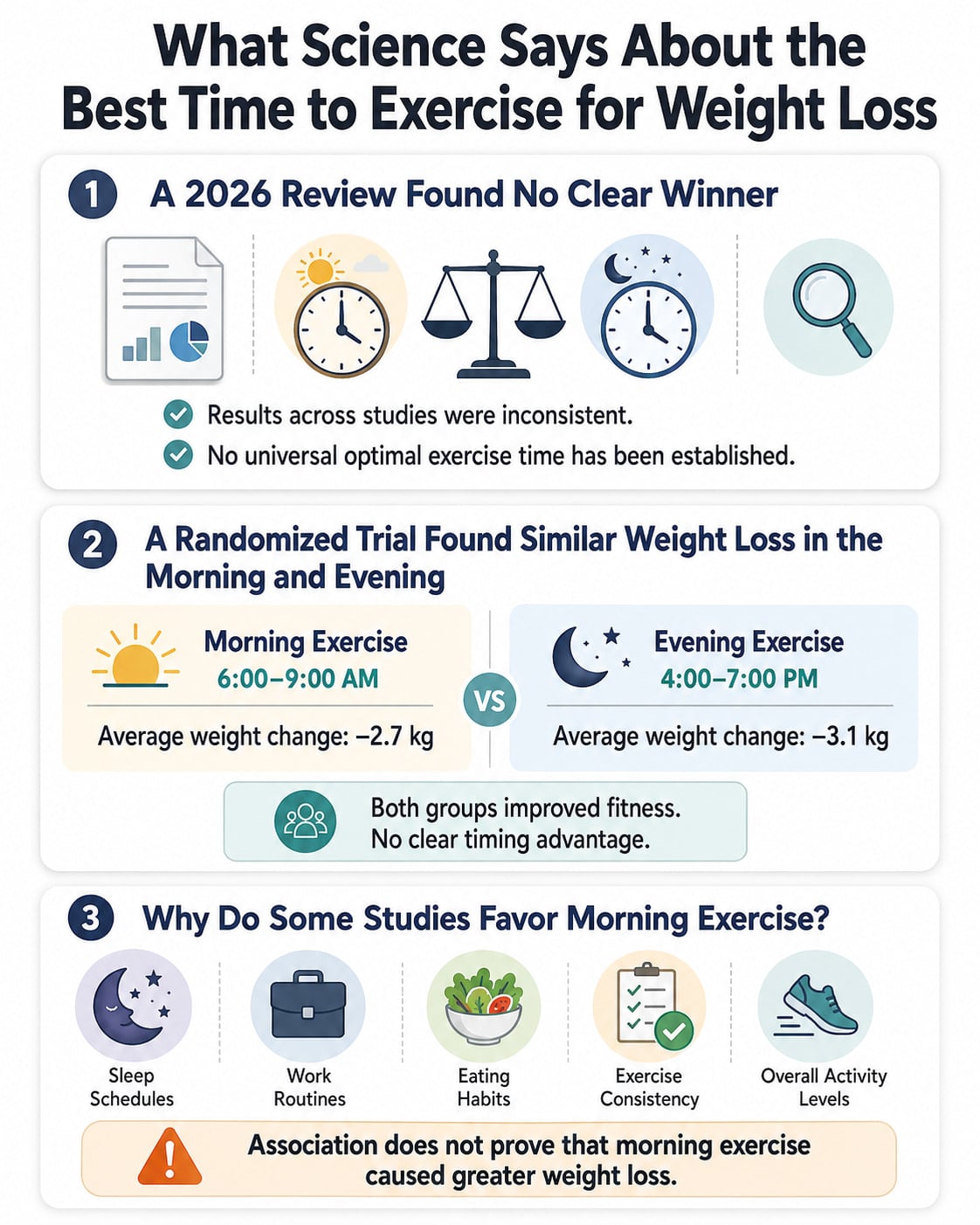
Scientists have investigated whether exercising earlier or later in the day changes body weight, appetite, calorie intake, and body composition.
The answer is not as simple as “morning is better.”
A 2026 Review Found No Clear Winner
A systematic scoping review published in Current Nutrition Reports in January 2026 examined research on exercise timing, eating behavior, body weight, and body composition.
The researchers found some individual studies showing time-of-day effects, but results across both short-term and longer-term studies were inconsistent.
The authors concluded that more controlled studies with longer training periods are needed before researchers can identify an optimal exercise time for weight management.
A Randomized Trial Found Similar Weight Loss in the Morning and Evening
One of the most useful studies directly comparing exercise times was a 12-week randomized controlled trial involving 100 inactive adults with overweight or obesity.
Participants were assigned to:
- Morning exercise between 6:00 and 9:00 AM
- Evening exercise between 4:00 and 7:00 PM
- A control group
The morning and evening groups were prescribed 250 minutes of self-paced aerobic exercise per week.
After 12 weeks:
- Morning exercisers lost an average of 2.7 kg
- Evening exercisers lost an average of 3.1 kg
Both exercise groups also improved cardiorespiratory fitness. Researchers concluded that there did not appear to be an optimal time of day for weight loss.
Why Do Some Studies Favor Morning Exercise?
Some observational and secondary analyses have found lower body weight or greater weight loss among people who exercise earlier in the day.
Those findings are interesting, but they do not necessarily prove that the morning workout itself caused the difference.
People who regularly exercise in the morning may also differ in:
- Sleep schedules
- Work routines
- Eating habits
- Exercise consistency
- Overall activity levels
- Lifestyle behaviors
That is why randomized trials are particularly important when deciding whether workout timing itself causes greater weight loss.
For now, the evidence supports viewing morning exercise as a useful option rather than a proven fat-loss advantage.
Benefits of Morning Exercise for Weight Loss
Morning workouts can still be an excellent choice even if they do not automatically burn more body fat.
It May Be Easier to Protect the Time
Exercising early can reduce the chance that work, errands, social plans, or unexpected responsibilities will replace your workout.
If morning exercise helps you complete more workouts over the course of a month, that consistency can be valuable.
It Can Create a Predictable Routine
Linking exercise to waking up, drinking water, or another regular morning habit can make workouts easier to remember.
A predictable routine may be especially useful if you frequently postpone exercise later in the day.
It Gets Activity Done Early
Some people simply feel better knowing their planned workout is finished before the rest of the day begins.
However, these are behavioral advantages. They should not be confused with evidence that morning exercise automatically causes greater fat loss.
Can Afternoon or Evening Exercise Be Just as Effective?
Yes. Afternoon and evening exercise can be just as effective for weight loss.
The randomized morning-versus-evening study described above found meaningful weight loss in both groups without a clear advantage for either exercise time.
Exercising later may actually be easier to maintain if:
- You dislike waking up early.
- You have more free time after work.
- You feel stronger later in the day.
- Morning workouts leave you rushed.
- You prefer exercising with a partner who is available later.
There is little benefit in choosing a theoretically “perfect” morning workout time if it causes you to skip half your sessions.
What About Exercising Late at Night?
A late workout is not automatically bad for weight loss.
If evening exercise fits your schedule and does not interfere with sleep, it can be a reasonable choice. If intense late-night training leaves you unusually alert and makes it difficult to sleep, try finishing earlier or choosing a lower-intensity activity.
Good sleep also supports overall health and weight-management behaviors, so workout timing should fit your sleep schedule rather than consistently disrupting it.
Does Exercising Before Breakfast Burn More Fat?
Fasted morning exercise is often promoted as a way to accelerate fat loss, but this claim needs context.
Your body may use a greater proportion of fat as fuel during some fasted workouts. However, burning more fat during one exercise session does not necessarily mean losing more body fat over several weeks or months.
In a small randomized study, young women followed a calorie-restricted diet and performed one hour of aerobic exercise three times per week for four weeks. One group exercised after an overnight fast, while the other exercised after eating.
Both groups lost weight and fat, but there was no significant difference between the fasted and fed groups.
Fasted exercise is therefore optional, not a requirement for weight loss.
If you feel weak, dizzy, unusually fatigued, or unable to train effectively without food, exercising after eating may be the better choice.
Why Consistency Matters More Than the Clock
Weight loss happens over time, not during a single workout.
A workout schedule becomes useful when you can repeat it week after week.
For example, imagine two people:
Person A plans to exercise at 6 AM because they believe morning workouts are superior, but regularly sleeps through the alarm and completes only one or two sessions per week.
Person B exercises after work at 6 PM and reliably completes four sessions each week.
Even if morning exercise had a small physiological advantage under certain conditions, Person B may accumulate much more exercise over time.
When choosing your workout time, ask:
- When am I least likely to cancel?
- When do I normally have enough energy?
- When can I exercise without rushing?
- Which time works with my sleep and meal schedule?
- Can I realistically maintain this schedule for months?
The answers are more useful than simply choosing the earliest possible workout.
How Much Exercise Do You Need for Weight Loss?
Exercise timing receives a lot of attention, but how much activity you perform is more important.
The CDC states that adults should get at least:
- 150 minutes per week of moderate-intensity aerobic activity, or
- 75 minutes per week of vigorous-intensity aerobic activity, or an equivalent combination
- Muscle-strengthening activity on at least 2 days per week
The CDC also notes that some people may need more activity for weight management.
Exercise Works Best as Part of a Complete Weight-Loss Strategy
Physical activity increases the amount of energy your body uses. When calorie expenditure exceeds calorie intake over time, the resulting energy deficit can contribute to weight loss.
The CDC emphasizes that most weight loss generally comes from reducing calorie intake, while regular physical activity is particularly important for maintaining lost weight.
Current 2026 cardiovascular-kidney-metabolic guidance also recommends lifestyle approaches that combine regular physical activity with appropriate dietary changes rather than relying on exercise alone.
What Type of Exercise Is Best for Weight Loss?
You do not need one special workout.
A practical program usually combines aerobic exercise, strength training, and everyday movement.
Aerobic Exercise
Examples include:
- Brisk walking
- Jogging
- Cycling
- Swimming
- Treadmill workouts
- Elliptical training
- Hiking
Aerobic activity can increase weekly calorie expenditure and improve cardiovascular fitness.
Strength Training
Strength training may include:
- Squats
- Rows
- Push-ups
- Lunges
- Resistance-band exercises
- Dumbbell exercises
- Machine-based resistance training
Strength training is particularly useful for maintaining or improving muscular strength and lean tissue while pursuing weight-management goals.
Everyday Physical Activity
Do not overlook movement outside formal workouts.
Walking more, taking stairs, doing household tasks, and taking movement breaks can all increase total daily activity.
How to Choose Your Best Workout Time
There is no need to overcomplicate the decision.
Use this guide:
| If this describes you | A practical workout time |
|---|---|
| Your evenings become unpredictable | Morning |
| You struggle to wake up early | Afternoon or evening |
| You have a reliable lunch break | Midday |
| You feel strongest after work | Afternoon or evening |
| Family responsibilities take over at night | Morning |
| Your schedule changes daily | Use flexible workout windows |
| You can reliably exercise at only one specific time | Use that time |
Try the Same Time for Two Weeks
Choose a realistic exercise window and test it for approximately two weeks.
Track:
- Workouts completed
- Energy during exercise
- Sleep quality
- Hunger
- Workout performance
- How rushed or stressed you feel
If you regularly complete your workouts and recover well, you probably have a suitable exercise time.
If you keep missing sessions, change the schedule rather than assuming you lack motivation.
A Simple Weekly Exercise Schedule for Weight Loss
The exact workout can be adjusted to your fitness level.
| Day | Example activity |
|---|---|
| Monday | 30-minute brisk walk |
| Tuesday | Full-body strength training |
| Wednesday | 30–45 minutes of moderate cardio |
| Thursday | Rest or light walking |
| Friday | Full-body strength training |
| Saturday | 30–60 minutes of walking, cycling, swimming, or another enjoyable activity |
| Sunday | Rest or easy movement |
You could complete these workouts in the morning, afternoon, or evening.
The important part is choosing times that allow you to perform them consistently.
If you are currently inactive, start with shorter sessions and gradually increase your activity rather than immediately attempting a high-volume program.
Common Workout-Timing Mistakes to Avoid
Believing Morning Exercise Automatically Burns More Body Fat
Morning workouts can be convenient, but current evidence does not establish them as universally superior for long-term fat loss.
Forcing Yourself to Exercise at a Time You Hate
A workout time that looks ideal on paper is not useful if you repeatedly skip it.
Assuming Fasted Exercise Is Necessary
Exercising before breakfast is optional. Research has not established that it produces greater long-term fat loss than comparable fed exercise.
Focusing on Timing but Ignoring Weekly Activity
Whether you exercise at 7 AM or 7 PM matters less than whether you exercise regularly.
Trying to Out-Exercise Your Eating Habits
Exercise supports weight management, but food intake still plays a major role in energy balance.
Sacrificing Sleep to Exercise
Regularly cutting sleep short just to complete an early workout may make the routine difficult to sustain. Choose a schedule that allows sufficient rest.
When to Get Professional Guidance
Most healthy adults can gradually begin moderate activities such as walking.
However, consider speaking with a qualified health professional before making major changes to your exercise or weight-loss program if you have a medical condition, significant physical limitations, unexplained symptoms during activity, or concerns about how exercise may interact with medications.
Stop exercising and seek appropriate medical attention for concerning symptoms such as chest pain, fainting, or severe unexplained shortness of breath.
Frequently Asked Questions
Is it better to exercise in the morning or evening to lose weight?
Neither time has been proven universally better. Randomized research found modest weight loss with both morning and evening aerobic exercise without evidence of an optimal time. Choose whichever time helps you exercise consistently.
Is 30 minutes of exercise a day enough to lose weight?
Thirty minutes of regular activity can make a meaningful contribution to your weekly exercise total. However, whether it produces weight loss depends on total activity, food intake, body size, health, and other individual factors. Some people need more activity and dietary changes to achieve their goals.
Does working out on an empty stomach burn more fat?
Fasted exercise can change fuel use during a workout, but it has not been shown to reliably produce greater long-term body-fat loss. Exercising before eating is optional.
Should I exercise before or after eating for weight loss?
Either can work. If you feel comfortable exercising before eating, that may suit you. If eating beforehand improves your energy and workout quality, exercising after a meal or snack can also support weight loss.
Does morning exercise boost metabolism all day?
Exercise increases energy expenditure, but current evidence does not show that morning workouts create a special all-day metabolic effect that makes them clearly superior for weight loss.
Is evening exercise bad for weight loss?
No. Evening exercise can support weight loss just as morning exercise can. If it fits your schedule and does not interfere with sleep, there is no need to avoid it simply because it occurs later in the day.
Conclusion
The best time to exercise for weight loss is the time you can consistently maintain.
Research does not currently support a universal rule that morning exercise produces more weight loss than afternoon or evening exercise. Morning workouts may make consistency easier for some people, while others perform better and exercise more regularly later in the day.
Instead of chasing a perfect workout hour, focus on the factors that matter most: regular physical activity, an appropriate overall calorie balance, strength training, adequate sleep, and a routine you can maintain.
Choose a realistic workout time, follow it consistently, and adjust it if your schedule or recovery tells you something else works better.
References
- CDC — Physical Activity and Your Weight and Health, updated April, 2026
- Hsieh et al. — Exercise Timing and its Effects on Eating Behavior, Weight, and Body Composition, 2026
- Brooker et al. — The Efficacy of Morning Versus Evening Exercise for Weight Loss
- 2026 AHA/ACC/ADA/ASN Guideline for Cardiovascular-Kidney-Metabolic Syndrome
- Schoenfeld et al. — Fasted Versus Fed Aerobic Exercise and Body Composition