
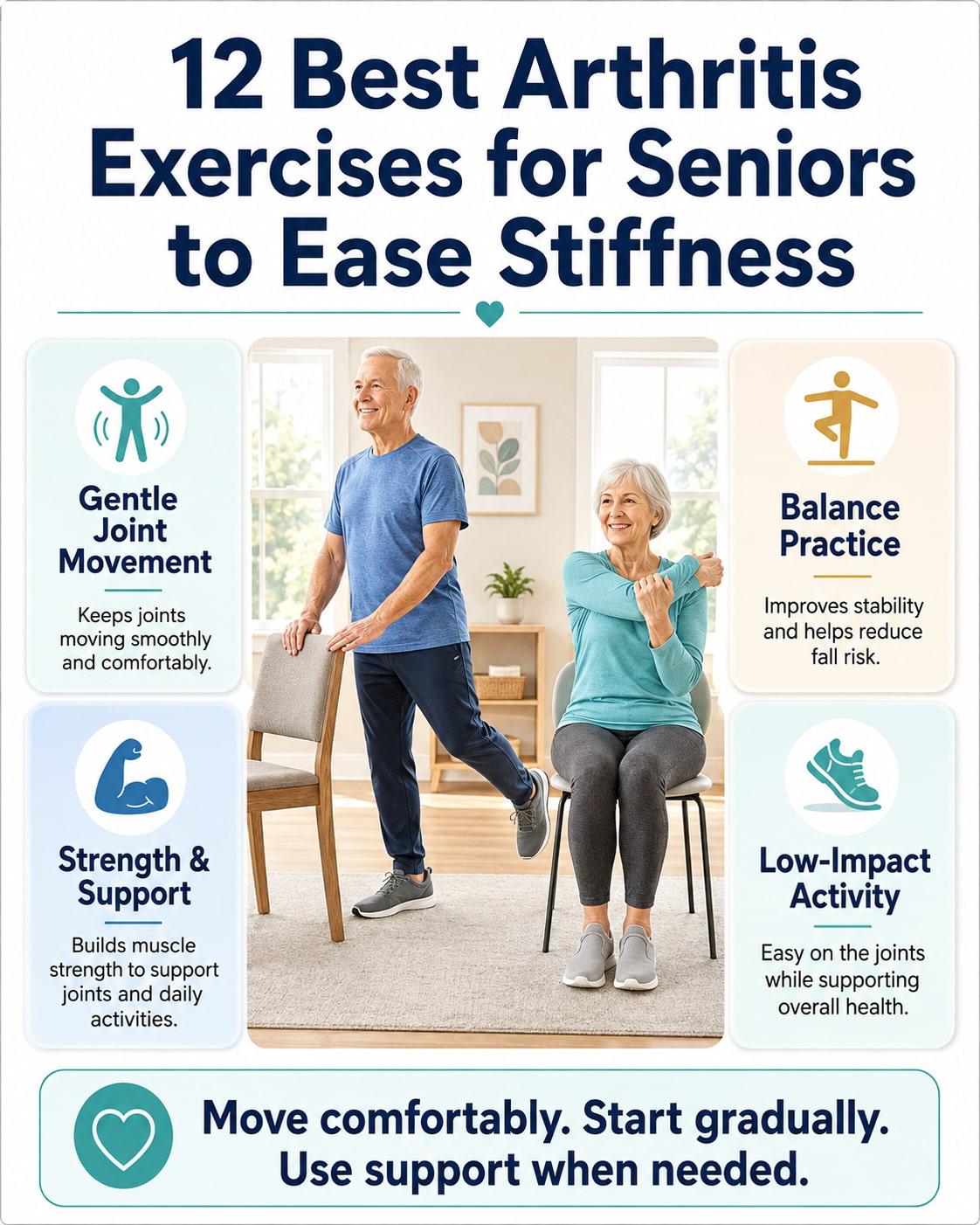
Arthritis can make the first movements of the morning, standing from a chair, walking, gripping objects, or reaching overhead feel uncomfortable. Although resting an irritated joint can sometimes be appropriate, avoiding movement altogether may allow stiffness, weakness, and reduced confidence to build over time.
Gentle arthritis exercises for seniors can help maintain joint movement, strengthen the muscles that support the joints, and make everyday activities easier. The Centers for Disease Control and Prevention explains that physical activity can help reduce arthritis-related joint pain while improving function and mood.
The goal is not to force a painful joint through exercise. Each movement should be adjusted to the person’s arthritis diagnosis, affected joints, balance, current fitness, and instructions from their healthcare professional.
Important: These exercises are general options, not a personalized treatment plan. Seniors with severe symptoms, a recent joint replacement, major balance problems, or uncertain exercise restrictions should speak with a doctor or physical therapist before starting.
What Are Arthritis Exercises for Seniors?
Arthritis exercises are movements selected to improve or maintain physical function without placing unnecessary stress on sensitive joints. A balanced program usually includes four types of activity:
- Range-of-motion exercise to move joints through a comfortable range
- Strengthening exercise to support the joints and daily activities
- Balance exercise to improve stability and reduce fall risk
- Aerobic activity to improve endurance and general health
The American College of Rheumatology recommends a combination of flexibility, strengthening, aerobic, and balance-related activity for people with arthritis. Exercise selection should still be individualized because osteoarthritis, rheumatoid arthritis, gout, psoriatic arthritis, and other joint conditions may require different precautions.
Osteoarthritis is especially common among older adults and frequently affects the hands, knees, hips, feet, neck, and lower back. The National Institute on Aging notes that a safe, well-rounded exercise program may reduce osteoarthritis-related pain and stiffness while improving flexibility, strength, and endurance.
Safety Tips Before Starting
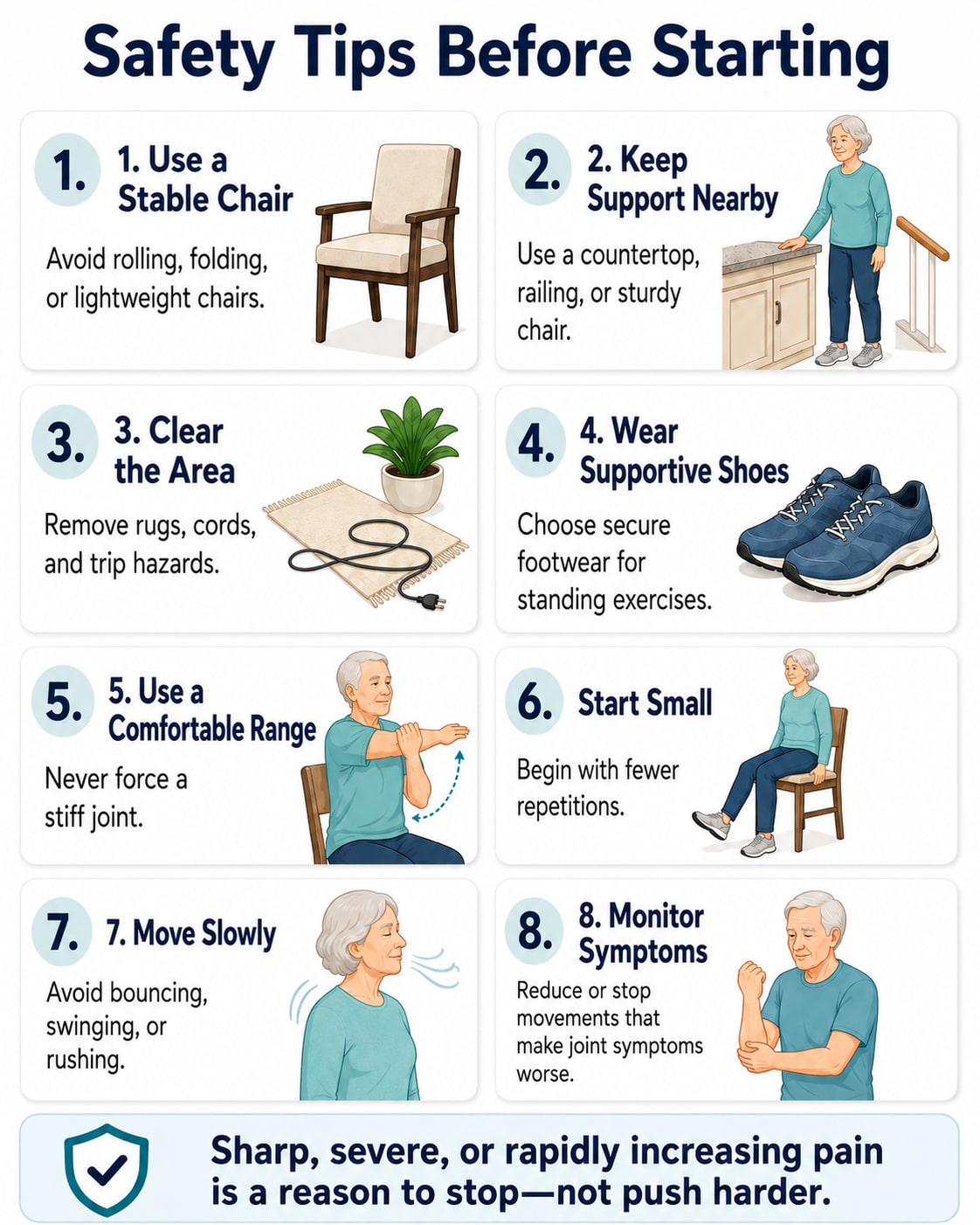
Use these precautions to make the exercises safer and more comfortable:
- Choose a stable chair. It should not roll, fold, rock, or slide. Place it against a wall when performing sit-to-stands.
- Keep support nearby. Use a sturdy countertop, railing, or heavy chair for standing exercises.
- Clear the exercise area. Remove rugs, cords, pets, and other objects that could cause a trip.
- Wear supportive footwear. Closed, well-fitting shoes are usually safer than exercising in loose slippers or socks during standing movements.
- Use a comfortable range. Do not force a stiff joint farther than it can comfortably move.
- Begin with a small amount. One set of 5–10 repetitions may be enough when starting.
- Move slowly. Controlled movement is usually more joint-friendly than bouncing, swinging, or rushing.
- Breathe normally. Exhale during the more difficult part of a strengthening exercise and avoid holding your breath.
- Follow prescribed support instructions. Continue using a cane, walker, brace, or other device if a healthcare professional has recommended it.
- Monitor the joint’s response. Reduce the range, repetitions, or duration if an exercise produces steadily increasing joint pain or leaves symptoms noticeably worse.
Mild muscular effort may occur during strengthening exercises. Sharp pain, sudden pain, severe joint discomfort, or rapidly increasing symptoms are signals to stop rather than push harder.
How to Warm Up for Arthritis Exercises
Warm up with approximately 5–10 minutes of easy movement. The American Academy of Orthopaedic Surgeons recommends warming up before arthritis exercise and suggests performing range-of-motion work regularly while allowing recovery between strengthening sessions.
A simple warm-up can include:
- One or two minutes of seated marching
- Gentle ankle pumps
- Slow hand opening and closing
- Small shoulder rolls
- Easy walking around the room
Start with a small range and gradually make the movement slightly larger if the joints begin to feel more comfortable. Avoid forceful stretching or bouncing, especially before the body is warm.
Arthritis Exercises for Seniors
1. Seated Marching
Why it works:
Seated marching gently moves the hips and knees while the chair provides support. It can be used as a warm-up or as an alternative when prolonged standing is uncomfortable.
Muscles worked:
Hip flexors, quadriceps, abdominal muscles, and other posture-supporting muscles.
How to do it:
- Sit near the front of a stable chair with both feet flat on the floor.
- Keep your chest comfortably lifted and hold the chair if needed.
- Lift one knee a few inches without leaning far backward.
- Lower the foot gently and repeat with the other leg.
- Continue alternating for 10–20 total repetitions.
Trainer Tip:
The knee does not need to rise high. Use a smaller lift or alternate heel lifts when hip movement is uncomfortable.
2. Ankle Pumps
Why it works:
Ankle pumps move the ankle without requiring body weight to be placed through it. They are suitable for warm-ups, seated exercise sessions, and periods when standing activity is limited.
Muscles worked:
Calves and the muscles along the front of the lower leg.
How to do it:
- Sit upright with one heel resting lightly on the floor.
- Pull the toes toward the shin as far as comfortably possible.
- Point the toes gently away from the body.
- Continue moving slowly between the two positions.
- Perform 10–20 repetitions before changing sides.
Trainer Tip:
Keep the movement controlled and avoid aggressively pointing the toes. A small, comfortable range is enough.
3. Seated Knee Extensions
Why it works:
This exercise moves the knee while strengthening the quadriceps, which contribute to standing, walking, and controlling the body when sitting down.
Muscles worked:
Quadriceps at the front of the thigh.
How to do it:
- Sit in a stable chair with both feet on the floor.
- Slowly straighten one knee.
- Stop when the leg is as straight as comfortably possible without forcing the joint.
- Pause briefly, then lower the foot under control.
- Complete 6–12 repetitions on each side.
Trainer Tip:
Shorten the range if the knee becomes uncomfortable. Begin without ankle weights; added resistance should only be used when the movement is already comfortable and well controlled.
4. Sit-to-Stand
Why it works:
The sit-to-stand strengthens the movement used to rise from chairs, toilets, beds, and car seats. It can also improve lower-body control and confidence.
Muscles worked:
Quadriceps, glutes, hamstrings, calves, and core muscles.
How to do it:
- Place a stable chair against a wall.
- Sit with your feet approximately hip-width apart and underneath or slightly behind the knees.
- Lean your torso forward slightly while keeping your back comfortably neutral.
- Press through both feet and stand.
- Pause, then push your hips back and lower yourself slowly.
- Perform 5–10 repetitions.
Trainer Tip:
Use the armrests when needed. A higher chair makes the movement easier, while a low, soft chair usually makes it more difficult.
5. Standing Hip Abduction
Why it works:
This exercise strengthens the muscles on the outside of the hip, which help stabilize the pelvis during standing and walking.
Muscles worked:
Gluteus medius, gluteus minimus, and other hip abductors.
How to do it:
- Stand beside a stable chair or countertop and hold it for support.
- Keep both feet facing forward and stand tall.
- Move one leg slowly out to the side.
- Keep your torso upright instead of leaning away.
- Return the foot beside the other foot.
- Perform 8–12 repetitions before changing sides.
Trainer Tip:
A few inches of movement may be enough. Avoid swinging the leg or turning the toes outward to create a larger range.
6. Supported Heel Raises
Why it works:
Heel raises strengthen the lower legs and move the ankles through a functional range used during walking and climbing steps.
Muscles worked:
Gastrocnemius, soleus, and smaller foot and ankle stabilizers.
How to do it:
- Stand behind a chair or face a countertop.
- Hold the support with both hands.
- Keep your knees relaxed and your body upright.
- Raise both heels slowly until you are standing on the balls of your feet.
- Pause briefly and lower your heels under control.
- Perform 8–15 repetitions.
Trainer Tip:
Use a small lift if the ankles or toes are sensitive. A seated heel raise is a lower-load alternative when standing is uncomfortable.
7. Supported Side-to-Side Weight Shifts
Why it works:
Weight shifts practice the controlled transfer of body weight needed for walking, turning, and stepping around objects. Both feet remain on the floor, making the exercise more accessible than single-leg balance drills.
Muscles worked:
Hip stabilizers, calves, thighs, and core muscles.
How to do it:
- Stand behind a stable chair or in front of a countertop.
- Place your feet approximately hip-width apart.
- Shift your weight slowly toward the right foot without lifting either foot.
- Return to the center.
- Shift your weight toward the left foot.
- Continue for 10–20 controlled shifts.
Trainer Tip:
Keep both hands on the support until the movement feels steady. Progress by using lighter hand pressure—not by closing your eyes or standing on an unstable surface.
8. Hand Open-and-Close
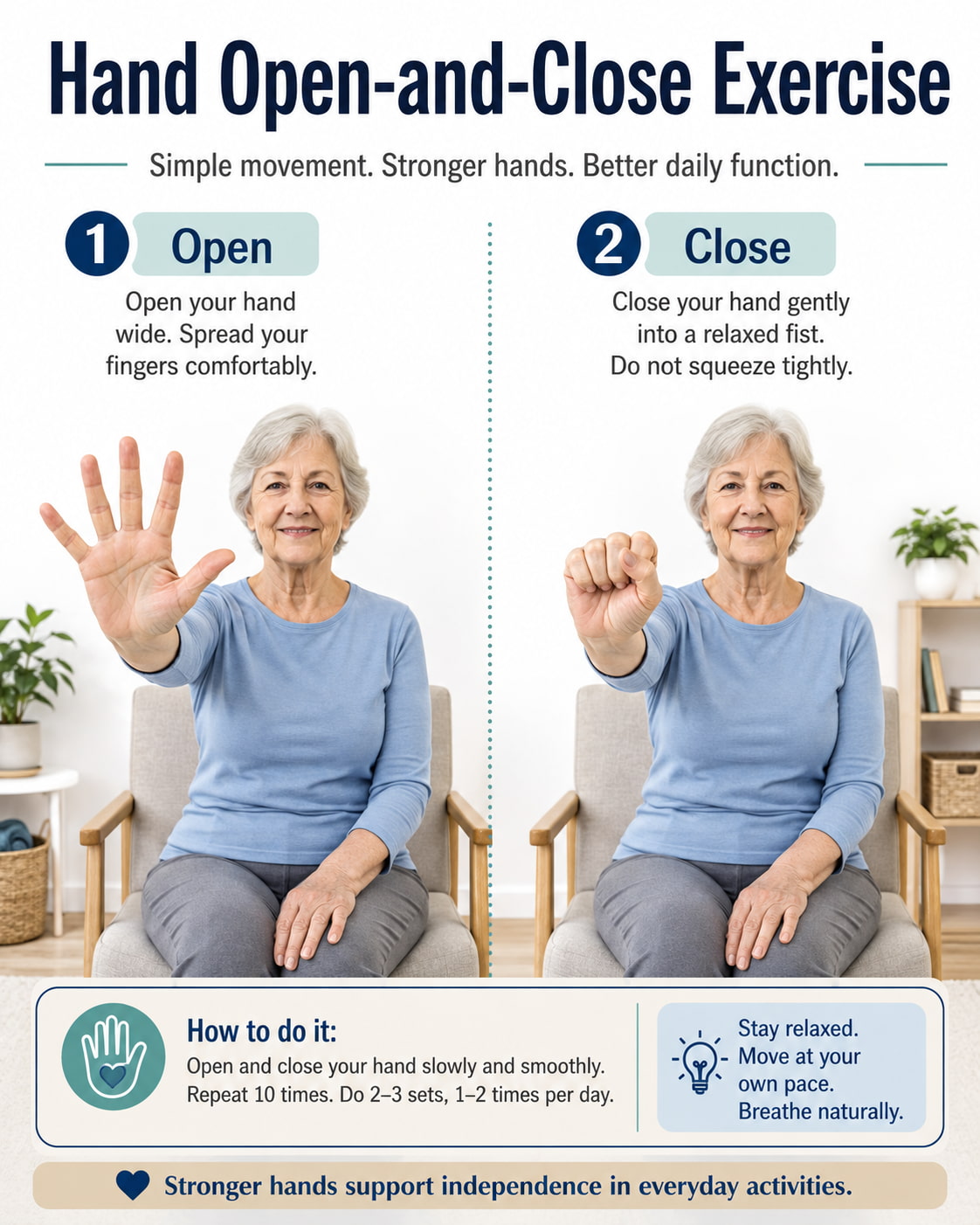
Why it works:
Gently opening and closing the hands moves the finger joints through a practical range used for holding utensils, dressing, writing, and carrying light objects.
Muscles worked:
Finger flexors, finger extensors, and small muscles within the hands.
How to do it:
- Rest your forearms on a table or your thighs.
- Begin with the fingers comfortably straight.
- Spread the fingers gently.
- Bring them together and form a loose fist.
- Open the hand again without snapping the fingers straight.
- Perform 5–10 repetitions with each hand.
Trainer Tip:
Do not squeeze the fist tightly. Stop before any finger reaches a painful or forced position, particularly when the joints are swollen.
9. Wrist Circles
Why it works:
Small wrist circles provide gentle movement in several directions and may help maintain the wrist mobility needed for gripping and reaching.
Muscles worked:
Forearm flexors, forearm extensors, and smaller wrist-stabilizing muscles.
How to do it:
- Rest your forearm on a table with the hand extending slightly beyond the edge.
- Keep the fingers relaxed.
- Draw a small circle with the hand.
- Complete five slow circles in one direction.
- Reverse direction for five circles.
- Repeat with the other wrist.
Trainer Tip:
Keep the circles small. When a circular motion pinches or catches, use gentle up-and-down wrist movement instead.
10. Shoulder Rolls
Why it works:
Shoulder rolls provide low-load movement around the shoulders and shoulder blades. They can be helpful after sitting in one position for an extended period.
Muscles worked:
Trapezius, rhomboids, and other muscles that move and stabilize the shoulder blades.
How to do it:
- Sit or stand with your head comfortably over your shoulders.
- Lift both shoulders gently toward the ears.
- Move them slightly backward.
- Lower them away from the ears.
- Complete 5–10 slow circles.
- Reverse direction only if it remains comfortable.
Trainer Tip:
Use small, smooth circles rather than forceful rotations. Keep the neck relaxed and stop if the movement causes pinching or radiating discomfort.
11. Wall Push-Ups
Why it works:
Wall push-ups strengthen the upper body while requiring considerably less body-weight support than floor push-ups. They may help with pushing doors, rising with arm support, and other daily tasks.
Muscles worked:
Chest, triceps, front shoulders, and core muscles.
How to do it:
- Face a wall and place your palms at approximately chest or shoulder height.
- Step back until your arms are straight without locking the elbows.
- Keep your body in a straight, comfortable line.
- Bend your elbows and move your chest toward the wall.
- Press through your hands to return to the starting position.
- Perform 6–12 repetitions.
Trainer Tip:
Standing closer to the wall makes the exercise easier. When pressure through the palms or wrists is uncomfortable, skip the movement or use a therapist-approved neutral-wrist modification. A gentle forearm-supported wall lean may be used as a lower-load alternative, although it is not an exact replacement for a push-up.
12. Easy-Pace Walking
Why it works:
Walking moves the hips, knees, and ankles through repeated ranges while building endurance for shopping, household activities, and community mobility.
Muscles worked:
Glutes, quadriceps, hamstrings, calves, foot muscles, and core muscles. Walking also challenges the heart and lungs.
How to do it:
- Choose a flat, clear, well-lit route.
- Wear supportive shoes and use a prescribed walking aid if needed.
- Begin with an easy pace that allows comfortable conversation.
- Walk for approximately 5–10 minutes, or use several 2–5-minute sessions.
- Increase the time gradually when symptoms remain manageable.
Trainer Tip:
Walking should not become a test of pain tolerance. Water walking, a stationary bicycle, or seated aerobic movement may be more comfortable when regular walking repeatedly aggravates the hips, knees, ankles, or feet.
How Often Should Seniors Do Arthritis Exercises?
Exercise frequency depends on the type of movement and the person’s symptoms.
- Range-of-motion exercises: Gentle ankle, wrist, finger, and shoulder movements can often be practiced most days when they remain comfortable.
- Strengthening exercises: Sit-to-stands, knee extensions, hip abduction, heel raises, and wall push-ups can begin on two nonconsecutive days per week. Start with one set and add repetitions or another set gradually.
- Balance exercises: Supported weight shifts can be practiced several days per week. Keep a stable support within reach.
- Aerobic activity: Walking or another joint-friendly aerobic activity can begin in short sessions. The Centers for Disease Control and Prevention recommends that older adults work toward at least 150 minutes of moderate-intensity aerobic activity per week, muscle strengthening on at least two days, and balance activity. Seniors who cannot meet the full target should remain as active as their health and abilities allow because some activity is better than none.
There is no need to complete all 12 exercises in one session. A practical beginner session might include a short warm-up, four to six exercises, and a brief walk.
How to Adjust Exercise During an Arthritis Flare
Arthritis symptoms can change from day to day. Mild stiffness may improve after a few minutes of comfortable movement, but a significant flare may require a temporary adjustment.
On a more sensitive day:
- Reduce the range of motion.
- Perform fewer repetitions.
- Remove added resistance.
- Replace standing exercises with seated options.
- Divide walking into shorter sessions.
- Focus on gentle mobility rather than challenging strength work.
- Avoid heavily loading a joint that is substantially swollen or painful.
People with inflammatory arthritis should follow their rheumatologist’s advice for exercising during flares. Gentle movement may sometimes remain appropriate, but persistent or severe symptoms should not simply be exercised through.
The NHS advises that a suddenly painful joint that is hot, red, or substantially swollen—especially with fever, chills, or feeling unwell—needs urgent medical evaluation rather than an exercise modification. These symptoms can have causes other than a routine arthritis flare.
Common Mistakes to Avoid
Forcing the Range of Motion
A joint does not need to reach its maximum possible range for an exercise to be useful. Use the range available without forcing or bouncing.
Progressing Too Quickly
Adding repetitions, exercise time, and resistance at the same time can make it difficult to identify what aggravated the joint. Increase one factor gradually.
Using Momentum
Swinging the limbs may move the joint farther than intended and reduce muscular control. Slow the movement down.
Exercising With an Unstable Chair
Rolling office chairs, folding chairs, and lightweight stools are poor support choices. Use a solid chair on a nonslip surface.
Holding the Breath
Breath-holding can occur during sit-to-stands and wall push-ups. Exhale as you stand or press away from the wall.
Doing Every Exercise Regardless of Symptoms
Someone with painful hand arthritis may need to skip wall push-ups, while a person with knee pain may need a smaller sit-to-stand range. The list should be adjusted to the affected joints.
Treating Pain as Proof That Exercise Is Working
More joint pain does not necessarily produce better results. The goal is controlled activity that can be repeated consistently.
Comparing Progress With Someone Else
Arthritis type, joint damage, medication, balance, fitness, and medical history all influence exercise tolerance. Progress should be measured against the person’s own starting point.
Benefits of Arthritis Exercises for Seniors
Regular, appropriately modified movement may help seniors:
- Maintain comfortable joint movement
- Reduce stiffness after sleeping or sitting
- Strengthen muscles that support affected joints
- Improve walking and stair-climbing ability
- Make getting into and out of a chair easier
- Maintain hand and wrist movement for daily tasks
- Improve balance and physical confidence
- Build endurance for everyday activities
- Support mood, sleep, and general health
The benefits are real, but they are not identical for everyone. A 2024 Cochrane review found that exercise probably improves pain and physical function in people with knee osteoarthritis over the short term. However, the average improvement may not be large enough to feel meaningful to every individual. Exercise should therefore be treated as a gradual, adjustable part of arthritis management rather than a guaranteed cure.
Exercise does not reverse existing joint damage or cure inflammatory arthritis. Its main role is to help people move, maintain strength, and function as comfortably as possible.
Who Can Benefit From These Exercises?
These exercises may be useful for:
- Seniors with mild or moderate arthritis symptoms
- People who feel stiff after waking or sitting
- Beginners returning to activity after inactivity
- Older adults who need chair-supported options
- People following a doctor- or therapist-approved exercise plan
- Seniors who want to maintain strength for everyday activities
A personalized program may be more appropriate for someone with:
- Severe or rapidly worsening joint pain
- Significant swelling, warmth, or redness
- Frequent inflammatory arthritis flares
- A recent fall, fracture, injection, or joint surgery
- A joint that locks, buckles, or repeatedly gives way
- Numbness, unexplained weakness, or loss of coordination
- A medical condition that limits safe physical activity
When to Stop and Seek Professional Guidance
Stop the exercise and speak with a healthcare professional if it causes:
- Sharp or severe joint pain
- Rapidly increasing pain
- New or substantial swelling
- A joint that repeatedly locks or gives way
- New numbness, tingling, or weakness
- Symptoms that continue to worsen after the activity
- New difficulty bearing weight or using the joint
Seek urgent medical care for:
- A suddenly hot, red, swollen, and painful joint
- Joint symptoms accompanied by fever or feeling seriously unwell
- A visibly deformed joint following a fall or injury
- New inability to bear weight after an injury
- Chest pain or pressure
- Fainting or severe dizziness
- Severe or unusual shortness of breath
MedlinePlus advises medical evaluation for severe joint pain, inability to bear weight, major swelling, warmth, redness, or a joint that buckles or locks.
Frequently Asked Questions
What is the best exercise for seniors with arthritis?
There is no single best exercise for every senior. The most useful program usually combines comfortable joint movement, strengthening, balance work, and an aerobic activity the person can perform consistently.
Someone with knee arthritis may benefit from seated knee extensions and sit-to-stands, while someone with hand arthritis may focus more on gentle finger and wrist movements.
Is walking good for seniors with arthritis?
Walking can be a practical, low-impact activity for many people with arthritis. Start on a flat surface, use a comfortable pace, and divide the walk into short sessions when necessary.
Walking is not automatically the right option for every affected joint. Water walking, cycling, or seated aerobic movement may be more comfortable when walking repeatedly worsens lower-body symptoms.
Are chair exercises effective for arthritis?
Chair exercises can help maintain movement and provide an accessible starting point for people who are not ready for prolonged standing. Seated marching, knee extensions, ankle pumps, and hand exercises can all be performed from a stable chair.
When appropriate, standing and walking exercises can gradually be added because daily life also requires balance and weight-bearing strength.
How often should seniors do arthritis exercises?
Gentle mobility work may be performed regularly when comfortable. Strengthening exercises commonly begin two days per week with recovery between sessions, while aerobic activity can be divided into short sessions throughout the week.
Frequency should be reduced temporarily when symptoms are more noticeable.
Should seniors exercise during an arthritis flare?
Mild stiffness may respond well to short, gentle range-of-motion exercises. During a more significant flare, reduce the range, repetitions, resistance, or duration and avoid heavily loading a swollen joint.
Contact a healthcare professional when the flare is unusually severe, persistent, or different from the person’s usual symptoms.
How much discomfort is normal during exercise?
Mild muscular effort, warmth, or a gentle stretching sensation may occur. Sharp joint pain, severe pain, catching, sudden instability, or pain that steadily increases during the movement is not a signal to continue.
Stop, adjust the exercise, and seek professional guidance if the problem persists.
Is water exercise better than land exercise for arthritis?
Water supports part of the body’s weight, which can make walking and strengthening movements more comfortable for some people with painful weight-bearing joints. The Arthritis Foundation notes that water exercise can provide aerobic and strengthening benefits while reducing stress on sensitive joints.
However, water exercise is not automatically superior. Accessibility, safe pool entry, supervision, water temperature, balance, and personal preference should all be considered.
Conclusion
Arthritis exercises for seniors should be gentle, controlled, and easy to adjust. Seated mobility exercises can help the joints begin moving, strengthening exercises can support everyday activities, balance work can improve stability, and short walks can build endurance.
Start with a few suitable exercises, use a comfortable range, and progress gradually. Exercise should help support movement and independence—not require someone to ignore severe pain or worsening joint symptoms.
References
- Centers for Disease Control and Prevention — About Physical Activity and Arthritis
- American College of Rheumatology — Exercise and Arthritis
- National Institute on Aging — Osteoarthritis
- American Academy of Orthopaedic Surgeons — Managing Arthritis Pain With Exercise
- Cochrane — Is Exercise an Effective Therapy to Treat Knee Osteoarthritis?
- Centers for Disease Control and Prevention — Older Adult Activity: An Overview
- MedlinePlus — Knee Pain
- NHS — Septic Arthritis
- Arthritis Foundation — Best Exercises for Rheumatoid Arthritis