
The best barbell exercises for seniors are simple, joint-friendly lifts that train the whole body with safe form and gradual progression. If you’re over 60, the goal is not “lifting heavy at all costs”—it’s building strength, balance, and confidence while protecting your back, hips, knees, and shoulders.
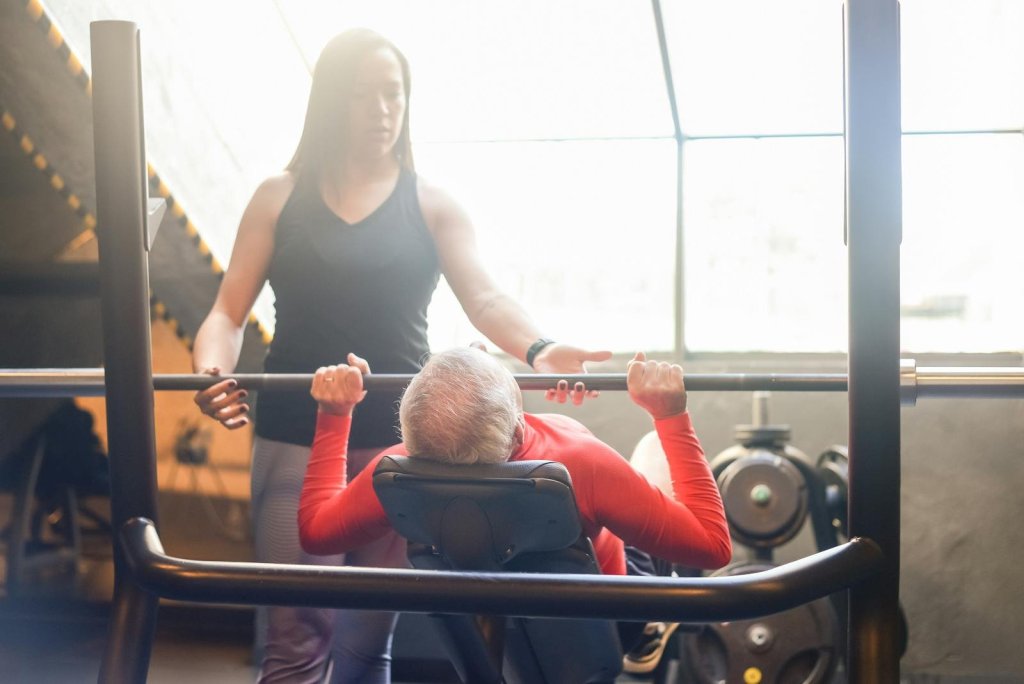
Most major health organizations recommend doing muscle-strengthening activity at least twice per week, and older adults also benefit from balance-focused work as part of their routine. For the official guideline overview, see the Centers for Disease Control and Prevention.
Why barbell exercises for seniors are worth doing
Barbells can look intimidating, but they’re one of the easiest tools to standardize your training: same setup, consistent technique, and clear progress over time. Done correctly, barbell training can support:
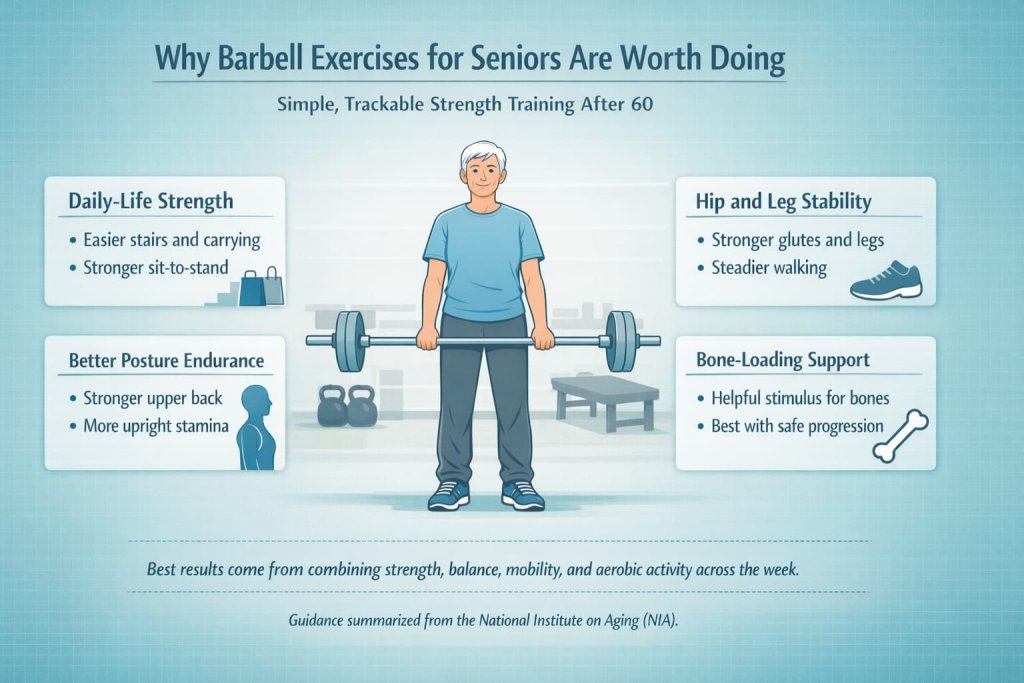
- Muscle strength for daily tasks (stairs, carrying groceries, getting up from a chair)
- Better posture and “upright” endurance
- Stronger hips and legs for walking stability
- Bone-loading stimulus (important as we age)
A practical, older-adult-friendly approach is to mix strength, balance, mobility, and aerobic activity across the week, as explained by the National Institute on Aging.
Quick safety checklist before you start
Before you touch a barbell, use this quick checklist.
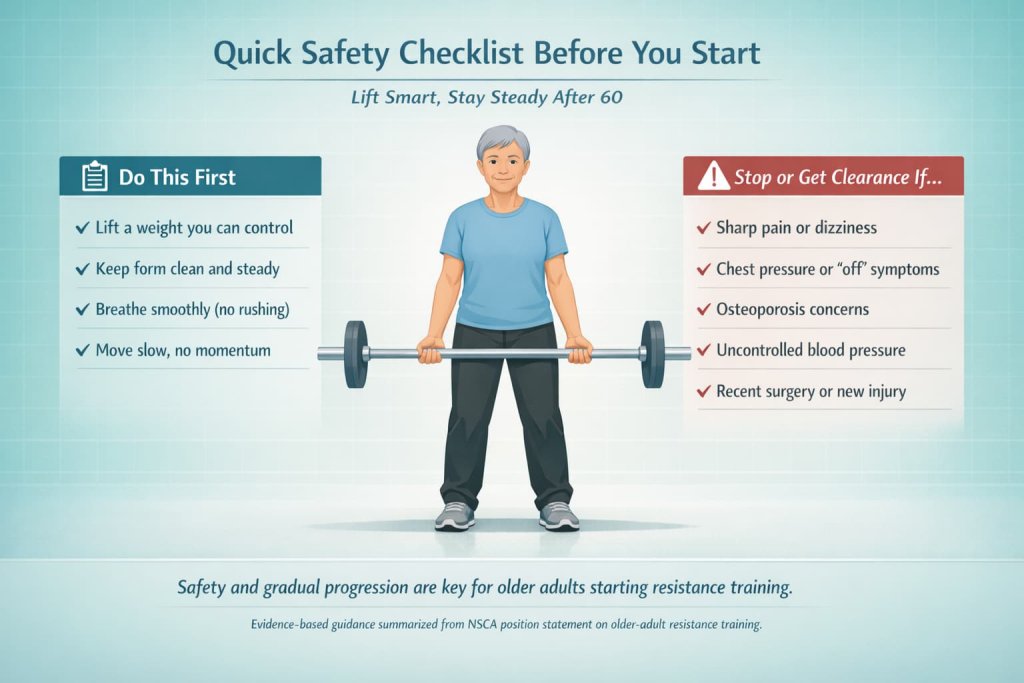
- Choose a load you can lift with clean form and steady breathing
- Prioritize controlled reps over speed or momentum
- Stop if you feel sharp pain, dizziness, chest pressure, or symptoms that feel “off”
- If you have osteoporosis, uncontrolled blood pressure, recent surgery, or a new injury, get clearance from a clinician or qualified professional first
For evidence-based guidance on resistance training considerations in older populations (including progression and safety).
How to choose the right starting weight
A simple, senior-friendly approach:
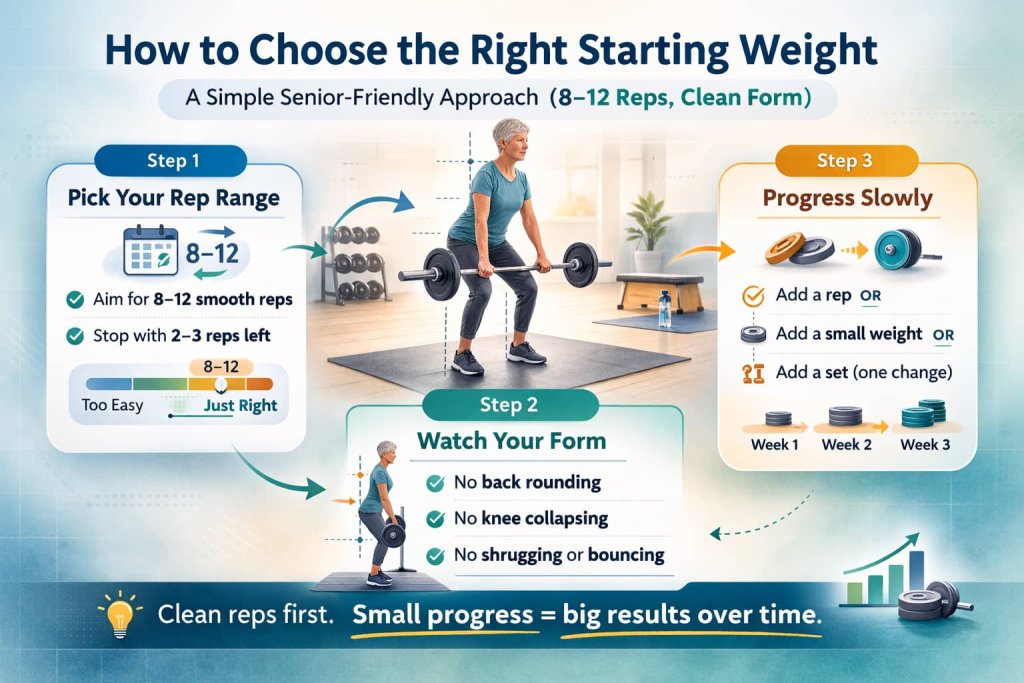
- Start with a weight you can lift for 8–12 smooth reps while keeping 2–3 reps in reserve (you could do more, but you stop early).
- If your form changes (back rounding, knee collapse, shrugging, bouncing), the weight is too heavy for today.
- Progress by adding small amounts of weight, adding a rep, or adding a set—one change at a time.
6 best barbell exercises for seniors
These six cover the major movement patterns: squat, hinge, push, pull, and hip extension. If you can do these well, you’re training the most important muscles for strength after 60.
1) Barbell Box Squat
How to do it:
- Set a sturdy box/bench behind you at a height that feels comfortable (often around chair height).
- Stand with feet about shoulder-width, brace your midsection, and keep your chest tall.
- Sit back and down under control until you lightly touch the box (don’t slam).
- Pause briefly, then stand up by pushing the floor away and squeezing your glutes.
Why it works:
The box gives you a reliable target, reduces the fear of “getting stuck,” and helps you practice strong sit-to-stand mechanics with consistent depth.
Muscles worked:
Quads, glutes, hamstrings, and core.
Trainer Tip:
Start with an empty bar or a very light bar. The goal is steady balance and repeatable depth—not speed.
2) Romanian Deadlift
How to do it:
- Stand tall with the bar at your thighs, hands just outside your legs.
- Soften your knees slightly and hinge your hips back (think “push hips toward the wall behind you”).
- Keep the bar close to your legs as you lower to mid-shin or as far as your hamstrings allow.
- Drive your hips forward to stand tall; avoid leaning back at the top.
Why it works:
The RDL strengthens the “backside chain” while teaching a clean hip hinge, which builds strength without requiring you to pull from the floor.
Muscles worked:
Glutes, hamstrings, spinal erectors (stabilizers), and upper back (posture support).
Trainer Tip:
If hamstrings feel tight, shorten the range and keep the hinge smooth. Mobility and control improve with consistent practice.
3) Landmine Press
How to do it:
- Place one end of the bar in a landmine base (or a secure corner setup).
- Hold the free end at shoulder height, with your elbow slightly in front of your ribs.
- Press up and forward in a smooth arc, keeping ribs down and core braced.
- Lower slowly back to shoulder height with control.
Why it works:
The angled pressing path is often more shoulder-friendly than straight overhead pressing, while still building strong, functional upper-body pushing strength.
Muscles worked:
Shoulders (deltoids), upper chest, triceps, and core.
Trainer Tip:
Use a split stance (one foot forward) for extra stability and to reduce the urge to over-arch your lower back.
4) Barbell Incline Bench Press
How to do it:
- Set a bench to a mild incline (not too steep).
- Plant your feet, set your shoulder blades gently “back and down,” and grip the bar evenly.
- Lower the bar to your upper chest with control.
- Press up smoothly without bouncing or shrugging.
Why it works:
A slight incline often allows a more comfortable shoulder path than flat pressing, while still training strong pushing mechanics for the chest and triceps.
Muscles worked:
Chest, shoulders, triceps, and upper-back stabilizers.
Trainer Tip:
If wrists or shoulders feel cranky, bring your grip slightly narrower and reduce the range of motion until pressing feels smooth again.
5) Barbell Bent-Over Row
How to do it:
- Hinge forward with a neutral spine and soft knees.
- Let the bar hang under your shoulders, then pull it toward your lower ribs.
- Pause briefly at the top, then lower slowly with control.
Why it works:
Rows strengthen the upper back for better posture, shoulder support, and everyday pulling strength—especially valuable for staying upright and strong after 60.
Muscles worked:
Lats, rhomboids, traps, rear delts, biceps, and core stabilizers.
Trainer Tip:
If the hinge position is hard to hold, reduce the torso angle (stand a bit taller) or use a chest-supported variation for back-friendly form.
6) Barbell Hip Thrust
How to do it:
- Set your upper back on a bench and place a padded bar across your hips.
- Keep feet flat and aim for shins close to vertical at the top position.
- Brace, then drive hips up until your torso is roughly parallel to the floor.
- Lower under control and repeat without bouncing.
Why it works:
Hip thrusts load the glutes strongly with a setup many seniors find joint-friendly, supporting walking, stairs, and hip stability.
Muscles worked:
Glutes (primary), hamstrings (secondary), and core.
Trainer Tip:
Start very light and prioritize setup comfort and alignment. A small tweak in foot position often makes the lift feel much better.
Simple weekly plan for barbell exercises for seniors
For most seniors, 2 days per week of full-body strength training is a strong starting point, aligned with global activity guidance such as the World Health Organization.
Two-day full-body plan
Day A
- Box squat: 2–3 sets of 6–10 reps
- Landmine press: 2–3 sets of 6–10 reps
- Bent-over row: 2–3 sets of 8–12 reps
Day B
- Romanian deadlift: 2–3 sets of 6–10 reps
- Incline bench press: 2–3 sets of 6–10 reps
- Hip thrust: 2–3 sets of 8–12 reps
Rest 1–2 minutes between sets. If you’re new, start with 2 sets and build up.
Common mistakes seniors should avoid with barbell training
- Rushing reps and using momentum
- Holding breath too long (brace firmly, but keep breathing between reps)
- Going too heavy too soon
- Ignoring pain signals or pushing through sharp discomfort
- Skipping warm-up sets (your joints and nervous system need a ramp)
Who Should Avoid Barbell Training (Or Get Medical Clearance First)
Barbell exercises for seniors can be safe, but some health situations require clearance first. If you have new or worsening symptoms, it’s best to check with a clinician before lifting.
- Chest pain/pressure, unexplained shortness of breath, fainting, or dizziness
- Uncontrolled high blood pressure or recent major medication changes
- Recent heart event/procedure or currently in cardiac rehab
- Recent fracture (especially hip or spine) or severe osteoporosis concerns
- Numbness, tingling, radiating pain, or new weakness in an arm/leg
- Severe joint swelling, instability, or sharp pain that worsens with movement
- Recent surgery (joint, abdominal, or spine) without a return-to-exercise plan
- Balance issues that make standing lifting unsafe without support
Warm-Up for Barbell Exercises for Seniors
A quick warm-up improves comfort, stability, and form. Keep it simple and repeatable.
- 1–2 minutes easy movement (walk, bike, march in place)
- 6–8 slow bodyweight squats (use a box/chair if needed)
- 6–8 hip hinges (hands on thighs, push hips back, neutral spine)
- 8–10 incline or wall push-ups
- 20–30 seconds gentle bracing practice (ribs down, breathe, light tension)
- 1–3 lighter ramp-up sets of your first barbell lift
Progression Tips for Seniors
Progress should be gradual and technique-driven. The goal is steady strength gains without joint flare-ups.
- Add reps first, then add weight (example: 6 reps → 10 reps before loading up)
- Increase in small jumps using the lightest plates available
- Keep 2–3 reps in reserve (avoid grinding)
- Change only one thing at a time: reps or sets or weight
- If form slips, reduce load or range of motion
- Use a lighter “easy week” when recovery feels slower than normal
FAQs about barbell exercises for seniors
Are barbell exercises safe for seniors?
They can be safe when you choose appropriate loads, use controlled technique, and progress gradually. If you have medical conditions or recent injuries, get professional clearance.
How often should seniors lift with a barbell?
Many guidelines support strength training at least two days per week, and many older-adult programs use 2–3 sessions weekly depending on recovery and experience.
What’s the best barbell exercise for seniors with knee pain?
Often, box squats (to a comfortable height) and hip hinge patterns like RDLs can be easier to adjust. If pain persists, consult a clinician or physical therapist.
Can seniors lift heavy weights?
Some seniors can, but “heavy” should be relative to your current ability and form quality. The safest path is building over time and keeping reps smooth and controlled.
What if I don’t have a full barbell setup?
You can start with a lighter technique bar, a fixed-weight barbell, or substitute similar patterns with dumbbells. The movement pattern matters more than the tool.
Do barbell exercises help balance in older adults?
Strength supports balance, especially when paired with balance practice (like single-leg stands or controlled step-ups). Many older adult programs combine both.
Should seniors avoid deadlifts?
Not necessarily. Many seniors do well with Romanian deadlifts because they reduce floor lifting demands. The key is hinge mechanics and sensible loading.
Conclusion
Barbell training after 60 doesn’t need to be complicated. Focus on six proven patterns, keep your form clean, and progress slowly. If you want, share your age range and any equipment you have (full gym, home barbell, Smith machine, or just a light bar), and I’ll turn this into a tighter beginner, intermediate, and advanced routine.
References
- National Strength and Conditioning Association (NSCA). Resistance Training for Older Adults: Position Statement (2019, PDF). National Strength and Conditioning Association (NSCA)
- PubMed. Resistance Training for Older Adults: NSCA Position Statement record (2019). PubMed
- PubMed Central (PMC). WHO 2020 guidelines on physical activity and sedentary behaviour (2020). PubMed Central (PMC)
- Centers for Disease Control and Prevention (CDC). Growing Stronger: Strength Training for Older Adults (PDF guide). Centers for Disease Control and Prevention (CDC)
- American College of Sports Medicine (ACSM). Physical Activity Guidelines resources and summaries (web resource). American College of Sports Medicine (ACSM)