
Working out can increase testosterone for a short time after exercise, but it does not reliably cause a big long-term rise in resting testosterone for every man. For most people, exercise helps testosterone most indirectly by improving body composition, fitness, recovery habits, and overall health rather than by permanently “boosting” the hormone on its own. PubMed
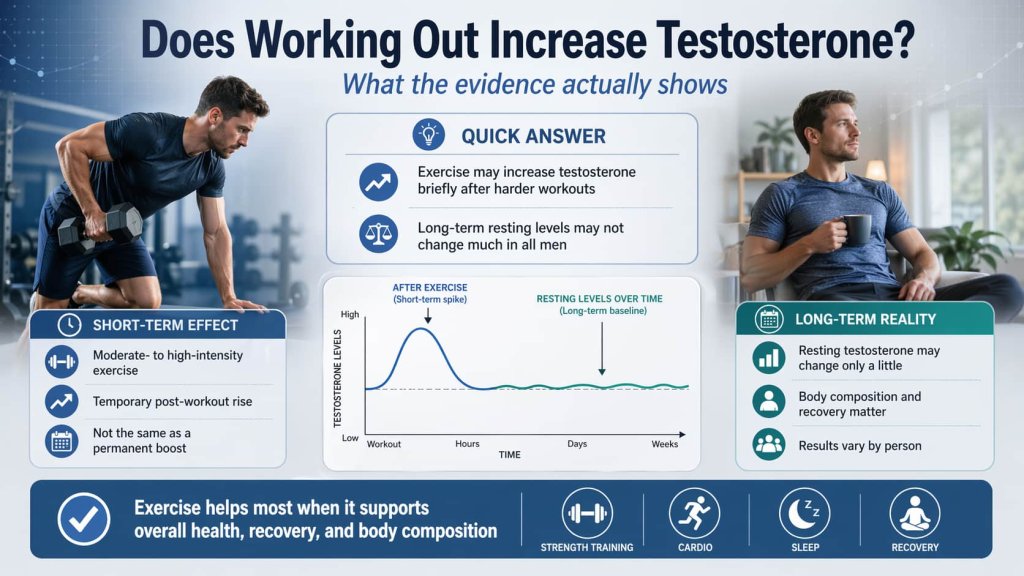
That matters because the question “does working out increase testosterone” often gets answered too simply. The real answer depends on whether you mean a short post-workout spike, your usual baseline level, or testosterone in someone who also has obesity, type 2 diabetes, poor sleep, or overtraining.
Does working out increase testosterone?
Yes, but mostly in the short term. A 2020 PubMed meta-analysis on acute exercise and testosterone found that testosterone increased after moderate- and high-intensity exercise, but not after mild physical activity. That means a challenging workout can temporarily raise testosterone, especially around the workout window.
What it does not mean is that every workout creates a lasting increase in your usual testosterone level. A 2021 systematic review and meta-analysis in PubMed found that exercise training had a negligible overall effect on resting total testosterone in insufficiently active, otherwise healthy men, and the result did not significantly change by training mode, age, body mass status, or testosterone measure.
So the best plain-English answer is this: exercise can raise testosterone briefly, but it is not a guaranteed long-term testosterone booster for everyone.
Why exercise may still help testosterone over time
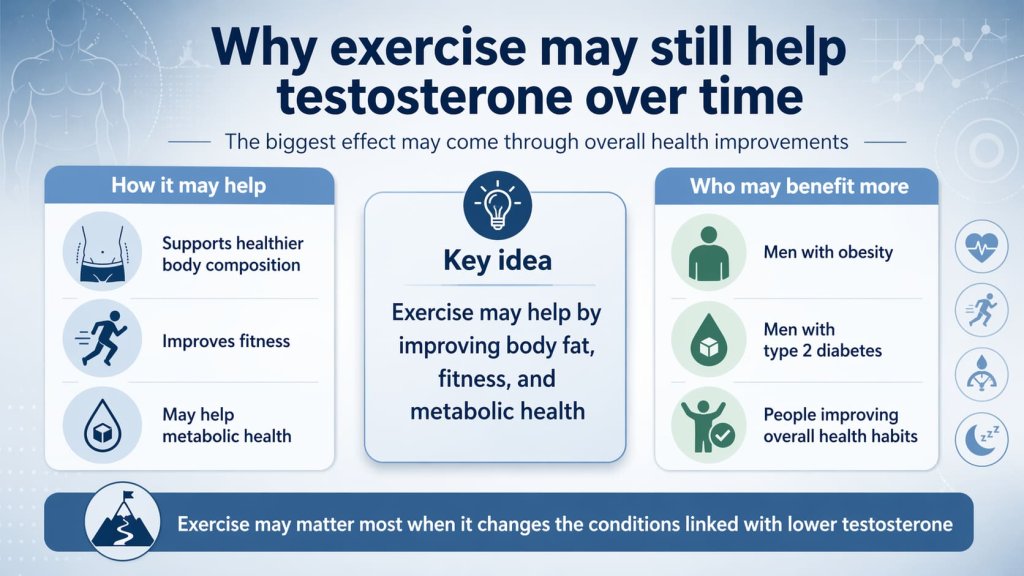
Even when baseline testosterone does not rise much, exercise can still support the conditions that matter. A 2024 PubMed review on aerobic exercise, obesity, type 2 diabetes, and testosterone found that aerobic exercise training may increase testosterone in men with obesity or type 2 diabetes. That is important because these are the kinds of situations where metabolic health and body composition can shift the picture.
There is also a practical reason for this. MedlinePlus lists too much body fat, obstructive sleep apnea, and chronic stress from too much exercise, also called overtraining syndrome, among possible reasons testosterone may be low. In other words, exercise may help not because it magically forces testosterone up, but because it can improve some of the factors tied to lower testosterone in the first place.
What kind of workout matters most?
There is no single magic “testosterone workout.” The evidence supports a more balanced approach:
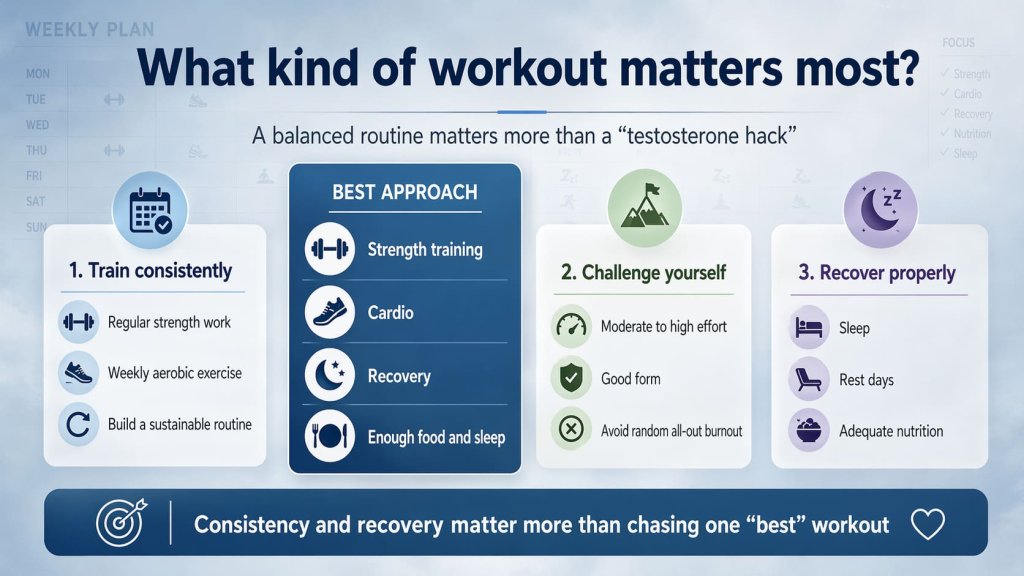
- Do regular muscle-strengthening exercise.
- Include aerobic work each week.
- Train hard enough to challenge yourself, but not so hard that recovery falls apart.
- Support training with enough food, sleep, and rest.
The broad health target from the CDC adult activity guidelines is at least 150 minutes of moderate-intensity aerobic activity a week or 75 minutes of vigorous activity, plus muscle-strengthening activity at least 2 days a week. That is a sensible foundation for general health and body composition, which is where exercise may matter most for testosterone.
If your goal is supporting healthy testosterone rather than chasing hype, focus on consistency. A realistic weekly routine beats occasional all-out sessions followed by poor sleep, under-eating, and burnout. Those habits are more consistent with what official endocrine guidance says about testosterone being affected by too much exercise and poor nutrition.
Can too much exercise lower testosterone?
Yes, it can. The Endocrine Society’s patient guidance on hypogonadism says testosterone can temporarily drop with too much exercise and poor nutrition.
This is one reason more training is not always better. If you are stacking hard sessions, sleeping badly, feeling run down, losing performance, and not eating enough, you are no longer in the healthy training zone people usually imagine when they talk about natural testosterone support. MedlinePlus also specifically lists overtraining syndrome as a possible contributor to lower testosterone.
Does lifting weights increase testosterone more than cardio?
Resistance training is often part of the kind of moderate- to high-intensity exercise that produces the short-term testosterone rise seen in research. But the bigger takeaway is not that one exercise category is magic. It is that intensity, total workload, recovery, and your overall health status matter more than chasing one move or one machine.
Cardio is not automatically bad for testosterone. In fact, the 2024 review found that aerobic training may raise testosterone in men with obesity or type 2 diabetes. So for many people, cardio belongs in the plan rather than being something to avoid.
Sleep and recovery can matter as much as exercise choice
Exercise is only one part of the testosterone picture. MedlinePlus lists sleep problems such as obstructive sleep apnea among possible causes of low testosterone, which is one reason a harder training plan is not always the answer. If sleep is poor, recovery is weak, or you are constantly run down, improving those basics may matter more than switching from cardio to lifting or adding extra workouts.
When low testosterone is more than a gym question
Poor workouts, low motivation, or a bad week in the gym do not diagnose low testosterone. A MedlinePlus testosterone levels test page says testing is usually considered when symptoms suggest abnormal testosterone, such as low sex drive, erectile dysfunction, infertility, enlarged breasts, thinning bones or anemia without a known cause, or loss of muscle mass.
Testing is usually done in the morning. MedlinePlus says testosterone blood samples are typically taken between 7 and 10 AM, when levels are highest.
Diagnosis also should not be based on one random number. The Endocrine Society testosterone therapy guideline recommends diagnosing hypogonadism only in men who have symptoms and signs consistent with testosterone deficiency plus unequivocally and consistently low serum testosterone, confirmed by repeating a morning fasting test.
One more detail matters: testosterone levels can change from day to day, and the normal range can vary by lab. That is why one borderline result should not be overinterpreted. In some cases, clinicians may also look at free testosterone, not just total testosterone, when the clinical picture and the lab result do not clearly match.
A smart way to think about exercise and testosterone
A practical way to look at this is:
- A hard workout may raise testosterone briefly.
- Regular exercise may or may not raise your resting level much.
- Exercise is still valuable because it can improve weight status, metabolic health, sleep, strength, and fitness.
- Those changes may matter more than a temporary hormone spike.
That perspective fits the current evidence better than “working out boosts testosterone” as a blanket claim.
Who should be careful before chasing “testosterone-boosting” workouts?
Be more cautious if any of these apply:
- You have symptoms of low testosterone, such as low libido, ED, infertility, or unexplained loss of muscle mass.
- You are constantly fatigued, under-eating, or pushing through heavy training without recovery.
- You have obesity or possible sleep apnea.
- You are thinking about testosterone therapy while trying to preserve fertility.
These situations call for a more medical and individualized conversation, not just a harder workout program.
Should you use testosterone therapy just because you want higher levels?
No. The FDA testosterone safety page says testosterone products are approved only for men who have low testosterone with an associated medical condition. FDA-approved products are not approved for men with low testosterone who do not have an associated medical condition.
The Endocrine Society guideline also recommends testosterone therapy for men with diagnosed hypogonadism and recommends against routine screening of men in the general population. It also advises against starting therapy in men planning fertility in the near term and in certain other clinical situations.
There is also an important fertility issue here. Men who want children now or in the near future should not assume testosterone therapy is harmless just because it may raise blood testosterone levels. The AUA/ASRM Male Infertility Guideline says clinicians should not prescribe exogenous testosterone therapy to men interested in current or future fertility, because external testosterone can suppress sperm production.
FAQ
How long does exercise increase testosterone?
The rise is usually temporary, not permanent. The evidence supports an acute post-exercise increase after moderate- and high-intensity activity, which is different from a lasting change in baseline testosterone.
Can working out fix low testosterone?
Not necessarily. Exercise can help some men, especially when obesity or type 2 diabetes is part of the picture, but true hypogonadism still needs proper medical evaluation and diagnosis.
Does cardio lower testosterone?
Not automatically. Excessive training with poor recovery can contribute to lower testosterone, but aerobic exercise itself can be part of a healthy routine and may help in some higher-risk groups.
What is the best exercise plan for healthy testosterone?
The best plan is usually the one you can sustain: regular strength training, enough weekly aerobic activity, good recovery, enough food, and enough sleep. That approach aligns better with current guidance than trying to copy extreme hormone hacks.
Safety box
This topic is worth medical follow-up if you have symptoms that suggest low testosterone, not just concern about muscle gain or workout performance. Do not self-start testosterone products for bodybuilding, appearance, or anti-aging. And do not ignore red flags like persistent fatigue, sexual symptoms, infertility, or signs of sleep apnea.
Conclusion
Working out can increase testosterone, but usually only for a short time after exercise. For long-term health, the better message is that regular training may support testosterone indirectly by helping with body fat, fitness, and recovery, while overtraining and poor nutrition can work against you. Stay consistent, train hard but recover well, and treat persistent low-testosterone symptoms as a medical issue instead of a gym myth.
If you are trying to support healthy testosterone naturally, build a sustainable weekly routine first and speak with a qualified clinician if symptoms point to something more than normal training ups and downs.
This content is for informational purposes only and not medical advice.
References
- PubMed — Effects of exercise training on resting testosterone concentrations in insufficiently active men: a systematic review and meta-analysis
- PubMed — The effects of aerobic exercise training on testosterone concentration in individuals who are obese or have type 2 diabetes: a systematic review and meta-analysis
- MedlinePlus — Testosterone Levels Test
- CDC — Adult Activity: An Overview
- Endocrine Society — Hypogonadism in Men
- Endocrine Society — Testosterone Therapy for Hypogonadism Guideline Resources
- FDA — Testosterone Information
- American Urological Association and American Society for Reproductive Medicine — Diagnosis and Treatment of Infertility in Men: AUA/ASRM Guideline