
Normal heart rate variability ranges by age vary widely, but average HRV generally decreases as people get older. For example, research-based median RMSSD values are approximately 48–52 milliseconds for adults ages 20–24, compared with about 15–16 milliseconds for adults age 75 and older.
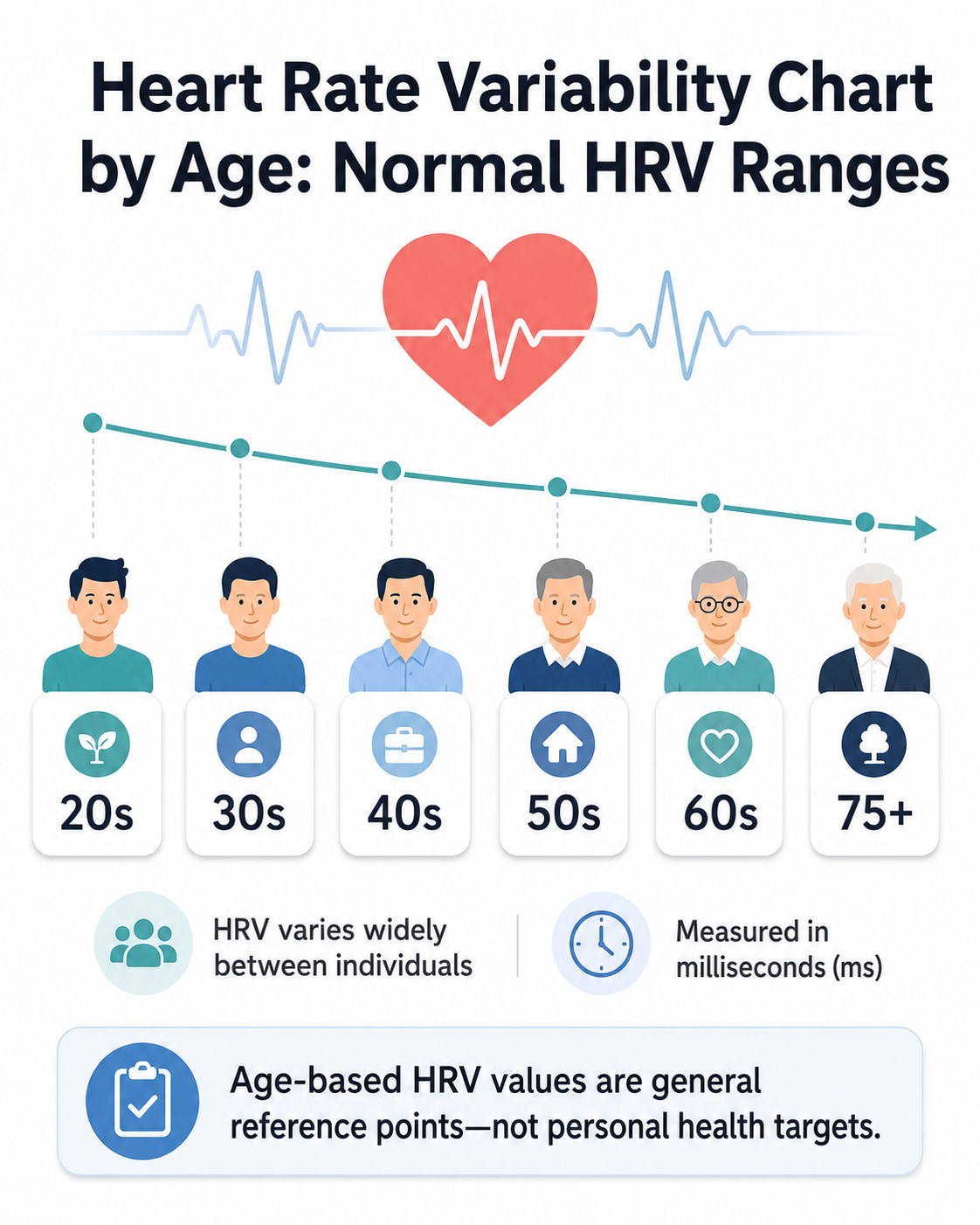
However, age alone cannot determine whether your HRV is healthy. Your measurement method, device, biological sex, fitness level, sleep, stress, medications, heart rhythm, and personal baseline can all affect the result.
The heart rate variability chart below provides useful age-based reference values. It should be used as a general guide—not as a diagnostic test or a target you must reach.
Heart Rate Variability Chart by Age
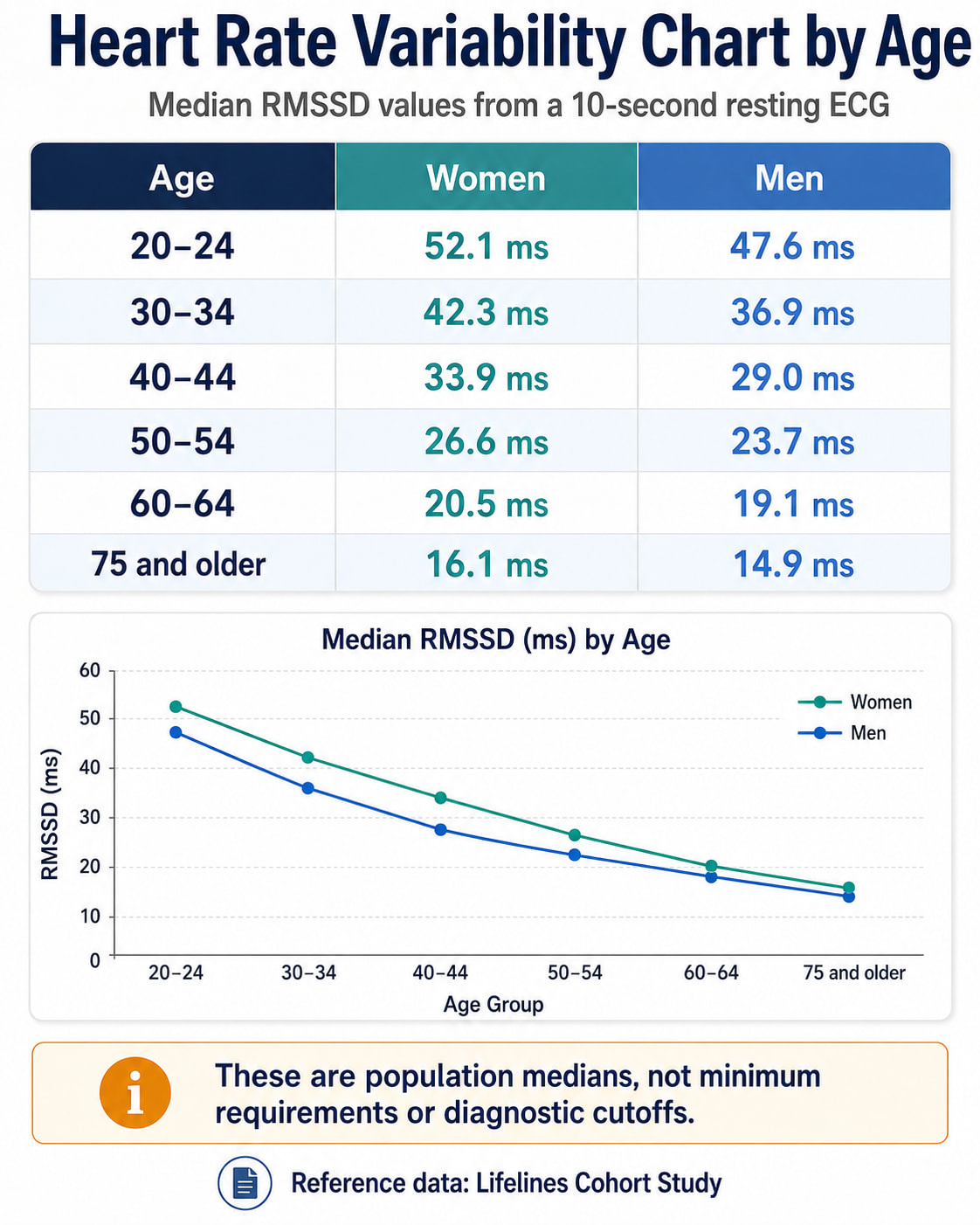
The following chart is based on the large Lifelines Cohort Study published in the European Journal of Preventive Cardiology. Researchers analyzed 10-second resting electrocardiogram recordings from 84,772 generally healthy participants between ages 13 and 91.
The study measured RMSSD, one of the most commonly reported HRV metrics. Each table entry shows the median result followed by the 2nd–98th percentile reference interval.
| Age | Women: Median RMSSD and Reference Interval | Men: Median RMSSD and Reference Interval |
|---|---|---|
| 13–14 | 66.5 ms (17.4–232.2) | 67.4 ms (12.8–213.0) |
| 15–19 | 60.7 ms (12.4–225.9) | 59.9 ms (9.8–213.2) |
| 20–24 | 52.1 ms (11.3–205.5) | 47.6 ms (9.6–174.0) |
| 25–29 | 47.5 ms (11.5–180.7) | 42.3 ms (10.1–172.7) |
| 30–34 | 42.3 ms (11.5–161.0) | 36.9 ms (10.2–140.8) |
| 35–39 | 37.9 ms (10.8–141.9) | 32.8 ms (8.6–123.8) |
| 40–44 | 33.9 ms (9.7–123.7) | 29.0 ms (8.1–105.5) |
| 45–49 | 29.2 ms (8.3–109.5) | 26.0 ms (7.1–95.5) |
| 50–54 | 26.6 ms (7.5–96.3) | 23.7 ms (6.7–87.5) |
| 55–59 | 22.5 ms (6.7–83.6) | 21.0 ms (5.5–89.5) |
| 60–64 | 20.5 ms (5.5–79.3) | 19.1 ms (4.8–86.6) |
| 65–69 | 17.8 ms (5.0–83.0) | 17.7 ms (4.9–110.5) |
| 70–74 | 18.3 ms (5.0–115.8) | 16.0 ms (4.7–161.9) |
| 75 and older | 16.1 ms (3.5–106.2) | 14.9 ms (3.7–130.3) |
Source: European Journal of Preventive Cardiology Lifelines Cohort Study
Important Limitations of the Chart
These values are population reference points, not required health targets.
The study used:
- A 10-second resting ECG
- The RMSSD measurement
- A generally healthy study population
- Controlled research conditions
- Age- and sex-specific groups
Your smartwatch, fitness strap, or smart ring may measure HRV for several minutes or throughout the night. Therefore, its results may not match this chart even when the device displays HRV in milliseconds.
The very wide reference intervals also show that healthy people of the same age can have substantially different HRV values.
What Is Heart Rate Variability?
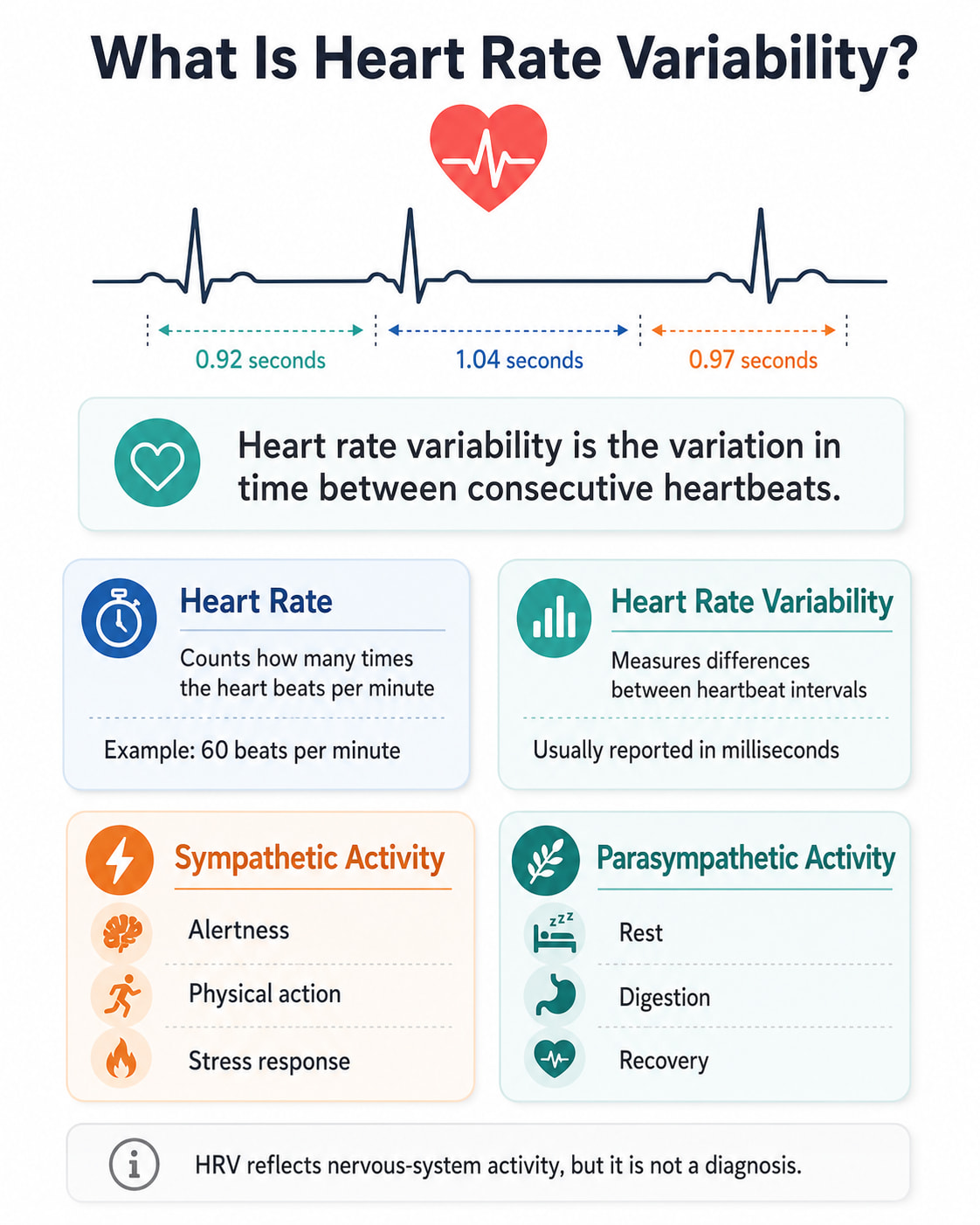
Heart rate variability is the variation in time between consecutive heartbeats.
A heart rate of 60 beats per minute does not usually mean the heart beats exactly once every second. One interval may be 0.92 seconds, while the next may be 1.04 seconds. HRV measures these small timing differences.
HRV is influenced by the autonomic nervous system, which helps regulate automatic body functions such as:
- Heart rate
- Blood pressure
- Breathing
- Digestion
- Temperature control
- Stress and recovery responses
The sympathetic branch of the nervous system generally supports alertness and physical action. The parasympathetic branch supports rest, digestion, and recovery. HRV reflects the interaction between these systems, but it cannot diagnose how well either branch is functioning by itself.
What Is a Good HRV for Your Age?
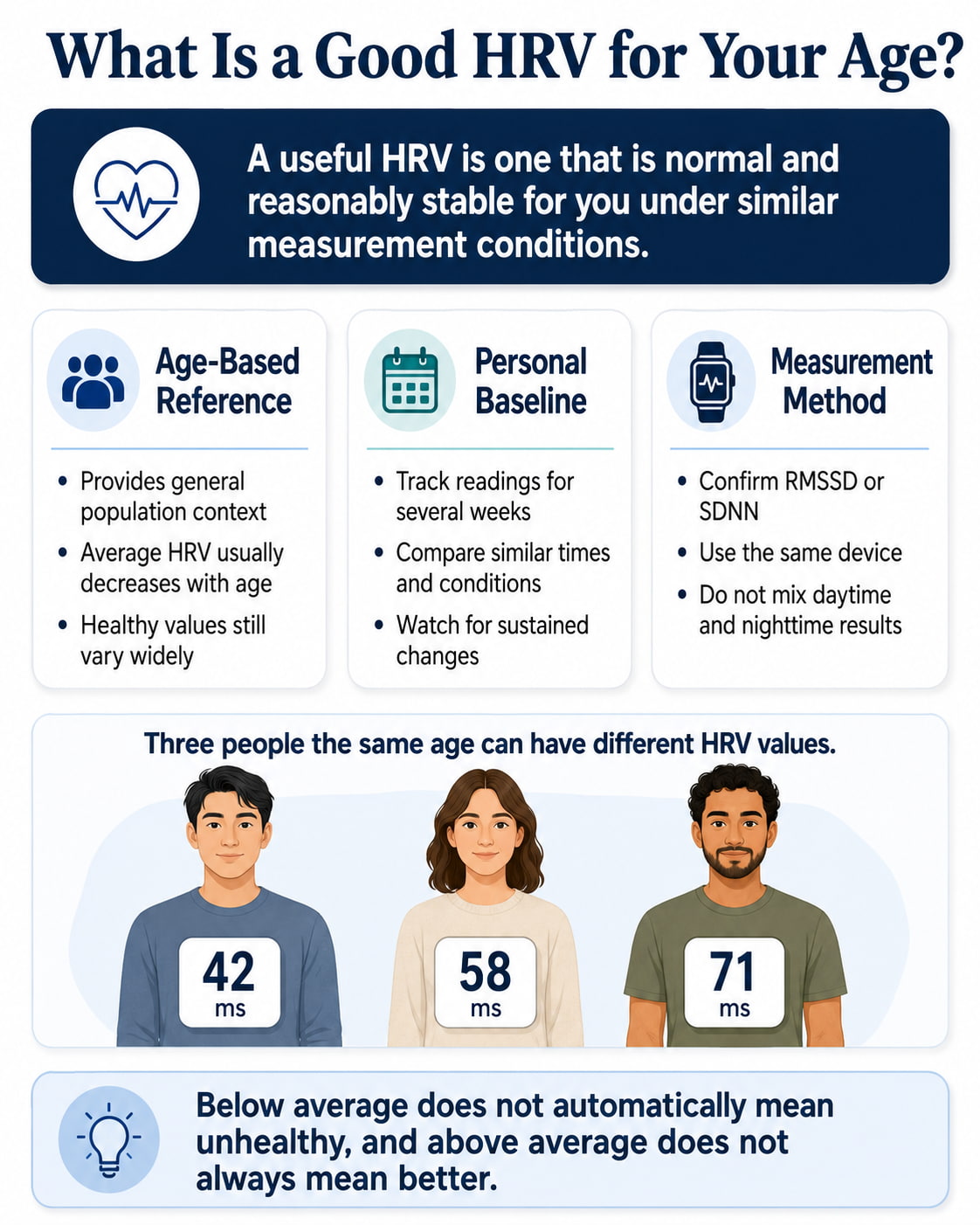
A good HRV is usually a value that is normal and stable for you under comparable measurement conditions.
Age-based medians provide useful context, but they cannot establish a personal ideal. Two healthy 40-year-olds may have very different HRV readings because of differences in heart rate, genetics, fitness, sleep, device type, medication use, and other factors.
As a broad research reference, median RMSSD values in the Lifelines study were approximately:
| Age Group | Women | Men |
|---|---|---|
| 20–24 | 52.1 ms | 47.6 ms |
| 30–34 | 42.3 ms | 36.9 ms |
| 40–44 | 33.9 ms | 29.0 ms |
| 50–54 | 26.6 ms | 23.7 ms |
| 60–64 | 20.5 ms | 19.1 ms |
| 75 and older | 16.1 ms | 14.9 ms |
These medians should not be interpreted as minimum requirements. A result below the median is not automatically unhealthy, and a result above the median is not necessarily better.
A 2025 systematic review found that universally accepted normal HRV values still do not exist. Studies use different recording durations, populations, metrics, devices, and testing conditions, making one universal cutoff impractical.
Why Does HRV Decrease With Age?
HRV generally decreases with age because aging affects the heart, nervous system, blood vessels, physical activity patterns, and the body’s ability to adapt quickly to internal and external demands.
This decline usually begins in early adulthood and continues gradually over time. However, the relationship is not perfectly linear.
In the Lifelines study, median RMSSD declined steadily through approximately age 60 and then became more stable. Some adults in their 60s, 70s, and older still recorded high HRV values, as shown by the broad upper reference limits.
This means age-related decline is common, but age does not determine an individual’s exact HRV.
RMSSD vs. SDNN: Why the HRV Metric Matters
HRV is not a single calculation. Different metrics describe different aspects of heartbeat variation.
RMSSD
RMSSD stands for the root mean square of successive differences.
It measures short-term changes between consecutive normal heartbeat intervals. RMSSD is commonly used by recovery-oriented fitness devices because it is strongly influenced by short-term parasympathetic activity.
The age chart in this article reports RMSSD.
SDNN
SDNN stands for the standard deviation of normal-to-normal heartbeat intervals.
It reflects overall variability during the recording period. The result can be affected significantly by how long the measurement lasts.
Apple Health identifies its heart rate variability data type as SDNN, while devices such as WHOOP commonly use RMSSD.
Both are measured in milliseconds, but they are not interchangeable. An RMSSD of 40 milliseconds does not mean the same thing as an SDNN of 40 milliseconds.
According to the 2024 heart rate and HRV measurement guideline, the metric, recording duration, body position, time of day, breathing pattern, and artifact correction should all be considered when interpreting HRV.
Why Wearable HRV Numbers Differ
Wearable devices do not all measure or calculate HRV in the same way.
Differences may include:
- RMSSD versus SDNN
- Daytime versus nighttime measurement
- One short reading versus multiple overnight samples
- ECG electrodes versus optical sensors
- Different artifact-removal algorithms
- Different averaging methods
- Different sampling frequencies
For example, a smartwatch may take occasional short measurements during the day, while a ring or strap may calculate an average from several nighttime readings.
WHOOP HRV Benchmarks
WHOOP measures RMSSD during sleep. Its April 2026 member data showed that the middle 50% of members ages 20–25 generally recorded about 55–105 milliseconds, while members ages 60–65 generally recorded about 25–45 milliseconds.
WHOOP reported approximate member averages of:
- 78 milliseconds at age 25
- 60 milliseconds at age 35
- 48 milliseconds at age 45
- 44 milliseconds at age 55
These numbers are higher than some short daytime ECG values because the measurement method and population differ. WHOOP members also tend to be more physically active or health-focused than the general population.
The company therefore recommends focusing on your personal trend rather than comparing your result directly with someone else’s. See the WHOOP HRV range guidance for its device-specific explanation.
How to Read Your HRV Result Correctly
Follow these steps before deciding whether your HRV appears low, high, or unusual.
1. Identify the Metric
Check whether your device reports RMSSD, SDNN, or another HRV metric.
Do not compare results from different metrics as though they were equivalent.
2. Check When the Reading Was Taken
Nighttime HRV often differs from a short daytime reading. Compare nighttime measurements only with other nighttime measurements whenever possible.
3. Use the Same Device
Different devices may produce different numbers because they use different sensors and calculation methods.
Switching from a watch to a ring may change the result even if your health has not changed.
4. Look at Your Personal Baseline
Track HRV consistently for several weeks. Your usual range is generally more meaningful than a single age-based average.
For example, a change from 55 to 50 milliseconds may not be important for one person. A sustained change from a personal average of 55 to 30 milliseconds may deserve more attention, especially if it occurs with illness, severe fatigue, poor sleep, or other symptoms.
5. Review the Measurement Conditions
Before interpreting a reading, consider whether you:
- Slept poorly
- Exercised intensely
- Consumed alcohol
- Were becoming ill
- Were dehydrated
- Took a new medication
- Measured at a different time
- Changed body position
- Experienced unusual stress
These factors can temporarily influence HRV.
What Causes Low HRV?
A lower-than-usual HRV may occur when the body is experiencing increased physical or psychological demand.
Possible influences include:
- Poor sleep
- Acute illness
- Fever
- Psychological stress
- Strenuous exercise
- Inadequate exercise recovery
- Alcohol consumption
- Dehydration
- Smoking
- Certain medications
- Chronic health conditions
- Changes in breathing
- Measurement errors
- Irregular heart rhythms
A low result does not identify the cause. It also does not prove that a person has heart disease, excessive stress, or overtraining.
The most useful question is often whether the reading is temporarily lower than your established baseline and whether the change is accompanied by symptoms or other health concerns.
What Causes High HRV?
A higher HRV can be associated with greater short-term adaptability and recovery, particularly when it is consistent with a person’s normal pattern.
However, higher is not always better.
An unexpectedly high reading may result from:
- Measurement artifacts
- Poor sensor contact
- Extra or irregular heartbeats
- Movement during the recording
- Device calculation errors
- Differences in breathing
- A change in the measurement method
A sudden increase far outside your usual range should not automatically be interpreted as improved fitness or recovery.
Is an HRV of 20, 30, or 40 Milliseconds Good?
The meaning depends on your age, metric, device, and personal baseline.
HRV of 20 Milliseconds
An RMSSD of 20 milliseconds is near the research median for many adults in their late 50s and 60s. It may be below average for a younger adult, but that alone does not mean it is unhealthy.
HRV of 30 Milliseconds
An RMSSD of 30 milliseconds is close to the median reported for adults in their early to mid-40s. It may also be normal for younger or older people because the healthy reference intervals are broad.
HRV of 40 Milliseconds
An RMSSD of 40 milliseconds is close to the median for many adults in their late 20s and 30s. It may be relatively high for an older adult or lower than usual for a highly trained younger person.
These examples apply only to RMSSD-style measurements. They should not be applied directly to SDNN readings.
How to Support a Healthy HRV Pattern
You do not need to chase the highest possible HRV number. Instead, focus on habits that support general cardiovascular health, sleep, recovery, and stress management.
Helpful habits may include:
- Following a consistent sleep schedule
- Getting regular aerobic and strength exercise
- Allowing adequate recovery after hard training
- Limiting or avoiding alcohol
- Staying appropriately hydrated
- Eating a balanced diet
- Avoiding tobacco
- Using relaxation or slow-breathing practices
- Managing long-term health conditions with professional care
- Taking medications exactly as prescribed
Avoid making major training, medication, or health decisions based on one wearable result.
A temporarily lower reading after a hard workout or poor night of sleep may return toward baseline once you recover.
When Should You Discuss HRV With a Healthcare Professional?
HRV alone is not usually an emergency indicator. Seek medical guidance when you are concerned about a persistent change or when an unusual reading occurs with symptoms.
Contact a healthcare professional if you experience:
- Chest pain or pressure
- Fainting or near-fainting
- Unexplained shortness of breath
- Persistent dizziness
- A new irregular heartbeat sensation
- Repeated unexplained heart-rate alerts
- Severe or unusual fatigue
- A sustained HRV change after starting medication
- Concerns about a known heart condition
Seek urgent medical care for severe chest pain, difficulty breathing, fainting, or other potentially serious symptoms.
The Cleveland Clinic HRV overview emphasizes that HRV can be difficult to interpret and that consumer devices do not replace an ECG or professional medical evaluation.
Frequently Asked Questions
What is a normal heart rate variability for my age?
There is no universal normal HRV for every person of a certain age. Median RMSSD values in a large population study declined from approximately 48–52 milliseconds at ages 20–24 to approximately 15–16 milliseconds at age 75 and older. However, the healthy reference intervals were very broad.
Is higher HRV always better?
No. A higher value may reflect greater short-term adaptability when it is consistent with your normal pattern. However, unusually high readings can also result from sensor errors, movement, irregular beats, or differences in measurement methods.
Is a low HRV dangerous?
A low HRV reading is not automatically dangerous. It may reflect age, stress, poor sleep, recent exercise, illness, alcohol, medication use, or your natural baseline. Persistent changes accompanied by concerning symptoms should be discussed with a healthcare professional.
Why is my HRV lower than other people my age?
Your HRV may differ because of genetics, resting heart rate, fitness, health conditions, medications, sleep, stress, device type, measurement timing, or the metric being used. Comparing your result with your own long-term baseline is usually more useful than comparing it with another person’s number.
Why does my smartwatch HRV change every day?
Daily HRV changes can occur because of sleep quality, training load, stress, alcohol, hydration, illness, breathing, and measurement conditions. Small daily fluctuations are common.
Can exercise improve HRV?
Regular physical activity may support cardiovascular fitness and autonomic regulation over time. However, a difficult workout can temporarily reduce HRV while the body recovers. Exercise should be increased gradually and matched to your health and fitness level.
Can I compare Apple Watch HRV with WHOOP or Oura?
Direct comparisons may be misleading. Apple Health reports SDNN, while WHOOP commonly reports RMSSD. Wearables may also measure at different times and use different sensors, averaging periods, and artifact-removal methods.
Conclusion
A heart rate variability chart by age can help you understand broad population patterns, but it cannot define your personal health status. HRV usually declines with age, yet healthy values remain highly variable within every age group.
For the most useful interpretation, confirm which metric your device uses, measure under consistent conditions, and focus on your personal trend over several weeks. Do not treat a single high or low reading as a diagnosis.
Speak with a healthcare professional when a sustained HRV change is accompanied by symptoms, irregular heartbeats, medication concerns, or an existing cardiovascular condition.
This content is for informational purposes only and not medical advice.