
A mesomorph body type usually describes a naturally more muscular build, but it does not mean you have a special metabolism or need a special “mesomorph diet” to lose fat.
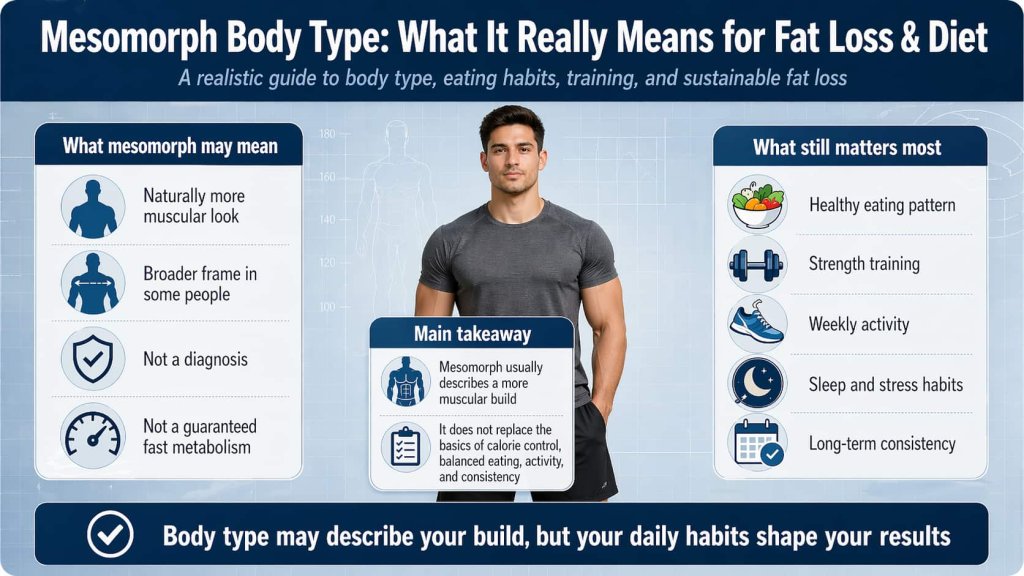
In real life, mesomorph fat loss still comes down to the same basics that work for everyone else: a healthy eating pattern you can stick to, calorie control, regular activity, strength training, sleep, and consistency. That matters because a lot of body-type advice online sounds specific, but current official guidance focuses on sustainable habits, not somatotype labels. According to the American Council on Exercise, body-type labels can easily be oversimplified and turned into rules they were never meant to support.
What Is a Mesomorph Body Type?
The term “mesomorph” comes from the old somatotype system. In that framework, mesomorphs are typically described as having a medium build, broader shoulders, and above-average muscular development with relatively lower body fat. But the American Council on Exercise also notes that placing a person into one neat category is more complicated than it looks, and turning body-type labels into diet or workout rules often spreads misinformation.
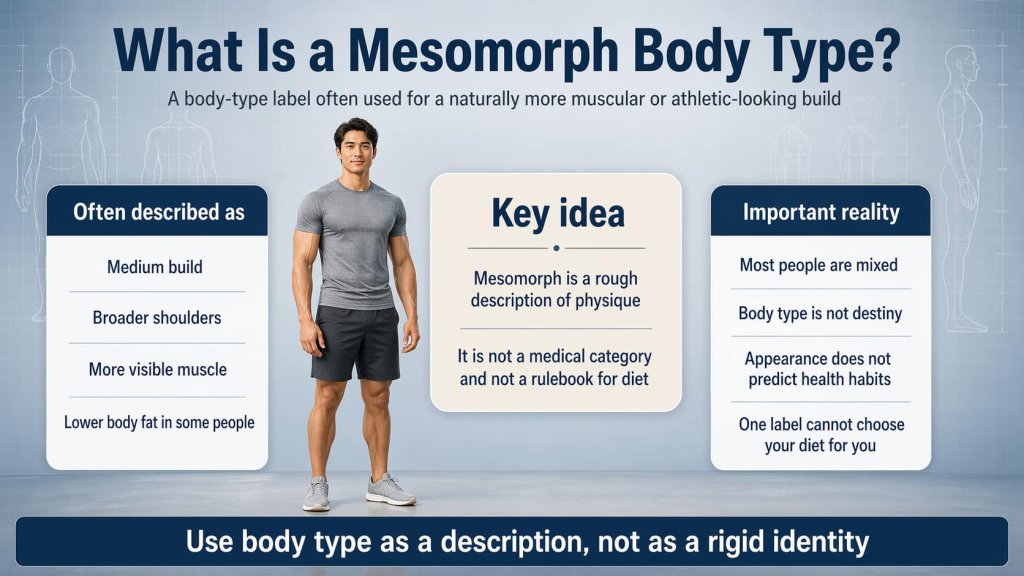
That is the most useful way to think about the mesomorph body type today: as a rough description of physique, not a diagnosis, not a guarantee, and not a shortcut to knowing exactly how your body will respond to food or training. ACE is especially clear that appearance should not dictate your macronutrient balance, rep ranges, or long-term goals.
Does Being a Mesomorph Make Fat Loss Easier?
Sometimes it can feel easier for people with a naturally more muscular build to look “fit,” but that does not mean fat loss happens automatically. ACE says people with mesomorphic traits can still gain fat, cannot simply eat anything without consequences, and still need exercise and healthy habits like anyone else. Official weight-management guidance from the National Institute of Diabetes and Digestive and Kidney Diseases and the Centers for Disease Control and Prevention also focuses on sustainable eating, physical activity, sleep, and stress management rather than body type.
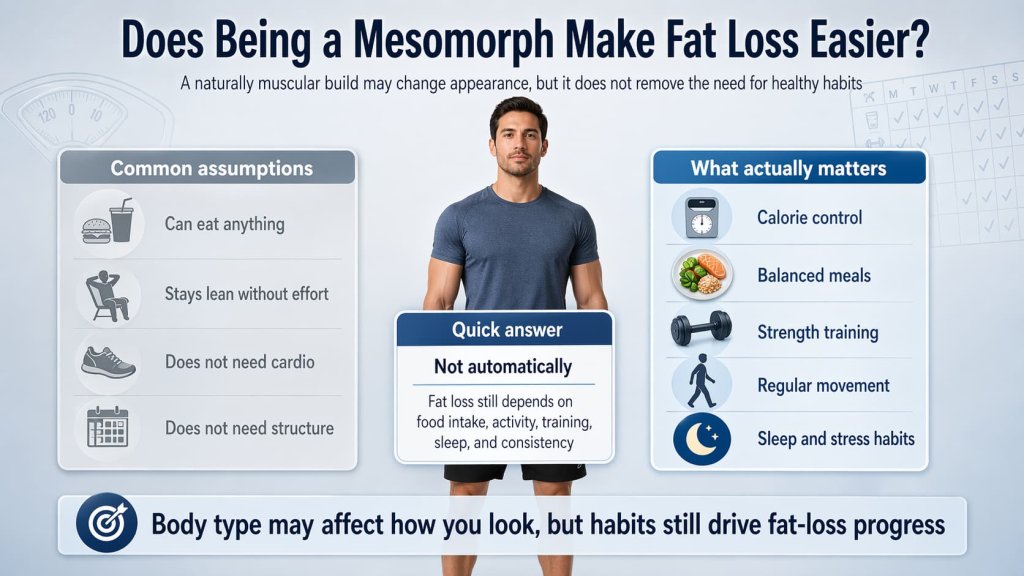
A better question than “Am I a mesomorph?” is usually this: “Can I follow a realistic plan long enough to lose fat without losing my energy, strength, or routine?” That is much closer to how official guidance approaches healthy weight management.
Mesomorph Myths That Are Not Supported
Here are the biggest claims to ignore:
- Mesomorphs need a unique food list or strict macro split. ACE says there are no hard-and-fast mesomorph diet rules, and the best plan is one a person can follow over the long term.
- Mesomorphs can eat anything they want. ACE says that is false; people with this body type can still gain fat like anyone else.
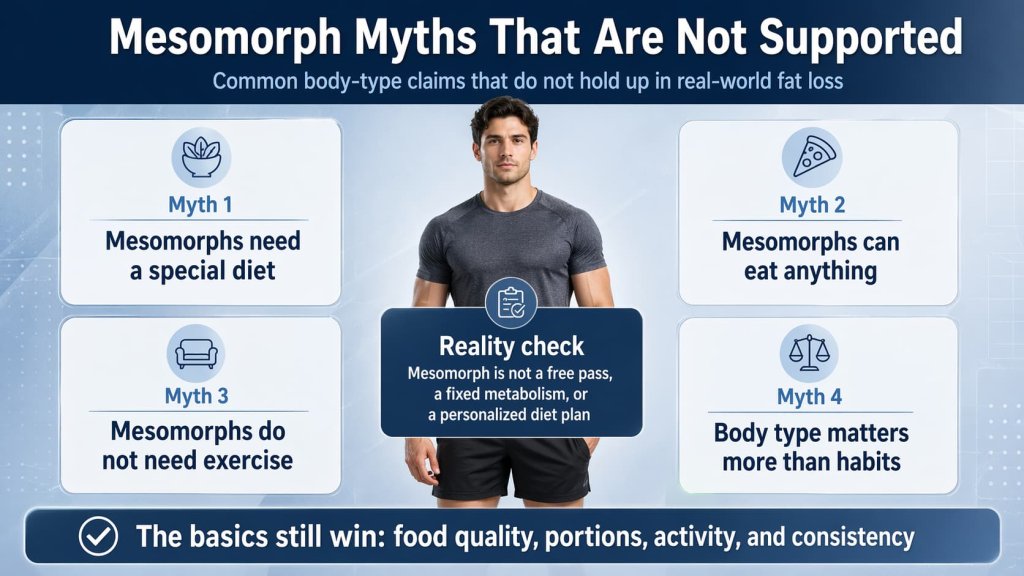
- Mesomorphs do not need exercise because they already look athletic. ACE says that is another myth, and outward appearance does not prove health.
- Cardio or lifting matters less if you are naturally muscular. CDC activity guidance still applies: adults need regular aerobic activity and muscle-strengthening work each week.
The Best Mesomorph Diet for Fat Loss
There is no official mesomorph diet from the CDC, USDA, or NIDDK. Current guidance instead points you toward a balanced eating pattern built around whole, nutritious foods and a calorie intake you can maintain long enough to see progress. The current Dietary Guidelines for Americans, 2025–2030 say the focus should be on whole, nutrient-dense foods while limiting highly processed foods, added sugars, and refined carbohydrates.
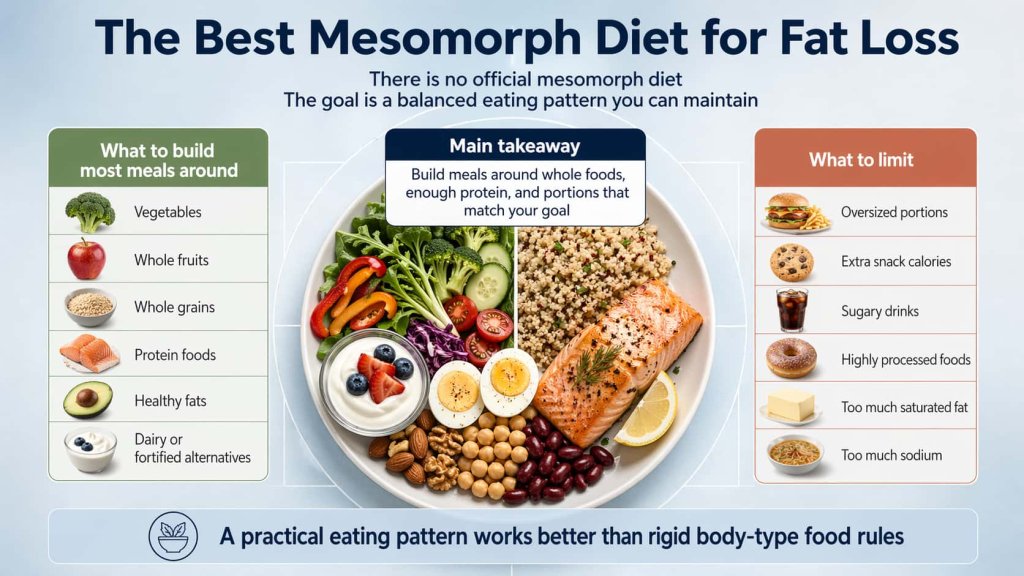
NIDDK says a healthy eating plan for weight loss should include vegetables, whole fruits, whole grains, dairy or fortified alternatives, protein foods, and certain oils. It also says adults who want to lose weight and keep it off should reduce calories from foods and beverages, while limiting added sugars to less than 10% of calories per day, saturated fat to less than 10% of calories per day, and sodium to less than 2,300 milligrams per day.
What to build most meals around
A practical mesomorph fat-loss diet should usually center on:
- Vegetables of all types
- Whole fruits more often than juice
- Whole grains such as oats, brown rice, and whole-wheat bread
- Protein foods such as poultry, eggs, seafood, beans, lentils, nuts, seeds, and soy foods
- Dairy or fortified alternatives that fit your needs
- Healthy fats from foods such as olive oil, nuts, seafood, and avocado
That usually works better than following a rigid body-type menu, because it gives you enough flexibility to eat well without turning every meal into a rule book. CDC also notes in its healthy eating guidance that comfort foods can still fit in limited amounts, which makes a fat-loss plan easier to live with.
What to limit
For fat loss and overall health, the main targets are still the usual ones:
- Extra calories you do not notice, especially from snacks, drinks, and oversized portions
- Added sugars above 10% of daily calories
- Saturated fat above 10% of daily calories
- Sodium above 2,300 mg per day
- A pattern built mostly around highly processed foods while vegetables, fruit, and protein get crowded out
Portion size deserves more attention than most body-type advice gives it. NIDDK explains in its guide to portion sizes and serving sizes that the two are not the same thing, and confusing them can quietly push calorie intake above your target. Reading the Nutrition Facts label, checking serving sizes, and being more deliberate with portions can make a bigger difference than trying to eat according to somatotype rules.
A simple example day
A mesomorph fat-loss day does not need to look extreme. One balanced example could be:
- Breakfast: Greek yogurt, berries, and oats
- Lunch: Chicken or lentil grain bowl with vegetables
- Snack: Fruit and a handful of nuts
- Dinner: Fish, tofu, or lean meat with potatoes or rice and a large serving of vegetables
The exact foods matter less than the pattern: meals built from mostly whole foods, enough protein foods to stay satisfied, and portions that match your goal.
How Much Should a Mesomorph Eat to Lose Fat?
There is no single calorie number for every mesomorph. Your intake depends on your age, sex, size, activity level, current intake, and goal pace. The NIDDK Body Weight Planner can help adults create a personalized calorie and physical-activity plan for a target weight and time frame.
For pace, the CDC says people who lose weight gradually, about 1 to 2 pounds per week, are more likely to keep it off than people who lose weight faster. CDC also notes that even modest weight loss can improve blood pressure, cholesterol, and blood sugar. For example, a 5% reduction in body weight can be meaningful for health.
That is why the best mesomorph diet for fat loss is usually not a crash cut. It is a plan that gives you steady progress while still leaving room for training, work, school, sleep, and real meals.
Another useful reality check is to track waist size, not just body weight. NIDDK says in its guidance on overweight and obesity that BMI and waist size together help assess weight-related health risk, and extra fat around the abdomen raises risk even in people who do not look obviously overweight. The CDC also notes that waist circumference above 35 inches in women and 40 inches in men is linked with higher health risk. That makes waist measurement especially useful when your goal is fat loss rather than simply seeing a lower number on the scale.
Training for Mesomorph Fat Loss
If you have mesomorphic traits, strength training is still worth keeping front and center. The goal is not only to burn calories, but also to keep the muscular look that often makes people identify with the mesomorph body type in the first place. Official guidance says adults need at least 150 minutes a week of moderate-intensity aerobic activity or 75 minutes of vigorous activity, plus muscle-strengthening work at least 2 days a week.
This matters because successful fat loss is not just about burning calories. The Physical Activity Guidelines for Americans say regular physical activity helps reduce abdominal fat and preserve muscle during weight loss. For people who identify with a mesomorph build, that is a strong reason to keep resistance training in the plan instead of focusing only on cardio or aggressive calorie cutting.
A simple fat-loss setup often includes:
- Regular walking or other aerobic work to help meet weekly activity targets
- Strength training at least two days per week for all major muscle groups
- Enough day-to-day movement that you are not sitting most of the time
The big takeaway is that a mesomorph workout for fat loss does not need to be exotic. Consistent lifting and enough weekly movement are a much stronger foundation than chasing a body-type routine.
Lifestyle Habits Matter More Than Somatotype
The CDC says healthy weight loss includes healthy eating patterns, regular physical activity, enough sleep, and stress management. It also recommends tracking where you are now, including nutrition, activity, sleep, and stress, because that makes it easier to see what needs to change.
That means mesomorph fat loss is not only about macros or workout splits. It is also about:
- Sleeping enough to support recovery and routine
- Managing stress so eating does not become purely reactive
- Planning meals ahead instead of relying on whatever is easiest
- Keeping track of habits long enough to spot patterns
Common Mesomorph Diet Mistakes
The most common mistakes are usually not biological. They are behavioral.
1. Assuming muscle means unlimited calories
ACE says mesomorphs can still gain fat, and CDC guidance makes clear that physically active people can still gain weight if they take in more calories than they use.
2. Following a plan you cannot maintain
NIDDK says the key to losing weight is choosing a healthy eating plan you can maintain over time. That one sentence is more useful than most body-type diet rules online.
3. Treating certain foods as automatically off limits
ACE specifically pushes back on the idea that people with mesomorphic traits need strict avoid-lists. CDC also notes that comfort foods can fit in limited amounts within a healthy eating pattern.
4. Letting the label matter more than progress
If your energy is crashing, your training is stalling, or your plan is making life harder to manage, the problem is not that you are “not mesomorph enough.” The problem is that the plan needs adjusting. That is exactly why official guidance centers on sustainable behavior, not physique labels.
Who Should Get Personalized Advice Before Trying to Lose Fat?
Get more individualized guidance before using any fat-loss plan if you are under 18, pregnant, breastfeeding, living with a chronic health condition, or taking medicines that affect weight. NIDDK states that its Body Weight Planner is for adults 18 and older and not for younger people or pregnant or breastfeeding women, and the CDC notes that medical conditions and medicines can affect weight management. NIDDK also advises talking with a health professional before starting regular physical activity if you have conditions such as heart disease, high blood pressure, or diabetes.
FAQ
Is mesomorph body type real?
It is real as a somatotype label used to describe physique, but it is not a medical diagnosis and not a reliable way to prescribe a one-size-fits-all diet. ACE says categorizing people this way should not replace an individualized approach.
What is the best mesomorph diet for fat loss?
The best mesomorph diet for fat loss is usually a balanced, calorie-aware eating pattern built from mostly whole foods that you can maintain. Official guidance emphasizes vegetables, fruits, whole grains, protein foods, healthy fats, and realistic long-term adherence.
Can mesomorphs gain belly fat?
Yes. ACE says people with mesomorphic traits can still gain fat, and CDC guidance makes clear that activity alone does not prevent weight gain if calorie intake stays too high.
Should mesomorphs cut carbs for fat loss?
Not automatically. Current official guidance focuses on total calorie intake and overall diet quality, not a special low-carb rule for mesomorphs. Whole grains and other nutrient-dense carbohydrate foods can still fit into a healthy fat-loss plan.
Is a mesomorph workout different from a normal fat-loss workout?
Not in any essential way. Adults still need regular aerobic activity and muscle-strengthening work each week. A solid mesomorph fat-loss plan is usually just a good basic plan done consistently.
Bottom Line
The mesomorph body type can be a useful description, but it should not run your diet. For fat loss, what matters most is not whether you fit a label, but whether your eating and activity plan is realistic enough to repeat week after week. Build meals around nutritious foods, keep calories appropriate for your goal, lift regularly, stay active, and focus on steady progress instead of body-type myths. That approach is more evidence-based, easier to sustain, and much more likely to work.
References
- American Council on Exercise — The Truth About Eating and Training With a Mesomorph Body Type
- National Institute of Diabetes and Digestive and Kidney Diseases — Eating and Physical Activity to Lose or Maintain Weight
- Centers for Disease Control and Prevention — Steps for Losing Weight
- Centers for Disease Control and Prevention — Tips for Healthy Eating for a Healthy Weight
- U.S. Department of Agriculture Food and Nutrition Service — Dietary Guidelines for Americans, 2025–2030
- National Institute of Diabetes and Digestive and Kidney Diseases — Body Weight Planner
- National Institute of Diabetes and Digestive and Kidney Diseases — Just Enough for You: About Food Portions
- Office of Disease Prevention and Health Promotion — Physical Activity Guidelines for Americans, 2nd edition