
A bunion is a progressive misalignment of the joint at the base of the big toe that creates a noticeable bump on the inside of the foot. The big toe gradually leans toward the smaller toes while the first metatarsal bone shifts in the opposite direction.

A bunion is not simply an extra piece of bone. It involves changes in the position of the joint, bones, tendons, and ligaments. Many bunions can be managed with wider shoes and other nonsurgical measures. Surgery is generally considered only when ongoing pain or loss of function does not improve with conservative care.
What Is a Bunion?
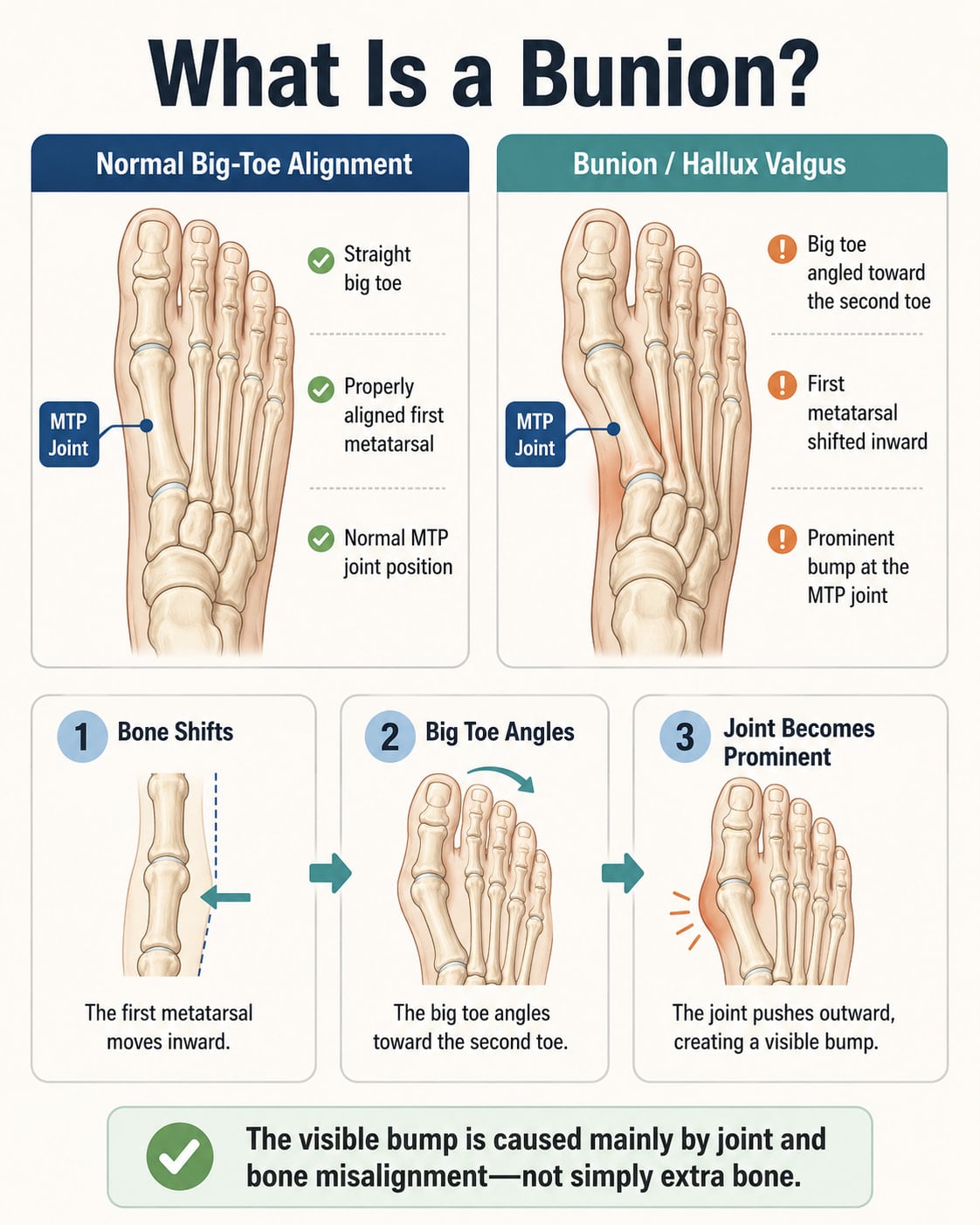
A bunion is the common name for the prominent bump associated with hallux valgus. “Hallux” refers to the big toe, while “valgus” describes its movement toward the other toes.
The bunion develops at the metatarsophalangeal joint, commonly called the MTP joint. This is where the first long bone of the foot meets the first bone of the big toe.
According to the American Academy of Orthopaedic Surgeons’ bunion guide, the condition usually develops slowly. As the bones shift out of alignment, the inside of the joint becomes more prominent and may be irritated by footwear.
What Happens to the Big-Toe Joint?
Three main changes occur as a bunion develops:
- The first metatarsal bone shifts toward the inside of the foot.
- The bones of the big toe angle toward the second toe.
- The MTP joint becomes more prominent on the inner side of the forefoot.
The surrounding soft tissues may also become unbalanced. Some ligaments and tendons become stretched, while others become tighter. This can encourage the toe to drift farther out of position over time.
Is a Bunion Just Extra Bone?
Not exactly. The bump is mainly created because the MTP joint and first metatarsal have moved out of their normal positions.
The joint may become enlarged, inflamed, and irritated. Additional bone or a swollen fluid-filled sac may sometimes contribute to the size of the bump, but the underlying problem is the change in alignment. Simply shaving down the bump does not usually correct that alignment.
Bunion vs. Bunionette
A bunion and a bunionette are similar deformities, but they develop in different locations.
| Condition | Location | Toe affected |
|---|---|---|
| Bunion | Inside of the foot | Base of the big toe |
| Bunionette | Outside of the foot | Base of the little toe |
A bunionette is also called a tailor’s bunion. It can cause redness, bursitis, corns, and calluses where the outside of the foot rubs against a shoe.
How Common Are Bunions?
Bunions are common, particularly among older adults and women.
A 2023 systematic review and meta-analysis that included 45 studies estimated that hallux valgus affects approximately 19% of people worldwide. The pooled estimates were about:
- 23.7% among females
- 11.4% among males
- 22.7% among adults older than 60
These are broad pooled estimates. Prevalence varied considerably among locations, age groups, and study methods, so the figures do not predict an individual person’s risk.
What Causes a Bunion?
There is usually no single cause. Bunions appear to develop through a combination of inherited foot structure, joint mechanics, medical conditions, and repeated pressure on the forefoot.
Genetics and Inherited Foot Structure
Some people inherit a foot shape or structure that makes the big-toe joint more likely to become unstable.
The AAOS reports that up to 70% of people who develop bunions have a family history of the condition. This does not mean a person directly inherits a bunion. Instead, they may inherit features such as joint shape, ligament flexibility, or foot mechanics that increase susceptibility.
Genetics may be particularly important when bunions develop during childhood or adolescence.
Narrow Shoes and High Heels
Narrow or sharply pointed shoes can crowd the toes and place repeated pressure over the big-toe joint. High heels shift more body weight toward the front of the foot, which can increase this pressure.
However, shoes are not necessarily the only cause. Current clinical understanding suggests that restrictive footwear may contribute to or aggravate a bunion in someone who is already susceptible because of their foot structure or biomechanics. Bunions can also occur in people who rarely wear high heels.
Medical and Structural Factors
Other factors that may contribute include:
- Inflammatory arthritis, including rheumatoid arthritis
- Neuromuscular conditions that affect muscle balance
- Abnormal alignment or instability within the foot
- Loose or flexible ligaments
- Age-related changes in joint structure
- A strong family history of bunions
Having one of these factors does not guarantee that a bunion will develop. Bunions are usually the result of several influences acting together.
What Does a Bunion Look and Feel Like?
The most recognizable sign is a bump at the base of the big toe. The big toe may also appear to lean toward the second toe.
Other bunion symptoms can include:
- Pain or tenderness over the bump
- Redness or swelling around the joint
- Pain that becomes worse in tight shoes
- Thick or hardened skin
- A corn over the bunion
- Calluses where the first and second toes rub together
- Stiffness in the big toe
- Reduced movement of the joint
- Pain under the ball of the foot
- Difficulty walking comfortably
- Difficulty finding shoes that fit
- The big toe crossing over or under the second toe
Symptoms can range from mild irritation after wearing certain shoes to persistent pain that limits walking and everyday activities.
Do All Bunions Hurt?
No. Some bunions remain painless or cause only occasional irritation.
The size of the bump does not always match the amount of pain. A relatively small bunion may hurt when it rubs against a shoe, while a visibly larger bunion may cause little discomfort.
Treatment decisions should therefore be based primarily on pain, shoe problems, and functional limitations—not appearance alone. A painless bunion may only need monitoring and appropriate footwear.
Do Bunions Get Worse Over Time?
Bunions often become more noticeable over time, but the rate of progression varies.
As the big toe moves farther toward the other toes, pressure within the forefoot may change. A more advanced bunion can contribute to:
- Overlapping or crossed toes
- Hammertoe deformities
- Corns and calluses
- Inflammation of the bursa, called bursitis
- Stiffness of the big-toe joint
- Arthritis within the joint
- Increasing difficulty wearing shoes
- Pain or difficulty during walking
Not every bunion becomes severely painful. Some people manage the condition for years without surgery by reducing pressure on the joint and wearing properly fitted shoes.
How Is a Bunion Diagnosed?
A healthcare professional can often identify a bunion by examining the foot. The evaluation may include checking:
- The position and movement of the big toe
- The location of pain and tenderness
- Skin irritation, corns, or calluses
- Joint flexibility and stiffness
- Foot shape and arch
- Walking pattern
- Whether the other toes have changed position
- The types of shoes that trigger symptoms
The clinician may also ask about family history, arthritis, previous injuries, daily activities, and how much the pain affects walking.
Standing Foot X-Rays
A standing, weight-bearing X-ray may be used to assess the alignment of the foot. Standing is important because the position of the bones can change when weight is placed on them.
An X-ray can help a clinician:
- Measure the degree of misalignment
- Determine the severity of the bunion
- Look for joint damage or arthritis
- Select an appropriate treatment
- Plan surgery when necessary
The appearance of the foot alone does not always reveal the full extent of the deformity.
Bunion Treatment Options
Bunion treatment depends on the severity of the symptoms rather than the size of the bump alone.
Most people begin with nonsurgical care. These measures are designed to reduce pressure, improve comfort, and maintain function. They do not reliably return an established bunion to normal alignment.
| Treatment | What it may help | Important limitation |
|---|---|---|
| Roomy shoes | Pressure, rubbing, and shoe discomfort | Does not straighten the joint |
| Bunion pads | Local tenderness and friction | A bulky pad may increase pressure |
| Orthotics | Pressure distribution and foot support | Does not remove the bunion |
| Toe spacers or splints | Temporary positioning or comfort | Does not permanently correct the deformity |
| Ice and activity changes | Temporary pain and swelling | Does not change bone alignment |
| Pain medication | Short-term pain and inflammation | Does not stop the structural deformity |
| Physical therapy or exercise | Mobility, strength, and function | Results vary; not a guaranteed correction |
| Surgery | Structural realignment and pain relief | Requires recovery and carries risks |
These realistic treatment goals are consistent with AAOS guidance: conservative care may reduce pain and sometimes limit worsening, but it cannot reliably reverse an established bunion.
1. Wear Shoes With a Wide Toe Box
Changing footwear is often the most useful first step.
Choose shoes that:
- Match the natural shape of your foot
- Have a wide and deep toe box
- Do not press directly against the bunion
- Have a stable, cushioned sole
- Have a low or moderate heel
- Allow the toes to move without being crowded
Try shoes on while standing, preferably later in the day when the feet may be slightly larger. Fit the shoe to your larger foot and leave approximately 3/8 to 1/2 inch between your longest toe and the end of the shoe.
Walk around before buying the shoes. Do not purchase a tight pair expecting it to stretch enough later.
2. Use Bunion Pads Carefully
Silicone, foam, or felt pads can cushion the bump and reduce friction against the inside of a shoe.
However, a thick pad takes up space. If the shoe is already narrow, adding padding may increase pressure rather than reduce it. Test a new pad for a short period and stop using it if pain, redness, or rubbing becomes worse.
3. Consider Orthotics, Toe Spacers, or Splints
Shoe inserts or orthotics may help redistribute pressure across the foot. They may be especially useful when other foot-mechanics problems contribute to discomfort.
Toe spacers sit between the first and second toes. Splints hold the big toe in a straighter position, often while resting or sleeping. These products may improve comfort for some people, but they should not be advertised as permanent bunion corrections.
AAOS notes that braces and splints have not been shown to permanently fix bunions. The toe usually returns toward its previous position after the device is removed.
4. Apply Ice and Modify Painful Activities
Wrapped ice may temporarily reduce discomfort and swelling after prolonged standing, walking, or exercise. Keep a cloth between the cold pack and your skin, and stop if the skin becomes painful, unusually pale, or numb.
You may also need to temporarily reduce activities that repeatedly irritate the joint. This does not necessarily mean avoiding all movement. Lower-impact activities and better-fitting footwear may allow you to stay active with less pressure on the bunion.
5. Use Pain Medication Appropriately
Nonsteroidal anti-inflammatory drugs, or NSAIDs, may help reduce pain and swelling for some people. Common examples include ibuprofen and naproxen.
These medicines are not suitable for everyone. Ask a healthcare professional or pharmacist before using them if you take other medications, have a medical condition, are pregnant, or are unsure whether an NSAID is safe for you. Follow the product label and do not use pain medication to repeatedly push through worsening foot pain.
6. Try Exercise or Physical Therapy
Exercises may support toe mobility, foot strength, balance, and walking function. A physical therapist or podiatrist may use movements such as gentle toe spreading, controlled big-toe movement, foot-muscle strengthening, and calf stretching.
A recent systematic review and network meta-analysis found that exercise may improve pain and measured alignment in some people with mild-to-moderate hallux valgus, particularly when exercise is combined with external support such as taping or a toe separator. However, programs and results varied, and this does not mean exercise will permanently reverse a fixed or advanced bunion.
Exercises should be comfortable and controlled. Do not forcefully pull, twist, or attempt to “pop” the big toe back into place. Stop if a movement causes sharp pain or makes the joint more inflamed.
Can a Bunion Go Away Without Surgery?
An established structural bunion generally does not disappear on its own.
Nonsurgical treatment may:
- Reduce pain
- Decrease rubbing and pressure
- Improve shoe comfort
- Support walking
- Maintain joint mobility
- Potentially slow progression
- Produce modest short-term improvements in mild cases
However, pads, orthotics, spacers, splints, and exercises do not consistently return the bones to normal alignment. Surgery is the treatment that directly repositions the bones of a fixed bunion.
That does not mean every bunion needs surgery. If the bunion is painless and does not limit your activities, observation and appropriate footwear may be all that is necessary.
When Is Bunion Surgery Considered?
Surgery may be considered when symptoms remain significant after a reasonable trial of nonsurgical treatment.
Possible reasons include:
- Persistent pain that limits walking
- Inability to wear reasonable shoes comfortably
- Ongoing swelling or inflammation
- Increasing stiffness of the big toe
- Difficulty completing work or daily activities
- The big toe crossing over or under another toe
- Worsening deformity combined with substantial symptoms
- Failure of footwear changes, padding, orthotics, and other conservative care
Bunion surgery is generally not recommended simply to improve the appearance of a painless foot or to prevent a bunion from becoming larger. The AAOS bunion surgery guide advises basing the decision on pain and functional limitations.
Common Types of Bunion Surgery
“Bunion surgery” is not a single operation. The procedure is selected according to the location and severity of the deformity, joint condition, age, activity needs, and X-ray findings.
Osteotomy
The surgeon cuts and repositions one or more bones. Screws, pins, or plates may be used to hold the bones in the corrected position while they heal.
Osteotomy is frequently combined with adjustments to the ligaments or tendons around the big toe.
Arthrodesis
Arthrodesis is a joint-fusion procedure. Damaged joint surfaces are removed, and the bones are held together until they fuse.
It may be considered for severe deformity, significant arthritis, instability, or a previous bunion operation that was unsuccessful.
Exostectomy
Exostectomy means removing or shaving down the bump.
It is rarely used by itself because it does not correct the underlying joint alignment. If only the bump is removed, the deformity may remain or return.
Open or Minimally Invasive Surgery
Open surgery uses a traditional incision. Minimally invasive surgery uses smaller openings and specialized instruments.
Minimally invasive procedures may produce less early swelling or a faster early recovery in selected patients, but they are not appropriate for every type of bunion. Long-term results may be similar to those of well-performed open procedures.
How Effective Is Bunion Surgery?
A 2024 Cochrane review included 25 studies involving 1,597 adults. It concluded that surgery may provide a clinically meaningful reduction in pain and small improvements in function and treatment satisfaction compared with no treatment or nonsurgical care.
However, the direct comparison was based largely on one study involving 140 participants, and the evidence was rated as low certainty. The review also found uncertainty about reoperation and adverse-event risks. Surgery can help selected patients, but it does not guarantee a pain-free foot or perfect alignment.
Bunion Surgery Recovery
Many bunion procedures are performed as same-day surgery, but the recovery period can be lengthy.
Depending on the procedure:
- Stitches may be removed after approximately two weeks.
- Dressings, a brace, or another form of support may be needed for 6 to 12 weeks.
- Some patients can bear weight early in a surgical shoe.
- Other patients must avoid putting weight on the foot for a period.
- Full recovery may take up to six months.
- Swelling may continue for six months to a year.
- Medical follow-up may continue for several months or, occasionally, up to a year.
Recovery instructions differ significantly among procedures. Putting weight on the foot too early can interfere with bone healing or cause the correction to shift.
Possible Surgical Risks
Potential complications include:
- Infection
- Nerve injury
- Persistent pain
- Delayed or failed bone healing
- Big-toe stiffness
- Hardware irritation
- Recurrence of the bunion
- Need for another operation
A surgeon should explain the expected benefits, limitations, recovery restrictions, and complication risks before the procedure.
Can You Prevent Bunions?
There is no guaranteed way to prevent every bunion, particularly when inherited foot structure is an important factor.
You may be able to reduce pressure and irritation by:
- Wearing shoes with a broad toe box
- Avoiding shoes that squeeze the toes
- Limiting prolonged use of high heels
- Replacing shoes that no longer fit properly
- Addressing repeated rubbing before the skin becomes damaged
- Seeking advice when pain or toe misalignment first appears
- Using appropriate inserts when recommended by a professional
These measures may support comfort and potentially slow symptom progression, but they cannot completely overcome genetic or structural susceptibility.
When Should You See a Doctor or Podiatrist?
Arrange an evaluation if the bunion:
- Continues to hurt despite wider shoes and basic self-care
- Limits walking, exercise, work, or daily activities
- Makes it difficult to find shoes that fit
- Is becoming noticeably worse
- Causes increasing stiffness
- Leads to overlapping or crossed toes
- Produces recurring corns, calluses, or skin irritation
- Causes pain under the ball of the foot
Seek prompt medical care for an open sore, drainage, rapidly increasing redness or swelling, fever, or other possible signs of infection. Foot problems also deserve earlier attention if you have diabetes, poor circulation, or reduced sensation in your feet.
A suddenly hot, red, swollen, and intensely painful big-toe joint should not automatically be assumed to be a bunion flare. Gout and joint infections can produce similar symptoms and may need different treatment. Gout attacks commonly begin suddenly and often affect the big toe.
Frequently Asked Questions
Is a bunion an extra bone?
A bunion is mainly caused by misalignment of the bones at the base of the big toe. Inflammation, thickened tissues, and some additional bone formation may add to the bump, but extra bone is not the entire problem.
Can a bunion corrector straighten a bunion permanently?
Bunion correctors, spacers, and splints may temporarily change the toe’s position or reduce pressure. They have not been shown to permanently straighten an established structural bunion.
Can a bunion go away naturally?
An established bunion usually does not disappear naturally. Wider shoes, padding, inserts, and appropriate exercises may improve comfort and function, but they do not reliably restore normal bone alignment.
Are bunions caused by tight shoes?
Tight, narrow, or pointed shoes can contribute to pressure and make bunions more painful. However, footwear is usually one part of the problem. Genetics, foot structure, and joint mechanics may also play important roles.
What type of shoe is best for a bunion?
Look for a shoe with a wide and deep toe box, a shape that matches your foot, a stable sole, and little or no direct pressure over the bump. Avoid buying shoes that already feel tight.
How do I know whether I need bunion surgery?
Surgery may be appropriate when pain significantly limits walking or daily life and does not improve after nonsurgical treatment. A painless bunion generally does not require surgery.
How can I tell a bunion from gout?
A bunion usually appears gradually as a persistent bump with progressive toe misalignment. A gout flare often begins suddenly with intense pain, warmth, redness, and swelling, frequently in the big-toe joint. A clinician should evaluate sudden or severe symptoms rather than relying on appearance alone.
Conclusion
A bunion is a structural change in the big-toe joint, not just a cosmetic bump. Genetics and foot mechanics often play important roles, while narrow shoes and high heels can increase pressure and aggravate symptoms.
Start with shoes that give your toes enough room. Pads, orthotics, spacers, activity changes, and appropriate exercises may also improve comfort. Seek professional advice when pain persists, walking becomes difficult, the toe is becoming stiff or crossed, or skin problems develop.
Surgery can realign the joint when a painful bunion does not respond to conservative care, but the decision should be based on symptoms, function, realistic expectations, and a careful discussion of recovery and risks.
This content is for informational purposes only and not medical advice.
References
- American Academy of Orthopaedic Surgeons: Bunions
- American Academy of Orthopaedic Surgeons: Bunion Surgery
- MedlinePlus Medical Encyclopedia: Bunions
- NCBI Bookshelf, StatPearls: Hallux Valgus
- Global Prevalence and Incidence of Hallux Valgus: Systematic Review and Meta-Analysis
- Cochrane Review: Surgical Interventions for Hallux Valgus and Bunions
- Effects of Exercise Combined With External Support on Hallux Valgus
- National Institute of Arthritis and Musculoskeletal and Skin Diseases: Gout