
The best leg exercises at home are simple, effective, and require no equipment—just your bodyweight. You can build strong quads, glutes, hamstrings, and calves right from your living room using proven movements like squats, lunges, bridges, and single-leg variations.
Understanding these exercises is important because lower-body strength supports daily activities such as walking, lifting, stair climbing, and maintaining balance. These moves also follow major recommendations from the CDC and ACSM, which advise strength training for all major muscle groups at least two days per week.
In this guide, you’ll learn 15 of the most effective at-home leg exercises, how to do them safely, common mistakes to avoid, and how to build your own routine.
Why Leg Exercises at Home Matter
Leg exercises at home matter because they strengthen the muscles you rely on every day—your quads, glutes, hamstrings, and calves—without needing equipment or a gym. Strong legs support balance, mobility, posture, and daily movements while helping reduce stress on your knees and lower back. At-home training also makes it easier to stay consistent and meet CDC recommendations for strength training at least two days per week.
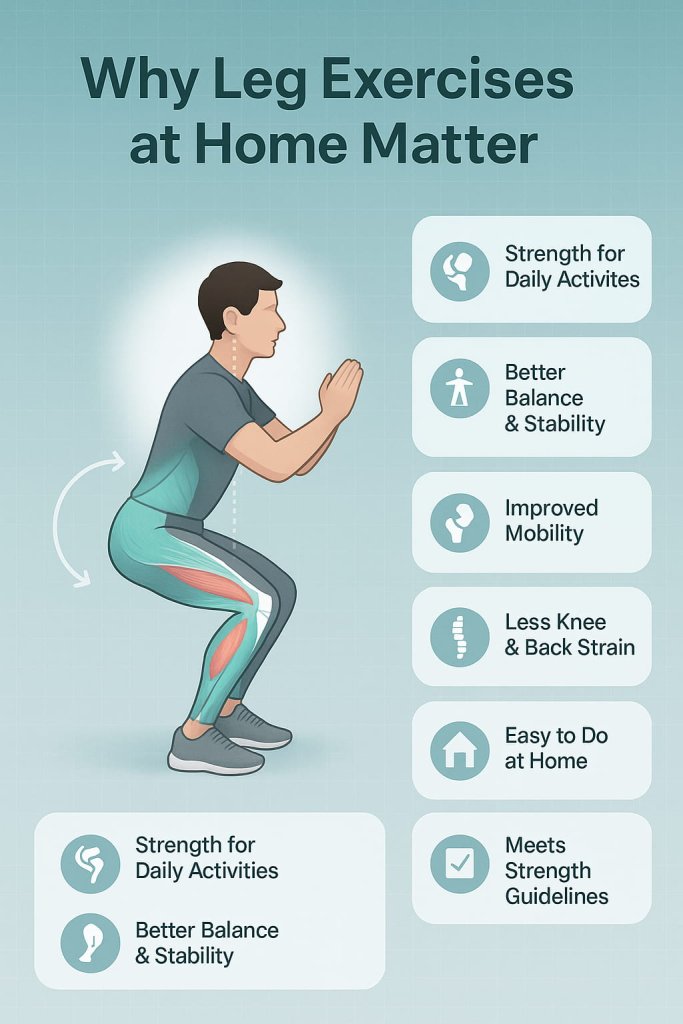
Key reasons they matter:
- Improve lower-body strength for daily activities
- Support better balance and stability
- Enhance mobility and joint function
- Reduce strain on knees, hips, and lower back
- Easy to perform consistently at home
- Require no equipment or gym access
- Help meet public health strength-training guidelines
How to Warm Up Before Leg Exercises at Home
A short 3–5 minute warm-up increases blood flow, activates muscles, and prepares your joints.
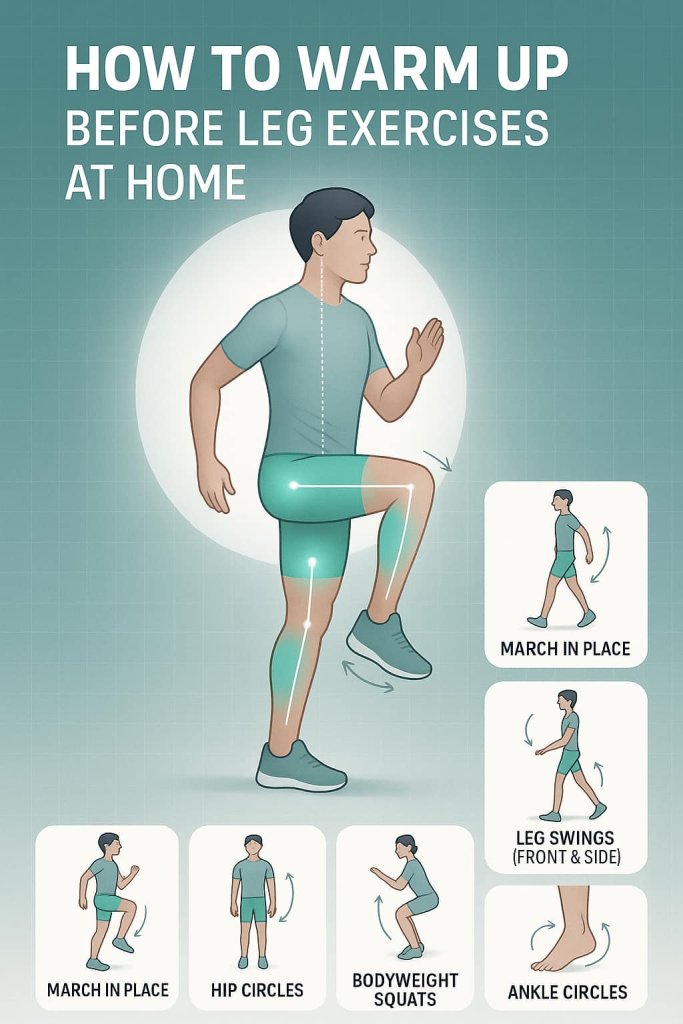
Try this simple routine:
- March in place – 30–45 seconds
- Leg swings (front and side) – 10 per direction
- Hip circles – 10 per side
- Bodyweight squats – 8–10 reps
- Ankle circles – 10 per side
15 Best Leg Exercises You Can Do at Home
Strengthen your quads, glutes, hamstrings, and calves without any equipment using these highly effective at-home leg exercises. Each move is beginner-friendly, safe, and designed to improve balance, mobility, and lower-body strength.
1. Bodyweight Squat
Why it works:
A foundational lower-body movement that builds strength in the quads, glutes, and hips while improving mobility and balance. Squats mimic everyday actions like standing and lifting, making them highly functional.
Muscles worked:
Quads, glutes, hamstrings, core, hips.
How to do it:
- Stand with feet shoulder-width apart.
- Brace your core and keep your chest lifted.
- Sit your hips back as if lowering onto a chair.
- Bend your knees and lower until thighs are parallel.
- Push through your heels to stand, squeezing your glutes.
Trainer Tip:
Keep your heels flat—if they lift, your stance may be too narrow.
2. Chair Squat
Why it works:
Helps beginners learn proper squat mechanics with a safe depth target. Reduces stress on the knees while reinforcing hip-hinge patterns.
Muscles worked:
Quads, glutes, hamstrings, core.
How to do it:
- Stand in front of a chair with feet hip-width apart.
- Gently tap your hips onto the chair without collapsing.
- Press through your heels to stand up with control.
- Repeat, maintaining a tall chest.
Trainer Tip:
Pause lightly—don’t sit fully or use momentum.
3. Reverse Lunge
Why it works:
A knee-friendly lunge variation that challenges balance and strengthens each leg individually, reducing strength imbalances.
Muscles worked:
Quads, glutes, hamstrings, calves, core.
How to do it:
- Step one foot backward.
- Lower until both knees reach roughly 90 degrees.
- Push through the front heel to return to standing.
- Alternate legs.
Trainer Tip:
Lean slightly forward over the front leg to activate glutes more.
4. Forward Lunge
Why it works:
Great for building functional strength and stability. Works multiple joints and muscles simultaneously.
Muscles worked:
Quads, glutes, hamstrings, calves, core.
How to do it:
- Step forward with one leg.
- Lower slowly until both knees bend.
- Push through the front heel to rise back.
- Switch legs each rep.
Trainer Tip:
Avoid over-striding—too long a step can stress your hips.
5. Glute Bridge
Why it works:
Targets the glutes and hamstrings while supporting lower-back stability. Ideal for beginners or those with knee discomfort.
Muscles worked:
Glutes, hamstrings, hip stabilizers, core.
How to do it:
- Lie on your back with knees bent, feet flat.
- Lift hips by squeezing your glutes.
- Hold briefly at the top.
- Lower slowly without arching your back.
Trainer Tip:
Drive through your heels and avoid pushing through your toes.
6. Hip Thrust (Floor or Sofa)
Why it works:
Provides deeper glute activation than bridges because of increased hip range of motion.
Muscles worked:
Glutes (all fibers), hamstrings, core.
How to do it:
- Rest upper back on a sofa or stay on the floor.
- Feet flat, knees bent.
- Drive hips upward to a flat torso position.
- Pause, then lower slowly.
Trainer Tip:
Tuck your chin slightly to prevent over-arching.
7. Wall Sit
Why it works:
An isometric strength exercise that builds quad endurance and improves knee stability.
Muscles worked:
Quads, glutes, calves.
How to do it:
- Stand against a wall and slide down.
- Stop when your knees are at 90 degrees.
- Hold for 20–45 seconds.
- Keep feet flat and core engaged.
Trainer Tip:
Push knees outward gently to maintain alignment.
8. Step-Up
Why it works:
Replicates stair climbing and strengthens each leg independently. Excellent for balance, stability, and functional power.
Muscles worked:
Quads, glutes, hamstrings, calves.
How to do it:
- Use a stable step or staircase.
- Step up with one foot.
- Bring your other foot to meet it.
- Step back down and repeat.
Trainer Tip:
Avoid pushing off the back foot—use your lead leg.
9. Bulgarian Split Squat
Why it works:
One of the most effective single-leg exercises for strength, stability, and glute development.
Muscles worked:
Glutes, quads, hamstrings, calves, core.
How to do it:
- Place your rear foot on a chair or sofa.
- Step the front leg forward.
- Lower straight down until the front thigh is parallel.
- Push through the front heel to rise.
Trainer Tip:
Keep your stride long to emphasize glutes; shorter to target quads.
10. Single-Leg Romanian Deadlift
Why it works:
Improves balance and strengthens the posterior chain without weights.
Muscles worked:
Hamstrings, glutes, calves, core.
How to do it:
- Stand tall on one leg.
- Hinge at the hips while the other leg extends back.
- Lower torso until parallel to the floor.
- Return to standing.
Trainer Tip:
Keep hips square—avoid letting one side rotate outward.
11. Side-Lying Leg Raise
Why it works:
Targets the outer glutes, which improve hip stability and knee alignment.
Muscles worked:
Glute medius, hip stabilizers, obliques (slightly).
How to do it:
- Lie on your side with legs stacked.
- Lift the top leg upward.
- Lower slowly without touching the bottom leg.
Trainer Tip:
Turn toes slightly downward to isolate the glutes.
12. Donkey Kicks
Why it works:
Great for activating and strengthening the glutes, especially the glute maximus.
Muscles worked:
Glutes, hamstrings, core.
How to do it:
- Kneel on hands and knees.
- Lift one leg upward toward the ceiling.
- Lower with control.
- Repeat on both sides.
Trainer Tip:
Keep your core tight—don’t let your lower back sag.
13. Fire Hydrants
Why it works:
Strengthens outer glutes and improves hip mobility, aiding in knee and ankle stability.
Muscles worked:
Glute medius, glute minimus, hip stabilizers, core.
How to do it:
- Start on hands and knees.
- Lift one knee out to the side like a “hydrant” motion.
- Pause, then lower.
Trainer Tip:
Avoid rotating your torso—movement should come from the hip.
14. Calf Raises
Why it works:
Strengthens the calf muscles and improves ankle stability, crucial for walking, running, and balance.
Muscles worked:
Gastrocnemius, soleus, ankles.
How to do it:
- Stand tall with feet hip-width apart.
- Lift heels off the ground.
- Pause at the top.
- Lower slowly.
Trainer Tip:
Perform the movement barefoot for better foot activation.
15. High Knees / Marching
Why it works:
Boosts heart rate while strengthening hip flexors, quads, and core. Works well as a warm-up or conditioning exercise.
Muscles worked:
Hip flexors, quads, calves, core.
How to do it:
- Run or march in place.
- Lift knees to hip height.
- Maintain rhythm and control.
Trainer Tip:
Keep your posture tall to prevent hip and lower-back strain.
How to Train Your Legs at Home (Beginner-Friendly Routine)
Try this simple routine 2–3 days per week:
| Exercise | Reps | Sets |
|---|---|---|
| Squats | 10–15 | 2–3 |
| Reverse Lunges | 8–12/leg | 2–3 |
| Glute Bridge | 12–15 | 2–3 |
| Step-Ups | 10–12/leg | 2 |
| Calf Raises | 15–20 | 2–3 |
| Wall Sit | 20–40 sec | 1–2 |
Rest 45–90 seconds between sets.
How to Make Leg Exercises Harder at Home
Increase difficulty using:
- More reps
- More sets
- Slower tempo
- 2–3 second holds at the bottom
- Single-leg variations
- Adding elevation (steps/sofa)
- Decreasing rest time
Research shows that bodyweight training can build strength when intensity and progression are properly applied.
Common Mistakes to Avoid
- Knees collapsing inward during squats or lunges
- Using momentum instead of controlled movement
- Arching lower back during bridges or donkey kicks
- Leaning too far forward during step-ups
- Going too fast and losing form
- Skipping warm-up or jumping into advanced variations too soon
Maintaining proper form helps prevent injuries and ensures muscle activation.
Who Should Avoid or Modify These Exercises
Modify or seek guidance if you have:
- Recent knee, hip, or lower-back injuries
- Balance limitations
- Joint pain during movement
- Post-surgery recovery without medical clearance
Always consult a qualified professional if you’re unsure.
Safety Tips for Leg Workouts at Home
Safety is essential when performing leg exercises at home, especially if you’re new to training or have existing knee, hip, or lower-back concerns. Following proper safety guidelines helps reduce injury risk and ensures you get the full benefit of each movement.
Here are important safety tips to follow:
- Warm up for 3–5 minutes before starting to increase blood flow and prepare joints.
- Use proper form—keep knees aligned with toes, engage your core, and avoid rounding your back.
- Start with easier variations such as chair squats, supported lunges, or shallow ranges of motion.
- Work on a stable, non-slip surface to prevent slipping or losing balance.
- Keep your workout area clear of clutter, pets, or obstacles.
- Use a chair or wall for balance during single-leg exercises if needed.
- Avoid pushing through sharp pain in the knees, hips, or lower back.
- Progress gradually, increasing volume or difficulty only when movements feel comfortable.
- Stop immediately if you experience dizziness, numbness, or sudden pain.
- Consult a qualified professional if you have recent injuries, mobility limitations, or medical concerns before starting new exercises.
These safety practices make at-home leg training more effective, controlled, and suitable for all fitness levels, helping you train with confidence.
Frequently Asked Questions
1. Can I build leg muscle at home without equipment?
Yes. Research shows bodyweight training can improve strength and muscle when you train close to fatigue.
2. How often should I do leg workouts at home?
Aim for 2–3 days per week, following CDC and ACSM guidelines.
3. Are lunges better than squats?
Both are effective. Lunges train each leg individually; squats hit both legs together.
4. How long until I see results?
Most people notice progress in 3–6 weeks with consistent effort.
5. Are these exercises safe for beginners?
Yes—start with chair squats, glute bridges, and marching if you are new.
6. Should I stretch after leg workouts?
Light stretching may help with flexibility and comfort.
Conclusion
Training your legs at home is simple, accessible, and highly effective. With these 15 no-equipment exercises, you can build strength, improve balance, and support daily function without ever going to the gym.
Start with the beginner routine, progress steadily, and stay consistent.
Your strongest legs can be built right at home.
References
- Youdas et al. – EMG Analysis of Gluteus Maximus and Hamstring Activity During Bridge Variations
https://pubmed.ncbi.nlm.nih.gov/28095102/ - Bodyweight Training for Muscular Strength & Endurance – Mini-Review (2022)
https://www.researchgate.net/publication/364308569_Bodyweight_Training_for_Muscular_Strength_Endurance - Liu et al. (2025) – Body-Weight-Based Resistance Training for Lower-Limb Strength and Balance in Older Women
https://www.mdpi.com/2075-4663/13/1/8 - Yang et al. – Overview of Current Physical Activity Guidelines (2019 Review)
https://pmc.ncbi.nlm.nih.gov/articles/PMC6536904/