
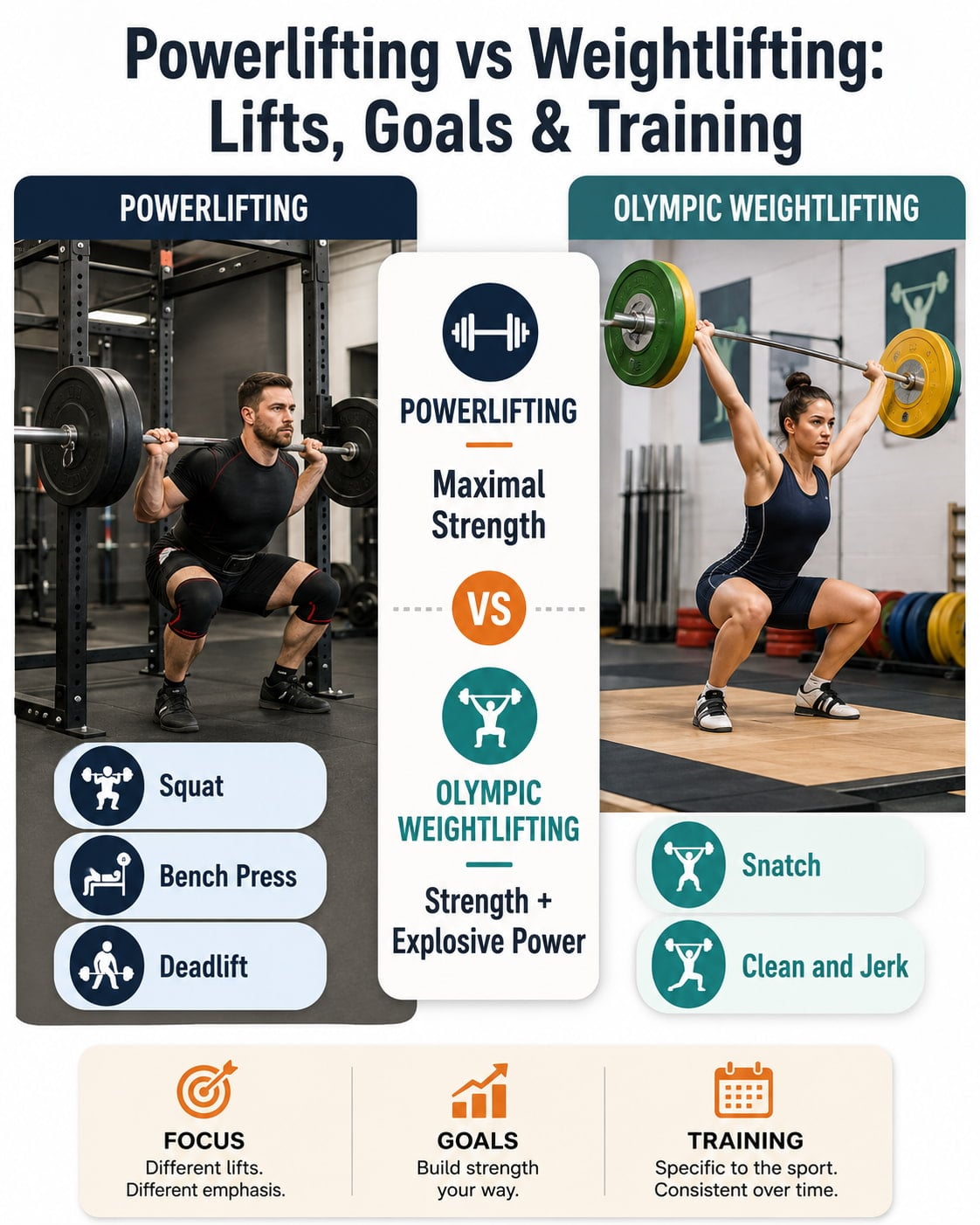
Powerlifting and weightlifting are different strength sports: powerlifting tests the squat, bench press, and deadlift, while Olympic weightlifting tests the snatch and clean and jerk. Powerlifting primarily emphasizes maximal strength. Weightlifting combines strength with explosive power, speed, coordination, mobility, and precise overhead technique.
Understanding the difference between powerlifting vs weightlifting can help you choose the right lifts, gym, coach, and training plan. Powerlifting may suit you better if you want to maximize your strength in three familiar barbell exercises. Olympic weightlifting may be a better match if you want to learn fast, technical movements and develop explosive power.
Powerlifting vs Weightlifting at a Glance
| Comparison | Powerlifting | Olympic Weightlifting |
|---|---|---|
| Competition lifts | Squat, bench press, and deadlift | Snatch and clean and jerk |
| Attempts | Three attempts per lift; nine total | Three attempts per lift; six total |
| Competition score | Best squat + best bench press + best deadlift | Best snatch + best clean and jerk |
| Main goal | Lift the greatest total weight in the three powerlifts | Lift the greatest total weight in the two Olympic lifts |
| Primary qualities | Maximal strength, bracing, stability, and lift-specific technique | Strength, explosive power, speed, timing, coordination, and mobility |
| Typical bar speed | May become very slow near a maximum attempt | Must be accelerated quickly enough to move and receive the bar |
| Overhead lifting | Not part of the competition | Central to both competition lifts |
| Common training exercises | Squats, bench presses, deadlifts, lift variations, and accessory exercises | Snatches, clean and jerks, pulls, squats, power variations, and technical drills |
| Learning curve | Generally simpler to begin, although difficult to master | Usually requires more technical instruction from the start |
| Major international event | The World Games | The Olympic Games |
Both sports involve attempting the heaviest successful barbell lifts within a bodyweight category. However, the movements, judging standards, physical demands, and training methods are substantially different.
What Is Powerlifting?
Powerlifting is a competitive strength sport built around three barbell exercises performed in this order:
- Squat
- Bench press
- Deadlift
A competitor normally receives three attempts at each lift. The heaviest successful squat, bench press, and deadlift are added together to produce the athlete’s total.
For example, a lifter who completes a 180-kilogram squat, a 120-kilogram bench press, and a 220-kilogram deadlift earns a 520-kilogram total.
The International Powerlifting Federation’s current technical rules became effective on March, 2026. Exact commands, equipment rules, weight classes, and judging requirements can differ among federations, so competitors should always read the rulebook for their specific meet.
The Squat
In the powerlifting squat, the athlete supports a loaded barbell across the back, waits for the referee’s command, descends to the required depth, and returns to a stable standing position.
The athlete must demonstrate sufficient depth, complete the ascent, and follow the referee’s commands. A squat that feels successful in the gym may still be rejected in competition if it is too shallow, the athlete loses balance, or the bar is returned to the rack before the command.
The Bench Press
The athlete lies on a competition bench and lowers the barbell to the chest or abdominal area. After the required pause and referee’s signal, the athlete presses the bar to the completed position and waits for the rack command.
Competition bench pressing is therefore different from quickly touching the bar to the chest during a regular gym workout. Pausing the bar, maintaining the required body position, and following the commands are part of the lift.
The Deadlift
The deadlift begins with the barbell on the floor. The athlete pulls it to a fully upright position, demonstrates control, and waits for the down command before returning the bar to the platform.
The deadlift is performed last, so it often determines the final rankings in a close competition. The official IPF overview describes the basic performance standards for all three lifts.
Classic vs Equipped Powerlifting
Powerlifting also has different equipment divisions.
Classic powerlifting, commonly called raw powerlifting, permits a limited amount of supportive equipment under the applicable federation’s rules. Athletes commonly use items such as a lifting belt, wrist wraps, knee sleeves, a singlet, and appropriate shoes.
Equipped powerlifting permits specialized supportive garments, such as squat or deadlift suits and bench shirts. These garments can affect lifting technique and allow trained equipped lifters to handle more weight.
The International World Games Association included both classic and equipped powerlifting at The World Games 2025. Classic powerlifting made its first World Games appearance at that edition.
What Is Olympic Weightlifting?
In this comparison, weightlifting means the competitive sport of Olympic weightlifting, not the general activity of exercising with weights.
Olympic weightlifting contains two competition lifts:
- Snatch
- Clean and jerk
Both movements take the barbell from the floor to a stable overhead position. The difference is how the athlete gets it there.
The Snatch
The snatch moves the barbell from the floor to overhead in one continuous movement.
The athlete accelerates the bar upward, rapidly moves under it, receives it overhead, and then stands under control. A wide grip reduces the distance the bar must travel overhead, but it also creates substantial demands on shoulder stability, balance, coordination, and technique.
The snatch is usually the lighter of the two Olympic lifts, but it is often considered the more technically sensitive movement.
The Clean and Jerk
The clean and jerk moves the bar overhead in two stages.
During the clean, the athlete lifts the bar from the floor and receives it on the front of the shoulders. The athlete then stands and prepares for the jerk, using the legs and arms to drive the bar overhead before receiving it in a split or other permitted position.
The athlete must then bring the feet into line and become motionless before the lift is completed.
Olympic Weightlifting Scoring
Each athlete receives three snatch attempts and three clean-and-jerk attempts. The heaviest successful snatch and heaviest successful clean and jerk are added together.
For example, an athlete with a 100-kilogram snatch and a 130-kilogram clean and jerk earns a 230-kilogram total.
An athlete needs at least one successful lift in both events to record a total. Missing all three attempts in either lift is commonly called “bombing out.”
The official LA28 Olympic weightlifting overview confirms the two-lift format, three attempts per lift, and weightlifting’s emphasis on power, coordination, strength, and technique.
Important 2026 Weight-Class Update
The International Weightlifting Federation introduced new senior and junior bodyweight categories effective August, 2026.
The current senior and junior categories are:
| Men | Women |
|---|---|
| 60 kg | 49 kg |
| 65 kg | 53 kg |
| 70 kg | 57 kg |
| 75 kg | 61 kg |
| 85 kg | 69 kg |
| 95 kg | 77 kg |
| 110 kg | 86 kg |
| Over 110 kg | Over 86 kg |
The USA Weightlifting weight-class resource confirms the August, 2026 implementation date. The official entry list for the 2026 IWF World Championships also uses these eight categories for men and women.
Not every IWF bodyweight category will be contested at the Olympic Games. LA28 currently lists six men’s and six women’s medal categories, so athletes should distinguish between general IWF classes and the Olympic event program.
Powerlifting vs Weightlifting: The Main Differences
Competition Goals
A powerlifter’s goal is to build the highest possible total across the squat, bench press, and deadlift.
A weightlifter’s goal is to build the highest possible total across the snatch and clean and jerk.
Both sports reward the amount of weight lifted. However, a weightlifter cannot rely on strength alone. The athlete must apply that strength rapidly while maintaining an efficient bar path and moving into an accurate receiving position.
Maximal Strength vs Explosive Power
Powerlifting is the more direct test of maximal strength in slow, heavy barbell movements. Near-limit squats, bench presses, and deadlifts may take several seconds to complete.
Olympic weightlifting also requires very high strength levels, especially in the legs, hips, and back. The difference is that the athlete must generate force quickly enough to accelerate the bar and move underneath it.
This makes weightlifting especially relevant to athletes interested in speed-strength, jumping, sprinting, and explosive movement. It does not mean powerlifters lack power or that weightlifters lack maximal strength. Each sport simply gives those qualities a different level of importance.
Technique and Coordination
Powerlifting technique focuses on creating stable, repeatable positions that allow the athlete to move the most weight while meeting competition rules.
Important skills include:
- Bracing the torso
- Controlling the bar path
- Maintaining balance
- Using efficient leverage
- Following commands
- Reaching the required positions
Weightlifting includes all the challenge of controlling a heavy bar, plus rapid changes in body position. The athlete must coordinate the pull, leg drive, bar turnover, foot movement, receiving position, and recovery.
For this reason, Olympic weightlifting generally has a steeper initial learning curve. Powerlifting is usually easier to begin, but performing the three lifts efficiently at an advanced level still requires considerable technical skill.
Mobility Requirements
Both sports require enough mobility to reach safe, legal positions.
Powerlifters need sufficient hip, knee, and ankle mobility to reach squat depth. They also need enough shoulder and upper-body mobility to establish a secure squat grip and bench press position.
Olympic weightlifters usually face greater overall mobility demands. The snatch may require a deep squat with a wide overhead grip, while the clean requires a stable front-rack position. The jerk also requires secure overhead positioning and, for many lifters, a balanced split stance.
Mobility should support the required movement rather than become a goal by itself. Individual anatomy influences grip width, stance, receiving position, and the amount of mobility each athlete needs.
Muscles Emphasized
Both sports train the entire body, but their competition lifts create different emphases.
Powerlifting places substantial demands on the:
- Quadriceps, glutes, and hamstrings
- Chest, shoulders, and triceps
- Spinal erectors and abdominal muscles
- Upper back and grip
Olympic weightlifting places substantial demands on the:
- Quadriceps, glutes, and hamstrings
- Upper back and trapezius
- Shoulders and triceps
- Core and spinal stabilizers
- Forearms and grip
The bench press gives powerlifting a direct horizontal pressing event. Weightlifting has no bench press event, but both Olympic lifts demand overhead support and full-body coordination.
Equipment and Training Environment
A powerlifting gym normally needs a strong rack, adjustable bench, barbell, plates, safety arms, and space for deadlifting.
A weightlifting facility needs a lifting platform, bumper plates, a barbell with rotating sleeves, and enough clear space to receive and safely drop the bar.
Weightlifting shoes usually have a raised, firm heel to support deep receiving positions. Powerlifters choose footwear according to the lift and personal technique. Some use raised-heel shoes for squats, while others prefer flat, firm footwear.
Before joining a gym, check whether it allows overhead lifting and controlled barbell drops. Many commercial gyms have racks and benches but are not designed for Olympic weightlifting.
Olympic and World Games Status
Olympic weightlifting is part of the Los Angeles 2028 Olympic program. The competition will include the snatch and clean and jerk.
Powerlifting is not currently an Olympic sport. International Powerlifting Federation competition is included in The World Games, where both classic and equipped powerlifting were contested in 2025.
How Powerlifting Training Works
Powerlifting training is designed to improve performance in the squat, bench press, and deadlift. Most programs combine competition-lift practice with variations and accessory exercises.
A powerlifting program may include:
- Competition-style squats, bench presses, and deadlifts
- Paused, tempo, close-grip, deficit, or block variations
- Rows, pull-downs, and upper-back exercises
- Triceps, hamstring, quadriceps, and glute work
- Bracing and trunk-strength exercises
- Planned reductions in volume before a competition
Powerlifters do not need to test a maximum every week. Most productive training is performed below maximal effort so the athlete can complete enough quality practice without creating excessive fatigue.
The American College of Sports Medicine’s 2026 resistance-training guidance emphasizes that programming should match the individual’s goals and ability to train consistently. Its evidence review notes that heavier loads are particularly useful for maximizing strength, while higher weekly volume is more relevant when muscle growth is the priority.
Example Three-Day Powerlifting Schedule
This is a general illustration, not an individualized program.
| Day | Main Work | Supporting Work |
|---|---|---|
| Day 1 | Squat and bench press | Row and trunk exercise |
| Day 2 | Deadlift and lighter press | Single-leg and hamstring exercise |
| Day 3 | Squat variation and bench variation | Upper-back, glute, and triceps work |
Beginners should use loads they can control consistently. The first goal is to repeat technically sound lifts, not to copy the weight or training volume of an experienced competitor.
How Olympic Weightlifting Training Works
Olympic weightlifting training combines technical practice with strength development.
A typical session may begin with the snatch, clean and jerk, or a related drill while the athlete is physically and mentally fresh. Squats, pulls, presses, and accessory exercises usually follow.
Common exercises include:
- Full snatches
- Full clean and jerks
- Power snatches and power cleans
- Hang or block variations
- Snatch pulls and clean pulls
- Front squats and back squats
- Push presses and jerk variations
- Overhead stability exercises
Coaches commonly divide the lifts into smaller parts before combining them. A beginner may practice the receiving position, bar path, pull from the floor, and turnover separately.
Technical lifts should not become slow, uncontrolled repetitions. When speed, balance, or receiving position deteriorates, reducing the load is often more useful than forcing another heavy attempt.
Example Three-Day Weightlifting Schedule
| Day | Technical Work | Strength Work |
|---|---|---|
| Day 1 | Snatch drills or power snatch | Overhead squat and back squat |
| Day 2 | Clean and jerk drills | Front squat and clean pull |
| Day 3 | Power snatch, power clean, and jerk practice | Back squat and upper-back work |
A qualified weightlifting coach can help beginners learn how to receive the bar, bail safely, use bumper plates, and progress from simple drills to the full lifts.
Which Sport Is Better for Your Goal?
| Your Main Goal | Better Match |
|---|---|
| Increase your squat, bench press, and deadlift | Powerlifting |
| Demonstrate maximal strength | Powerlifting |
| Develop explosive barbell power | Olympic weightlifting |
| Learn the snatch and clean and jerk | Olympic weightlifting |
| Improve overhead receiving skill | Olympic weightlifting |
| Build muscle | Either, with sufficient training volume |
| Develop general strength | Either |
| Begin with less complex competition lifts | Powerlifting |
| Compete in an Olympic sport | Olympic weightlifting |
Which Builds More Strength?
Powerlifting is the more direct choice when “strength” means lifting the heaviest possible squat, bench press, or deadlift. Its training is specifically organized around improving those three one-repetition maximums.
Weightlifters also develop exceptional strength, particularly in squats, pulls, and overhead support. However, their competition performance depends on how effectively they express strength through the snatch and clean and jerk.
Which Develops More Power?
Olympic weightlifting has the clearer advantage for explosive barbell power. The athlete must accelerate the bar quickly and coordinate a rapid transition into the receiving position.
Powerlifters can also use explosive intent during training, but their competition lifts are not judged by speed. A slow squat, bench press, or deadlift can still be successful if it meets the rules.
Which Is Better for Building Muscle?
Either sport can support muscle growth, but neither is specifically a bodybuilding system.
Powerlifting training often includes more bench pressing and controlled accessory exercises, making it relatively easy to add training volume for the chest, triceps, back, legs, and hips.
Weightlifting develops the legs, hips, upper back, shoulders, and trunk through frequent squats, pulls, and overhead lifts. Weightlifters may add targeted accessory exercises when muscle growth or structural balance is a priority.
The sport name matters less than total training volume, exercise selection, effort, nutrition, recovery, and consistency. ACSM’s 2026 guidance notes that higher weekly volume is generally more relevant for optimizing hypertrophy than simply choosing the heaviest possible load.
Which Is Better for General Fitness?
Both can be effective forms of resistance training, but you do not have to compete or perform maximum attempts to benefit.
Choose the style you enjoy, can perform safely, and can practice consistently. Someone interested in basic strength may prefer a simplified powerlifting-style program. Someone who enjoys fast athletic movements may find weightlifting practice more engaging.
Which Is Easier for Beginners?
Powerlifting is generally easier to begin because its competition lifts involve fewer rapid transitions and no overhead receiving phase.
That does not make heavy powerlifting simple or risk-free. Beginners still need to learn bracing, bar control, appropriate depth, safe bench press setup, and correct use of racks and safety equipment.
Olympic weightlifting usually requires more instruction at the beginning. An athlete may need to develop the front-rack position, overhead stability, squat mobility, pulling mechanics, and safe receiving technique before attempting meaningful loads.
A useful beginner progression is:
| Powerlifting Foundation | Weightlifting Foundation |
|---|---|
| Bodyweight or goblet squat | Front squat position |
| Controlled hip hinge | Overhead squat position |
| Push-up or dumbbell press | Snatch-grip overhead support |
| Light barbell squat | Clean and snatch pulls |
| Bench press with safeties | Technique work with a dowel or empty bar |
| Light deadlift | Power variations before full lifts |
Beginners in either sport should avoid frequent one-repetition maximum testing. Build movement quality first, then increase the load gradually.
Can You Combine Powerlifting and Weightlifting?
Yes. You can train powerlifting and Olympic weightlifting together, especially when your goal is broad strength and athletic development rather than peak competition performance.
However, training all five competition lifts equally can become demanding. It is usually better to choose one primary goal and use selected lifts from the other sport as supporting work.
For example, a powerlifter might use clean pulls, jumps, or power cleans to develop explosiveness. A weightlifter might use deadlifts, bench presses, or other controlled strength exercises as accessories.
A simple hybrid week could look like this:
| Day | Training Focus |
|---|---|
| Day 1 | Snatch technique, squat, and upper-back work |
| Day 2 | Bench press, deadlift, and trunk work |
| Day 3 | Clean and jerk technique, front squat, and pressing |
Perform fast technical lifts early in the session, before fatigue affects timing and coordination. Avoid trying to peak your squat, bench press, deadlift, snatch, and clean and jerk simultaneously unless an experienced coach has designed the program.
Powerlifting vs Weightlifting Injury Risk
Neither sport is automatically safe or dangerous. Injury risk depends on factors such as training load, experience, technique, fatigue, equipment, prior injuries, and coaching.
A 2024 systematic review in BMJ Open Sport & Exercise Medicine reported the following injury-incidence ranges:
- Olympic weightlifting: 2.4–3.3 injuries per 1,000 training hours
- Powerlifting: 1.0–4.4 injuries per 1,000 training hours
These ranges overlap. The researchers cautioned that direct comparisons were difficult because the included studies used different populations, settings, and definitions of injury. The evidence therefore does not establish that one sport is universally safer than the other.
Frequently reported areas included the knees, lower back, shoulders, and hands or fingers in weightlifting. In powerlifting, commonly reported areas included the lower back or pelvis, shoulders, and elbows or upper arms. These are group-level research findings, not predictions about what will happen to an individual athlete.
Practical Safety Guidelines
- Learn the movements with light, controllable resistance.
- Increase weight gradually rather than making large jumps.
- Use safety arms or competent spotters for squats and bench presses.
- Do not bench press alone without an appropriate safety setup.
- Use bumper plates and a suitable platform for Olympic lifts.
- Practice how to move away from a missed Olympic lift.
- Stop a set when technique becomes uncontrolled.
- Allow enough recovery between demanding sessions.
- Avoid copying advanced programs designed for experienced competitors.
- Seek professional assessment for persistent pain, repeated instability, numbness, or an injury that changes your movement.
People with an existing injury, cardiovascular condition, uncontrolled blood pressure, pregnancy-related restrictions, or another medical concern should obtain individualized guidance before beginning heavy or explosive barbell training.
How to Choose Between Powerlifting and Weightlifting
Choose powerlifting when you are most excited about:
- Becoming stronger in the squat, bench press, and deadlift
- Tracking clear one-repetition maximums
- Training in a standard strength gym
- Competing in classic or equipped lifting
- Beginning with less complex competition movements
Choose Olympic weightlifting when you are most excited about:
- Learning the snatch and clean and jerk
- Developing explosive power
- Lifting and stabilizing weight overhead
- Practicing speed, timing, and coordination
- Competing in an Olympic sport
Your access to facilities and coaching also matters. A good powerlifting gym needs safe racks, benches, and lifting platforms. A suitable weightlifting gym needs bumper plates, overhead clearance, platforms, and coaches who understand the Olympic lifts.
The best choice is not the sport that appears more impressive online. It is the one whose training you can perform safely, consistently, and enthusiastically.
Frequently Asked Questions
Is powerlifting the same as weightlifting?
No. Powerlifting uses the squat, bench press, and deadlift. Olympic weightlifting uses the snatch and clean and jerk.
The word “weightlifting” is sometimes used casually for any workout involving weights, but in competitive sport it refers specifically to the snatch and clean and jerk.
Is powerlifting harder than Olympic weightlifting?
Neither is universally harder.
Powerlifting places a more direct emphasis on maximal strength and the ability to complete very heavy, sometimes slow repetitions. Weightlifting usually involves a steeper technical learning curve because the bar must be accelerated, received, and stabilized overhead.
The harder sport for you will depend on your strength, mobility, coordination, experience, and preferred training style.
Which sport builds more muscle?
Both can build muscle when the program includes sufficient training volume, progressive loading, food, and recovery.
Powerlifting may make it easier to emphasize the chest and triceps because the bench press is a competition lift. Weightlifting often creates substantial development in the legs, hips, upper back, shoulders, and trapezius.
Do Olympic weightlifters bench press?
Some do, but the bench press is not an Olympic weightlifting event. Coaches may use it or other pressing variations as accessory work when appropriate.
Weightlifters more commonly prioritize overhead presses, push presses, jerks, squats, and pulling exercises because those movements transfer more directly to their competition lifts.
Can powerlifters perform snatches and cleans?
Yes. Some powerlifters use Olympic-lifting variations to support athleticism or power development.
However, the snatch and clean and jerk are technical skills. They should be learned with appropriate equipment, manageable loads, and qualified instruction rather than treated as casual conditioning exercises.
Is powerlifting an Olympic sport?
No. Powerlifting is not currently on the Olympic program. International Powerlifting Federation competition is part of The World Games.
Olympic weightlifting is on the Los Angeles 2028 program and includes the snatch and clean and jerk.
Which sport is safer?
Current research does not show that one is universally safer. Reported injury-incidence ranges overlap, and studies use different methods.
Appropriate coaching, gradual progression, suitable equipment, fatigue management, and individualized exercise selection are more useful safety considerations than the sport’s name alone.
Conclusion
Powerlifting and Olympic weightlifting both develop impressive strength, but they express it differently.
Powerlifting is the better match when your primary goal is to maximize the squat, bench press, and deadlift. Weightlifting is the better match when you want to combine strength with speed, coordination, and the technical challenge of moving a barbell overhead.
You do not need to test your maximum immediately. Start by learning the basic positions, use manageable weights, and choose a gym or coach with the right equipment and experience. Consistent, technically sound training will take you further than repeatedly forcing heavy attempts.
References
- International Powerlifting Federation — Technical Rules
- LA28 — Olympic Weightlifting
- USA Weightlifting — Weight Classes
- American College of Sports Medicine — 2026 Resistance Training Guidelines
- BMJ Open Sport & Exercise Medicine — Injuries in Weightlifting and Powerlifting
- International World Games Association — Powerlifting