
Shoulder stretching exercises are gentle movements that improve shoulder range of motion and reduce stiffness by lengthening tight tissues and encouraging smoother joint movement. When done consistently and pain-free, they can make everyday tasks like reaching overhead, driving, dressing, and desk work feel easier.

For best results, follow widely used flexibility guidelines: stretch slowly, avoid bouncing, and hold most stretches about 10–30 seconds, repeating 3–5 times, as recommended by the American Heart Association.
What Are Shoulder Stretching Exercises?
Shoulder stretching exercises are gentle, controlled movements designed to improve flexibility and range of motion in the shoulder joint. They focus on lengthening tight muscles and supporting smoother, pain-free movement.
Because the shoulder is highly mobile, it can become stiff from:
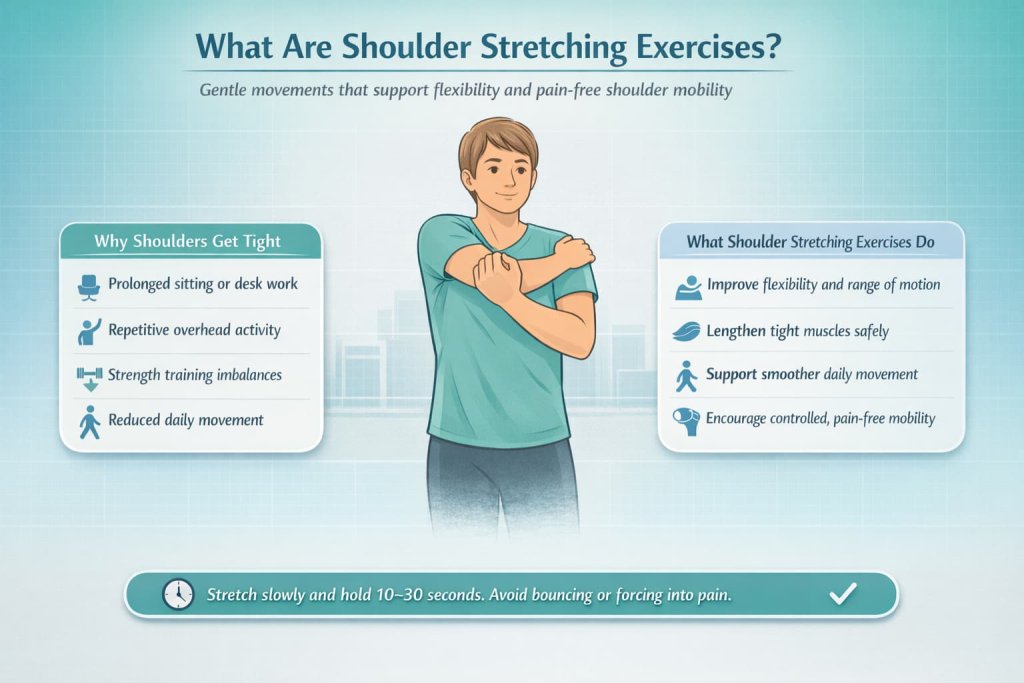
- Prolonged sitting or desk work
- Repetitive overhead activity
- Strength training imbalances
- Reduced daily movement
General flexibility guidance from the American Heart Association recommends slow, controlled stretches held for about 10–30 seconds without bouncing or forcing into pain.
Common areas targeted include:
- Chest (pectoralis muscles)
- Rear shoulder (posterior deltoid area)
- Rotator cuff muscles
- Upper back and shoulder blades
- Lats and side body
14 Best Shoulder Stretching Exercises
Improve flexibility and reduce stiffness with these 14 best shoulder stretching exercises designed to support smoother, pain-free movement. Each stretch helps enhance mobility, posture, and everyday overhead reach when performed consistently and safely.
1) Pendulum Stretch
How to do it:
- Lean forward slightly at the hips while keeping your back flat.
- Support yourself with your non-stretching hand on a sturdy chair, table, or counter.
- Let the stretching arm hang completely relaxed toward the floor.
- Gently swing the arm forward and backward.
- Then move it side to side.
- Finish with small, controlled circles in each direction.
- Continue for about 1–2 minutes total if symptoms do not increase.
Why it works:
This gentle, gravity-assisted motion reduces joint stiffness without forcing the shoulder into end range. It promotes comfortable circulation within the joint and supports early-stage mobility. It is commonly included in rehabilitation-style programs described by the Mayo Clinic.
Muscles worked:
Shoulder capsule (mobility focus), rotator cuff (light activation), upper back stabilizers (postural support).
Trainer Tip:
Start with very small circles. If the shoulder begins to tense or shrug upward, reduce the size of the movement and focus on relaxing the arm.
2) Cross-Body Shoulder Stretch
How to do it:
- Stand or sit upright with your spine neutral and shoulders relaxed.
- Bring one arm across your chest at shoulder height.
- Use your opposite hand to support the upper arm just above the elbow.
- Gently pull the arm closer to your body until you feel mild tension.
- Keep your torso facing forward.
- Hold, then switch sides.
Why it works:
This stretch targets the back of the shoulder, which commonly becomes tight from desk work, driving, and strength training. It is frequently recommended for improving posterior shoulder flexibility.
Muscles worked:
Posterior deltoid, posterior shoulder tissues, upper back stabilizers.
Trainer Tip:
If you feel pinching in the front of the shoulder, slightly lower the arm and reduce pulling pressure.
3) Doorway Chest and Shoulder Stretch
How to do it:
- Stand in a doorway with elbows bent about 90 degrees.
- Place forearms against the door frame.
- Step one foot forward slowly.
- Allow your chest to move gently forward.
- Hold the stretch while breathing steadily.
- Step back to release.
Why it works:
This stretch opens the front of the chest and shoulders, which often tighten from prolonged sitting and rounded posture.
Muscles worked:
Pectoralis major and minor, anterior shoulder, biceps (light stretch).
Trainer Tip:
Keep your ribs stacked over your hips. Avoid arching your lower back to “push” deeper into the stretch.
4) Wall Chest Stretch (Single-Arm)
How to do it:
- Stand sideways next to a wall.
- Place your palm and forearm on the wall at shoulder height.
- Slowly rotate your torso away from the wall.
- Hold the gentle stretch.
- Return to start and switch sides.
Why it works:
This variation allows you to control intensity and isolate one side at a time.
Muscles worked:
Chest muscles, anterior shoulder, biceps (light involvement).
Trainer Tip:
Keep your shoulder blade gently down and back rather than letting it shrug upward.
5) Overhead Triceps and Lat Stretch
How to do it:
- Raise one arm overhead.
- Bend your elbow so your hand reaches down your upper back.
- Use the opposite hand to gently guide the elbow backward.
- Keep your torso upright.
- Hold, then switch sides.
Why it works:
Tight triceps and lats can limit overhead reach. This stretch supports smoother arm elevation.
Muscles worked:
Triceps, latissimus dorsi, side-body tissues.
Trainer Tip:
Relax your neck and avoid pulling aggressively on the elbow.
6) Towel Behind-the-Back Stretch
How to do it:
- Hold a towel behind your back with one hand reaching overhead.
- Grip the bottom of the towel with your opposite hand.
- Gently pull upward with the top hand.
- Keep your chest tall.
- Hold, then switch sides.
Why it works:
Improves internal rotation mobility needed for reaching behind your back.
Muscles worked:
Internal rotation range of the shoulder, lats, chest (depending on angle).
Trainer Tip:
Move slowly and stay within a pain-free range.
7) Sleeper Stretch (Gentle Version)
How to do it:
- Lie on your side with the bottom arm bent at 90 degrees.
- Keep the shoulder blade stable against the rib cage.
- Use your top hand to gently guide the forearm downward slightly.
- Hold briefly and release.
Why it works:
Targets the back of the shoulder capsule and posterior tissues.
Muscles worked:
Posterior shoulder tissues.
Trainer Tip:
If discomfort occurs, choose the cross-body stretch instead.
8) Child’s Pose Side Reach
How to do it:
- Kneel and sit back into child’s pose.
- Walk both hands forward.
- Shift hands slightly to one side.
- Hold, then switch sides.
Why it works:
Improves flexibility in the lats and side body, supporting overhead motion.
Muscles worked:
Lats, teres major, mid-back tissues.
Trainer Tip:
Focus on slow breathing to allow muscles to relax.
9) Thread-the-Needle
How to do it:
- Start on hands and knees.
- Slide one arm under the opposite arm.
- Let your upper back rotate gently.
- Hold and breathe.
- Switch sides.
Why it works:
Enhances upper-back mobility, which supports healthier shoulder movement.
Muscles worked:
Rear shoulder, thoracic spine mobility, rotator cuff stabilizers.
Trainer Tip:
Place padding under your shoulder or head if needed.
10) Wall Slide
How to do it:
- Stand facing a wall.
- Place fingertips on the wall at chest height.
- Slide fingers upward slowly.
- Stop before discomfort.
- Slide back down with control.
Why it works:
Promotes controlled overhead mobility without forcing the shoulder joint.
Muscles worked:
Shoulder flexion mobility, serratus anterior, upper back stabilizers.
Trainer Tip:
Avoid shrugging your shoulders as you lift your arms.
11) Finger Walk Up the Wall
How to do it:
- Face the wall.
- Walk your fingers upward slowly.
- Pause briefly at a comfortable height.
- Walk fingers back down.
Why it works:
Encourages gradual mobility improvements through controlled progression.
Muscles worked:
Shoulder flexion and abduction mobility.
Trainer Tip:
Keep your rib cage stable and avoid leaning forward.
12) Shoulder Shrugs and Backward Rolls
How to do it:
- Lift shoulders gently toward ears.
- Roll them backward and downward.
- Repeat slowly and smoothly.
Why it works:
Helps reduce upper trapezius tension and restore scapular motion.
Muscles worked:
Upper trapezius, levator scapulae, scapular stabilizers.
Trainer Tip:
Move slowly and breathe steadily.
13) Upper Trapezius Stretch
How to do it:
- Sit tall with one arm hanging down.
- Gently tilt your ear toward the opposite shoulder.
- Keep the stretching-side shoulder down.
- Hold, then switch sides.
Why it works:
Addresses neck and shoulder tension from prolonged screen use.
Muscles worked:
Upper trapezius, levator scapulae.
Trainer Tip:
Avoid pulling your head forcefully.
14) Scapular Retraction Hold
How to do it:
- Sit or stand tall.
- Gently draw shoulder blades back and down.
- Hold 5–10 seconds.
- Relax and repeat.
Why it works:
Improves shoulder blade positioning, which supports overall shoulder mobility and reduces strain during stretching.
Muscles worked:
Mid trapezius, lower trapeziius, rhomboids.
Trainer Tip:
Focus on controlled engagement rather than squeezing hard.
Benefits of Shoulder Stretching Exercises
When performed consistently and correctly, shoulder stretching exercises may:
- Improve range of motion
- Reduce stiffness from sitting or screen use
- Support better posture
- Enhance overhead reach
- Complement strength training programs
Stretching supports mobility, but persistent or worsening pain should be evaluated by a professional.
How often should you do shoulder stretching exercises?
Most people do well with:
- Frequency: 3–6 days per week
- Hold time: 10–30 seconds per stretch
- Reps: 3–5 repeats per side
These ranges align with general flexibility recommendations from the American Heart Association and orthopedic safety principles from the AAOS.
Quick safety check before you stretch
Stretching should feel like mild-to-moderate tension, not sharp pain. Stop and seek medical guidance if you have:
- Sudden injury, deformity, or you can’t lift your arm
- New swelling, warmth, redness, fever, or severe pain
- Numbness/tingling, unexplained weakness, or pain that worsens quickly
- Recent surgery or dislocation without clearance
Also warm up first. Stretching “cold” muscles can increase injury risk, according to guidance from the American Academy of Orthopaedic Surgeons (AAOS).
Simple 10-Minute Shoulder Stretch Routine
- 2 minutes: Pendulum stretch
- 2 minutes: Cross-body stretch
- 2 minutes: Doorway stretch
- 2 minutes: Wall slides
- 2 minutes: Thread-the-needle
Keep movements slow, smooth, and pain-free, following warm-up and flexibility advice from the American Heart Association.
Common Mistakes
Avoid these common errors to keep stretching safe and effective:
- Forcing the stretch into sharp pain
- Bouncing instead of holding steadily
- Shrugging shoulders toward the ears
- Holding your breath
- Stretching cold muscles without warming up
Stretching should feel like mild tension, not discomfort.
When to Seek Medical Guidance
Consult a healthcare professional if you experience:
- Sudden injury or inability to lift your arm
- Pain lasting more than 2–3 weeks
- Night pain that disrupts sleep
- Numbness, tingling, or weakness
- Swelling, redness, or warmth in the joint
Stretching can support mobility, but it does not replace medical care for structural shoulder conditions.
FAQs
How long should I hold a shoulder stretch?
Most guidelines suggest 10–30 seconds per stretch, repeated several times, as outlined by the American Heart Association.
Can I stretch my shoulders every day?
Many people can perform gentle stretches daily, provided they remain pain-free.
Should stretching hurt?
No. Stretching should create mild tension but not sharp pain, according to AAOS safety principles.
Are shoulder stretches good for desk posture?
They may help improve mobility and reduce tightness when paired with strengthening and posture awareness.
When should I see a professional?
If pain worsens, mobility decreases, or symptoms include numbness or weakness, seek medical guidance.
Conclusion
Consistent, controlled shoulder stretching exercises can help reduce tightness and improve comfortable movement. Start gently, stay consistent, and focus on smooth, pain-free motion. Over time, even short daily sessions can support healthier, more mobile shoulders.