
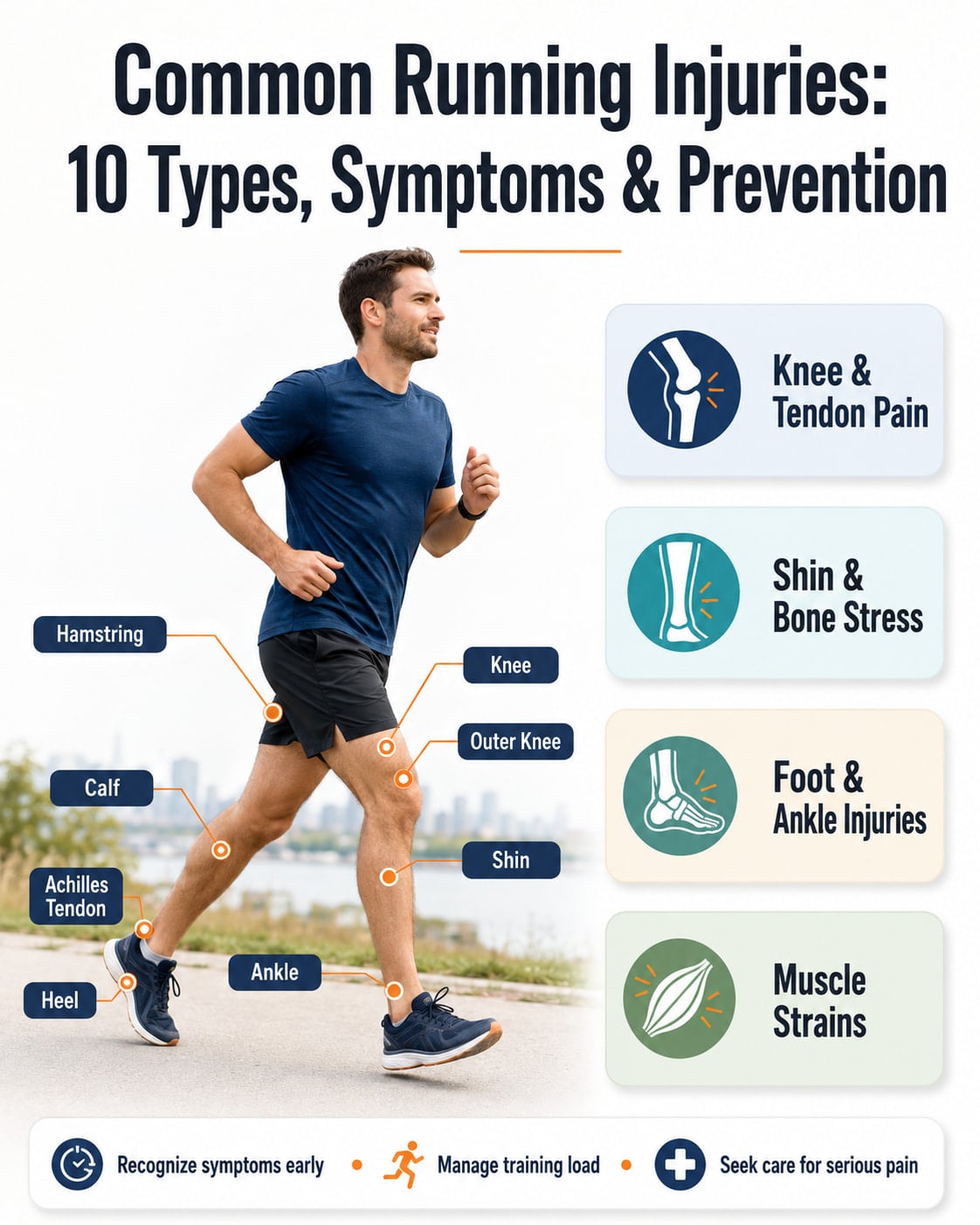
Common running injuries include runner’s knee, IT band syndrome, shin splints, Achilles tendinopathy, plantar fasciitis, bone stress injuries, ankle sprains, hamstring strains, calf strains, and patellar tendinopathy. Many develop when running load increases faster than the muscles, tendons, joints, or bones can adapt.
Recognizing symptoms early matters because continuing to run through worsening pain can turn a manageable problem into a longer-lasting injury. Gradual training progression, adequate recovery, strength work, comfortable footwear, and adjusting training when pain appears can all help reduce risk.
A systematic review of running injuries found that the knee, ankle, lower leg, and foot account for a large share of running-related problems. Achilles tendinopathy, medial tibial stress syndrome, patellofemoral pain, plantar fasciitis, and ankle sprains were among the injuries with the highest incidence proportions in non-ultramarathon runners.
Common Running Injuries at a Glance
| Running injury | Where it usually hurts | Common symptom pattern |
|---|---|---|
| Runner’s knee | Around or behind kneecap | Dull pain with running, stairs, or squatting |
| IT band syndrome | Outside of knee | Aching or burning pain during a run |
| Shin splints | Inner or front lower leg | Diffuse shin soreness and tenderness |
| Achilles tendinopathy | Back of ankle/heel | Morning stiffness and activity-related pain |
| Plantar fasciitis | Bottom of heel | Pain with first steps after rest |
| Bone stress injury | Shin, foot, or other weight-bearing bone | Localized pain that worsens with loading |
| Ankle sprain | Around ankle | Sudden pain, swelling, or bruising after a twist |
| Hamstring strain | Back of thigh | Sudden pulling or sharp pain |
| Calf strain | Back of lower leg | Sudden calf pain, especially when pushing off |
| Patellar tendinopathy | Below kneecap | Localized tendon pain with running or jumping |
Symptoms can overlap. This table can help you recognize a pattern, but it cannot confirm a diagnosis.
10 Common Running Injuries, Symptoms, and Prevention
1. Patellofemoral Pain Syndrome (Runner’s Knee)
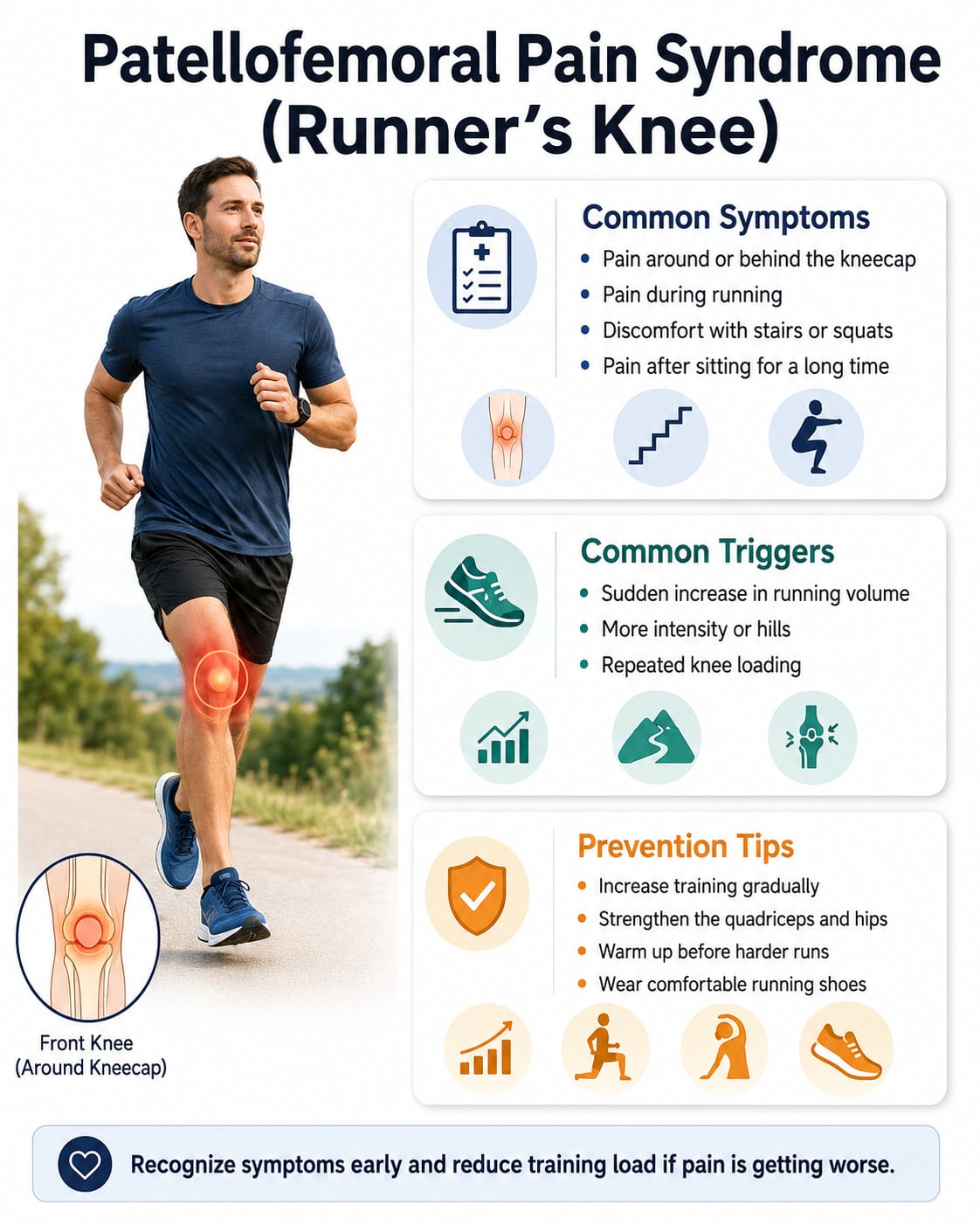
Patellofemoral pain syndrome is often called runner’s knee. It typically causes pain at the front of the knee or around the kneecap.
The American Academy of Orthopaedic Surgeons notes that repeated knee loading and sudden changes in exercise frequency, duration, or intensity can contribute to the condition.
Common symptoms include:
- Dull or aching pain around the kneecap
- Pain during running
- Discomfort when climbing or descending stairs
- Pain with squats or lunges
- Pain after sitting with the knee bent for a long time
- Occasional popping or crackling sensations
How to reduce your risk:
Build mileage and intensity progressively rather than making abrupt increases. Strengthening the quadriceps and hip muscles may improve the body’s ability to control the knee during running.
Warm up before harder sessions and wear shoes that are comfortable and appropriate for your running.
For more detail, see the AAOS guide to patellofemoral pain syndrome.
2. Iliotibial Band Syndrome
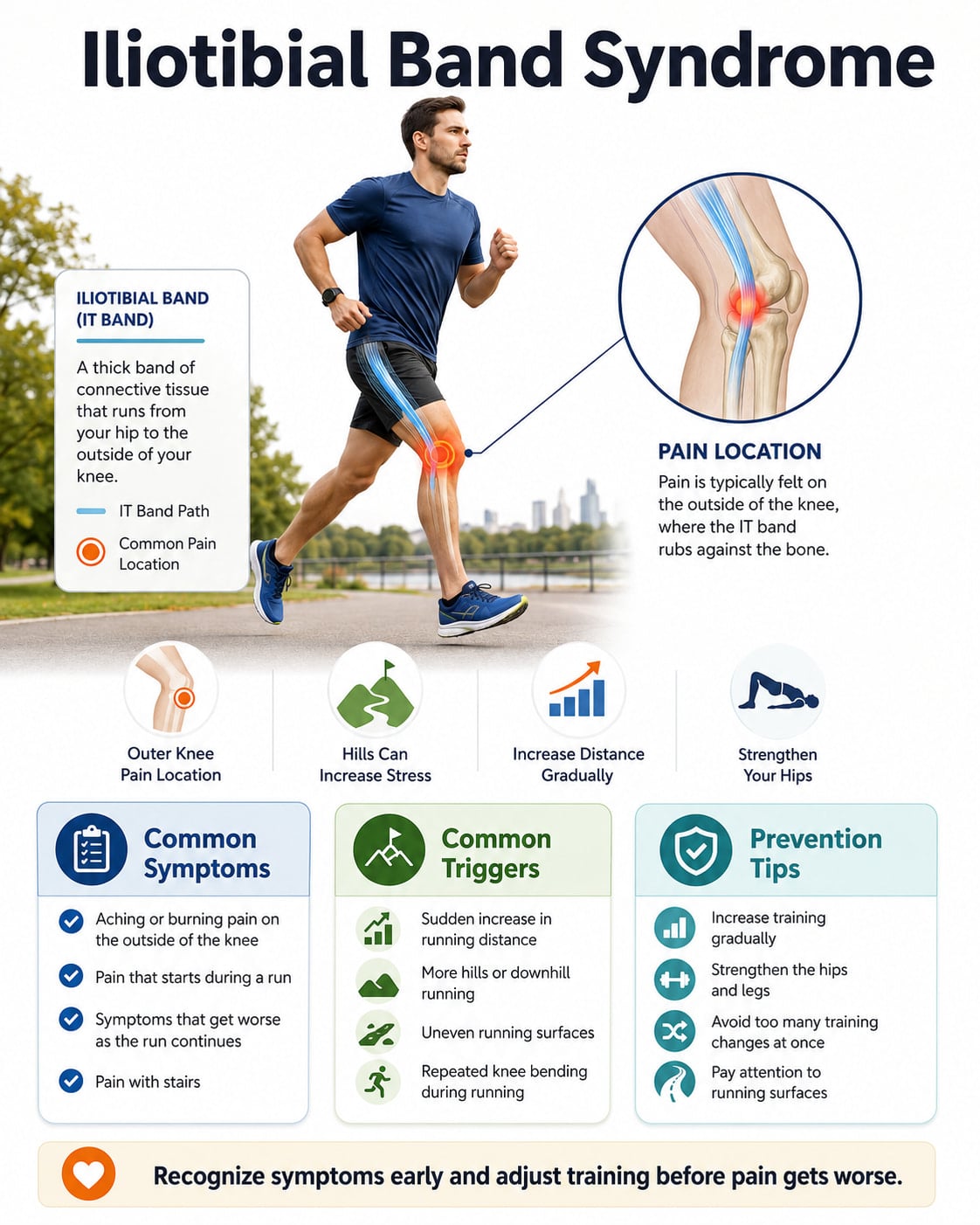
Iliotibial band syndrome, or IT band syndrome, commonly causes pain on the outside of the knee.
The iliotibial band is a thick band of connective tissue running along the outside of the thigh. Repeated bending and straightening of the knee during distance running can irritate tissues around the outer knee.
Common symptoms include:
- Aching or burning pain on the outside of the knee
- Pain that begins after running for a certain distance
- Symptoms that become progressively worse during a run
- Pain when going up or down stairs
- Occasionally, discomfort extending upward along the outer thigh
Running downhill or on uneven surfaces and rapidly increasing training are possible contributors.
How to reduce your risk:
Increase your training gradually and avoid making several major changes—such as adding mileage, hills, and speed work—at the same time.
Strengthening the hips and surrounding leg muscles may also help improve control during running.
Johns Hopkins Medicine provides additional information in its IT band syndrome guide.
3. Shin Splints
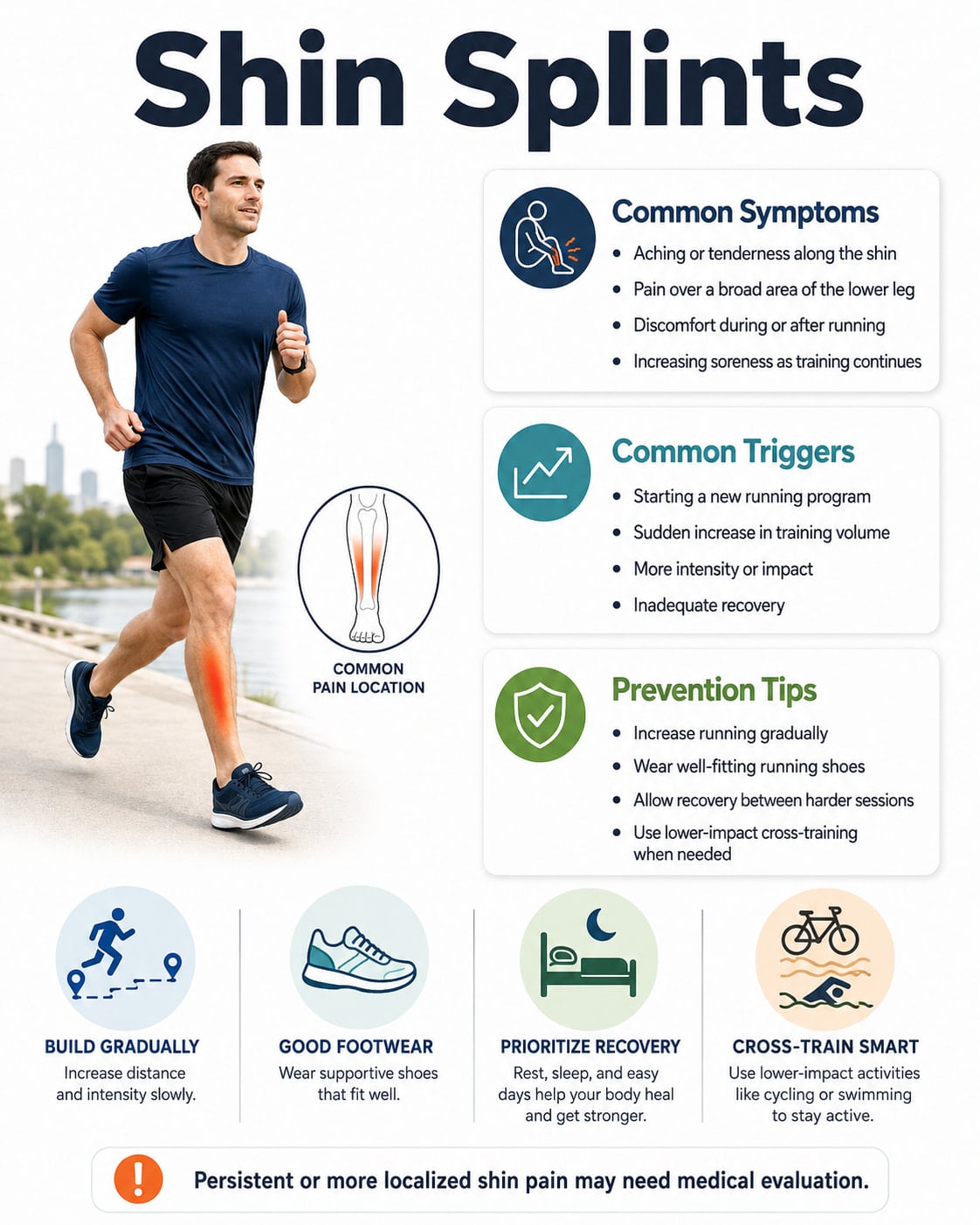
“Shin splints” commonly refers to exercise-related pain along the tibia, particularly medial tibial stress syndrome.
It often appears after a runner starts a new program or increases training volume or intensity.
Common symptoms include:
- Aching or tenderness along the shin
- Pain over a relatively broad area rather than one small point
- Discomfort during or after running
- Increasing soreness as training continues
How to reduce your risk:
Increase running distance, intensity, and frequency gradually. Well-fitting running shoes and appropriate recovery between harder sessions can also help.
Lower-impact cross-training such as cycling or swimming can be useful when you want aerobic exercise without adding more repetitive running load.
See the Johns Hopkins Medicine shin splints guide for additional information.
Shin Splints vs. Stress Fracture
Do not automatically assume every shin pain is shin splints.
Shin splints generally cause more diffuse tenderness along the lower leg, while a bone stress injury is more likely to produce pain concentrated in a specific area. Pain that progresses to normal walking, everyday activity, or rest deserves medical evaluation.
4. Achilles Tendinopathy
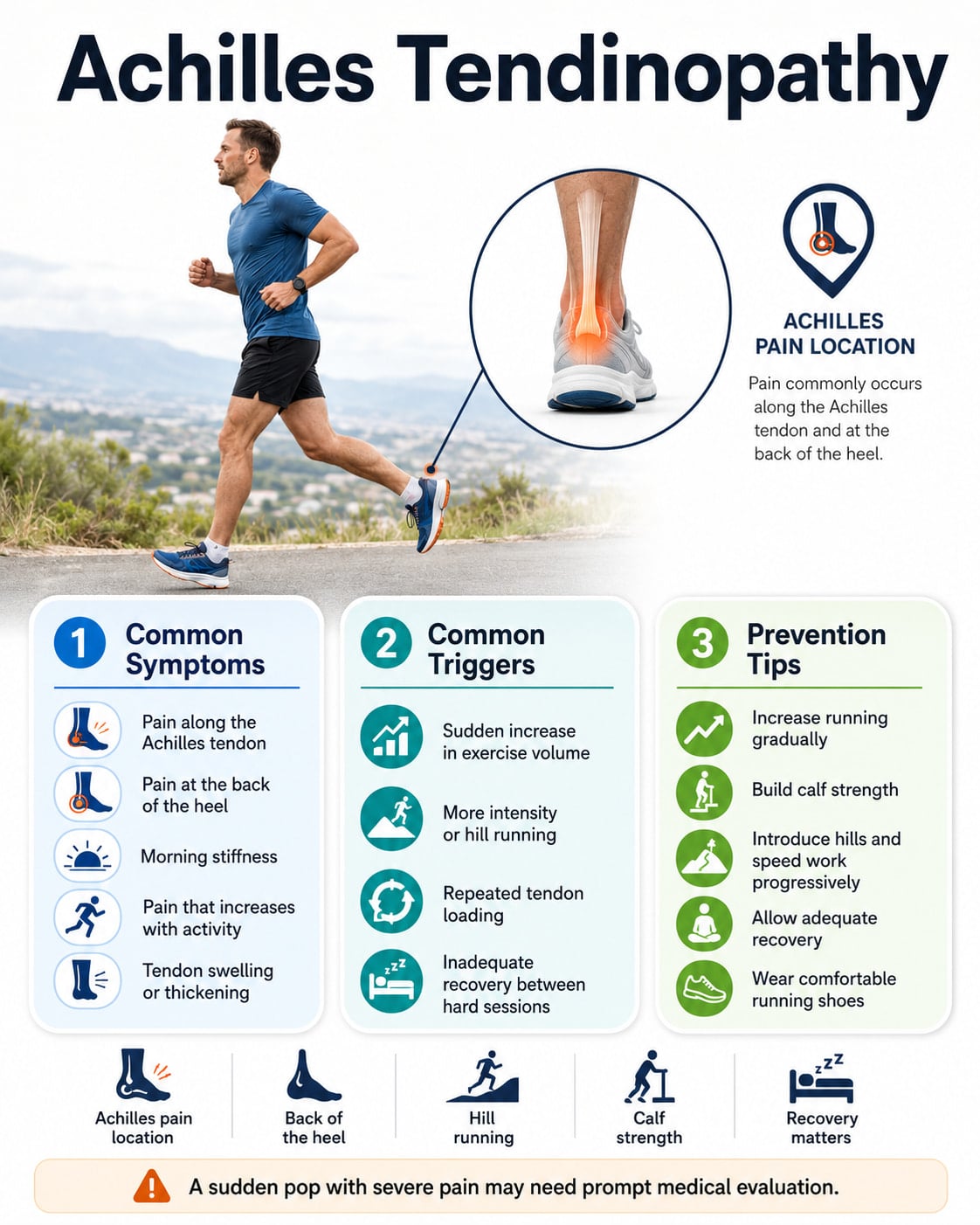
The Achilles tendon connects the calf muscles to the heel. Running places substantial repetitive loads on this tendon, especially during faster running, hill work, and pushing off the ground.
Achilles tendinopathy generally develops gradually rather than from a single traumatic event.
Common symptoms include:
- Pain along the Achilles tendon
- Pain at the back of the heel
- Morning stiffness
- Pain that increases with activity
- Tendon swelling or thickening
- Increased soreness after demanding exercise
AAOS identifies a sudden increase in exercise volume or intensity as one factor that may contribute to Achilles problems.
How to reduce your risk:
Introduce running distance, hills, and speed work progressively. Building calf strength and giving the tendon adequate recovery between demanding workouts may help it adapt to loading.
A sudden pop at the back of the calf or heel followed by significant pain is different from typical gradual tendinopathy and may indicate an Achilles rupture. Prompt medical evaluation is appropriate in that situation.
More information is available in the AAOS Achilles tendon guide.
5. Plantar Fasciitis
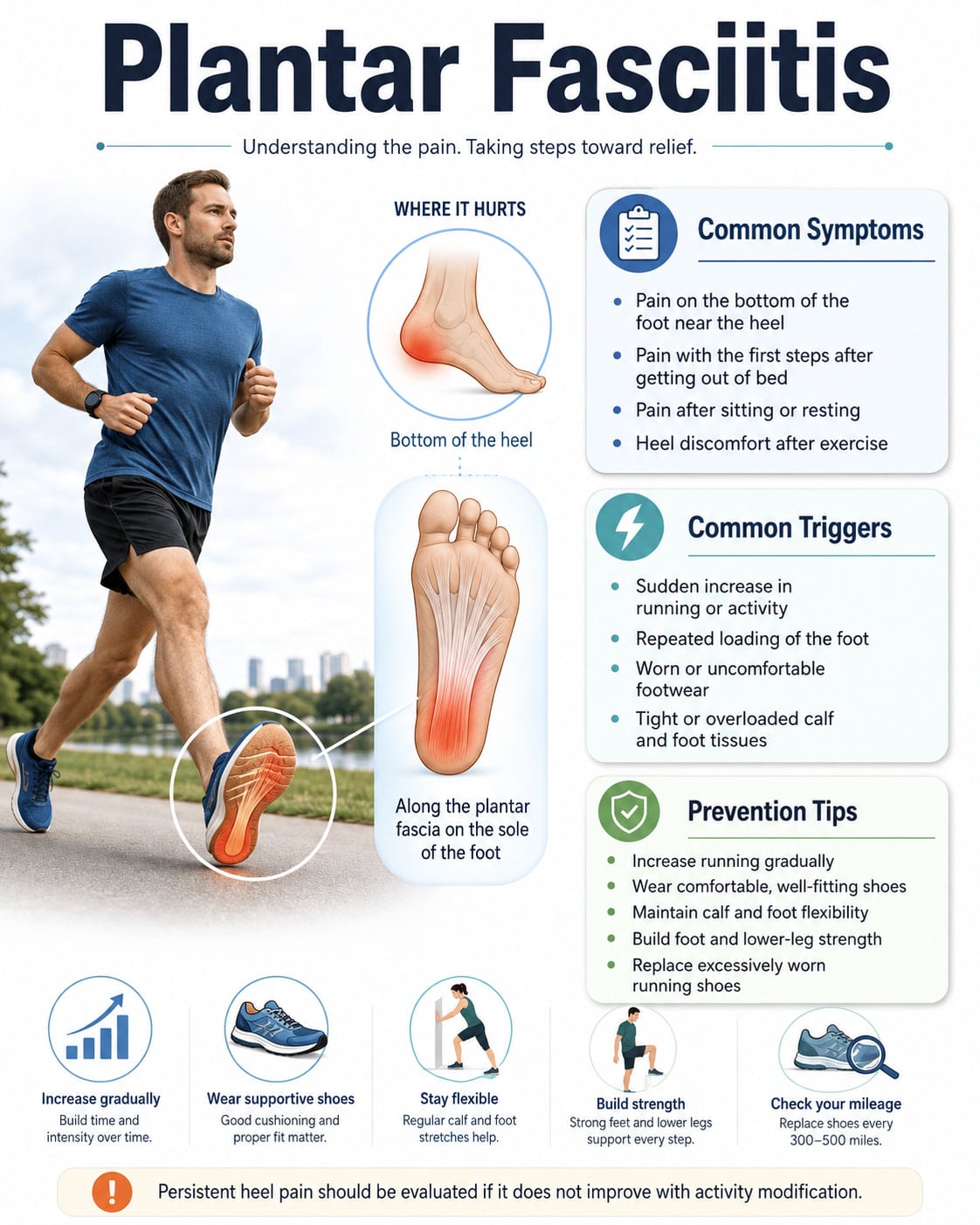
Plantar fasciitis affects the thick band of tissue running along the bottom of the foot from the heel toward the toes.
Running is one activity that repeatedly loads this tissue. A new or substantially increased activity level can contribute to symptoms.
Common symptoms include:
- Pain on the bottom of the foot near the heel
- Stronger pain during the first steps after getting out of bed
- Pain after sitting or resting for a long period
- Heel discomfort after exercise
The classic “first-step” morning pain pattern can help distinguish plantar fasciitis from some other causes of heel pain, although only a healthcare professional can diagnose the cause reliably.
How to reduce your risk:
Progress running gradually and use comfortable shoes that are not excessively worn. Maintaining calf and foot flexibility and strength may also help your feet tolerate running loads.
AAOS provides more detail in its plantar fasciitis guide.
6. Bone Stress Injury or Stress Fracture
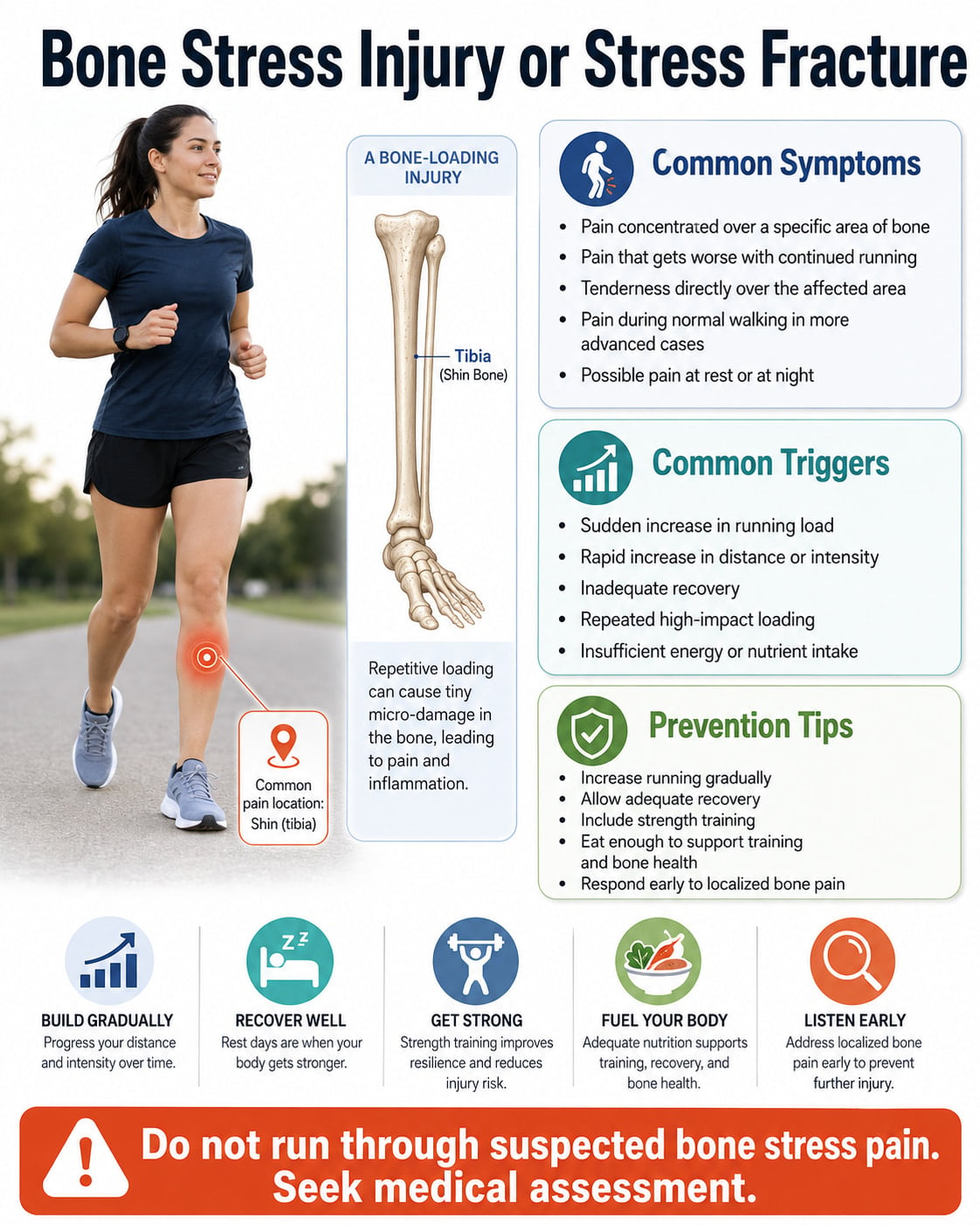
Bone stress injuries occur when repeated loading exceeds the bone’s ability to recover and rebuild.
They range from an early stress reaction to a more advanced stress fracture. The tibia and bones of the foot are particularly vulnerable in runners.
Possible symptoms include:
- Pain concentrated over a specific area of bone
- Pain that initially develops late in a run
- Pain occurring earlier as the problem progresses
- Tenderness directly over the affected area
- Pain during normal walking in more advanced cases
- Possible swelling
- Pain at rest or at night in more significant injuries
Unlike ordinary post-workout muscle soreness, bone stress pain should not simply be pushed through.
How to reduce your risk:
Avoid sudden increases in running load and allow adequate recovery. Strength training can help muscles absorb running forces.
Adequate food and nutrient intake is also important because insufficient energy availability can negatively affect bone health.
If you suspect a bone stress injury, stop running on the painful area and seek medical assessment. AAOS warns that continuing to exercise through a bone stress injury can allow it to worsen.
7. Ankle Sprain
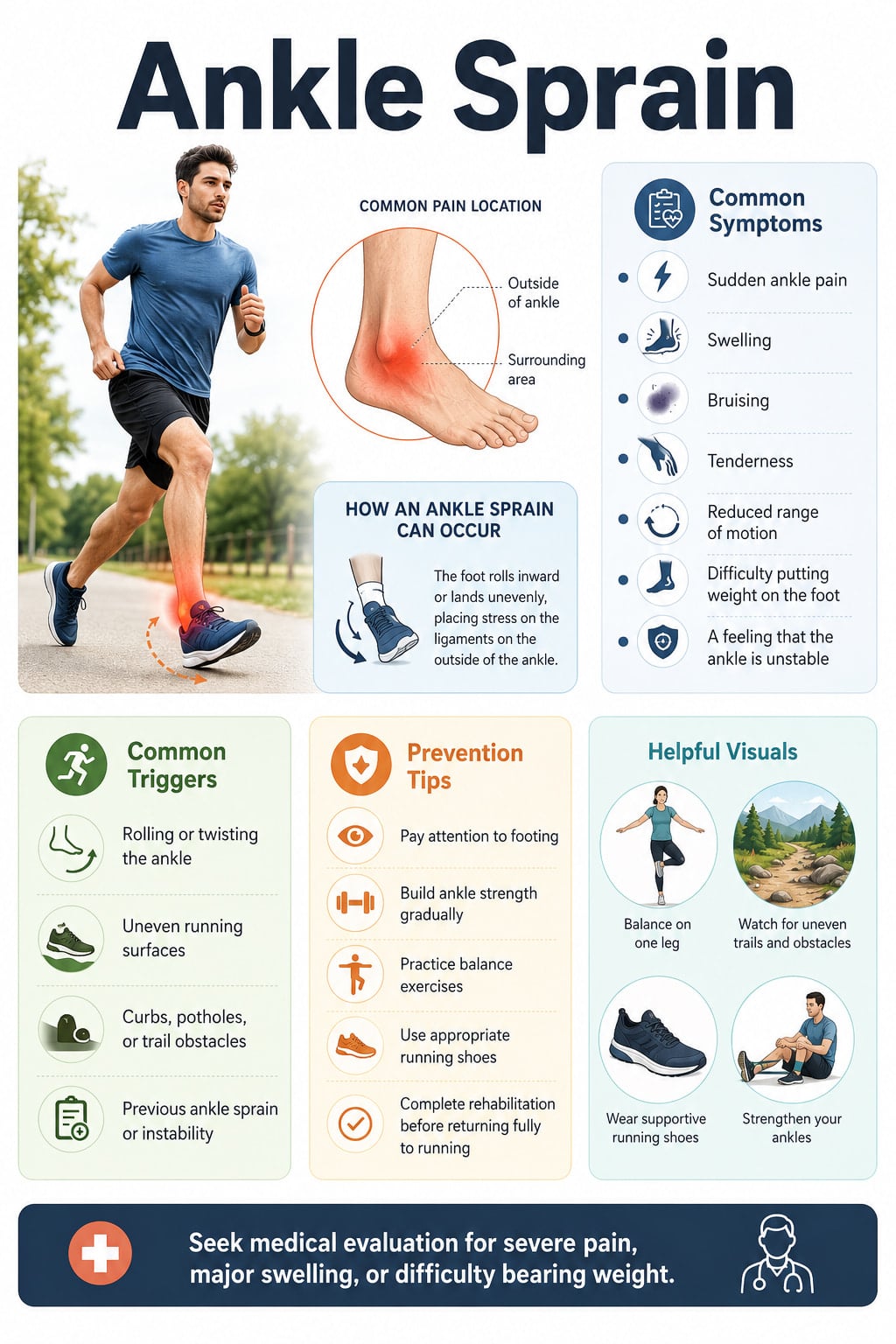
Unlike most overuse running injuries, an ankle sprain usually occurs suddenly.
It often happens when the foot rolls unexpectedly on a curb, trail, pothole, or uneven surface, stretching or damaging the ligaments supporting the ankle.
Common symptoms include:
- Sudden ankle pain
- Swelling
- Bruising
- Tenderness
- Reduced range of motion
- Difficulty putting weight on the foot
- A feeling that the ankle is unstable
How to reduce your risk:
Pay attention to footing, particularly when running trails or in low light. Gradual ankle-strengthening and balance exercises can improve the body’s ability to control the ankle.
Runners returning from a previous ankle sprain should complete appropriate rehabilitation rather than assuming the ankle is ready as soon as the pain disappears.
8. Hamstring Strain
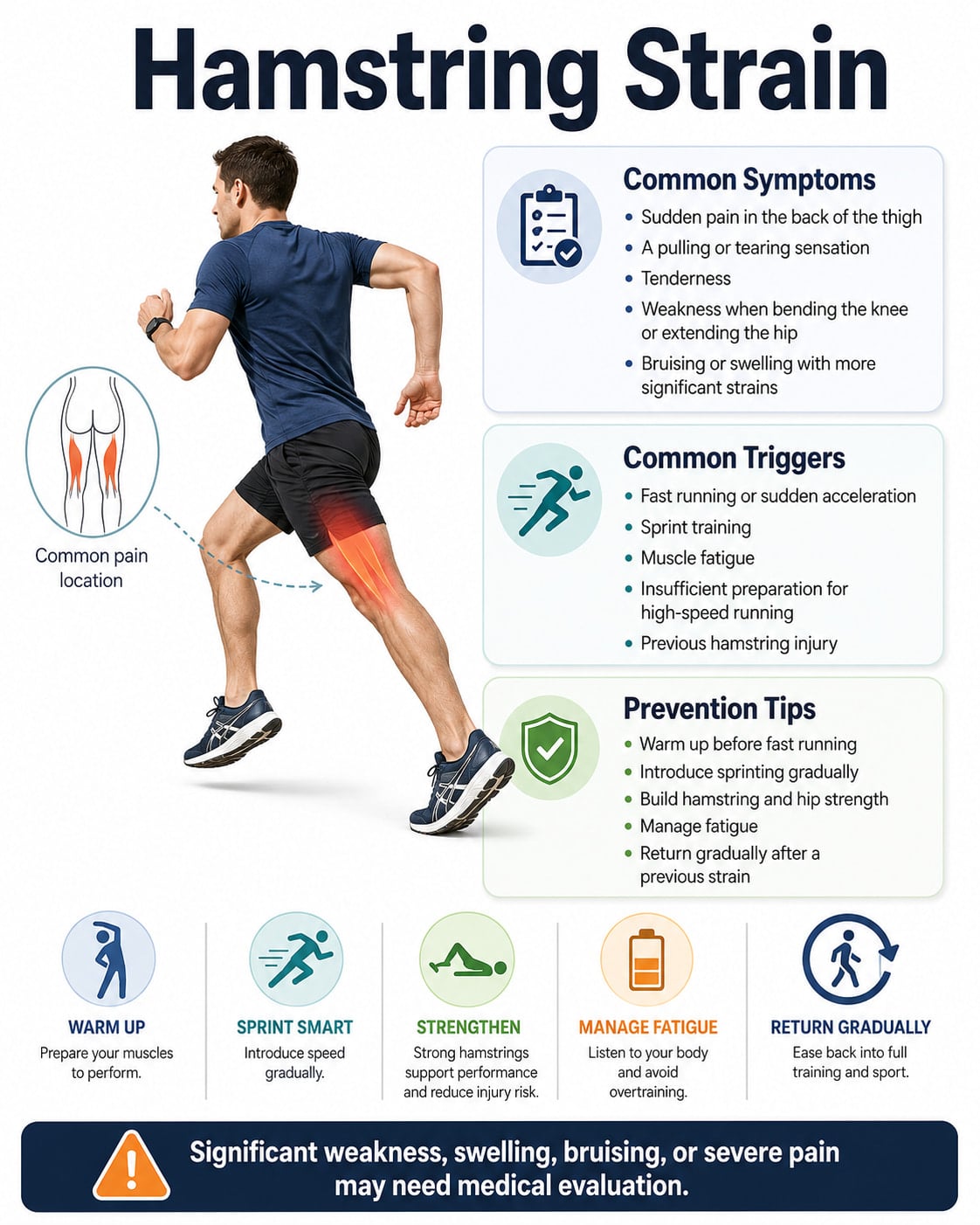
The hamstrings are the muscles running along the back of your thigh. Strains can occur when the muscle is overloaded, particularly during faster running or acceleration.
Common symptoms include:
- Sudden pain in the back of the thigh
- A pulling or tearing sensation
- Tenderness
- Weakness when bending the knee or extending the hip
- Bruising or swelling with more significant strains
How to reduce your risk:
Warm up before fast running, introduce sprinting gradually, and develop hamstring and hip strength.
Fatigue can reduce running control, so avoid adding maximal-speed efforts when your body is not prepared for them.
A previous hamstring injury may also increase the chance of another strain, making proper rehabilitation and gradual return to speed important.
9. Calf Muscle Strain
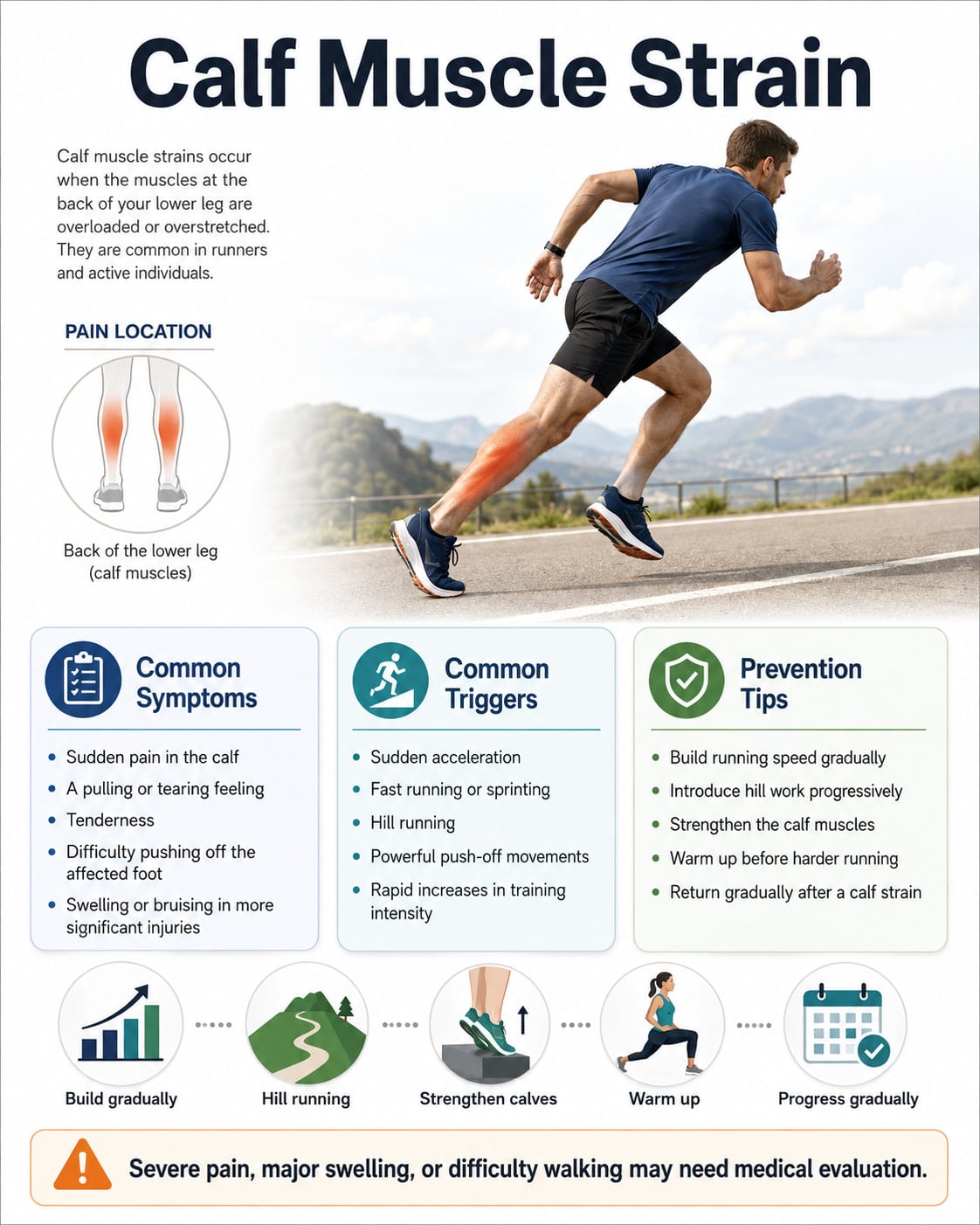
A calf strain involves one or more muscles at the back of the lower leg, commonly during a powerful push-off, sudden acceleration, hill effort, or sprint.
Common symptoms include:
- Sudden pain in the calf
- A pulling or tearing feeling
- Tenderness
- Difficulty pushing off the affected foot
- Swelling or bruising in more significant injuries
How to reduce your risk:
Build running speed and hill work gradually. Progressive calf-strengthening exercises can help prepare the muscles for the forces involved in running.
Avoid immediately returning to fast running just because you can walk without pain. Running places considerably greater demands on the calf than normal walking.
10. Patellar Tendinopathy
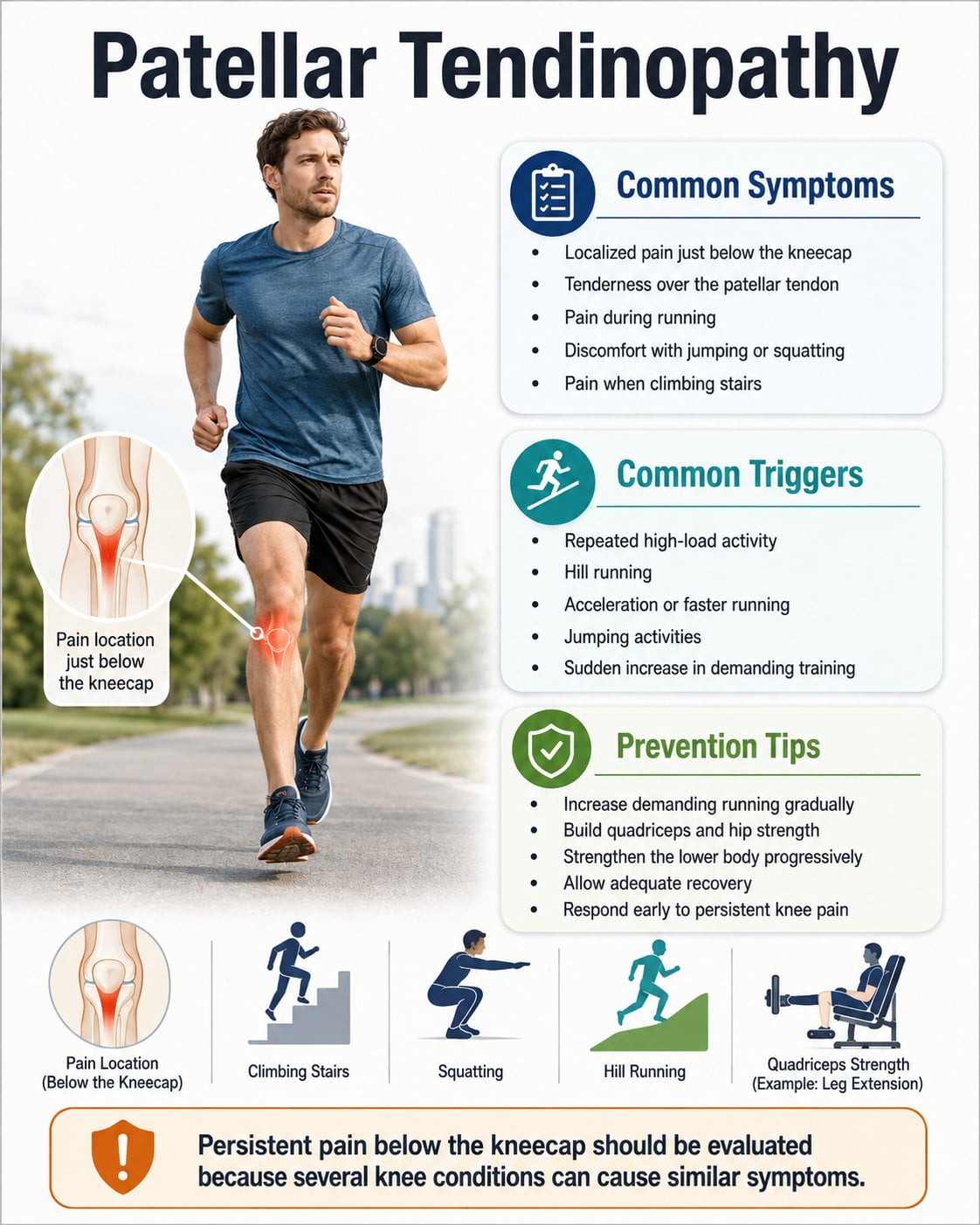
The patellar tendon connects the kneecap to the tibia. Repeated loading can irritate or overload this tendon.
Although patellar tendinopathy is strongly associated with jumping sports, runners can also develop it, particularly when training includes hills, acceleration, or other high-load activities.
Common symptoms include:
- Localized pain just below the kneecap
- Tenderness over the patellar tendon
- Pain during running
- Discomfort with jumping or squatting
- Pain when climbing stairs
How to reduce your risk:
Avoid abrupt increases in demanding running sessions. Progressive quadriceps, hip, and lower-body strengthening can help improve the body’s capacity to tolerate repeated loading.
Persistent pain below the kneecap should be evaluated because several knee conditions can produce similar symptoms.
What Causes Running Injuries?
There is rarely one cause that explains every running injury.
A systematic review found that injury patterns vary considerably among runners and across studies. Training exposure, previous injury, recovery, physical capacity, biomechanics, terrain, and individual health factors can all play a role.
One of the most practical factors you can control is how quickly your training changes.
Sudden Training Spikes Matter
A 2025 British Journal of Sports Medicine prospective study followed 5,205 adult runners across 588,071 running sessions. During follow-up, 1,820 runners reported a running-related injury.
The researchers found higher overuse-injury rates when the distance of an individual run exceeded the runner’s longest run from the previous 30 days by more than 10%. The largest distance spikes were associated with the greatest increase in injury rate.
This does not mean every runner must follow a universal 10% rule. The researchers also found that common week-to-week workload calculations did not predict injuries in the same way.
The practical lesson is simpler: avoid making one run dramatically longer than anything your body has recently handled.
You can read the full 2025 British Journal of Sports Medicine running-load study.
How to Prevent Common Running Injuries
No strategy can guarantee that you will remain injury-free, but sensible training habits can help reduce unnecessary stress.
Increase Your Training Gradually
Avoid suddenly increasing several training variables at once.
For example, adding more weekly mileage, a long run, hill repeats, and speed work in the same week creates much more stress than changing one element gradually.
Give Your Body Time to Recover
Muscles, tendons, and bones adapt to training during recovery as well as during exercise.
Schedule easier days between demanding sessions when needed, and pay attention when your normal soreness begins lasting longer than expected.
Strength Train
Regular strength training can improve the capacity of your legs, hips, and trunk to handle running forces.
Useful movement patterns include:
- Squats
- Split squats
- Step-ups
- Hip hinges
- Calf raises
- Hamstring exercises
- Hip-strengthening exercises
Strength work should progress gradually just like running.
Warm Up Before Hard Runs
Before intervals, hill sessions, or faster running, begin with several minutes of easy movement.
Easy jogging followed by progressively faster running can prepare the body for higher-intensity efforts better than starting at full speed immediately.
Wear Comfortable Running Shoes
There is no single shoe that prevents injuries in every runner.
Choose shoes that feel comfortable, fit properly, and are suitable for your running environment. Replace footwear when it becomes substantially worn or no longer feels supportive rather than relying only on a universal mileage number.
Introduce Hills and Speed Carefully
Hills and speed sessions can be useful, but they place different stresses on muscles and tendons than easy running.
A beginner who has just increased weekly distance may benefit from allowing that change to settle before also introducing hard intervals or steep hills.
Use Cross-Training When Helpful
Cycling, swimming, rowing, or other lower-impact exercise can provide cardiovascular training without repeating exactly the same running loads.
Cross-training is particularly useful when you need more recovery between runs.
Respond to Pain Early
Minor stiffness after a workout is not automatically an injury. However, pain that becomes progressively stronger, changes your running mechanics, or continues from one workout to the next deserves attention.
Reducing or modifying training early can be more sensible than continuing until symptoms interfere with normal walking.
Should You Run Through Pain?
Usually, worsening or persistent pain should not be treated as something you simply need to “push through.”
Stop or modify running and consider professional assessment if pain:
- Becomes sharper as you continue
- Makes you limp
- Changes your normal stride
- Gets progressively worse from run to run
- Is localized directly over a bone
- Continues during normal walking
- Occurs at rest or during the night
- Does not improve after reducing the aggravating activity
A healthcare professional or physical therapist can help determine the actual cause because different running injuries often produce similar symptoms.
When to Seek Medical Attention for a Running Injury
Seek prompt medical care if you experience:
- Severe pain after a fall or sudden injury
- Inability to bear weight
- Significant swelling or bruising
- Visible deformity
- A sudden pop at the Achilles tendon followed by weakness or severe pain
- Persistent, highly localized bone pain
- Numbness or significant weakness
- Symptoms that continue to worsen despite reducing activity
Bone stress injuries deserve particular caution. AAOS recommends medical evaluation when one is suspected because continued loading can allow the injury to progress.
Frequently Asked Questions
What is the most common running injury?
There is no single answer across every running population. A systematic review found that the knee was the most frequently affected anatomical region among non-ultramarathon runners. Specific injuries frequently reported included patellofemoral pain, Achilles tendinopathy, medial tibial stress syndrome, plantar fasciitis, IT band syndrome, and ankle sprains.
What are the first signs of a running injury?
Common early signs include pain appearing consistently during a run, tenderness in one area, stiffness that persists beyond normal post-exercise soreness, swelling, or discomfort that begins earlier with each workout.
How do I know if running pain is serious?
Pain is more concerning when it is severe, causes limping, prevents normal weight-bearing, occurs at rest, is highly localized over a bone, follows a sudden pop, or continues to worsen. Seek professional medical assessment if you are unsure.
Are shin splints the same as a stress fracture?
No. Shin splints generally involve more diffuse shin pain, while a stress fracture is a bone injury and tends to cause more localized tenderness. Because symptoms can overlap, persistent or focal shin pain should be evaluated by a healthcare professional.
Can running shoes prevent injuries?
No shoe can guarantee injury prevention. Good-fitting, comfortable shoes appropriate for the runner and activity are reasonable, but training load, recovery, previous injury, strength, and other factors also influence injury risk.
Does strength training help prevent running injuries?
Strength training helps build the capacity of muscles and connective tissues to handle force and can be a useful part of a balanced running program. It should complement sensible training progression and recovery rather than being viewed as a guarantee against injury.
How quickly should I increase my running mileage?
There is no percentage that is proven safe for every runner. Recent evidence suggests avoiding large increases in the distance of an individual run compared with what you have recently completed. Progress according to your experience, recovery, current training, and symptoms rather than treating one mathematical rule as universal.
Conclusion
Most common running injuries involve the knees, lower legs, ankles, feet, muscles, or tendons. The best approach is not to fear running but to give your body enough time to adapt to it.
Increase training progressively, recover between demanding sessions, build strength, use comfortable footwear, and pay attention when pain becomes persistent or progressively worse. When symptoms suggest a significant injury—especially localized bone pain, inability to bear weight, or a sudden tendon injury—get an appropriate medical evaluation rather than continuing to run through it.
Consistent, manageable training is usually more valuable than forcing one workout your body is not prepared to handle.
This content is for informational purposes only and not medical advice.
References
- American Academy of Orthopaedic Surgeons (AAOS). Patellofemoral Pain Syndrome. OrthoInfo.
- American Academy of Orthopaedic Surgeons (AAOS). Stress Fractures. OrthoInfo.
- Johns Hopkins Medicine. Iliotibial Band Syndrome.
- Johns Hopkins Medicine. Shin Splints.
- Frandsen JS, et al. How Much Running Is Too Much? Identifying High-Risk Running Sessions in a 5200-Person Cohort Study. British Journal of Sports Medicine. 2025.
- Kakouris N, Yener N, Fong DTP. A Systematic Review of Running-Related Musculoskeletal Injuries in Runners. Journal of Sport and Health Science. 2021.