
Weighted core exercises are movements that use external resistance—like dumbbells, kettlebells, cables, or medicine balls—to strengthen your abs, obliques, and deep stabilizer muscles more effectively than bodyweight alone.
These exercises add load so your core must work harder, helping you build real strength, better stability, and functional power.
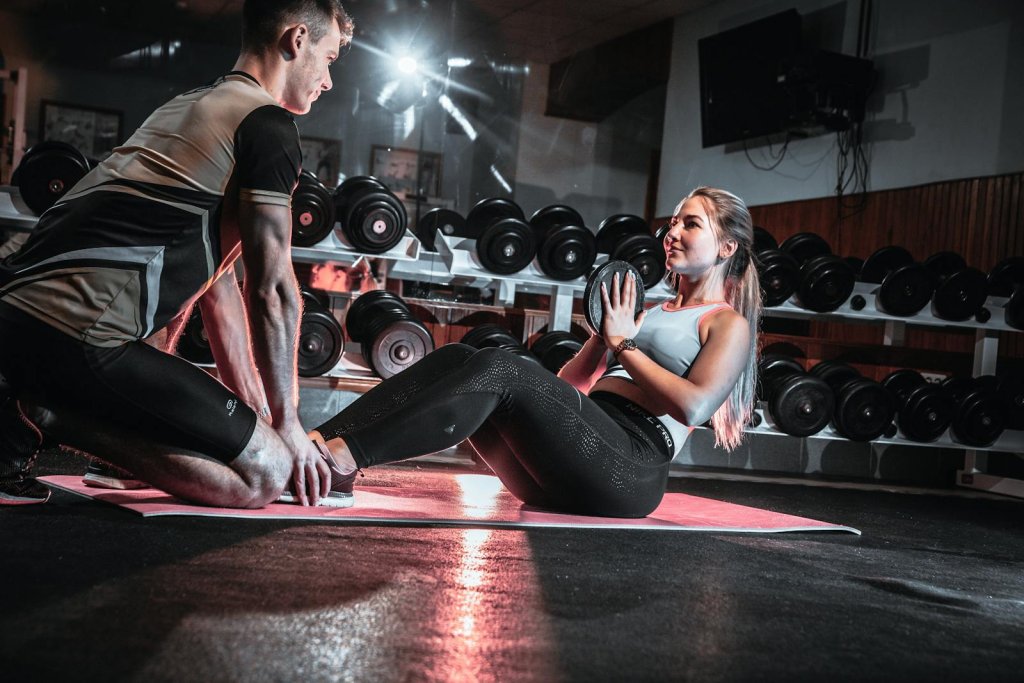
Understanding weighted core training is important because your core controls posture, balance, lifting strength, and spinal support. Research from respected organizations such as the Mayo Clinic and the American College of Sports Medicine (ACSM) shows that core strengthening supports stability, enhances movement efficiency, and contributes to overall physical function.
In this guide, you’ll learn the best weighted core exercises, proper technique, benefits, progression, common mistakes, FAQs, and research-backed references.
Why Weighted Core Exercises Matter
Weighted core exercises matter because they strengthen your trunk more efficiently than bodyweight movements alone. Adding resistance forces your abs, obliques, and deep stabilizer muscles to work harder to maintain posture, control movement, and protect your spine. This creates meaningful improvements in strength, stability, and real-world function.
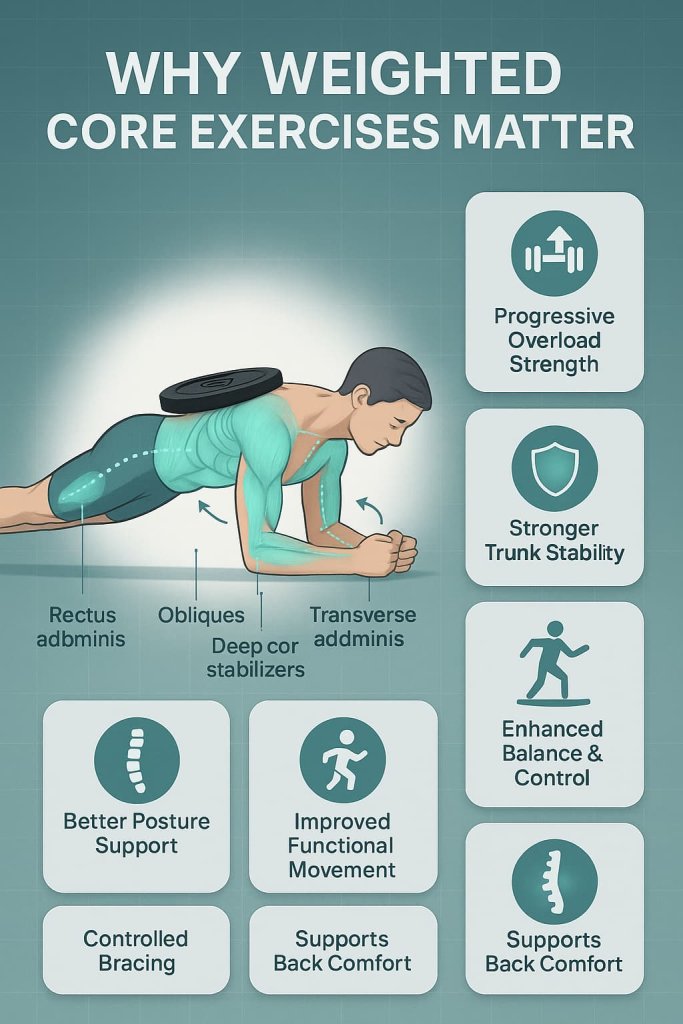
Weighted core training is important for several reasons:
- Supports better posture and spinal stability: A strong core may help you maintain neutral alignment during daily tasks and exercise.
- Improves functional movement: Your core controls how you lift, rotate, bend, carry, and transfer force through your body.
- Progressive overload for stronger abs: External load makes it easier to increase intensity safely, helping you build strength over time.
- Enhances balance and coordination: Anti-extension, anti-rotation, and anti-lateral-flexion movements challenge your core to stay stable during changing forces.
- Boosts performance in sports and lifting: A strong, stable core may help support power, speed, and control in athletic movements.
- Supports lower-back comfort: Strengthening the deep trunk muscles can help support the spine during everyday activities, when done with proper form.
Weighted core exercises matter because they offer a safer, more structured way to progress your training while targeting all layers of the core—not just the surface-level abs.
How Often Should You Do Weighted Core Exercises
Most adults benefit from doing weighted core exercises 2–3 times per week, allowing at least 24–48 hours of rest between sessions. Weighted movements create higher stress on the trunk muscles than bodyweight alone, so recovery is essential. Beginners should start with 1–2 sessions weekly, while intermediate lifters can build up to 3 focused core days.
General guidelines:
- 2–3 weighted core sessions per week
- 1–2 sets per exercise for beginners; 2–3 sets for intermediate lifters
- 8–12 reps or 20–40 second holds
- Increase weight gradually when movements feel easier
- Avoid intense weighted core training on consecutive days
Warm-Up Before Weighted Core Workouts
A proper warm-up prepares your abs, hips, and spine for resistance-based core training. It increases blood flow, activates stabilizer muscles, and reduces the risk of strain when using external load.
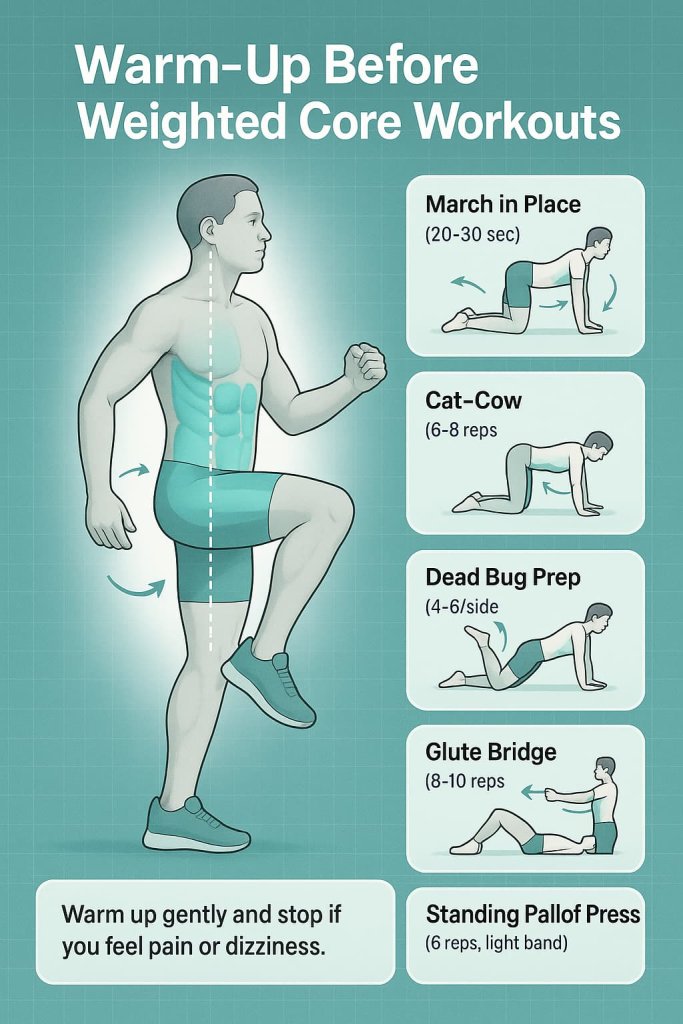
Try this simple 2–4 minute warm-up before weighted core work:
- March in place — 20–30 seconds: Activates core and hips.
- Cat–Cow — 6–8 reps: Gently mobilizes the spine.
- Dead Bug Prep — 4–6/side: Engages the deep core before heavier work.
- Glute Bridge — 8–10 reps: Primes posterior chain and bracing muscles.
- Standing Pallof Press (light band) — 6 reps: Activates anti-rotation stabilizers.
Warm up gently and stop if you feel pain or dizziness.
22 Best Weighted Core Exercises
To keep this list structured, the exercises are grouped into 6 science-based categories that reflect how your core stabilizes your spine.
Anti-Extension Weighted Core Exercises
1. Weighted Plank
Why it works:
Adding weight to the traditional plank increases the demand on your deep stabilizers. This makes your core resist spinal extension more effectively, improving overall trunk stiffness and posture under load.
Muscles worked:
Transverse abdominis, rectus abdominis, obliques, spinal stabilizers, shoulders.
How to do it:
- Start in a forearm plank with a straight line from head to heels.
- Have a partner place a plate or sandbag across your upper back.
- Brace your core and keep ribs pulled down.
- Hold for 20–40 seconds with controlled breathing.
Trainer Tip:
If your hips sag, reduce the load or shorten the hold to maintain a neutral spine.
2. Weighted Dead Bug
Why it works:
Adding resistance above your chest increases the challenge to your deep core as you coordinate opposite-arm and opposite-leg movement while stabilizing your spine.
Muscles worked:
Transverse abdominis, hip flexors, obliques, deep spinal stabilizers.
How to do it:
- Lie on your back, knees bent at 90 degrees, arms holding a dumbbell or ball over your chest.
- Extend the right leg while lowering the left arm behind your head.
- Return to start and switch sides.
- Keep your lower back gently supported throughout.
Trainer Tip:
Move slowly—if your ribs flare upward, lighten the weight.
3. Ab Wheel Rollout (Weighted Variation)
Why it works:
Rollouts teach powerful anti-extension control by forcing your core to resist hyperextending your lower back as your body lengthens.
Muscles worked:
Rectus abdominis, transverse abdominis, lats, shoulders.
How to do it:
- Kneel and hold an ab wheel or light-loaded barbell.
- Roll forward in a slow, controlled motion.
- Stop before your lower back begins to arch.
- Pull back to the starting position using your core.
Trainer Tip:
Start with a small range of motion and build distance gradually for safety.
4. Stability Ball Body Saw With Weight
Why it works:
The weight on your upper back adds intensity as you extend your body forward, requiring strong anti-extension bracing throughout the movement.
Muscles worked:
Anterior core, obliques, deep stabilizers, shoulders.
How to do it:
- Begin in a plank with forearms on a stability ball.
- Have a partner place a small plate on your back.
- Slide your body forward and back in a saw-like motion.
- Maintain a neutral spine throughout.
Trainer Tip:
Keep movements small and precise to prevent lower-back strain.
Anti-Rotation Weighted Core Exercises
5. Pallof Press (Cable or Band)
Why it works:
The cable or band pulls you into rotation; your core must resist this force, strengthening anti-rotation stability used in sports and lifting.
Muscles worked:
Obliques, transverse abdominis, deep trunk stabilizers.
How to do it:
- Stand sideways to a cable or anchored band.
- Hold the handle at your chest.
- Press arms straight out without letting your torso twist.
- Return with control.
Trainer Tip:
The goal is resisting movement—not creating it. Keep hips square.
6. Half-Kneeling Pallof Hold
Why it works:
The narrow base of support increases core activation as you resist rotation while stabilizing the pelvis.
Muscles worked:
Obliques, deep core stabilizers, hip stabilizers.
How to do it:
- Kneel with one leg forward (half-kneeling stance).
- Hold the cable or band at chest height.
- Extend arms and hold the position.
- Maintain even hips and shoulders.
Trainer Tip:
Squeeze your glutes to keep your pelvis stable.
7. Cable Anti-Rotation Walkouts
Why it works:
Walking out increases the lever arm, forcing your core to brace harder to prevent twisting.
Muscles worked:
Obliques, transverse abdominis, deep stabilizers.
How to do it:
- Hold a cable handle at your chest.
- Step sideways away from the machine.
- Maintain torso alignment throughout.
- Step back with control.
Trainer Tip:
Stop the walkout if your torso begins drifting toward the cable.
8. Medicine Ball Iso-Twist Hold
Why it works:
Holding the ball away from your body increases rotational torque, strengthening your ability to resist unwanted twisting.
Muscles worked:
Obliques, core stabilizers, shoulders.
How to do it:
- Sit or stand tall with a ball held at arm’s length.
- Keep spine neutral and ribs down.
- Hold position without twisting left or right.
- Maintain slow, steady breathing.
Trainer Tip:
The farther the ball is from your chest, the harder your core works—adjust accordingly.
Anti-Lateral Flexion Weighted Core Exercises
9. Suitcase Carry
Why it works:
Carrying weight on one side forces the opposite side of your core to resist bending, building strong lateral stability.
Muscles worked:
Obliques, quadratus lumborum (QL), grip, forearms.
How to do it:
- Stand tall holding a dumbbell in one hand.
- Walk slowly with upright posture.
- Don’t lean toward the weight.
- Switch sides after each set.
Trainer Tip:
Keep steps small and controlled—no rushing.
10. Offset Kettlebell Carry
Why it works:
Carrying a kettlebell in a racked position challenges your core to stay tall and centered.
Muscles worked:
Obliques, QL, upper back, posture muscles.
How to do it:
- Rack a kettlebell on one shoulder.
- Walk a set distance without leaning.
- Maintain braced core and vertical torso.
Trainer Tip:
Think of “growing tall” through the crown of your head as you walk.
11. Dumbbell Side Plank Raise
Why it works:
Lifting into a side plank while holding weight increases difficulty and targets deeper lateral stabilizers.
Muscles worked:
Obliques, QL, transverse abdominis, shoulders.
How to do it:
- Lie on your side with forearm down.
- Rest a dumbbell on your top hip.
- Lift hips into a side plank.
- Lower with control and repeat.
Trainer Tip:
Avoid rotating your torso—stay stacked shoulder over shoulder.
12. Landmine Lateral Hold
Why it works:
The angled resistance of the landmine challenges lateral stability and anti-flexion control.
Muscles worked:
Obliques, QL, hips, upper back.
How to do it:
- Stand sideways to a landmine bar.
- Hold the sleeve with one hand.
- Keep torso upright as you resist side bending.
- Hold for time or perform small pulses.
Trainer Tip:
Use a light weight first—the lateral torque can feel surprisingly strong.
Weighted Flexion & Rotation Exercises (Advanced)
13. Cable Wood Chop (High-to-Low)
Why it works:
This diagonal chopping pattern strengthens rotational control and hip-core coordination.
Muscles worked:
Obliques, rectus abdominis, lats, hips.
How to do it:
- Set cable above shoulder height.
- Pull handle downward across your body.
- Rotate through ribs and shoulders—not the lower back.
- Return with control.
Trainer Tip:
Keep hips facing forward to protect the spine.
14. Cable Lift (Low-to-High)
Why it works:
The upward diagonal pattern strengthens anti-rotation control while improving cross-body force production.
Muscles worked:
Obliques, serratus, core stabilizers, hips.
How to do it:
- Set cable low near the floor.
- Pull handle up across your body.
- Keep ribs down and spine neutral.
- Control the descent.
Trainer Tip:
Exhale gently as you pull to maintain core bracing.
15. Weighted Sit-Up
Why it works:
Adding load increases the challenge to your rectus abdominis, helping build strength and muscle endurance.
Muscles worked:
Rectus abdominis, hip flexors.
How to do it:
- Lie on your back with knees bent.
- Hold weight plate at your chest.
- Sit up with controlled movement.
- Lower slowly without collapsing.
Trainer Tip:
Avoid pulling the weight behind your head—it stresses the neck.
16. Medicine Ball Russian Twist
Why it works:
Holding the ball increases rotational demand and improves dynamic oblique strength when done with a supported spine.
Muscles worked:
Obliques, hip flexors, deep core stabilizers.
How to do it:
- Sit with knees bent and chest tall.
- Hold ball at chest level.
- Rotate side to side with slow control.
- Stop if your lower back rounds.
Trainer Tip:
Keep movement from your ribs, not your low back.
17. Weighted Reverse Crunch
Why it works:
Adding weight between your feet increases resistance as you lift your pelvis, targeting the lower portion of your abs.
Muscles worked:
Lower abs, hip flexors, transverse abdominis.
How to do it:
- Place a dumbbell between your feet.
- Pull knees toward your chest.
- Curl pelvis gently upward.
- Lower with control.
Trainer Tip:
Keep your tailbone lifting—not swinging your legs.
Hip-Dominant “Core-Plus” Weighted Exercises
18. Weighted Glute Bridge
Why it works:
Strengthens the posterior chain while teaching the core to stabilize under load—important for lifting and athletic performance.
Muscles worked:
Glutes, hamstrings, lower back, deep stabilizers.
How to do it:
- Lie on your back with feet flat.
- Hold a plate or dumbbell over your hips.
- Lift hips until your body forms a straight line.
- Lower with control.
Trainer Tip:
Keep ribs down—avoid overarching at the top.
19. Kettlebell Deadlift
Why it works:
Teaches hip hinging under load, strengthening spinal stabilizers and core bracing.
Muscles worked:
Glutes, hamstrings, erectors, deep core.
How to do it:
- Stand with kettlebell between your feet.
- Push hips back and grip the handle.
- Stand tall by driving through heels.
- Keep spine neutral throughout.
Trainer Tip:
Think “hips back, not down” to avoid squatting the deadlift.
20. Good Morning (Light Load)
Why it works:
Builds posterior-chain strength while training your core to stabilize through a large hinge movement.
Muscles worked:
Hamstrings, glutes, erectors, core stabilizers.
How to do it:
- Hold a light barbell on your upper back.
- Hinge forward with soft knees.
- Stop when your torso is nearly parallel.
- Return to standing.
Trainer Tip:
Use light weight—this exercise is highly demanding on the lower back.
Loaded Carries & Functional Weighted Core Exercises
21. Farmer’s Carry
Why it works:
Carrying heavy weights improves total-body stability, grip strength, and upright posture while challenging core stiffness.
Muscles worked:
Obliques, erectors, upper back, forearms.
How to do it:
- Stand tall with a dumbbell in each hand.
- Walk with small, controlled steps.
- Keep shoulders back and chest lifted.
- Maintain a steady pace.
Trainer Tip:
Choose a weight that challenges you but doesn’t pull your arms outward or downward excessively.
22. Overhead Dumbbell Carry
Why it works:
Holding weights overhead forces your core to stabilize your spine while maintaining ideal shoulder alignment.
Muscles worked:
Shoulders, upper back, deep core, obliques.
How to do it:
- Press one or two dumbbells overhead.
- Walk slowly while maintaining vertical alignment.
- Keep ribs down and abs engaged.
- Lower weights safely after the set.
Trainer Tip:
If your ribs flare or low back arches, reduce load and reset your posture.
How Often Should You Do Weighted Core Exercises?
Most adults benefit from:
- 2–3 core sessions per week
- 2–3 sets per exercise
- 8–12 reps (or 20–40 seconds for holds)
- At least 24–48 hours rest between hard core sessions
Progress by adding weight, slowing tempo, or increasing hold time.
Common Mistakes to Avoid
- Arching the lower back during weighted planks or rollouts
- Using momentum during rotation movements
- Starting with heavy loads before mastering technique
- Training core intensely every day
- Holding breath instead of bracing properly
Safety Guidelines
- Keep spine in a neutral position—avoid excessive bending under load.
- Increase weight gradually (ACSM recommends 2–10% increments).
- People with back conditions or chronic pain should consult a professional first.
- Move slowly and with control—avoid jerky rotation.
- Stop if you feel sharp pain, numbness, or dizziness.
FAQ
1. Are weighted core exercises better than regular ab exercises?
They can be more effective for strength and muscle development, because they allow progressive overload.
2. How much weight should beginners start with?
Start with light weights (2–8 lbs) or unweighted until you master technique.
3. Can weighted core exercises reduce belly fat?
No exercise can target fat loss. However, weighted core training may strengthen underlying muscles and improve overall fitness.
4. Are weighted ab exercises safe for beginners?
Yes—if you choose anti-movement exercises first (Pallof press, carries, dead bug).
5. Can I do weighted core training every day?
Daily training is not recommended. Your core needs 24–48 hours to recover.
6. Which weighted core exercise is best?
The Pallof press, suitcase carry, and ab-wheel rollout are strongest research-backed options.
7. Do weighted core exercises help with lower back support?
They may help support spine stability when performed with proper form.
Conclusion
Weighted core exercises offer a powerful, research-backed way to build stronger abs, improve posture, and enhance total-body stability. By adding load, you challenge your muscles beyond what bodyweight alone can achieve—leading to better strength, control, and functional movement.
Start with the easiest exercises, progress slowly, and follow the safety guidelines above.
This content is for informational purposes only and not medical advice.
References
- American College of Sports Medicine (ACSM) — Progression Models in Resistance Training for Healthy Adults
Evidence-based guidelines for sets, reps, intensity, and progression (e.g., 2–10% load increases). - ACSM — Resistance Training & Physical Activity Guidelines
Core source for recommended training frequency (≥2 days/week) and major muscle group coverage. - Mayo Clinic — Strength Training: Get Stronger, Leaner, Healthier
Supports your warm-up, technique, and safety advice for weighted training. - Huang et al. — Core Stability Exercise vs General Exercise for Chronic Low Back Pain: A Meta-Analysis (PLoS One)
Shows core stability training can reduce pain and improve function in chronic non-specific low back pain. - Fountaine 2017 — Core Training: Separating Fact From Fiction (ACSM’s Health & Fitness Journal)
Great for E-E-A-T; clarifies evidence-based core training principles vs common myths.