
Kyphosis exercises can help improve posture and reduce upper back rounding by building thoracic (upper-back) mobility, strengthening spinal extensor muscles, and retraining shoulder-blade control. In many cases, a consistent program of stretching and strengthening is part of conservative management, especially for posture-related kyphosis, as outlined by the Mayo Clinic.
Kyphosis is common, particularly with aging. Research reviews published in PubMed Central report that hyperkyphosis affects roughly 20 to 40 percent of adults over age 60, depending on how it’s measured. That’s why learning proper movement patterns matters—better posture mechanics can support daily comfort, shoulder positioning, and functional strength.
When kyphosis exercises are most helpful
Kyphosis exercises tend to be most useful when:
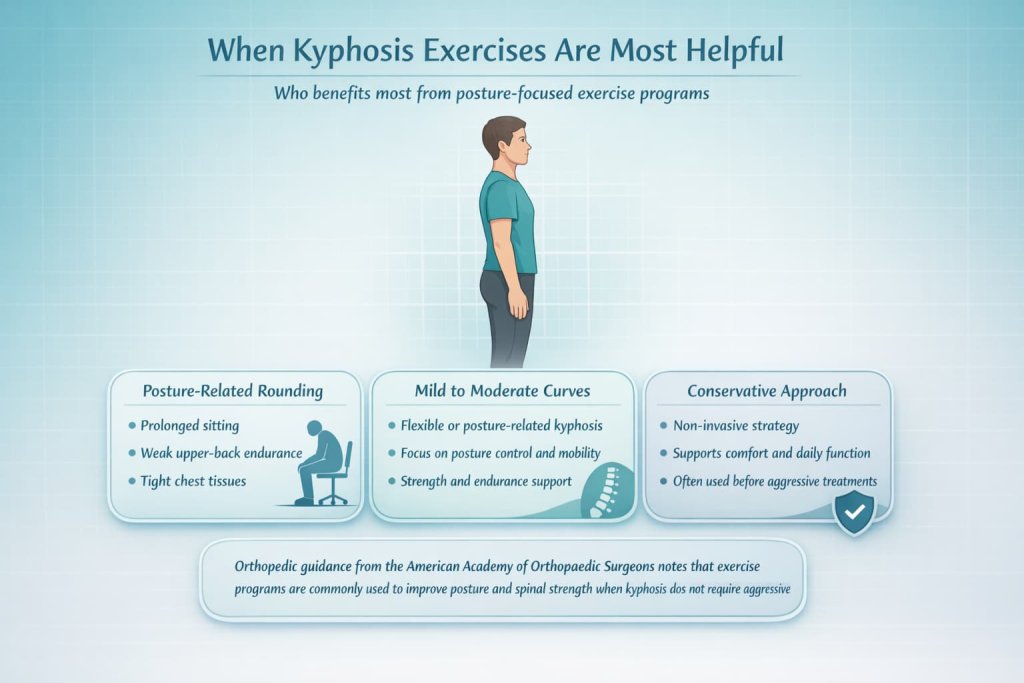
- You have posture-related rounding often linked to prolonged sitting, weak upper-back endurance, and tight chest tissues
- Your curve is mild to moderate and your main goals are posture control, mobility, and strength
- You want a conservative approach to support comfort and function
Orthopedic guidance from the American Academy of Orthopaedic Surgeons (AAOS) notes that many people use exercise programs to improve posture and strengthen the spine when kyphosis does not require more aggressive treatment.
Who Can Benefit From Kyphosis Exercises
Kyphosis exercises are most beneficial for people whose upper back rounding is influenced by posture habits, muscle imbalances, or age-related changes rather than severe structural spinal deformities. These exercises focus on improving movement control, strength, and endurance, which can support better alignment in daily life.
People who may benefit include:
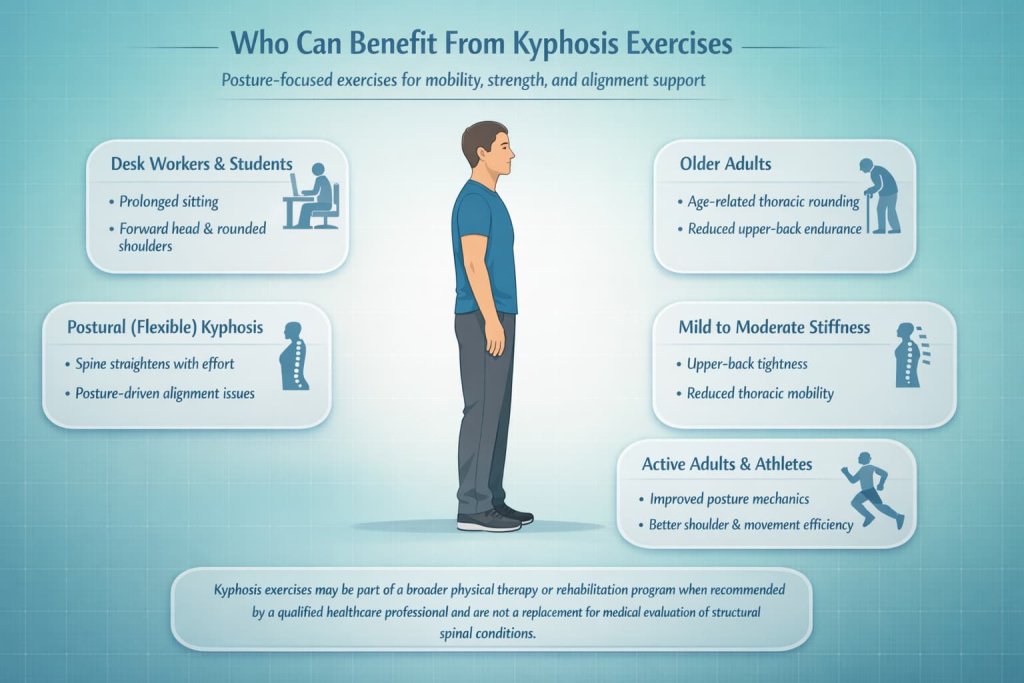
- Desk workers and students who spend long hours sitting with forward head and rounded shoulder posture
- Older adults experiencing age-related thoracic rounding and reduced spinal extensor endurance
- Individuals with postural (flexible) kyphosis, where the spine can straighten with active effort
- People with mild to moderate upper back stiffness who want to improve mobility and comfort
- Active individuals and athletes looking to improve posture, shoulder mechanics, and movement efficiency
Kyphosis exercises may also be included as part of a broader physical therapy or rehabilitation program when recommended by a qualified healthcare professional. However, they are not intended to replace medical evaluation or treatment for structural or severe spinal conditions.
9 best kyphosis exercises
These kyphosis exercises focus on improving upper back mobility, strengthening postural muscles, and reducing rounded shoulder posture. When performed consistently, they help support better spinal alignment and posture control.
1) Chin Tuck (Cervical Retraction)
Why it works:
Forward head posture commonly accompanies thoracic kyphosis, shifting the head in front of the rib cage and increasing strain on the upper back. Chin tucks retrain cervical alignment by encouraging the head to stack directly over the shoulders, reducing compensatory thoracic rounding and improving overall postural balance.
Muscles worked:
Deep cervical flexors, cervical stabilizers, and postural neck muscles.
How to do it:
- Stand tall against a wall or sit upright with your back supported
- Keep your eyes level and jaw relaxed
- Gently slide your head straight backward without tipping it up or down
- Hold the retracted position for 3–5 seconds
- Relax and repeat for 6–10 controlled repetitions
Trainer Tip:
The movement should feel subtle and controlled. If you feel neck strain or jaw tension, reduce the range and slow the pace.
2) Wall Angels (Wall Slides)
Why it works:
Wall angels combine thoracic extension, shoulder external rotation, and scapular control—three elements that are often limited in people with rounded upper backs. Practicing this movement against a wall provides feedback that encourages better alignment and postural awareness.
Muscles worked:
Middle and lower trapezius, rotator cuff muscles, serratus anterior.
How to do it:
- Stand with your head, upper back, and hips close to a wall
- Slightly bend the knees and keep ribs stacked over hips
- Place arms in a goalpost position against the wall
- Slowly slide arms upward, then lower with control
- Perform 6–10 slow repetitions
Trainer Tip:
Do not force your arms to stay flat against the wall. Prioritize smooth, pain-free movement over range.
3) Doorway Pec Stretch
Why it works:
Tight chest muscles can pull the shoulders forward, reinforcing rounded posture and limiting thoracic extension. Stretching the pectoral muscles helps reduce this forward pull, allowing the upper back to sit in a more neutral position.
Muscles worked:
Pectoralis major and pectoralis minor (stretch emphasis).
How to do it:
- Place forearms on the sides of a doorway at shoulder height
- Step one foot forward until a gentle stretch is felt across the chest
- Hold the stretch for 20–40 seconds
- Repeat 2–3 times
Trainer Tip:
Avoid arching the lower back during the stretch. Keep ribs down and chin gently tucked.
4) Thoracic Extension Over a Foam Roller or Towel
Why it works:
Limited thoracic extension is a major contributor to kyphosis. This drill restores extension capacity in the mid-back without loading the spine, making upright posture easier to maintain throughout the day.
Muscles worked:
Thoracic spine structures, spinal extensors (light activation).
How to do it:
- Lie on your back with a foam roller or rolled towel placed across the mid-back
- Support your head and neck with your hands
- Gently extend your upper back over the support while exhaling
- Pause briefly, then return to neutral
- Perform 6–10 slow repetitions
Trainer Tip:
Move slowly and stay relaxed. The motion should come from the upper back, not the lower spine.
5) Open-Book Thoracic Rotations
Why it works:
Thoracic rotation and extension often decline together. Improving rotational mobility helps reduce stiffness, supports better spinal mechanics, and complements extension-based posture work.
Muscles worked:
Thoracic spine tissues, obliques, upper-back musculature.
How to do it:
- Lie on your side with hips and knees bent
- Extend arms straight in front of you
- Rotate the top arm open while keeping knees stacked
- Exhale during the rotation, then return slowly
- Perform 6–8 repetitions per side
Trainer Tip:
Keep the movement smooth and controlled. Stop before any shoulder discomfort occurs.
6) Prone Cobra (Chest Lift Hold)
Why it works:
Posture correction requires endurance, not just strength. The prone cobra trains spinal extensors and scapular stabilizers to hold an upright position against gravity for longer periods.
Muscles worked:
Thoracic spinal extensors, middle and lower trapezius, rhomboids.
How to do it:
- Lie face down with arms resting alongside your body
- Gently lift your chest a few inches off the floor
- Keep the neck long and shoulders drawn down and back
- Hold the position for 10–20 seconds
- Perform 3–5 controlled holds
Trainer Tip:
A small lift is enough. If the lower back feels strained, reduce height and focus on shoulder blade engagement.
7) Band Pull-Apart
Why it works:
Band pull-aparts strengthen the muscles responsible for pulling the shoulders back and maintaining upright posture, helping counteract prolonged sitting and forward shoulder drift.
Muscles worked:
Rear deltoids, rhomboids, middle trapezius.
How to do it:
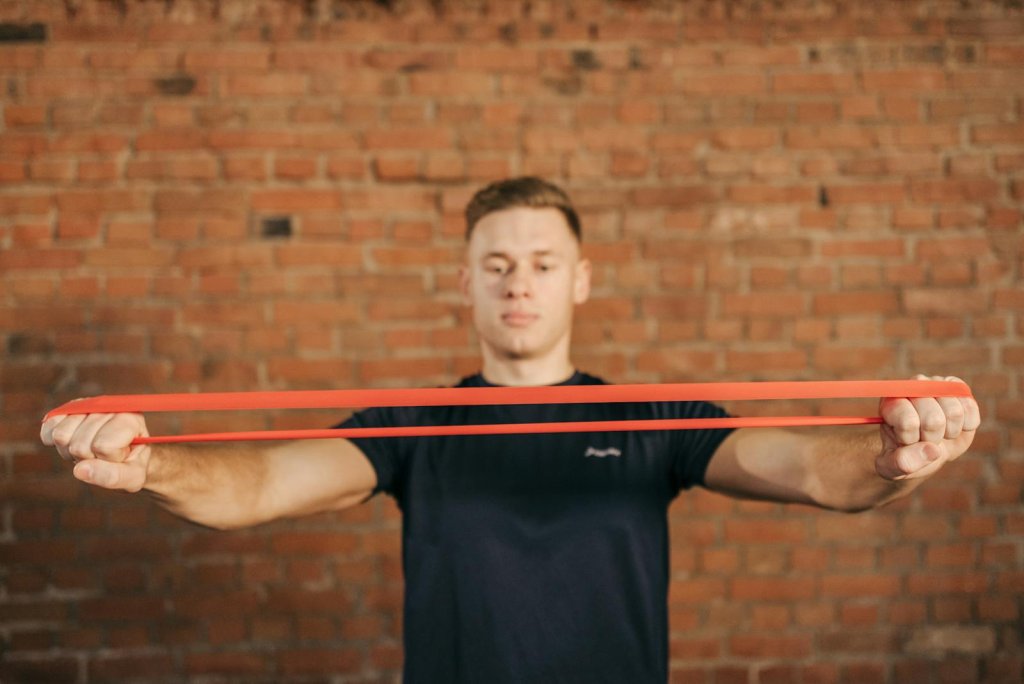
- Hold a resistance band at shoulder height with arms straight
- Pull the band apart by moving hands outward
- Pause briefly at full tension
- Return slowly and repeat for 10–15 repetitions
Trainer Tip:
Maintain rib-to-pelvis alignment. If your ribs flare, reduce resistance.
8) Seated or Band Row
Why it works:
Rows reinforce scapular retraction and upper-back strength, which are essential for sustaining improved posture during daily activities such as sitting, lifting, and carrying.
Muscles worked:
Latissimus dorsi, rhomboids, trapezius, biceps.
How to do it:
- Anchor a resistance band at chest height
- Start with arms extended and shoulders relaxed
- Pull shoulder blades back first, then bend elbows
- Finish with hands near ribs and elbows close to the body
- Perform 8–12 repetitions
Trainer Tip:
Think “shoulder blades before arms” to avoid overusing the biceps.
9) Hip Hinge Drill (Wall Hinge)
Why it works:
Many people compensate for poor hip mechanics by rounding the upper back during bending. Hip hinge drills retrain proper movement patterns, reducing habitual thoracic flexion.
Muscles worked:
Glutes, hamstrings, spinal stabilizers.
How to do it:
- Stand with your back a few inches from a wall
- Soften your knees slightly
- Push hips back until they tap the wall
- Keep your spine long and chest tall
- Perform 8–12 controlled repetitions
Trainer Tip:
Move slowly and keep the head aligned with the spine throughout the motion.
How to use these kyphosis exercises for best results
The most effective programs consistently combine:
- Thoracic extension mobility
- Scapular control and shoulder positioning
- Spinal extensor endurance
- Chest and anterior shoulder mobility
Systematic reviews indexed through PubMed show that structured therapeutic exercise programs can improve thoracic hyperkyphosis measurements and related outcomes such as balance and physical function, although results vary by program design and population.
A practical weekly structure:
- 3 days per week (10–20 minutes): strength and endurance focus
- Daily (5–8 minutes): mobility and posture resets
- Progress every 1–2 weeks: longer holds, more repetitions, or slightly harder variations
Common mistakes that slow progress
- Stretching without strengthening
- Overarching the lower back to appear “upright”
- Shrugging shoulders during pulling exercises
- Forcing mobility drills
- Inconsistent practice
A simple 10-minute kyphosis routine
Perform 3 days per week:
- Chin tucks: 8 reps
- Wall angels: 8 reps
- Band pull-aparts: 12 reps
- Prone cobra: 3 holds of 15 seconds
- Band rows: 10 reps
- Doorway pec stretch: 30 seconds per side
On non-strength days:
- Thoracic extension drill: 6 reps
- Open-book rotations: 6 reps per side
Safety first before you start
Stop and seek medical guidance if you experience:
- New or worsening pain, numbness, tingling, weakness, or balance changes
- A recent fall, suspected fracture, or known spinal compression fracture
- Breathing limitation, rapidly worsening posture, or severe spinal curvature
If kyphosis is related to osteoporosis or increased fracture risk, exercise recommendations from the International Osteoporosis Foundation emphasize avoiding repeated spinal flexion and prioritizing spine-safe extension, posture control, and gradual progression.
When to see a clinician or physical therapist
Seek professional guidance if posture continues to worsen, pain persists, neurological symptoms appear, or kyphosis is linked to osteoporosis or previous spinal fractures, as recommended by the American Academy of Orthopaedic Surgeons.
FAQs
Can kyphosis exercises permanently straighten my back?
Exercises may improve posture control, mobility, and muscle endurance. Structural kyphosis may not fully reverse, but function and alignment often improve with consistency.
How long does it take to see results?
Clinical trials published in BMC Geriatrics show measurable improvements after structured 6-week exercise programs, with earlier changes often felt within weeks.
Should I avoid crunches with kyphosis?
For people with osteoporosis or fracture risk, spine-safety guidance from the International Osteoporosis Foundation discourages repeated spinal flexion.
Are kyphosis exercises safe for teens?
Postural kyphosis often responds well to exercise, while structural forms may require monitoring or bracing during growth, as outlined by the Mayo Clinic.
Do adults need braces for kyphosis?
Bracing is rarely used in adults and is more common in specific adolescent cases.
What is the single best kyphosis exercise?
There isn’t one. Best results come from combining mobility, strengthening, and endurance exercises.
Conclusion
Kyphosis exercises are most effective when they address the entire posture system—thoracic mobility, scapular strength, and spinal extensor endurance. Start with short, consistent routines, progress gradually, and seek professional guidance when symptoms are significant or worsening.