
IT band stretches can help reduce outer hip and knee discomfort by easing tightness in the muscles around the iliotibial band (especially the TFL and glutes) and improving hip movement control. The IT band itself is thick connective tissue, so the biggest benefit usually comes from stretching surrounding muscles and improving hip mechanics—an approach commonly emphasized in guidance from the American Academy of Orthopaedic Surgeons (AAOS).
Understanding how to stretch safely matters because outer knee or hip pain can flare with walking, running, stairs, and prolonged sitting. Below are the most effective IT band stretches, plus safety tips, common mistakes, and when to seek professional guidance.
What Are IT Band Stretches?
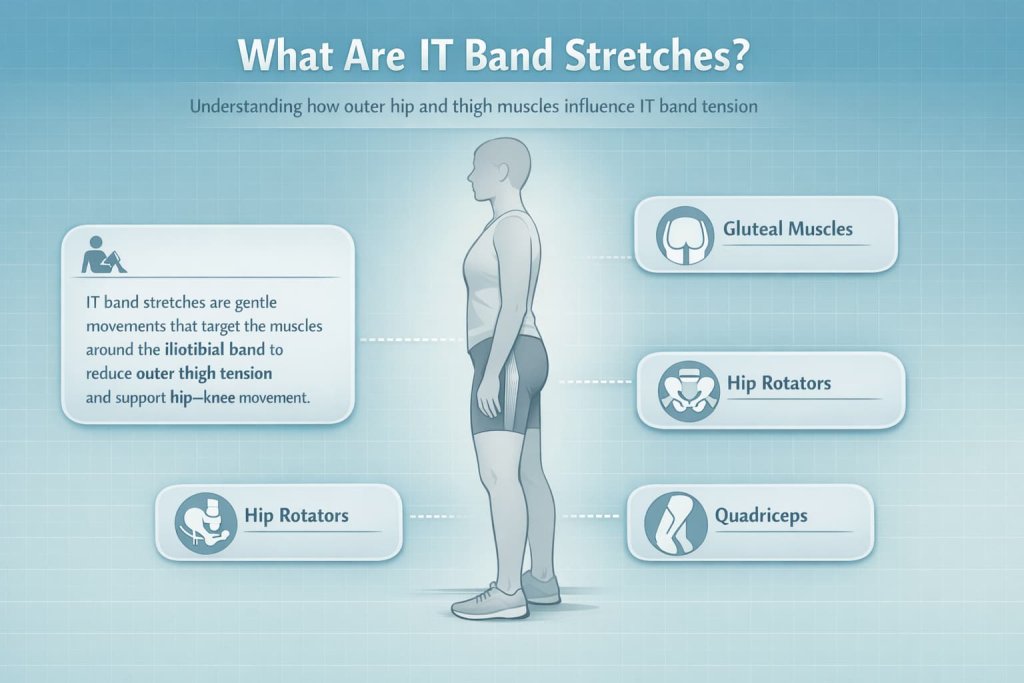
IT band stretches are gentle movements that target the muscles around the iliotibial band to reduce tension along the outer thigh. Since the IT band itself is connective tissue, these stretches focus on nearby muscles that influence how stress is transferred from the hip to the knee.
They commonly focus on:
- Tensor fasciae latae (TFL)
- Gluteal muscles
- Hip rotators
- Quadriceps
Why IT Band Stretches Matter for Hip and Knee Pain
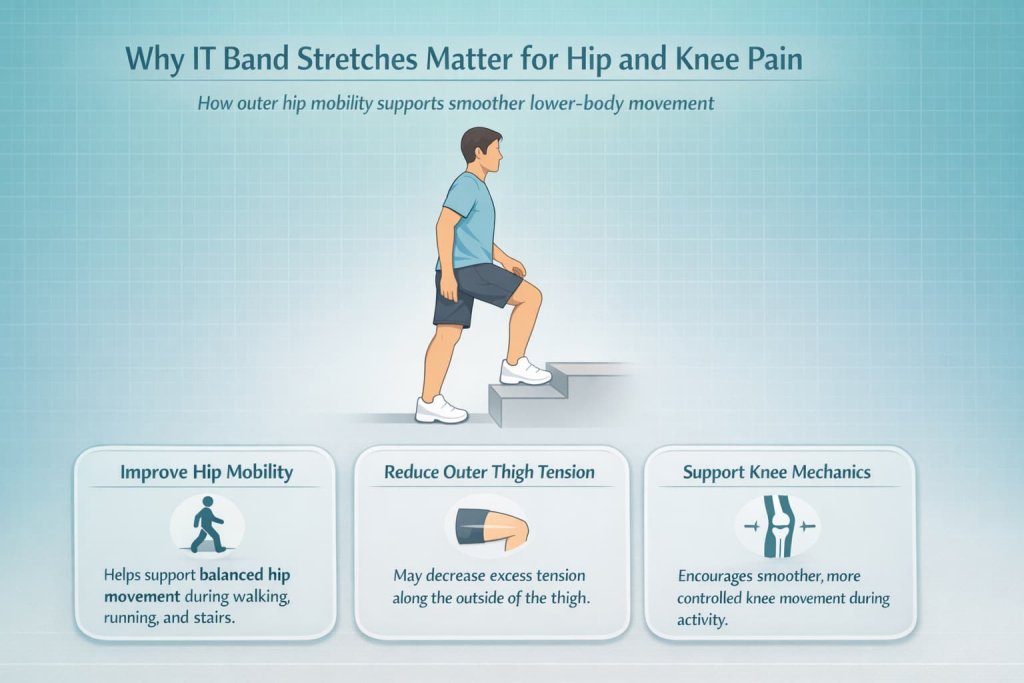
The IT band helps stabilize the hip and knee during walking, running, and stair use. When surrounding muscles are tight or poorly controlled, extra strain can develop along the outside of the leg.
IT band stretches may help by:
- Improving hip mobility and movement balance
- Reducing excess tension along the outer thigh
- Supporting smoother knee mechanics during activity
10 Best IT Band Stretches
These IT band stretches focus on the muscles around the outer hip and thigh to help reduce tension that can contribute to hip or knee discomfort. When performed gently and consistently, they can support better movement quality and overall lower-body mobility.
1) Standing IT Band Stretch (Wall-Supported)
How to do it:
- Stand sideways next to a wall, using it lightly for balance
- Cross the leg closest to the wall behind your other leg
- Keep both feet flat and knees straight but relaxed
- Shift your hips gently toward the wall without leaning forward
- Hold for 20–30 seconds, then switch sides
Why it works:
This stretch places the hip into slight adduction, which lengthens the tissues that influence tension along the outside of the thigh. It is commonly used in orthopedic rehabilitation programs and is frequently recommended by the American Academy of Orthopaedic Surgeons for managing IT band–related symptoms.
Muscles worked:
Tensor fasciae latae (TFL), gluteus medius, gluteus minimus.
Trainer Tip:
Keep your chest tall and ribs stacked over the pelvis. If you feel the stretch mostly in your lower back, reduce the hip shift slightly.
2) Cross-Over Reach IT Band Stretch
How to do it:
- Stand upright with one leg crossed over the other at the ankle
- Raise the arm on the side of the back leg overhead
- Gently lean your torso away from the back leg
- Keep hips facing forward
- Hold for 20–30 seconds per side
Why it works:
The added side bend increases stretch demand through the outer hip and thigh while maintaining an upright posture. This variation is commonly shown in flexibility guidance from the Mayo Clinic.
Muscles worked:
TFL, lateral hip fascia, obliques (secondary).
Trainer Tip:
Think “reach up before you lean.” Creating length first prevents compression through the spine.
3) Side-Lying IT Band Stretch
How to do it:
- Lie on your side with the bottom knee bent for stability
- Keep the top leg straight and slightly behind your body
- Slowly lower the top leg toward the floor under control
- Stop at the first comfortable stretch
- Hold for 20–30 seconds, then switch sides
Why it works:
Removing balance demands allows the hip muscles to relax, which can make this stretch more comfortable for people with knee or balance limitations.
Muscles worked:
TFL, lateral thigh tissues, gluteal muscles (lengthened).
Trainer Tip:
Keep your pelvis stacked vertically. Rolling backward shifts the stretch away from the target area.
4) Figure-4 Glute Stretch
How to do it:
- Lie on your back with both knees bent
- Cross one ankle over the opposite thigh
- Grasp the uncrossed thigh and gently pull it toward your chest
- Keep your head and shoulders relaxed
- Hold for 20–30 seconds per side
Why it works:
Restricted glute and deep hip rotator mobility can increase lateral hip tension during walking or running. This stretch is commonly included in home rehabilitation programs used by academic medical centers such as Dartmouth Health.
Muscles worked:
Piriformis, deep hip rotators, gluteus maximus.
Trainer Tip:
If knee pressure is uncomfortable, cross the ankle lower on the thigh or perform the stretch seated.
5) Seated Piriformis Stretch
How to do it:
- Sit upright on the floor or a firm chair
- Cross one leg over the other so the foot rests outside the opposite knee
- Rotate your torso gently toward the bent knee
- Keep your spine long and chest lifted
- Hold for 20–30 seconds per side
Why it works:
Improving hip rotation mobility can reduce compensatory movement patterns that increase strain along the outer thigh.
Muscles worked:
Piriformis, gluteus medius, deep hip rotators.
Trainer Tip:
Avoid forcing the rotation. The stretch should feel gradual, not jammed.
6) Half-Kneeling Hip Flexor Stretch
How to do it:
- Kneel on one knee with the opposite foot planted in front
- Squeeze the glute of the kneeling leg
- Gently shift your hips forward without arching your back
- Keep ribs stacked over the pelvis
- Hold for 20–30 seconds per side
Why it works:
Hip flexor tightness often accompanies TFL overactivity, especially in runners and people who sit for long periods. Addressing this area can indirectly reduce lateral hip tension.
Muscles worked:
Iliopsoas, rectus femoris, TFL.
Trainer Tip:
If you feel pressure in the lower back, reduce the forward shift and emphasize the glute squeeze.
7) Quadriceps Stretch
How to do it:
- Stand tall while holding a wall or chair for balance
- Bend one knee and bring the heel toward your glute
- Keep knees close together
- Lightly tuck the pelvis to avoid arching
- Hold for 20–30 seconds per side
Why it works:
Quadriceps tightness can affect hip and knee mechanics, which may increase strain through the lateral thigh during movement.
Muscles worked:
Quadriceps, particularly rectus femoris.
Trainer Tip:
If balance is limited, perform this stretch lying on your side or use a strap.
8) Supine Hamstring Stretch
How to do it:
- Lie on your back with one leg raised
- Loop a strap or towel around the foot
- Slowly straighten the knee until a stretch is felt
- Keep the opposite leg relaxed
- Hold for 20–30 seconds per side
Why it works:
Limited hamstring flexibility can alter stride mechanics and pelvic control, indirectly increasing lateral chain loading.
Muscles worked:
Hamstrings.
Trainer Tip:
Stop before you feel pulling behind the knee or tingling down the leg.
9) Adductor (Inner Thigh) Stretch
How to do it:
- Sit with the soles of your feet together or assume a gentle side-lunge position
- Keep your chest upright and spine neutral
- Ease into the stretch gradually
- Hold for 20–30 seconds
Why it works:
Balanced hip mobility supports better knee alignment and load distribution. Inner-thigh flexibility is often paired with lateral hip routines in educational materials from HipKneeInfo.
Muscles worked:
Hip adductors.
Trainer Tip:
Avoid forcing the knees downward; let gravity do the work.
10) Foam Rolling the Outer Thigh (Optional)
How to do it:
- Place a foam roller under the outer thigh
- Support your body with your arms and opposite leg
- Roll slowly from just below the hip toward mid-thigh
- Pause briefly on tender areas
- Spend 30–60 seconds per side
Why it works:
Some people experience short-term symptom relief through soft-tissue techniques, although research findings are mixed. Reviews published by MDPI suggest foam rolling should be considered a supportive option rather than a primary intervention.
Muscles worked:
Lateral thigh tissues and surrounding fascia.
Trainer Tip:
Discomfort should feel tolerable, not sharp or bruising-like. Reduce pressure if needed.
How to use these IT band stretches
A simple, effective routine:
- Choose 3–5 stretches per session
- Hold each stretch for 20–30 seconds
- Perform 1–2 rounds
- Practice most days of the week if symptoms allow
Important notes before you start IT band stretches
The iliotibial band is a strong band of fascia that helps transfer forces from the hip to the knee. Because it’s connective tissue, it doesn’t lengthen like muscle tissue. Many so-called IT band stretches primarily affect the tensor fasciae latae (TFL), gluteal muscles, hip rotators, and quadriceps, which influence tension along the outer thigh, as outlined in anatomical research published by the National Center for Biotechnology Information (NCBI).
For best results:
- Stretch gently, not aggressively
- Hold positions for about 20–30 seconds
- Focus on the outer hip or upper thigh, not sharp knee pain
- Pair stretching with hip strengthening, which AAOS highlights as essential for long-term improvement
Quick safety checklist
Stop and seek medical or physical therapy guidance if you experience:
- Sharp or worsening pain
- Swelling, locking, or instability
- Numbness or tingling down the leg
- Pain after a fall or traumatic injury
Common mistakes to avoid with IT band stretches
- Stretching into sharp outer-knee pain
- Only stretching and skipping hip strengthening
- Overstretching during symptom flare-ups
- Ignoring training or activity errors
What else helps besides IT band stretches
Clinical guidance from AAOS consistently supports a combined approach:
- Stretching
- Hip strengthening (especially abductors)
- Cross-training
- Gradual training progression
- Footwear and movement assessment
Who Should Be Careful Before Doing IT Band Stretches
IT band stretches are generally safe when performed gently, but extra caution is recommended if any of the following apply to you:
- Recent hip, knee, or lower-back injury
- History of knee, hip, or spine surgery
- Significant swelling, warmth, or redness around the knee or hip
- Sharp pain on the outside of the knee rather than a mild stretching sensation
- Numbness, tingling, or weakness traveling down the leg
- Known joint conditions such as advanced osteoarthritis or inflammatory arthritis
In these situations, stretching without proper guidance may increase irritation rather than improve movement. Clinical guidance from organizations such as the American Academy of Orthopaedic Surgeons emphasizes modifying or temporarily avoiding exercises that reproduce pain.
When to stop or seek professional guidance
Consider evaluation by a clinician or physical therapist if:
- Symptoms persist beyond two weeks
- Pain repeatedly returns with activity
- You notice limping or strength loss
Movement assessments and load-management strategies are commonly emphasized in clinical research summarized by ScienceDirect.
FAQs
Do IT band stretches actually work?
They may help improve comfort and movement, but long-term improvement usually requires hip strengthening.
How long should I hold IT band stretches?
Most guidelines recommend 20–30 seconds per stretch.
Should I stretch during a flare-up?
Rest first, then reintroduce stretching gradually.
Is foam rolling safe?
Yes for many people, if done gently and away from the knee.
Why do runners get IT band pain so often?
Repetitive loading, training errors, and lateral hip weakness are common contributors.
How often should I stretch?
Most days, as long as symptoms don’t worsen.
Conclusion
IT band stretches can support comfort and mobility, but they work best as part of a broader plan that includes hip strengthening and smart activity progression. Start gently, stay consistent, and focus on movement quality rather than intensity. Persistent or worsening pain should be evaluated by a professional.