
A carb cycling meal plan can help with fat loss and performance when you use more carbs on harder training days, fewer on rest days, and still keep total calories and protein in a good range. It is not a magic fat-loss shortcut. The main drivers of results are still a sustainable calorie deficit for fat loss, enough protein to help protect lean mass, and smart fueling around training. The CDC’s weight-loss guidance makes that foundation clear.
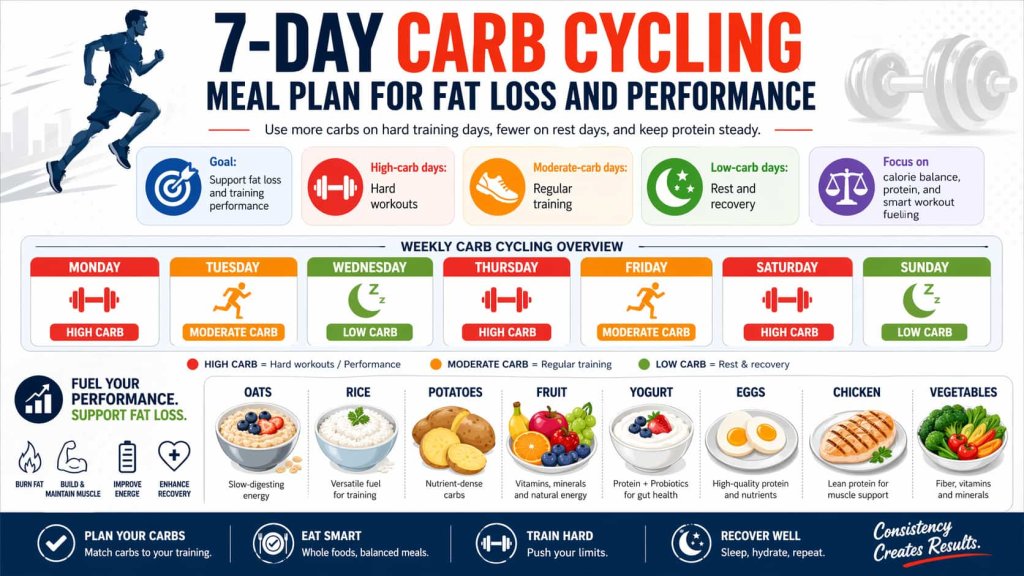
Carb cycling is best understood as a practical version of periodized sports nutrition. In real life, that means you do not eat the same amount of rice, oats, fruit, potatoes, or pasta every day. You raise carbohydrate intake when training is hardest, and pull it back on easier days, while keeping the rest of your diet built around nutrient-dense foods. The USDA MyPlate guidance remains a strong foundation: fruits, vegetables, grains, protein foods, and dairy or fortified soy alternatives, with less added sugar, saturated fat, and sodium.
What Is a Carb Cycling Meal Plan?
A carb cycling meal plan is an eating pattern that changes your carbohydrate intake across the week based on activity. On high-demand days, you eat more carbohydrate to support training, glycogen, and recovery. On lower-demand days, you eat less carbohydrate because you do not need the same amount of fuel. Sports-nutrition reviews discuss this idea under periodized nutrition for athletes and carbohydrates for training and competition.
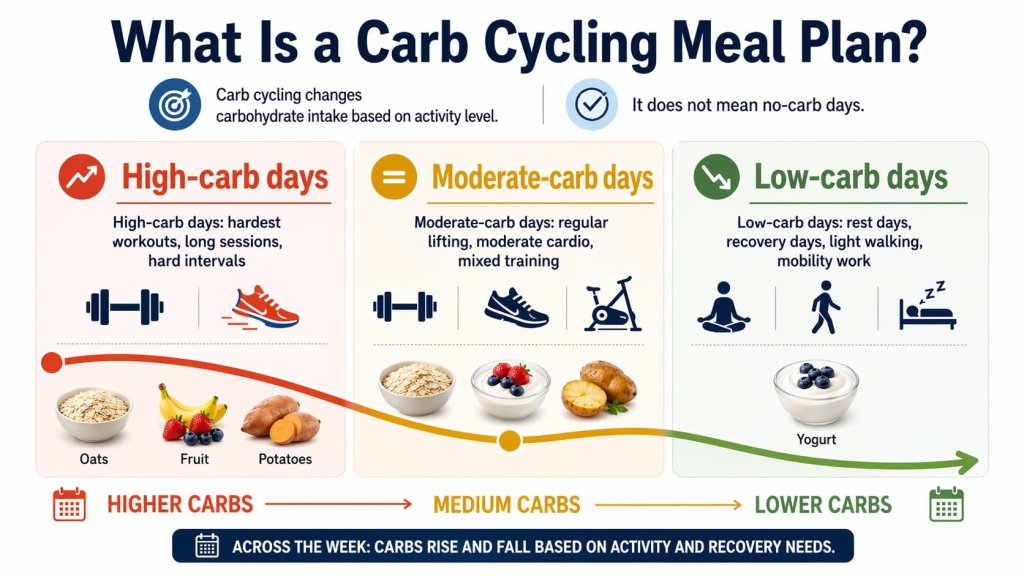
A simple way to think about it is this:
- High-carb days: hardest workouts, long sessions, hard intervals, competition-style training
- Moderate-carb days: regular lifting, moderate cardio, mixed training
- Low-carb days: rest days, recovery days, light walking, mobility work
That does not mean no-carb days. Even on lower-carb days, most people still do better with some carbohydrate from foods like fruit, beans, yogurt, milk, and whole grains, especially if they want to train well the next day. That approach also fits the general healthy-eating pattern in MyPlate.
Does Carb Cycling Work for Fat Loss?
Carb cycling can work for fat loss, but not because carbs are automatically fattening on some days and harmless on others. Fat loss still depends on a calorie deficit. The CDC explains that weight loss comes from using more calories than you take in over time, supported by healthy eating patterns and regular activity.
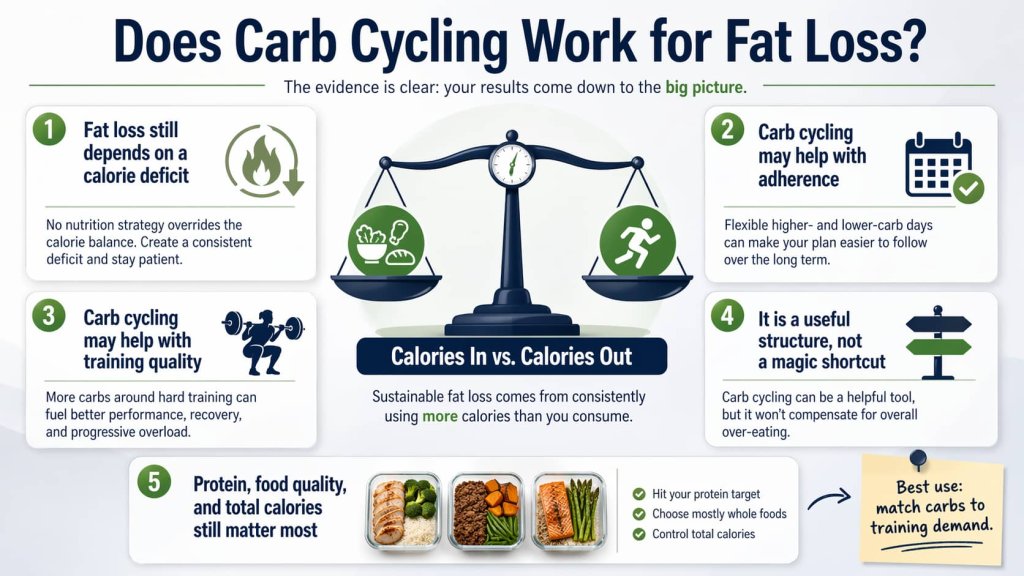
Where carb cycling may help is adherence and training quality. Many people find it easier to diet when they eat more carbohydrate on the days they train hardest. That can make lifting, interval work, or longer sessions feel better, which may help them preserve training performance while staying in a calorie deficit. In a fat-loss phase for resistance-trained athletes, a narrative review in PubMed notes that carbohydrate intake should be adapted to activity level, and a weekly weight-loss rate of about 0.5% to 1.0% of body weight is a practical target for retaining more lean mass.
So the realistic answer is this: carb cycling can be a useful structure, but it is not clearly better than any other calorie-matched diet if total intake, protein, and food quality are already in place.
How a Carb Cycling Meal Plan May Help Performance
Carbohydrate is the most useful fuel for higher-intensity training. Reviews on sports nutrition note that carbohydrate availability can be increased through intake in the hours or days before training, during longer sessions, and during recovery afterward. That is why harder training days are usually the best place for more carbohydrate in a carb cycling plan.
A recent review on carbohydrate intake and exercise performance reported practical targets such as 1 to 3 g/kg of carbohydrate about 3 to 4 hours before exercise and 30 to 60 g per hour during exercise in the right settings. Those numbers are mainly useful for harder or longer sessions, not easy walks or brief gym sessions.
Food choice matters too. A food-first sports nutrition review notes that practical pre-exercise carbohydrate sources can include oats, rice, potatoes, raisins, honey, and lentils. For a general meal plan, that translates well to oats, fruit, rice bowls, potatoes, beans, pasta, yogurt, and milk.
Who a Carb Cycling Meal Plan Fits Best
A carb cycling meal plan usually makes the most sense for:
- people who train 3 to 6 days per week
- lifters who also do some conditioning
- runners, cyclists, or field-sport athletes with clear hard and easy days
- active adults trying to lose fat without feeling flat during training
- people who like structure and meal planning
It usually makes less sense for people who are mostly sedentary, dislike tracking or portion awareness, or want a very simple plan they can repeat daily. In those cases, a steady calorie deficit and consistent meal pattern may be easier to follow.
Who Should Be Careful With Carb Cycling
Carb cycling can backfire when it turns into chronic under-fueling. The 2023 IOC consensus on Relative Energy Deficiency in Sport (RED-S) warns that low energy availability can harm health and performance in both female and male athletes. A separate review on low carbohydrate availability in female endurance athletes also highlights performance and health concerns when carbohydrate intake stays too low for training demand.
Be especially careful if you:
- have a history of disordered eating
- do high-volume endurance training
- notice worsening recovery, irritability, poor sleep, or stalled performance
- have frequent illness or repeated injuries
- are pregnant, breastfeeding, or managing diabetes or another medical condition that changes nutrition needs
Do Not Use a Generic Carb Cycling Plan With Diabetes Medication
If you use insulin or another glucose-lowering medication, do not copy a generic high- and low-carb pattern without medical guidance. Exercise can change carbohydrate needs from day to day, and blood glucose responses can vary with exercise type, workout timing, medication, and recent meals. For people with diabetes, carbohydrate timing and amount should be individualized with a clinician or sports dietitian rather than guessed from a template. The consensus statement on exercise and type 1 diabetes management supports that individualized approach.
Signs Your Carb Cycling Plan Is Too Aggressive
Common red flags include unusually low energy, worsening workouts, poor recovery, irritability, poor sleep, dizziness, constant food thoughts, repeated illness, and, in women, menstrual changes. Those signs can point to low energy availability rather than a lack of discipline. If they show up, increase total food intake and workout fueling instead of stacking more low-carb days. This matters most for athletes and very active adults, because chronic under-fueling can hurt both performance and health.
In those cases, a registered dietitian or qualified sports dietitian is a better next step than copying a generic carb-cycling template.
How to Set Up Your Carb Cycling Meal Plan
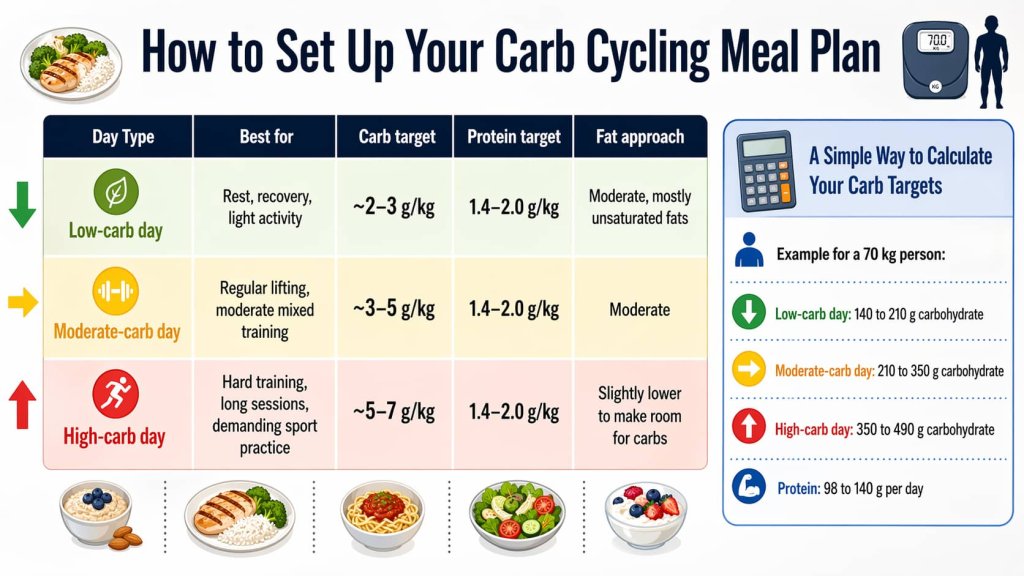
The easiest way to build a carb cycling meal plan is to keep protein fairly steady, move carbohydrates up or down based on training, and adjust fat so total calories stay where you need them. The ISSN position stand on protein and exercise states that about 1.4 to 2.0 g/kg/day is sufficient for most exercising people. For carbohydrate, sports-nutrition guidance commonly places general training around 5 to 7 g/kg/day, heavier endurance work around 7 to 10 g/kg/day, and fat-loss phases in resistance-trained athletes around 2 to 5 g/kg/day depending on activity level.
Here is a practical starting framework:
| Day type | Best for | Carb target | Protein target | Fat approach |
|---|---|---|---|---|
| Low-carb day | Rest, recovery, light activity | ~2–3 g/kg | 1.4–2.0 g/kg | Moderate, mostly unsaturated fats |
| Moderate-carb day | Regular lifting, moderate mixed training | ~3–5 g/kg | 1.4–2.0 g/kg | Moderate |
| High-carb day | Hard training, long sessions, demanding sport practice | ~5–7 g/kg | 1.4–2.0 g/kg | Slightly lower to make room for carbs |
These are starting points, not hard rules. If your training volume is very high, you may need more carbohydrate than this. If your activity is lower, you may need less.
A Simple Way to Calculate Your Carb Targets
If you want to turn the ranges above into real numbers, start with your body weight in kilograms and multiply it by the target for that day type. For example, a 70 kg person could begin around 140 to 210 g of carbohydrate on a low-carb day, 210 to 350 g on a moderate-carb day, and 350 to 490 g on a high-carb day. Protein can stay steadier across the week at about 98 to 140 g per day if you use the common 1.4 to 2.0 g/kg range for active adults. If the high-carb range feels too aggressive, start at the lower end and place more of those carbs around your workout instead of spreading them evenly across the whole day.
Best Foods for High-, Moderate-, and Low-Carb Days
High-carb day foods
Build meals around easier-to-digest carbohydrate sources and keep protein present at each meal:
- oats, rice, potatoes, pasta, whole-grain bread
- bananas, berries, oranges, raisins
- beans, lentils, lower-fat dairy, yogurt, milk
- lean protein such as chicken, fish, eggs, tofu, tempeh, turkey
Moderate-carb day foods
Use a balanced plate:
- one solid carbohydrate source per meal
- plenty of vegetables
- a clear protein source
- fruit once or twice through the day
Low-carb day foods
Keep protein and produce high, but do not turn the day into a fat-only diet:
- eggs, Greek yogurt, cottage cheese, fish, chicken, tofu
- salads, roasted vegetables, soups, stir-fries
- smaller portions of beans, fruit, oats, quinoa, or potatoes as needed
- avocado, nuts, seeds, olive oil for satisfaction
That overall pattern lines up well with MyPlate’s advice to eat a variety of fruits, vegetables, grains, protein foods, and dairy or fortified soy alternatives, while choosing nutrient-dense foods more often.
7-Day Carb Cycling Meal Plan for Fat Loss and Performance
This sample week is designed for a healthy active adult doing a mix of strength and conditioning. Adjust portion sizes to your body size, calorie needs, and training volume.
How to Scale This Sample Week to Your Size
This sample plan shows meal structure, not fixed calories. Keep protein foods and vegetables fairly similar across the week, then change your starch portions based on training demand. On low-carb days, use smaller portions of foods like rice, oats, potatoes, bread, pasta, or beans. On moderate-carb days, use a normal portion at most meals. On high-carb days, add an extra carb serving before or after hard training rather than turning the whole day into a free-for-all. This makes the plan easier to scale for smaller bodies, larger bodies, and different training volumes while keeping the overall pattern practical.
Day 1 — High-Carb Day
Best for: hard lower-body lift, intervals, or a demanding sport session
Breakfast: Oatmeal made with milk, banana, berries, and Greek yogurt
Lunch: Chicken rice bowl with black beans, corn, salsa, and mixed vegetables
Pre-workout snack: Bagel or toast with honey and a banana
Dinner: Salmon, roasted potatoes, green beans, and fruit
Evening snack: Yogurt with cereal or oats
Why it works: most of the day’s carbohydrate is placed before and after a hard training session, while protein stays present across meals.
Day 2 — Moderate-Carb Day
Best for: upper-body strength or moderate mixed training
Breakfast: Eggs, oatmeal, and berries
Lunch: Turkey wrap with fruit and carrots
Snack: Greek yogurt and an apple
Dinner: Lean beef, quinoa or rice, roasted vegetables
Optional snack: Cottage cheese and fruit
This day still supports training, but it does not need the same carbohydrate load as your hardest session.
Day 3 — Low-Carb Day
Best for: rest day, walking, light mobility
Breakfast: Veggie omelet, avocado, and berries
Lunch: Large salad with chicken, chickpeas, olive oil, and vinegar
Snack: Cottage cheese or Greek yogurt with cucumber or tomatoes
Dinner: Baked fish or tofu, roasted vegetables, and a smaller serving of sweet potato
Optional snack: Nuts and fruit
This is a lower-carb day, not a zero-carb day. You are simply matching intake to lower energy demand.
Day 4 — High-Carb Day
Best for: tempo run, longer cardio session, or hard team practice
Breakfast: Overnight oats with milk, chia, banana, and yogurt
Lunch: Rice bowl with lean protein, beans, vegetables, and fruit
Pre-workout snack: Toast with jam and a banana
Dinner: Pasta with turkey meat sauce, side salad, and fruit
Post-workout option: Milk or yogurt plus a cereal bar if you need a fast recovery meal
This is another day where higher carbohydrate availability is useful because training demand is higher.
Day 5 — Moderate-Carb Day
Best for: full-body lift or moderate conditioning
Breakfast: Greek yogurt parfait with oats, berries, and nuts
Lunch: Tuna or chicken sandwich with fruit
Snack: Apple and a cheese stick or yogurt
Dinner: Chicken stir-fry with rice and vegetables
Optional snack: Cottage cheese with pineapple
This day is balanced enough for performance but still easier to fit into a fat-loss phase than repeated high-carb days.
Day 6 — High-Carb Day
Best for: longest workout of the week
Breakfast: Bagel, eggs, fruit, and yogurt
Lunch: Burrito bowl with rice, beans, lean beef or tofu, vegetables, and salsa
During training: Sports drink or easy carbs if the session is long enough to justify it
Dinner: Potatoes, chicken or lean steak, salad, and fruit
Evening snack: Milk and cereal or yogurt with granola
For long or very hard sessions, this is the kind of day where more carbohydrate usually makes the most sense.
Day 7 — Low-Carb Day
Best for: full rest day
Breakfast: Scrambled eggs with vegetables and a side of fruit
Lunch: Salmon or tofu salad with olive oil dressing
Snack: Greek yogurt or cottage cheese
Dinner: Chicken thighs or tempeh, roasted vegetables, and a small serving of quinoa
Optional snack: Nuts or berries
Ending the week with a lower-carb day can help keep the weekly calorie budget in check while still covering protein and micronutrient needs.
Pre- and Post-Workout Tips for a Carb Cycling Meal Plan
For your harder sessions, a simple pre-workout meal with carbohydrate and some protein is usually enough. A meal containing about 1 to 3 g/kg of carbohydrate a few hours before exercise is a common evidence-based target. Easy examples include oats and yogurt, rice and chicken, or toast with eggs and fruit.
During exercise, extra carbohydrate is usually most helpful when the session is long or intense enough to drain glycogen. A general sports-nutrition target of 30 to 60 g per hour is commonly used in those settings.
After harder training, focus on a normal mixed meal sooner rather than later: protein plus carbohydrate, plus fluids. For most active adults, that matters more than chasing a perfect recovery supplement.
Common Carb Cycling Meal Plan Mistakes
1. Cutting carbs too hard on low days
That often leads to poor training, strong cravings, and rebound overeating.
2. Forgetting that calories still matter
A high-carb day can still fit a fat-loss plan. A low-carb day can still overshoot calories.
3. Letting protein drop
Protein should stay consistent across the week, even when carbs move up and down.
4. Treating every workout like a glycogen emergency
You do not need sports drinks and large carb loads for every 30-minute easy workout. Match your plan to the actual session.
5. Ignoring food quality
Carb cycling works better when it is built on oats, rice, potatoes, fruit, beans, dairy, and whole grains more often than pastries, sweets, and ultra-processed snack foods.
FAQs
Is a carb cycling meal plan better than a low-carb diet for fat loss?
Not automatically. Fat loss still comes down to calorie intake, food quality, protein, and adherence. Carb cycling may feel better for people who train hard because it places more fuel where it is most useful.
How many low-carb days should you have each week?
There is no single best number. Many people do well with 2 to 3 lower-carb days, 2 to 3 moderate days, and 1 to 3 higher-carb days, depending on how often and how hard they train. That is a practical planning approach rather than an official rule.
Should you avoid carbs at night?
No. Carbohydrate timing matters more around training demand than around the clock. If you train later in the day, an evening meal with carbs may be the right choice.
Can women use a carb cycling meal plan?
Yes, but under-fueling is a real concern, especially with higher training volumes. Women who notice fatigue, cycle changes, poor recovery, or repeated illness should not push low-carb days too hard.
Final Take
A carb cycling meal plan can be a smart way to eat for fat loss and performance when it helps you keep a calorie deficit, train well, and recover well. The best version is not extreme. It keeps protein steady, matches carbs to workload, and uses mostly nutrient-dense foods. Start simple, watch your energy, performance, hunger, and recovery, and adjust from there. If your goal is to lose fat without feeling flat in the gym, carb cycling can be a useful structure worth trying.
References
- CDC — Physical Activity and Your Weight and Health
- USDA MyPlate — Start Simple with MyPlate
- Dietary Guidelines for Americans, 2020–2025 — Dietary Guidelines for Americans
- PubMed — Guidelines for Daily Carbohydrate Intake: Do Athletes Achieve Them?
- PubMed — Influence of Carbohydrate Intake on Different Parameters of Soccer Performance
- PubMed — 2023 International Olympic Committee Consensus Statement on Relative Energy Deficiency in Sport
- PubMed — Considerations of Low Carbohydrate Availability to Relative Energy Deficiency in Sport in Female Endurance Athletes
- PMC — Exercise Management in Type 1 Diabetes: A Consensus Statement