
The glute ham raise is a challenging lower-body exercise that trains the hamstrings through both knee flexion and hip extension, while also involving the glutes and trunk to keep the body aligned. That matters because the hamstrings are not just “back-of-the-leg” muscles. They help bend the knee, extend the hip, and handle force during running, jumping, and other powerful movements. The NSCA and ACE both describe the movement and hamstring function in ways that make the glute ham raise especially useful for strength-focused training.
The big takeaway is simple: the glute ham raise can be highly effective, but it is not a beginner move for most people. Good setup, controlled reps, and honest progressions matter more than chasing full reps too soon. For general health, adults should still build their weekly training around the bigger picture, including regular strength work on at least 2 days per week, as outlined by the CDC.
What Is the Glute Ham Raise?
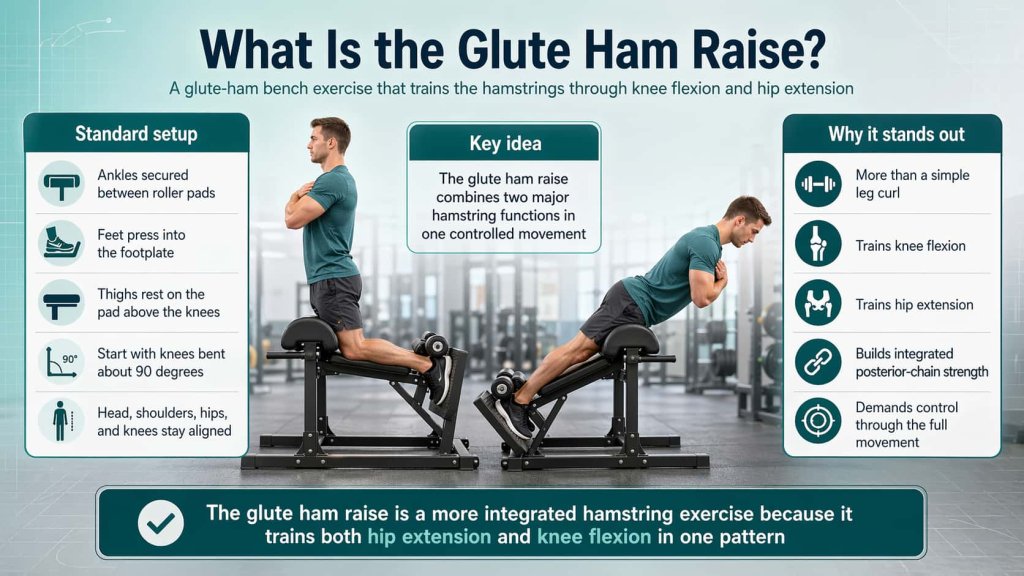
The glute ham raise is typically performed on a glute-ham bench. In the standard setup, your ankles are secured between roller pads, your feet press into the footplate, and your thighs rest on the pad just above the knees. From there, you control the descent by extending the knees, then return by extending the hips and flexing the knees back to the start. The NSCA technique guide describes the start position with the knees bent to about 90 degrees and the head, shoulders, hips, and knees aligned.
What makes this exercise different from a simple leg curl is that it combines two major hamstring functions in one movement pattern. ACE explains that the hamstrings are responsible for both hip extension and knee flexion, which is exactly why the glute ham raise stands out as a more integrated posterior-chain exercise.
Why the Glute Ham Raise Works
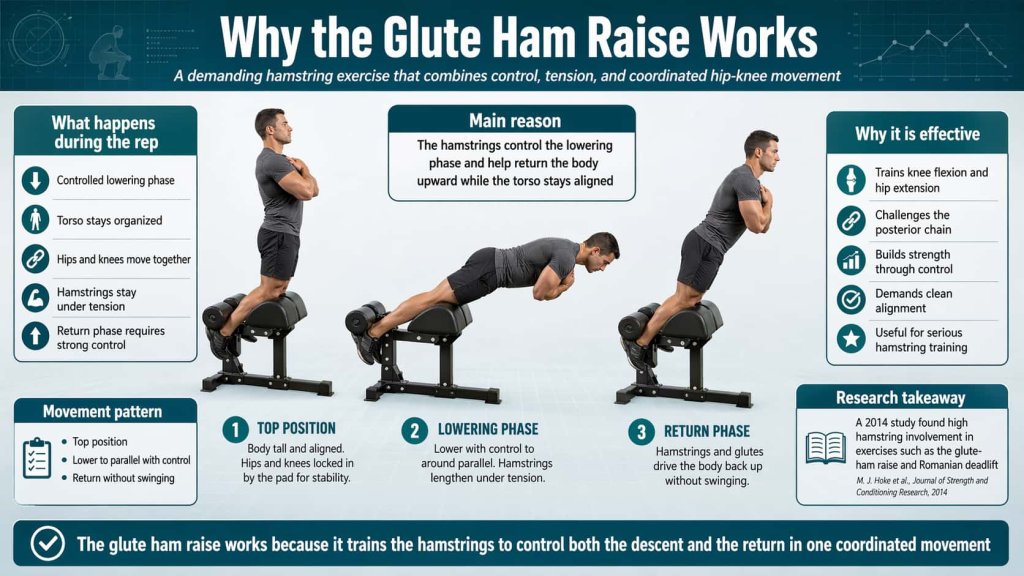
The glute ham raise works because it asks the hamstrings to control the lowering phase and contribute to the return phase while the torso stays organized. That creates a demanding strength challenge, especially when the hips and knees must work together smoothly instead of one joint doing all the work. The NSCA technique description shows this clearly in the transition from the top position to parallel and then back up.
A 2014 study indexed in PubMed compared muscle activation across several hamstring exercises, including the glute-ham raise and Romanian deadlift, and concluded that athletes and coaches who want high hamstring involvement should consider those exercises. That does not mean the glute ham raise is automatically the single best option for everyone, but it does support its reputation as a serious hamstring-strength exercise.
How to Do the Glute Ham Raise with Proper Form
How to do it:
- Set up on a glute-ham bench with your ankles secured between the roller pads.
- Press your feet into the platform and place your thighs on the pad just above the knees.
- Start with your knees bent to about 90 degrees and your torso upright.
- Keep your head neutral and your shoulders, hips, and knees aligned.
- Lower slowly by letting the knees extend while keeping the torso controlled.
- As you approach parallel, allow the hips to flex so you can continue the descent under control.
- Reverse the motion by extending the hips and flexing the knees.
- Return to the top without jerking, swinging, or cranking your lower back.
Trainer Tip: Think about staying “long and braced,” not yanking yourself up. Most ugly glute ham raises happen when the lifter loses alignment and turns the rep into a loose back extension. The clean rep is slower than most people expect, which also matches the coaching emphasis from the NSCA.
Glute Ham Raise Muscles Worked
The main muscles worked in the glute ham raise are the hamstrings. ACE identifies the hamstrings as the biceps femoris, semitendinosus, and semimembranosus, and notes that together they extend the hip and flex the knee.
Secondary contributors include the glutes and the trunk muscles that help you keep your torso from folding or twisting out of position. In practice, you also need foot pressure, body tension, and solid alignment to perform the movement cleanly, which is why the exercise often feels like more than “just hamstrings.” The NSCA movement description emphasizes keeping the shoulders and hips aligned throughout both the downward and upward phases.
Glute Ham Raise Benefits
The biggest glute ham raise benefit is stronger hamstrings through a movement that blends knee and hip action. That is valuable for lifters, field-sport athletes, and anyone trying to build a more complete posterior chain, as explained by the NSCA.
Other practical benefits include:
- Builds hamstring strength through a long range of control
- Adds glute involvement without turning into a pure back-extension drill
- Helps expose left-right strength or control issues when you cannot hold alignment
- Trains body tension and positioning, not just isolated movement
- Can complement sprinting, deadlifting, and other lower-body work when programmed realistically
There is also useful broader context from hamstring-injury research. A 2024 systematic review on Nordic hamstring exercise interventions reported positive effects on sprint performance, muscle activation, eccentric strength, and muscle architecture, and a widely cited review in PubMed found that programs including the Nordic hamstring exercise reduced hamstring injuries by up to 51%. That evidence applies most directly to Nordic work, not specifically to the glute ham raise, but it supports the larger point that dedicated hamstring training matters.
Common Glute Ham Raise Mistakes
The most common mistake is trying to do full unassisted reps before you can control the descent. That usually leads to a sudden drop, excessive low-back movement, or a shortened range that does not really train the intended pattern. The NSCA consistently emphasizes controlled knee extension, hip movement, and torso alignment.
Other frequent mistakes include:
- Setting the machine too far forward or backward so the pad hits the wrong spot on the thigh
- Letting the neck crank upward instead of staying neutral
- Turning the rep into a hyperextension-style swing
- Using momentum to get through the hardest part
- Training to technical failure too early in the workout
A useful rule is this: if you cannot lower with control, you are not ready to chase full reps. Use assistance, reduce the range, or switch to a progression.
Glute Ham Raise vs Nordic Curl vs Leg Curl
This is one of the most useful comparisons for readers, because all three movements train the hamstrings, but they do not do it the same way.
| Exercise | Main emphasis | Equipment | Best use |
|---|---|---|---|
| Glute ham raise | Knee flexion plus hip extension | Glute-ham bench | Integrated posterior-chain strength |
| Nordic curl | Heavy eccentric hamstring loading | Partner or anchored feet | Hamstring resilience and eccentric strength |
| Leg curl | Mostly knee flexion | Machine | Simpler hamstring isolation and easier loading control |
The Nordic curl has stronger direct injury-prevention evidence in the research literature. The glute ham raise, on the other hand, is a broader gym-based strength movement that combines hip and knee action. A machine leg curl is usually easier for beginners to learn and to load in small increments, but it does not train hip extension the way the glute ham raise does, as explained in the hamstrings guide from ACE.
Easier Progressions and Alternatives
Most people should not start with full bodyweight glute ham raises from day one. A smarter approach is to build the pattern step by step.
Good progressions include:
- Assisted glute ham raises using a band or light push from the hands
- Eccentric-only reps where you lower slowly and reset
- Stability ball hamstring curls
- Machine leg curls
- Romanian deadlifts
- Sliding hamstring curls
- Reverse hip raises
These options can build hamstring strength while you work toward the control needed for stricter glute ham raise reps. ACE includes glute-ham raise variations, Romanian deadlifts, stability ball curls, and reverse hip raises among the exercises discussed in its hamstring review.
Who Should Be Careful Before Doing Glute Ham Raises?
The glute ham raise is not a good “just try it” exercise if you already have a hamstring strain, major knee irritation, uncontrolled low-back pain, or a history of losing position during demanding lower-body movements. AAOS OrthoInfo notes that muscle tightness, muscle imbalance, poor conditioning, and fatigue can all raise hamstring strain risk.
Use extra caution if you:
- Are returning from a recent hamstring injury
- Feel sharp pulling or cramping early in the rep
- Cannot control the lowering phase
- Do not have the machine adjusted correctly
- Are stacking this exercise on top of heavy sprinting or high-fatigue lower-body work the same day
If you have pain, recent injury, or rehab concerns, use a clinician or qualified coach’s guidance before adding this movement.
How Many Sets and Reps Should You Do?
Because the glute ham raise is demanding, a practical starting range is usually 2 to 3 sets of 4 to 6 high-quality reps or eccentric-only reps if full reps are not there yet. More advanced lifters may build toward 3 to 4 sets of 6 to 10 reps, but only if technique stays clean.
For most people, the better progression is:
- Earn control first
- Add reps second
- Add difficulty last
That approach fits well inside broader weekly strength training. The CDC recommends muscle-strengthening work on 2 or more days per week for all major muscle groups, so glute ham raises make the most sense as one part of a balanced plan, not the only lower-body exercise you do.
Where the Glute Ham Raise Fits in a Workout
The glute ham raise usually fits best after your main warm-up and before smaller accessory work. If you are using it as a priority movement, place it earlier in the session while your hamstrings are still fresh.
A simple lower-body order might look like this:
- Warm-up and movement prep
- Main lift such as a squat or deadlift
- Glute ham raise
- Single-leg work
- Calves or core
If sprinting is also part of your plan, be careful with total hamstring load. AAOS OrthoInfo notes that hamstrings are heavily lengthened and loaded during sprinting, which helps explain why fatigue management matters.
Frequently Asked Questions About the Glute Ham Raise
Is the glute ham raise good for beginners?
Usually not as a full bodyweight version. Most beginners do better with assisted reps, eccentric-only reps, or simpler hamstring exercises first.
Does the glute ham raise work the glutes or mostly the hamstrings?
It is mostly a hamstring-focused exercise, but the glutes contribute because the movement also involves hip extension and body alignment, as shown in the NSCA exercise guide.
Is the glute ham raise better than the Nordic curl?
Not universally. The glute ham raise is excellent for integrated gym-based hamstring strength, while the Nordic curl has stronger direct evidence for hamstring injury reduction based on research indexed in PubMed.
Why is the glute ham raise so hard?
It is hard because you are controlling your bodyweight through a long lever while the hamstrings work across the knee and hip. Weakness, poor setup, and rushing full reps make it feel even harder, which is also reflected in the technical coaching points from the NSCA.
Can I do glute ham raises without a glute-ham bench?
You can mimic parts of the pattern with Nordic-style setups, sliding curls, or other hamstring variations, but the standard glute ham raise is designed around the glute-ham bench, as explained by ACE.
How often should I train glute ham raises?
For most people, 1 to 2 times per week is enough, especially if you also sprint, deadlift, or do other hard hamstring work. That schedule usually gives enough recovery while still fitting inside weekly strength training. The CDC recommends strength work on at least 2 days per week as part of an overall training plan.
Conclusion
The glute ham raise is one of the most useful hamstring-strength exercises for lifters who want more than a simple curl machine can offer. It trains knee flexion and hip extension together, challenges body control, and can support stronger lower-body training when it is programmed honestly.
The key is not to rush it. Start with the setup, own the lowering phase, use assistance when needed, and build your reps from clean form. That is the best way to make the glute ham raise a long-term strength tool instead of just a hard exercise you struggle through once.
References
- NSCA — Glute Ham Raise
- ACE — The Hamstrings Blueprint: Evidence-Based Exercises for Better Function
- PubMed — Hamstrings Muscle Activation During Three Romanian Deadlift Variations and Two Hamstring Exercises
- PubMed — The Effects of Nordic Hamstring Exercise on Performance Variables: A Systematic Review
- PubMed — Including the Nordic Hamstring Exercise in Injury Prevention Programmes Halves the Rate of Hamstring Injuries Across Multiple Sports: A Systematic Review and Meta-Analysis
- CDC — Adult Activity: An Overview
- AAOS OrthoInfo — Hamstring Muscle Injuries
- CDC — Adding Physical Activity as an Adult