
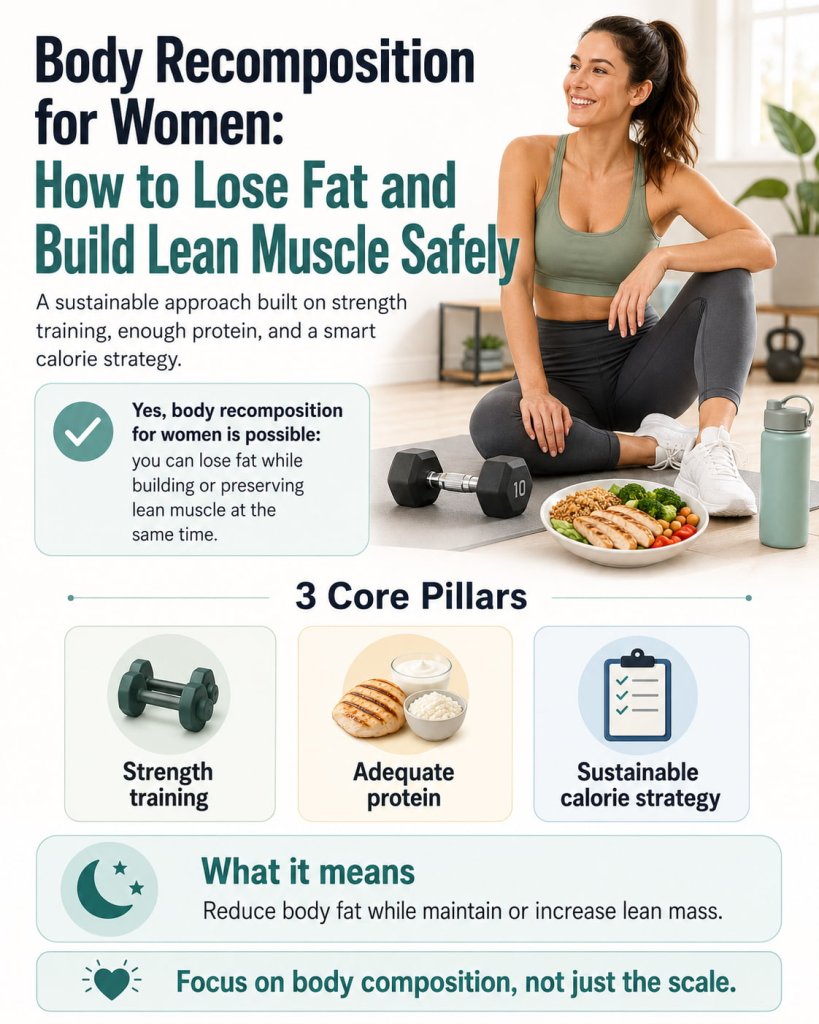
Yes, body recomposition for women is possible: you can lose fat while building or preserving lean muscle at the same time when you combine progressive resistance training, enough protein, and a sustainable calorie strategy. What matters most is not a crash diet or a “tone up” shortcut. It is a steady plan that improves your body composition, meaning the balance of fat mass and lean mass, rather than just driving the scale down.
Understanding body recomposition matters because many women do not actually want simple weight loss. They want to look firmer, feel stronger, improve health, and keep the results. That usually means protecting muscle while losing fat, not chasing the lowest body weight possible. Research and public-health guidance point to the same foundation: strength training, adequate protein, and an approach you can sustain.
What body recomposition for women actually means
Body recomposition means reducing body fat while maintaining or increasing lean mass. That is why scale weight can move slowly, stay flat for a while, or tell only part of the story. If fat mass is going down while lean mass is holding steady or improving, you can be making real progress even without dramatic weekly changes on the scale.
Can women lose fat and build muscle at the same time?
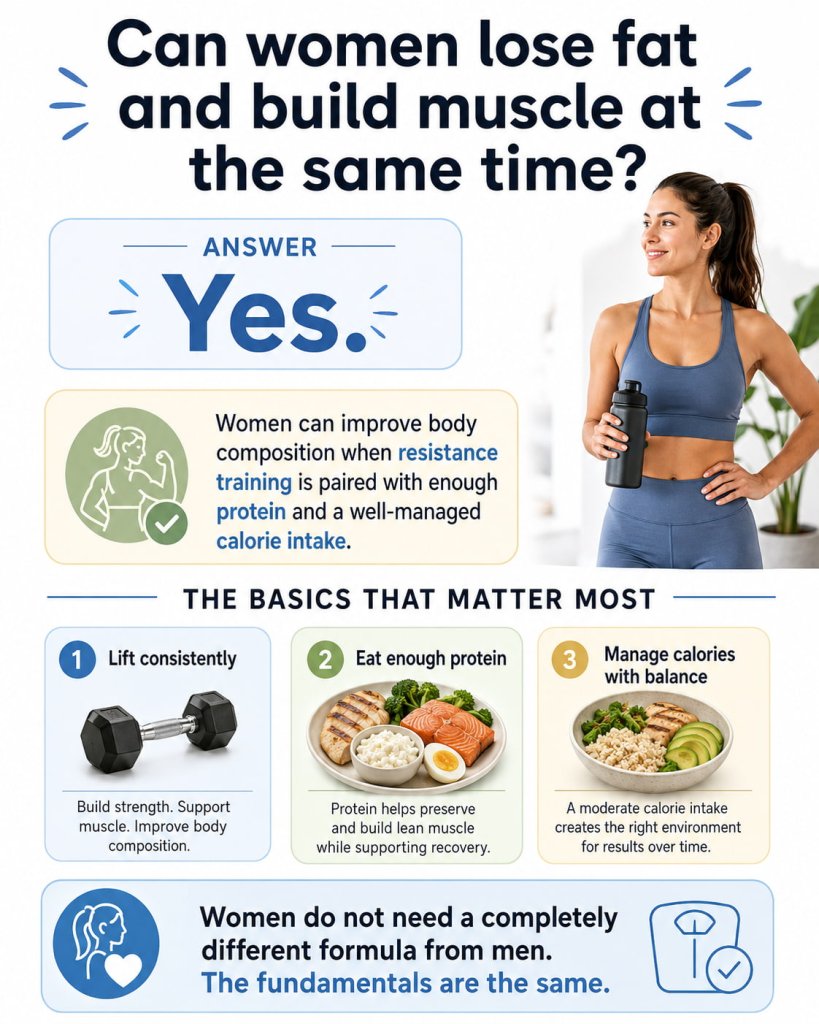
Yes. The best evidence shows that women can improve body composition when resistance training is paired with enough protein and a well-managed calorie intake. In a well-known trial, a higher-protein diet during an energy deficit helped preserve lean body mass and supported a better body-composition outcome when combined with hard training.
Women also do not need a fundamentally different muscle-building formula from men. A systematic review found similar hypertrophy responses between females and males, with similar lower-body strength adaptations as well. In practical terms, women benefit from the same core basics: lift, progress gradually, eat enough protein, and avoid overly aggressive dieting.
The best workout plan for body recomposition for women
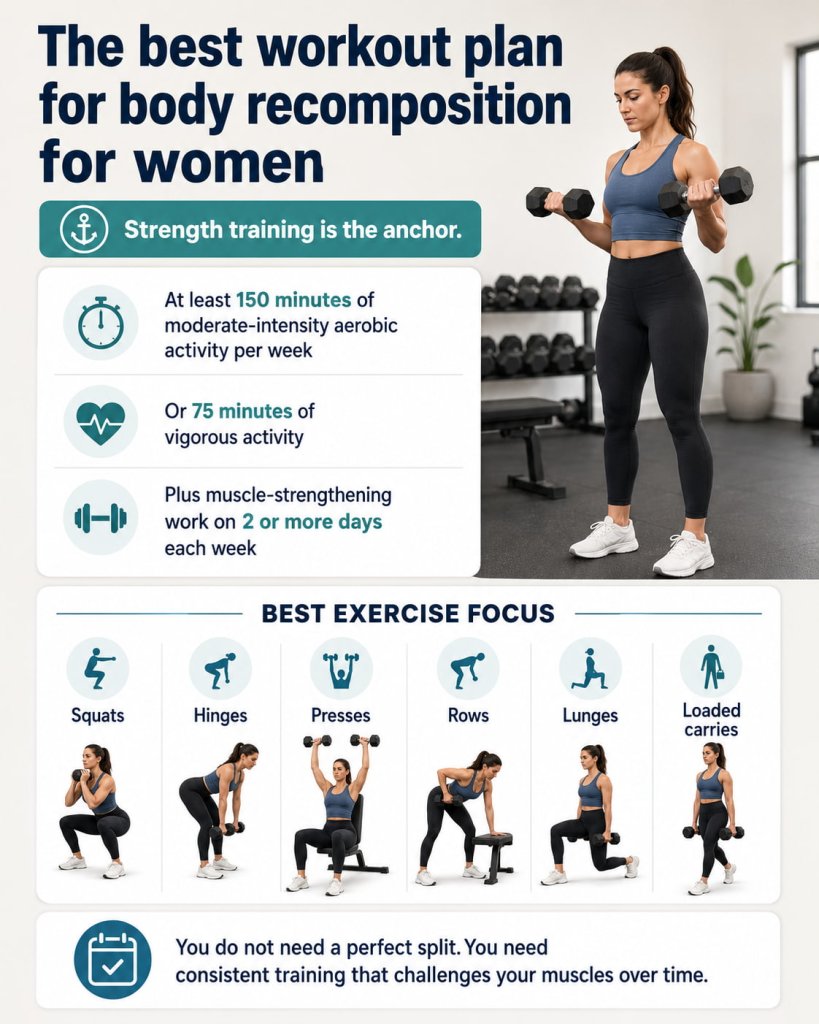
For overall health, the CDC recommends that adults get at least 150 minutes of moderate-intensity aerobic activity per week or 75 minutes of vigorous activity, plus muscle-strengthening work on 2 or more days each week for all major muscle groups. For body recomposition, that muscle-strengthening piece is the anchor. Cardio supports health and energy expenditure, but resistance training is what gives your body a reason to keep or build muscle.
A practical body recomposition plan for women usually includes full-body or lower/upper-body strength sessions built around basics such as squats, hinges, presses, rows, lunges, and loaded carries. You do not need a perfect split or fancy gym routine to start. You need consistent training that challenges your muscles over time. The CDC guidance is the minimum floor; many women will choose to strength train more often than twice weekly because it is easier to distribute work and recover well that way.
A simple weekly structure that works
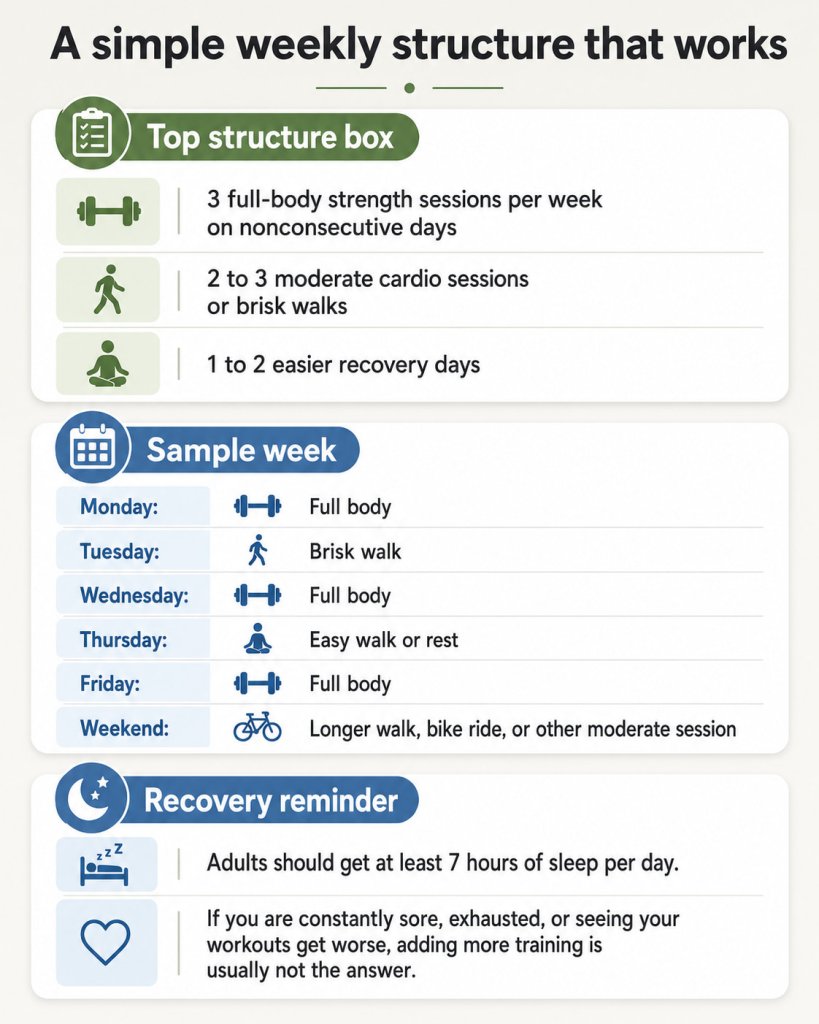
If you want a practical starting point, a simple setup is 3 full-body strength sessions per week on nonconsecutive days, plus 2 to 3 moderate cardio sessions or brisk walks, and at least 1 to 2 easier recovery days. That fits the core of the CDC physical activity guidelines while keeping strength training as the main driver of body recomposition. A beginner week might look like this: Monday full body, Tuesday brisk walk, Wednesday full body, Thursday easy walk or rest, Friday full body, and one longer walk, bike ride, or other moderate session over the weekend.
Recovery also needs to be treated as part of the program, not as an optional extra. The CDC notes that adults should get at least 7 hours of sleep per day, and ACSM explains that building muscle takes more than just lifting and protein; it also depends on adequate sleep, energy balance, and recovery. If you are constantly sore, exhausted, or seeing your workouts get worse, adding more training is usually not the answer.
Cardio still belongs in the plan, just not at the expense of lifting. In postmenopausal women, a recent systematic review found that exercise training improves body composition overall, with aerobic exercise tending to help fat loss more and resistance exercise helping muscle gain more. That is a useful model for most adult women too: keep some cardio for health and fat-loss support, but let strength training drive the “recomposition” part.
How much protein for body recomposition for women?
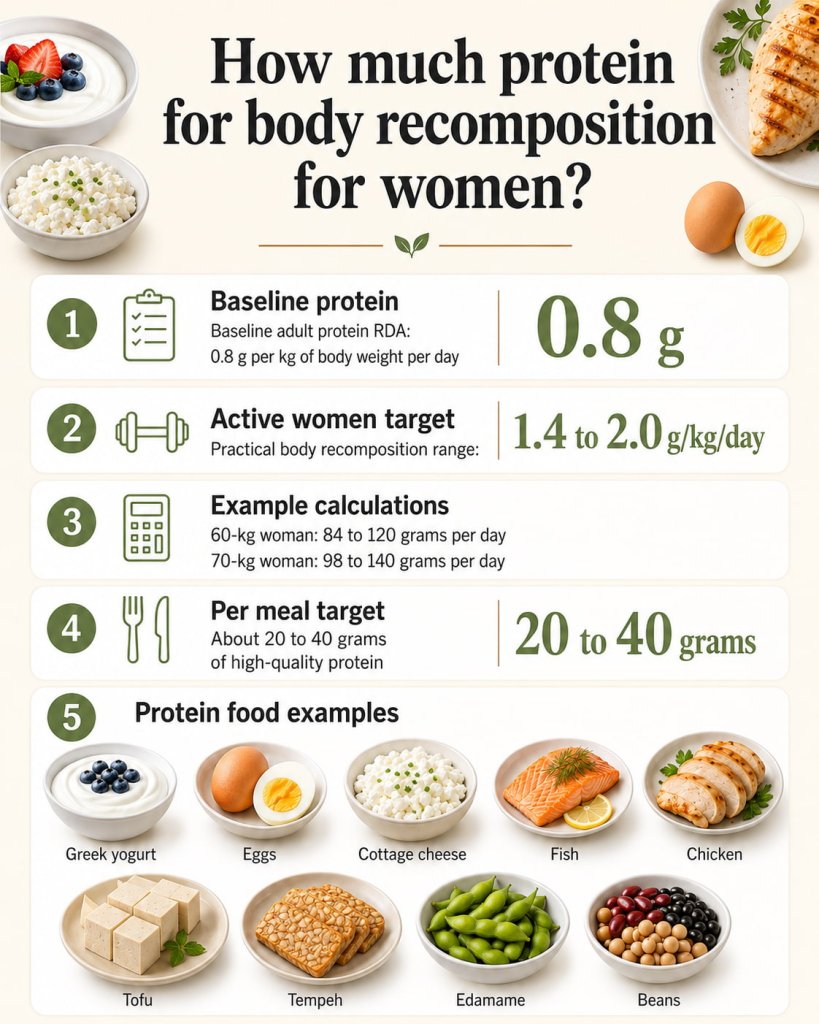
The baseline adult protein RDA from the National Academies is 0.8 g per kg of body weight per day. That is a general requirement level, not a body recomposition target. Sports nutrition guidance goes higher for exercising people because building or preserving muscle requires more than simply avoiding deficiency.
The International Society of Sports Nutrition says that an overall daily intake of 1.4 to 2.0 g/kg/day is sufficient for most exercising individuals, and that higher amounts may be useful during calorie restriction when the goal is to maintain fat-free mass. For a 60-kg woman, that works out to about 84 to 120 grams of protein per day. For a 70-kg woman, it is about 98 to 140 grams per day.
How you spread protein across the day matters too. ISSN guidance suggests about 0.25 g/kg per meal, or roughly 20 to 40 grams of high-quality protein per feeding, spaced across the day. For many women, that means building meals around foods like Greek yogurt, eggs, cottage cheese, fish, chicken, tofu, tempeh, edamame, beans, or a protein shake when food alone is not practical.
Protein matters, but body recomposition is not just about protein
Protein is a priority, but body recomposition is not a protein-only project. ACSM notes that building muscle also depends on adequate energy balance, sleep, and getting carbohydrate and protein in the right amounts to support muscle protein synthesis rather than muscle breakdown. That matters because lifting performance usually suffers when women cut carbohydrates too aggressively. Carbohydrate helps support training quality, and dietary fat helps round out an overall healthy eating pattern rather than turning every meal into a low-energy, hard-to-sustain plan.
In real life, most women do better with meals built around protein + a carbohydrate source + produce + a source of healthy fat. For example, that could mean Greek yogurt with fruit and nuts, eggs with potatoes and vegetables, chicken with rice and salad, or tofu with quinoa, edamame, and roasted vegetables. The Dietary Guidelines for Americans and MyPlate also emphasize an overall healthy dietary pattern built around vegetables, fruits, whole grains, protein foods, and dairy or fortified soy alternatives, while limiting added sugars, saturated fat, and sodium.
Should you eat in a deficit, at maintenance, or in a surplus?
For most women trying to lose fat and improve muscle definition at the same time, a small calorie deficit is usually the most practical setup. The reason is simple: you need some degree of energy shortfall to lose fat, but not such a large shortfall that training quality, recovery, and lean-mass retention fall apart. CDC guidance favors a gradual pace of weight loss, about 1 to 2 pounds per week, because slower, steadier loss is more likely to be maintained.
Aggressive cutting is where many body recomposition plans fail. In women, under-fueling can push you toward low energy availability, which is linked with menstrual dysfunction and poor bone health. If your calories are too low to support training and normal physiology, the plan is not disciplined. It is counterproductive.
If you are already fairly lean and your bigger goal is muscle gain or strength gain, eating around maintenance can make more sense than trying to diet hard. Large surpluses are usually not necessary for better results, and research suggests that faster body-mass gain from larger surpluses tends to increase fat gain more than it improves strength or muscle-thickness outcomes.
Body recomposition for women and hormonal health
One of the most important women-specific issues in body recomposition is low energy availability. The Female Athlete Triad framework describes the relationship among low energy availability, menstrual dysfunction, and low bone mineral density. You do not have to be a competitive athlete for this to matter. Any woman who trains hard while consistently under-eating can run into similar problems.
Signs your plan is probably too aggressive
A body recomposition plan is probably too aggressive if your gym performance is falling for weeks, recovery is getting worse, you feel unusually hungry or irritable, your sleep is deteriorating, or your menstrual cycle becomes irregular. The Female Athlete Triad literature links low energy availability with menstrual dysfunction and low bone mineral density, and the CDC notes that adults who sleep less than 7 hours are getting insufficient sleep. In practice, those signs usually mean it is smarter to increase calories modestly, reduce training stress, or both rather than trying to push through a plan that your body is not tolerating well.
The goal of body recomposition is not to see how little you can eat. The goal is to create enough of a fat-loss signal to reduce body fat without undermining training quality, recovery, hormonal health, and lean-mass retention. If your body is sending repeated stress signals, the plan needs adjustment.
That is why a good body recomposition plan should never celebrate missing periods, chronic fatigue, or repeated bone stress problems. Those are warning signs, not proof that the program is working. If your cycle becomes irregular or stops, or if you are constantly exhausted, cold, injured, or preoccupied with rigid restriction, it is smart to pause the fat-loss push and get medical or nutrition support.
Safety box
Be especially careful with body recomposition if any of these apply to you:
- Your periods have become irregular or stopped since increasing training or cutting calories.
- You have a history of disordered eating or you are sliding into obsessive food rules and chronic under-eating.
- You have had recurrent stress injuries or have been told you have low bone density.
Body recomposition for women over 40 and after menopause
Body recomposition often becomes more important after 40 because menopause and aging are associated with losses in muscle mass and strength. The good news is that resistance training still works. Recent reviews report that resistance training is effective for counteracting age- and menopause-related declines in muscle and strength, and broader exercise interventions improve body composition in postmenopausal women.
This is also why “eat less and do more cardio” is usually the wrong message for midlife women. Strength training deserves a central role, and protein intake becomes even more important when you are trying to keep lean mass while losing fat. A slower pace, consistent lifting, and better recovery usually beat an aggressive short-term push.
Do supplements help with body recomposition for women?
Most women do not need a long supplement stack for body recomposition. Food, training, and consistency matter more. The one supplement with strong support is creatine, which the NIH Office of Dietary Supplements says can improve performance during repeated short bursts of intense activity such as sprinting and weightlifting. That can help you train harder over time, which is why creatine is often relevant to body recomposition.
Creatine also has an important caveat: it usually causes some weight gain from water retention. That does not mean it is making you fatter. It means scale weight may jump even while training performance and lean mass improve. If you use it, judge progress by more than body weight alone.
Be cautious with fat burners, bodybuilding blends, or flashy performance supplements. NCCIH warns that some products marketed for bodybuilding or performance enhancement may contain dangerous hidden ingredients, including anabolic steroids or prescription-drug ingredients not listed on the label. That is a good reason to keep your supplement approach simple and conservative.
How to tell if your body recomposition plan is working
Because body recomposition is about changing body composition, not just total body weight, progress is best judged with more than one marker. Better signs include improved strength, better training tolerance, smaller waist or hip measurements, progress photos, and clothes fitting differently. That approach matches the whole point of recomposition: reducing fat while holding or gaining lean mass.
A reasonable time frame is measured in months, not days. Sustainable fat loss is usually gradual, and muscle gain is also gradual, especially after the beginner stage. That is why the best body recomposition plans for women feel almost boring: enough protein, repeatable lifting, manageable calories, patience, and regular course corrections.
FAQ
Can women lose fat and gain muscle at the same time?
Yes. That is the definition of body recomposition, and it is most realistic when resistance training, adequate protein, and a sustainable calorie strategy are all in place.
What is the best protein intake for body recomposition for women?
For active women, a practical evidence-based range is usually 1.4 to 2.0 g/kg/day, with protein spread across the day in servings of about 20 to 40 grams.
Is cardio bad for body recomposition?
No. Cardio supports heart health and can help with fat loss, but it should complement strength training rather than replace it. For muscle-focused body recomposition, lifting remains the priority.
Do women need a different body recomposition program than men?
Not in the basic sense. Women and men show similar hypertrophy responses to resistance training, so the core formula is the same: progressive training, enough protein, and smart calorie control.
Final thoughts
Body recomposition for women works best when you stop treating fat loss and muscle gain like separate extremes. You do not need a punishing cut, a dirty bulk, or a drawer full of supplements. You need a plan built around lifting, protein, adequate recovery, and calories that support the goal instead of fighting it. The smartest place to start is simple: set a protein target, schedule your strength sessions for the week, and keep the plan sustainable enough to repeat next month.
This content is for informational purposes only and not medical advice.
References
- CDC — Adult Activity: An Overview
- CDC — Steps for Losing Weight
- National Academies — Dietary Reference Intakes: Applications in Dietary Assessment
- ACSM — Ten Things You Need to Know About Sports Nutrition
- NIH Office of Dietary Supplements — Dietary Supplements for Exercise and Athletic Performance
- Longland et al. — Higher compared with lower dietary protein during an energy deficit: effects on body composition and strength
- Roberts et al. — Sex Differences in Resistance Training: A Systematic Review and Meta-Analysis
- Resistance training and menopause-related body composition changes