
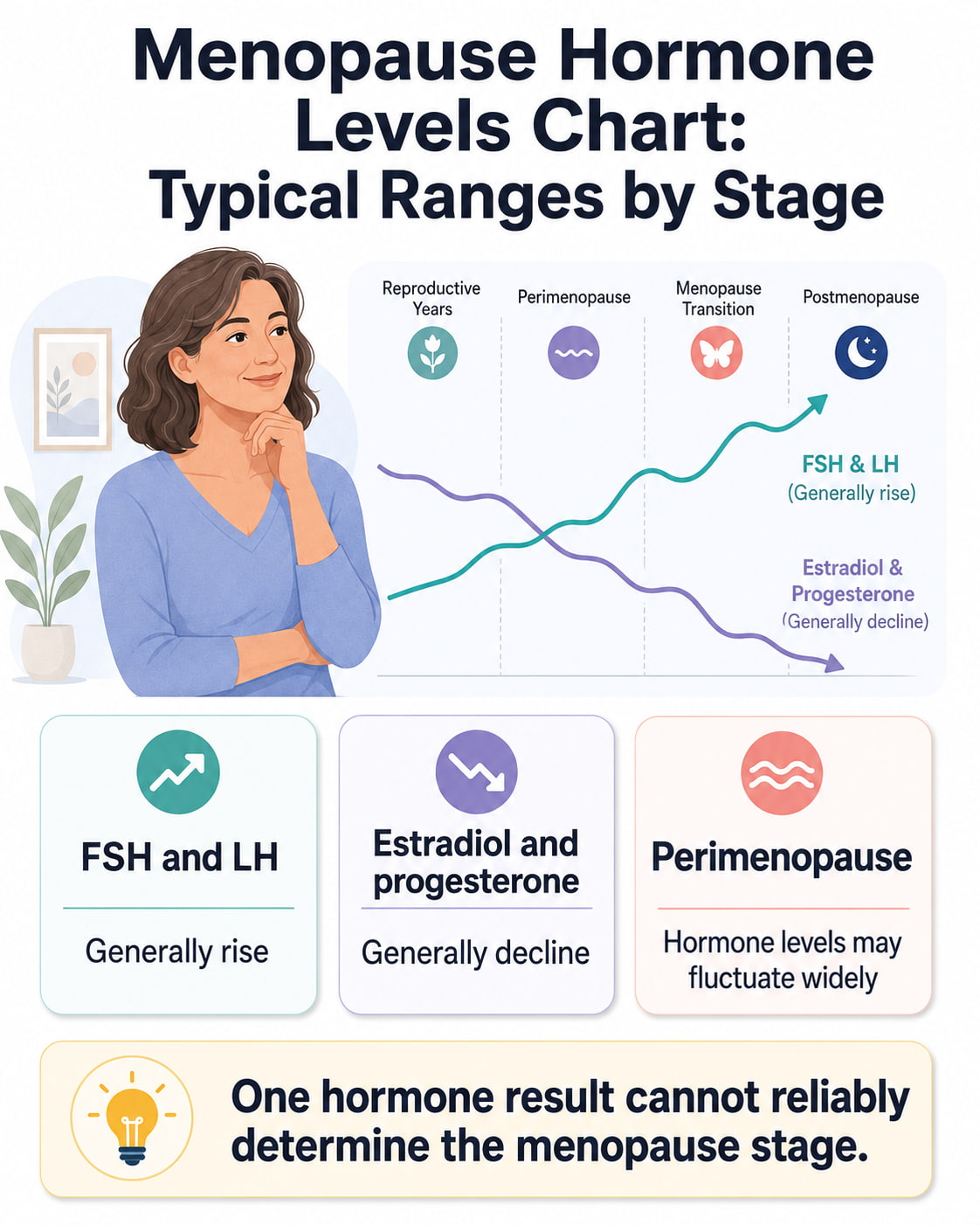
Menopause hormone levels generally shift toward higher FSH and LH and lower estradiol and progesterone, but no single hormone result can reliably determine your menopause stage. During perimenopause, these hormones may rise and fall sharply from one week or menstrual cycle to the next.
Doctors usually identify perimenopause from symptoms and changes in menstrual patterns. Natural menopause is confirmed after 12 consecutive months without menstrual bleeding or spotting when no other condition, medication, or procedure explains the absence of periods.
The menopause hormone levels chart below shows the typical patterns at each stage, along with example laboratory reference ranges. Always compare your results with the range printed on your own laboratory report.
Menopause Hormone Levels Chart at a Glance
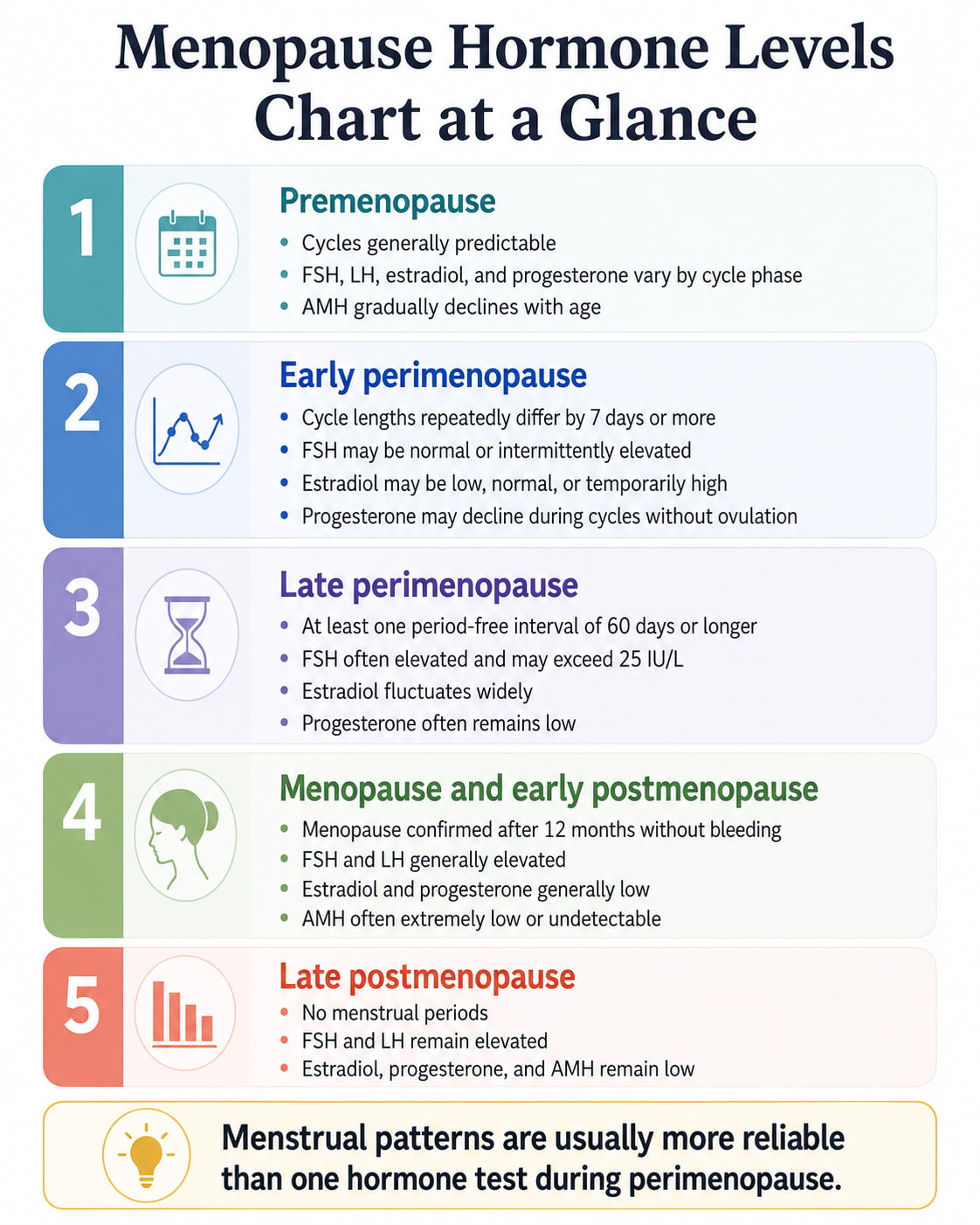
| Stage | Menstrual pattern | FSH | Estradiol | Progesterone | LH | AMH |
|---|---|---|---|---|---|---|
| Premenopause | Cycles are generally predictable | Changes by cycle phase, commonly about 1.4–23.2 IU/L | Changes widely, commonly 15–350 pg/mL | Low before ovulation and higher during the luteal phase | Changes by cycle phase, commonly 0.7–118 IU/L | Detectable but gradually declines with age |
| Early perimenopause | A persistent difference of at least 7 days between consecutive cycle lengths | May be normal or intermittently elevated | May be low, normal, or temporarily high | May decline during cycles without ovulation | Variable and may begin rising | Usually lower than in earlier reproductive years |
| Late perimenopause | At least one interval of 60 days or longer without a period | Often elevated; a random result above 25 IU/L is characteristic but not diagnostic by itself | Fluctuates greatly and may occasionally rise | Often low because ovulation becomes less frequent | Often rises but remains variable | Usually very low |
| Menopause | Confirmed after 12 months without bleeding | Commonly above 40 IU/L; example laboratory range 16–157 IU/L | Usually low; one laboratory uses below 10 pg/mL | Usually very low; one laboratory uses 0.20 ng/mL or lower | Commonly elevated; example range 5.3–65.4 IU/L | Often extremely low or undetectable |
| Early postmenopause | No periods after the final menstrual period | Continues rising for approximately 2 years before stabilizing | Continues declining for approximately 2 years | Remains very low | Generally remains elevated | Usually extremely low |
| Late postmenopause | No menstrual periods | Usually remains elevated, although levels may decline somewhat at advanced ages | Remains low | Remains very low | Usually remains elevated | Usually undetectable or near the assay limit |
The early menopausal transition begins when cycle lengths repeatedly differ by at least seven days. The late transition begins when a person has a period-free interval of at least 60 days. These menstrual criteria are more dependable than a single blood test because FSH and estradiol can fluctuate dramatically during perimenopause.
Important: The numbers in this chart are examples, not universal diagnostic cutoffs. Laboratories use different equipment, testing methods, units, and reference populations.
Example Menopause Hormone Reference Ranges
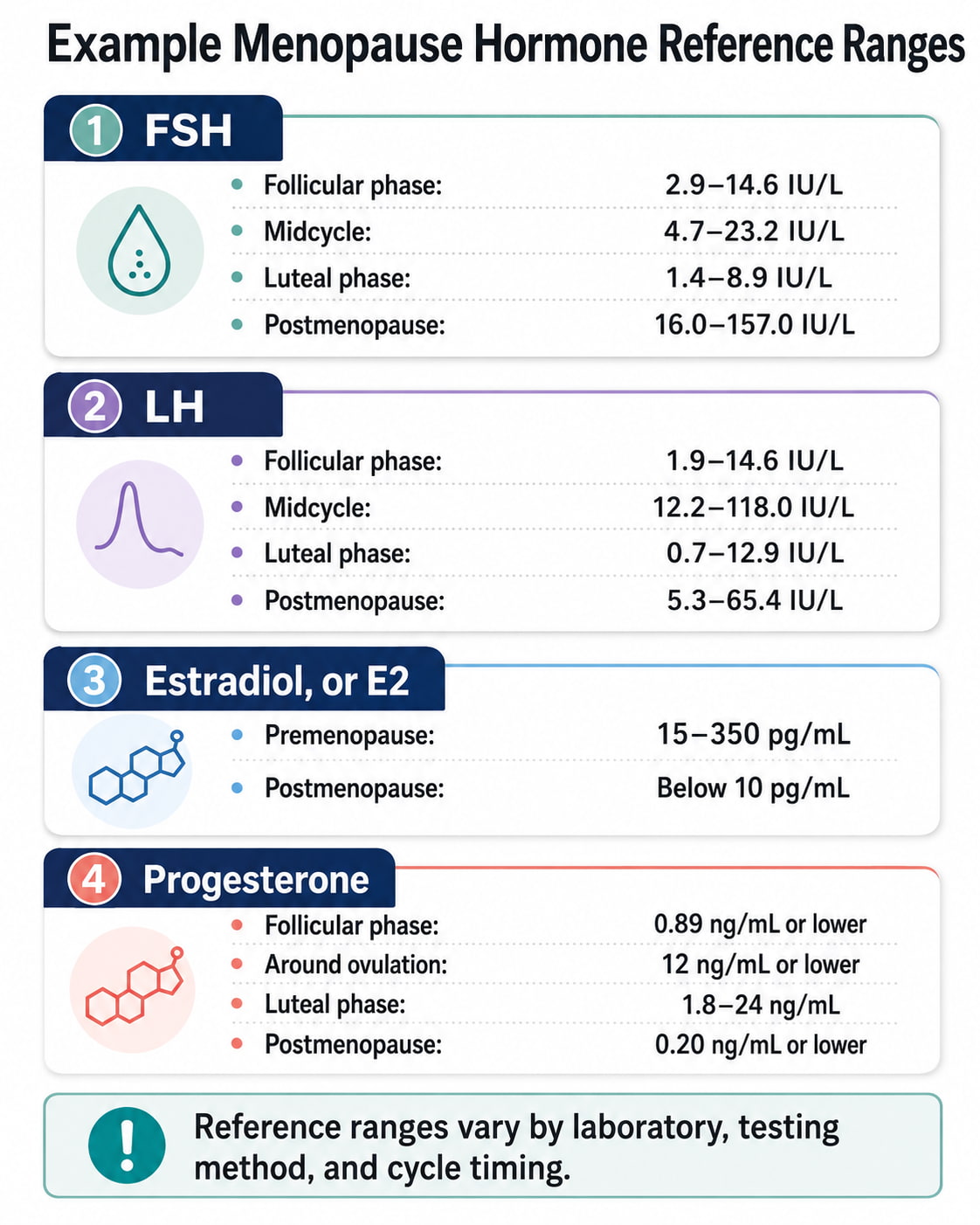
The following values come from current Mayo Clinic Laboratories test information. They show how much results can differ by menstrual-cycle phase and why your own laboratory’s range should take priority.
| Hormone | Follicular phase | Midcycle or ovulation | Luteal phase | Postmenopausal range |
|---|---|---|---|---|
| FSH | 2.9–14.6 IU/L | 4.7–23.2 IU/L | 1.4–8.9 IU/L | 16.0–157.0 IU/L |
| LH | 1.9–14.6 IU/L | 12.2–118.0 IU/L | 0.7–12.9 IU/L | 5.3–65.4 IU/L |
| Estradiol, or E2 | colspan: varies across cycle | colspan: commonly within 15–350 pg/mL before menopause | colspan: varies across cycle | Below 10 pg/mL |
| Progesterone | 0.89 ng/mL or lower | 12 ng/mL or lower | 1.8–24 ng/mL | 0.20 ng/mL or lower |
Mayo Clinic Laboratories notes that postmenopausal FSH and LH levels are generally above 40 IU/L. However, the full postmenopausal reference intervals are wider, and an individual result must be interpreted with age, menstrual history, symptoms, medications, and the laboratory method.
How Hormone Levels Change During Menopause
The ovaries contain a limited supply of follicles. As the remaining follicle supply declines, the ovaries respond less consistently to signals from the pituitary gland.
The pituitary gland may release more FSH in an attempt to stimulate follicle development. Ovulation becomes less predictable, progesterone production declines during cycles without ovulation, and estradiol production becomes increasingly irregular.
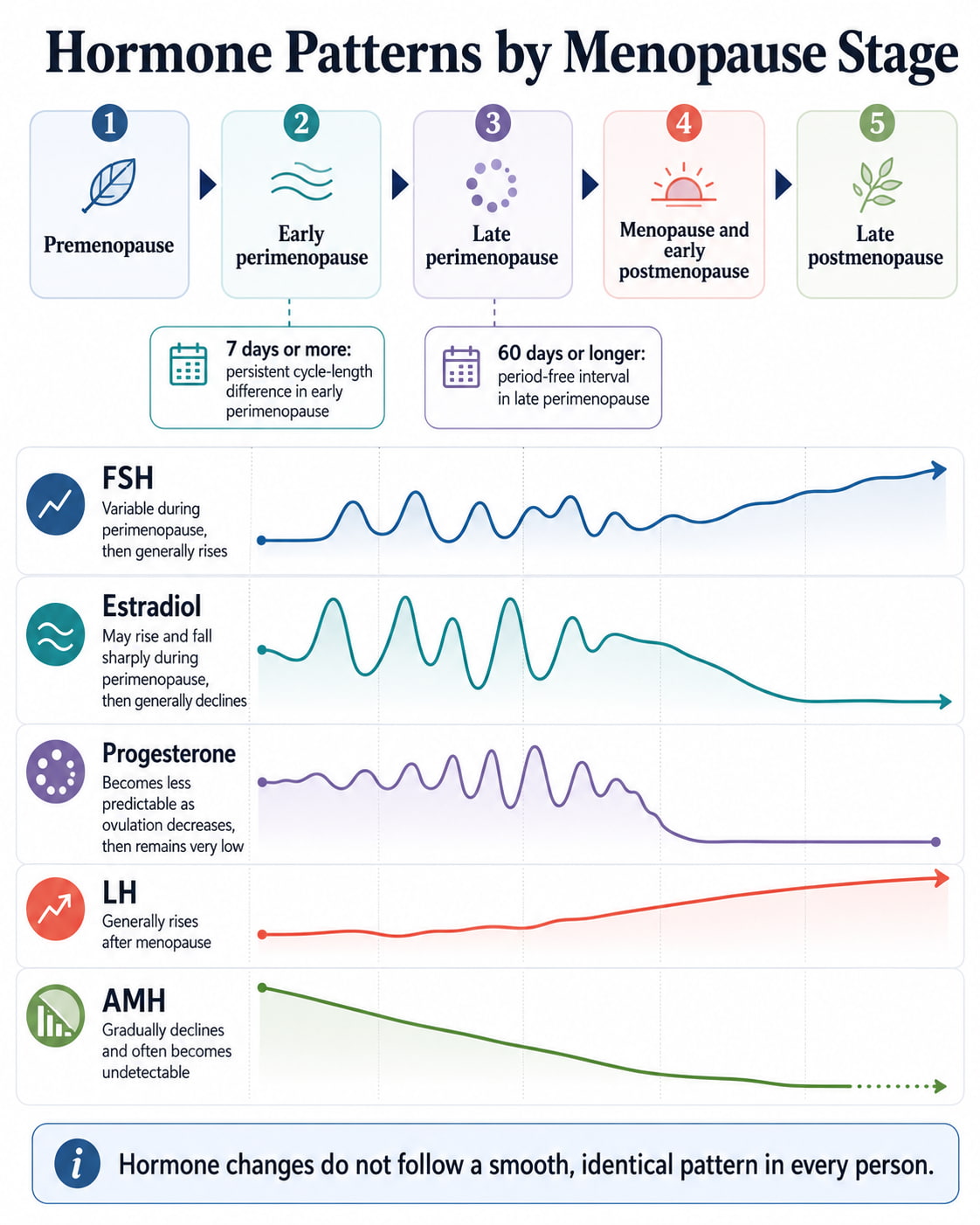
These changes do not occur in a smooth, straight line. A person may have a high FSH result one month and a much lower result during another month. Estradiol can also become temporarily elevated before declining more consistently after the final menstrual period.
Hormone Patterns by Menopause Stage
Premenopause
Before perimenopause, ovulation usually occurs regularly. Hormones rise and fall in a predictable sequence:
- FSH helps stimulate ovarian follicles.
- Estradiol rises as a follicle develops.
- LH surges before ovulation.
- Progesterone rises after ovulation.
The timing of a blood test therefore matters. A progesterone result that is normal before ovulation would appear low if someone incorrectly compared it with a luteal-phase range.
Early Perimenopause
Early perimenopause usually begins with noticeable changes in cycle length. Under the STRAW+10 reproductive-aging criteria, a persistent difference of seven days or more between consecutive cycle lengths marks the early menopausal transition.
Hormone patterns commonly include:
- FSH that is sometimes elevated and sometimes within a premenopausal range.
- Estradiol that may be low, normal, or unusually high.
- Lower progesterone during cycles in which ovulation does not occur.
- Declining AMH as the ovarian follicle supply decreases.
Symptoms such as hot flashes, sleep changes, breast tenderness, mood changes, or heavier or lighter bleeding may occur, but symptoms vary widely.
Late Perimenopause
Late perimenopause begins when menstrual cycles include an interval of at least 60 days without bleeding.
A random FSH result above 25 IU/L is characteristic of this stage under STRAW+10 criteria. However, FSH may temporarily return to a reproductive-age range, particularly when estradiol rises.
Ovulation becomes less frequent, which means progesterone often remains low. Hormonal fluctuations may also become more extreme, causing symptoms to appear, disappear, or change in intensity.
Menopause and Early Postmenopause
Menopause is a point in time rather than a long stage. It is identified retrospectively after 12 consecutive months without bleeding or spotting.
After the final menstrual period:
- FSH generally rises.
- Estradiol generally declines.
- Progesterone remains very low because regular ovulation has stopped.
- LH generally remains elevated.
- AMH is commonly extremely low or undetectable.
FSH may continue increasing and estradiol may continue decreasing for approximately two years after the final menstrual period. Hormone levels then become more stable during later postmenopause.
What FSH Level Indicates Menopause?
There is no single FSH number that proves natural menopause in every person.
Common interpretations include:
- Above 25 IU/L: Characteristic of the late menopausal transition when accompanied by an appropriate menstrual pattern.
- Above 40 IU/L: Common after menopause.
- 16–157 IU/L: One laboratory’s complete postmenopausal reference interval.
A result above 40 IU/L may support a postmenopausal hormone pattern, but it does not replace the 12-month menstrual-history criterion in someone experiencing natural menopause.
A lower FSH result also does not rule out perimenopause. Estradiol can temporarily suppress FSH, and both hormones may fluctuate substantially during the transition.
Estradiol Levels During Perimenopause and Menopause
Estradiol, also called E2, is the main form of estrogen during the reproductive years.
Before menopause, estradiol changes significantly throughout the menstrual cycle. Mayo Clinic Laboratories lists a broad premenopausal interval of 15–350 pg/mL and a postmenopausal value below 10 pg/mL for its assay.
Other laboratories may use a higher postmenopausal upper limit. Therefore, a result such as 15 or 20 pg/mL may be classified differently depending on the testing method.
During perimenopause, estradiol does not necessarily decline steadily. It may temporarily become higher than expected because an ovarian follicle can produce a strong burst of estrogen even when ovulation is becoming less reliable.
Progesterone Levels After Menopause
Progesterone rises mainly after ovulation. When ovulation becomes irregular during perimenopause, progesterone production also becomes inconsistent.
Mayo Clinic Laboratories lists:
- Follicular phase: 0.89 ng/mL or lower.
- Luteal phase: 1.8–24 ng/mL.
- Postmenopause: 0.20 ng/mL or lower.
A low progesterone result does not independently diagnose menopause. It may simply mean that the test occurred before ovulation, after the luteal phase ended, or during a cycle in which ovulation did not occur. Hormonal contraceptives and prescribed progesterone also affect interpretation.
LH Levels During Menopause
Luteinizing hormone works with FSH to regulate ovulation and ovarian hormone production. LH rises sharply around ovulation during reproductive cycles.
After menopause, LH generally remains elevated because the ovaries no longer respond to pituitary signals in the same way. One laboratory uses a postmenopausal LH range of 5.3–65.4 IU/L and notes that levels are generally above 40 IU/L.
Doctors do not usually rely on LH alone to identify menopause because it provides less useful staging information than menstrual history, symptoms, and—when appropriate—FSH.
What AMH Can and Cannot Tell You
Anti-Müllerian hormone, or AMH, reflects the number of small ovarian follicles. It usually declines with reproductive aging and may become undetectable around menopause.
Example age-based Mayo Clinic Laboratories reference intervals include:
| Age | AMH reference interval |
|---|---|
| 40–44 years | 0.03–5.5 ng/mL |
| 45–50 years | Below 2.6 ng/mL |
| 51–55 years | Below 0.88 ng/mL |
| Older than 55 years | Below 0.03 ng/mL |
AMH may provide information about ovarian reserve, but it cannot reliably predict the exact age or date when a person will reach menopause. A low AMH result also does not prove that pregnancy is impossible. Polycystic ovary syndrome, hormonal contraception, fertility medications, and laboratory methods can affect AMH results.
Can a Blood Test Confirm Menopause?
For otherwise healthy people aged 45 or older with typical menopause symptoms and menstrual changes, routine hormone testing is generally unnecessary.
The current NICE menopause guidance recommends identifying perimenopause and menopause in this age group without laboratory testing. It also advises against routinely using AMH, estradiol, ovarian-volume measurements, or antral follicle counts to identify menopause in people 45 or older.
A healthcare professional may consider FSH testing when:
- Menopause symptoms and menstrual changes begin between ages 40 and 45.
- Premature ovarian insufficiency is suspected before age 40.
- A person has had a hysterectomy and menstrual patterns cannot be followed.
- Symptoms or test results do not fit the expected pattern.
- Another cause of absent or irregular periods needs investigation.
A pregnancy test, thyroid testing, prolactin testing, or other evaluation may be more appropriate depending on the symptoms and medical history.
Premature Ovarian Insufficiency Before Age 40
Menopause-type symptoms or absent periods before age 40 require medical evaluation. They may indicate premature ovarian insufficiency, commonly abbreviated as POI, although other conditions can cause similar symptoms.
The 2024 American Society for Reproductive Medicine POI guideline uses the following diagnostic criteria:
- Irregular or absent menstrual cycles for at least four months.
- An FSH concentration above 25 IU/L.
FSH does not need to be tested on a particular cycle day. A clinician may repeat it after four to six weeks when the diagnosis remains uncertain. Pregnancy should also be excluded when appropriate.
POI is not identical to natural menopause. Ovarian activity may occur intermittently, and spontaneous ovulation can occasionally happen.
Factors That Can Affect Menopause Hormone Test Results
Several factors may change hormone concentrations or make a result difficult to interpret:
- Cycle timing: FSH, LH, estradiol, and progesterone naturally change throughout a menstrual cycle.
- Hormonal contraception: Birth control pills, injections, implants, patches, rings, and hormonal intrauterine devices may alter bleeding and hormone results.
- Menopausal hormone therapy: Estrogen and progesterone products directly affect measured levels.
- Pregnancy: Pregnancy changes reproductive hormones and must be considered when periods stop unexpectedly.
- PCOS: Polycystic ovary syndrome can cause irregular periods and may raise AMH.
- Recent ovarian or pelvic surgery: Surgery may temporarily affect FSH and other markers.
- Chemotherapy or radiation: Cancer treatments may reduce ovarian function.
- Low body weight or intense exercise: Both may suppress reproductive hormones.
- Pituitary or thyroid conditions: These conditions can cause symptoms or menstrual changes that resemble perimenopause.
- Laboratory method: Different assays may produce different reference intervals.
Do not compare a result from one laboratory directly with another laboratory’s reference range.
How to Read a Menopause Hormone Test
Use these steps when reviewing your laboratory report:
- Check the test name. Estradiol, total estrogen, estrone, FSH, LH, progesterone, and AMH measure different things.
- Check the unit. Estradiol may appear in pg/mL or pmol/L, while progesterone may appear in ng/mL or nmol/L.
- Use the printed reference range. Do not rely only on an online chart.
- Record the cycle day. The timing of the test may explain an apparently high or low value.
- List medications and hormones. Include birth control, hormone therapy, fertility medication, and supplements.
- Consider the menstrual pattern. Cycle changes often provide more useful staging information than one test.
- Discuss unexpected results. A healthcare professional can decide whether repeat testing or another test is appropriate.
Are At-Home Menopause Tests Accurate?
Most at-home menopause tests detect FSH in urine. They may show that FSH is elevated at the time of testing, but they cannot reliably confirm menopause.
An at-home test cannot determine:
- Whether you have permanently stopped ovulating.
- Whether pregnancy is still possible.
- Your exact perimenopause stage.
- Whether symptoms come from menopause or another condition.
- Whether treatment is appropriate.
A negative result does not rule out perimenopause, and a positive result does not replace medical evaluation or the 12-month definition of natural menopause.
When to Contact a Healthcare Professional
Consider scheduling an evaluation when:
- Menopause-type symptoms or missed periods begin before age 45.
- Periods stop before age 40.
- Bleeding becomes unusually heavy, frequent, prolonged, or unpredictable.
- Bleeding occurs between periods or after sex.
- Symptoms significantly affect sleep, work, relationships, or daily activities.
- You are unsure whether missed periods could indicate pregnancy.
- You use hormonal medication and cannot tell whether menopause has occurred.
- A laboratory result is far outside the printed reference range.
Contact a healthcare professional promptly for any vaginal bleeding after menopause. The Office on Women’s Health states that bleeding after menopause is not normal and should be evaluated.
Frequently Asked Questions
What is a normal FSH level during menopause?
One laboratory lists a postmenopausal FSH range of 16–157 IU/L and notes that levels are generally above 40 IU/L. Other laboratories may use different ranges. A single FSH result cannot confirm natural menopause without considering menstrual history and other factors.
Can FSH be normal during perimenopause?
Yes. FSH may rise and fall during perimenopause. It can temporarily return to a premenopausal range, particularly when estradiol increases. A normal result does not rule out perimenopause.
What estradiol level indicates menopause?
Estradiol is usually low after menopause. Mayo Clinic Laboratories uses a postmenopausal reference value below 10 pg/mL for one assay, but other laboratories may use different limits. Estradiol alone does not confirm menopause.
What is a typical progesterone level after menopause?
Mayo Clinic Laboratories lists a postmenopausal progesterone value of 0.20 ng/mL or lower. Prescribed progesterone, hormone therapy, medications, and the testing method can change the result.
Does high LH confirm menopause?
No. LH commonly rises after menopause, but it also changes during reproductive cycles and may be affected by several medical conditions. Doctors rarely use LH alone to diagnose menopause.
Can AMH predict when menopause will happen?
AMH generally declines as ovarian reserve decreases, but it cannot accurately predict the exact date of menopause for an individual. It should not replace menstrual history or clinical assessment.
Can you still become pregnant during perimenopause?
Yes. Ovulation can still occur unpredictably during perimenopause, even after several missed periods. The Office on Women’s Health advises continuing appropriate contraception until menopause has been established when pregnancy is not desired.
Conclusion
A menopause hormone levels chart can help you recognize the overall pattern: FSH and LH tend to rise, while estradiol, progesterone, and AMH tend to decline. However, perimenopause hormones fluctuate too much for one result to identify the stage reliably.
Pay attention to your menstrual pattern, symptoms, medications, age, test units, and the reference range on your report. Discuss unexpected results, symptoms before age 45, or bleeding after menopause with a qualified healthcare professional.
This content is for informational purposes only and not medical advice.
References
- Office on Women’s Health: Menopause Basics
- American Society for Reproductive Medicine: STRAW+10 Reproductive-Aging Stages
- Mayo Clinic Laboratories: Follicle-Stimulating Hormone Reference Values
- NICE: Menopause Identification and Management
- American Society for Reproductive Medicine: Premature Ovarian Insufficiency Guideline