
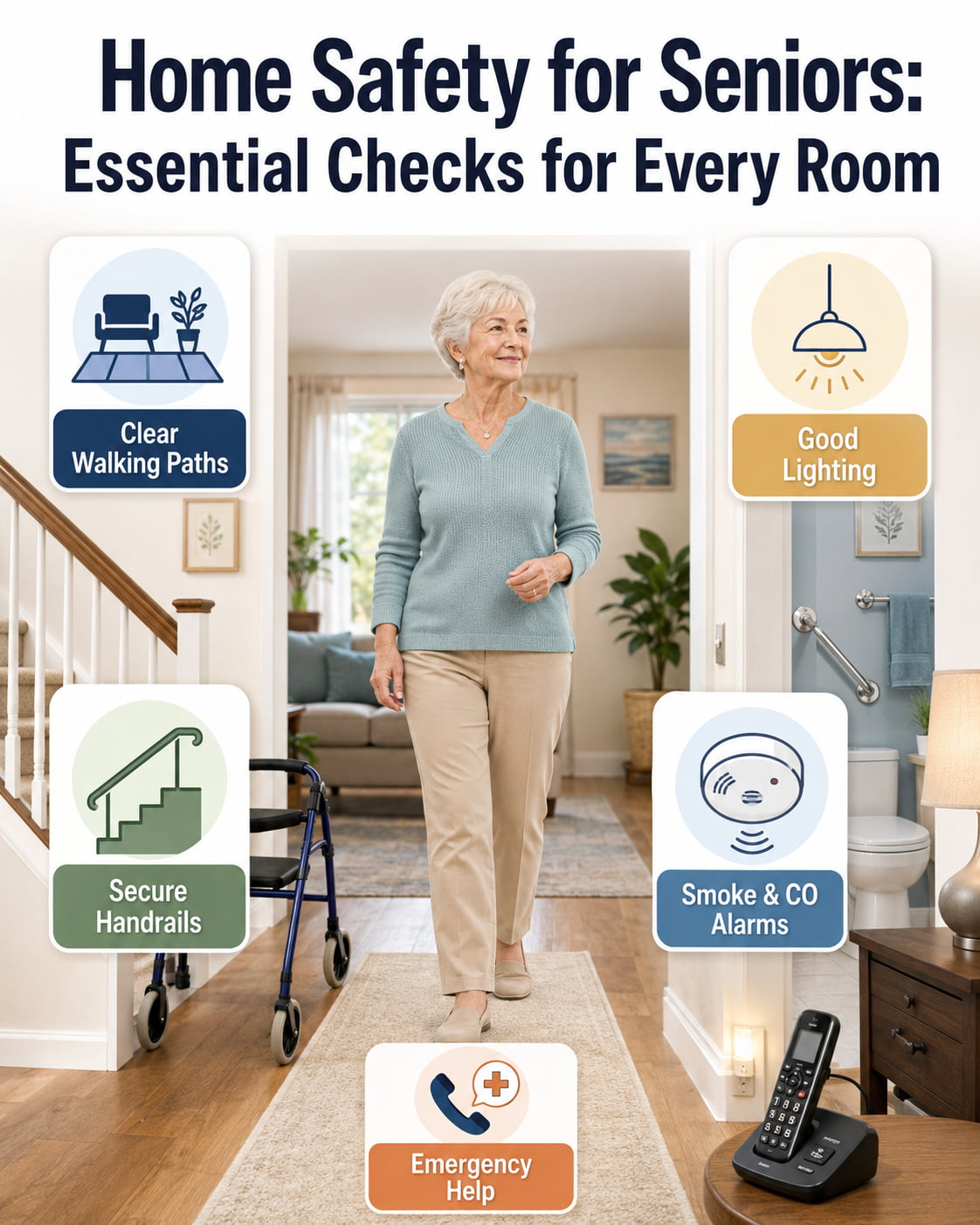
Home safety for seniors starts with removing fall hazards, improving lighting, adding secure support where needed, checking smoke and carbon monoxide alarms, and making sure emergency help is always within reach. Walk through the home one room at a time, correct immediate dangers first, and choose modifications that match the older adult’s mobility, vision, hearing, strength, and memory.
This matters because falls are the leading cause of injury among U.S. adults age 65 and older. According to the Centers for Disease Control and Prevention, more than 14 million older adults—about one in four—report falling each year. About 37% of those who fall report an injury that requires medical care or limits activity. The age-adjusted fall-death rate also rose 21% between 2018 and 2024.
Most home-safety improvements are straightforward: create clear walking paths, secure flooring, improve lighting, make transfers easier, place essential items within reach, and prepare for emergencies. However, a modification that helps one person may not be appropriate for another, so significant changes should reflect the individual’s abilities and health needs.
Why Home Safety for Seniors Matters
Falls are not the only concern in an aging household. Fire, burns, carbon monoxide exposure, unsafe medication use, difficult transfers, and delays in reaching emergency help can also threaten independence.
Older adults face a particularly high fire risk. The U.S. Fire Administration reports that adults age 65 and older were 2.5 times as likely as the general population to die in a fire in 2023. The relative risk increased to 3.4 times for adults age 85 and older.
A safer home does not need to look institutional. Small, well-planned changes can preserve comfort while making everyday activities easier and less risky.
Home Safety for Seniors at a Glance
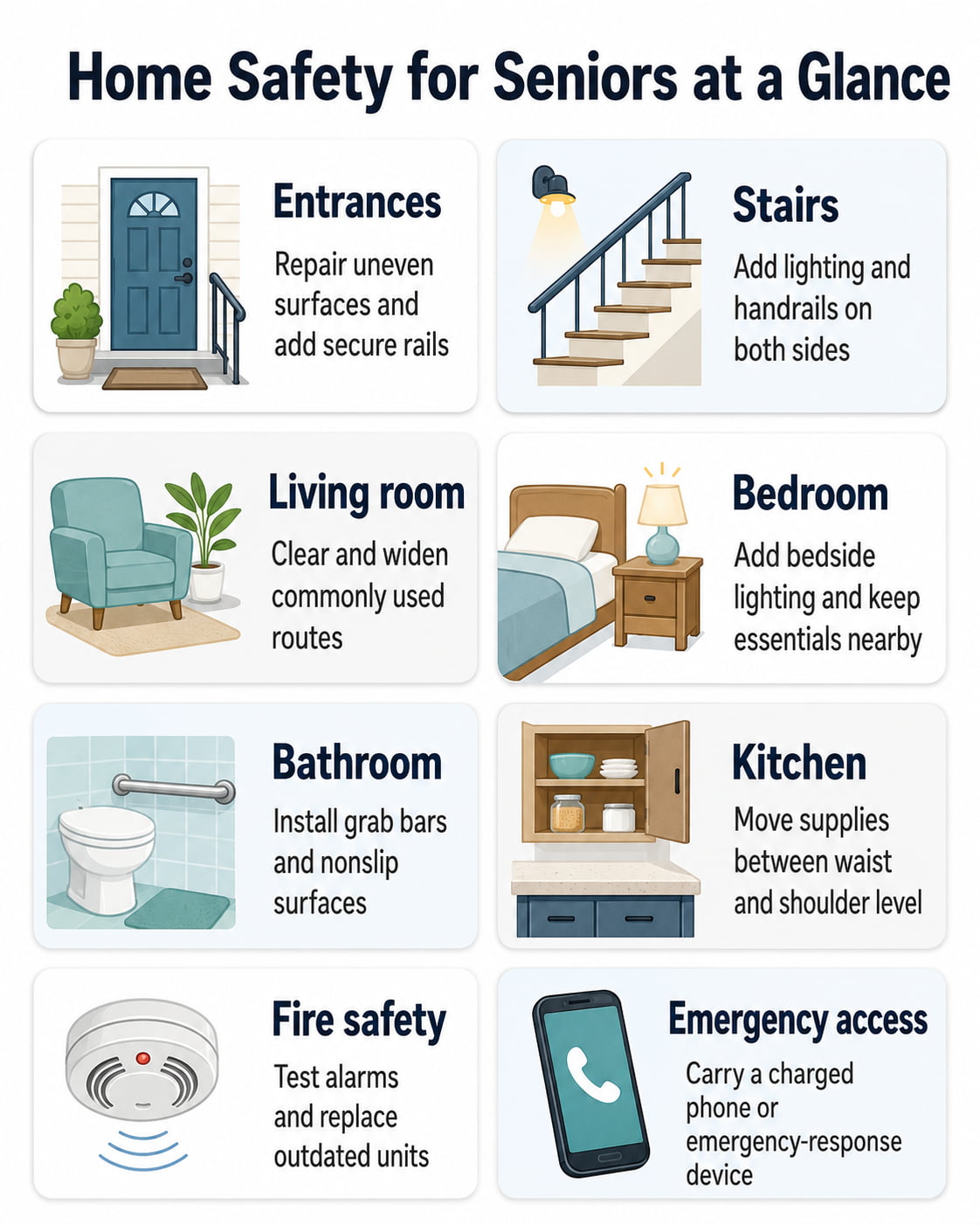
Use this table to identify the most urgent checks before completing the detailed room-by-room assessment.
| Area | Essential check | Common improvement |
|---|---|---|
| Entrances | Are steps, thresholds, and walkways stable and well lit? | Repair uneven surfaces and add secure rails |
| Stairs | Can the person see every step and hold a rail? | Add lighting and handrails on both sides |
| Living room | Are cords, rugs, and low furniture in the walking path? | Clear and widen commonly used routes |
| Bedroom | Can the person reach a light and phone before standing? | Add bedside lighting and keep essentials nearby |
| Bathroom | Are toilet and shower transfers stable? | Install grab bars and nonslip surfaces |
| Kitchen | Can everyday items be reached without climbing? | Move supplies between waist and shoulder level |
| Fire safety | Are working alarms installed in the correct places? | Test alarms and replace outdated units |
| Emergency access | Can help be contacted from every main area? | Carry a charged phone or emergency-response device |
The National Institute on Aging recommends secure handrails, good lighting, fixed carpeting, bathroom grab bars, accessible storage, clear walking paths, and a reliable way to contact help.
Start With These Immediate Safety Checks
Before reviewing individual rooms, correct hazards that could cause a fall, fire, or delayed emergency response today:
- Remove boxes, shoes, loose papers, electrical cords, and other objects from walking paths.
- Remove small throw rugs or secure any floor covering that can slide, bunch, or curl.
- Replace burned-out bulbs and improve lighting on stairs, in hallways, and between the bed and bathroom.
- Repair loose handrails, broken steps, uneven flooring, and unstable furniture.
- Test smoke and carbon monoxide alarms.
- Place a charged phone where the older adult can reach it without walking across the room.
- Check that frequently used doors, including exits, open easily.
- Make sure mobility aids are within reach and do not block an escape route.
- Review any recent dizziness, weakness, vision problems, or medication changes with an appropriate health professional.
Do not try to complete every improvement at once. Correct the most dangerous problems first, especially unstable stairs, dark walking routes, wet bathroom surfaces, missing alarms, and obstacles that repeatedly cause trips.
Home Safety for Seniors: Room-by-Room Checklist
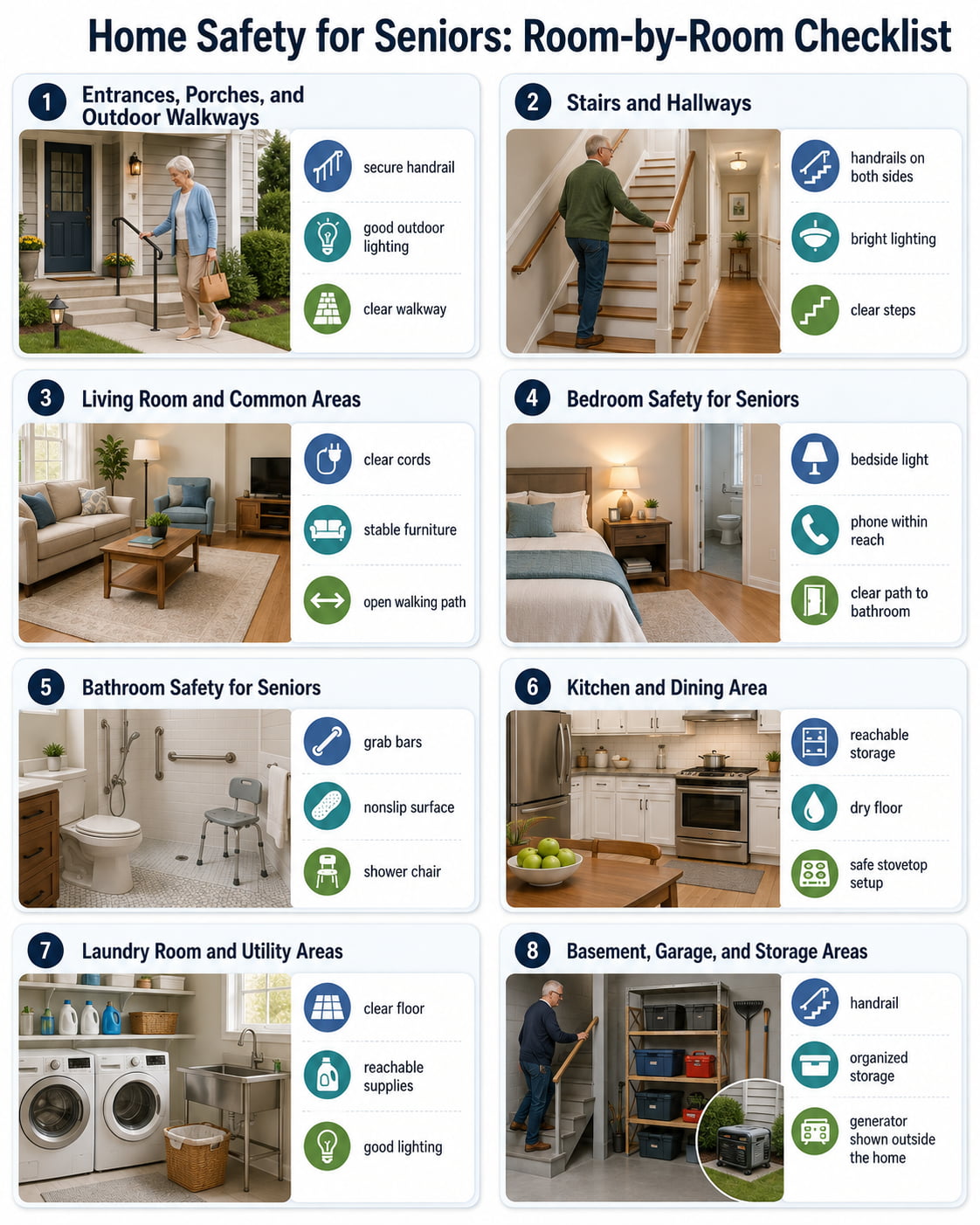
Entrances, Porches, and Outdoor Walkways
The route into the home should be stable, visible, and wide enough for the person’s usual mobility aid.
Check the following:
- Repair loose, broken, or uneven steps.
- Install secure handrails beside stairs and ramps.
- Add nonslip material to surfaces that become wet.
- Remove hoses, garden tools, leaves, packages, and other obstacles.
- Improve lighting around the walkway, driveway, and door.
- Make sure railings do not move when pulled.
- Reduce raised thresholds that catch a cane, walker, or foot.
- Add a support handle near the door when balance is difficult while locking or unlocking it.
- Keep the house number visible from the street for emergency responders.
- Arrange regular help with ice, snow, leaves, or outdoor maintenance when needed.
The National Institute on Aging advises addressing unstable outdoor surfaces, poor lighting, and missing handrails as part of a room-by-room fall-prevention assessment. A permanent ramp or major entrance change should be properly designed for the person, mobility device, available space, and local construction requirements.
Stairs and Hallways
Stairs require clear vision, balance, strength, and a reliable place to hold. A problem in any one of these areas can make stairs unsafe.
Complete these checks:
- Install secure handrails on both sides when possible.
- Make sure the rail extends across the full staircase.
- Place light switches at both the top and bottom.
- Use bright, even lighting that does not create heavy shadows.
- Consider motion-activated lights for nighttime use.
- Repair loose carpet, damaged boards, and uneven steps.
- Keep shoes, laundry, books, and storage boxes off every step.
- Avoid patterned carpeting that makes step edges difficult to see.
- Add visual contrast to step edges when poor vision makes them hard to distinguish.
- Do not carry items that block the view of the stairs.
- Keep walkers, wheelchairs, and furniture out of hallways and exit routes.
Stair gates are generally not a substitute for addressing mobility limitations in an older adult. If stairs can no longer be used safely, consider moving essential daily activities to one level or requesting a professional assessment.
Living Room and Common Areas
The main living area should have wide, predictable routes between the entrance, seating, bathroom, kitchen, and telephone.
Look for these hazards:
- Electrical cords crossing the floor
- Low coffee tables or footstools in walking paths
- Loose rugs or curled carpet edges
- Unstable floor lamps
- Furniture that slides when used for support
- Pet bowls, toys, or leashes underfoot
- Clutter beside chairs
- Narrow spaces that cannot accommodate a walker
Choose chairs and sofas that are firm, stable, and high enough for the individual to sit and stand with control. Avoid relying on lightweight tables, rolling chairs, or furniture backs for balance.
Keep remotes, reading glasses, phones, drinks, and other frequently used items within easy reach. The National Institute on Aging also recommends avoiding climbing to reach high shelves and using safer alternatives, such as a reaching tool or asking for help.
Bedroom Safety for Seniors
The bedroom should allow a person to wake, sit, stand, and reach the bathroom without searching for a light or stepping over obstacles.
Check that:
- A lamp or light switch is reachable from the bed.
- Night-lights illuminate the route to the bathroom.
- A flashlight is available during a power outage.
- A charged phone is within reach.
- Glasses and hearing aids are easy to find.
- Shoes or nonslip footwear are beside the bed.
- Blankets, clothing, charging cables, and oxygen tubing remain off the floor.
- The bedside table is stable and does not obstruct movement.
- The bed is not so low that standing becomes difficult or so high that the person must climb onto it.
- The cane or walker can be reached before standing.
- Emergency contacts are saved in the phone and displayed in large print.
The National Institute on Aging recommends keeping a light, flashlight, and telephone near the bed. If the person frequently slides, becomes tangled in bedding, or has difficulty transferring, ask an occupational or physical therapist to assess the bed setup rather than adding equipment at random.
Bathroom Safety for Seniors
Bathrooms combine water, hard surfaces, limited space, and difficult transfers. Give this room priority even when the person has not fallen before.
Essential improvements include:
- Install properly secured grab bars near the toilet and inside and outside the shower or tub.
- Do not use a towel rack as a weight-bearing support.
- Add nonslip strips or an appropriate nonskid surface in wet areas.
- Remove bath mats that slide or bunch.
- Use bright lighting and an automatic night-light.
- Keep soap, towels, and toiletries within easy reach.
- Clean water from the floor immediately.
- Make sure the bathroom door can be opened during an emergency.
- Consider a shower chair and handheld showerhead when standing is tiring or unstable.
- Consider a toilet safety frame, commode chair, or raised toilet seat when transfers are difficult.
Bathroom equipment must fit the user, toilet, shower, and available space. An unstable or incorrectly sized device can create a new hazard.
The Consumer Product Safety Commission recommends keeping household water-heater temperature at no more than 120°F to help reduce scald risk. Ask a qualified person to adjust the system when its controls are unfamiliar or difficult to reach.
Kitchen and Dining Area
Arrange the kitchen so that routine tasks do not require climbing, deep bending, or carrying heavy items across the room.
For fall prevention:
- Store frequently used cookware and food between approximately waist and shoulder level.
- Avoid standing on chairs or unstable stools.
- Clean spills immediately.
- Keep pet bowls, bags, cords, and step stools out of walking paths.
- Prepare food while seated when fatigue or balance is a concern.
- Use lightweight dishes and cookware when hand strength is limited.
- Place heavy items where they can be lifted without reaching overhead.
For fire and burn prevention:
- Stay in the kitchen while using the stovetop.
- Turn off the burner before leaving the room.
- Turn pot handles toward the back of the stove.
- Keep towels, packaging, loose sleeves, and wooden utensils away from heat.
- Keep a lid or baking sheet nearby to cover a small pan fire.
- Never pour water on a grease fire.
- Use timers as reminders, but do not depend on a timer instead of supervision.
The U.S. Fire Administration reports that cooking caused 46.7% of the estimated 343,000 residential building fires in 2024, making it the leading cause of home fires that year. For someone with memory loss, repeated cooking incidents, or difficulty operating controls, an automatic stove-shutoff device may provide an additional safeguard.
Laundry Room and Utility Areas
Laundry and utility spaces often become cluttered because they are used for storage.
Check that:
- Baskets do not block doors, stairs, or hallways.
- Detergents and cleaning products remain labeled.
- Frequently used supplies can be reached without climbing.
- Leaks and wet floors are corrected promptly.
- Appliance cords and plugs are not damaged.
- Extension cords are not being used as permanent wiring.
- The room has enough light to see floor-level obstacles.
- Heavy containers are stored below shoulder height.
Ask an electrician or appliance professional to inspect outlets, cords, or equipment that become unusually hot, spark, smell burned, or repeatedly trip a breaker.
Basement, Garage, and Storage Areas
These areas commonly contain uneven flooring, poor lighting, tools, hoses, chemicals, and overhead storage.
Make them safer by:
- Adding strong lighting near stairs and work areas.
- Installing secure handrails.
- Moving boxes, cords, and hoses away from walking paths.
- Storing sharp tools safely.
- Keeping heavy items at a manageable height.
- Labeling chemicals and storing them in their original containers.
- Keeping combustible materials away from heaters and ignition sources.
- Avoiding tasks that require climbing when no one else is nearby.
The Consumer Product Safety Commission advises never operating a vehicle or portable generator in a closed garage and recommends running portable generators outdoors only, at least 20 feet from the home, with exhaust directed away from the building.
Smoke Alarms, Carbon Monoxide Alarms, and Fire Safety
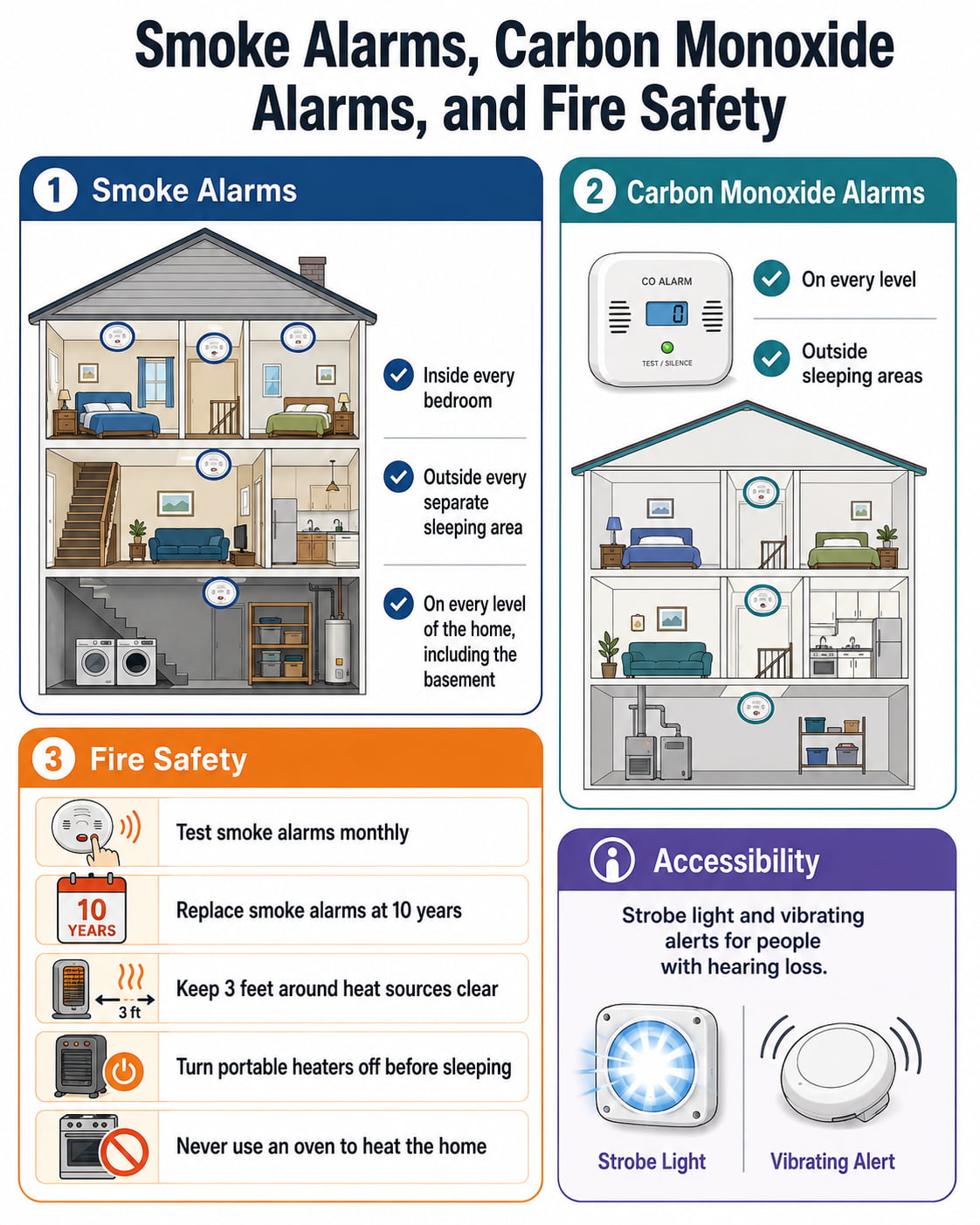
Install smoke alarms:
- Inside every bedroom
- Outside every separate sleeping area
- On every level of the home, including the basement
The U.S. Fire Administration recommends testing smoke alarms monthly and replacing the entire alarm when it reaches 10 years of age. Interconnected alarms provide added protection because all units sound when one detects smoke.
People with hearing loss may need alarms with strobe lights, vibrating pads, or other accessible alerts. Test the system while the person is asleep or in another room to confirm that the warning can be detected. Some local fire departments provide free or reduced-cost smoke alarms or help with installation.
The Consumer Product Safety Commission recommends carbon monoxide alarms on every level of the home and outside sleeping areas. If a CO alarm sounds or carbon monoxide exposure is suspected, move outside to fresh air and call 911. Do not reenter until emergency personnel say it is safe.
For heating safety:
- Keep anything that can burn at least three feet from fireplaces, radiators, space heaters, and other heat sources.
- Turn portable heaters off before leaving the room or going to bed.
- Never use an oven to heat the home.
- Have heating systems, chimneys, and vents inspected as appropriate.
- Keep mobility devices and oxygen equipment away from open flames and heat sources.
The U.S. Fire Administration recommends maintaining a three-foot safety zone around heat sources and shutting portable heaters off before sleeping or leaving the area.
Are Portable Bed Rails Safe for Seniors?
Portable bed rails are not automatically safe or appropriate for every older adult. Gaps within a rail or between the rail and mattress can trap a person’s head, neck, chest, or limbs. A loose or poorly fitted rail can also move during use.
The Consumer Product Safety Commission established mandatory federal safety requirements for adult portable bed rails manufactured after August, 2023. The standard addresses retention systems, structural strength, entrapment zones, labeling, and other hazards.
On August, 2026, the Consumer Product Safety Commission announced the recall of about 12,000 Liuqibax BR-11 adult bed rails because of entrapment and asphyxiation hazards. The recalled products also lacked required warning labels.
Before using any portable bed rail:
- Search the CPSC recall database for the brand and model.
- Confirm that it complies with the current federal standard.
- Follow the mattress-size and bed-frame instructions exactly.
- Install the required retention system.
- Check for gaps after installation.
- Recheck the fit whenever the mattress or bed position changes.
- Stop using the rail if it loosens, shifts, bends, or creates an opening.
- Ask an occupational therapist or other qualified professional whether a rail is appropriate for the individual.
A bed rail should not be used simply because someone is considered a fall risk. In some situations, changing bed height, improving transfers, adding floor-level lighting, or repositioning furniture may be safer.
Medication and Health Factors That Affect Home Safety
Home modifications cannot correct every fall risk. Dizziness, drowsiness, poor vision, muscle weakness, foot pain, low blood pressure, and an incorrectly used mobility aid can make a well-maintained home unsafe.
Review the following:
- New prescriptions or recent dose changes
- Medicines that cause dizziness, confusion, or sleepiness
- Alcohol use with medications
- Vision and hearing changes
- Poorly fitting or smooth-soled footwear
- Difficulty standing from a chair
- Frequent loss of balance
- Incorrect cane or walker height
- Rushing to the bathroom
- Standing up too quickly
The National Institute on Aging recommends discussing medication side effects, standing slowly, completing appropriate strength and balance activities, having vision and hearing checked, and using a cane or walker when greater stability is needed.
The U.S. Food and Drug Administration also warns that some medication and alcohol combinations can contribute to sleepiness, memory problems, poor coordination, and falls. Do not stop or change a prescribed medicine without speaking with the prescriber or pharmacist.
Emergency Planning for Older Adults Living at Home
A safety plan should address what happens after a fall, fire, storm, power outage, or medical emergency.
Keep these items accessible:
- A charged mobile phone or working landline
- Emergency contacts saved as favorites
- The home address displayed in large print
- An updated medication and allergy list
- Basic medical information
- Flashlights with working batteries
- Water, food, and essential supplies for several days
- Backup batteries or power options for necessary equipment
- A plan for refrigerated medicines
- Glasses, hearing aids, mobility devices, and chargers
- Spare keys or an approved emergency-entry arrangement
Ready.gov recommends including prescriptions, medical equipment, disabilities, and functional needs in the household emergency plan. People who depend on powered medical devices or refrigerated medicines should discuss a power-outage plan with their health professional or equipment provider.
Someone who lives alone may benefit from scheduled family check-ins, a wearable emergency-response device, a smartwatch with emergency features, or a voice-activated device. These systems vary in reliability, coverage, and monthly cost. The National Institute on Aging notes that personal emergency-response services usually charge a fee and are often not covered by insurance.
When to Request a Professional Home-Safety Assessment
Consider an occupational therapy, physical therapy, nursing, or other qualified home assessment when the older adult:
- Has fallen or experienced repeated near-falls
- Has trouble entering the shower or using the toilet
- Cannot rise safely from a bed or chair
- Has recently started using a walker or wheelchair
- Has returned home after surgery or hospitalization
- Has had a stroke, fracture, or major change in strength
- Experiences frequent dizziness
- Has progressive vision loss
- Has dementia or increasing confusion
- Cannot use stairs reliably
- Is unsure where grab bars, rails, or transfer aids should be installed
The National Institute on Aging notes that an occupational therapist, physical therapist, or nurse may assess the home after a fall and recommend individualized changes. An occupational therapist can evaluate how the person performs household tasks, while a physical therapist may help assess walking, balance, transfers, strength, and mobility-device use.
Low-Cost Home-Safety Improvements
Many effective changes cost little or nothing.
No-Cost or Low-Cost Changes
- Remove clutter and loose rugs.
- Rearrange furniture to widen walking paths.
- Move everyday items to reachable shelves.
- Place a phone beside the bed.
- Add emergency contacts to phone favorites.
- Replace burned-out bulbs.
- Add plug-in night-lights.
- Mark difficult-to-see step edges.
- Keep floors dry.
- Place frequently used shoes and mobility aids within reach.
- Ask the local fire department about alarm programs.
Changes That May Require Professional Installation
- Grab bars
- Permanent handrails
- Ramps
- Threshold modifications
- Improved electrical wiring
- Hardwired or interconnected alarms
- Walk-in or accessible showers
- Doorway widening
- Stair lifts
- Major flooring changes
Structural modifications should be completed by someone qualified to install them securely and in a location that matches the individual’s movement pattern.
Does Medicare Pay for Senior Home-Safety Equipment?
Original Medicare does not treat every home-safety purchase as covered medical equipment. Coverage depends on the item, medical necessity, the prescriber’s order, the supplier, and applicable Medicare rules.
According to Medicare, Part B may cover medically necessary equipment ordered for home use, including canes, commode chairs, hospital beds, walkers, wheelchairs, and certain other devices. After the Part B deductible, the beneficiary generally pays 20% of the Medicare-approved amount when the supplier accepts assignment.
Do not assume that grab bars, ramps, remodeling, medical-alert subscriptions, or other modifications will be covered. Check with Medicare, a Medicare Advantage plan, Medicaid, the equipment supplier, or another funding program before purchasing.
Local assistance may be available through an Area Agency on Aging, housing program, veterans program, Medicaid waiver, nonprofit organization, or local government. The federal Eldercare Locator can connect U.S. families with local aging services at 1-800-677-1116.
How Often Should You Complete a Senior Home-Safety Check?
A practical schedule is to complete a full room-by-room review at least once a year and inspect high-risk areas more often.
Repeat the assessment after:
- A fall or near-fall
- A hospital or rehabilitation stay
- Surgery or a fracture
- A change in vision or hearing
- A new medication that causes dizziness or drowsiness
- The introduction of a cane, walker, wheelchair, or oxygen equipment
- A change in memory or judgment
- A move to a different bedroom or floor
- A renovation or furniture rearrangement
- A change in caregiver support
The U.S. Fire Administration recommends testing smoke alarms monthly rather than waiting for the annual home-safety review.
Frequently Asked Questions
What are the most common home hazards for seniors?
Common hazards include loose rugs, clutter, cords, poor lighting, unstable stairs, missing handrails, wet bathroom floors, difficult toilet or shower transfers, low furniture, unsafe footwear, and items stored out of reach. Medication side effects and balance problems can increase the danger these hazards create.
What is the first thing I should do to make a senior’s home safer?
Clear the main walking routes first. Remove tripping hazards, improve lighting, repair unstable stairs or railings, and make sure a working phone is accessible. Then check the bathroom, bedroom, smoke alarms, and carbon monoxide alarms.
Should all throw rugs be removed?
Small throw rugs are a common tripping and slipping hazard, particularly when they curl, bunch, or move on smooth flooring. Removing them is usually the simplest option. When a larger rug must remain, make sure it lies flat and is securely fixed without creating a raised edge.
What bathroom equipment helps prevent falls?
Secure grab bars, nonslip surfaces, a shower chair, a handheld showerhead, a toilet safety frame, or a properly fitted raised toilet seat may help, depending on the person’s needs. Equipment should fit the room and remain stable during use.
Are bed rails a good way to prevent senior falls?
Not always. Portable bed rails can create entrapment, asphyxiation, and fall hazards when they are recalled, poorly fitted, or unsuitable for the user. Check current recalls and seek individualized advice before installing one.
Does Medicare cover grab bars and home modifications?
Coverage varies, and many household modifications do not meet Medicare’s definition of durable medical equipment. Medicare Part B may cover medically necessary items such as walkers, canes, commode chairs, hospital beds, or wheelchairs when its requirements are met. Verify coverage before purchasing.
What safety equipment should an older adult living alone have?
At minimum, the home should have working smoke and carbon monoxide alarms, accessible lighting, a charged phone, emergency contacts, a flashlight, appropriate mobility equipment, and a clear emergency plan. A wearable alert device or scheduled check-in system may add protection when the person has a high fall risk.
Conclusion
Home safety for seniors is most effective when it supports the person’s actual daily routine. Begin with the routes used most often, correct immediate fall and fire hazards, and make sure help can be reached from the bedroom, bathroom, kitchen, and living area.
Complete the checklist with the older adult rather than making changes without their input. When transfers, stairs, mobility, vision, or memory create ongoing concerns, request a professional home-safety assessment instead of relying on generic equipment. A few targeted improvements can make the home easier to navigate while supporting confidence and independence.
This content is for informational purposes only and not medical advice.
References
- Centers for Disease Control and Prevention: Older Adult Falls Data
- National Institute on Aging: Preventing Falls at Home—Room by Room
- National Institute on Aging: Six Tips to Help Prevent Falls
- U.S. Fire Administration: Older Adult Fire Death Risk
- U.S. Fire Administration: Smoke Alarms
- Consumer Product Safety Commission: Carbon Monoxide Safety
- Consumer Product Safety Commission: Adult Portable Bed Rails
- U.S. Food and Drug Administration: Medication Safety Tips for Older Adults
- Ready.gov: Emergency Planning
- Medicare: Durable Medical Equipment Coverage