
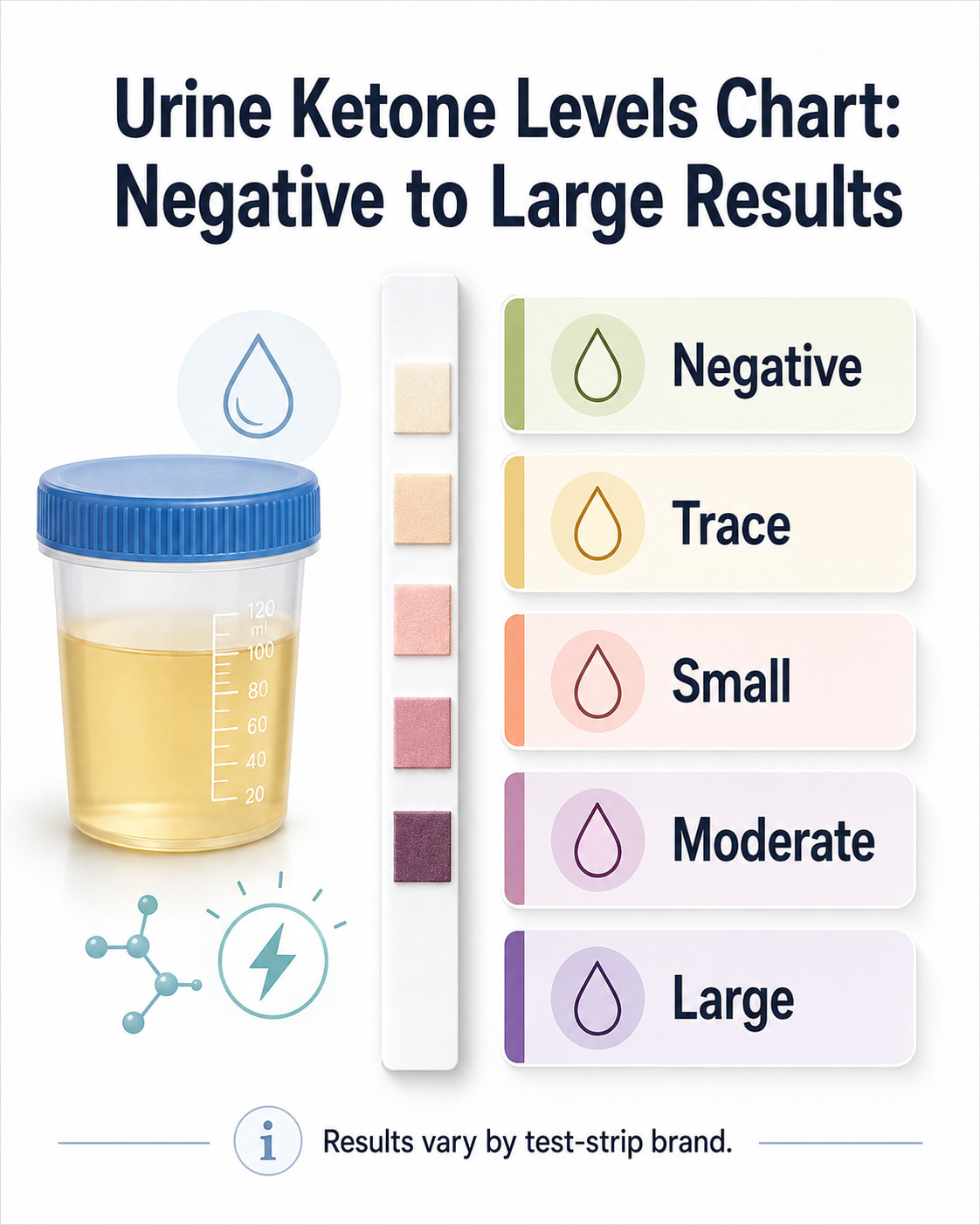
Urine ketone test strips commonly report results as negative, trace, small, moderate, or large. On the widely used KETOSTIX scale, these correspond to negative, about 5 mg/dL, 15 mg/dL, 40 mg/dL, and 80–160 mg/dL, respectively. However, urine ketone ranges can differ between test-strip brands, so always compare your result with the color chart supplied with your specific product.
A urine ketone levels chart can help you understand how much ketone a test strip detected, but the number alone cannot diagnose diabetic ketoacidosis (DKA). Your diabetes status, blood glucose, symptoms, illness, medications, hydration, and sometimes blood ketone or laboratory results all affect what a result means.
Urine Ketone Levels Chart
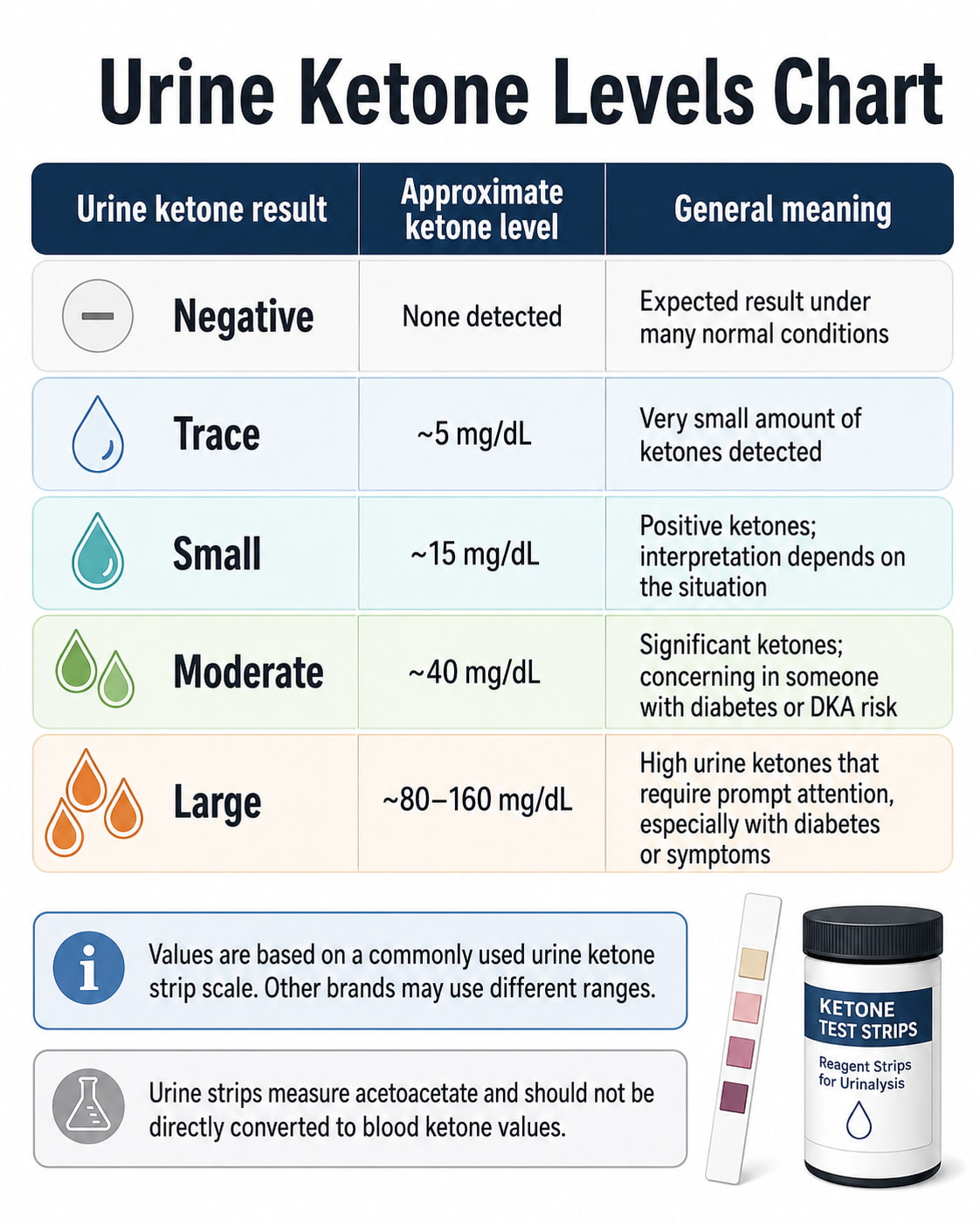
The following chart uses the nominal values listed for Ascensia Diabetes Care KETOSTIX reagent strips. Other urine ketone strips may use different concentrations, colors, or reporting categories.
| Urine ketone result | Approximate ketone level | General meaning |
|---|---|---|
| Negative | None detected | Expected result under many normal conditions |
| Trace | ~5 mg/dL | Very small amount of ketones detected |
| Small | ~15 mg/dL | Positive ketones; interpretation depends on the situation |
| Moderate | ~40 mg/dL | Significant ketones; concerning in someone with diabetes or DKA risk |
| Large | ~80–160 mg/dL | High urine ketones that require prompt attention, especially with diabetes or symptoms |
These values measure acetoacetate in urine. They should not be directly converted to blood ketone values because blood ketone meters generally measure a different ketone body called beta-hydroxybutyrate.
What Are Ketones in Urine?
Ketones are substances your liver produces when your body uses fat for energy instead of relying primarily on glucose.
This can happen when carbohydrate or glucose availability is reduced, such as during fasting or a very-low-carbohydrate diet. Ketones may also increase when the body cannot use glucose normally because there is not enough effective insulin.
According to MedlinePlus from the U.S. National Library of Medicine, ketones may appear with diabetes, prolonged vomiting or diarrhea, starvation, low-carbohydrate diets, prolonged strenuous exercise, pregnancy, and certain other conditions.
Small amounts do not automatically mean something is wrong. High or rising ketones are more concerning, particularly for someone with diabetes because they can be associated with ketoacidosis.
What Is a Normal Urine Ketone Level?
For commonly used home urine strips, negative is generally the expected result under ordinary conditions. However, a small amount of ketones can occur when the body is using more fat for fuel.
Your result can be affected by:
- How recently you ate
- Carbohydrate intake
- Fasting
- Exercise
- Pregnancy
- Illness
- Vomiting or diarrhea
- Diabetes control
- Hydration
- Certain medications
For this reason, there is no single urine ketone value that has the same meaning for everyone.
What Do Negative, Trace, Small, Moderate, and Large Ketones Mean?
Negative Urine Ketones
A negative result means the strip did not detect a measurable amount of acetoacetate at its testing threshold.
For most people eating normally and feeling well, this is an expected result.
A negative urine result does not necessarily provide a complete picture of ketone production in someone who is seriously ill. If DKA is suspected clinically, healthcare professionals may use blood beta-hydroxybutyrate and other laboratory testing rather than relying on a urine strip alone.
Trace Urine Ketones — About 5 mg/dL
A trace result indicates a very small amount of ketones.
Trace ketones may occur during fasting, lower-carbohydrate eating, exercise, pregnancy, or periods of reduced food intake. The result is not automatically dangerous.
If you have diabetes, however, a trace result should be interpreted alongside your blood glucose, symptoms, illness status, and personal sick-day or ketone-management plan.
Small Urine Ketones — About 15 mg/dL
A small result means ketones are clearly detectable.
For a person without diabetes who has been fasting or eating very few carbohydrates, this may have a different meaning than it does for someone who uses insulin and has high blood glucose.
If you have diabetes and ketones are increasing, follow your individualized diabetes plan and recheck as directed rather than waiting for the strip to reach the “large” category.
Moderate Urine Ketones — About 40 mg/dL
Moderate ketones require more attention, particularly for someone with diabetes.
The KETOSTIX manufacturer specifically advises contacting a doctor or diabetes educator when a test shows moderate or large urine ketones.
Do not adjust or stop insulin solely because of a generic urine ketone chart. Follow the correction, hydration, and retesting instructions that your diabetes care team has provided.
Large Urine Ketones — About 80–160 mg/dL
A large result means a substantial amount of urinary ketone has been detected.
Large ketones are especially concerning when they occur with diabetes, elevated glucose, illness, vomiting, dehydration, abdominal pain, unusual tiredness, confusion, fruity-smelling breath, or rapid/deep breathing.
The American Diabetes Association advises urgent medical evaluation when ketones stay high or worsen, or when severe symptoms such as vomiting, inability to drink, confusion, or heavy breathing occur.
When Are Urine Ketones Dangerous?
The level becomes more concerning when ketones are rising or moderate-to-large and the person is at risk of DKA.
Watch particularly carefully if you:
- Have type 1 diabetes
- Use insulin
- Have missed an insulin dose
- Have an insulin-pump or infusion-site problem
- Are sick or have an infection
- Are dehydrated
- Are vomiting
- Are pregnant and have diabetes
- Take an SGLT2 inhibitor or another medication for which your diabetes team has discussed ketoacidosis risk
Symptoms associated with high ketone levels can include nausea, vomiting, abdominal pain, rapid or heavy breathing, severe tiredness, confusion, and fruity-smelling breath.
Seek Emergency Help for Possible DKA
Seek emergency medical care if you have diabetes and develop serious DKA warning signs, particularly:
- Trouble breathing or fast, deep breathing
- Repeated vomiting or inability to keep fluids down
- Confusion or marked drowsiness
- Fruity-smelling breath
- Multiple DKA symptoms
- Ketones that remain high or continue increasing
The Centers for Disease Control and Prevention identifies DKA as a medical emergency and advises immediate emergency evaluation for these warning signs.
Urine Ketones and Diabetic Ketoacidosis
A positive urine ketone test does not by itself mean you have DKA.
DKA involves a combination of abnormal ketone accumulation and metabolic acidosis, usually in the setting of diabetes or impaired insulin action. Current ADA clinical criteria consider significant ketosis to include blood beta-hydroxybutyrate of at least 3.0 mmol/L or urine ketones of 2+ or greater, but DKA diagnosis also requires other clinical and laboratory criteria, including metabolic acidosis.
That distinction is important. Someone can have urine ketones because of fasting or carbohydrate restriction without having DKA.
Conversely, anyone with diabetes who feels seriously ill should not rely on the color of a urine strip alone to decide whether medical care is necessary.
When Should People With Diabetes Check Urine Ketones?
Current American Diabetes Association guidance recommends checking ketones when you feel unwell, are sick or dehydrated, or have blood glucose of 250 mg/dL or higher for at least two hours. Your healthcare team may give you a lower testing threshold based on your individual situation.
The CDC also advises people with diabetes who are sick or have blood glucose 250 mg/dL or higher to check glucose every four to six hours and test for urine ketones.
Your personal diabetes plan takes priority over a general guideline.
You may also be instructed to test ketones when:
- You have nausea or vomiting
- You develop DKA symptoms
- You have an infection or fever
- Your insulin pump stops working properly
- Blood glucose remains above your target
- You are pregnant
- Your diabetes care team specifically recommends testing
Urine Ketones vs. Blood Ketones
Urine and blood ketone tests are related, but they do not measure exactly the same thing.
| Urine ketone test | Blood ketone test |
|---|---|
| Usually measures acetoacetate | Usually measures beta-hydroxybutyrate |
| Uses urine test strips | Uses a blood ketone meter or laboratory test |
| Results often shown as negative, trace, small, moderate, or large | Results generally reported in mmol/L |
| Reflects ketones that have passed into urine | Gives a more direct assessment of current circulating ketones |
| Convenient and inexpensive | ADA describes blood testing as the more accurate option |
The ADA currently identifies a blood ketone meter as the most accurate way to check ketones, although urine strips remain a useful home-testing option.
Do not try to convert a urine result such as 40 mg/dL directly into a blood beta-hydroxybutyrate result. They are different measurements.
Why Can You Have Ketones Without Diabetes?
Ketones simply indicate that the body is using more fat for energy. Diabetes is only one possible reason.
Urine ketones can also occur with:
Fasting or Not Eating Enough
When glucose availability falls during fasting or prolonged low food intake, the body increasingly uses stored fat and produces ketones.
Low-Carbohydrate or Ketogenic Diets
Restricting carbohydrates encourages greater fat use, so urine ketones may appear even when a person does not have diabetes.
Vomiting or Diarrhea
Prolonged vomiting or diarrhea may reduce calorie and carbohydrate intake while contributing to dehydration.
Prolonged Exercise
Long periods of strenuous activity can increase fat metabolism and ketone production.
Pregnancy
Ketones may develop more easily during pregnancy, particularly when food intake is poor or vomiting occurs. Pregnant people should follow their obstetric or diabetes care team’s advice about ketone testing.
MedlinePlus lists each of these situations among recognized reasons for positive urine ketones.
How to Use Urine Ketone Test Strips Correctly
Always use the instructions supplied with your specific test-strip brand because testing and reading times can differ.
A typical process involves:
- Check the expiration date.
- Remove one strip without touching the reagent pad.
- Replace the container cap promptly.
- Dip the reagent area into fresh urine or pass it through the urine stream, depending on the manufacturer’s instructions.
- Remove excess urine if instructed.
- Start timing immediately.
- Compare the strip with the manufacturer’s color chart at the exact specified time.
- Record the result.
For example, KETOSTIX instructions specify comparing the reagent pad with the color chart exactly 15 seconds after testing. That timing should not automatically be applied to another brand.
Common Reasons for an Unreliable Result
Results may be misleading if:
- The strips have expired
- The container was left open
- Moisture or heat damaged the strips
- You read the strip too early or too late
- You used the wrong brand’s color chart
- The urine sample or certain medicines interfere with color interpretation
If the result seems inconsistent with how you feel, repeat the test according to the instructions and seek medical advice when appropriate.
What Should You Do After a Positive Urine Ketone Test?
What to do depends strongly on why you tested.
If you do not have diabetes and feel well, a trace or small result after fasting, strenuous exercise, or carbohydrate restriction may have a straightforward explanation.
If you have diabetes:
- Check your glucose as instructed.
- Follow your personal ketone or sick-day plan.
- Continue insulin as prescribed unless a healthcare professional tells you otherwise.
- Take correction insulin only according to your established plan.
- Drink fluids if your care plan permits.
- Recheck ketones at the interval recommended by your care team.
- Contact your healthcare professional if ketones do not improve or you feel worse.
The ADA recommends developing an individualized ketone-management plan rather than making insulin changes from a generic chart.
Frequently Asked Questions
Is trace ketones in urine normal?
Trace ketones can occur when the body is using more fat for energy, including during fasting, strenuous exercise, pregnancy, or low-carbohydrate eating. In someone with diabetes, trace ketones should still be interpreted alongside glucose levels, symptoms, and their diabetes plan.
What does 15 mg/dL of ketones in urine mean?
On the KETOSTIX scale, 15 mg/dL is categorized as “small.” This means ketones are present but does not by itself diagnose DKA. Other test-strip brands may use different scales.
What does 40 mg/dL of urine ketones mean?
On KETOSTIX, 40 mg/dL is categorized as “moderate.” Moderate ketones are particularly important for someone with diabetes, who should follow their ketone-management plan and contact their healthcare team as advised.
Are 80 mg/dL urine ketones dangerous?
KETOSTIX classifies 80–160 mg/dL as large. Large ketones may indicate a serious problem in someone with diabetes, especially when accompanied by illness, high glucose, vomiting, abdominal pain, confusion, dehydration, or abnormal breathing.
Can you have ketones in urine without having diabetes?
Yes. Ketones may appear during fasting, ketogenic diets, prolonged exercise, pregnancy, starvation, or prolonged vomiting or diarrhea. A positive urine ketone result is therefore not specific to diabetes.
Can urine ketone strips diagnose DKA?
No. Urine strips provide useful information about ketones, but DKA cannot be diagnosed from a urine strip alone. Diagnosis requires assessment of ketones together with other clinical and laboratory findings, particularly metabolic acidosis.
Conclusion
A urine ketone levels chart makes home test results easier to interpret: on a common KETOSTIX scale, negative means no ketones detected, trace is about 5 mg/dL, small is 15 mg/dL, moderate is 40 mg/dL, and large is 80–160 mg/dL. Remember that these are manufacturer-specific nominal values rather than universal cutoff points.
For people with diabetes, the trend in ketones, blood glucose, symptoms, illness, medications, and personal diabetes plan matter more than one color block. Moderate or large ketones, worsening results, or DKA warning signs should never be ignored.
If you regularly need to test ketones, ask your healthcare team which testing method and action thresholds are appropriate for you.
This content is for informational purposes only and not medical advice.
References
- Ascensia Diabetes Care — KETOSTIX Reagent Strips Instructions and Color Chart
- American Diabetes Association — Managing Ketones With Diabetes
- Centers for Disease Control and Prevention — Diabetic Ketoacidosis
- MedlinePlus, U.S. National Library of Medicine — Ketones in Urine
- American Diabetes Association — Standards of Care in Diabetes: Diabetes Care in the Hospital