
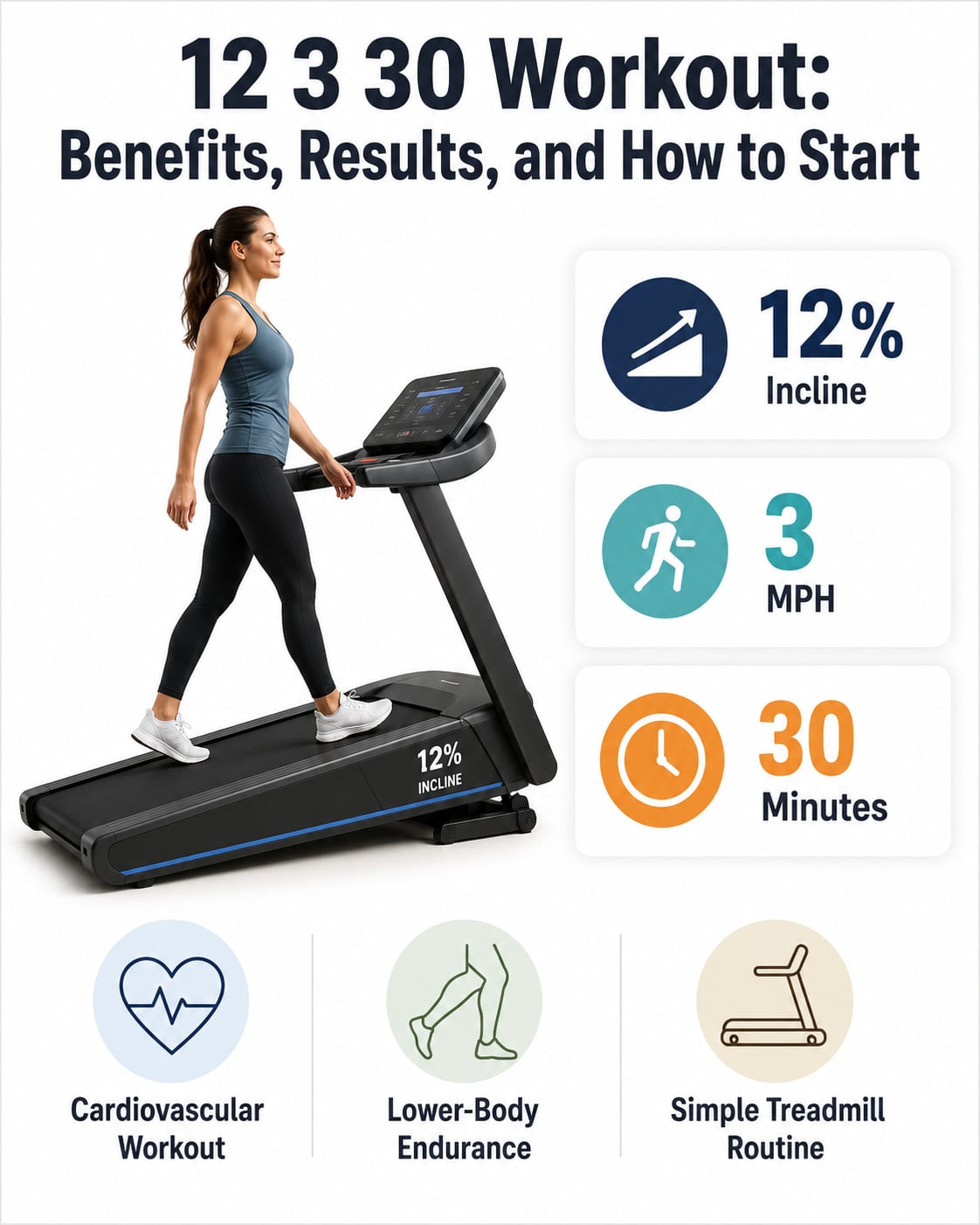
The 12 3 30 workout is a treadmill routine that combines a 12% incline, a speed of 3 miles per hour, and 30 minutes of continuous walking. It can provide an effective cardiovascular workout and support weight-management goals, but the full settings are challenging and are not the right starting point for every beginner.
The routine is easy to remember, requires no running, and can be adjusted to match your current fitness level. The key is to treat 12-3-30 as a target—not a test you must pass on your first day.
What Is the 12 3 30 Workout?
The three numbers describe the treadmill settings:
| Number | Meaning |
|---|---|
| 12 | Set the treadmill to a 12% incline |
| 3 | Walk at 3 miles per hour, or about 4.8 kilometers per hour |
| 30 | Continue walking for 30 minutes |
A 12% incline is a treadmill grade, not a 12-degree angle. It is equivalent to an angle of approximately 6.8 degrees.
The routine was popularized by social media creator Lauren Giraldo. Although its format is simple, a 12% incline is steep enough to make a moderate walking speed feel demanding. Cleveland Clinic recommends adjusting the incline, speed, or workout duration when the original settings exceed your current ability.
A complete session should also include a warm-up and cool-down, so plan for approximately 40 to 50 minutes rather than only 30 minutes.
Does the 12 3 30 Workout Actually Work?
Yes, it can work as a structured form of aerobic exercise. It raises heart rate, increases energy expenditure, and challenges the lower-body muscles more than easy, level walking.
However, research has not shown that the specific combination of 12%, 3 mph, and 30 minutes has unique fat-loss or fitness benefits that other appropriately challenging cardio workouts cannot provide.
What a 2024 Study Found
A 2024 study in the International Journal of Research in Exercise Physiology measured the immediate responses of 17 healthy adults completing one full 12-3-30 session.
The researchers reported:
- An average heart rate of 124.2 beats per minute
- An average intensity of 47.4% of heart-rate reserve
- An average intensity of 5.5 metabolic equivalents, or METs
- Average energy expenditure of 220.8 calories
- Generally positive enjoyment and post-workout feeling scores
On average, the workout fell within a moderate exercise-intensity range, although individual responses varied considerably.
The study provides useful information about what happens during one workout. It does not prove how much weight someone will lose, how quickly fitness will improve, or whether the routine is safe for every population.
What a 2025 Study Found
A 2025 International Journal of Exercise Science study compared the 12-3-30 workout with self-paced treadmill running. Sixteen physically active adults enrolled, and data from the 14 participants who completed both conditions were analyzed.
The two sessions were matched for total energy expenditure:
| Measurement | 12-3-30 | Self-Paced Running |
|---|---|---|
| Average workout time | 30.08 minutes | 23.89 minutes |
| Total energy expenditure | 307.58 calories | 309.74 calories |
| Energy expenditure per minute | 10.23 calories | 13.08 calories |
| Energy supplied by fat | 40.56% | 33.12% |
| Energy supplied by carbohydrates | 59.98% | 67.47% |
Running burned calories faster, while the incline walk used a higher percentage of fat as fuel during the session.
That does not mean 12-3-30 automatically produces more body-fat loss. Fuel use during one workout and long-term changes in stored body fat are different outcomes. Long-term results depend on total activity, food intake, consistency, recovery, sleep, and individual factors.
Both direct studies were small and focused mainly on immediate responses. Longer studies are still needed to determine how the workout affects fitness, body composition, adherence, and injury rates over time.
12 3 30 Workout Benefits
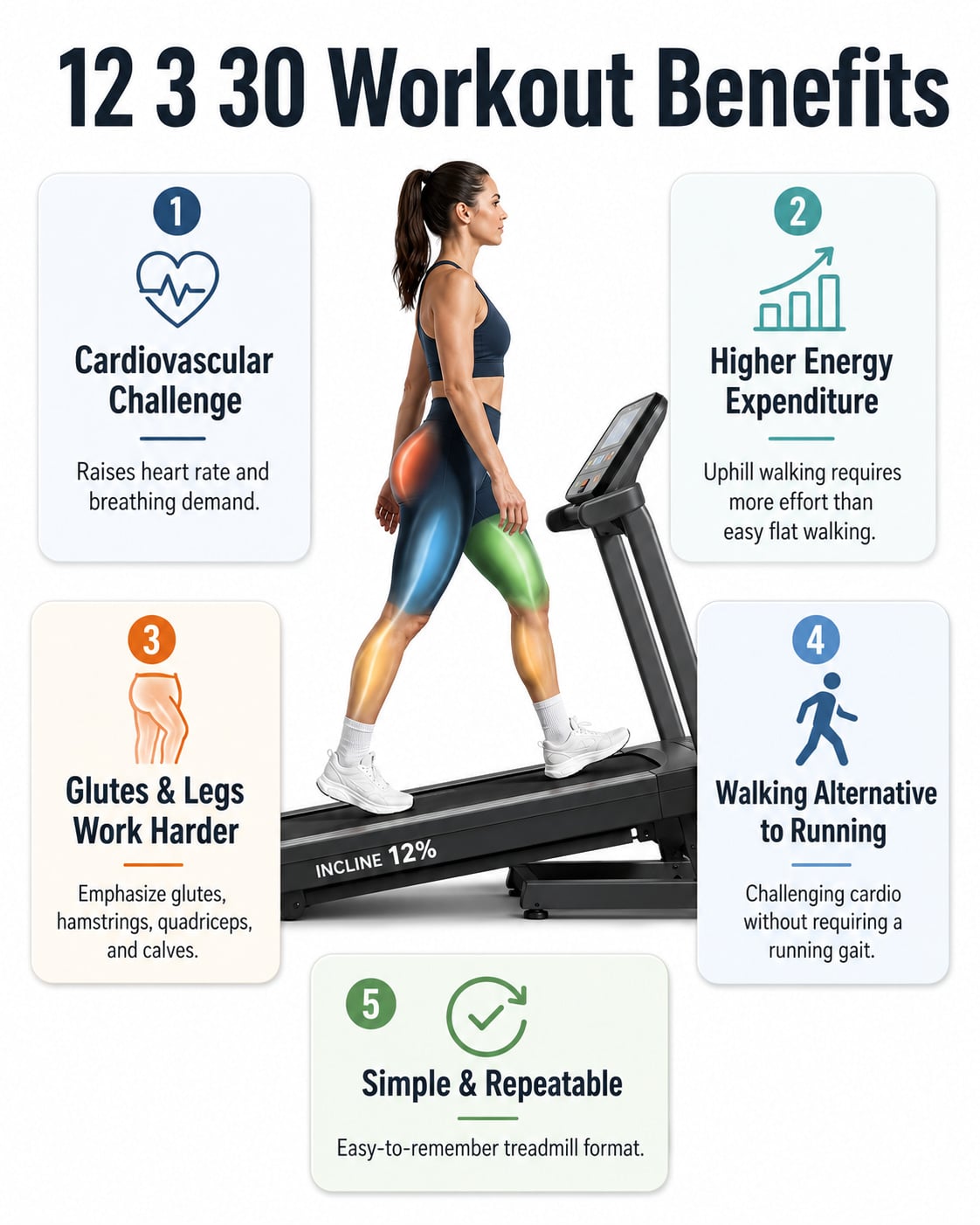
1. It Provides a Meaningful Cardiovascular Challenge
Walking at a 12% incline requires more effort than walking at the same speed on level ground. Your heart rate and breathing rate rise because the body must repeatedly lift its weight uphill.
The 2024 study found that the routine produced cardiovascular and metabolic responses consistent with a useful aerobic workout in its young, generally healthy study group.
Your personal intensity may be different. For one person, 12-3-30 may feel moderate. For another, it may be vigorous or unsustainable.
A simple talk test can help:
- Light intensity: You can talk and sing comfortably.
- Moderate intensity: You can talk but not sing.
- Vigorous intensity: You can say only a few words before pausing for breath.
Reduce the incline or speed when you cannot maintain controlled breathing or safe form.
2. It Increases Calorie Expenditure
Incline walking requires more energy than easy flat walking because you are working against gravity.
The two direct studies reported average energy expenditures of approximately 221 and 308 calories per session. The difference illustrates why there is no universal calorie number for this workout.
Your calorie expenditure depends on factors such as:
- Body size
- Fitness level
- Walking technique
- Treadmill calibration
- Whether you support your weight on the handrails
- Individual metabolic differences
Treat the treadmill calorie display as an estimate, not a precise measurement.
3. It Challenges the Glutes and Legs
Uphill walking increases the demand placed on the muscles that extend the hips, knees, and ankles.
The main muscles involved include:
- Gluteus maximus
- Hamstrings
- Quadriceps
- Gastrocnemius and soleus muscles of the calves
- Core and hip muscles that help stabilize your body
Laboratory research on incline walking found that the activity of the hip, knee, and ankle extensor muscles increased as the uphill grade became steeper.
This can support lower-body muscular endurance. However, treadmill walking does not provide the same progressive strength stimulus as exercises such as squats, deadlifts, lunges, rows, and presses.
4. It Offers a Walking Alternative to Running
Because walking does not include the airborne phase found in running, it is generally considered lower impact. This may make 12-3-30 appealing to people who dislike running or prefer to remain in a walking gait.
Lower impact does not mean effortless or risk-free. A steep grade can place substantial demand on the calves, Achilles tendons, feet, hamstrings, and hips.
Running was more time-efficient in the 2025 comparison, but 12-3-30 produced a similar total calorie expenditure when the two sessions were intentionally matched for calories.
5. It Is Simple and Repeatable
You do not need to remember intervals, exercise circuits, or complicated programming. Once you select the settings, you follow the same basic format for 30 minutes.
That simplicity may help some people exercise more consistently. The best cardio routine is usually one that is sufficiently challenging, fits your health and schedule, and can be repeated without persistent pain or excessive fatigue.
12 3 30 Workout Results: What Can You Expect?
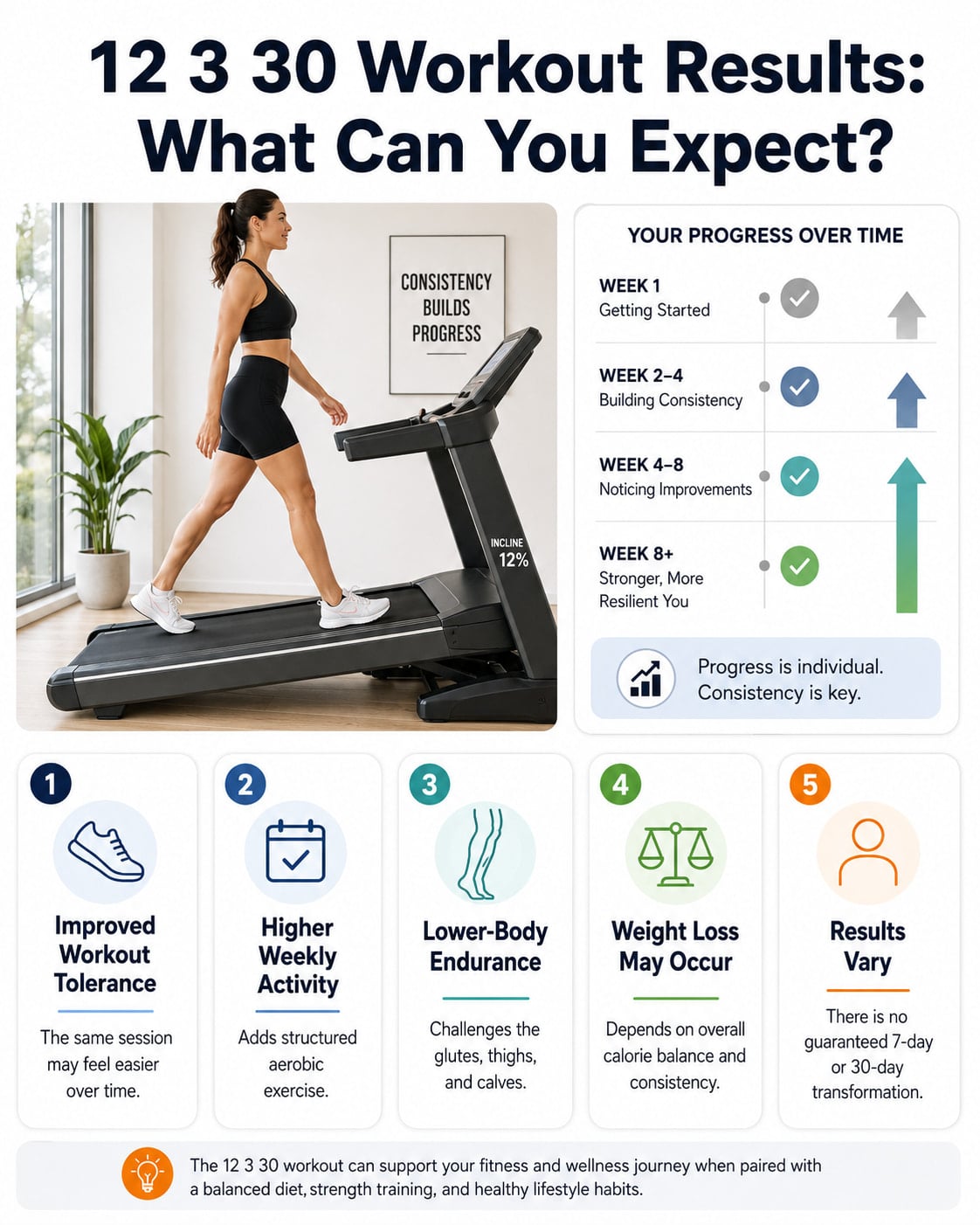
Results vary, and no reliable study can tell you exactly what will happen after seven days, two weeks, or one month of 12-3-30.
| Possible result | Realistic expectation |
|---|---|
| Improved workout tolerance | The same settings may begin to feel easier as your cardiovascular conditioning and walking efficiency improve. |
| Higher weekly calorie expenditure | Each session adds meaningful activity, but exact calorie burn varies. |
| Weight loss | Possible when the workout contributes to a sustainable calorie deficit, but not guaranteed. |
| Greater leg endurance | Your glutes, thighs, and calves may become less easily fatigued during hills, stairs, and longer walks. |
| Better consistency | The simple format may make it easier to follow a regular cardio schedule. |
| Visible muscle definition | Possible as part of broader body-composition changes, but incline walking alone is not a complete muscle-building plan. |
Can the 12 3 30 Workout Help With Weight Loss?
The workout may support weight loss by increasing your total energy expenditure. It does not directly control how much you eat, and it cannot guarantee a specific change on the scale.
A 2024 systematic review in JAMA Network Open analyzed 116 randomized trials involving 6,880 adults with overweight or obesity. Longer weekly durations of moderate-to-vigorous aerobic exercise were associated with progressively greater reductions in body weight, waist circumference, and body-fat measures. At least 150 minutes per week was associated with clinically important changes in waist circumference and body-fat measures.
Five 30-minute sessions equal 150 minutes, but that does not mean everyone should immediately perform the full routine five days per week. Beginners may need fewer sessions, lower inclines, or shorter workouts while their bodies adapt.
Weight-loss results also depend on:
- Overall calorie intake
- Food quality and portion sizes
- Daily activity outside the gym
- Sleep and recovery
- Medications and health conditions
- Starting body weight and body composition
- How consistently the routine is followed
Do not judge progress only by daily scale changes. Fluid balance, sodium intake, digestion, menstrual-cycle changes, and post-exercise water retention can cause temporary weight fluctuations.
How Long Does It Take to See Results?
Some people notice improved workout tolerance within several weeks. Body-weight and appearance changes usually require longer and are less predictable.
Direct 12-3-30 studies have not established a standard results timeline. Be cautious of social media claims promising a specific number of pounds lost in 30 days.
Track several forms of progress instead:
- How long you can walk comfortably
- Whether you need less handrail support
- Your breathing and perceived effort
- Weekly workout consistency
- Waist measurements taken under similar conditions
- Changes in strength, energy, and everyday mobility
How to Start the 12 3 30 Workout
You do not have to begin at a 12% incline. Choose settings that let you maintain good form without hanging on the treadmill.
Step 1: Check Your Starting Point
Before attempting the original routine, see whether you can walk comfortably for 20 to 30 minutes on a flat or gently inclined treadmill.
The full version may be too aggressive when you are:
- New to regular exercise
- Returning after a long break
- Unfamiliar with treadmill walking
- Experiencing poor balance
- Recovering from a foot, ankle, knee, hip, or back problem
Start lower and progress gradually.
Step 2: Warm Up for 5 to 10 Minutes
Begin with easy walking at approximately 0% to 2% incline. Gradually increase your speed and incline as your muscles warm and your breathing becomes slightly faster.
The American Heart Association recommends warming up for 5 to 10 minutes before moderate or vigorous aerobic activity. A gradual cool-down of similar length helps your heart rate and breathing return toward resting levels.
Step 3: Select Manageable Settings
Adjust any of the three variables:
- Incline: Start around 3% to 5% instead of 12%.
- Speed: Begin around 2 to 2.8 mph instead of 3 mph.
- Duration: Start with 10 to 20 minutes instead of 30.
Changing the numbers does not make the workout ineffective. It makes the workout appropriate for your current capacity.
Step 4: Use Proper Treadmill Form
During the working portion:
- Keep your head up and look forward.
- Keep your chest open rather than rounding your shoulders.
- Maintain a tall torso with a small natural forward lean.
- Take controlled steps instead of overstriding.
- Let your arms swing naturally.
- Keep your feet directed forward.
- Avoid leaning backward while pulling on the rails.
- Use the handrails briefly for balance when changing settings, then release them when safe.
If you must continuously grip the rails to avoid falling behind, lower the incline or speed. Holding your body up with the rails changes your posture and reduces the workload your legs and cardiovascular system must handle. Cleveland Clinic similarly advises lowering the settings when you cannot walk without hanging on.
Step 5: Cool Down Gradually
Reduce the incline and speed for 5 to 10 minutes after the main workout. Do not jump directly from a steep grade to standing still.
A cool-down is particularly useful after incline walking because your heart rate may remain elevated and your calves may feel tight or fatigued.
Beginner 12 3 30 Workout Progression
The following plan is a flexible example, not a clinically tested protocol. Repeat a week or reduce the settings whenever necessary.
| Week | Frequency | Incline | Speed | Working time |
|---|---|---|---|---|
| 1 | 2–3 days | 3%–5% | 2.3–2.8 mph | 15–20 minutes |
| 2 | 2–3 days | 5%–7% | 2.5–3 mph | 20–25 minutes |
| 3 | 3 days | 7%–10% | 2.6–3 mph | 25–30 minutes |
| 4 and beyond | 3–4 days | Progress toward 12% | Progress toward 3 mph | Progress toward 30 minutes |
Increase only one major variable at a time. For example, extend the duration before raising both the incline and speed.
You are ready for the complete routine when you can:
- Maintain safe posture for the entire session
- Walk without continuously pulling on the handrails
- Control your breathing
- Finish without sharp pain
- Recover normally before your next planned workout
There is no requirement to reach all three original numbers. A modified version can remain challenging and useful.
How Often Should You Do the 12 3 30 Workout?
For most beginners, two or three sessions per week provide a reasonable starting point. Leave recovery time between sessions if your calves, feet, or hips are not accustomed to steep walking.
More experienced exercisers may perform it three to five times per week, provided the routine does not cause persistent soreness, declining performance, or worsening joint or tendon discomfort.
The current Physical Activity Guidelines for Americans recommend that adults work toward 150 to 300 minutes of moderate-intensity aerobic activity per week. Adults should also perform muscle-strengthening activities involving the major muscle groups on at least two days each week.
The 12-3-30 workout can contribute to your aerobic total, but it should not be your only form of training.
Example Balanced Weekly Schedule
| Day | Activity |
|---|---|
| Monday | Modified or full 12-3-30 workout |
| Tuesday | Full-body strength training |
| Wednesday | Easy walking, mobility work, or rest |
| Thursday | Modified or full 12-3-30 workout |
| Friday | Full-body strength training |
| Saturday | Optional easy cardio or shorter incline walk |
| Sunday | Rest or gentle activity |
Adjust the schedule around your experience, health, and recovery.
12 3 30 Workout vs. Flat Walking vs. Running
| Feature | Flat Walking | 12-3-30 | Running |
|---|---|---|---|
| Intensity at a typical pace | Usually lower | Moderate to vigorous for many people | Usually moderate to vigorous |
| Impact | Low | Low impact but high incline demand | Higher impact |
| Calorie rate | Usually lowest | Higher than comparable flat walking | Often highest per minute |
| Lower-body demand | Moderate | High demand on glutes, thighs, and calves | Depends on speed and grade |
| Best suited for | Beginners, recovery, longer easy sessions | People who want challenging walking cardio | People comfortable with running |
| Main limitation | May not provide enough intensity by itself | Steep incline may overload unprepared tissues | Greater impact and skill demand |
The 2025 comparison found that running expended energy faster than 12-3-30. It did not prove that running is always better or that incline walking produces better fat loss.
Choose the option that you can perform safely and consistently. You can also combine them instead of treating them as competing methods.
Common 12 3 30 Workout Mistakes
Starting at the Full Settings Too Soon
A 12% grade is demanding. Beginning at full intensity can cause excessive fatigue and make it harder to maintain proper form.
Start below the target and progress.
Skipping the Warm-Up
Moving directly from standing still to a steep incline can make the first part of the workout unnecessarily difficult.
Use several minutes of easy walking before increasing the grade.
Hanging on the Handrails
Pulling on the rails allows your arms to support part of your body weight. It may also encourage leaning backward or hunching over the console.
Lower the settings until you can walk safely with minimal support.
Chasing the Treadmill Calorie Number
Calorie displays use formulas and may not accurately represent your personal expenditure.
Focus on effort, duration, progress, and weekly consistency.
Doing the Workout Every Day Despite Pain
Normal muscular fatigue is different from sharp, localized, or worsening pain. Continuing through tendon or joint pain can make the problem harder to manage.
Use easier walking, cross-training, or rest when needed.
Treating It as a Complete Fitness Program
The workout provides cardio and lower-body endurance, but it does not fully train upper-body strength, pulling strength, maximal leg strength, power, or mobility.
Include resistance training and other forms of movement in your week.
Who Should Modify the Workout?
Consider starting with a lower incline or seeking individualized guidance when you have:
- Current foot, ankle, Achilles, knee, hip, or back pain
- Significant balance difficulties
- A recent injury or surgery
- A diagnosed heart or lung condition
- Uncontrolled blood pressure
- Exercise-related dizziness or fainting
- A medication that substantially affects heart rate or exercise tolerance
- A medical condition for which your clinician has provided exercise restrictions
Stop the workout if you develop chest pressure, faintness, unusual severe shortness of breath, new concerning heart palpitations, or sharp and worsening musculoskeletal pain. Seek prompt medical care when symptoms are severe or do not resolve.
Frequently Asked Questions
Does the 12 3 30 workout help you lose weight?
It may support weight loss by increasing weekly energy expenditure. Weight loss is not guaranteed and also depends on food intake, daily activity, sleep, consistency, medications, and individual biology.
How many calories does the 12 3 30 workout burn?
Small laboratory studies reported averages of approximately 221 and 308 calories, but your result may be higher or lower. Body size, fitness, form, and treadmill accuracy all affect the estimate.
Is the 12 3 30 workout good for beginners?
The format can be adapted for beginners, but the original 12% incline may be too difficult at first. Begin with a lower incline, slower speed, shorter duration, or all three.
How many times per week should you do 12 3 30?
Begin with two or three sessions per week. You may gradually add sessions when you recover well and can maintain proper form. Five sessions provide 150 minutes of activity, but five full sessions are not necessary or appropriate for everyone.
How long does it take to see 12 3 30 results?
You may notice that the workout feels easier after several weeks of consistent training. Weight and body-composition changes take longer and cannot be predicted accurately. No direct study has established a standard 12-3-30 results timeline.
Can you hold the treadmill handrails?
Use the rails briefly when stepping on, changing settings, or regaining balance. Avoid supporting your body weight on them throughout the workout. Reduce the speed or incline when you cannot walk safely without a firm grip.
Is 12 3 30 better than running?
Neither is universally better. Running generally burns calories faster, while 12-3-30 offers a challenging walking option with less impact. Your best choice depends on your goals, preferences, injury history, fitness level, and ability to exercise consistently.
Conclusion
The 12 3 30 workout is a simple way to turn treadmill walking into challenging cardiovascular exercise. It can raise your heart rate, increase calorie expenditure, and improve lower-body endurance, but the numbers themselves are not magical.
Start with settings you can control, maintain upright form, and build gradually. Combine incline walking with strength training, easier activity, and adequate recovery for a more complete fitness routine. Your goal is not to force the original settings—it is to create a workout you can perform safely and consistently.
References
- International Journal of Research in Exercise Physiology: Physiological Responses of the 12-3-30 Workout
- International Journal of Exercise Science: 12-3-30 Compared With Self-Paced Running
- JAMA Network Open: Aerobic Exercise and Weight Loss in Adults
- Office of Disease Prevention and Health Promotion: Physical Activity Guidelines for Americans
- Cleveland Clinic: What Is the 12-3-30 Workout?
- American Heart Association: Warm Up and Cool Down
- PubMed: Effects of Grade and Speed on Leg-Muscle Activation During Walking