
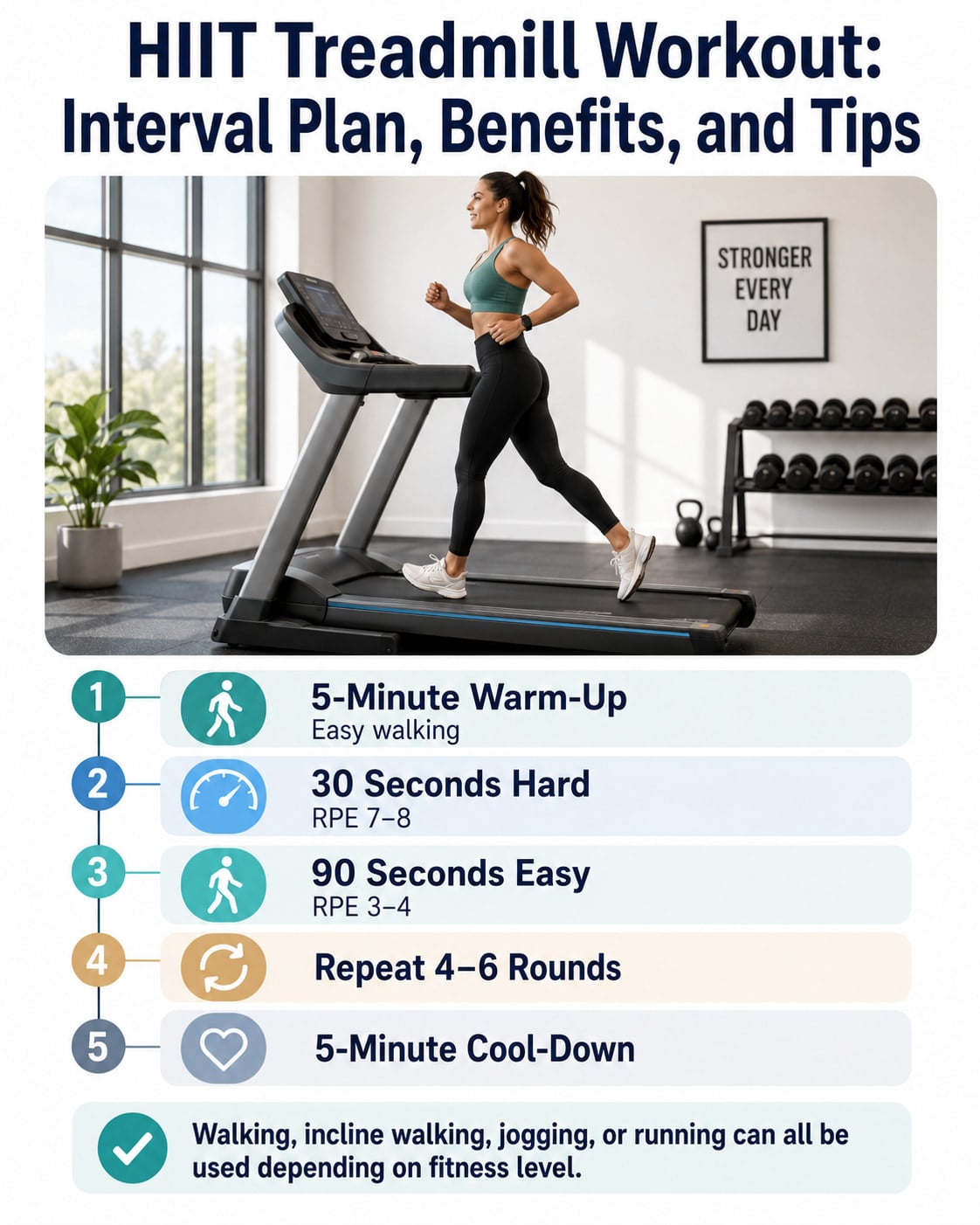
A HIIT treadmill workout alternates short periods of challenging walking, jogging, or running with easier recovery periods. A practical beginner plan is 30 seconds of hard effort followed by 90 seconds of easy walking, repeated four to six times after a proper warm-up.
You do not need to sprint at maximum speed to benefit. The hard intervals only need to feel vigorous relative to your current fitness level. This makes treadmill HIIT adaptable for beginners, incline walkers, recreational runners, and experienced athletes.
HIIT Treadmill Workout at a Glance
| Workout detail | Beginner recommendation |
|---|---|
| Main goal | Improve cardiovascular fitness and conditioning |
| Total time | Approximately 18–22 minutes |
| Warm-up | 5 minutes of gradually faster walking |
| Hard interval | 30 seconds at RPE 7–8 out of 10 |
| Recovery interval | 90 seconds at RPE 3–4 out of 10 |
| Starting rounds | 4–6 rounds |
| Cool-down | 5 minutes of gradually slower walking |
| Treadmill mode | Walking, incline walking, jogging, or running |
| Starting frequency | 1–2 sessions per week |
| Main rule | Increase only one workout variable at a time |
What Is a HIIT Treadmill Workout?
HIIT stands for high-intensity interval training. It uses repeated periods of relatively challenging exercise separated by easier recovery periods.
The American College of Sports Medicine explains that HIIT programs can vary considerably. Work intervals, recovery periods, intensity levels, and the total number of rounds do not have to follow one fixed formula.
On a treadmill, the harder interval may involve:
- Increasing your walking speed
- Raising the incline
- Moving from walking to jogging
- Running at a faster but controlled pace
- Combining a moderate speed with a steeper incline
The recovery interval normally involves lowering the speed or incline until your breathing begins to settle.
In this guide, “high intensity” means a controlled vigorous effort. It does not mean jumping onto a fast-moving belt or sprinting as hard as possible.
Beginner 22-Minute HIIT Treadmill Workout
This plan uses a 1:3 work-to-recovery ratio. The relatively long recovery period gives beginners time to regain control before the next hard interval.
The Interval Plan
| Phase | Duration | Effort | Instructions |
|---|---|---|---|
| Warm-up | 5 minutes | RPE 2–4 | Begin with an easy walk and gradually increase the pace |
| Hard interval | 30 seconds | RPE 7–8 | Use a brisk walk, incline walk, jog, or controlled run |
| Recovery interval | 90 seconds | RPE 3–4 | Reduce the speed or incline and walk comfortably |
| Repeat | 6 rounds | — | Complete six hard and recovery intervals |
| Cool-down | 5 minutes | RPE 2–3 | Gradually reduce the speed until breathing settles |
Total workout time: approximately 22 minutes.
A completely new exerciser can begin with four rounds, creating an approximately 18-minute session. Add another round only when you can finish the current workout without losing balance or form.
How to Perform the Workout
- Start with five minutes of comfortable walking.
- Gradually raise your pace during the final two minutes of the warm-up.
- Increase either the speed or incline for a 30-second hard interval.
- Reduce the setting and walk easily for 90 seconds.
- Repeat the interval cycle four to six times.
- Finish with five minutes of gradually slower walking.
The American Heart Association recommends warming up for 5–10 minutes before moderate or vigorous aerobic activity. It also advises gradually reducing your pace during the cool-down rather than stopping suddenly.
Walking, Jogging, and Running Options
Your hard interval should match your current ability. Running is not required.
| Fitness level | Hard interval | Recovery interval |
|---|---|---|
| New exerciser | Faster level walking | Comfortable walking |
| Beginner walker | Brisk walking with a small incline | Level or low-incline walking |
| Intermediate | Incline power walking or light jogging | Comfortable walking |
| Recreational runner | Controlled faster running | Walking or easy jogging |
| Experienced runner | Fast but technically controlled running | Easy jogging |
Walking-Only HIIT Option
A walking interval can count as high intensity when it makes you breathe hard and allows you to speak only a few words at a time.
Try this approach:
- Keep the belt at a manageable walking speed.
- Raise the incline during the hard interval.
- Lower the incline during recovery.
- Keep your steps short enough to stay centered on the belt.
- Avoid leaning backward or hanging from the handrails.
Start with a small incline increase. There is no need to immediately use the treadmill’s steepest setting.
Walk-Jog Option
Use a comfortable walk during recovery and a light jog during each 30-second hard interval.
The jogging pace should feel challenging but controlled. You should be able to step back into your recovery walk smoothly without grabbing the rails.
Running Option
Experienced runners can use a faster running pace for the hard intervals and an easy jog or walk for recovery.
The pace should remain below an all-out sprint. Choose a speed that allows you to stay centered, maintain a natural stride, and complete every interval with similar form.
How Hard Should Treadmill HIIT Feel?
Treadmill speeds are not equally difficult for everyone. Height, running experience, fitness level, incline, medication use, and treadmill calibration can all affect how hard a setting feels.
For most readers, perceived exertion and the talk test are more practical than copying a specific speed.
Rate of Perceived Exertion
| Workout phase | RPE | What it should feel like |
|---|---|---|
| Warm-up | 2–4 out of 10 | Easy and comfortable |
| Hard interval | 7–8 out of 10 | Challenging but controlled |
| Recovery | 3–4 out of 10 | Breathing begins to settle |
| Cool-down | 2–3 out of 10 | Easy and gradually becoming easier |
An RPE of 10 represents your maximum possible effort. Beginners generally do not need to reach that level during treadmill HIIT.
Use the Talk Test
During the hard interval, you should be breathing hard enough that speaking more than a few words is difficult. During recovery, you should gradually become able to speak in short sentences again.
The current U.S. physical activity guidance uses the same general distinction: a person performing vigorous activity typically cannot say more than a few words without pausing for breath.
Heart-Rate Guidance
The American Heart Association target heart-rate guide places vigorous activity at approximately 70%–85% of estimated maximum heart rate. However, these percentages and age-based formulas are general estimates rather than exact limits.
Heart rate may also be affected by fitness level, temperature, stress, and medications. People with a heart condition or medication that changes heart rate should ask a healthcare professional about an appropriate exercise-intensity range.
How to Choose Your Treadmill Speed and Incline
There is no universal “best” treadmill speed for HIIT. A speed that is easy for one person may be unsafe for another.
Use this process:
1. Find Your Recovery Pace
Choose a speed that lets you walk comfortably without holding the rails. This becomes your recovery setting.
2. Change One Setting
For the hard interval, increase either speed or incline first. Changing both at once can make it difficult to determine which setting caused the workout to become too hard.
3. Check Your Effort
By the middle of the 30-second interval, the effort should feel like approximately 7–8 out of 10.
If the interval still feels easy, make a small adjustment during the next round. Do not make a large speed increase while the belt is already moving quickly.
4. Watch Your Form
Reduce the difficulty when you begin to:
- Drift toward the back of the treadmill
- Take unusually long or uncontrolled steps
- Hold the rails continuously
- Lean excessively forward or backward
- Struggle to transition into recovery safely
5. Record Your Settings
Write down your recovery speed, hard speed, incline, and number of rounds. This makes progression more accurate than guessing during every workout.
Benefits of a HIIT Treadmill Workout
It Can Improve Cardiorespiratory Fitness
Cardiorespiratory fitness reflects how effectively the heart, lungs, blood vessels, and working muscles support sustained physical activity.
A July 2026 systematic review and meta-analysis indexed by PubMed examined 31 real-world HIIT studies involving 1,119 adults. In pooled before-and-after analyses, the researchers found an average VO₂max or VO₂peak improvement of 3.9 mL/kg/min.
The review also found that HIIT improved cardiorespiratory fitness compared with inactive control conditions. Compared with other active exercise programs, its clearest additional advantage was a smaller improvement of approximately 1.1 mL/kg/min.
Individual results will vary according to fitness level, program design, consistency, and health status.
It Offers a Time-Efficient Cardio Format
The main interval portion of this beginner workout lasts only 12 minutes when six rounds are completed.
You should still count the warm-up and cool-down as part of the session. A safe 22-minute workout is more useful than advertising only the hard intervals and ignoring the time required to prepare and recover.
It Can Be Adapted Without Running
Speed is only one way to raise treadmill intensity. Incline walking can create a challenging interval while allowing the user to continue walking.
This is useful for people who:
- Do not enjoy running
- Are still developing jogging technique
- Prefer lower-speed treadmill sessions
- Want to vary their cardio routine
Incline walking is not automatically easy. Reduce the incline when your posture, balance, or stride begins to deteriorate.
It May Support Selected Cardiometabolic Outcomes
In the same 2026 review, pooled before-and-after results included average reductions of approximately:
- 4 mm Hg in systolic blood pressure
- 3 mm Hg in diastolic blood pressure
- 1.7 centimeters in waist circumference
These were study averages, not guaranteed outcomes. The authors also reported substantial variation between studies and moderate methodological quality, so the results should be interpreted cautiously.
It Makes Progress Easy to Measure
A treadmill displays speed, incline, time, and distance. That makes it easier to repeat the same workout and track small improvements.
Progress might mean:
- Completing an additional round
- Using a slightly higher incline
- Increasing speed by a small amount
- Recovering more comfortably at the same settings
- Maintaining better form throughout the workout
Is Treadmill HIIT Good for Weight Loss?
A HIIT treadmill workout can contribute to weekly physical activity and energy expenditure, which may support a broader weight-management plan.
However, HIIT does not target fat from the stomach or any other specific area. It also does not guarantee faster weight loss than every other form of cardio.
In the 2026 real-world review, HIIT’s clear advantage over other active exercise programs was mainly related to cardiorespiratory fitness rather than every cardiometabolic or body-composition outcome.
Long-term changes in body weight depend on several factors, including:
- Total weekly activity
- Food intake
- Sleep
- Recovery
- Health status
- Consistency over time
Choose HIIT because it fits your schedule and preferences, not because it is marketed as a shortcut.
How Often Should You Do Treadmill HIIT?
A reasonable starting schedule is one treadmill HIIT session per week.
After several controlled sessions, you may progress to two weekly workouts when:
- You recover normally between sessions.
- Your legs are not unusually sore or fatigued.
- You can maintain stable treadmill technique.
- The workout does not interfere with strength training or other activities.
Leave at least one easier or rest day between demanding interval sessions. Daily HIIT is unnecessary for most recreational exercisers.
For general health, adults should work toward a complete weekly activity plan rather than relying on one interval workout. Current federal guidance recommends at least 150 minutes of moderate aerobic activity or 75 minutes of vigorous aerobic activity per week, or an equivalent combination. Adults should also perform muscle-strengthening activity on at least two days per week.
People who are currently inactive should begin with smaller amounts and build up gradually.
How to Progress Your HIIT Treadmill Workout
Progress only after you can finish the current workout with consistent form.
Use the following order:
- Start with four rounds.
- Build to five and then six rounds.
- Increase the incline slightly.
- Increase the hard-interval speed by a small amount.
- Extend the hard interval from 30 to 40 seconds.
- Shorten recovery only when your breathing and technique remain controlled.
Change only one variable at a time.
For example, do not increase your speed, incline, interval duration, and number of rounds during the same session. The ACSM notes that activity-related injury risk increases with the size of a sudden increase in training volume or intensity.
Common HIIT Treadmill Mistakes
| Mistake | Why it causes problems | Better approach |
|---|---|---|
| Starting with all-out sprints | Speed may exceed your current control | Use an RPE of 7–8 |
| Copying someone else’s speed | Treadmill intensity is individual | Choose settings by effort and form |
| Skipping the warm-up | The first interval becomes an abrupt intensity jump | Walk progressively for 5–10 minutes |
| Holding the rails throughout | It changes posture and reduces natural movement | Lower the speed or incline |
| Jumping onto the side rails | It creates an unnecessary fall risk | Slow the belt before stopping |
| Raising speed and incline together | The intensity may increase too quickly | Change one setting at a time |
| Making every interval harder | Early rounds become too easy and later rounds unsafe | Use repeatable settings |
| Doing HIIT too often | Fatigue can reduce performance and technique | Alternate hard and easier days |
HIIT Treadmill Safety Tips
Before beginning, learn how to operate the treadmill’s speed controls, incline controls, pause button, and emergency stop.
During the workout:
- Attach the safety clip when the treadmill provides one.
- Keep your body centered on the belt.
- Look forward instead of continuously looking at your feet.
- Increase speed in small steps.
- Use a pace that allows a smooth transition into recovery.
- Slow down when your stride becomes uncontrolled.
- Do not step onto or off a fast-moving belt.
- Stop for sharp pain, chest discomfort, unusual dizziness, faintness, or unexpected breathing difficulty.
Get professional guidance before vigorous treadmill exercise when you have a known heart or lung condition, a recent operation or lower-body injury, significant balance problems, or symptoms that appear during physical activity.
Frequently Asked Questions
How long should a HIIT treadmill workout be?
A beginner session can last approximately 18–22 minutes, including a five-minute warm-up and five-minute cool-down. The hard intervals themselves do not need to take up most of the workout.
What is a good treadmill speed for beginner HIIT?
There is no single beginner speed. Choose a pace that feels like 7–8 out of 10 during the hard interval while allowing you to remain centered and controlled. For one person, that may be brisk walking; for another, it may be jogging.
Can walking on a treadmill count as HIIT?
Yes. Brisk walking or incline walking can count when the hard intervals reach a vigorous effort relative to your fitness level and are separated by easier recovery periods.
Should beginners sprint during treadmill HIIT?
No. Beginners should use fast but controlled intervals rather than maximum-effort sprints. Start with walking, incline walking, or light jogging and progress gradually.
Is speed or incline better for treadmill intervals?
Neither is automatically better. Speed works well for people with confident walking or running mechanics. Incline can raise the effort without requiring a fast belt speed. Choose the option that lets you maintain better control.
How many times per week should I do treadmill HIIT?
Start with one session per week. Progress to two when you recover well and can maintain consistent technique. Use easier cardio, strength training, or rest between demanding HIIT sessions.
Is treadmill HIIT better than steady-state cardio?
Both can improve fitness. HIIT uses shorter, harder efforts with recovery periods, while steady-state cardio uses a more consistent pace. HIIT may be convenient when time is limited, but steady cardio may be easier to recover from and sustain for longer sessions. Many people benefit from using both.
Conclusion
A HIIT treadmill workout does not need extreme speeds or all-out sprinting. The most effective starting point is a controlled plan that matches your current fitness.
Begin with five minutes of walking, complete four to six rounds of 30 seconds hard and 90 seconds easy, and finish with a gradual cool-down. Record your settings and progress only one variable at a time.
Your first goal is not to reach the highest treadmill speed. It is to complete every interval with stable form, appropriate effort, and enough control to train consistently.
References
- American College of Sports Medicine: High-Intensity Interval Training
- Office of Disease Prevention and Health Promotion: Physical Activity Guidelines Questions and Answers
- American Heart Association: Target Heart Rates
- American Heart Association: Warm Up and Cool Down
- PubMed: Effects of HIIT in Real-World Settings, 2026