
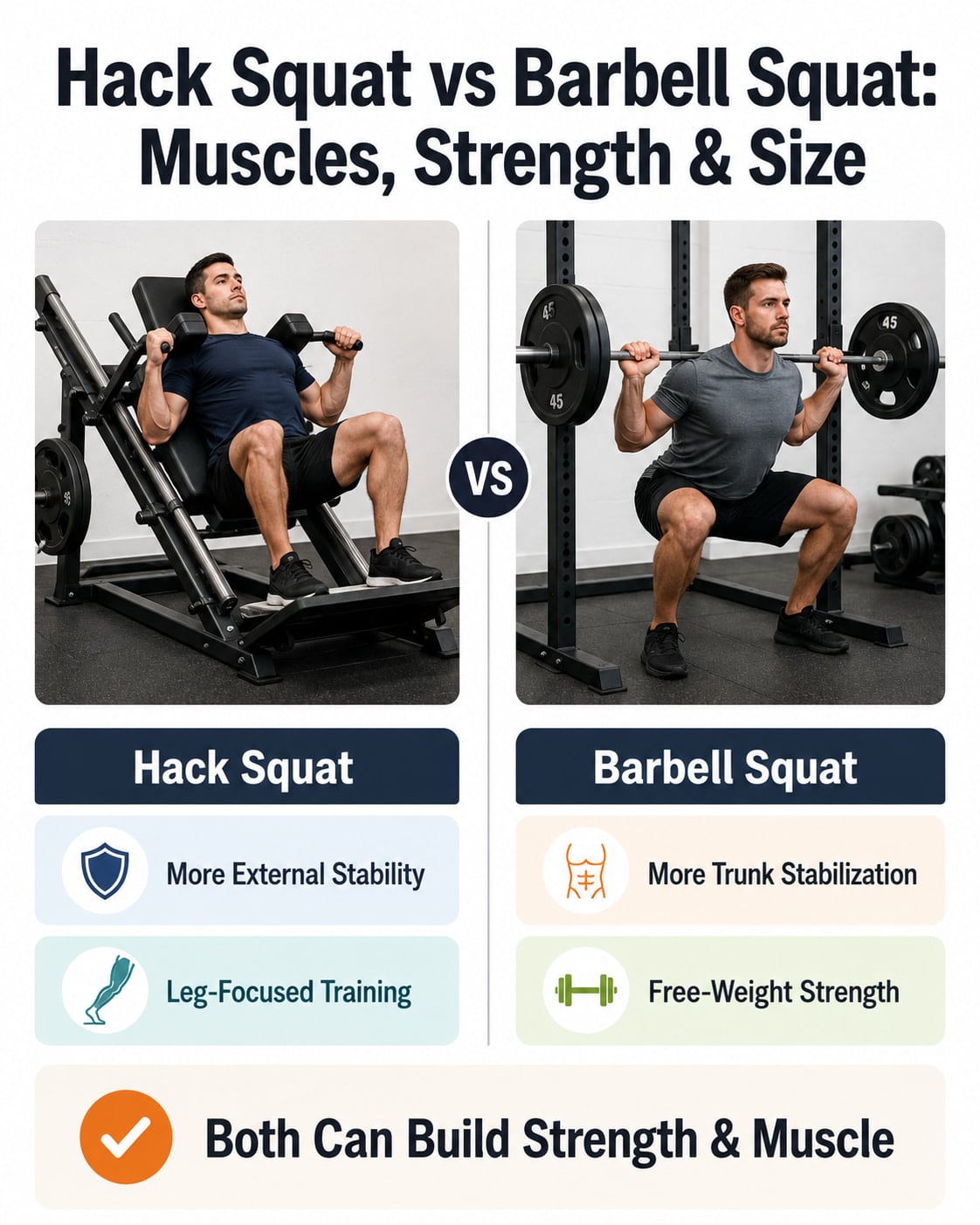
The barbell squat is generally better for barbell-specific strength, whole-body coordination, and trunk stabilization, while the hack squat is often better for stable, leg-focused training. For muscle size, both exercises can be highly effective, and current evidence does not show a clear overall hypertrophy winner.
Your best choice depends on your goals, experience, equipment, comfort, and which movement you can perform consistently with controlled technique. Many lifters benefit from using the barbell squat as a primary strength exercise and the hack squat for additional quadriceps and glute training.
In this comparison, “hack squat” refers to the machine version with a supported back pad and guided sled. “Barbell squat” refers to the conventional barbell back squat.
Hack Squat vs Barbell Squat at a Glance
| Category | Hack Squat | Barbell Squat |
|---|---|---|
| Movement path | Guided by the machine | Controlled by the lifter |
| Torso support | Back supported by a pad | No external torso support |
| Main muscles | Quadriceps, glutes, and adductors | Quadriceps, glutes, and adductors |
| Core demand | Moderate | Higher |
| Balance requirement | Lower | Higher |
| Learning curve | Usually simpler | Usually more technical |
| Strength carryover | Best for hack squat strength | Best for barbell squat strength |
| Muscle-building potential | High | High |
| Equipment needed | Specific hack squat machine | Rack, barbell, plates, and safeties |
| Best for | Stable leg-focused training | Free-weight strength and coordination |
Neither exercise is automatically superior. The better option is the one that matches the result you want.
What Is the Difference Between a Hack Squat and a Barbell Squat?
Both exercises use simultaneous hip and knee extension to train the lower body. The major difference is how much stabilization the lifter must provide.
Hack Squat
A machine hack squat places your back and shoulders against a pad while your feet press into an angled platform. The sled follows a fixed or semi-fixed track.
Because the machine guides the movement, you do not have to balance a bar or control its path through space. This lets many lifters concentrate more directly on pushing through the legs.
However, the fixed path may not feel natural for every body type. Foot position, machine angle, sled design, and platform size can noticeably change how the movement feels.
How to Perform a Hack Squat
- Place your back and shoulders firmly against the pads.
- Position your feet about shoulder-width apart on the platform.
- Keep your head and torso supported.
- Brace your midsection before releasing the safety handles.
- Bend your hips and knees to lower the sled under control.
- Descend only as far as you can maintain a stable foot position and controlled posture.
- Push through your whole foot to extend your knees and hips.
- Finish tall without aggressively snapping your knees into lockout.
- Secure the safety handles before leaving the machine.
Avoid letting your heels lift, knees collapse inward, or hips roll noticeably away from the pad at the bottom.
Barbell Squat
During a barbell back squat, the bar rests across the upper back while you control the descent and ascent without machine guidance.
Your legs still produce most of the movement, but your trunk, upper back, feet, and hips must work together to keep the bar balanced over your base of support. This makes the barbell squat a more complex skill.
How to Perform a Barbell Squat
- Set the bar in a rack at approximately upper-chest height.
- Position the bar securely across your upper back.
- Grip the bar firmly and brace your torso.
- Unrack it and take a small number of controlled steps backward.
- Set your feet in a stable stance with your toes turned slightly outward if comfortable.
- Bend your hips and knees together while keeping the bar balanced over the middle of your feet.
- Descend to a controlled depth.
- Push the floor away and extend your hips and knees together.
- Finish in a stable standing position before beginning the next repetition.
- Walk the bar forward carefully and confirm that it is fully supported by the rack.
Set the safety arms just below your normal squat depth, particularly when training without a spotter.
Hack Squat vs Barbell Squat: Muscles Worked
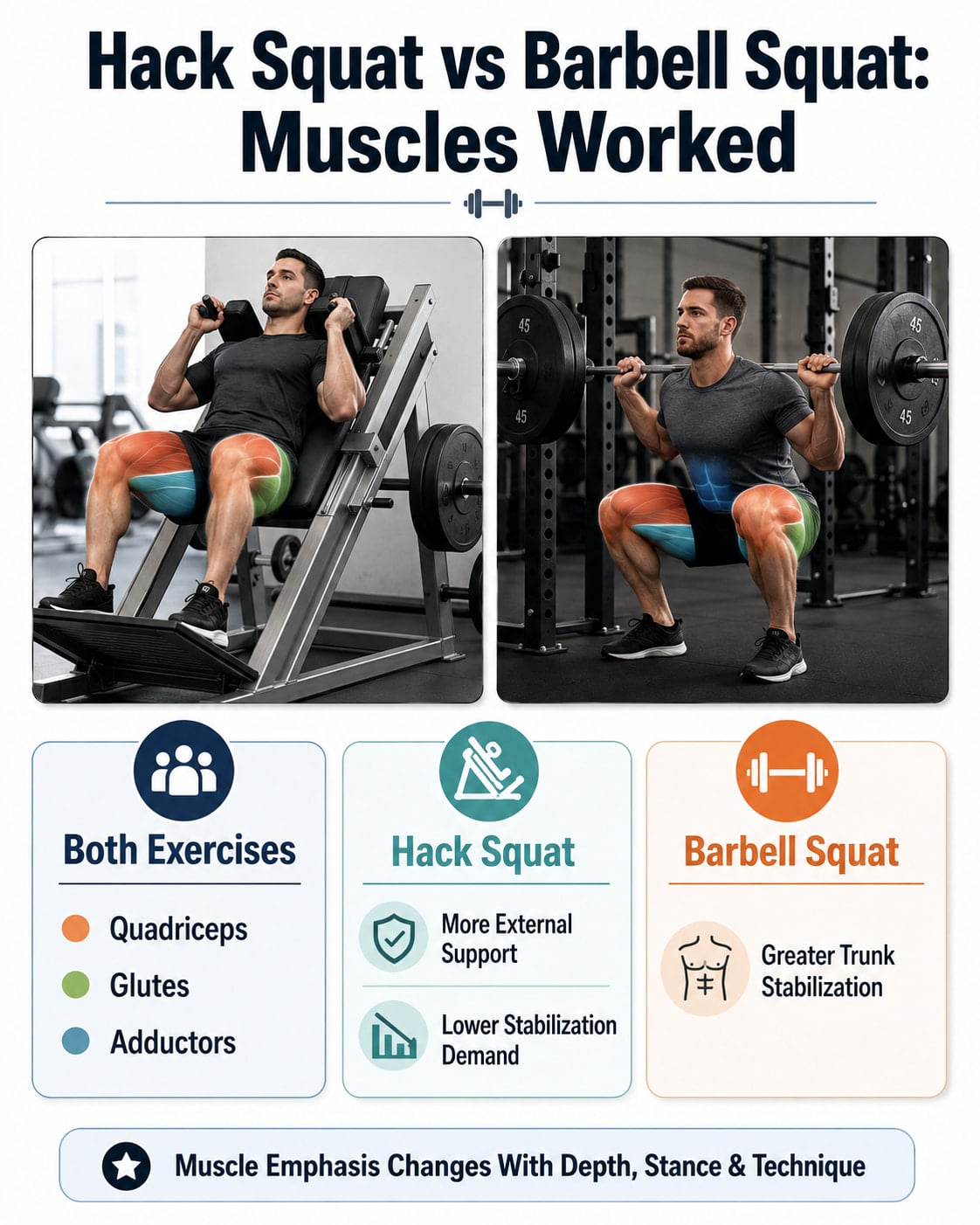
Both exercises primarily train the same major lower-body muscle groups:
- Quadriceps
- Gluteus maximus
- Adductor magnus and other hip adductors
- Calves as supporting muscles
- Trunk muscles for stabilization
The amount each muscle contributes can change with squat depth, stance, foot position, load, machine design, and individual anatomy.
Quadriceps
The quadriceps straighten the knees and work hard during both exercises.
The hack squat often feels more quadriceps-focused because the back pad reduces the amount of balance and torso control required. That can make it easier to continue challenging the legs after the trunk would have started limiting a barbell squat set.
However, it is not accurate to claim that the hack squat always activates or grows the quadriceps more.
A small study involving 10 trained men compared hack squats and barbell back squats at the same relative loads. The back squat produced greater vastus lateralis activation during the lifting phase, even though participants could use a higher absolute load on the hack squat. The study also found greater trunk muscle activation during the back squat. Because this was an acute electromyography study, it measured electrical activity during the exercise rather than long-term muscle growth. (PubMed’s study summary)
The practical takeaway is that both exercises can train the quadriceps effectively. Technique, effort, progression, and weekly volume matter more than assuming one variation automatically targets the quads better.
Glutes and Adductors
The gluteus maximus and adductor magnus help extend the hips as you stand up.
Their contribution generally becomes more important as you squat through a greater, controlled range of motion. A 10-week study comparing full and half barbell squats found similar quadriceps growth between the groups but greater glute and adductor growth from full squats.
That does not mean everyone must squat to the deepest possible position. Use the deepest range you can control while keeping your feet stable and avoiding painful or forced positions.
Hamstrings
The hamstrings contribute to hip control and knee stability, but neither squat variation should be considered a complete hamstring exercise.
In the same squat-depth study, neither full nor half squats produced a significant increase in hamstring muscle volume. Exercises such as Romanian deadlifts, leg curls, and hip hinges provide a more direct hamstring stimulus.
Core and Lower Back
The barbell squat creates a greater trunk-stabilization challenge because you must support and balance the bar without a back pad.
The direct hack squat versus back squat study found significantly greater trunk muscle activation during the barbell squat. This makes the barbell squat more specific for developing strength while stabilizing an unsupported external load.
The hack squat still requires bracing and body control, but the machine provides much more external stability. This can be useful when you want to train your legs without making trunk endurance the main limiting factor.
Which Is Better for Strength?
The answer depends on how you define strength.
Barbell Squat for Free-Weight Strength
Choose the barbell squat when your main goal is to:
- Increase your barbell squat one-repetition maximum
- Compete in powerlifting
- Improve free-weight coordination
- Develop strength while supporting an unstable load
- Practice bracing and maintaining a controlled bar path
Strength is highly specific to the movement you practice. A 2023 systematic review and meta-analysis found that people training with free weights improved more on free-weight strength tests, while machine training produced greater improvements on machine-based tests. Overall differences became much smaller when strength was assessed using neutral tests. (Systematic review in BMC Sports Science, Medicine and Rehabilitation)
Therefore, someone who wants a stronger barbell squat should regularly practice barbell squats rather than relying only on hack squats.
Hack Squat for Machine-Based Leg Strength
Choose the hack squat when you want to:
- Increase strength on the hack squat machine
- Overload the legs without balancing a bar
- Reduce trunk fatigue during leg training
- Add demanding lower-body sets after another compound exercise
- Train close to muscular fatigue with a stable setup
The hack squat can be an excellent strength exercise, but its strength gains are most specific to the machine and movement path being used.
Why Can You Hack Squat More Weight?
Many people can place more total weight on a hack squat machine than they can squat with a barbell. This does not mean they are producing proportionally more usable strength.
Hack squat numbers are affected by:
- The angle of the sled
- Friction along the machine track
- Sled weight
- Counterbalance systems
- Platform angle
- Machine-specific leverage
- Range of motion
For this reason, a 300-pound hack squat is not equivalent to a 300-pound barbell squat. Numbers from two different hack squat machines may not be directly comparable either.
Track progress on each exercise separately.
Which Is Better for Muscle Size?
Neither exercise has a proven overall advantage for building lower-body muscle.
A 2023 meta-analysis included 13 studies and 1,016 adults. It found no significant overall difference in muscle hypertrophy between machine-based and free-weight resistance training. The review included only five studies that measured hypertrophy, so the result should be interpreted as no demonstrated overall difference—not proof that every machine and free-weight exercise produces identical regional growth.
An eight-week study of 38 resistance-trained men also compared matched machine-based and free-weight programs. The machine group used a hack squat, while the free-weight group used a barbell squat. Both groups increased muscle size and strength, with no significant difference in measured hypertrophy between them. Participants became strongest in the exercises they trained. (Study abstract from the National Library of Medicine)
This study compared complete training programs rather than isolating only the hack squat and barbell squat. It also involved trained men over eight weeks. It supports the usefulness of both methods but does not prove that every lifter will experience identical results.
What Matters Most for Muscle Growth?
For building muscle, focus on:
- Performing enough challenging weekly sets
- Using a controlled range of motion
- Gradually increasing repetitions or resistance
- Keeping the target muscles under meaningful tension
- Training consistently
- Recovering between sessions
- Choosing an exercise you can perform without persistent pain
The American College of Sports Medicine’s 2026 resistance-training guidance reviewed 137 systematic reviews representing more than 30,000 participants. It concluded that equipment type did not consistently change outcomes for the average healthy adult. For hypertrophy, ACSM identified approximately 10 weekly sets per muscle group as a useful general target, although the appropriate amount varies with experience and recovery.
Those weekly sets include all exercises for the muscle group—not only squats.
Hack Squat Benefits and Limitations
Benefits of the Hack Squat
- The machine provides a stable movement path.
- Less balance is required.
- The torso is supported by a back pad.
- It can reduce trunk fatigue during leg-focused training.
- Many lifters find it easier to approach muscular fatigue safely.
- It works well after barbell squats or hip-hinge exercises.
- It may be easier for beginners to understand.
Limitations of the Hack Squat
- It requires access to a specific machine.
- The fixed path may not suit every lifter.
- Foot placement can vary substantially between machines.
- Strength gains do not fully transfer to barbell squat performance.
- Machine load numbers are difficult to compare.
- It provides less unsupported trunk-stabilization practice.
Barbell Squat Benefits and Limitations
Benefits of the Barbell Squat
- It directly develops barbell squat strength.
- It requires coordinated lower-body and trunk effort.
- It allows the lifter to control the movement path.
- It is specific to powerlifting.
- It develops skill in bracing and balancing an external load.
- Progress can be tracked consistently when the same bar, stance, and depth are used.
Limitations of the Barbell Squat
- It requires more technique and practice.
- Balance or trunk strength may limit the legs.
- Heavy sets can create substantial overall fatigue.
- A rack and properly positioned safety arms are needed.
- Poor setup can make the exercise unnecessarily difficult.
- Some lifters may find another squat variation more comfortable.
Is the Hack Squat Safer Than the Barbell Squat?
Neither exercise is automatically safe or dangerous.
The hack squat removes much of the balance requirement and reduces active trunk stabilization. This can make it feel more controlled, especially for beginners or lifters who want to focus on their legs.
However, the fixed path may place some people in a position that does not match their preferred hip, knee, or ankle movement. A machine that feels comfortable for one person may feel awkward for another.
The barbell squat requires more skill and stabilization, but it also lets you adjust your stance, torso angle, and movement path more freely.
Use these safety principles for either exercise:
- Begin with a manageable load.
- Use a controlled descent.
- Keep your heels and the rest of your foot firmly supported.
- Let your knees track generally in the same direction as your toes.
- Avoid bouncing out of a depth you cannot control.
- Do not force a stance or range of motion that causes pain.
- Increase weight only when your technique remains consistent.
- Use the machine stops or rack safety arms correctly.
Muscular effort and temporary fatigue are expected during hard training. Sharp, worsening, or persistent joint or back pain is different and should not be ignored. Consider consulting a qualified healthcare professional or physical therapist when pain continues or changes how you move.
Does Foot Placement Change the Muscles Worked?
Foot placement can change joint angles and where you feel the exercise, but it does not completely isolate one muscle.
On a hack squat machine:
- A lower foot position usually creates more forward knee travel and may feel more quadriceps-dominant.
- A higher foot position usually reduces some knee travel and allows more hip contribution.
- A wider stance may increase the involvement of the adductors and hips.
- A narrower stance may feel more quadriceps-focused for some lifters.
These are general tendencies rather than universal rules. Machine design, limb length, ankle mobility, and squat depth can change the result.
Do not use an extreme foot position simply to target a muscle. Choose a stance that lets you keep your feet stable, knees controlled, and hips supported.
Which Exercise Should You Choose?
Choose the Hack Squat If:
- Your main goal is stable lower-body hypertrophy.
- Balance limits your barbell squat.
- Your trunk becomes fatigued before your legs.
- You want additional quadriceps volume after another compound lift.
- You prefer machine-based training.
- The machine’s path feels comfortable and controlled.
Choose the Barbell Squat If:
- You want to improve your barbell squat.
- You compete or plan to compete in powerlifting.
- You want more trunk-stabilization demand.
- You enjoy free-weight training.
- You want to develop coordination under an unsupported load.
- You have the equipment and technical experience to perform it safely.
Use Both If:
- Your goals include strength and muscle size.
- You train your lower body more than once per week.
- You want a heavy free-weight movement plus a stable accessory exercise.
- You need more leg volume than you can recover from using barbell squats alone.
How to Program Hack Squats and Barbell Squats Together
A simple approach is to perform the more important exercise first.
Example Strength and Size Workout
| Exercise | Sets | Repetitions |
|---|---|---|
| Barbell squat | 3–4 | 4–6 |
| Hack squat | 2–4 | 8–12 |
| Romanian deadlift | 2–3 | 6–10 |
| Calf raise | 2–4 | 10–15 |
Use loads that allow you to complete each repetition with controlled form. Most sets do not need to reach complete muscular failure. Stopping with approximately one to three good repetitions remaining is a practical way to maintain technique while still training hard.
Rest long enough to repeat the movement safely and effectively. Heavy barbell squat sets often require two to four minutes. Moderate-repetition hack squat sets may require approximately two to three minutes.
This is an example, not a mandatory plan. Adjust the total volume based on the other exercises in your week, training experience, and recovery.
Can Hack Squats Replace Barbell Squats?
Hack squats can replace barbell squats when your main goal is developing the quadriceps, glutes, and general lower-body strength.
They do not fully replace barbell squats when your goal is:
- Improving your barbell squat technique
- Competing in powerlifting
- Developing strength in an unsupported squat
- Practicing balance and trunk stabilization under a bar
You do not have to barbell squat to build muscular legs. You also do not have to avoid machines to become strong. Match the exercise to the specific adaptation you want.
Frequently Asked Questions
Is the hack squat better than the barbell squat?
The hack squat is better for stable, machine-based leg training, while the barbell squat is better for barbell-specific strength and unsupported stabilization. Neither is universally better.
Which exercise builds bigger quadriceps?
Both can build the quadriceps effectively. Current research does not establish that either exercise always produces greater quadriceps growth. Your weekly volume, range of motion, effort, progression, and consistency are more important.
Which squat is better for glutes?
Both train the glutes. Using a controlled, sufficiently deep range of motion may increase the glute and adductor stimulus. Individual technique and anatomy also affect how much hip extension occurs.
Are hack squats bad for the knees?
Hack squats are not automatically bad for the knees. They can be comfortable for many lifters, but machine design and foot placement matter. Reduce the load or range of motion when you cannot keep your feet stable or when the movement causes pain.
Why is my hack squat stronger than my barbell squat?
The machine supports your torso and guides the movement. Its sled angle, friction, leverage, and counterbalance also affect the displayed load. Hack squat and barbell squat weights should not be compared directly.
Can beginners do hack squats?
Yes. The external stability can make the movement easier to learn. Beginners should still use a light load, control the descent, set the safety stops correctly, and avoid forcing an uncomfortable depth.
Can I do hack squats and barbell squats in the same workout?
Yes. Perform the exercise most closely related to your main goal first. A common approach is to use barbell squats for lower-repetition strength work and hack squats for moderate- or higher-repetition leg volume.
Conclusion
The hack squat versus barbell squat debate does not need one universal winner.
Choose the barbell squat for barbell strength, powerlifting specificity, coordination, and greater trunk-stabilization demands. Choose the hack squat for a more stable setup, focused lower-body volume, and hard leg training with less balance required.
For muscle size, both exercises can work extremely well. Use the movement that fits your body and goals, train it consistently, and progress your repetitions, resistance, or total work over time.
References
- American College of Sports Medicine: Updated Resistance Training Guidelines, 2026
- Haugen et al.: Free-Weight vs. Machine-Based Strength Training Systematic Review and Meta-Analysis
- Hernández-Belmonte et al.: Free-Weight and Machine-Based Training for Strength and Hypertrophy
- Clark et al.: Trunk Muscle Activation in the Back and Hack Squat
- Kubo et al.: Squat Depth and Lower-Limb Muscle Growth